‘Key moment’ as Scottish Government considers grouse moor licensing

It’s been three months since the Government-commissioned Werritty Review on grouse moor management was published (see here) and we’ve been waiting for the Scottish Government’s official response, which is due this spring.

We did hear from Nicola Sturgeon at First Ministers Questions in December that shortening the timescale for which grouse moor licensing may be introduced was ‘a serious consideration’ (here) which was very welcome news, although not to all.  Grouse moor trustee Magnus Linklater argued in a Times opinion piece that licensing threatened gamekeepers jobs (here), although he didn’t manage to explain how being law-abiding and not killing protected birds of prey would cost a gamekeeper his employment.

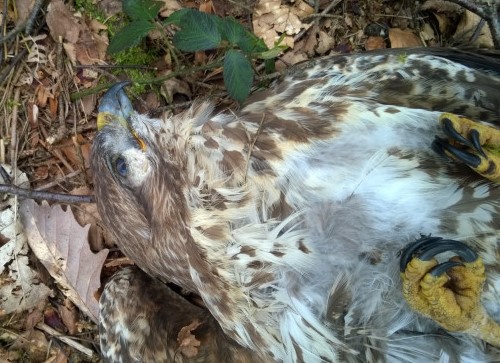
[An illegally-poisoned golden eagle in the Cairngorms National Park. Photo by Dave Dick]

As a follow up to the First Minister’s comments in December, Andy Wightman MSP (Scottish Greens) recently lodged this Parliamentary question:

S5W-27631: To ask the Scottish Government, further to the comments by the First Minister on 19 December 2019 (Official Report, c. 21), what its timescale is for reconsideration of the introduction of a licensing scheme for grouse shooting.

Environment Minister Mairi Gougeon has now responded:

We are giving very careful consideration to the recommendations in the report by the Grouse Moor Management Group (the ‘Werritty Review’).

We will set out our response to the report in due course, which will cover the recommendation on introducing licensing of grouse moor businesses.

Earlier this week Duncan Orr Ewing, RSPB Scotland’s Head of Species and Land Management wrote a very good blog (here) discussing the Werritty Review’s primary recommendation that grouse moor licensing be introduced but that the review had suggested a five-year delay. He goes on to explain what options are available to the Scottish Government as they consider the Werritty Review recommendations. Well worth a read.

Duncan describes this as a ‘key moment which could help safeguard some of Scotland’s most spectacular wildlife’ if the Scottish Government chooses to finally do what it’s been threatening for years and years and introduce a grouse moor licensing scheme.

He urges members of the public to contact their MSPs and ask them to encourage the Scottish Government to make grouse shooting both legal and more sustainable through a licencing system for grouse moors.

You can find contact details for your MSPs by entering your postcode on the “Find Your MSP” tool on the Scottish Parliament website here.

For those who don’t live in Scotland please contact Scottish Ministers at scottish.ministers@gov.scot.

Derbyshire police respond to criticism over poisoned buzzard investigation

In early February we blogged about an illegally poisoned buzzard that had been found dead in the Peak District National Park, next to an illegal poisoned bait (see here). The focus of the blog was the long delay from discovery (April 2019) to publicity (Jan 2020) and even then the publicity had come from the RSPB, not from the police.

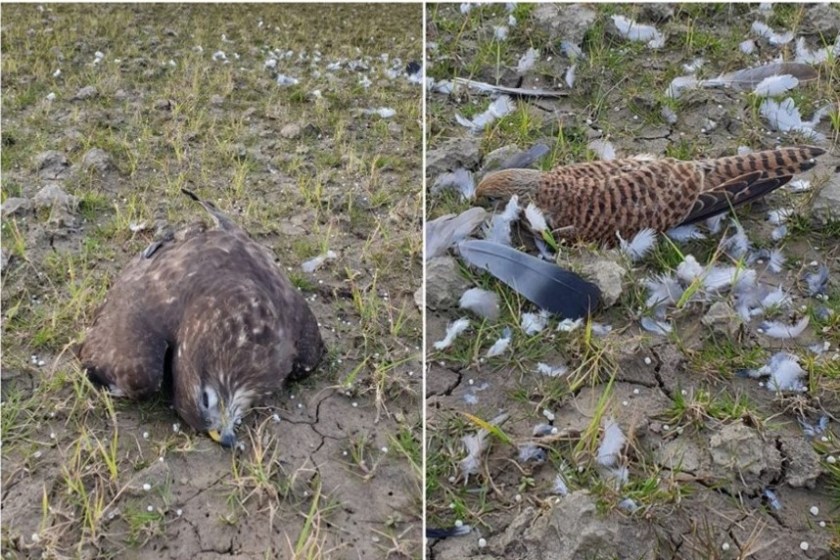
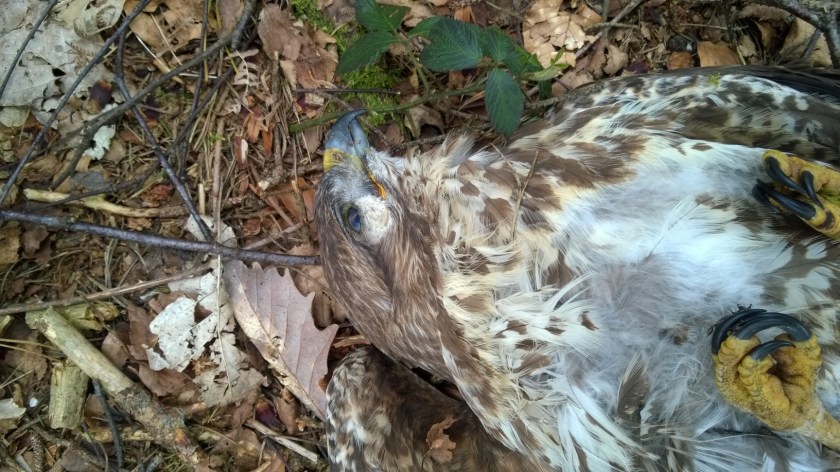
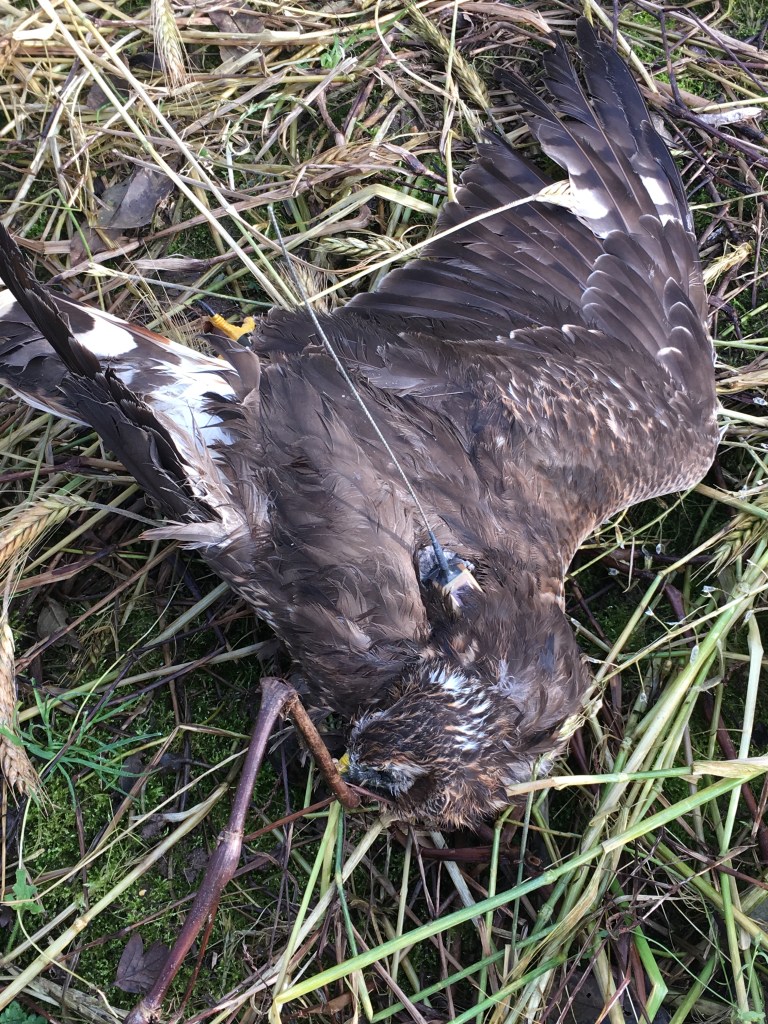
[The illegally poisoned buzzard. Photo by Peak District Raptor Monitoring Group]

We then wrote a follow-up blog last week (here) after Derbyshire Constabulary had claimed, with straight faces, that the discovery of the poisoned buzzard next to the poisoned bait was ‘inconclusive’, even though the official toxicology examination had concluded that,

The evidence therefore suggests that the Buzzard died as the result of the deliberate and illegal use of a high concentration of chloralose on a partridge bait, rather than through secondary poisoning from a different legally applied source…..”.

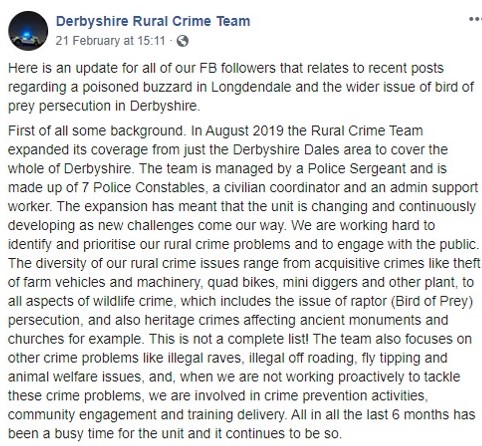
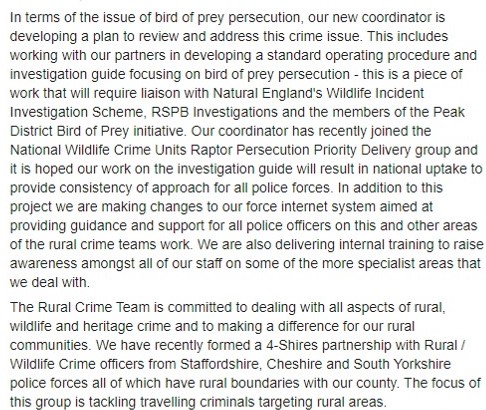
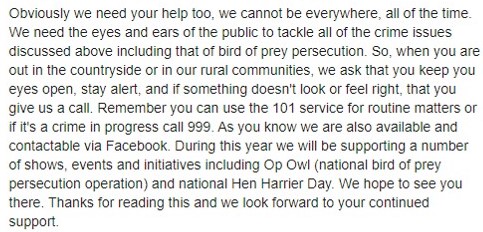
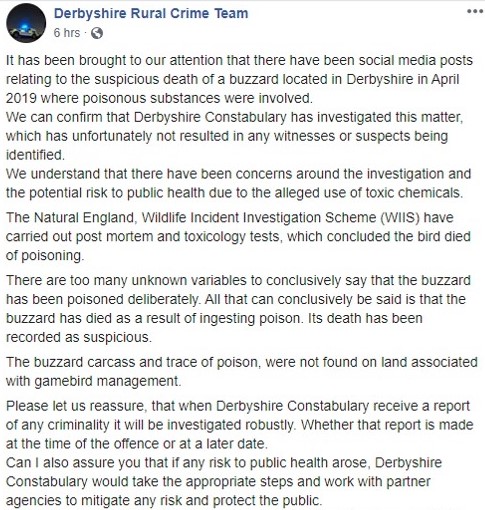
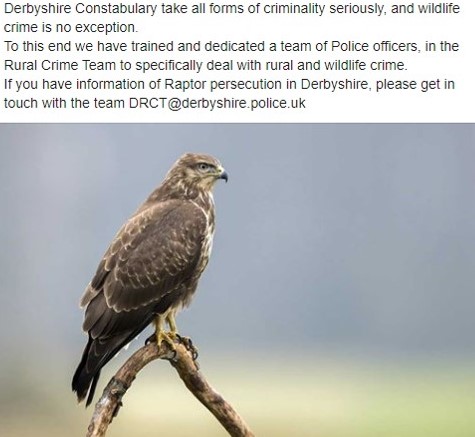
Derbyshire Constabulary came in for some well-earned criticism and have now responded with the following post on Facebook:

First the good points. This post is more conciliatory and far less antagonistic than recent posts on Derbyshire’s Rural Crime Team’s Facebook page. That’s a smart move. It’s also helpful to explain to the public the high workload demands, the large geographic area and the small size of the team. Like most police forces, they’re up against budget cuts and lack of resources. It’s good for the public to be reminded of these things to help manage expectations.

It’s also good to hear that the new civilian coordinator has been invited to join the Raptor Persecution Priority Delivery Group (RPPDG) and that he’s working with partner agencies, including the RSPB’s Investigations Team, to develop a standard operating procedure investigation guide. Although it’s hard to believe that such an SOP doesn’t already exist, especially in a county that has such a long running history of bird of prey persecution in association with driven grouse shooting.

However, this ‘update’ from the Rural Crime Team doesn’t address the initial issue at all – that is, what appears to be a fundamental cock-up in to the investigation of a dead poisoned buzzard that was found next to a poisoned bait. There’s no acknowledgement that there has been a cock-up, certainly no apology, and no indication that anything further will be done.

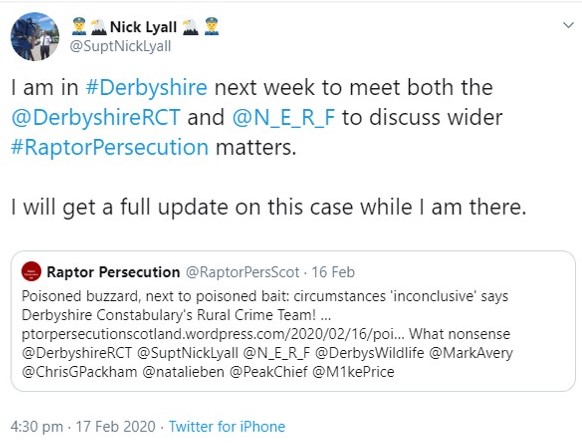
Police Supt Nick Lyall, who Chairs the national Raptor Persecution Priority Delivery Group has been made aware of this case and he’s looking in to it:


2018 worst year in more than a decade for illegal raptor persecution in England

Yesterday the RSPB published more data on its Raptor Persecution Map Hub, which now includes 12 years worth of searchable incidents. You can read about it here on the RSPB Investigations Team’s blog.

Coinciding with this release was a piece on the BBC’s Six O’Clock News followed up with a feature on BBC North West’s Inside Out programme.

The Inside Out programme is available to watch on iPlayer here for the next 29 days.
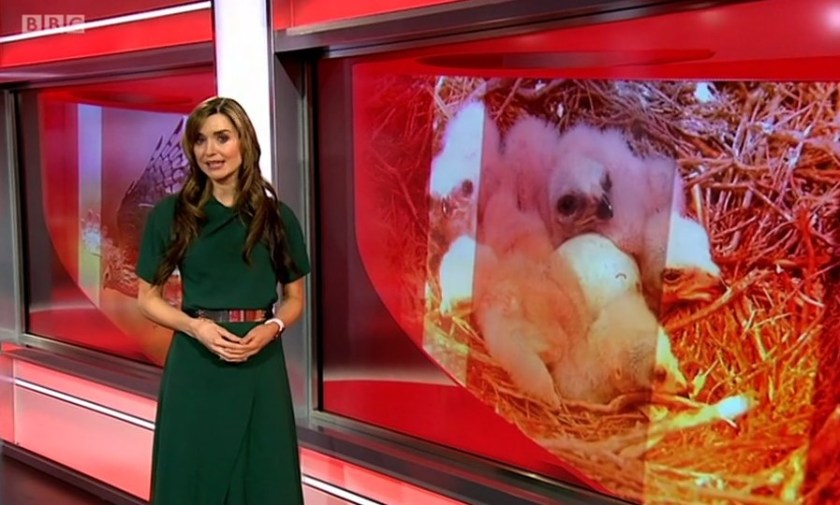
The feature runs for about ten minutes and includes interviews with the RSPB’s Investigations Team, North Yorkshire Police’s award-winning Wildlife Crime Officer Sgt Stu Grainger, and the Moorland Association’s top contortionist Amanda Anderson.

To be honest there’s nothing new here at all – it’s a well-rehearsed pantomime with claims made by the RSPB (based on evidential data) and counter-claims from the grouse shooting industry (pretending everything’s fine) but nevertheless, still well worth the airplay on national news that undoubtedly will have reached some people who’d previously been unaware of the level of criminality on many of the grouse moors of northern England.

The journalist, Gareth Barlow, did a reasonable job although just lacked the killer questions that would have exposed the Moorland Association’s nonsense with ease. For example, he picked up that 2018 was the worst year for recorded raptor persecution crimes in over a decade but he let Amanda Anderson get away with some snakeish slithering around the facts, as follows:

Gareth Barlow:A study from last year of data trackers showed that hen harriers are ten times more likely to die or disappear over land associated with grouse moors. How do you react to that data?”

Amanda Anderson:The study of tagged birds up to 2017 raises considerable issues. But actually since then 2018 saw 34 fledged hen harrier chicks in England and last year a record-breaking 47 chicks fledged, mostly from grouse moors“.

Let’s just analyse Amanda’s response. A casual and uninformed listener might think that, based on what she said, the grouse shooting industry has cleaned up its act since 2017, with ‘record-breaking’ [ahem] numbers of chicks fledging and everything’s fine now, nothing to see here, move along, gamekeepers love hen harriers too and the killing has stopped. But what happens to those ‘record-breaking’ number of fledged hen harriers once they leave the nest?

What Amanda ‘forgot’ to mention was the long list of satellite-tagged hen harriers that have either vanished in suspicious circumstances or been found illegally shot or trapped or poisoned, mostly on or close to land managed for game bird shooting, since 2018 (and since DEFRA’s so-called Hen Harrier Action Plan was enacted):

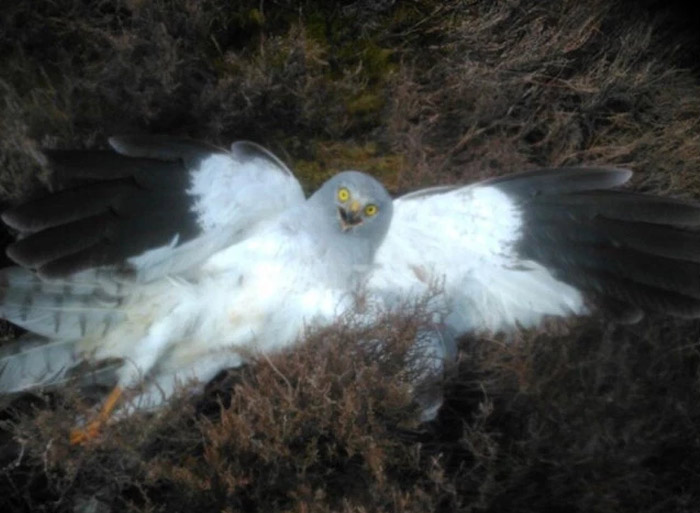
February 2018: Hen harrier Saorsa ‘disappeared’ in the Angus Glens in Scotland (here). The Scottish Gamekeepers Association later published false information claiming the bird had been re-sighted. The RSPB dismissed this as “completely false” (here).

5 February 2018: Hen harrier Marc ‘disappeared’ on a grouse moor in Durham (here)

9 February 2018: Hen harrier Aalin ‘disappeared’ on a grouse moor in Wales (here)

March 2018: Hen harrier Blue ‘disappeared’ in the Lake District National Park (here)

March 2018: Hen harrier Finn ‘disappeared’ near Moffat in Scotland (here)

18 April 2018: Hen harrier Lia ‘disappeared’ in Wales and her corpse was retrieved in a field in May 2018. Cause of death was unconfirmed but police treating death as suspicious (here)

8 August 2018: Hen harrier Hilma ‘disappeared’ on a grouse moor in Northumberland (here).

16 August 2018: Hen harrier Athena ‘disappeared’ on a grouse moor in Scotland (here)

26 August 2018: Hen Harrier Octavia ‘disappeared’ on a grouse moor in the Peak District National Park (here)

29 August 2018: Hen harrier Margot ‘disappeared’ on a grouse moor in Scotland (here)

29 August 2018: Hen Harrier Heulwen ‘disappeared’ on a grouse moor in Wales (here)

3 September 2018: Hen harrier Stelmaria ‘disappeared’ on a grouse moor in Scotland (here)

24 September 2018: Hen harrier Heather ‘disappeared’ on a grouse moor in Scotland (here)

2 October 2018: Hen harrier Mabel ‘disappeared’ on a grouse moor on the edge of the Yorkshire Dales National Park (here)

3 October 2018: Hen Harrier Thor ‘disappeared’ next to a grouse moor in Bowland, Lanacashire (here)

26 October 2018: Hen harrier Arthur ‘disappeared’ on a grouse moor in the North York Moors National Park (here)

10 November 2018: Hen harrier Rannoch ‘disappeared’ on a grouse moor in Scotland (here). Her corpse was found nearby in May 2019 – she’d been killed in an illegally-set spring trap (here).

14 November 2018: Hen harrier River ‘disappeared’ on a grouse moor in the Nidderdale AONB (here). Her corpse was found nearby in April 2019 – she’d been illegally shot (here).

16 January 2019: Hen harrier Vulcan ‘disappeared’ in Wiltshire close to Natural England’s proposed reintroduction site (here)

7 February 2019: Hen harrier Skylar ‘disappeared’ next to a grouse moor in South Lanarkshire (here)

22 April 2019: Hen harrier Marci ‘disappeared’ on a grouse moor in the Cairngorms National Park (here)

11 May 2019: A male hen harrier was caught in an illegally-set trap next to his nest on a grouse moor in South Lanarkshire. He didn’t survive (here)

7 June 2019: A hen harrier was found dead on a grouse moor in Scotland. A post mortem stated the bird had died as a result of ‘penetrating trauma’ injuries and that this bird had previously been shot (here)

11 September 2019: Hen harrier Romario ‘disappeared’ on a grouse moor in the Cairngorms National Park (here)

10 October 2019: Hen harrier Ada ‘disappeared’ on a grouse moor in the North Pennines AONB (here)

12 October 2019: Hen harrier Thistle ‘disappeared’ on a grouse moor in Sutherland (here)

November 2019: Hen harrier Mary found illegally poisoned on a pheasant shoot in Ireland (here)

There are two more satellite-tagged hen harriers (Tony & Rain) that are reported either confirmed or suspected to have been illegally killed in the RSPB’s Hen Harrier LIFE Project Report but no further details are available.

And then there were last year’s brood meddled hen harrier chicks that have been reported ‘missing’ but as they’re carrying a new type of tag known to be unreliable it’s not known if they’ve been bumped off or if they’re still ok. For the purposes of this mini-analysis we will discount these birds.

So that makes a total of at least 29 hen harriers that are known to have either ‘disappeared’ in suspicious circumstances or have been found illegally killed in the last two years, during the period that Amanda Anderson was suggesting the killing had stopped.

That’s a lot of incidents for Amanda to ‘forget’ to mention, isn’t it?

And we’re supposed to trust the Moorland Association when it claims to have ‘zero tolerance’ for raptor persecution!

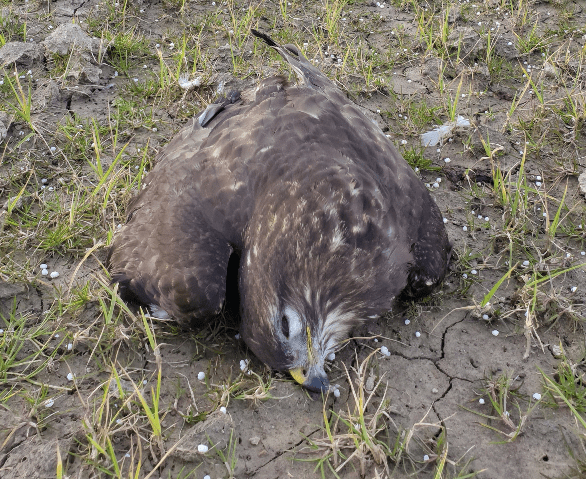
Poisoned buzzard, next to poisoned bait: circumstances ‘inconclusive’ says Derbyshire Constabulary!

I don’t know what’s going on at Derbyshire Constabulary’s Rural Crime Team but someone needs to check that Amanda Anderson isn’t moonlighting.

You may recall a couple of weeks ago we blogged about an illegally poisoned buzzard that had been found dead in the Peak District National Park, next to an illegal poisoned bait (see here). The focus of the blog was the long delay from discovery (April 2019) to publicity (Jan 2020) and even then the publicity had come from the RSPB, not from the police.

[The illegally poisoned buzzard. Photo by Peak District Raptor Monitoring Group]

The story doesn’t end there.

On Friday (14th Feb), the following post appeared on Derbyshire Constabulary’s Rural Crime Team’s Facebook page:

Er….right oh.

The Peak District Raptor Monitoring Group has called out this nonsense with another blog and an open letter of complaint to the Derbyshire Police & Crime Commissioner – read it here.

Of particular note, this official toxicology report on the buzzard and the poisoned bait, written by Dr Ed Blane (National Coordinator for the independent Wildlife Incident Investigation Scheme, HM Inspector Health & Safety Executive) who writes:

“…..The evidence therefore suggests that the Buzzard died as the result of the deliberate and illegal use of a high concentration of chloralose on a partridge bait, rather than through secondary poisoning from a different legally applied source…..

And yet Derbyshire Constabulary’s Rural Crime Team claims “There are too many unknown variables to conclusively say that the buzzard has been poisoned deliberately“.

And guess who’ll be using that ‘official police statement’ to play down the ongoing problem of illegal raptor persecution in the Peak District National Park?

Supt Nick Lyall – you need to be looking at this with some urgency.

UPDATE 23 February 2020: Derbyshire Police respond to criticism over poisoned buzzard investigation (here)

Buzzard illegally poisoned in Peak District National Park

A buzzard has been found illegally poisoned in the Peak District National Park.

A poisoned bait (a red-legged partridge) was found close by.

Toxicology tests revealed both the buzzard and the partridge contained the pesticide Alphachloralose.

[The poisoned buzzard. Photo by Peak District Raptor Monitoring Group]

The thing is, this illegally poisoned buzzard wasn’t found in January, or December, or in any other recent month. It was discovered on 14th April 2019.

The police decided, for whatever reason, that it was best to keep quiet about this. There were no public appeals for information and no public warnings that a poisoner was actively placing baits containing dangerous, highly toxic chemicals out in the countryside. Baits that if touched by a child, adult or a dog could result in acute illness and even death.

Two weeks ago the RSPB issued a press statement about this poisoning crime that reads as follows:

BUZZARD POISONED IN PEAK DISTRICT NATIONAL PARK

22 January 2020

A protected bird of prey has been illegally poisoned in one of the UK’s worst raptor persecution blackspots.

In April 2019 a member of the public found a buzzard freshly dead in woodland near Tintwistle, just north of Valehouse Reservoir, in the Peak District National Park. Close by were the remains of a red-legged partridge.

A post-mortem and toxicology tests under taken by Natural England showed that the buzzard and partridge both contained the pesticide Alphachloralose.

Natural England concluded that ‘abuse of chloralose, using a bird bait, has occurred at this location and at least one buzzard has been poisoned’.

All birds of prey are protected by the Wildlife and Countryside Act 1981. To kill or injure one is a criminal offence and could result in an unlimited fine or up to six months in jail. Derbyshire Police were made aware at the time of the discovery and informed of the toxicology result in August.

Alphachloralose is one of the most commonly abused pesticides for illegally targeting birds of prey.

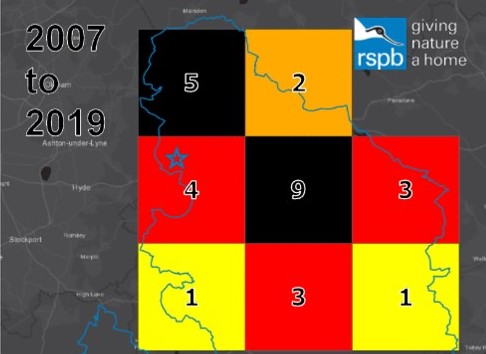
The northern Dark Peak has been the scene of many crimes involving the poisoning, trapping and shooting of birds of prey, making it one of the UK’s worst blackspots, according to the RSPB’s recent Birdcrime report. A scientific article, Raptor Persecution in the Peak District National Park, cemented the link between raptor persecution and land managed for driven grouse shooting in the Peak District National Park.

[Confirmed raptor persecution crimes in the Dark Peak area of the Peak District National Park, 2007-2019. Map produced by RSPB]

Howard Jones, Investigations Officer at the RSPB, said: “The relentless destruction of birds of prey in the Dark Peak needs to stop. This area has become a black hole for birds of prey like buzzards though this is exactly the habitat where they should be thriving. Deliberately poisoning birds is not only illegal but incredibly dangerous to other wildlife, not to mention people and pets. What if a dog or a child had found this and touched it? It doesn’t bear thinking about.”

If you have any information relating to this incident, call Derbyshire Police on 101.

If you find a wild bird of prey which you suspect has been illegally killed, contact RSPB investigations on 01767 680551 or fill in the online form.

ENDS

When you’ve read more of these types of press release than you care to remember, you get a feel for style and content. It seems quite apparent that this is not a joint press release between the RSPB and the police, as so many of them often are. There’s no quote from an investigating police officer, there’s no incident number, and there’s a pointed sentence that Derbyshire Police were informed of the incident in April and updated with the toxicology results in August.

And then there’s this recent blog about the poisoning incident from the Peak District Raptor Monitoring Group, which is a bit difficult to follow because it references unsighted material and various unnamed email correspondents. However, what does seem clear is that someone from the shooting industry is claiming that a police officer said this poisoning incident was suspicious but ‘definitely not illegal persecution’.

Er…..right.

Haven’t we been in this position before, where it looked like deliberate attempts were being made to suppress confirmed raptor crimes in the Peak District National Park?

Let’s hope that isn’t what’s going on here, but nevertheless, there is absolutely no excuse for the police not to have warned the public about the presence of potentially lethal poisonous baits, at the time they were discovered, especially inside one of the country’s most visited National Parks.

UPDATE 16 February 2020: Poisoned buzzard, next to poisoned bait: circumstances ‘inconclusive’ says Derbyshire Constabulary! (here)

UPDATE 23 February 2020: Derbyshire Police respond to criticism over poisoned buzzard investigation (here)

Satellite-tagged hen harrier found poisoned on a pheasant shoot in Ireland

A young hen harrier named Mary that hatched on the Isle of Man in 2019 and had been satellite-tagged by the RSPB’s LIFE Project was found poisoned on a pheasant shoot in Co Meath in Ireland in November 2019. Tests revealed she had consumed the banned poison Carbofuran which was found on a pigeon bait and on other meat baits next to her corpse.

[Hen harrier Mary found dead on a pheasant shoot. Photo by BirdWatch Ireland]

There are a few press releases doing the rounds about this latest killing, one from BirdWatch Ireland (here) and one from the RSPB (here).

There’s also a video documenting the discovery of Mary’s corpse:

Reading between the lines of both media releases there appears to be concern that the National Parks and Wildlife Service (NPWS) and the Gardai (Irish Police) could be doing more in terms of investigation, enforcement and liaison. Without knowing the details of this case it’s difficult to comment further but the pointed commentary in both press releases seems quite deliberate.

In recent years the NPWS has instigated a new monitoring and recording scheme for raptor persecution in Ireland, to which BirdWatch Ireland’s John Lusby alludes in his press quote. It’s worth having a look at the most recent monitoring report (2018) and particularly the long table in Appendix 1 (pages 21-28) documenting the number of recorded persecution incidents between 2007 – 2018; there is clearly a massive persecution issue in the Irish Republic.

Raptor Persecution Ireland 2018 report

This ongoing and relentless persecution affects not only local and regional raptors but, as we have seen with hen harrier Mary, raptors from across our isles that travel without political boundaries. Likewise, a white-tailed eagle from Ireland has recently spent several months in temporary residence in Scotland, the north of England and the Isle of Man, as revealed by his satellite tag data. Amazingly he survived but he could so easily have been unlawfully killed over this side of the water given the extent of the persecution here.

There’s been increasing public pressure on the authorities here to crack down on the illegal killing; let’s hope the same pressure is being felt in Ireland and that the NPWS and Gardai conduct a thorough investigation in to the poisoning of this young hen harrier.

UPDATE 9 JUNE 2020: Poisoned hen harrier ‘Mary’ – open letter calls for action (here)

Spain continues to impose strong penalties for raptor poisoning

Once again the Spanish authorities are leading the way with their zero tolerance approach to illegal raptor persecution by imposing another meaningful penalty on an individual who was found guilty of poisoning four vultures (one Cinereous and three griffon) with a banned pesticide in 2012.

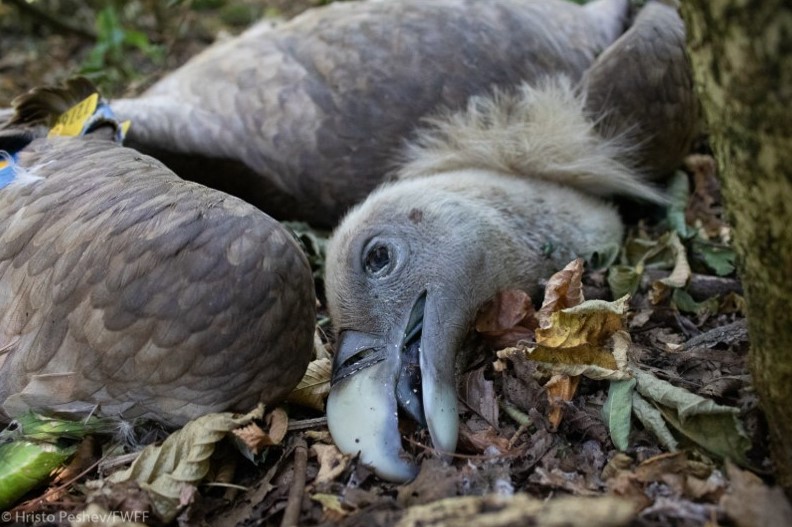
[A poisoned griffon vulture, photo by Hristo Peshev]

According to this article (roughly translated from Spanish via Google but clear enough to understand the main points), the unnamed criminal was given a six month custodial sentence AND a fine of 36,000 Euros AND was disqualified from hunting for a period of two years.

It’s not clear why it took so long for the case to come to court but previous cases have shown the Spanish authorities go to great lengths to find supportive evidence in these poisoning cases (e.g. seeking court warrants to collect blood samples from 150 sheep to link to a poisoned bait! – see here) and the routine use of sniffer dogs to detect traces of poisoned baits or poisoned victims. These extended investigations are not currently possible in the UK because there is a time bar on when proceedings must begin after a wildlife crime has been committed (three years in Scotland, two years in England & Wales).

This isn’t the first time that the Spanish authorities have come down hard on raptor poisoners. We’ve blogged about three previous cases (here here and here) where custodial sentences, massive fines and an extended disqualification from hunting have all been part of the sentencing package. Spain is putting the UK to shame.

However, things may soon be changing in Scotland. With the proposed new penalties for wildlife crime (including a substantial increase for many raptor persecution offences) currently going through the Parliamentary process it hopefully won’t be long before the Scottish courts will have the ability, and desire, to impose lengthy custodial sentences and massive fines on those found guilty of killing raptors.

It would be helpful if, like in Spain, there was also the option to disqualify the criminal (and his/her employing estate, if appropriate) from ‘hunting’ for a period of time commensurate with the offence(s). Of course, for this to happen we need to see the Scottish Government finally commit to introducing a licensing scheme for game bird shooting, starting with driven grouse shooting where much of the criminality is embedded.

We await the Government’s response to the Werritty Review with great interest.

New Chairman for Scottish Land & Estates

Scottish Land and Estates (SLE), the grouse moor owners’ lobby group (amongst other things) has announced its new Chairman will be sporting estate owner Mark Tennant.

Mark will begin his new role in April 2020 when the current Chair, Lord David Johnstone, steps down.

We don’t know much about Mark other than what SLE has written in its announcement (here) but let’s be honest, he’s not exactly got big shoes to fill. His predecessor, ‘Dumfriesshire Dave’ has spent the last five years pretending everything’s fine and suggesting there’s really no need to do anything about the illegal killing of raptors on grouse moors because it’s no longer an issue, it’s mostly just the RSPB trying to smear the good name of the industry and/or ‘activists’ trying to ‘set up’ law-abiding estates. (E.g. see here, here, here, here, here). Talk about dial ‘D’ for denial.

It’s hard to think of a single example where Dumfriesshire Dave has inspired any confidence in the industry’s willingness, let alone ability, to clean up its act, so Mark Tennant has a bit of an open goal to get off to a good start, should he choose to take it.

According to the SLE announcement, Mark will be working ‘to help fight climate change’. Excellent. Can we expect all SLE-member grouse moor owners to commit to stopping their routine heather burning regimes, including on deep peat, in the interests of addressing the climate emergency?

What we do know about Mark, from the SLE announcement, is that his ‘family business Innes Estate in Elgin has been a member of SLE for over 40 years‘. That’s really interesting. So SLE didn’t expel the estate when the then head gamekeeper was convicted in 2007 for poisons and firearms offences, then? NOTE: there is no suggestion that those historical offences were part of a wider pattern of continued wildlife crime on the estate – as far as we are aware there are no further reports of alleged offences at this estate – we’re just interested at SLE’s apparent lack of action in response to wildlife crime.

Speaking of which, here’s something Mark could sort out for us. We’re still waiting to hear from SLE whether the Longformacus Estate (the location of a catalogue of horrific and violent wildlife crimes for which a gamekeeper was recently convicted) was, and if so still is, a member of Scottish Land & Estates? We asked SLE this specific question in August, after the Crown Office chose not to pursue a prosecution for alleged vicarious liability and SLE had until then avoided commenting on the estate’s membership status. We had a quick response from the Membership Department who told us, ‘I have forwarded on your email to our Senior Management Team who will respond in due course‘. Needless to say, silence since then.

Over to you, Mark. Was/is Longformacus Estate a member of Scottish Land & Estates?

‘Certificate of appreciation’ for Northern England Raptor Forum (NERF)

The Northern England Raptor Forum (NERF) has received a certificate of appreciation from Police Supt Nick Lyall, Chair of the Raptor Persecution Priority Delivery Group.

In an accompanying letter (read it on the NERF website here), Nick Lyall writes:

Having recently reviewed the 5 year NERF contribution to the RSPB Hen Harrier Life Project I was astounded to see that NERF members had completed nearly 15000 voluntary hours and over 150000 miles on the road to conduct their voluntary work in support of this important project.

The modest estimation would suggest that the value in kind of this contribution would be in excess of £400,000. This is a staggering commitment of both people personal time and money in order to monitor and protect endangered hen harrier.

I would therefore like you to accept this letter and the attached certificate of appreciation as a small thank you for the time effort and commitment for all of your members and volunteers“.

It’s richly deserved recognition for NERF but it only scratches the surface of its members efforts. These volunteers have been undertaking fieldwork on 23 species of raptors, owls and raven (honorary raptor) since 2006 and they’ve amassed a critically important dataset for use in conservation planning and policy.

The statutory agencies have a duty to monitor species’ population trends but they wouldn’t be able to do so without the contribution of voluntary raptor workers’ data. In Scotland, NERF’s counterpart the Scottish Raptor Study Group has estimated that its ~300 volunteers’ annual contribution is worth £1.8M (i.e. this is what it would cost SNH to replicate the SRSG’s monitoring efforts with paid ecologists).

It’s an extraordinary effort, and yet in return these fieldworkers are harassed and abused, both in the field and online. That’s why recognition such as this certificate of appreciation is so welcome.

But harassment is probably the least of their worries. If anyone is still unconvinced about how deserving NERF is of this certificate of appreciation, cast your eyes over this:

This is from page 3 of NERF’s latest Annual Review (2018). It’s the first block of text in the report and it’s a warning to NERF members that they risk serious illness (potentially fatal) should they stumble across the corpse of an illegally poisoned bird of prey as part of their monitoring efforts.

It tells you all you need to know about the ongoing persecution of birds of prey in the northern uplands as we head in to the second decade of the 21st Century.

Congratulations to NERF members – you all deserve medals. Without your efforts (and those of your colleagues in Scotland, Wales, Northern Ireland and the Irish Republic) our raptors wouldn’t have so much of a fighting chance.

Gamekeepers caught with banned poisons should receive mandatory jail sentence

Yesterday the Scottish Rural Affairs & Environment Minister, Mairi Gougeon, gave evidence to the cross-party Environment, Climate Change & Land Reform (ECCLR) committee which is currently considering Stage 1 of the Animals and Wildlife (Penalties, Protections and Powers) (Scotland) Bill.

We’ll come back to the wider evidence session in another blog because there were some interesting and important discussions but one point raised deserves an immediate reaction:

Possession of banned poisons.

Here’s the mini transcript:

ECCLR Committee Member Rachael Hamilton MSP: I will go back to the categorisation of wildlife offences and the different tiers of the penalty system. We heard evidence that perhaps possession of illegal pesticides should be categorised as a tier 1 offence, because they are currently illegal anyway. Do you have any comments on that point and do you have any plans to have an amnesty on illegal pesticides prior to the bill being passed? People should not possess illegal pesticides anyway, so using them in connection with animal crimes should attract the highest and severest category of penalty.

Environment Minister Mairi Gougeon: That has been the feeling behind that issue. As you said, possession of such pesticides is already illegal and there are offences in place to deal with that individual issue separately. Using such pesticides as part of another offence would attract the higher penalty. As they are already illegal and there are offences attached to them, using them in relation to any other offences could well attract severe penalties.

In relation to your amnesty point, I would be happy to consider looking at the matter.

Scottish Government Wildlife Management Team leader Leia Fitzgerald: Just to clarify, there was a previous amnesty, which was quite successful and resulted in a lot of pesticides being handed in. We could speak to stakeholders about whether that is something that could be done again. We would hope that we got all of what we needed after the last amnesty, but we can look at the matter.

Environment Minister Mairi Gougeon: I will happily get back to the committee and let you know how we get on with that.

ENDS

Is the Scottish Government seriously considering yet another amnesty for banned poisons, which would be the third amnesty in the 15 years since it became an offence to even possess these deadly toxins, let alone use them? (The Possession of Pesticides (Scotland) Order 2005).

The first amnesty took place in 2011 (see here), six years after the ban was first introduced. The second amnesty came four years later in 2015 (see here).

Since then poisoning crimes have certainly dropped in Scotland, probably thanks to the increase in satellite-tagged raptors, whose tags lead researchers to the poisoned corpses that would otherwise remain undetected, and also due to the introduction of vicarious liability legislation in 2012 which made it possible for landowners to be prosecuted for raptor persecution crimes committed by their gamekeeper employees. However, these poisoning crimes haven’t been totally eradicated and we’re still reading reports about illegally-poisoned birds (and some dogs) that have died after ingesting banned poisons in Scotland including some that were killed this year, and some even inside the Cairngorms National Park (e.g. see here, here, here, here, here, here, here, here, here, here, here, here).

[An illegally-poisoned buzzard found on the boundary of a sporting estate in Perthshire. Contributed photo]

How many more chances is the Scottish Government planning on giving to these criminals? How many more get-out-of-jail-free cards will be dished out?

Why can’t the Scottish Government, 15 years on, implement a zero tolerance policy on this vile and primitive crime that not only risks the lives of wildlife and domestic animals but puts humans at risk as well? In the most recent criminal case, a Scottish gamekeeper was found with two cartons containing the banned poison Carbofuran. He was carrying one of these containers in his bum bag – presumably he wasn’t just taking the container out for company every day – and yet 180 schoolchildren were put at risk when they attended the grouse shooting estate on an officially-sanctioned school trip. Can you believe that? The gamekeeper was convicted for possession (along with a litany of other wildlife offences) and received a community payback order. No fine, no jail sentence, no deterrent whatsoever. Compare and contrast to how illegal poisoners are dealt with in Spain (see here, here and here).

The criminals who persist with such reckless activity in Scotland deserve a mandatory custodial sentence – there can be no more excuses, no more discussion and certainly no more amnesties.

Enough.