Poisoned golden eagle: confirmation it was found dead on a grouse moor at Invercauld Estate

Earlier today I blogged about how Invercauld Estate Manager Angus McNicol had been quoted in the press saying that the area where the poisoned golden eagle had been found on Invercauld Estate near Crathie was “not managed for driven grouse shooting” (see here).

Shurely shome mishtake?

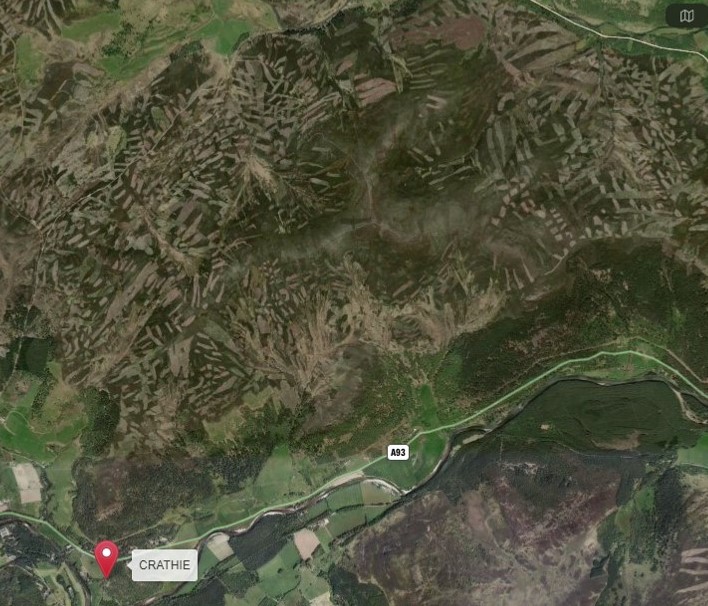
I’d commented that this seemed an odd claim to make given the amount of strip muirburn (a classic indication of grouse moor management) in the area:

This evening, a comment has been posted on this blog from someone directly involved in the investigation, Ian Thomson from RSPB Scotland:

For anyone struggling to read the small print, it says:

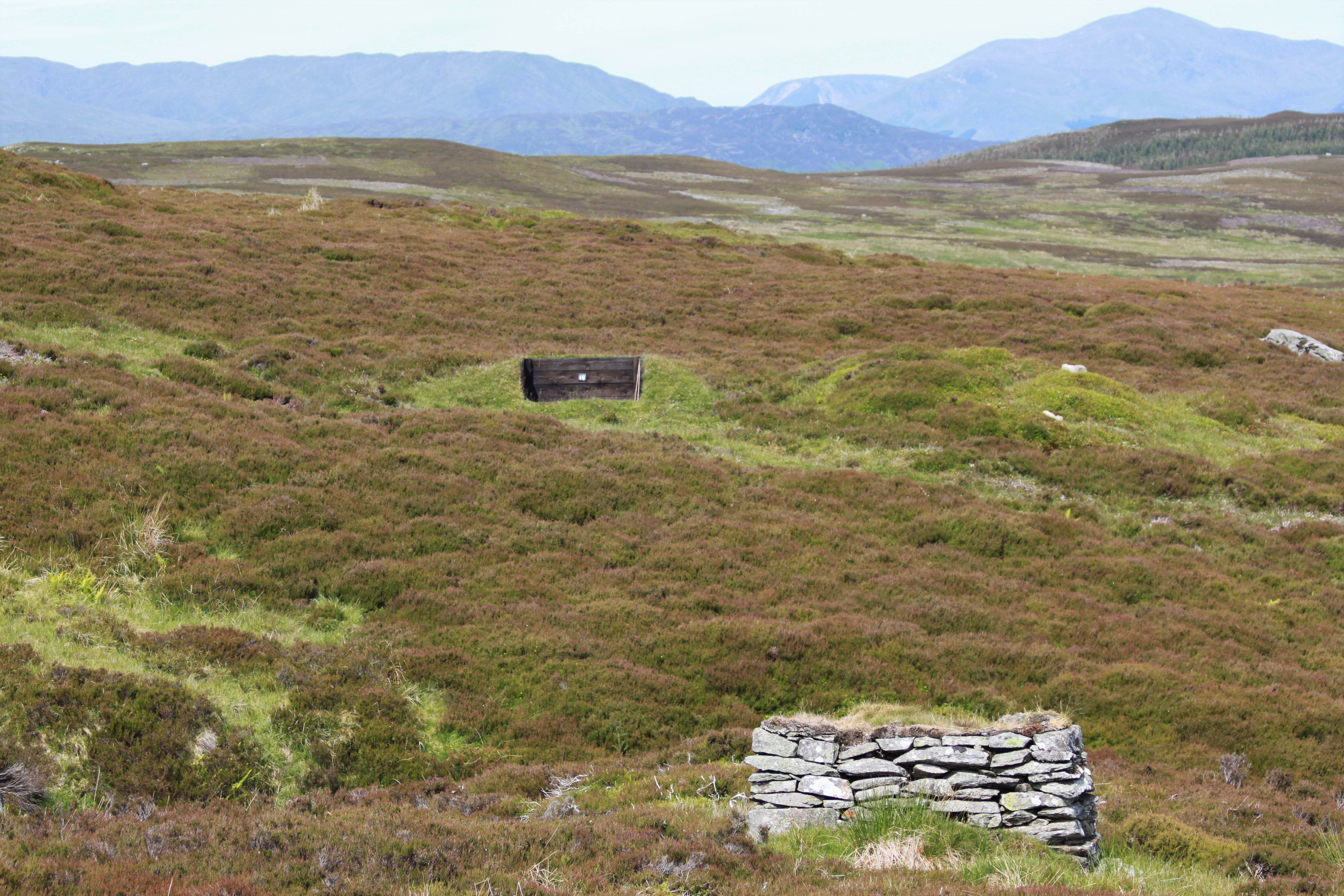
For the avoidance of doubt, the eagle was found poisoned next to a mountain hare bait, in an area of strip muirburn within 200m of a line of grouse butts and a landrover track‘.

That’s that, then.

Thanks, Ian.

Poisoned golden eagle: examining the statement from Invercauld Estate

Further to the news that a poisoned golden eagle was found dead on Invercauld Estate in March 2021 and the subsequent police raid that took place on the estate earlier this week (Tues 4th May – see here), I want to examine a statement that subsequently appeared in the press (e.g. here), attributed to Invercauld Estate Manager, Angus McNicol.

[The poisoned golden eagle, lying dead next to a poisoned mountain hare bait, on heather moorland on Invercauld Estate. Photo by RSPB Scotland]

The statement was interesting because it appeared in the late afternoon just a few hours after the raids had taken place and importantly, prior to ANY media output from the Police, even though the estate’s statement alluded to a ‘police appeal’. What police appeal? It could be argued that this was a damage limitation exercise by Invercauld Estate.

The statement went as follows:

Angus McNicol, estate manager at Invercauld, said: “We have been informed by the police that the bird that was found contained pesticide. We are very disturbed indeed to learn that a bird of prey has been found on Invercauld in these circumstances.

We wholeheartedly support the appeal about this bird and anyone with information should contact Police Scotland on 101 urgently. Naturally we are offering our cooperation to the police as they conduct their inquiries and hope they are able to identify anyone who is involved.

The area where the bird was found is on a let farm in an area which is managed for sheep farming and is on the edge of an area of native woodland regeneration. It is not managed for driven grouse shooting. Within the last two weeks, we have had to call the police to report an incident of damage to gamekeeping equipment and another of anti-social behaviour on a wetland habitat and this more recent report is a further serious concern for us.

Given the relative proximity of the location to houses and the A93 main road, we are hopeful that a member of the public may have seen something which might help the investigation.

Mr McNicol continued: “So much of what we do at Invercauld is about conservation so this news is particularly distressing. Staff and contractors are actively involved in activities that help conserve many species in the Estate’s valleys, woodlands, moorland and montane habitats. We pride ourselves in the biodiversity this creates and this news is therefore especially disheartening.

We are committed to our conservation work on the Estate and would like to see this incident investigated as thoroughly and quickly as possible.”

I want to look closely at Mr McNicol’s claim that the area where the poisoned golden eagle was found “Is not managed for driven grouse shooting“.

The precise location on Invercauld Estate where the poisoned eagle (and the poisoned bait that killed it) has not been revealed, but the RSPB photograph of the poisoned eagle clearly shows heather and Mr McNicol does give away some information about the proximity of houses and the A93 main road and an area of native woodland regeneration.

We also know, from the official police statement published the following day, that the area was ‘near to Crathie’. That narrows it down considerably.

Here are a couple of Google Earth maps showing Crathie and an area of Invercauld Estate to the NE of Crathie (north of the A93 main road) that I understand to be a woodland regeneration area, and then oh, look, right next to that is a vast area of muirburn strips. You know, the tell-tale burned scars of a moorland managed for, er, driven grouse shooting:

Or have I got that wrong? Is this not a vast area managed for driven grouse shooting at all, but just a large area of moorland that is routinely set alight to create so-called ‘wildfire breaks’? I’m sure I saw some lines of grouse butts when I zoomed in, too. Probably historical, kept for nostalgic purposes, eh?

You can draw your own conclusions about the accuracy of Mr McNicol’s claim that ‘the area is not managed for driven grouse shooting‘.

I also just want to comment about something I’ve read on social media about the timing of the publicity surrounding this crime, and how ‘convenient’ it is that it coincides with the Scottish Parliamentary elections. The clear accusation has been made that ‘anti-grouse moor campaigners’ have somehow conspired to get this in the news this week.

This is absolute nonsense, of course. It was the statement from Invercauld Estate that triggered news coverage of this crime – at that time (Tuesday afternoon, the day of the police raids), nobody had said anything about it. Not campaigners, not the police, just Invercauld Estate. Had the estate kept quiet, I would bet that this news wouldn’t have seen the light of day until at least next week, well after the elections. Indeed, I’m told by my media contacts that Police Scotland was forced to issue an official statement the day after Invercauld Estate’s statement, simply because of the media interest generated by Invercauld’s statement. The police received so many enquiries their hand was forced early and they had to issue a statement.

I’ll be writing about Police Scotland’s response to the crime in a forthcoming blog. I’ll also be returning to the claimed conservation credentials of Invercauld Estate.

UPDATE 6th May 2021: Poisoned golden eagle: confirmation it was found dead on a grouse moor on Invercauld Estate (here)

Poisoned golden eagle: statement from Cairngorms National Park Authority

Further to the news that a poisoned golden eagle was found dead on Invercauld Estate in March 2021 (see here), the Cairngorms National Park Authority has issued the following statement in response:

GOLDEN EAGLE DEATH

The Cairngorms National Park Authority has issued the following statement in relation to the death of a Golden Eagle in Deeside.

The Cairngorms National Park Authority (CNPA) have been informed by Police Scotland that a golden eagle was found poisoned on Invercauld Estate within the Cairngorms National Park. The CNPA condemns this senseless and irresponsible behaviour in the strongest possible terms. Raptor persecution has no place in 21st century Scotland and no place in this National Park. We are working closely with Police Scotland, NatureScot and a range of other partners on an appropriate, coordinated response to this incident, and will continue to work in partnership to prevent incidents like this occurring in future. We cannot make any further comment on this specific case due to the ongoing police enquiry.”

This statement is issued on behalf of Xander McDade CNPA Board Convener and CNPA Chief Executive Grant Moir.

ENDS

This statement from the CNPA is an improvement on the pathetic effort it made in response to the poisoned white-tailed eagle, found dead on a grouse moor inside the National Park last year (see here), and it’s good that this time the CNPA hasn’t had to be nudged into providing a response, which is what usually happens, but even so, this is nowhere near a strong enough reaction or statement of intent.

I’ll be returning to this subject shortly, but for now readers might want to familiarise themselves with the Eastern Cairngorms Moorland Partnership (ECMP). One of the stated aims of this ‘partnership’, comprising six contiguous estates and the CNPA, is to ‘enhance raptor and other priority species conservation’. Invercauld Estate is one of the member estates.

Things need to change in the Cairngorms National Park. Current policies and so-called ‘partnerships’ are obviously not working when atrocities like poisoning eagles is still going on.

Below is a list of all the known raptor persecution crimes uncovered in the Cairngorms National Park since it was established (it was formally established in Sept 2003 but I’ve included 2002 for context and an indication that National Park status has had zero influence). As far as I’m aware, nobody has been prosecuted, yet alone convicted, for any of these offences, with the exception of one for the attempted shooting of a hen harrier in 2003.

ILLEGAL RAPTOR PERSECUTION INCIDENTS CAIRNGORMS NATIONAL PARK

2002

Feb: 2 x poisoned buzzards (Carbofuran) + rabbit bait. Tomintoul (No prosecution)

Mar: 2 x poisoned buzzards (Carbofuran) + 2 rabbit baits. Cromdale (No prosecution)

2003

Apr: 3 x poisoned buzzards (Carbofuran) + 2 grey partridge baits. Kingussie (No prosecution)

Jun: Attempted shooting of a hen harrier. Crannoch (Successful prosecution)

2004

May: 1 x poisoned buzzard (Carbofuran). Cuaich (No prosecution)

Nov: 1 x poisoned red kite (Carbofuran). Cromdale (No prosecution)

Dec: 1 x poisoned buzzard (Carbofuran). Cromdale (No prosecution)

2005

Feb: 1 x poisoned buzzard (Carbofuran). Cromdale (No prosecution)

Feb: 1 x poisoned buzzard (Carbofuran). Cromdale (No prosecution)

Mar: 3 x poisoned buzzards, 1 x poisoned raven (Carbofuran). Crathie (No prosecution)

2006

Jan: 1 x poisoned raven (Carbofuran). Dulnain Bridge (No prosecution)

May: 1 x poisoned raven (Mevinphos). Grantown-on-Spey (No prosecution)

May: 1 x poisoned golden eagle (Carbofuran). Morven [corbett] (No prosecution)

May: 1 x poisoned raven + 1 x poisoned common gull (Aldicarb) + egg bait. Glenbuchat (No prosecution)

May: egg bait (Aldicarb). Glenbuchat, Strathdon (No prosecution)

Jun: 1 x poisoned golden eagle (Carbofuran). Glenfeshie (No prosecution)

2007

Jan: 1 x poisoned red kite (Carbofuran). Glenshee (No prosecution)

Apr: Illegally set spring trap. Grantown-on-Spey (No prosecution)

May: Pole trap. Grantown-on-Spey (No prosecution)

May: 1 x poisoned red kite (Carbofuran). Tomintoul (No prosecution)

May: Illegally set spring trap. Grantown-on-Spey (No prosecution)

Jun: 1 x poisoned buzzard (Carbofuran) + rabbit & hare baits. Grantown-on-Spey (No prosecution)

Jun: 1 x poisoned buzzard (Carbofuran) + rabbit bait. Grantown-on-Spey (No prosecution)

Jul: 1 x poisoned raven (Carbofuran). Ballater (No prosecution)

Sep: 1 x shot buzzard. Newtonmore (No prosecution)

Sep: 1 x shot buzzard. Grantown-on-Spey (No prosecution)

Dec: 1 x poisoned buzzard (Alphachloralose). Grantown-on-Spey (No prosecution)

Dec: 1 x poisoned buzzard (Carbofuran) + rabbit bait. Grantown-on-Spey (No prosecution)

2008

Jan: 1 x poisoned buzzard (Alphachloralose). Nr Grantown-on-Spey (No prosecution)

Mar: 1 x poisoned buzzard (Carbofuran). Nr Grantown-on-Spey (No prosecution)

Dec: 1 x poisoned buzzard (Alphachloralose). Nr Grantown-on-Spey (No prosecution)

2009

May: 2 x poisoned ravens (Mevinphos). Delnabo (No prosecution)

Jun: rabbit bait (Mevinphos). nr Tomintoul (No prosecution)

Jun: 1 x shot buzzard. Nr Strathdon (No prosecution)

Jun: 1 x illegal crow trap. Nr Tomintoul (No prosecution)

2010

Apr: Pole trap. Nr Dalwhinnie (No prosecution)

Jun: 1 x pole-trapped goshawk. Nr Dalwhinnie (No prosecution)

Jun: Illegally set spring trap on tree stump. Nr Dalwhinnie (No prosecution)

Sep: 2 x poisoned buzzards (Carbofuran) + rabbit bait. Glenlochy (No prosecution)

Oct: 2 x poisoned buzzards (Carbofuran) + rabbit bait. Nr Boat of Garten (No prosecution)

2011

Jan: 1 x shot buzzard. Nr Bridge of Brown (No prosecution)

Mar: 1 x poisoned golden eagle (Carbofuran). Glenbuchat (No prosecution)

Apr: 1 x poisoned buzzard (Carbofuran & Aldicarb). Nr Bridge of Brown (No prosecution)

May:  1 x poisoned buzzard (Carbofuran) + rabbit bait. Glenbuchat, Strathdon (No prosecution)

May: 1 x shot short-eared owl, found stuffed under rock. Glenbuchat, Strathdon (No prosecution)

Jun: 1 x shot peregrine. Pass of Ballater (No prosecution)

Aug: grouse bait (Aldicarb). Glenlochy (No prosecution)

Sep: Satellite-tagged golden eagle ‘disappears’. Nr Strathdon

Nov: Satellite-tagged golden eagle ‘disappears’. Nr Strathdon

2012

Apr: 1 x shot short-eared owl. Nr Grantown-on-Spey (No prosecution)

Apr: Peregrine nest site burnt out. Glenshee (No prosecution)

May: Buzzard nest shot out. Nr Ballater (No prosecution)

2013

Jan: White-tailed eagle nest tree felled. Invermark (No prosecution)

May: 1 x shot hen harrier. Glen Gairn (No prosecution)

May: Satellite-tagged golden eagle ‘disappears’. Glenbuchat, Strathdon

2014

Apr: Satellite-tagged white-tailed eagle ‘disappears’. Glenbuchat, Strathdon

May: Armed masked men shoot out a goshawk nest. Glen Nochty, Nr Strathdon (No prosecution)

2015

Sep: Satellite-tagged hen harrier ‘Lad’ found dead, suspected shot. Newtonmore (No prosecution)

2016

May: 1 x shot goshawk. Strathdon (No prosecution)

Jun: Illegally set spring traps. Invercauld (No prosecution)

Aug: Satellite-tagged hen harrier ‘Brian’ ‘disappears’. Kingussie

2017

Mar: Satellite-tagged golden eagle #338 ‘disappears’. Glenbuchat, Strathdon

Aug: Satellite-tagged hen harrier ‘Calluna’ ‘disappears’. Ballater

2018

May: Satellite-tagged white-tailed eagle Blue T ‘disappears’. Ballater

Aug: Satellite-tagged hen harrier ‘Athena’ ‘disappears’. Nr Grantown on Spey

Aug: Satellite-tagged hen harrier ‘Margot’ ‘disappears’. Nr Strathdon

Sept: Satellite-tagged hen harrier ‘Stelmaria’ ‘disappears’. Ballater

2019

April: Satellite-tagged hen harrier ‘Marci’ ‘disappears’. Nr Strathdon

April: Four geese poisoned and Carbofuran bait found on an estate nr Kingussie (no prosecution)

August: Golden eagle photographed with a spring trap dangling from its foot, nr Crathie, Deeside

September: Satellite-tagged hen harrier Wildland 1 ‘disappears’ on a grouse moor nr Dalnaspidal

September: Satellite-tagged hen harrier Wildland 2 ‘disappears’ on a grouse moor at Invercauld

2020

April: Satellite-tagged hen harrier Hoolie ‘disappears’ on grouse moor nr Newtonmore

April: Satellite-tagged hen harrier Marlin ‘disappears’ on grouse moor nr Strathdon

April: Satellite-tagged white-tailed eagle found illegally poisoned on grouse moor in Strathdon.

2021

March: Poisoned golden eagle found on Invercauld Estate.

In addition to the above list, two recent scientific publications have documented the long-term decline of breeding peregrines on grouse moors in the eastern side of the National Park (see here) and the catastrophic decline of breeding hen harriers, also on grouse moors in the eastern side of the Park (see here).

Police statement on poisoned golden eagle found on Invercauld Estate, Cairngorms National Park

Further to yesterday’s news that Police Scotland had conducted a raid, under warrant, on Invercauld Estate following the discovery of a poisoned golden eagle (see here), the police have just issued the following statement:

Officers are continuing enquiries into the poisoning of a bird of prey found dead near to Crathie in Aberdeenshire

On Friday, 19 March, 2021, a Golden Eagle was found dead on a hillside on the Invercauld Estate.

Subsequent forensic examination confirmed the bird had been illegally and intentionally poisoned.

Extensive enquiries are being carried out and on Tuesday, 4 May, 2021, officers acting under warrant, searched a number of properties on the Invercauld Estate. No arrests were made and enquiries are ongoing.

[The poisoned golden eagle found lying in moorland heather next to a poisoned bait on Invercauld Estate. Photo by RSPB Scotland]

Detective Constable Daniel Crilley, wildlife crime unit said: “Poisoning a bird or animal is not only cruel and callous but it can also harm other wildlife. Illegal persecution of raptors will not be tolerated. It is one of the six priorities set by the UK National Wildlife Crime Unit and Raptor Persecution is the current focus of Police Scotland’s year-long campaign, Operation Wingspan.

We are determined to protect these magnificent birds and here in the North East, we work closely with a number of partners, such as the RSPB and NatureScot, to tackle wildlife crime, which can be particularly challenging to investigate.”

Detective Chief Superintendent Gary Cunningham, wildlife crime lead for Police Scotland, said: “Scotland’s rich, rare and diverse wildlife and landscapes are among its biggest attractions. We cannot allow the indiscriminate use of poisons and pesticides to threaten our natural heritage.

Police Scotland, working with our key partners, is committed to protecting our wildlife habitats and to bringing those who seek to destroy or harm it, to justice.”

Ian Thomson, RSPB Scotland’s Head of Investigations said: “Raptor persecution crimes on grouse moors in this area happen regularly. In 2019, a young eagle was photographed caught in a trap less than two miles from here, and in 2016, a line of illegal traps targeting birds of prey was found set across the hill less than three miles away. The perpetrators of these crimes don’t just threaten wildlife, but put at risk the reputation of the area and the jobs dependent on the associated tourist industry.”

Members of the public are police’s eyes and ears and anyone with information regarding this matter is asked to call Police Scotland via 101, quoting incident number 2757 of 19 March 2021.

ENDS

I will be blogging further about this case and other raptor persecution incidents that have been reported on Invercauld Estate in previous years.

If you are commenting on this blog, please remember this is a live investigation and nobody has been arrested in connection with the poisoning of this eagle, yet alone charged or convicted. Libellous comments will not be published. Thanks.

UPDATE 6th May 2021: Poisoned golden eagle: statement from Cairngorms National Park Authority (here)

Desperate & delusional: Scottish Land & Estates’ grand plan for tackling raptor persecution

Cast your mind back to August 2020 for a minute. We were still waiting for the Scottish Government’s response to the Werritty Review (would they licence grouse shooting or not?) and bad news linking raptor persecution and grouse shooting was all over the press in the run up to the Inglorious 12th, the opening of the grouse-shooting season.

[Grouse-shooting butts in Strathbraan. Photo by Ruth Tingay]

For example, Chris Packham pressing First Minister Nicola Sturgeon to take action after the discovery of a poisoned white-tailed eagle on a grouse moor in the Cairngorms National Park (here), Hen Harrier Day going online and attracting an audience of around 150,000 (here), an e-action by the RSPB, Hen Harrier Action and Wild Justice mobilising over 120,000 people to put pressure on their politicians to take action on raptor persecution (here), police investigated more wildlife crime allegations at Leadhills Estate (here), the suspicious disappearance of yet another satellite-tagged golden eagle (‘Tom’) on a grouse moor in Strathbraan (here), Nicola Sturgeon having to discuss raptor persecution during First Minister’s Questions (here), Cabinet Secretary Roseanna Cunningham being forced to make a statement about the ongoing killing of raptors on grouse moors after thousands of letters pour in from the public (here), a parliamentary motion prompted by the suspicious disappearance of golden eagle Tom (here), a shocking new report by the League Against Cruel Sports suggesting that up to a quarter of a million animals may be killed (legally) on Scottish grouse moors every year to increase the number of red grouse available to be shot (here), a damning article in The Times reporting on the atrocities at Leadhills and the local community’s horror (here) etc etc.

You get the picture. The pressure was on, of that there’s no doubt.

So what do you think the grouse moor owners’ lobby group, Scottish Land & Estates (SLE) was making of all this? New information, released in an FoI this week, is pretty revealing.

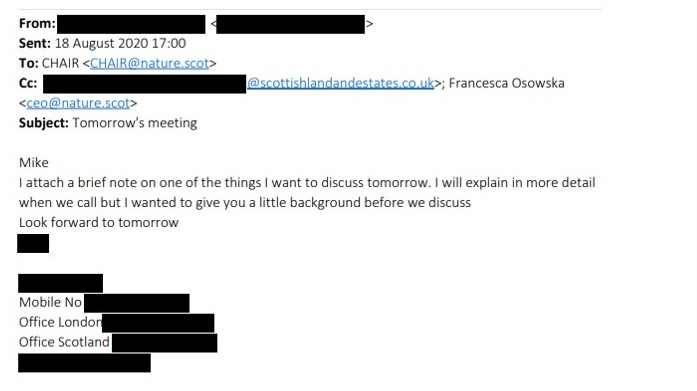
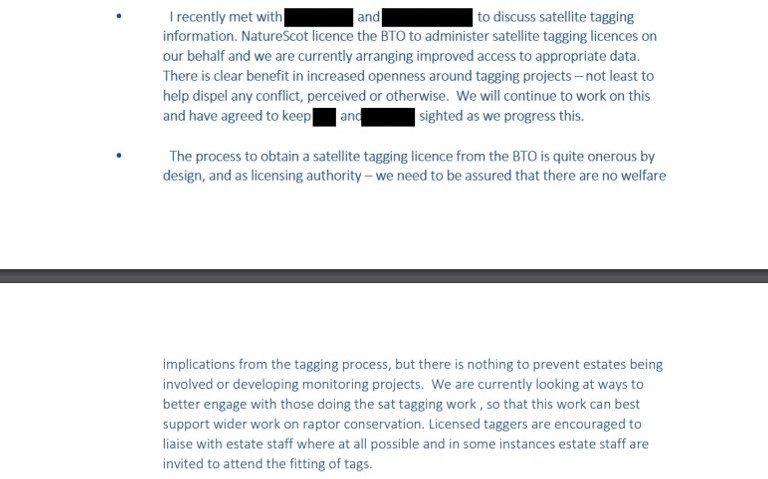
Here is a copy of an email sent to Mike Cantlay, Chair of NatureScot, on 18th August 2020. It was sent either by Tim Baynes (Moorland Director, SLE) or Mark Tennant (Chair, SLE). I know this because of the way my FoI was worded and even though NatureScot has redacted the sender’s name, my money would be on Mark Tennant.

Aside from the breath-taking arrogance, this letter reveals the desperation and delusion of SLE’s position.

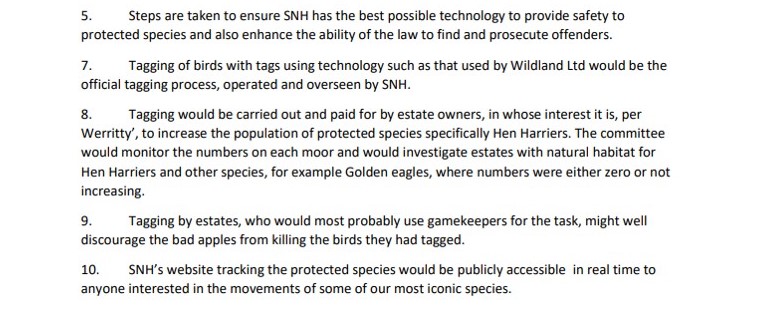
The opening line is the standard position of denial we’ve come to expect from SLE whenever raptor persecution is raised – I’ve blogged about it time and time and time again. There hasn’t been any ‘real progress’ on the prevention of raptor persecution and no matter how many times SLE claims there has, it doesn’t change the fact that there hasn’t! That is precisely why the grouse shooting industry is under so much scrutiny and pressure – because it has been unable to self regulate and boot out the criminals that seem to be allowed to operate in plain sight.

The idea of removing one dysfunctional group (PAW Scotland Raptor Group) and replacing it with another dysfunctional one (COPBAN) is hilarious. I did laugh, a lot, when I read about those plans. And by the way, SLE, nobody has asked Wild Justice whether it’d be interested in participating and I guess nobody has asked the groups already serving on the (dysfunctional) PAW Raptor Group how they’d feel about being side-lined. I’m pretty sure BASC, GWCT, Scottish Raptor Study Group etc would all have something to say!

The idea that estates would fund raptor satellite tagging (presumably excluding all legitimate scientific researchers??) and that gamekeepers would fit the tags demonstrates the high level of ignorance about how satellite tagging is regulated in the UK. There is currently only a handful of expert taggers in the UK, probably less than 20, who are sufficiently qualified, licensed and experienced to fit satellite-tags to birds of prey. Quite rightly, it takes years and years and years to reach the high standards required by the licensing authority. That SLE still hasn’t grasped this very simple concept is jaw-dropping.

And as for having a public website showing the live positions, day and night, of highly-threatened species like golden eagles and hen harriers – yeah, what could possibly go wrong?!

Here is NatureScot’s response to this outlandish proposal from SLE:

I’ll be blogging about some more communications between these two organisations in due course, also uncovered via FoI and related to grouse moor management, the Werritty Review and raptor satellite tracking.

With straight faces, landowners’ lobby group asks tourists to ‘respect nature’

This made me laugh out loud.

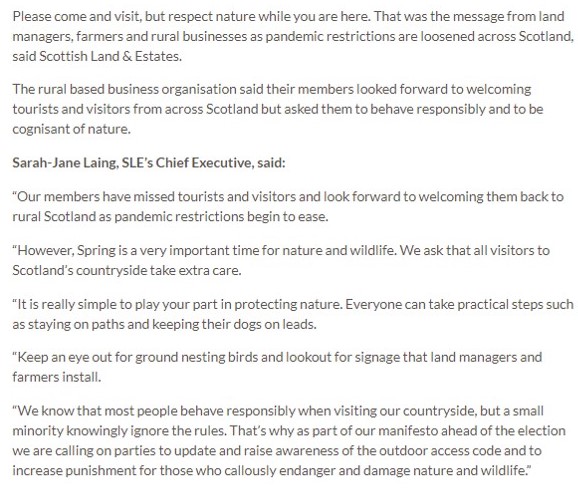
Landowners’ lobby group Scottish Land & Estates (SLE) posted this on their website two days ago:

This is the same Scottish Land & Estates whose membership includes the notorious Leadhills Estate, a grouse-shooting estate in South Lanarkshire where over 70 confirmed incidents of wildlife crime have been reported since 2000 and is currently serving a three-year general licence restriction based on “clear evidence” of ongoing raptor persecution (see here).

This is the same Scottish Land & Estates whose Moorland Group Chair, for years, was Lord Hopetoun of Leadhills Estate as illustrated by this screengrab from the SLE website:

This is also the same Scottish Land & Estates whose membership includes the notorious Longformacus Estate in the Scottish Borders, a grouse and pheasant-shooting estate where gamekeeper Alan Wilson was convicted of nine wildlife crime offences including the shooting of protected raptors, badgers and otters, the setting of illegal snares and the possession of banned poisons (see here). According to SLE’s CEO, Sarah-Jane Laing, responding to a question on this blog on 31 March 2021 (here) about why the Longformacus Estate hadn’t been expelled from SLE:

Yes, Longformacus is a member. As per our statements at the time membership was suspended during the police investigation in to the atrocious crimes but was reinstated when the police took no action against the estate owner“.

This is also the same Scottish Land & Estates who supports seven regional moorland groups; grouse moors in five of those seven regions have been in the last three years, or currently are, under police investigation for alleged raptor persecution crimes (grouse moors in the regions covered by the Angus Glens Moorland Group, Grampian Moorland Group, Tomatin Moorland Group, Tayside & Central Moorland Group and the Southern Uplands Moorland Group).

And SLE has the audacity to ask tourists to ‘respect nature’?!

Police conduct another multi-agency raid after two buzzards confirmed poisoned in Teesdale

Press statement from Durham Constabulary (21 April 2021)

Operation targets raptor persecution

Officers have teamed up with partner agencies on a special operation to target raptor persecution.

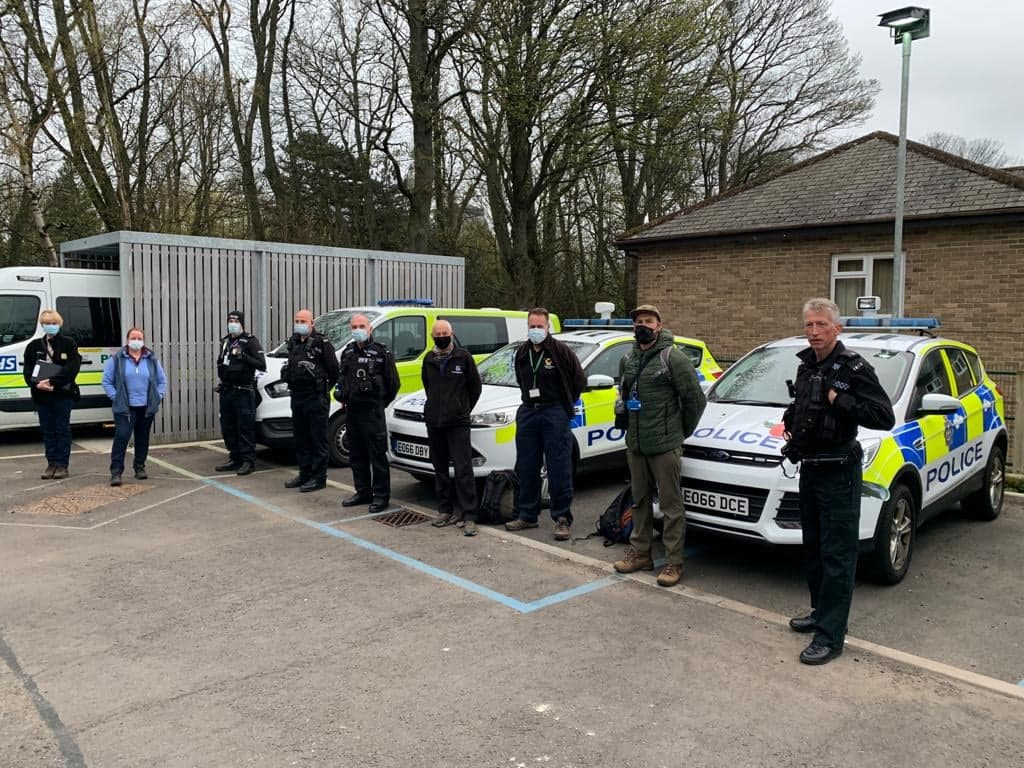
Operation Sunbeam included members of the Barnard Castle Neighbourhood Policing Team, RSPB, Natural England and the National Wildlife Crime Unit who carried out searches at two properties in Teesdale this morning (April 21).

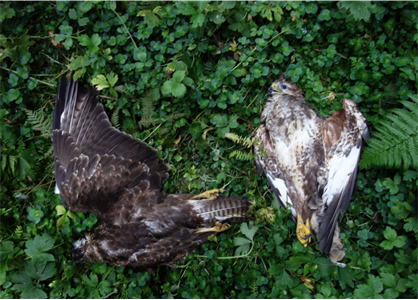
It follows an incident last year when two common buzzards were found dead in Teesdale woodland. Forensic tests indicate they were illegally poisoned with a banned pesticide.

[Two poisoned buzzards. Photo by RSPB]

After gathering all the information, the team searched the properties for any harmful substances and two men are now helping officers with their enquiries.

PC David Williamson, who led the operation, said: “We will always do everything we can to support our rural communities and work with partners to act on information received about alleged criminal activity.

The positive action taken this morning will continue and I would encourage anyone with information about this type of crime to get in touch.”  

[Genuine & credible partnership working. Photo from Durham Constabulary]

The action was part of the Health and Safety Executive’s Wildlife Incident Investigation Scheme which was makes enquiries into the death or illness of wildlife, pets and beneficial invertebrates that may have resulted from pesticide poisoning. 

Guy Shorrock, senior investigating officer for the RSPB, provided specialist advice on the subject.

He said: “The illegal killing of birds of prey is a serious national problem so we are delighted with the really well-prepared response from Durham Police, working with partner agencies.

We hope this sends a clear message that the illegal killing of birds of prey won’t be tolerated and action will be taken.”

Ian Guildford, investigative support officer for the National Wildlife Crime Unit added: “It was a very well organised response and great to see agencies coming together to tackle this type of issue.”

If you have any information call 101 or email PC Williamson at david.williamson@durham.police.uk

ENDS

This is brilliant and follows in the footsteps of three other recent multi-agency raids in response to raptor persecution crimes.

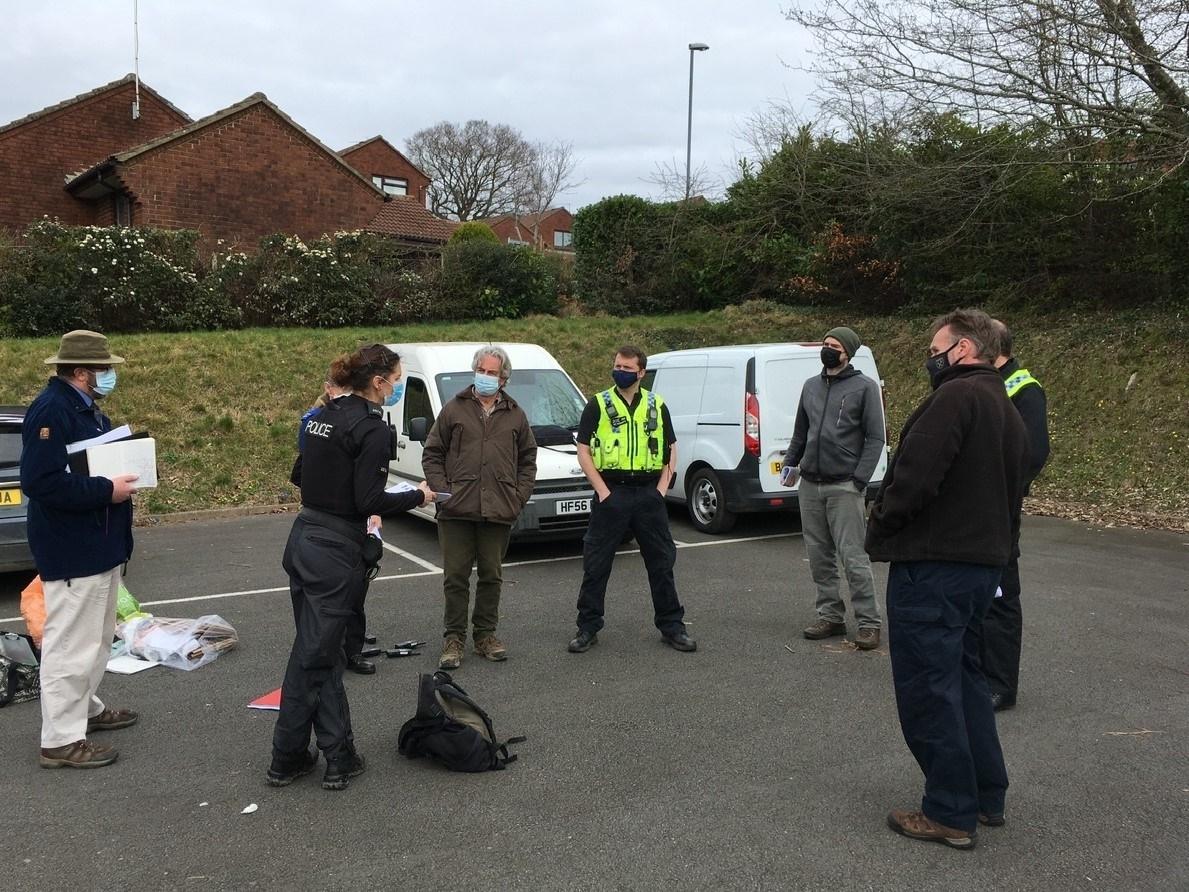
On 15th March 2021 there was a raid in Lincolnshire (see here), on 18th March a raid in Dorset (here), on 26th March a raid in Devon (see here) and now this raid in Teesdale.

It’s alarming that all four raids were triggered by the use of banned poisons to kill birds of prey and it’s also quite telling that these offences took place in counties spread across England. This is not a small, localised issue as the shooting industry would have us believe – this is widespread criminality and involves the use of banned poisons that have the capacity to kill anything that touches it, including humans.

Well done to all the partners involved – this is genuine and credible partnership working. Let’s hope their efforts are rewarded with successful prosecutions and convictions.

Lincolnshire Police provide update on investigation into poisoned red kite

On 15th March this year, the RSPB tweeted that there’d been a multi-agency raid on two properties in Lincolnshire in connection with the poisoning of a red kite in 2020. Lincolnshire Police, supported by the National Wildlife Crime Unit, Natural England and the RSPB’s Investigations team, reportedly seized substances that were sent off for toxicology (see here).

[Multi-agency partnership working in Lincolnshire in March 2021. Photo by RSPB]

Today, Lincolnshire Police have issued the following press statement:

Investigation launched into suspected bird poisoning

Last year a Red Kite was found dead by a member of the public on a piece of land in the Crowland area.

The bird was sent off for forensic toxicology tests through the government Wildlife Incident Investigation Scheme (WIIS). The result of this analysis has been returned to us and indicates that the bird was poisoned.

Following this result, Lincolnshire Police Wildlife Crime officers, along with partner agencies including the National Wildlife Crime Unit (NWCU), Natural England and the RSPB, have been involved in a detailed investigation and two searches have been carried out at addresses in the Crowland area under the Wildlife and Countryside Act 1981.

During these searches, items have been recovered which are believed to have been linked to this offence, including some suspected banned pesticides. Investigations are ongoing and two people have been identified in relation to this and they will be spoken with in due course. 

Detective Constable Aaron Flint, Officer in the case has said: “Raptor Persecution is one of the UK’s National wildlife crime priorities and is taken very seriously by Lincolnshire Police. These offences will always be dealt with expeditiously and robustly. Deliberate killing of birds of prey is an offence which I urge the public to report if they become aware of it.

I would like to add, that if a bird of prey is found dead and you believe it is suspicious it should be reported to the police immediately to allow an investigation into its death to commence. The bird may have been poisoned which poses obvious health and safety concerns if handled. Providing the police with the What3words location would be extremely useful when reporting an incident”.

Guy Shorrock, senior Investigations officer with the RSPB, added: “Though raptor persecution data for 2020 has not yet been collated, the number of online reports relating to confirmed incidents and police follow up action around the UK indicate this problem is clearly not going away

Lincolnshire police would like to remind the public that any offences or information they come across can be reported via 999 (for urgent matters) or 101 for other non-urgent matters or visit the Lincolnshire police website to report it online.

ENDS

This is good stuff from Lincolnshire Police. Strong partnership-working with specialist agencies for the follow-up raids and a clear statement about what the investigation is about and its current status.

Let’s hope these efforts result in a prosecution and conviction.

UPDATE 15th April 2023: Lincolnshire Police charge man after investigation into poisoned red kite (here)

Keith Tordoff, candidate for North Yorkshire Police & Crime Commissioner is raptor champion

Last week I blogged about how a coalition of organisations under the umbrella group Wildlife & Countryside LINK was asking Police and Crime Commissioner candidates to prioritise wildlife crime should they be elected on 6th May 2021 (see here).

The role of a Police and Crime Commissioner (PCC) has the potential to be hugely influential as to how local policing operates. The PCC has a number of statutory responsibilities including:

  • to secure an efficient and effective police for their area;
  • to appoint the Chief Constable, hold them to account for running the force, and if necessary dismiss them;
  • to set the police and crime objectives for their area through a police and crime plan;
  • to set the force budget and determine the precept;
  • to contribute to the national and international policing capabilities set out by the Home Secretary; and
  • to bring together community safety and criminal justice partners, to make sure local priorities are joined up.

In North Yorkshire, the UK’s undisputed raptor persecution capital, there’s a candidate that should appeal to blog readers in that county – Keith Tordoff (visit Keith’s website here).

Keith has a varied background, including serving for 20 years with West Yorkshire Police, and now runs the sweet shop in Pateley Bridge.

Blog readers may recognise him from the Channel 4 piece last year (6 min video here) about the rampant crimes against birds of prey that continue to be reported across North Yorkshire, including in Pateley Bridge in the Nidderdale Area of Outstanding Natural Beauty, with its proximity to several notorious driven grouse moors.

Keith was interviewed as one of a number of local businessmen who had put up a reward to find the criminals responsible for laying poisoned baits that killed a buzzard and a local family’s pet dog (see here). It wasn’t the first time he’d stepped up with a reward, either.

As a long-standing and outspoken critic of the raptor killers, Keith has suffered abuse such as eggs being thrown at his shop windows and death threat letters being pushed through his letterbox, but he continues to defy the local grouse moor criminals and has considerable support from other Pateley Bridge residents who are tired of having the town’s reputation tarnished as a raptor persecution hotspot. I have no doubt that if elected, he’d continue that effort right across North Yorkshire.

If you’re a North Yorkshire resident and you want to see police resources continue to be prioritised to help fight wildlife crime, and especially raptor persecution, Keith may be just the candidate you’re looking for on 6th May.

Gun, banned poisons & dead birds of prey seized in third multi-agency raid in England

Press release from Dorset Police (1st April 2021)

Officers and partners who executed a warrant at a rural property in East Dorset have seized pesticides, dead birds of prey and a firearm.

Dorset Police Wildlife Crime Officers have been working with the Police National Wildlife Crime Unit (NWCU), Natural England and the RSPB to investigate the alleged poisoning of a Red Kite, which was found dead in a field in north east Dorset in November 2020.

The bird of prey was recovered by police following the discovery by a member of the public and sent for forensic analysis at a specialist laboratory. The results of a post mortem examination subsequently indicated that it had been poisoned. 

On Thursday 18 March 2021 officers, accompanied by NWCU, Natural England and RSPB, attended an address in rural north east Dorset, having obtained a warrant and also exercised further powers under the Wildlife and Countryside Act 1981. 

A number of dead birds of prey and several pesticides, including banned substances, were located at the premises. A firearm was also recovered. 

[Photo by Guy Shorrock]

Police Constable Claire Dinsdale, Lead Wildlife Crime Officer for Dorset Police said: “This investigation is ongoing and no further information or comment can be made at this time regards this specific case

The national picture is that the persecution of birds of prey sadly continues in the UK. This is one of our six national priorities for wildlife crime, highlighted on the National Wildlife Crime Unit’s website https://www.nwcu.police.uk/. 

A great deal of work has already been done by police and partner organisations but still there are those who think they are above the law.  The deliberate killing of birds of prey will not be tolerated. We have had previous cases in Dorset of illegal shooting and trapping as well as poisoning. 

I would urge the public to be vigilant and report dead birds of prey to police. Clear evidence of a wildlife crime, such as an illegal trap, shooting or suspected poison bait should be reported immediately to police without delay. A ‘What Three Words’ location or grid reference is really useful.

If a dead bird of prey is located and you are not sure whether it is suspicious or not, still report it to police immediately. We can access assistance from vets to examine and x-ray birds and submit them for forensic testing, therefore ruling out natural causes. Police can access forensic funding for such wildlife crime cases. 

A wildlife crime in progress is a 999 call, an urgent suspicious finding needs to be called in on 101 immediately and for all other non-urgent reports you can email 101@dorset.pnn.police.uk or visit Dorset Police online https://www.dorset.police.uk/do-it-online/. 

If you have any information on the illegal killing of birds of prey or other types of wildlife crime, you can speak to police in confidence by emailing 101@dorset.pnn.police.uk. We do not act in a way that would identify the source of the information to the police.” 

ENDS

This is the third multi-agency raid that’s taken place in England in the space of a couple of weeks, in relation to the suspected persecution of birds of prey.

On 15th March 2021 there was a raid in Lincolnshire (see here), on 18th March this raid in Dorset, and on 26th March a raid in Devon (see here).

It’s alarming that all three raids were triggered by the use of poisons to kill birds of prey.

Well done to all the partners involved – let’s hope their efforts are rewarded with successful prosecutions and convictions.

UPDATE 1st January 2023: Gamekeeper due in court facing multiple charges of raptor persecution, poisons and firearms offences (here)