61 hen harriers confirmed illegally killed or ‘missing’ since 2018, most of them on or close to UK grouse moors

For anyone who still wants to pretend that the grouse shooting industry isn’t responsible for the systematic extermination of hen harriers on grouse moors across the UK, here’s the latest catalogue of crime that suggests otherwise.

[This male hen harrier died in 2019 after his leg was almost severed in an illegally set trap that had been placed next to his nest on a Scottish grouse moor (see here). Photo by Ruth Tingay]

This is the blog I now publish after every reported killing or suspicious disappearance.

They disappear in the same way political dissidents in authoritarian dictatorships have disappeared” (Stephen Barlow, 22 January 2021).

Today the list has been updated to include the most recently reported victim, a young hen harrier whose satellite tag inexplicably stopped transmitting and whose corpse vanished in to thin air a few weeks ago on 10th February 2022 (see here).

The disgraceful national catalogue of illegally killed and ‘missing’ hen harriers will continue to grow – I know of at least one more on-going police investigation which has yet to be publicised.

I’ve been compiling this list only since 2018 because that is the year that the grouse shooting industry ‘leaders’ would have us believe that the criminal persecution of hen harriers had stopped and that these birds were being welcomed back on to the UK’s grouse moors (see here).

This assertion was made shortly before the publication of a devastating new scientific paper that demonstrated that 72% of satellite-tagged hen harriers were confirmed or considered likely to have been illegally killed, and this was ten times more likely to occur over areas of land managed for grouse shooting relative to other land uses (see here).

2018 was also the year that Natural England issued itself with a licence to begin a hen harrier brood meddling trial on grouse moors in northern England. For new blog readers, hen harrier brood meddling is a conservation sham sanctioned by DEFRA as part of its ludicrous ‘Hen Harrier Action Plan‘ and carried out by Natural England (NE), in cahoots with the very industry responsible for the species’ catastrophic decline in England. For more background see here.

Brood meddling has been described as a sort of ‘gentleman’s agreement’ by commentator Stephen Welch:

I don’t get it, I thought the idea of that scheme was some kind of trade off – a gentleman’s agreement that the birds would be left in peace if they were moved from grouse moors at a certain density. It seems that one party is not keeping their side of the bargain“.

With at least 61 hen harriers gone since 2018, I think it’s fair to say that the grouse shooting industry is simply taking the piss. Meanwhile, Natural England pretends that ‘partnership working’ is the way to go and DEFRA Ministers remain silent.

‘Partnership working’ appears to include authorising the removal of hen harrier chicks from a grouse moor already under investigation by the police for suspected raptor persecution (here) and accepting a £10K bung from representatives of the grouse shooting industry that prevents Natural England from criticising them or the sham brood meddling trial (see here).

[Cartoon by Gill Lewis]

So here’s the latest gruesome list. Note that the majority of these birds (but not all) were fitted with satellite tags. How many more [untagged] harriers have been killed?

February 2018: Hen harrier Saorsa ‘disappeared’ in the Angus Glens in Scotland (here). The Scottish Gamekeepers Association later published wholly inaccurate information claiming the bird had been re-sighted. The RSPB dismissed this as “completely false” (here).

5 February 2018: Hen harrier Marc ‘disappeared’ on a grouse moor in Durham (here)

9 February 2018: Hen harrier Aalin ‘disappeared’ on a grouse moor in Wales (here)

March 2018: Hen harrier Blue ‘disappeared’ in the Lake District National Park (here)

March 2018: Hen harrier Finn ‘disappeared’ near Moffat in Scotland (here)

18 April 2018: Hen harrier Lia ‘disappeared’ in Wales and her corpse was retrieved in a field in May 2018. Cause of death was unconfirmed but police treating death as suspicious (here)

8 August 2018: Hen harrier Hilma ‘disappeared’ on a grouse moor in Northumberland (here).

16 August 2018: Hen harrier Athena ‘disappeared’ on a grouse moor in Scotland (here)

26 August 2018: Hen Harrier Octavia ‘disappeared’ on a grouse moor in the Peak District National Park (here)

29 August 2018: Hen harrier Margot ‘disappeared’ on a grouse moor in Scotland (here)

29 August 2018: Hen Harrier Heulwen ‘disappeared’ on a grouse moor in Wales (here)

3 September 2018: Hen harrier Stelmaria ‘disappeared’ on a grouse moor in Scotland (here)

24 September 2018: Hen harrier Heather ‘disappeared’ on a grouse moor in Scotland (here)

2 October 2018: Hen harrier Mabel ‘disappeared’ on a grouse moor on the edge of the Yorkshire Dales National Park (here)

3 October 2018: Hen Harrier Thor ‘disappeared’ next to a grouse moor in Bowland, Lanacashire (here)

23 October 2018: Hen harrier Tom ‘disappeared’ in South Wales (here)

26 October 2018: Hen harrier Arthur ‘disappeared’ on a grouse moor in the North York Moors National Park (here)

1 November 2018: Hen harrier Barney ‘disappeared’ on Bodmin Moor (here)

10 November 2018: Hen harrier Rannoch ‘disappeared’ on a grouse moor in Scotland (here). Her corpse was found nearby in May 2019 – she’d been killed in an illegally-set spring trap (here).

14 November 2018: Hen harrier River ‘disappeared’ on a grouse moor in the Nidderdale AONB (here). Her corpse was found nearby in April 2019 – she’d been illegally shot (here).

16 January 2019: Hen harrier Vulcan ‘disappeared’ in Wiltshire close to Natural England’s proposed reintroduction site (here)

7 February 2019: Hen harrier Skylar ‘disappeared’ next to a grouse moor in South Lanarkshire (here)

22 April 2019: Hen harrier Marci ‘disappeared’ on a grouse moor in the Cairngorms National Park (here)

26 April 2019: Hen harrier Rain ‘disappeared’ on a grouse moor in Nairnshire (here)

11 May 2019: An untagged male hen harrier was caught in an illegally-set trap next to his nest on a grouse moor in South Lanarkshire. He didn’t survive (here)

7 June 2019: An untagged hen harrier was found dead on a grouse moor in Scotland. A post mortem stated the bird had died as a result of ‘penetrating trauma’ injuries and that this bird had previously been shot (here)

5 September 2019: Wildland Hen Harrier 1 ‘disappeared’ on a grouse moor nr Dalnaspidal on the edge of the Cairngorms National Park (here)

11 September 2019: Hen harrier Romario ‘disappeared’ on a grouse moor in the Cairngorms National Park (here)

14 September 2019: Hen harrier (Brood meddled in 2019, #183704) ‘disappeared’ in North Pennines (here)

23 September 2019: Hen harrier (Brood meddled in 2019, #55149) ‘disappeared’ in North Pennines (here)

24 September 2019: Wildland Hen Harrier 2 ‘disappeared’ on a grouse moor at Invercauld in the Cairngorms National Park (here)

24 September 2019: Hen harrier Bronwyn ‘disappeared’ near a grouse moor in North Wales (here)

10 October 2019: Hen harrier Ada ‘disappeared’ on a grouse moor in the North Pennines AONB (here)

12 October 2019: Hen harrier Thistle ‘disappeared’ on a grouse moor in Sutherland (here)

18 October 2019: Member of the public reports the witnessed shooting of an untagged male hen harrier on White Syke Hill in North Yorkshire (here)

November 2019: Hen harrier Mary found illegally poisoned on a pheasant shoot in Ireland (here)

January 2020: Members of the public report the witnessed shooting of a male hen harrier on Threshfield Moor in the Yorkshire Dales National Park (here)

23 March 2020: Hen harrier Rosie ‘disappeared’ at an undisclosed roost site in Northumberland (here)

1 April 2020: Hen harrier (Brood meddled in 2019, #183703) ‘disappeared’ in unnamed location, tag intermittent (here)

5 April 2020: Hen harrier Hoolie ‘disappeared’ on a grouse moor in the Cairngorms National Park (here)

8 April 2020: Hen harrier Marlin ‘disappeared’ on a grouse moor in the Cairngorms National Park (here)

19 May 2020: Hen harrier Fingal ‘disappeared’ on a grouse moor in the Lowther Hills, Scotland (here)

21 May 2020: Hen harrier (Brood meddled in 2019, #183701) ‘disappeared’ on a grouse moor in Cumbria shortly after returning from wintering in France (here)

27 May 2020: Hen harrier Silver ‘disappeared’ on a grouse moor on Leadhills Estate, Scotland (here)

day/month unknown: Unnamed male hen harrier breeding on RSPB Geltsdale Reserve, Cumbria ‘disappeared’ while away hunting (here)

9 July 2020: Unnamed female hen harrier (#201118) ‘disappeared’ from an undisclosed site in Northumberland (here).

25 July 2020: Hen harrier Harriet ‘disappeared’ on a grouse moor in the Yorkshire Dales National Park (here)

14 August 2020: Hen harrier Solo ‘disappeared’ in confidential nest area in Lancashire (here)

7 September 2020: Hen harrier Dryad ‘disappeared’ on a grouse moor in the Yorkshire Dales National Park (here)

16 September 2020: Hen harrier Fortune ‘disappeared’ from an undisclosed roost site in Northumberland (here)

19 September 2020: Hen harrier Harold ‘disappeared’ on a grouse moor in the Yorkshire Dales National Park (here)

20 September 2020: Hen harrier (Brood meddled in 2020, #55152) ‘disappeared’ next to a grouse moor in North Yorkshire (here)

24 February 2021: Hen harrier Tarras ‘disappeared’ next to a grouse moor in Northumberland (here)

12th April 2021: Hen harrier Yarrow ‘disappeared’ near Stockton, County Durham (here)

18 May 2021: Adult male hen harrier ‘disappeared’ from its breeding attempt on RSPB Geltsdale Reserve, Cumbria whilst away hunting (here)

18 May 2021: Another adult male hen harrier ‘disappeared’ from its breeding attempt on RSPB Geltsdale Reserve, Cumbria whilst away hunting (here)

24 July 2021: Hen harrier Asta ‘disappeared’ at a ‘confidential site’ in the North Pennines (here)

14th August 2021: Hen harrier Josephine ‘disappeared’ at a ‘confidential site’ in Northumberland (here)

17 September 2021: Hen harrier Reiver ‘disappeared’ in a grouse moor dominated region of Northumberland (here)

24 September 2021: Hen harrier (Brood meddled in 2021, R2-F-1-21) ‘disappeared’ in Northumberland (here)

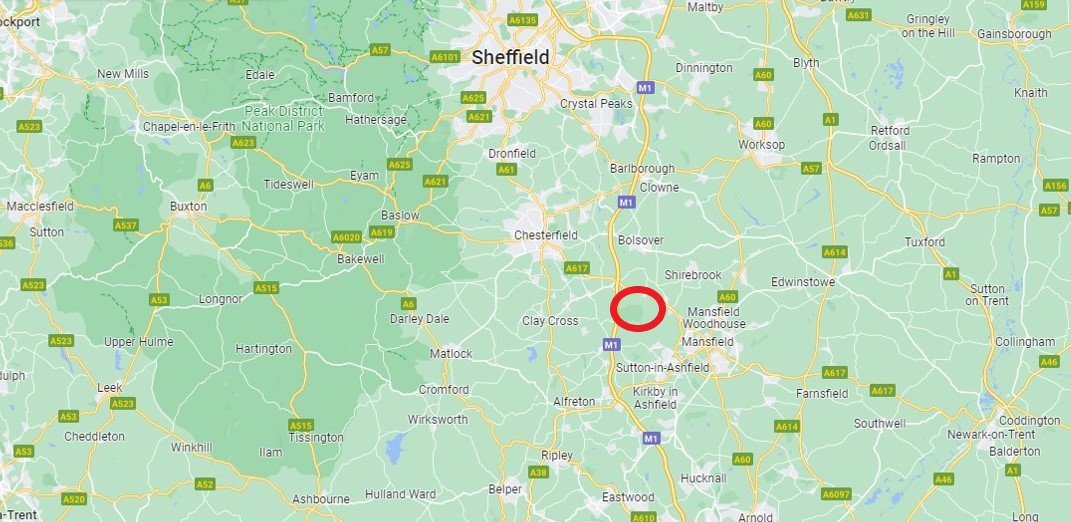
10 February 2022: An unnamed satellite-tagged hen harrier ‘disappeared’ in a grouse moor dominated area of the Peak District National Park (here)

To be continued……..

Oh, and we’re still waiting for Natural England to tell us the cause of death of two brood meddled hen harriers whose corpses were found in October 2021 (see here). Will they, too, be added to this list?

NatureScot refuses to publish details of Leadhills Estate’s general licence restriction appeal

This is a long and sorry saga, and it’s not yet over.

As many blog readers will know, the notorious Leadhills Estate, a grouse-shooting estate in South Lanarkshire that has been at the centre of police wildlife crime investigations at least 70 times since the early 2000s, is currently serving an unprecedented TWO General Licence restrictions imposed by NatureScot after ‘clear evidence’ of wildlife crime was provided to the statutory regulator by Police Scotland (see here and here), including the illegal killing of short-eared owls, buzzards, hen harriers and the discovery of two stashes of banned poisons.

Incredibly, Leadhills Estate with its double General Licence restriction is STILL a member of the lobby group Scottish Land & Estates, which claims to have a ‘zero tolerance’ approach to raptor persecution. Convincing, eh?

[Grouse moor on the Leadhills Estate. Photo by Ruth Tingay]

The first three-year General Licence restriction was imposed on Leadhills Estate in November 2019 (here). The estate appealed this decision, with an hilarious letter of objection (here), but its appeal failed.

The second General Licence restriction was imposed on Leadhills Estate in September 2021 (here) after Police Scotland reported even more wildlife crime while the estate was still serving its first restriction.

Once again, Leadhills Estate appealed the decision with a written objection letter.

It is this letter of objection that I have been trying to get from NatureScot since September 2021. Five months on, it is still being withheld, for what I have argued are spurious reasons.

Here’s a short summary of what’s happened so far:

On 30th September 2021 I submitted an FoI to NatureScot to request copies of Leadhills Estate’s appeal.

On 3 November 2021 NatureScot responded as follows:

We have withheld a letter from an agent acting on behalf of Leadhills Estate, pending an appeal against NatureScot’s decision to restrict General Licence. This information is of a sensitive nature and disclosure into the public domain could prejudice the applicant’s right to a fair hearing’.

I didn’t see how public disclosure could possibly prejudice a hearing given that it’s all done in-house at NatureScot but fine, I could wait.

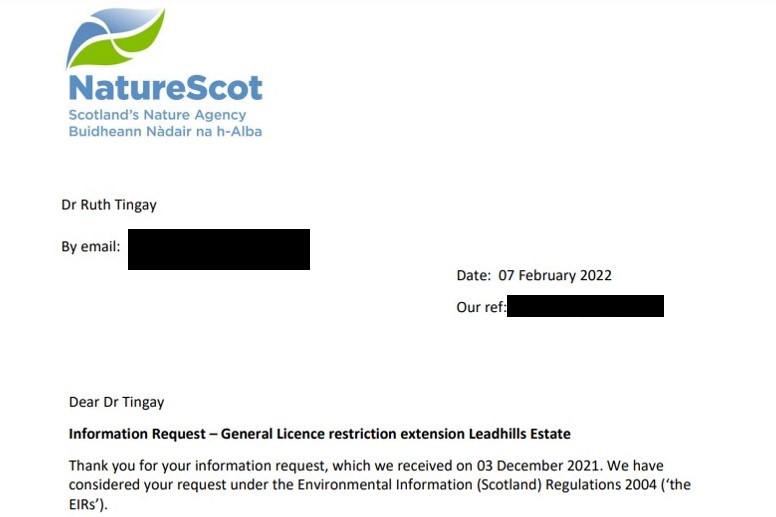
In December 2021 it was announced that Leadhills Estate had lost its appeal against the second General Licence restriction (here) so I wrote back to NatureScot on 3rd December as follows:

You told me in the letter dated 3 November 2021 that you were withholding a letter from an agent who was acting on behalf of Leadhills Estate, and the reason you gave for withholding it was that releasing it may prejudice the applicant’s right to a fair appeal. As the appeal process has now concluded and therefore the applicant’s right to a fair hearing cannot be affected, please can you send me the agent’s letter that was previously withheld‘.

On 5th January 2022 NatureScot responded as follows:

We have completed our information searches, and we have identified eight documents comprising 126 pages relevant to your request. We shared a redacted version of these documents with the solicitors acting on behalf of Leadhills Estate, who have provided additional legal arguments as to why certain information should be withheld. We will need additional time to assess these arguments and, potentially, take further legal advice.

Regulation 7 of the EIRs allows public authorities to extend the time for compliance with requests for up to an additional 20 working days. This means we must respond to your information request by 3 February 2022 at the latest‘.

Hmm. Why might Leadhills Estate not want the details of its appeal to be made public? And what legal arguments might it use to block the transparency of the decision-making process of a statutory agency?

On 7th February 2022, NatureScot sent this explanation:

That’s all very interesting. Obviously, I’ve appealed this decision and asked for a review. I don’t believe there are further proceedings to ‘prejudice’ as Leadhills Estate has now exhausted the appeals process for the General Licence restriction. I also don’t believe that correspondence between an agent and a public authority qualifies as ‘legal privilege’ and especially when it’s in the public interest to understand how the statutory agency has reached its decision with transparency and fairness.

Let’s see. Another 20 working days to wait, which will take us to six months since I made the original request.

General Licence restriction imposed on Invercauld Estate in Cairngorms after poisoned golden eagle & baits found

In March last year a dead golden eagle was found face-down on a grouse moor on Invercauld Estate in the Cairngorms National Park. It had been ‘deliberately’ poisoned with a banned substance, according to Police Scotland, and two poisoned baits were found close-by (see here).

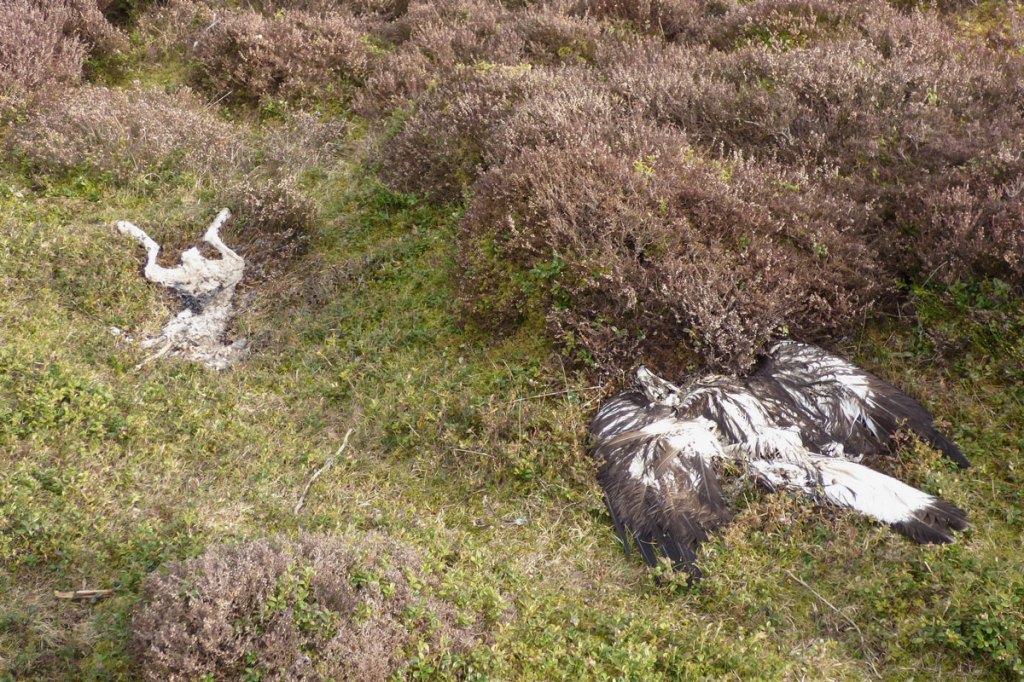
[The poisoned golden eagle, next to a poisoned hare bait. Photo by RSPB Scotland]

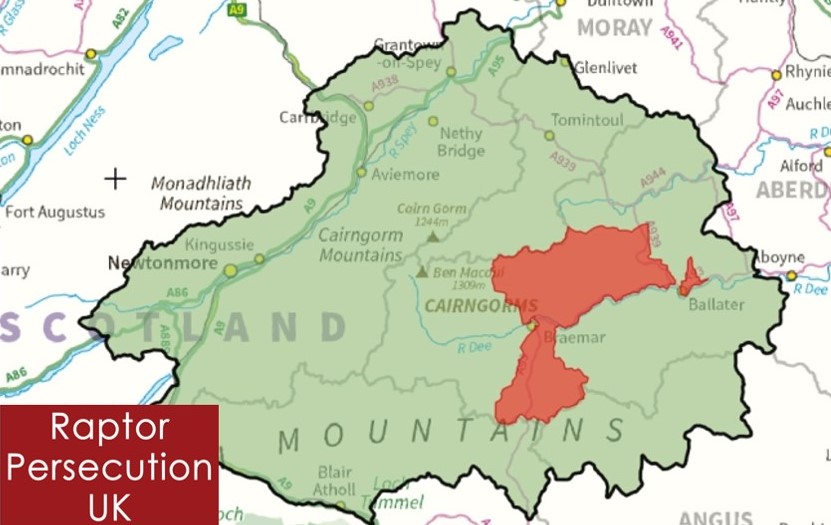
[Invercauld Estate inside the Cairngorms National Park. Boundary data from Andy Wightman’s Who Owns Scotland website]

Today, 11 months after the grim discovery, the Scottish Government’s statutory nature conservation agency NatureScot has imposed a three-year General Licence restriction on part of Invercauld Estate. Here’s the press release:

General Licence restricted on Cairngorms Estate

NatureScot has restricted the use of general licences on part of the Invercauld Estate in the Cairngorms National Park.

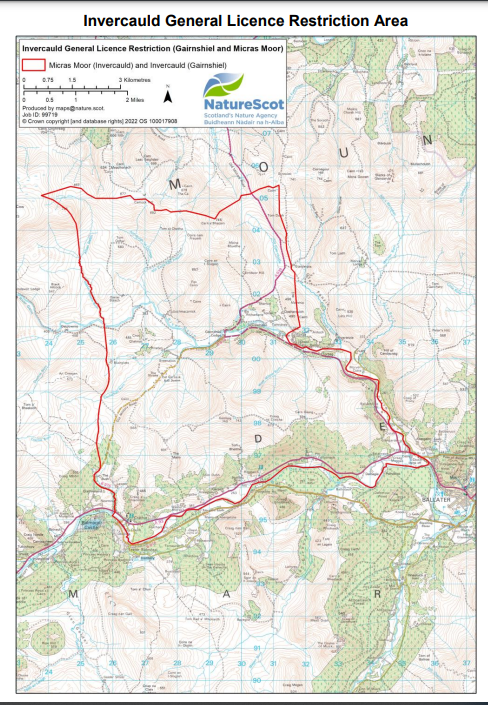
The decision was made on the basis of evidence provided by Police Scotland of wildlife crime against birds. This evidence included a poisoned golden eagle found on the estate in March 2021, along with a rabbit and a hare carcass, both baited with poison. The restriction will apply to the Gairnshiel and Micras moor on the estate, where the evidence of poisoning was found.

Donald Fraser, NatureScot’s Head of Wildlife Management, said: ““These poisoning incidents are appalling and an act of animal cruelty. The indiscriminate use of poisons is not only lethal to our iconic Scottish wildlife, but can also pose a serious health risk to people and domestic animals that come into contact with it. 

We are committed to using all the tools we have available to tackle wildlife crime. In this case, there is clear evidence of criminal behaviour. Because of this, and the risk of more wildlife crimes taking place, we have suspended the use of general licences on this property for three years. They may still apply for individual licences, but these will be closely monitored.

This measure will help to protect wild birds in the area, while still allowing necessary land management activities to take place, although under tighter supervision. We believe this is a proportionate response to protect wild birds in the area and prevent further wildlife crime.

We work closely with Police Scotland and will continue to consider information they provide on cases which may warrant restricting general licences. The detection of wildlife crime can be difficult, but this is the third time in recent months when we have restricted use of general licences on the basis of evidence of crime taking place. New and emerging technologies, along with a commitment from a range of partners to take a collective approach to these issues, will help us stop wildlife crime.”

General licences allow landowners or land managers to carry out control of common species of wild birds, such as crows and magpies, to protect crops or livestock, without the need to apply for an individual licence.

ENDS

Here is the map showing the restricted areas on Invercauld Estate. The restriction applies from 9th February 2022 to 9th February 2025.

This has been a long time coming for this estate. I wrote about it in May 2021 (here) and I’ll repeat it here.

Invercauld Estate and the surrounding area has been at the centre of many alleged wildlife crimes over the years, including the discovery of three poisoned buzzards on the estate in 2005 (here), the discovery of a poisoned red kite at the Spittal of Glenshee on Invercauld Estate in January 2007 according to former police wildlife crime officer Alan Stewart (in litt. 9 Feb 2022), the discovery of an illegally shot peregrine at the Pass of Ballater in 2011, the reported coordinated hunt and subsequent shooting of an adult hen harrier at Glen Gairn on the border of Invercauld and Dinnet Estates in 2013, the illegally-set traps that were found near Geallaig Hill on Invercauld Estate in 2016, the suspicious disappearance of satellite-tagged hen harrier Calluna ‘on a grouse moor a few miles north of Ballater’ on 12 August 2017, the opening day of the grouse shooting season (here) although it’s not clear whether this was on Invercauld Estate or neighbouring Dinnet Estate, the suspicious disappearance of satellite-tagged white-tailed eagle ‘Blue T’ on Invercauld Estate in May 2018 (see here), the suspicious disappearance of satellite-tagged hen harrier Stelmaria ‘last recorded on grouse moor a few miles north west of Ballater, Aberdeenshire on 3rd September 2018 (see here), the discovery of a golden eagle flying around the area with a spring trap attached to its foot in August 2019 (here), the suspicious disappearance of satellite-tagged hen harrier (Wildland 2) on Invercauld Estate on 24 September 2019 (here) and the discovery of a deliberately poisoned golden eagle and poisonous baits on a grouse moor on Invercauld Estate in March 2021 (see here).

I’m pleased to see this restriction finally imposed on Invercauld, although I’d much rather have seen a series of criminal prosecutions. The restriction will have very little material affect on the game-shooting activities on Invercauld because the estate can simply apply for an individual licence allowing it to continue its activities as if no ‘clear evidence of criminal behaviour’ has been uncovered (more on that ridiculous situation shortly) but it does mean the estate’s reputation is damaged and it also means this can be used to apply pressure on organisations such as Scottish Land & Estates and the Scottish Gamekeepers Association, who both claim to have a zero tolerance of raptor persecution.

Will Invercauld Estate and its gamekeepers remain members of these two organisations?

UPDATE 7th April 2022: Invercauld Estate in Cairngorms National Park loses appeal against General Licence restriction imposed for wildlife crime (here)

Multi-agency raid following suspected raptor poisoning in North Wales

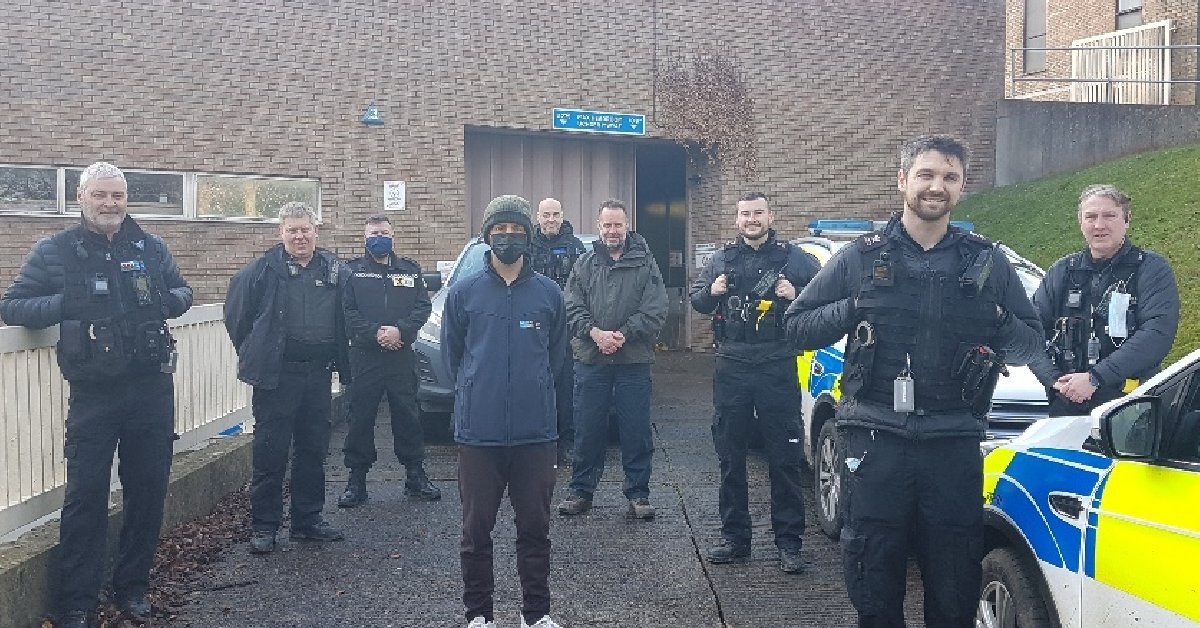
North Wales Police Rural Crime Team has posted this photograph on Twitter of a multi-agency raid that took place in Flintshire, North Wales today, involving the police, Welsh Government, National Wildlife Crime Unit and the RSPB’s Investigations Team.

There aren’t any further details other than a statement from the police:

The use of poisons to target birds of prey within our countryside will not be tolerated‘.

Well done to all the agencies involved.

This is the latest in a surge of multi-agency investigations in response to raptor persecution crimes over the last 13 months, including a raid on 18th January 2021 in Suffolk (here), another raid in January 2021 in Nottinghamshire (here), on 15th March 2021 a raid in Lincolnshire (see here), on 18th March 2021 a raid in Dorset (here), on 26th March 2021 a raid in Devon (see here), on 21st April 2021 a raid in Teesdale (here), on 2nd August 2021 a raid in Shropshire (here), on 12th August 2021 a raid in Herefordshire (here), on 14th September 2021 a raid in Norfolk (here), a raid in Wales in October 2021 (here) and on 10th December 2021 a raid in Humberside (here).

The Nottinghamshire investigation concluded on 28th January 2022 when gamekeeper John Orrey was sentenced for battering to death two buzzards he’d caught inside a trap (here).

Let’s hope some of these other raids have secured sufficient evidence to bring defendants to court.

Marsh harrier dies in suspected rodenticide poisoning

An article from Jersey Evening Post, 3rd February 2022

Death of ‘iconic’ bird of prey leads to rat poison warning

ISLANDERS should take care when laying rat poison after a marsh harrier was found dead in St Ouen’s Bay, an environmentalist has said.

Bob Tompkins said the bird of prey was recently found lying face down by National Trust rangers. A post-mortem examination by the JSPCA revealed that the likely cause of death was rodenticide poisoning.

‘One is too many,’ Mr Tompkins said, describing the bird’s death as ‘completely avoidable’.

‘They are an iconic bird, like the red kite or the golden eagle.’

Several peregrine falcons were poisoned in Guernsey over the space of a year recently, an act which Mr Tompkins said ‘was deliberate’.

‘I am not saying that is the case here,’ said Mr Tompkins, but he added that it was a ‘possibility’.

‘If you need to put rodenticide poison out, make sure it is done in a professional manner,’ Mr Tompkins stressed.

Leaving poison out in the open carried a risk of rats dying in the open, he said, adding that these would then be feasted on by carrion eaters such as marsh harriers, barn owls and buzzards, another bird which the environmentalist said had recently been killed by poison.

The deceased marsh harrier was found in otherwise peak condition without a mark on it, he said, but had blood in and around its mouth, beak and digestive system, prompting concerns that it had swallowed a large amount of poison.

Mr Thompson added that birds that did not die straight away suffered the long-term effects, causing a decline in their condition and making them easy prey, as the poison built up in their system.

Poisonings had a ‘domino effect’ on the wider ecosystem, said Mr Tompkins, with birds less able to raise their young successfully, an egg’s chances of survival being reduced and the poison passed on to chicks. He cited one case in which he had come across a nest of barn-owl chicks, which were ‘obviously blind’.

Writing in today’s Nature pages, Mr Tompkins said it was ‘always concerning when a high-profile bird is found dead’.

It was ‘something, unfortunately, that is all too commonly seen in raptors and carrion eaters’, he added.

ENDS

Raptor persecution ignored in North York Moors National Park draft management plan

The North York Moors National Park Authority (NYMNPA) is currently consulting on its draft management plan, which aims to set out a series of priority actions to help the Park tackle issues which include ‘recovery from the COVID pandemic, escalating climate and nature emergencies, increasing mental and physical health problems among the general population, and the need to change the way we look after our landscapes‘.

You can download the draft plan here:

I had a quick read through this document at the weekend and was surprised to see how little substance it contained and how vague its stated 22 priority objectives were. For example, whilst there was general commentary around ‘active restoration’ of degraded blanket bog and peat habitats, the only reference I found that might possibly allude to the massive environmental problems caused by intensive driven grouse shooting, which dominates the landscape of this National Park, was this:

Objective 8 – Work with our moorland community to support the sustainable management of moorland to ensure it retains a natural remoteness which supports a greater variety of species and habitats.

I didn’t find one single reference to tackling wildlife crime, and especially raptor persecution, which has long been recognised as an ongoing characteristic of this National Park. For example, just in the last few years alone we’ve seen a shot buzzard (here), a poisoned buzzard (here), deliberate disturbance of a goshawk breeding attempt (here), a satellite-tagged hen harrier vanish in suspicious circumstances (here), another shot buzzard (here), and another shot buzzard (here), a goshawk trapped, reportedly killed and taken away in sack (here), another poisoned buzzard (here), an illegally-set trap (here), and five shot buzzards found stuffed under a rock (here).

Nor did I find any reference to targeting the mass release of non-native gamebirds (pheasants and red-legged partridge) or assessing the damage they cause inside the National Park. It seems the North York Moor National Park Authority could do with taking a look at the Cairngorms National Park Authority’s management plan, which has recently included this issue as one of its priorities (see here).

The North York Moors National Park draft management plan is important, because it aims to set out its vision for how the National Park will be in 20 years time.

According to the NYMNPA website, ‘the draft plan is the result of a series of conversations with stakeholders and partners over the last year. The proposals it contains are not set in stone. Neither we nor our partners possess a monopoly of wisdom. This document invites discussion, input and feedback so that the final plan can properly reflect as wide a range of views as possible. It is an opportunity for everyone to collaborate with us to create a shared plan that will shape the future of the North York Moors National Park‘.

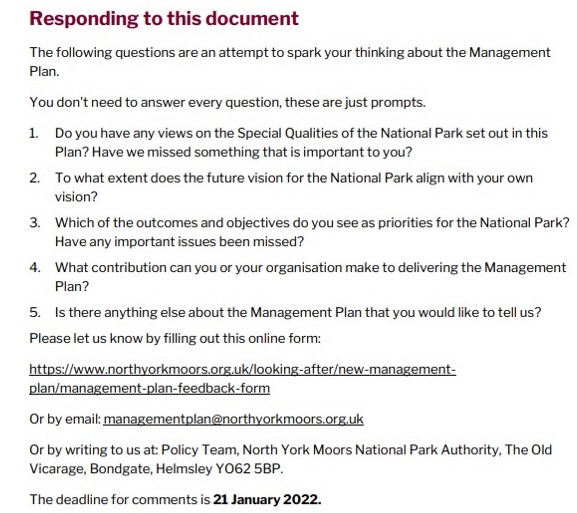
The Park Authority wants your views, whether you live in the Park or you are a visitor. Particularly, it wants to know whether it has ‘missed something that is important to you’:

If you share my concerns about ongoing raptor persecution in this National Park, and the unregulated mass release of non-native species for shooting, I’d encourage you to contact the NYMNPA and ask them to prioritise tackling these issues in the management plan. Contact details are shown in the image above.

Please note, the consultation closes this Friday (21st January 2022).

Thank you.

Leadhills Estate wants to keep details of its General Licence restriction appeal a secret

As many blog readers will know, the notorious Leadhills Estate, a grouse-shooting estate in South Lanarkshire that has been at the centre of police wildlife crime investigations at least 70 times since the early 2000s, is currently serving two General Licence restrictions imposed by NatureScot after ‘clear evidence’ of wildlife crime was provided to the statutory regulator by Police Scotland (see here and here).

For new blog readers, a General Licence restriction is a light-touch sanction for estates in Scotland where there is sufficient evidence of wildlife crime taking place but insufficient evidence to prosecute a specific individual. It’s not really a sanction at all though, because an estate can simply apply to NatureScot for ‘individual’ licences instead of a General Licence which allows them to continue the activities they were supposedly restricted from doing, just with a tiny bit of scrutiny attached (e.g. 1,000 birds were legally killed on a shooting estate despite being under a General Licence restriction, see here).

Nevertheless, a General Licence restriction is useful for campaigners for highlighting to the law makers that wildlife crime persists and further regulation/enforcement is therefore required.

So, back to Leadhills Estate. The reason why this grouse moor estate is currently serving an unprecedented double General Licence restriction is because of police reports relating to the illegal killing of a short-eared owl, two buzzards and three hen harriers that were ‘shot or caught in traps’ on Leadhills Estate in the last few years (see here), the discovery of banned poisons on the estate in May 2019 (see here), the alleged shooting of a(nother) short-eared owl by a masked gunman on a quad bike as witnessed by a local resident and his eight year old son in July 2020 (see here) and the discovery of yet another batch of banned poisons, also in July 2020 (here). A satellite-tagged hen harrier (Silver) also vanished in suspicious circumstances on the estate in May 2020 (here), and although NatureScot don’t consider missing satellite-tagged raptors as sufficient evidence for a General Licence restriction, the disappearance can be used as supportive evidence if further alleged offences are also being considered.

Incredibly, Leadhills Estate with its double General Licence restriction is STILL a member of the lobby group Scottish Land & Estates, which claims to have a ‘zero tolerance’ approach to raptor persecution. Hmm.

[Grouse moor on the Leadhills Estate. Photo by Ruth Tingay]

As you may recall, Leadhills Estate’s second General Licence restriction was announced by NatureScot in late September 2021 (here) and the estate was reported to be considering an appeal (here).

Having seen the estate’s previous (failed) appeal against its first General Licence restriction in 2019 (here), I was keen to see the arguments it would make for an appeal against a second restriction.

On 30th September 2021 I submitted an FoI to NatureScot to request copies of Leadhills Estate’s appeal.

On 3 November 2021 NatureScot responded as follows:

We have withheld a letter from an agent acting on behalf of Leadhills Estate, pending an appeal against NatureScot’s decision to restrict General Licence. This information is of a sensitive nature and disclosure into the public domain could prejudice the applicant’s right to a fair hearing’.

I didn’t see how public disclosure could possibly prejudice a hearing given that it’s all done in-house at NatureScot but fine, I could wait.

In December 2021 it was announced that Leadhills Estate had lost its appeal against the second General Licence restriction (here) so I wrote back to NatureScot on 3rd December as follows:

You told me in the letter dated 3 November 2021 that you were withholding a letter from an agent who was acting on behalf of Leadhills Estate, and the reason you gave for withholding it was that releasing it may prejudice the applicant’s right to a fair appeal. As the appeal process has now concluded and therefore the applicant’s right to a fair hearing cannot be affected, please can you send me the agent’s letter that was previously withheld‘.

Yesterday (5th January 2022) NatureScot responded to my latest FoI request, as follows:

We have completed our information searches, and we have identified eight documents comprising 126 pages relevant to your request. We shared a redacted version of these documents with the solicitors acting on behalf of Leadhills Estate, who have provided additional legal arguments as to why certain information should be withheld. We will need additional time to assess these arguments and, potentially, take further legal advice.

Regulation 7 of the EIRs allows public authorities to extend the time for compliance with requests for up to an additional 20 working days. This means we must respond to your information request by 3 February 2022 at the latest‘.

That’s interesting. Why might Leadhills Estate not want the details of its appeal to be made public? And what legal arguments might it use to block the transparency of the decision-making process of a statutory agency?

I guess we’ll find out on 3rd February.

UPDATE 23rd February 2022: NatureScot refuses to publish details of Leadhills Estate’s general licence restriction appeal (here)

“These crimes are being covered up”: RSPB Scotland speaks out as bird crime soars

Bird crime soared across the UK in 2020, and RSPB believes Scotland’s native birds of prey will continue to be persecuted, according to two new articles published yesterday in The Courier and The Press & Journal:

Birds of prey such as hawks, eagles, kites, buzzards, harriers, falcons and owls are protected by the Wildlife and Countryside Act 1981.

The RSPB’s annual report revealed that 2020 was the worst year on record for bird crime across the UK.

There were 137 known and confirmed incidents of birds of prey being killed, the highest number in 30 years.

This trend has continued in 2021, according to Ian Thomson, RSPB Scotland’s head of investigations.

He said: “Bird crime covers a whole manner of crimes against wild birds, but what is particularly of concern are those crimes that have an impact on the populations and ranges of a variety of species.”

According to Mr Thomson, bird crime, also known as raptor persecution, is particularly rife in the north-east, with the hen harrier population being a fraction of what it was 20 years ago.

He also explained that golden eagles are only occupying around a third of the breeding territories that they ought to; meanwhile, peregrines have largely disappeared from the uplands in the north-east.

Mr Thomson believes that these low population numbers are largely down to the persecution of birds of prey for the intense land management of grouse moors.

Birds of prey are at the top of the food chain and they hunt and eat grouse and pheasants.

In an attempt to maximise the number of game birds available for clients to shoot, grouse moor managers will eliminate any threats to their birds.

This can include burning patches of heather moorland and releasing clouds of smoke into the air, leaving medicated grit out in the open and hare baiting.

The National Golden Eagle Survey shows that across Scotland the population as a whole is doing well and that there are significant increases in the west where there are no grouse moors.

Mr Thomson said it is the east of Scotland where the populations are a fraction of what they should be.

Scientific reports show that the illegal persecution of golden eagles, hen harriers, red kites and peregrines are largely happening in areas managed for game bird shooting.

Unfortunately, these findings are largely happening in the middle of nowhere,” Mr Thomson said, “out of sight, out of mind, where witnesses are very far and few between.

But, occasionally, an incident occurs that is detected.

In 2020, about a week into lockdown when the entire population of the country was told to stay indoors or to exercise within five miles of your house, we had a young white-tailed eagle poisoned on a grouse moor in Strathdon, in an area with an appalling history of crimes against birds of prey going back 10-plus years.”

Mr Thomson explained there have been cases of birds of satellite-tagged birds disappearing under “suspicious circumstances”.

In March a golden eagle was illegally poisoned on the Invercauld Estate, a grouse moor in the Cairngorms.

Last year a satellite transmitter that had been fitted on a golden eagle was found at the side of a river.

It was wrapped in lead sheeting and thrown into the river where it lay for four years until a walker found it on the bank.

Mr Thomson said: “This is the efforts that people are going to cover up these crimes, they don’t want to be caught.

The problem is, as I say, these crimes are seldom witnessed; to actually get any idea of the scale of it we’re really depending on doing population studies.

We’re never going to find all the victims because, needless to say, if someone shoots a golden eagle they’re not going to leave it around for the RSPB or the police or a hillwalker to find.

These crimes are being covered up.”

The RSPB Scotland’s head of investigations explained that there are other factors that have impacted the populations of birds of prey.

He said that all birds face challenges “just surviving”, through natural mortality, starvation, and loss of habitat due to the intensification of land management or agriculture.

Because of this, populations are much lower than what would be ideal, and so deliberate and illegal killing is adding extra strain to the populations.

As well as being important for biodiversity, birds of prey are an attraction for tourists visiting Scotland.

People interested in photography travel from all over the world to capture Scottish wildlife, bringing millions to the economy.

Mr Thomson highlighted that, on the Isle of Mull, around £5 million a year goes into the island from people going to see white-tailed eagles.

The Scottish Government plans to introduce licensing to grouse moors, which Mr Thomson described as a “game-changer”.

He believes the loss of a license to shoot will introduce a significant deterrent to the estates that do persecute birds of prey.

There are places you wouldn’t want to take your dog for a walk in case it gets caught in a trap or eats something poisonous,” he said. “It’s not just birds that are dying, it’s people’s pets.

Perish the thought that some day some small child will come into contact with chemicals like this, it could have absolutely devastating effects.

It’s not only illegal but it’s reckless and indiscriminate.”

ENDS

Multi-agency raid following suspected raptor persecution in Humberside

Humberside Police led a multi-agency raid on 10th December 2021, executing a warrant in relation to suspected raptor persecution crimes after a number of dead buzzards were found with unusually high levels of rat poison.

The police were joined by staff from Natural England, National Wildlife Crime Unit and RSPB Investigation’s team.

The investigation is ongoing.

Photos from Humberside Police Rural Crime Team:

This is one of many multi-agency searches in the UK this year, all in response to raptor persecution crimes. On 18th January 2021 there was a raid in Suffolk (here), on 15th March there was a raid in Lincolnshire (see here), on 18th March a raid in Dorset (here), on 26th March a raid in Devon (see here), on 21st April a raid in Teesdale (here), on 2nd August a raid in Shropshire (here), on 12th August a raid in Herefordshire (here), on 14th September a raid in Norfolk (here), and a raid in Wales in October (here).

That’s a lot of raids in a relatively short space of time, in comparison to recent years. It’s testament to the agencies involved that they are being so proactive and working well together in a genuine multi-agency partnership, which is brilliant to see. It’s also testament to the fact that raptor persecution continues in many locations across the UK, despite what the game-shooting organisations would have us believe.

Whether these investigations result in prosecutions is another matter entirely (although we’ve already seen two successful convictions in recent weeks – here and here), but personally I’m delighted that at least this early part of the criminal justice process appears to have been re-energised after a long period of stagnation. Well done to all those involved.

Leadhills Estate loses appeal over extension to General Licence restriction

Regular blog readers will be well aware that the notorious Leadhills Estate, a grouse-shooting estate in South Lanarkshire that has been at the centre of police wildlife crime investigations at least 70 times since the early 2000s, is currently serving a three-year General Licence restriction based on what NatureScot described as ‘clear evidence’ of raptor persecution offences, including the illegal killing of a short-eared owl, two buzzards and three hen harriers that were ‘shot or caught in traps’ on Leadhills Estate since 1 January 2014 (see here) and the discovery of banned poisons on the estate in May 2019 (see here).

That original General Licence restriction was imposed on Leadhills Estate by NatureScot in November 2019 and is valid until November 2022.

A General Licence restriction can be imposed by NatureScot when there is sufficient evidence of wildlife crime on an estate but insufficient evidence for the police to charge a named individual. Leadhills Estate has denied all knowledge of any wildlife crime on its land.

[Chris Packham holds a dead hen harrier. This bird was caught by the leg in an illegally-set trap on the Leadhills Estate grouse moor in May 2019. The trap had been set next to the harrier’s nest and was hidden by moss. The harrier’s leg was almost severed. Unfortunately, extensive surgery could not save this bird. Photo by Ruth Tingay]

Since that original General Licence restriction was imposed on Leadhills Estate in November 2019, further alleged offences have been reported and are the subject of ongoing police investigations (see here) including the alleged shooting of a(nother) short-eared owl by a masked gunman on a quad bike as witnessed by a local resident and his eight year old son in July 2020 (see here) and the discovery of yet another batch of banned poisons, also in July 2020 (here). A satellite-tagged hen harrier (Silver) also vanished in suspicious circumstances on the estate in May 2020 (here), and although NatureScot don’t consider missing satellite-tagged raptors as sufficient evidence for a General Licence restriction, the disappearance can be used as supportive evidence if further alleged offences are also being considered.

In light of these latest allegations, in late September 2021 NatureScot announced that a further three-year General Licence restriction (an extension to the first one) was being imposed on Leadhills Estate (here), although it turned out that it wasn’t a three-year extension, as NatureScot had claimed, but was rather an eight-month extension because this latest restriction was running concurrently with the first restriction (see here).

In early October 2021 Leadhills Estate was reported to be considering appealing against the extended restriction (here) and shortly afterwards NatureScot removed the official notification of the extension from its website, a sure sign that an appeal was underway.

Roll on two months and the official notification has been re-posted on NatureScot’s website (here), which I take to mean that Leadhills Estate has lost its appeal and the General Licence restriction has been re-instated until it expires on 8th July 2023. This means that the estate cannot undertake certain activities (e.g. the operation of crow cage traps to kill hundreds of corvids) unless estate gamekeepers apply to NatureScot for an individual licence and NatureScot approves the application(s).

I’ll be monitoring this and will be keen to see whether individual licences are granted to gamekeepers on an estate that has had, in effect, a double General Licence restriction imposed after evidence of multiple wildlife crimes has been provided to NatureScot by Police Scotland.

Earlier this autumn I submitted an FoI to NatureScot to find out on what basis Leadhills Estate was appealing the General Licence restriction. The last time the estate appealed (against the original General Licence restriction), the grounds for appeal were laughable (see here) and were not accepted by NatureScot.

This time, NatureScot refused to release the details of the estate’s appeal because at the time the appeal was considered to be ‘live’ and it was thought that publication might affect the estate’s right to a fair hearing. I don’t know how it would have affected the estate’s appeal, given the appeal is heard in-house at NatureScot and cannot be influenced by outside commentary, but that was NatureScot’s decision.

That’s fine. Now the appeal has been dismissed and the restriction is in place, I have submitted another FoI to NatureScot and I expect the estate’s grounds for appeal to be released in to the public domain.

A response is due from NatureScot by the end of this month. I’ll keep you posted.

UPDATE 23 February 2022: NatureScot refuses to publish details of Leadhills Estate’s general licence restriction appeal (here)