Your opportunity to question Dorset Police Chief Constable on poisoned eagle case & breaches of FoI law

Here’s your opportunity to ask questions of Dorset Police Chief Constable Scott Chilton and the Dorset Police & Crime Commissioner David Sidwick about the Force’s failure to fully investigate the circumstances of a poisoned white-tailed eagle found dead on an unnamed shooting estate in January this year (see here).

The police investigation was closed prematurely, without even a search of the estate. This coincided with the Force’s award-winning wildlife crime officer going on long-term sick leave and, reportedly, being told that if/when she returned she’d no longer be leading the wildlife crime team (now rebranded as the Rural Team).

Both Dorset Police and the Dorset Police & Crime Commissioner are also in breach of the Freedom of Information Act by failing to respond to requests for information about their communication with local Conservative MP Chris ‘eagles aren’t welcome in Dorset’ Loder, who published a series of tweets berating Dorset Police for investigating the poisoning of the eagle.

Many thanks to Miles King (@MilesKing10) for sharing the details of a Facebook Live event, taking place this evening at 6.30pm, where the public is invited to put policing questions to Chief Constable Chilton and Commissioner Sidwick:

Unfortunately I can’t make this evening’s event but here are some questions you might like to ask:

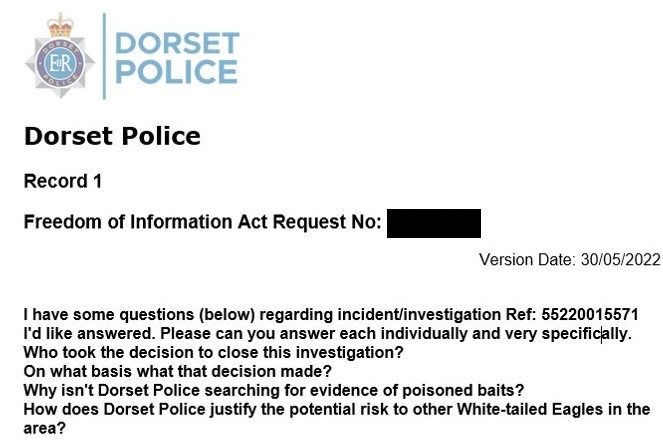
Who took the decision to close the investigation into the poisoned eagle without conducting a search of the estate?

On what basis was that decision made?

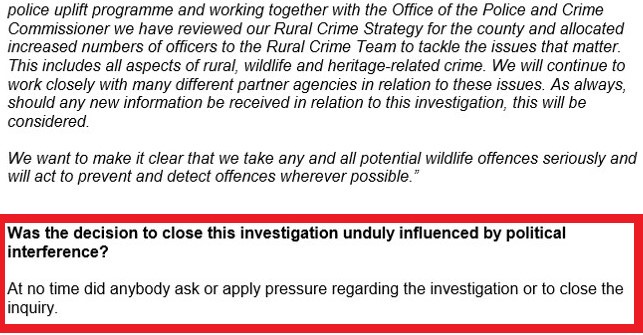
Was the decision unduly influenced by political interference?

Why isn’t Dorset Police searching for evidence of poisoned baits?

Why isn’t Dorset Police searching for evidence of unlawful poison storage?

Was this decision unduly influenced by political interference?

How does Dorset Police justify the potential risk to other white-tailed eagles in the area?

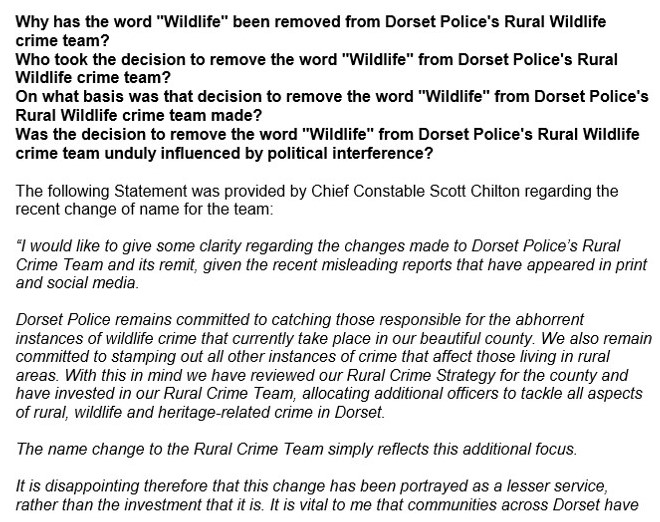
Why has the word ‘wildlife’ been removed from Dorset Police’s Rural Wildlife crime team?

Who took the decision to remove it?

On what basis was that decision made?

Was the decision unduly influenced by political interference?

Why has Dorset Police’s award-winning wildlife crime officer, Claire Dinsdale, been told she will no longer lead on wildlife crime when/if she returns from long-term sick leave?

Where are the toxicology results of all the other dead raptors found on estates in north Dorset in recent months, suspected of being poisoned?

Why is Dorset Police refusing to respond to FoI requests, in breach of legislation?

Why is the Dorset Police & Crime Commissioner refusing to respond to FoI requests, in breach of legislation?

Further breach of Freedom of Information Act by Dorset Police re: poisoned eagle

Yesterday I blogged about how Dorset Police and the Dorset Police & Crime Commissioner, David Sidwick, were both in breach of the Freedom of Information Act by failing to respond to Chris Packham’s FoI requests about the poisoned eagle incident within the statutory period of 20 working days (see here).

Today I can report a further breach of the Freedom of Information Act by Dorset Police in relation to my FoI requests, also relating to the poisoned eagle incident.

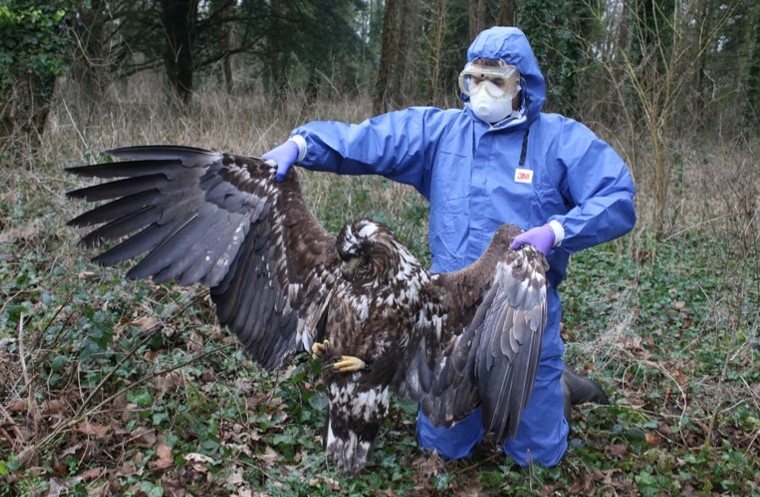
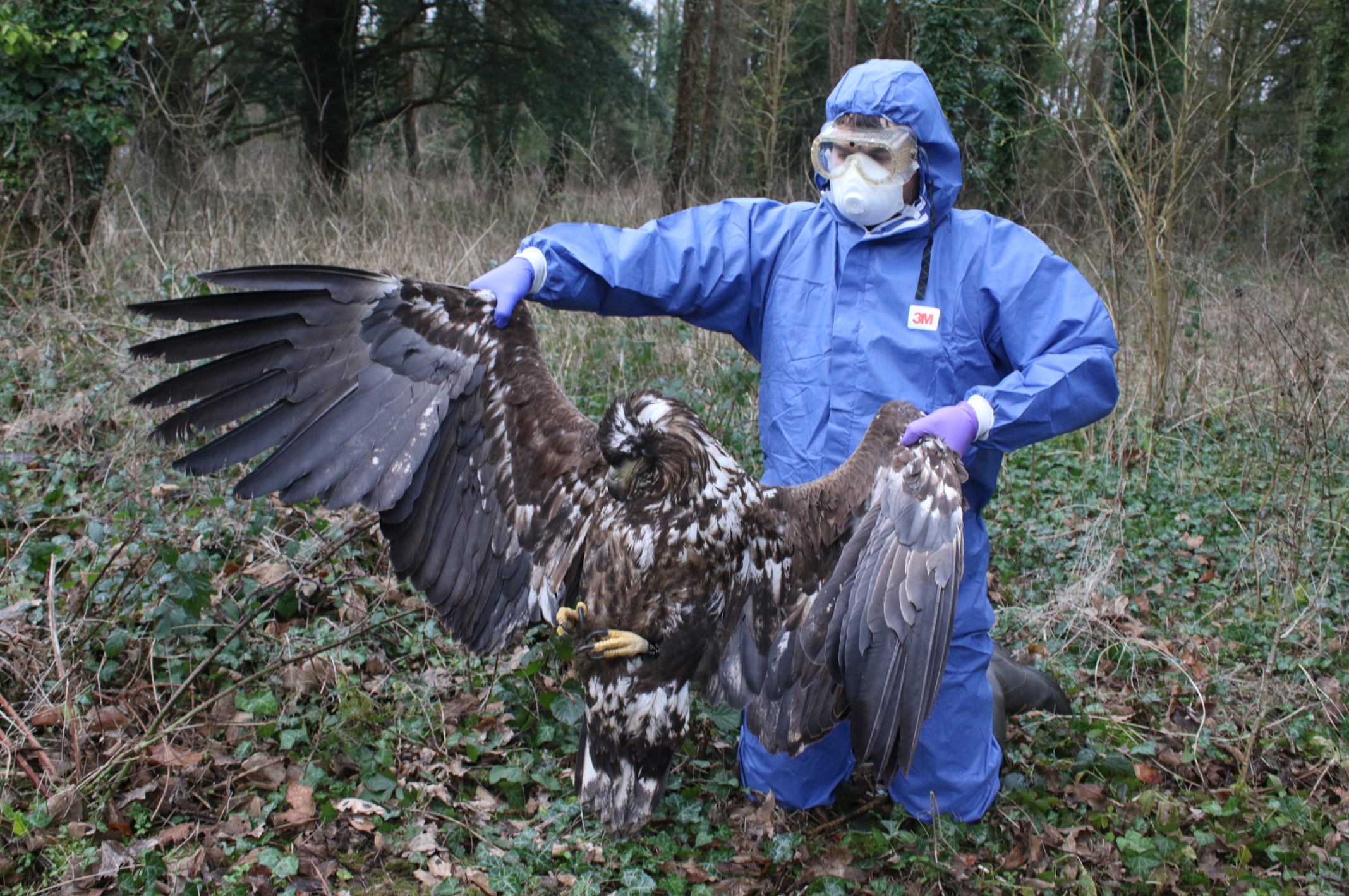
[The poisoned white-tailed eagle found dead on an unnamed shooting estate in North Dorset in January 2022. Photo by Dorset Police]

Regular blog readers may recall I submitted an FoI request to Dorset Police on 4th March 2022, asking for copies of all correspondence between Dorset Police and local Conservative MP Chris ‘eagles aren’t welcome in Dorset‘ Loder on the subjects of wildlife crime, police wildlife crime officers, and eagle reintroductions, from 1 January 2022 to date.

On 17th March 2022 Dorset Police tried to fob me off with a refusal notice with what is perhaps the most ludicrous excuse I’ve ever seen (see here to read it in full).

I appealed that decision and requested a review of it on 14th April 2022. According to the FoI Act, the public authority has another 20 working days in which to respond to that review request. Taking into account all the public bank holidays in April and May, Dorset Police should have responded no later than 17th May 2022.

It’s now 26th May 2022 and Dorset Police hasn’t responded. I have written to them, again, to remind them of their legal obligations. If their silence continues I will escalate my complaint.

Meanwhile, you may also recall that I’d sent a similar FoI request to the Dorset Police & Crime Commissioner (PCC) (David Sidwick) in early March. After a series of reminders to the PCC’s office (see here), I did finally get a response in late April 2022.

However, under scrutiny it became apparent that some of the correspondence I’d requested to see between Chris Loder MP and the PCC, David Sidwick, was missing from the bundle of information I received (see here).

So I wrote back to the PCC and asked them to forward ALL the correspondence, not just the bits they were happy for me to see.

That response was due back next Monday (30th May 2022) but I’m pleased to say it has arrived early and is now sitting in my inbox.

I’ve had a quick skim-read and it’s immediately obvious why ‘someone’ might not have wanted me to see it. I don’t have time to blog about that right now but will come back to it shortly…

UPDATE 16.00hrs: There’s quite a lot going on behind the scenes. For strategic reasons, I won’t be blogging further on this FoI response from the PCC until later next week. I’m sorry I can’t explain why right now but it will hopefully become apparent (and in a good way) next week. Thanks for your patience.

Dorset Police and the PCC in breach of Freedom of Information Act by failing to respond to Chris Packham’s request for info on poisoned eagle

In April 2022, Chris Packham submitted two separate Freedom of Information requests to Dorset Police and to the Dorset Police & Crime Commissioner (PCC) David Sidwick, asking for copies of all correspondence between Dorset Conservative MP Chris ‘Eagles are not welcome in Dorset‘ Loder and various named senior police officers and the Dorset Police & Crime Commissioner, relating to the poisoned eagle incident and wildlife crime in general (Chris’s two FoI requests can be read here).

Chris submitted his Freedom of Information requests on 18th April 2022, which were acknowledged by both Dorset Police and the Dorset PCC within a couple of days.

Dorset Police and the PCC, as public authorities, ‘must respond to requests promptly, and by the twentieth working day following date of receipt of the request‘, according to Section 10 of the FoI Act.

Taking in to account a number of public Bank Holidays in April and May, the latest date by which Dorset Police and the PCC needed to respond was 17th May 2022. If Dorset Police and/or the PCC needed more time to fulfil the request (they are permitted a further 20 working days in exceptional circumstances), they should have told Chris that within the first 20 working days.

Chris has written again to Dorset Police and to the PCC to ask them to comply with the FoI Act and respond by return. So far, they have remained silent. If this continues, Chris will escalate his complaint through the relevant authorities.

More on this shortly.

UPDATE 26th May 2022: Further breach of Freedom of Information Act by Dorset Police re: poisoned eagle (here)

Wildlife Crime Working Group seeks (& receives) assurance from Sussex Police re: poisoned eagle investigation

In February this year, I blogged about the suspicious deaths of two white-tailed eagles on two separate game-shooting estates – one in Dorset and the other one rumoured to be in West Sussex (see here).

Both eagles were from the Isle of Wight Reintroduction Project – a privately-funded but Government-backed five-year project bringing young sea eagles from Scotland and releasing them on the Isle of Wight to re-establish this species in part of its former range.

The dead eagle found poisoned on an unnamed shooting estate in Dorset remains an ongoing issue of concern, not least because Dorset Police chose to close the investigation prematurely without a proper explanation (see here, and more on that case shortly).

The dead eagle found poisoned on an unnamed shooting estate in West Sussex has received less attention, although in April I revealed this eagle had been poisoned with Bendiocarb and that toxicology results from a dead dog found on the same shooting estate were pending (see here).

The reason this eagle poisoning case has received less attention is simply down to the fact that Sussex Police has failed to publicise the crime, even though it took place seven months ago (Oct 2021)! However, I was pleased to see The Independent picked up the story from this blog, as did The Telegraph, so it did make the national news but we’ve heard nothing more from Sussex Police.

To ensure that Sussex Police doesn’t ‘do a Dorset Police’ and drop this investigation without an explanation, Wildlife & Countryside LINK’s Wildlife Crime Working Group, England’s largest coalition of organisations working to tackle wildlife crime, has written to the Chief Constable of Sussex Police seeking assurance to that effect.

Here’s the letter that was sent last week:

To her absolute credit, Chief Constable Jo Shiner phoned LINK that afternoon to reassure the Wildlife Crime Working Group that the Sussex investigation is very much ongoing and that she understands the need for possible raptor persecution crimes to be looked at closely. I’m told, by people who know these things, that a fast and personal response like this is unheard of.

Compare and contrast Jo Shiner’s response to that of the Chief Constable of Dorset Police, who had also received a letter from LINK (see here) seeking an explanation about the Force’s failure to investigate the poisoned eagle found dead in Dorset. He has yet to reply.

I’m really pleased to see LINK’s Wildlife Crime Working Group applying pressure in these cases to ensure they’re taken seriously by the respective police forces (not that that should even be needed), but should it really be down to wildlife and conservation NGOs to do this? Surely this is what our statutory agencies should be doing? Wilful blindness, writ large, again.

Wildlife Crime Working Group seeks explanation from Dorset Police about failure to investigate poisoned eagle incident

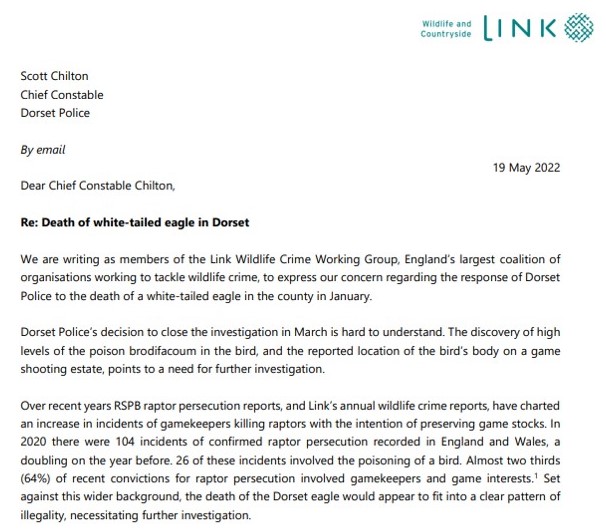
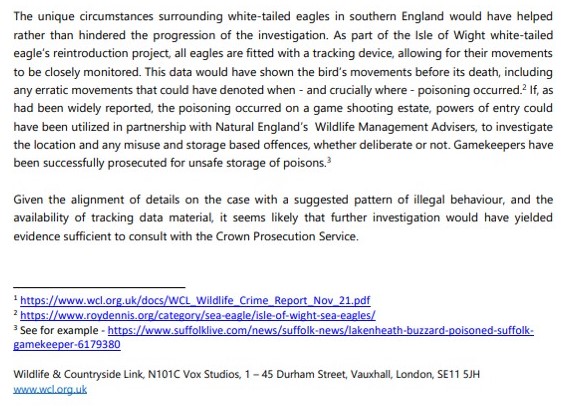
Wildlife & Countryside LINK’s Wildlife Crime Working Group, England’s largest coalition of organisations working to tackle wildlife crime, has written to the Chief Constable of Dorset Police with concerns about the premature decision to terminate the police investigation into the poisoned eagle found dead on a game-shooting estate in January.

For new blog readers, this young white-tailed eagle, one of the reintroduced birds from the Isle of Wight, was found dead in January on an unnamed estate and a post-mortem revealed its liver contained the rodenticide Brodifacoum, at an exceptionally high concentration (x 7 the amount needed to kill a bird of this size). This indicates either (a) misuse of the product (e.g. failure to adhere to the strict terms of use) or (b) abuse of the product (e.g. the deliberate placing of a bait containing an exceptionally high concentration of poison). Either way, it’s an offence and thus requires a full investigation.

Unbelievably, instead of undertaking a follow-up search of the estate, Dorset Police chose to close the investigation abruptly without adequate explanation. This decision came shortly after local Conservative MP Chris Loder made statements on Twitter about how the police should be focusing on other issues and not on suspected wildlife crime on game-shooting estates. Mr Loder’s entry on the Parliamentary Register of Interests reveals substantial donations to his election campaign by notable game-shooting estates in Dorset.

Since the decision to close the investigation, Dorset Police has attempted to dodge Freedom of Information requests about this incident (see here and here) and responses are now overdue. More on that tomorrow.

Here is the letter sent today by the LINK Wildlife Crime Working Group to the Chief Constable of Dorset Police, Scott Chilton:

Note, the deadline given by the Wildlife Crime Working Group for the police response is 1st August, two and half months from now. That’s just because it’s the editorial deadline for the Group’s annual report, which will feature this failed investigation as an example of how some wildlife crime investigations are still well below the standard required, even high profile cases of national significance such as this one.

Well done to Wildlife & Countryside LINK and especially its Wildlife Crime Working Group for pursuing an explanation about this disgraceful case. But it really shouldn’t be left to environmental NGOs to have to do this – where is the National Wildlife Crime Unit? Where is DEFRA??

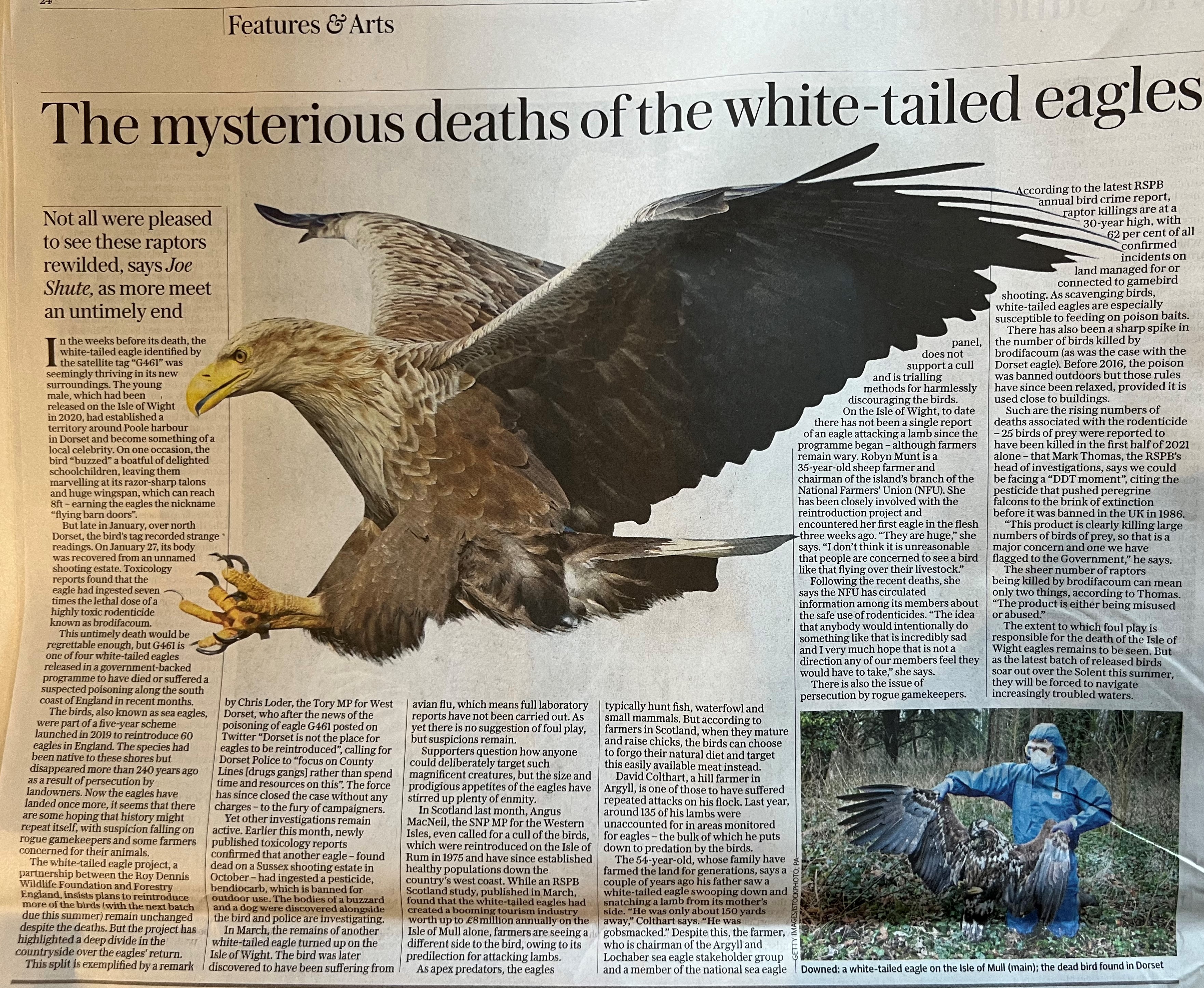
Poisoned eagles in south of England feature in The Telegraph

The news that white-tailed eagles are being poisoned in southern England is still making the headlines, and rightly so.

The Telegraph included a feature article on Saturday and, considering the paper’s typical demographic, it was pretty good, even though the deaths of these eagles on game-shooting estates in Dorset and Sussex is anything but ‘mysterious’. The article was well-researched although it didn’t provide us with any new information about either incident.

This news story just won’t go away.

Tomorrow is the deadline for Dorset Police to respond to my challenge of their refusal to provide the details of correspondence between them and Conservative MP Chris Loder, which I’d asked for as part of a Freedom of Information request back in March. As you may recall, they tried to fob me off by claiming my request would exceed the statutory 18 hours they’re permitted to pull together such information, because they’d need to ask all 2,500 staff members (that would include mechanics, accountants, personal safety trainers etc!) to check their emails for correspondence with Mr Loder. It was a ludicrous excuse, made, in my opinion, to avoid revealing any potentially compromising correspondence.

I look forward to hearing from them tomorrow.

Email correspondence between Chris Loder MP & Dorset Police & Crime Commissioner re: poisoned eagle

After a long delay and several reminder emails, I’ve finally received a response to my Freedom of Information request from the office of the Dorset Police & Crime Commissioner (PCC), David Sidwick.

If you recall, in early March I’d asked for copies of all correspondence between the PCC and Chris Loder MP in relation to the (mis)handling of the police investigation into the poisoned white-tailed eagle found dead on a shooting estate in North Dorset in January 2022.

I was interested in finding out whether Chris Loder MP had interfered with / influenced Dorset Police’s decision to pull the plug on the investigation before a search had even taken place, given his outspoken objections to the investigation when it was still active.

You may also recall I’d asked for the same information in another Freedom of Information request to Dorset Police, which they have refused to answer. Their explanation for this refusal had zero credibility so I’ve asked for a formal review of their decision – I’m awaiting a response to that request.

The FoI response to me from the PCC’s office is here:

So there was correspondence between the two ‘good chums‘, as expected, and you can see Chris Loder’s exasperation at not receiving information to which he appeared to feel entitled.

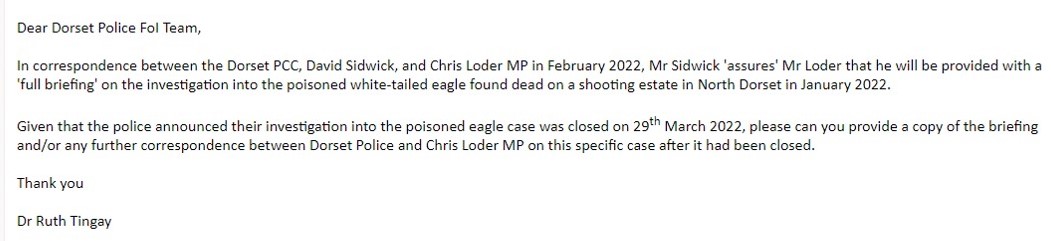
I note with interest David Sidwick’s assurance to Chris Loder that he will receive ” a full briefing” after the investigation has closed. Given that Dorset Police closed the investigation (prematurely) on 29th March, exactly one month ago, I wonder whether that briefing to Chris Loder has now been provided? This was beyond the dates/scope of my original FoI request but it will be covered by Chris Packham’s later FoI request so I look forward to seeing what that briefing says.

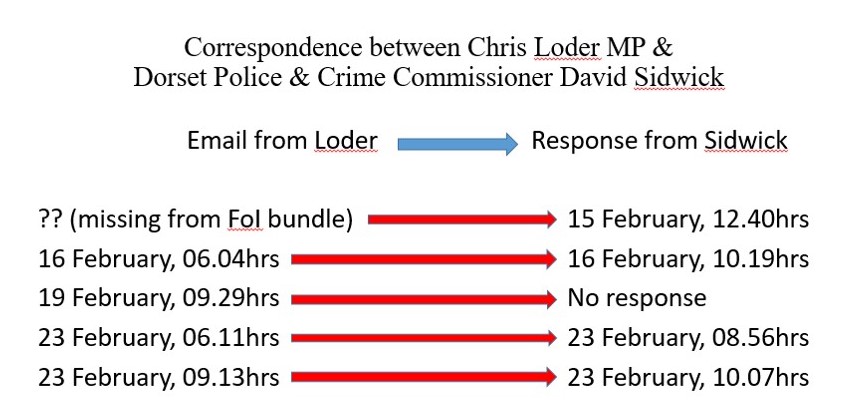
Meanwhile, back to the FoI response sent to me from the PCC’s office, above. The eagle-eyed amongst you might have picked up that there appears to be some correspondence ‘missing’ from the bundle I’ve been sent:

That very first email from David Sidwick to Chris Loder (dated 15th February) appears to be a response to correspondence from Loder (Sidwick’s opening words are, ‘As requested…’) but Loder’s ‘request’ has not been provided in full in my FoI bundle. There are parts of Loder’s request incorporated in Sidwick’s reply, but the original, full email from Loder is missing.

In the same email, Sidwick also includes a line that appears to be taken from Loder’s (missing) email:

Presumably from Loder: “Could you also help with the earlier question about the name of the rural crime team? Rural Crime Team / Rural Crime Wildlife & Heritage Team

Response from Sidwick: “RCT is the form preferred and the long version will be dropped“.

Nowhere in this bundle is there a copy of the “earlier question” from Loder to Sidwick about the rebranding of the Rural Crime Team.

I have written back to the PCC’s office and asked them to check for these missing pieces of correspondence.

Another dead buzzard in Dorset – Police warn public of suspected poisoned baits

Yet another dead buzzard has been found in North Dorset.

Whilst the cause of death has yet to be ascertained (presumably the carcass has been sent for post mortem), yesterday PC Rob Hammond warned the public to keep their dogs on leads to avoid the risk of them coming into contact with potential poisoned baits.

Well done to PC Hammond for putting out this timely warning. Even though poisoning has not yet been confirmed, the potential risk to the public and their dogs is high so he’s done exactly the right thing.

Dorset is fast becoming quite the hotspot for raptor persecution. I’ve been looking through some reports from the last few years and have found the following incidents of raptor persecution recorded in the county:

May 2018: Buzzard found shot dead (here).

May 2018: Suspicious deaths of two barn owls and several more buzzards (here).

March 2020: Disturbance of nesting peregrines (here).

April 2020: Several buzzards were found dead within close proximity to each other in the Ashmore Wood area near Blandford. These birds were sent for testing and enquiries remain ongoing (here).

August 2020: Two buzzards, one dead, were found near the body of a rabbit. An owl and a further two buzzards were also found. Analysis has confirmed Brodifacoum in the buzzard which is likely to have caused the death. The second buzzard and the owl had background residues and the analysis on the rabbit was negative.

September 2020: A dead buzzard was found on a bridleway, it had been shot.

November 2020: A dead red kite and rat were found near a footpath. Analysis has confirmed Bendiocarb in the stomach contents of the red kite and in pots removed from a vehicle and a sachet in a shed, which is likely to be the cause of death. No residues were found in the rat.

February 2021: A buzzard and a red kite were found in a wooded area. Analysis has confirmed Brodifacoum in the liver of the red kite which will have contributed to its death, the levels of Brodifacoum in the buzzard are borderline and uncertain if the exposure contributed to its death. 

March 2021: A multi-agency raid was carried out on a shooting estate in North Dorset. A number of dead birds of prey and several pesticides, including banned substances, were located at the premises. A firearm was also recovered (here).

January 2022: A dead white-tailed eagle was found poisoned on a shooting estate in North Dorset. The post mortem found its liver contained 7 x lethal dose of rodenticide Brodifacoum. Inexplicably, Dorset Police closed the investigation before conducting a search (here).

February 2022: Another white-tailed eagle was suspected to have been poisoned on another shooting estate in North Dorset. This one survived (here).

February 2022: A dead buzzard and a dead red kite are found dead on a shooting estate in North Dorset, suspected poisoned. Toxicology results awaited (here).

April 2022: A dead buzzard found dead in the Ashmore area. Toxicology results awaited.

It’s pretty clear that Dorset has a raptor persecution issue and I understand there are several more investigations that have yet to be reported in the public domain. Given these incidents, and more, it’s astonishing that the local MP, Chris Loder, thinks the police shouldn’t ‘waste resources’ on investigating wildlife crimes.

It’s even more astounding that Dorset Police shut down the poisoned eagle investigation, without conducting a search, and continue to refuse any explanation for their decision and yet still the top brass claim to be taking raptor persecution ‘seriously’, not that anyone believes them anymore.

It’s heartening then to see on-the-ground officers like PC Rob Hammond, trying to do the right thing. I wonder how long it’ll be before he’s told to drop the case and/or stop investigating wildlife crime, as has his colleague, PC Claire Dinsdale?

Dorset Police Chief Constable and the Police & Crime Commissioner on a futile damage limitation exercise

Right, moving away from this morning’s news about the illegally poisoned white-tailed eagle in Sussex, we’re back on the poisoned white-tailed eagle found dead in Dorset (it’s hard to keep up, I know).

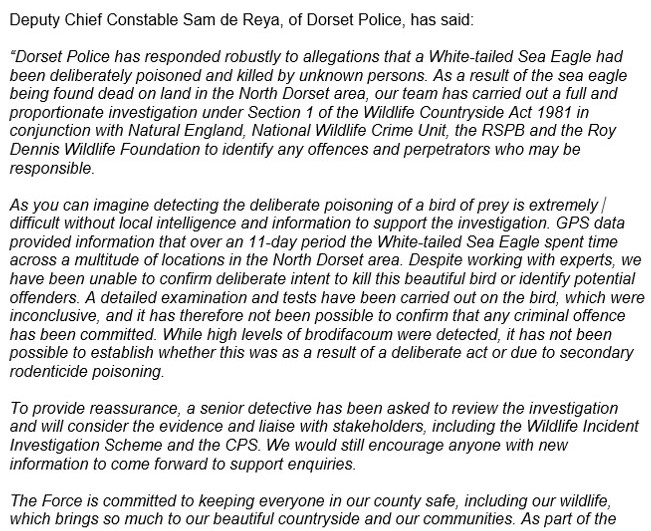
This afternoon, Dorset Police & Crime Commissioner (PCC) David Sidwick, and Dorset Police Chief Constable Scott Chilton, have both published statements in response to all the media attention brought to their doors by the failure of Dorset Police to fully investigate the circumstances of the poisoned eagle found dead on a shooting estate after it had ingested 7 x the lethal dose of a toxic rodenticide.

Here is what has appeared on the PCC’s website:

I’m sorry to say that I don’t see anything here other than a damage limitation exercise and an attempt to close down the public and media scrutiny to which both the police and the PCC’s office have been subjected (and rightly so, in my opinion).

It’s meaningless to talk about how ‘Dorset police continues to take any and all potential wildlife offences seriously and will act to prevent and detect offences wherever possible‘ when the investigation into the poisoned eagle was ended so abruptly and prematurely.

Why was the multi-agency search of the estate, planned for by Dorset Police’s award-winning wildlife crime officer, Claire Dinsdale, called off at the last minute? There still hasn’t been an explanation for that and neither of these two statements comes close to addressing it.

And why was that award-winning wildlife crime officer, Claire Dinsdale, removed from her post as wildlife crime lead?

And why was the word ‘wildlife’ removed from the title of the Rural Crime team if the team is still tackling wildlife crime?

There’s still more to come out in the public domain about this poisoned eagle case. Legal restrictions prevent me from publishing it right now but I’m hopeful that within a few weeks I’ll be able to do so once the wheels of justice have turned a bit further. And once this information is out, the public will be even more angry than they already are about the premature closing of the investigation. And I reckon Dorset Police know that. The PCC might not be aware of it but rest assured, he soon will be.

Meanwhile, this morning I finally received a response to my Freedom of Information request from the Dorset PCC’s office. I’ll be blogging about that very soon.

White-tailed eagle poisoned with banned pesticide on a game-shooting estate in West Sussex

In February this year, I blogged about the suspicious deaths of two white-tailed eagles on two separate game-shooting estates – one in Dorset and the other one rumoured to be in West Sussex (see here).

Both eagles were from the Isle of Wight Reintroduction Project – a Government-backed five-year project bringing young sea eagles from Scotland and releasing them on the Isle of Wight to re-establish this species in part of its former range.

The dead eagle found on a shooting estate in Dorset in January has barely been out of the news since then, not least because even though a post mortem found its liver contained 7 x the lethal dose of the rodenticide Brodifacoum, Dorset Police decided to shut down the investigation prematurely for reasons which are still to be established (see here).

The eagle rumoured to have been found dead on a shooting estate in West Sussex last October (2021) has received less media attention because, inexplicably, Sussex Police have failed to make a public statement about it.

Today, I can report that this white-tailed eagle was poisoned with the banned pesticide Bendiocarb, according to a recently published laboratory report. It reads:

A dog died and a sea eagle and buzzard were found dead. Analysis has confirmed bendiocarb in the stomach contents of the sea eagle which is an abuse of the product. Negative analysis for the buzzard‘.

Until recently, a product containing 80% Bendiocarb was available for registered use in England (it’s been banned in Scotland since 2005 and it’s so toxic that even possession of this pesticide is considered a serious offence there). However, approval for this particular product was withdrawn in England in December 2020. Another product containing a much lower concentration of Bendiocarb (1.25%) was re-approved for use in England in 2019 but with a significant caveat – it was for indoor use only.

So unless this sea eagle broke into secure premises, opened a few sachets with its nail scissors and scoffed the contents, it seems pretty likely that a serious wildlife crime has taken place, probably including the use of poisoned bait(s) laced with Bendiocarb.

The report mentions that the buzzard tested negative for Bendiocarb poisoning but it’s interesting that no results are provided for the dog. I wonder why that is?

The immediate questions, of course, are why Sussex Police have failed, after six months, to make a statement about such a high profile criminal investigation (I assume there is an investigation, but given what’s been going on in Dorset, then who knows?) and why Sussex Police have failed to warn the public that a dangerously toxic poison is in use in a particular area where the public may have access? (The banned product containing 80% Bendiocarb can have fatal consequences for humans [adults and children] if the product is swallowed or inhaled. You can expect the same result for a pet dog).

If you’re a West Sussex resident, may I suggest you contact your MP and ask what the hell is going on? Why are you being exposed to such risk without any public warning being issued? The police are supposed to be there to protect the public, not the poisoners.

If you’re a responsible game-shooter thinking about booking to attend a pheasant or partridge shoot in West Sussex this coming season, I hope you’ll carry out due diligence and boycott any estate involved.

UPDATE 16.50hrs: The Independent has picked up on this blog and published an article (here)

UPDATE 25th May 2022: Wildlife Crime Working Group seeks (& receives) assurance from Sussex Police re: poisoned eagle investigation (here)