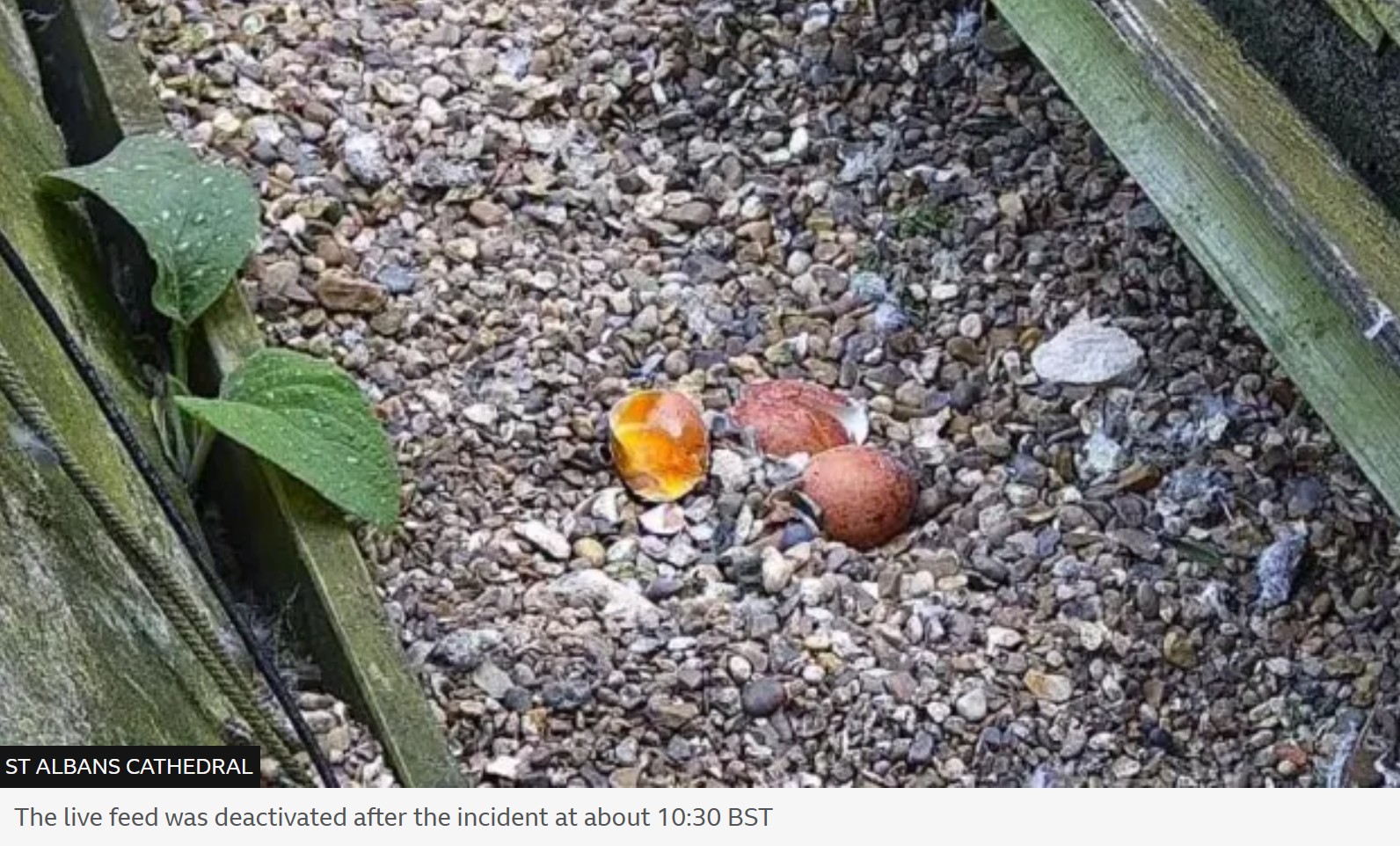
Peregrine eggs smashed at St Albans Cathedral as person seen walking over them on livestream camera

An individual is ‘helping police with their inquiries‘ after a person was seen on livestream camera deliberately walking over three Peregrine falcon eggs laid by the resident breeding pair at St Albans Cathedral in Hertfordshire yesterday.

The livestream feed, run in partnership by St Albans Cathedral and Herts and Middlesex Wildlife Trust, has been taken off air.

A livestream viewer said:

The female bird was sitting on the eggs and all of a sudden there was a noise that spooked her, it sounded like a door opening.

Then I saw a man’s leg enter in front of the camera. He stood there for 30 or 40 seconds before literally walking across – he didn’t stamp but he stepped on the eggs and just kept walking“.

More details on BBC News website here.

UPDATE 5 May 2025: ‘Investigation still ongoing’ into person seen trampling Peregrine eggs at St Albans Cathedral (here).

DEFRA endorses Natural England’s recommendations for a presumption AGAINST the issuing of licences for taking wild birds of prey for falconry

Some good news for birds of prey! DEFRA has endorsed Natural England’s recommendations for a presumption AGAINST the issuing of licences for taking birds of prey from the wild for falconry and aviculture.

A licensing policy review was undertaken by Natural England following the furore in 2020 when NE issued licenses for the removal of young peregrines from the wild for a purported captive-breeding programme.

That news had generated heated arguments both for and against the licences, as reported on Mark Avery’s blog (e.g. see herehere and here). In 2022 NE said that although licences had been issued in 2020, ‘the licenses expired earlier this year with no chicks having been taken‘. It’s not clear why the licences weren’t used.

Young peregrines on a nest ledge. Photo by Ruth Tingay (taken under licence)

In 2022, licences to take birds of prey from the wild were temporarily suspended whilst NE began a fairly comprehensive licensing policy review which included a public consultation with wide stakeholder engagement from the falconry and non-falconry communities. Natural England has published links to various reports resulting from the consultation process, here.

The species most frequently mentioned by those wanting to take birds from the wild for falconry purposes were peregrine (58%), sparrowhawk (58%), merlin (22%) and goshawk (10%). One individual falconer respondent mentioned buzzard and golden eagle. However, many falconer and non-falconer respondents considered the latter two species to be unsuitable for inclusion in a future wild take licensing regime. In the case of golden eagles, it was stated that this was due to their rarity in England. Many falconers also considered merlin to be unsuitable for inclusion due to their rarity.

The consultation process included detailed evidence from the National Wildlife Crime Unit (NWCU) about the increase in the legal and illegal trade in peregrines, both for the domestic and international market, and how licensed ‘wild take’ may add to the problem.

Many of you will be familiar with Operation Tantallon, the recent successful multi-agency investigation leading to the subsequent prosecution and conviction of two peregrine launderers in south Scotland who were selling wild Scottish peregrines to wealthy falconers in the Middle East (see here).

The scale of their offending was considerable and I heard at a wildlife crime conference earlier this week that many more cases are currently under investigation as a result of Operation Tantallon.

In October 2023 Natural England’s ‘wild-take’ licensing review came to an end and drew the following conclusions:

  • Wild take is not integral to the present-day practice of falconry or aviculture in England. Few modern falconry texts define falconry as involving the use of ‘wild’ birds of prey and there are limited historical references to the cultural importance of wild take or of  wild-taken birds to British falconers. No clear consensus exists within the falconry community or in the available falconry literature regarding the cultural importance of wild take as a core aspect of falconry practice.
  • Despite rapid growth in the popularity of falconry in recent decades, the available evidence suggests that there are sufficient birds of the relevant species readily available – via captive populations – to meet current demand. There is no evidence of significant inbreeding risks in these captive populations and captive-bred birds are generally considered to perform to a similar standard as wild birds when used for falconry purposes.
  • Most non-falconers are opposed to licenced wild take on ethical grounds and have concerns regarding the potential impacts of falconry and wild take on the conservation and welfare of the species affected. Both falconers and non-falconers are supportive of additional measures to ensure that individuals keeping birds of prey have suitable experience in caring for such birds.
  • Few respondents to the public call for evidence expressed a desire to gain commercially from wild take. However, risks identified relating to the illegal trade in birds of prey nevertheless suggest a need for strict controls on commercial use of such birds alongside improved traceability and other measures to be taken forwards by the responsible agencies. Difficulties in tracing individual birds under current arrangements mean there is a credible risk that the offspring of a wild bird taken under licence could be illegally laundered via commercial breeding operations into the domestic and international trade.

On the basis of the above conclusions, Natural England put forward the following recommendations to DEFRA in late 2023 and advised that a clear policy statement should be published for England setting out the following:

  • That licences permitting the wild take of native birds of prey for falconry or avicultural purposes should not be issued other than in exceptional circumstances;
  • That the commercial use of native birds of prey taken from the wild under a licence issued for falconry or avicultural purposes – and any offspring of such birds –should not be permitted other than in exceptional circumstances; and,
  • That the power to grant licences remains on statute, with the adopted policy (as above) subject to future evidence-based review as required.

These are the recommendations that DEFRA has now endorsed and has implemented the policy of a presumption AGAINST issuing licences to take wild birds of prey for falconry and aviculture.

Natural England has stated that, ‘Whilst the power to grant licences will remain on statute, Defra ministers support the view that licences should not be issued, other than in exceptional circumstances. No evidence was provided during the review process that would support the issuing of licences for any specific exceptional circumstances at the present time‘.

There’s a useful Natural England blog on the subject, here.

For those interested in Natural England’s policy review, it can be read/downloaded here:

From my personal point of view, this is an excellent decision and is good news for birds of prey in England.

I’ve previously outlined my reasons, here.

50,000 people support the Northern Ireland Raptor Study Group’s petition to ban possession of dangerous, raptor-killing pesticides

Many, many thanks to all of you who signed the Northern Ireland Raptor Study Group’s (NIRSG) petition calling for a ban on the possession of dangerous, raptor-killing pesticides.

The petition has just passed its target of 50,000 signatures and the NIRSG has issued the following press release:

The NIRSG held a recent Raptor Conference which provided incredible insights into a range of topics locally and globally. Many of the talks raised a consistent theme of targeted persecution of birds of prey. Not least amongst these was the on-going issue in Northern Ireland of the Possession of Dangerous pesticides.

Some of the NIRSG 2025 conference attendees supporting the call for a ban on dangerous, raptor-killing pesticides. Photo by Marc Ruddock

The NIRSG highlighted that 63 raptors have been killed between 2009 and 2023 with a range of poisons, dominated by Carbofuran which has been banned for nearly 25 years. There have been at least 30 buzzards, 16 peregrine falcons, 13 red kites, 3 white tailed eagles and 1 golden eagle all poisoned in this time frame.

This evidence is collated by the Partnership for Action Against Wildlife Crime in Northern Ireland (PAW NI) and published in raptor persecution reports, which include ‘hotspots’ of illegal killing of our native birds of prey. These reports are publicly available on the PAWNI webpage available here and also aggregated in the RSPB Bird Crime reports available here.

In 2011, the wildlife legislation in Northern Ireland was strengthened, resulting in increased sentences of £5,000 fines (per offence) and up to 6 months imprisonment. The updated laws included a provision to ban the possession of prescribed ingredients under “Section 15B Possession of pesticides harmful to wildlife” of the Wildlife (Northern Ireland) Order 1985 as amended.

As part of that legislation there should have been an attached Order listing the banned chemicals. That list has never been created. Wildlife has continued to be poisoned by these dangerous and banned substances.

The legislation states in Section 15B Part 2: “A prescribed ingredient is one which is prescribed for the purposes of this Article by an order made by the Department; but the Department may not make an order under this Article unless it is satisfied that it is necessary or expedient to do so in the interests of protecting wild birds or wild animals from harm”. [Emphasis added by NIRSG]

There is significant evidence of continued harm from banned pesticides to birds of prey, based on robust post-mortem and laboratory results, which has been published in many reports. We believe it is indeed expedient for Minister Andrew to implement this Order to protect our birds of prey from harm. 50,000 people agree with us. Thank you to everyone who has supported the petition and helped give a voice to our wildlife.

The NIRSG will be seeking a meeting with Minister Andrew Muir to present the petition now that it has surpassed 50,000 signatures.   

ENDS

NatureScot fails to make any compliance checks on use of new grouse moor licences

As many of you will be aware, the 2024 grouse shooting season in Scotland (12 Aug – 10 Dec 2024) saw the use of grouse moor licences for the first time ever, introduced by the Wildlife Management & Muirburn (Scotland) Act 2024 passed by the Scottish Parliament in March 2024.

For new readers, this Act was introduced as the Scottish Government’s response to the continued widespread illegal killing of birds of prey on grouse moors. It works on the basis that all red grouse shooting must now be licensed in Scotland under a section 16AA licence and if, on the civil burden of proof (i.e. on the balance of probability) sufficient evidence is found that the licence has been breached (including evidence of illegal raptor persecution), the licence can be withdrawn as a sanction, preventing the shooting of red grouse on a particular estate for a period of up to five years.

The licences have already been weakened significantly by NatureScot after a legal threat from the game-shooting industry (see here) and I’ll be writing more about that, probably later this week.

Red grouse photo by Pete Walkden

As part of the new grouse moor licensing scheme, NatureScot published a Code of Practice for Grouse Moor Management (also known as the Grouse Code) which sets out the legal requirements associated with managing land for killing and/or taking red grouse.

The Wildlife Management & Muirburn (Scotland) Act 2024 requires that a licence holder comply with the Grouse Code. Non-adherence to the Grouse Code could result in a licensing sanction and/or suspension or revocation. Here is the Grouse Code:

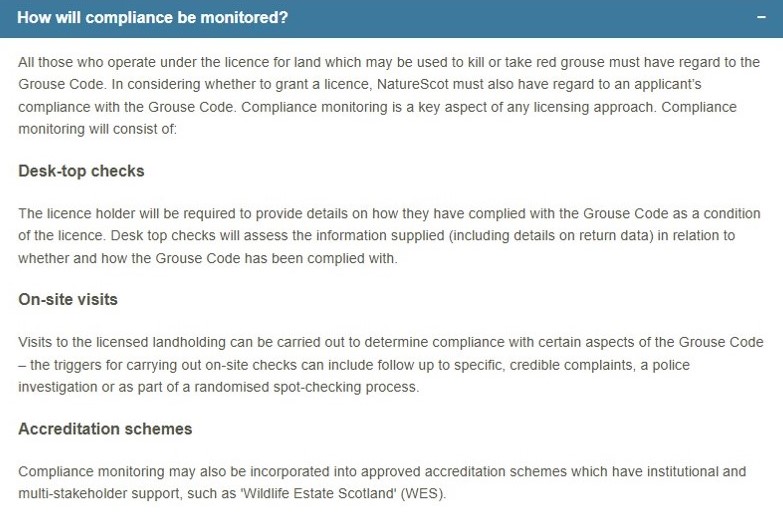
You’ll note on pages 2-3 of the Grouse Code that it includes a section on compliance monitoring.

Stating the obvious, NatureScot says, ‘Compliance monitoring is a key aspect of any licensing approach‘ and then outlines the types of compliance monitoring checks it says it will conduct:

Sounds reassuringly comprehensive, doesn’t it?

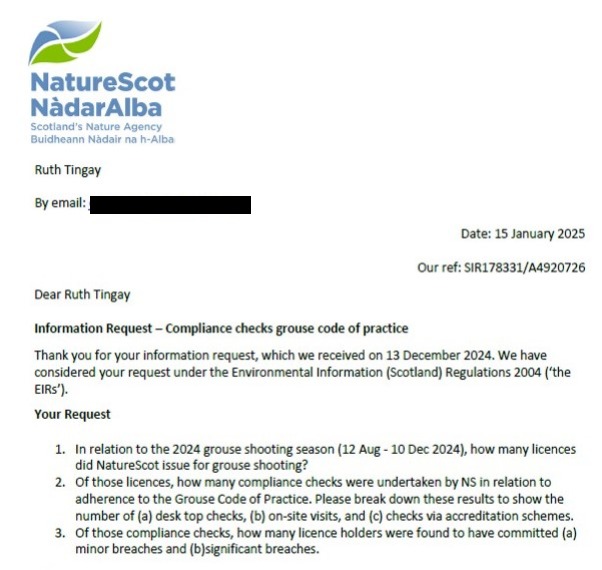
However, in recent months I’ve learned that NatureScot can’t be trusted (more on that soon!) so rather than rely on what NatureScot says it will do with regard to Grouse Code compliance checks, I decided to find it what it actually did by submitting an FoI request as follows:

  1. In relation to the 2024 grouse shooting season (12 Aug – 10 Dec 2024), how many licences did NatureScot issue for grouse shooting?
  2. Of those licences, how many compliance checks were undertaken by NatureScot in relation to adherence to the Grouse Code of Practice? Please break down these results to show the number of (a) desk top checks, (b) on-site visits, and (c) checks via accreditation schemes.
  3. Of those compliance checks, how many licence holders were found to have committed (a) minor breaches and (b) significant breaches?

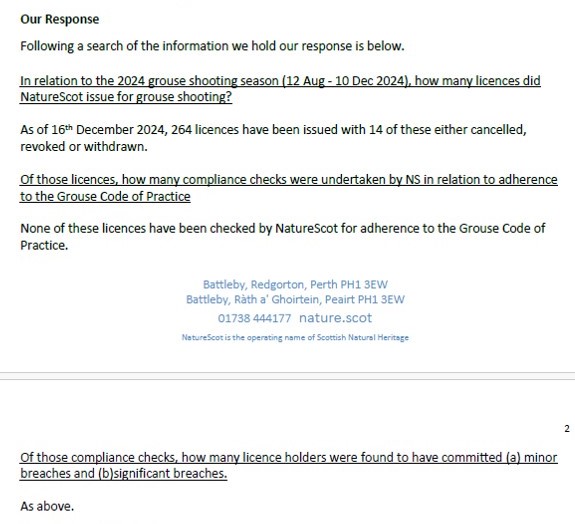
Here is NatureScot’s response:

So, NatureScot issued 264 grouse shooting licences for the 2024 season and says that 14 ‘were either cancelled, revoked or withdrawn‘. I’m guessing that none of them were ‘cancelled’ or ‘revoked’, but rather all 14 were ‘withdrawn’ by the licence applicant, probably as a result of the threatened legal challenge against NatureScot by the grouse-shooting industry that resulted in a narrowing of the licensable area, so perhaps some licence holders withdrew their original licence applications and submitted revised applications showing the more limited boundary.

Whatever the reason, I’m quite confident that no licences have been ‘cancelled’ or ‘revoked’ by NatureScot because if they had, NatureScot would have publicised it on its website in the same way it does for General Licence restrictions. I suspect in this case, NatureScot has deliberately included the words ‘cancelled’ and ‘revoked’ in its FoI response in an attempt to infer enforcement action when actually it hasn’t done any enforcement whatsoever.

That leaves 250 grouse shooting licences that NatureScot issued for the 2024 grouse shooting season. Of those, NatureScot didn’t undertake one single compliance check.

That’s astonishing, given that the Scottish Parliament introduced grouse shoot licensing on the basis that many grouse moor owners and managers couldn’t be trusted to abide by the law, despite years of warnings that if they didn’t stop illegally killing birds of prey they’d face imposed regulations. Given this long history of criminality, you’d think that compliance monitoring would be fundamental.

Regulation, in this case licensing, is only as strong as the associated compliance monitoring efforts and subsequent enforcement action. We’ve already seen the illegal shooting of an osprey (here) and a peregrine (here) since the licensing scheme began, and no sign of any subsequent enforcement action, which suggests that the licensing scheme simply isn’t an effective mechanism for stopping The Untouchables. NatureScot’s failure to undertake a single licence compliance check is playing right into their hands.

‘Why are birds of prey still being killed in Scotland despite new legislation?’ – special report in The National

The National newspaper published a special report on Monday 16 December 2024 entitled, ‘Why are birds of prey still being killed in Scotland despite new legislation?’, with a particular focus on the Cairngorms National Park.

It’s reproduced below.

SCOTLAND passed the Wildlife Management and Muirburn (Scotland) Bill earlier this year, introducing a licensing scheme for the grouse shooting industry in a bid to end the illegal killing of birds of prey.

The first licenses were issued this past summer, and while considered a blueprint for tougher legislation across the UK – people are still killing birds of prey on grouse moors, which is not an easy thing to do.

Guilty parties must have access to a vehicle, equipment such as a firearm, opportunity and motive.

This isn’t people traveling from towns and cities going up onto our hills and randomly killing birds of prey. These are targeted offences,” Ian Thomson, investigations manager for the RSPB, told The National.

But why? And who would do this?

Why are grouse moor shootings still taking place?

A Hen Harrier disappeared in February. A buzzard was shot in Perthshire in mid-May. An osprey was shot in the Glen Doll area in August. A dead golden eagle was found in a plastic bag near Loch Rusky in November.

In the last 15 years, more than 1500 birds of prey have been killed, with 57 convictions. However, the majority of these sentences are suspended, and only one person has been jailed.

Most of the evidence gathered by investigators is from satellite tags, fitted to allow conservationists to monitor the movements around the country.

The technology is estimated to be about 97% reliable, and “very rarely suffers some sort of technical function”, according to Thomson.

Often we believe that there is strong evidence that supports the fact that these birds are being shot often at night, the tags destroyed, and the carcass is disposed of,” Thomson said.

The RSPB investigations team assists Police Scotland by speaking to local land managers and liaising with the community if a tag stops working. When asked why anyone would target the birds, even with the new legislation in place, Thomson said: “The killings are being undertaken by people who are working on the land.

That’s the reality, and the vast majority of raptor persecution offenses occurring in Scotland are linked to management for kind of game bird shooting and particularly grouse shooting.

There are many layers of evidence that support that.

First of all, the location of the incidents that are found. Whether its birds shot, birds poisoned, or nests destroyed, these are all subject to police investigations.

A significant proportion of people convicted for raptor persecution offenses have been gamekeepers,” Thomson shared.

RSPB data shows that at least 54% of all confirmed incidents in the last 10 years (2014-2023) have been linked to land managed for pheasant, partridge and grouse shooting.

The association of these crimes with the gamebird industry is also evidenced by criminal court records. Of all individuals convicted of bird of prey persecution related offences from 2009 to 2023, 75% were connected to the gamebird shooting industry and 68% were gamekeepers.

The Angus Glens crime hotspot

Angus Glens in the Cairngorms is a hotspot for the number of raptor persecution in Scotland, with the Highlands having 69 since 2009.

There have been multiple confirmed incidents occurring on several estates in the area. This includes many poisoning incidents using chemicals whose possession was long banned, repeated illegal misusing abuse of crow traps and pole traps, shootings and destruction of nests.

Earlier this year, NatureScot placed restrictions on an estate on the edge of the Cairngorms National Park for three years following evidence of bird poisoning on the property.

Thomson said there had been 10 suspicious disappearances of satellite tags on birds of prey in the Angus Glen in the last 15 years.

There has been a peregrine, and an osprey shot since the start of the shooting season in Angus Glens this year, which Thomson described as “worrying”.

The law as it has stood since 2012 has been serious liability, which means landowners are responsible for the actions of their employees and the land.

So are landowners aware of the circumstances surrounding raptor persecutions on their land?

A wall of silence

The first licenses under the new bill were approved this past July, but Thomson noted there would have been no need for it had the industry “taken possession of this problem decades ago”.

He added: “I think had the industry rooted out criminals, then we wouldn’t have needed this sort of legislation moved on.

We are in a situation where some Victorian management practices towards birds of prey persist. It really is time that the shooting industry got into the 21st century.

Thomson said it was rare for estates to report raptor persecutions.

When asked whether estates may be protecting or turning a blind eye to those who target birds of prey, Thomson said he could not confirm but he and his team frequently hear of peer pressure within estates to keep reporting low, adding that crimes are rarely reported by the industry.

The problem is the game keeping industry is used to operating a bit like a closed shop,” Thomson said.

It’s very difficult. There is no whistleblowing culture, and it would be fantastic if organizations representing gamekeepers set up a scheme where people could report incidents taking place and those are passed on to the police.

But that just never seems to happen. Exceedingly rare truths are told.”

Thomson revealed that gamekeepers come to the team sharing their worries and are “terrified” to come forward.

They say to us this information can’t come from me because I may lose my job and I may lose my friends and I may lose my hobby. People are under considerable pressure to keep their mouths shut,” he said.

Either people won’t see anything or there is just a culture of denial.”

Thomson described “efforts to deny or downplay” incidents, and said that when satellite tags start to disappear, people blame “imaginary wind farms” or factors, dismissing science and evidence of crimes.

It’s a mix of cultural misinformation, a wall of silence and complete denial”, Thomson added.

ENDS

For those who are sick to the back teeth of birds of prey being illegally killed on grouse moors, you might want to sign this new petition from Wild Justice calling for a ban on driven grouse shooting – HERE.

Peregrine found poisoned – Police appeal for information six months later

Press release from PSNI (Police Service for Northern Ireland), 13 December 2024

POLICE CONFIRM BIRD POISONING IN ARMAGH

Police have confirmed that an adult bird of prey was found dead in the Forkhill area of Armagh in June of this year was poisoned.

It was reported on the 12th June that a Peregrine Falcon was found dead in the Forkhill area. The bird was retrieved by our search and rescue team and underwent testing to ascertain the exact circumstances, with enquiries ongoing the last number of months.

Peregrine photo by Pete Walkden

Constable Millen said: “We can now confirm the Peregrine Falcon found was poisoned with Carbofuran which is very concerning. This is not only a dangerous substance but it has been banned since 2001.

We would remind the public if there is a suspicion of a crime, such as poisoning on any bird of prey in their local area, to leave the bird(s) and/or bait in situ and to call the police as soon as possible for officers to action.

We have been working closely with our partners in Northern Ireland Environment Agency and National Wildlife Crime Unit and Northern Ireland Raptor Study Group regarding the matter and will continue to do so, in the hope to find those responsible.

“Police would appeal to anyone who has information on any suspected bird poisoning to please make contact via our non-emergency number 101, or online at http://www.psni.police.uk/makeareport/ or you can contact Crimestoppers anonymously on 0800 555 111 or online at http://crimestoppers-uk.org/.   

ENDS

As far as I’m aware, nobody has ever been prosecuted for the illegal poisoning of any wildlife in Northern Ireland, which might explain why poisoning offences, especially against birds of prey, continue.

The Police waiting for six months before issuing an appeal for information about a poisoning crime won’t help, either.

Following the illegal poisoning of two white-tailed eagles in May 2023, found dead together on Northern Ireland’s only driven grouse moor at Glenwherry in the Antrim Hills (here), the Northern Ireland Raptor Study Group launched a petition calling for a ban on the possession of dangerous pesticides (here).

This petition is still live and has attracted almost 46,000 signatures. If you’d like to support it, please click here (you don’t have to be a resident/citizen of NI to sign – it’s open to anyone).

To learn more about recent raptor persecution incidents in Northern Ireland, this excellent report is well worth a read. It covers incidents reported in 2021 and 2022 (published May 2024).

Suzanne Hall, wife & mother of convicted peregrine launderers ‘no longer a serving police officer’

Last week I blogged about the status of a fraud allegation against Suzanne Hall, a serving police officer and the wife and mother of convicted peregrine launderers Timothy and Lewis Hall (see here for background).

Young peregrines at a nest site in Scotland. Photo (taken under licence) by Ruth Tingay

There was uncertainty about whether Hall’s fraud trial had been dropped and efforts to confirm the status of the prosecution with the Crown Office and Jedburgh Sheriff Court proved fruitless.

Thanks to the blog reader who today sent me a copy of an article that was published in the Border Telegraph on 20 Nov 2024, there is now some clarification. Here’s what the article said:

FRAUD CHARGE DROPPED

A former police officer accused of a fraud involving almost £10,000 has walked free after the charge was dropped. Forty-six-year-old Suzanne Hall had been charged with telling Scottish Borders Council she had just moved into her home at Lamberton Holdings, in Berwickshire, with her family in December 2020.

The charge had alleged it had been her sole or main residence sine August 2015, and she was due the local authority £9,613 in back dated council tax.

Hall had pleaded not guilty to the charge and a trial date had been fixed for Tuesday [19 Nov 2024] at Jedburgh Sheriff Court with an intermediate hearing on November 4.

But the case did not call on November 4 and the trial was cancelled.

A spokesperson for the Crown Office and Procurator Fiscal Service said: “It is the duty of the Crown to keep cases under review, and following full and careful consideration of the facts and circumstances of the case, including the available admissible evidence, the Procurator Fiscal decided that there should be no further criminal proceedings at this time.

The Crown reserves the right to proceed in the future should further evidence become available“.

The fraud charge originated from a police raid on her home in May 2021 in relation to the illegal sale of peregrine falcons.

Hall – who was a serving police officer at the time – initially faced wildlife charges but her pleas of not guilty were accepted by the Crown in December 2023.

The fraud charge remained outstanding but has now been dropped for the time being.

Police Scotland confirmed this week she is no longer a serving officer.

ENDS

Fraud charge dropped? The weird case of WPC Suzanne Hall, wife & mother of convicted peregrine launderers.

A fraud charge appears to have been dropped against serving police officer Suzanne Hall, the wife and mother of convicted peregrine launderers Timothy and Lewis Hall.

A quick recap.

WPC Hall, 46, initially faced multiple charges in 2022 in relation to the illegal laundering of Scottish peregrines that were stolen from nest sites across the south of Scotland and then sold on for profit to falconers in the Middle East.

The charges were the result of a joint Police Scotland /SSPCA raid at Hall’s property at Lamberton Holdings, Berwickshire, in May 2021 and a subsequent lengthy investigation codenamed Operation Tantallon.

Hall’s husband, Timothy Hall, and son Lewis both pleaded guilty (and received staggeringly inadequate sentences) but WPC Suzanne Hall’s not guilty pleas were accepted by the court in 2023. It was reported that the Crown Office deserted a fraud charge against WPC Hall but reserved the right to re-raise the case at a future date (see here).

Young peregrines at a nest site in Scotland. Photo (taken under licence) by Ruth Tingay

News then emerged in the Border Telegraph in July 2024 that WPC Hall was facing a fraud charge relating to almost £10,000 worth of council tax (here). It wasn’t clear whether this was the fraud charge that the Crown Office had previously deserted or another one. Hall denied the allegation and a trial date was set at Jedburgh Sheriff Court for 19 November 2024.

Then in October 2024, after I’d referred in a blog to this forthcoming trial, I started to receive emails from WPC Hall’s convicted husband Timothy Hall, who claimed there were no pending charges against his wife and he accused me of slander, threatening to sue me if I didn’t remove the blog post.

I didn’t bother trying to explain that what I’d written was accurate and fair reporting (based on the information available in the public domain at the time) and nor did I remove the blog post, for the same reason. This seemed to infuriate him and he did his best to write what he probably thought were hard-hitting threats but just sounded like somebody who’d watched too many episodes of Jeremy Kyle:

My solicitor will be in touch” and “No doubt we will be seeing each other in court, I will be taking this all the way“.

I was curious though, so I contacted the Crown Office for an update on the status of the case against WPC Hall.

COPFS replied by giving me the contact details of Jedburgh Sheriff Court accompanied by a one liner: “They may be able to assist you further with your enquiry“.

So I called Jedburgh Sheriff Court. I was told that the information I sought was covered by the Data Protection Act and I was passed on to the Scottish Courts’ media team.

The response I received was this:

I have searched our court rolls with the information you have provided and I am unable to locate a case with those details“.

Hmm.

My last attempt at trying to verify the status of the case against WPC Hall was today, when I viewed the online court roll for Jedburgh Sheriff Court which provides details of all the criminal cases being heard over the next five days (given that WPC Hall’s trial was scheduled to begin this coming Tuesday).

There is no listing for a case against WPC Hall.

It seems then, that the fraud charge against WPC Hall has either been moved or has been dropped. It’s impossible to determine the outcome, and impossible to know, if the case has been dropped, the reason behind that decision.

UPDATE 23 November 2024: Suzanne Hall, wife & mother of convicted peregrine launderers ‘no longer a serving police officer’ (here).

Satellite-tagged golden eagle ‘disappears’ in suspicious circumstances on grouse moor in the notorious Angus Glens

Press release from RSPB:

EAGLE VANISHES IN BIRD OF PREY CRIME HOTSPOT

  • The young Golden Eagle, fitted with a satellite-tag, was being monitored by researchers in Scotland until it suddenly disappeared in the Angus Glens – an area dominated by grouse moors and with a history of raptor persecution.
  • Scotland’s national bird, Golden Eagles are still heavily – and criminally – persecuted.

The sudden disappearance of a satellite-tagged Golden Eagle has sparked concerns of criminal activity in the Angus Glens. 

The young bird, which hatched in Tayside in 2022, was fitted with a satellite tag while in its nest. This work was supported by Forestry and Land Scotland for research purposes.

The tag was transmitting as expected until May 2024 when it suddenly went offline. Its last known location was an area of moorland in the Angus Glens – an area with a long history of illegal bird of prey persecution

The data from the bird’s tag was swiftly provided to the police for independent scrutiny. Police Scotland, the National Wildlife Crime Unit and RSPB Scotland then conducted a search of the area but found no trace of the bird or its tag. 

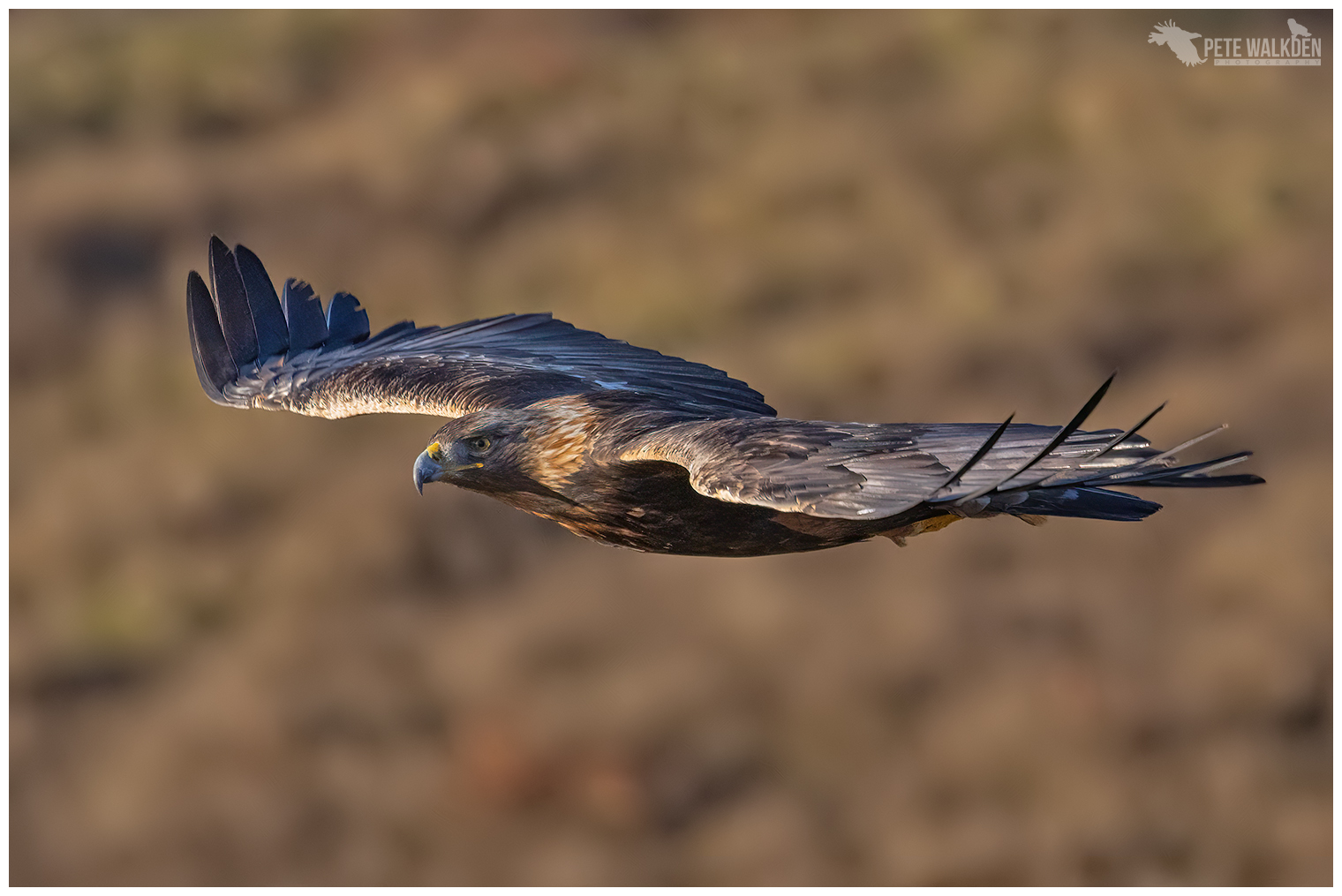
Golden eagle photo by Pete Walkden

It is a crime to kill a bird of prey, and anyone caught doing so faces a fine or even jail. Furthermore, legislation introduced in March 2024 means that, if illegal activity takes place on a grouse moor, that grouse moor could lose its license to operate. 

Will Hayward, RSPB Scotland Senior Investigations Officer, said: “The sudden cessation of transmissions from this tag strongly suggests human interference, and reflects a pattern of tagged birds ‘disappearing’ almost exclusively on or near grouse moors that has become all too evident in recent years. Had this bird died of natural causes or if the tag had become detached, we would be able to locate and retrieve it. Given the well-proven reliability of this technology, when no body or tag is found, this is highly suspicious. We believe this bird has been killed and the tag destroyed.”

Unfortunately, this young bird is the latest of many to disappear without explanation on or near a grouse moor. 

Angus was one of the raptor crime hotspots identified in a Government-commissioned report on the fates of satellite tracked golden eagles in Scotland, published in 2017. Sadly there has been no let-up in confirmed incidents and suspicious disappearances since then. Most recently, an Osprey was found shot in the Glen Doll area on 12 August – the opening day of the grouse shooting season. [Ed: And a Peregrine was found shot in the Angus Glens on 3 September 2024, here]. And earlier this year sat-tagged Hen Harrier ‘Shalimar’ disappeared in circumstances similar to this Golden Eagle. 

If you notice a dead or injured bird of prey in suspicious circumstances, call Police Scotland on 101 and fill in the RSPB’s online reporting form here.

If you have information about anyone killing birds of prey which you wish to report anonymously, call the RSPB’s confidential Raptor Crime Hotline on 0300 999 0101.

ENDS

Scottish court orders convicted Peregrine launderer Lewis Hall to pay back thousands under Proceeds of Crime Act

In February this year, part-time gamekeeper Timothy Hall, 48, and his son Lewis Hall, 23, were sentenced after they’d pleaded guilty to the illegal laundering of wild peregrines that had been stolen from nest sites across southern Scotland and were sold on to falconers in the Middle East (see here).

Young peregrines at a nest site in Scotland. Photo (taken under licence) by Ruth Tingay

Despite their offences passing the threshold for a custodial sentence, Timothy Hall was only ordered to complete 220 hours of unpaid work and Lewis Hall was only ordered to complete 150 hours. These sentences were considered to be staggeringly inadequate given the extent of the Halls’ offending (see here).

Lewis Hall leaving court in February, before being prosecuted under the Proceeds of Crime Act. Photo screen-grabbed from BBC Reporting Scotland footage.

However, the Crown Office reported at the time that Lewis Hall would also be subject to action under the Proceeds of Crime Act, where profits from criminal activity can be confiscated.

At a court hearing in June, it was revealed that prosecutors were seeking to recover £164,028.80 from Hall (here) and the Sheriff allowed Hall additional time to provide evidence from a forensic accountant to challenge this amount.

Following a hearing at Selkirk Sheriff Court today (10 Oct 2024), Lewis Hall accepted that he benefitted from “general criminal conduct” by £110,000.

The court ordered he repay £27,182 (based on an amount the court deemed was available) and he is likely to have to pay this within six months.

That leaves £82,981 unrecovered. However, the Crown has the power to apply to the court to extend the order to seize money and any assets Hall acquires in the future to pay back the full amount he made from his crimes. I hope the Crown pursues this.

Police Officer Suzanne Hall, who was cleared of involvement in the peregrine laundering crimes, is reportedly facing a separate charge of alleged fraud relating to almost £10,000, to which she has pleaded not guilty. Her trial is due to begin on 19th November 2024 (see here).

Please note – as Suzanne Hall’s case is still active, no blog comments about it will be posted on this blog until proceedings finish. However, as Lewis Hall’s case has now concluded, comments about his case are now accepted. [UPDATE 12 October 2024: I’ve received an unconfirmed report that the case against WPC Suzanne Hall has been dropped. I’m seeking confirmation of this and will report in due course. Comments about her case remain switched off until confirmation is received from the prosecuting authorities].

This is a significant and relatively rare result for a wildlife crime case in the UK. It doesn’t excuse the pathetically inadequate sentences handed down in February to Timothy and Lewis Hall for the serial offending they committed over a long period of time, but it does provide gratification that they haven’t escaped justice entirely. It should also act as a meaningful deterrent to others. I also hope it provides some satisfaction to the investigatory team behind Operation Tantallon who put in several years of painstaking work to get these criminals in to court.

The Crown Office has released the following statement about Lewis Hall’s case:

Man convicted of illegally selling peregrine falcon chicks agrees to repay £27,000

A man convicted of possessing and selling wild peregrine falcon chicks for large sums of money has agreed to pay back more than £27,000 in a Proceeds of Crime confiscation action. 

Lewis Hall, 24, was ordered to carry out 150 hours of unpaid work over 15 months and banned from possessing or having under his control any bird of prey for five years after being sentenced in February at Jedburgh Sheriff Court. 

He had earlier pled guilty at Selkirk Sheriff Court to acquiring for commercial purposes, keeping for sale, and selling the chicks between 2020 and 2021. 

Hall, of Berwick-Upon-Tweed, has now agreed to repay £27,182 under Proceeds of Crime legislation following a hearing at Selkirk Sheriff Court. The figure is based on an amount which the court deems as being available. 

Court records show that Hall accepted he benefited from “general criminal conduct” by £110,000. 

The Crown has the power to apply to the court to extend the order to seize money and any assets Hall acquires in the future to pay back the full amount he made from his crimes. 

Sineidin Corrins, Deputy Procurator Fiscal for specialist casework at the Crown Office and Procurator Fiscal Service (COPFS), said: “The sale of peregrine falcons has become an extremely lucrative business. 

Lewis Hall took advantage of that for his own financial gain and to the detriment of the wild peregrine falcon population in the South of Scotland.  

However, even after a conviction was secured in this matter, the Crown commenced Proceeds of Crime action to ensure the funds Hall obtained illegally were pursued. 

Prosecution of those involved in financial crime does not stop at criminal conviction and sentencing.  

The funds recovered from Lewis Hall will be added to those already gathered from Proceeds of Crime, to be re-invested in the community by Scottish Ministers through the CashBack for Communities programme.” 

The court heard how in April 2021 a member of the Lothian and Borders Raptor Study Group alerted police to suspicious failures of peregrine falcon nests in the Berwickshire area which had previously been productive.  

Officers later investigated two nesting sites and discovered they had been disturbed and a number of eggs were missing from both locations.  

A police search of Lewis Hall’s father’s home in Berwick-Upon-Tweed subsequently found a total of seven peregrine falcon chicks as well as a number of other birds of prey.  

Further enquiries concluded that none of the chicks were captive-born and had been taken from the wild.  

Under legislation, selling captive-bred peregrine falcons is legal but possessing or selling wild birds is unlawful.  

ENDS