Further to this morning’s blog about a Peregrine being euthanised after being found with gunshot injuries in Leicestershire (see here), the Leicestershire Wildlife Hospital has released more details and has issued an appeal for information, as follows:
APPEAL FOR INFORMATION
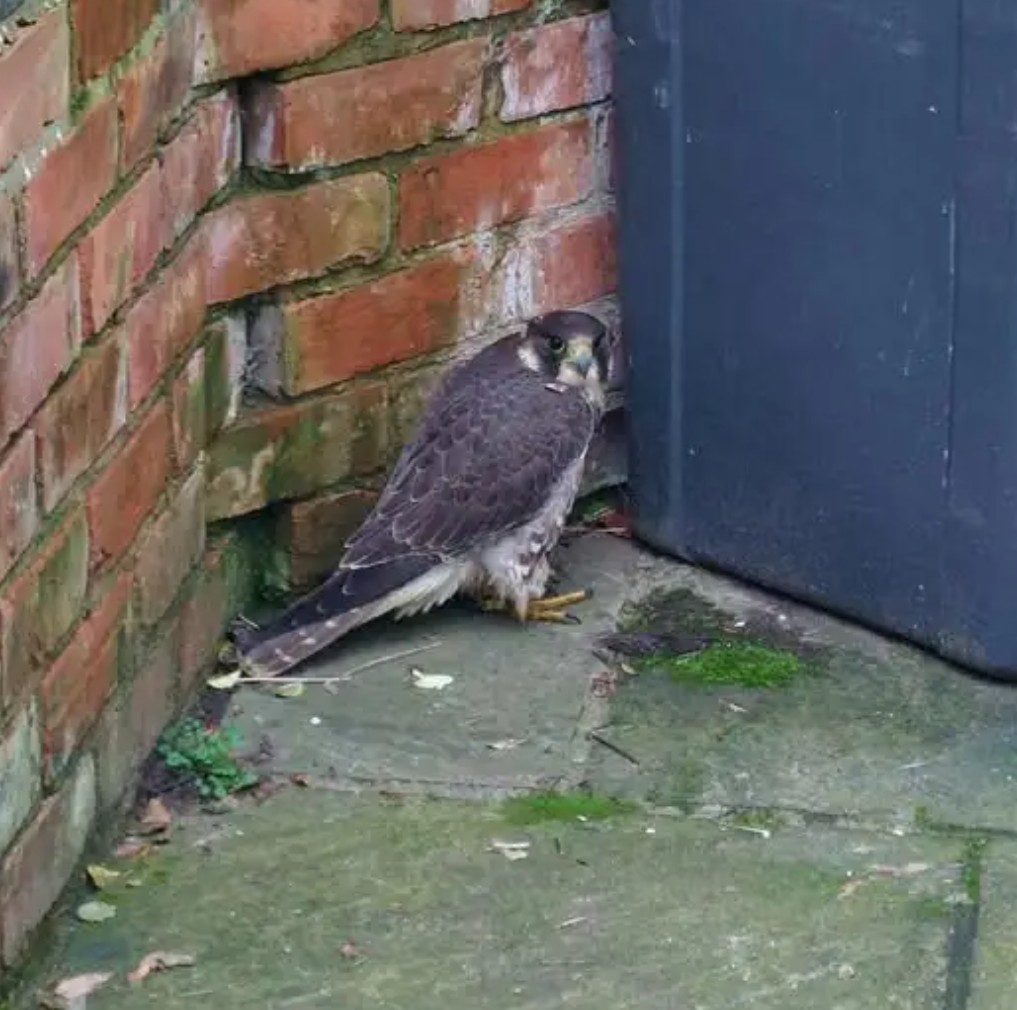
Yesterday we admitted a peregrine falcon that was found grounded in a garden on Smeeton Road, Kibworth.
Our team collected the peregrine and her assessment found that she had been shot [suspected to have been an air rifle]. This could have happened any time between the 21st and 23rd December.
Peregrine falcons are a schedule 1 bird in the UK. It is an illegal act to intentionally harm or kill them.
This crime has been reported to the police and we are now appealing for any information you may have.
Have you seen anything suspicious?
Have you heard any gunshots?
Did you see this crime take place?
If you have ANY information, please contact the police [call 101] on with reference number 25000748549.
The peregrine sadly had to be put to sleep as she was suffering from a severe break to her right humerus – likely as a result of the fall after being shot. She was this years young, from Leicester cathedral, known as X6F (her ring number).
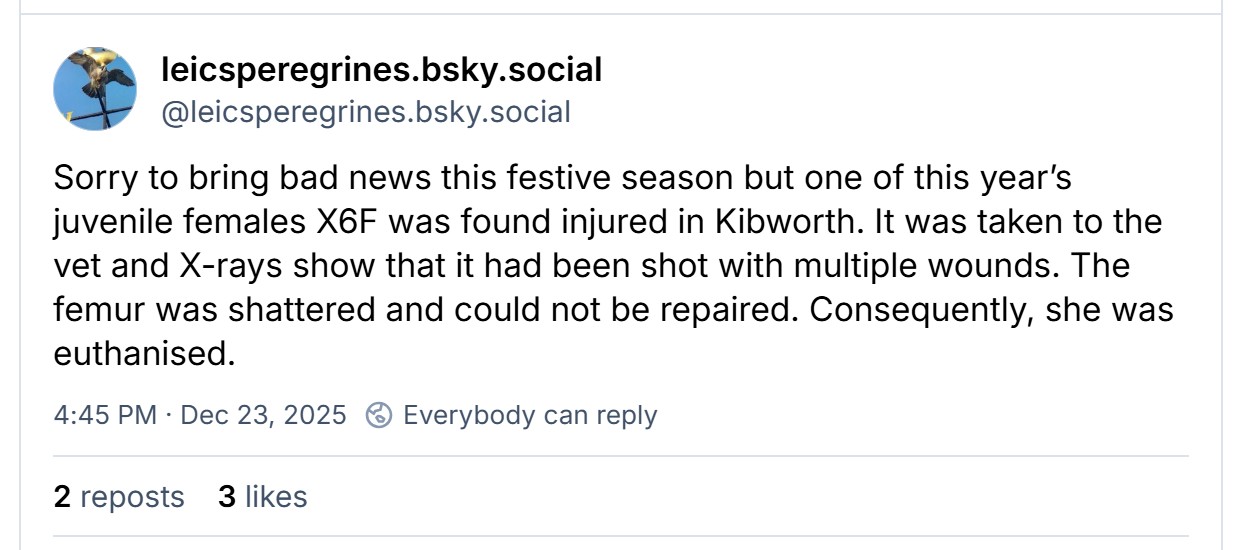
A young peregrine that fledged from Leicestershire Cathedral this summer has been euthanised after being found with gunshot injuries in nearby Kibworth.
A post on social media yesterday by the Leicestershire Peregrine Project, an initiative run by the Leicestershire & Rutland Ornithological Society in collaboration with Leicester City Council and Leicester Cathedral, reads as follows:
Juvenile female Peregrine X6F shown here with her sibling. Photo from the Leicester Peregrine Project website.
In happier news for Peregrines in Leicestershire, Market Harborough District Council’s planning committee has recently approved the installation of a Peregrine nest platform on the council’s Grade II listed Symington Building.
Leader of the council Phil Knowles said the Peregrines “are a much-loved feature of Market Harborough”, and added: “We are delivering what we believe our community wants.”
The work will take place in time for the 2026 breeding season and is being sponsored by WW Brown & Sons, the local building contractor carrying out restoration work on the historic landmark.
Derbyshire Police Rural Crime Team posted the following on Facebook on 3 December 2025:
WILDLIFE CRIME AWARENESS – INJURED PEREGRINE
Between 01/09/25 – 08/09/25, we received a report from the Youlgrave [Youlgreave] area that a peregrine falcon had been sadly shot.
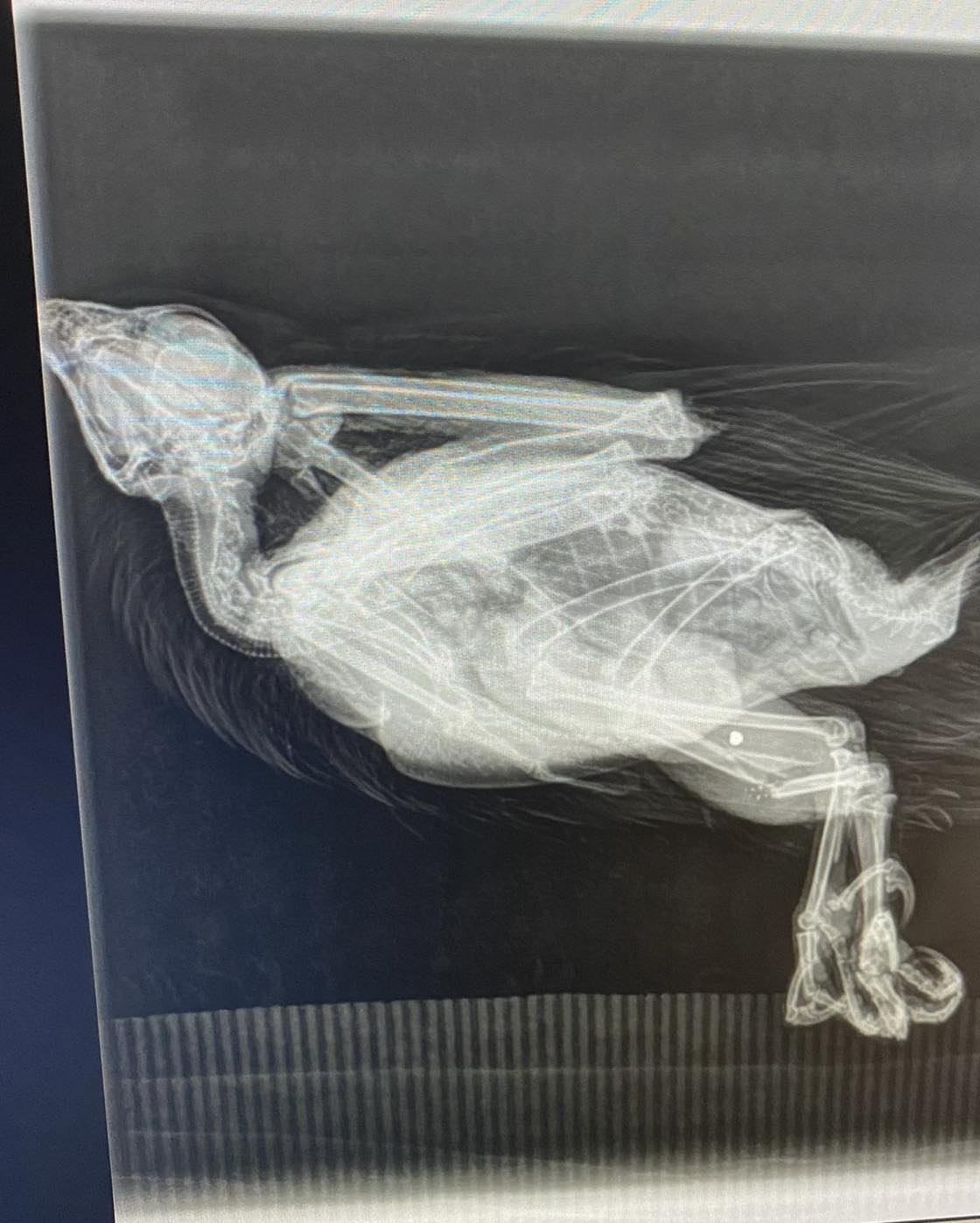
After x-rays it showed that the incident caused the bird’s wing to shatter.
X-ray provided by Derbyshire Police Rural Crime Team. Annotated by RPUK
Thankfully, this story doesn’t end in tragedy — the peregrine is alive and currently undergoing rehabilitation.
This post is a reminder that peregrines are legally protected, and it is a criminal offence to intentionally injure or kill them under the Wildlife and Countryside Act 1981.
If you witness wildlife crime or anything suspicious:
If you have any information relating to this incident, please quote 25*580157
Together, we can protect our wildlife
ENDS
It’s not known where or when this Peregrine was shot, but given the extent of its injuries it’s unlikely to have been able to fly far from that location.
I don’t know why it’s taken Derbyshire Constabulary three months to appeal for information on a supposed priority wildlife crime.
To the relief of many raptor conservationists, a proposal to downlist the Peregrine Falcon from Appendix 1 to Appendix II of CITES (Convention on International Trade in Endangered Species), which would allow the capture and trade of wild Peregrines) has been thwarted at the 20th Conference of the Parties on CITES (CoP20), currently taking place in Uzbekistan.
Young Peregrines in the wild, not related to this case (Photo by Ruth Tingay, taken under licence)
Peregrines have been listed as an endangered species on CITES Appendix 1 since 1975, prohibiting international trade of this species, following the catastrophic effect of pesticides on Peregrine populations globally.
Since then, many populations have ‘recovered’ after significant conservation effort over many decades, although recent declines of ‘recovered’ populations are reported in a number of countries, and the species’ status is still poorly understood in many other countries.
Canada and the USA proposed downlisting the Peregrine from Appendix to 1 to Appendix II to allow capture of wild Peregrines and international trade to meet demands for falconry. Here’s a copy of the proposal to the CITES Conference of Parties:
However, a large number of raptor biologists and conservationists from around the world, many of them specialising in Peregrine research, opposed the proposal and warned of the high risk to some populations.
This excellent paper published recently in the scientific journal AnimalConservation explains those concerns:
A vote on the downlisting proposal took place at the CITES Conference yesterday (3 Dec 2025) and did not receive sufficient support to pass and the proposal was rejected.
Here is a note of what happened, published by the International Institute for Sustainable Development (IISD) in its Earth Negotiations Bulletin as part of its daily CITES Conference reporting:
This is good news for Peregrines globally, but I haven’t seen, nor do I understand, the UK’s rationale for supporting the proposal. If any blog readers have information about that, it’d be interesting to read.
Even if the proposal had been agreed at an international scale, national governments would still retain responsibility for regulating ‘wild take’ in their own countries.
You may remember in March this year, Defra endorsed Natural England’s recommendations for a presumption AGAINST the issuing of licences for taking wild birds of prey for falconry (see here).
The theft of wild Peregrines in the UK for trade continues to be a problem. Recent prosecutions include the conviction of two men found guilty of laundering wild Peregrines stolen from nest sites across south Scotland (see here) and an ongoing prosecution of a man in Worcestershire accused of 21 charges relating to the possession and trade of wild Peregrines (here).
Press release from Cairngorms National Park Authority (24 November 2025)
PEREGRINE NUMBERS IN DECLINE IN CAIRNGORMS NATIONAL PARK
The last UK-wide survey of peregrines took place in 2014 and covered Scotland as a whole, showing a 9% decline in numbers across the country. The Scottish Raptor Monitoring Scheme also found some evidence of a decline from 2009-18; however, no survey was undertaken to assess peregrine populations specifically within the National Park during that time.
In 2024 the Cairngorms National Park Authority collaborated with three of the regional branches of the Scottish Raptor Study Group: Highland, North East of Scotland and Tayside and Fife, to carry out a survey to establish how many peregrine sites within the National Park were occupied and assess their breeding success.
Raptor Study Groups have records going back to the 1960s of sites where peregrines have bred within the Cairngorms National Park and these were used as the basis for the survey. The study shows that the estimated number of peregrine pairs in the breeding season within the National Park has declined by 56% since 2002, with less than half of territorial pairs successfully fledging young in 2024.
Contributing factors are likely to include upland land management practices, decreased prey availability for peregrines, wildlife crime and, more recently, outbreaks of Avian Flu.
It is a complex picture, and more research is needed to understand the key factors and gain a better understand of upland raptor population dynamics – including interspecific competition (ie competition for resources between individuals of different species) and the influence of prey availability. It will require action from the Park Authority working with a range of partners, including the Raptor Study Groups, NGOs and estates on the ground, as well as NatureScot and other public bodies, to explore what can be done to try and turn the tide for peregrine and all raptors in the National Park.
Dr Sarah Henshall, Head of Conservation at the Cairngorms National Park Authority, said: “This is the first time we have been able to get a clear view of peregrine falcon numbers in the National Park and it paints a bleak picture. We will be working closely with Raptor Study Groups, estates and other experts to explore a range of options such as the installation of nest cameras to help us understand bird behaviour, DNA work to support wildlife crime prevention initiatives and GPS tagging to get information on bird movements and survival.
“Our ongoing conservation work, from ecological restoration to increasing the sustainability of moorland management, aims to benefit habitats for peregrine and other key upland species. This survey further highlights the importance of this work and strengthens our resolve to help this iconic bird thrive.”
The continued decline of Peregrines in the Cairngorms National Park comes as no surprise whatsoever, and its link to intensively-managed driven grouse moors even less so.
The illegal persecution of Peregrines on driven grouse moors is an issue that has been documented repeatedly in scientific papers since the early 1990s, nationally (e.g. see here) and regionally (e.g. see here for research from northern England). A particularly illuminating paper published in 2015 reported specifically on the decline of breeding Peregrines on grouse moors in North-East Scotland, including those on the eastern side of the Cairngorms National Park (here).
This latest report from the Cairngorms National Park Authority, based on fieldwork undertaken by the Scottish Raptor Study Group, is a welcome addition to the literature and will help inform the new requirement (under the Wildlife Management & Muirburn Act 2024) to monitor and report every five years on the status of a number of raptor species (Peregrine, Golden Eagle, Hen Harrier & Merlin) on grouse moors in Scotland as a measure of how well / badly the legislation is working.
The report’s findings are cautious, citing a number of factors that could be potential drivers influencing the recent decline (e.g. Bird Flu, interspecific competition etc) but these cannot, and do not, account for the long-term decline of Peregrines in the uplands, either within the Cairngorms National Park or in other upland areas. I’m pleased to see the report acknowledge this.
Let’s not kid ourselves. The Cairngorms National Park Authority has known for some time that illegal raptor persecution is a huge issue within the Park boundary – check out what the CNPA was proposing in 2013 to tackle the problem (see here) – unsurprisingly, it didn’t work.
The latest report includes an analysis of the relationship between Peregrine breeding site occupancy and the intensity of grouse moor management (ranging from ‘low’ to ‘high’ management intensity and everything in between).
Many people probably imagine that the use of poisons to kill protected wildlife is something out of the pre-Victorian era, like cock fighting and bull baiting. However, this senseless and cruel slaughter is still happening in Britain, with many mammals and birds of prey suffering horrific and agonising deaths, even though this practice has been banned since 1911.
It is a crime which not only kills wildlife, but also kills much loved family pets and can even kill people. This is a wildlife crime that frequently occurs on remote and private land where the chance of detection is very low and most victims are never found. Those cases which are reported and then investigated must be considered to be a very small tip of a very large ‘iceberg’ of sickening rural felonies.
An illegally poisoned Red Kite (photo via WPRUK)
In 2017, in an attempt to combat this wildlife crime, the UK Government initiated a project to map incidents of illegal bird poisonings. This provided information to the public and other interested parties as to where these crimes were taking place and it was intended that these maps would be updated annually to “provide an invaluable intelligence tool to help fight crimes against birds of prey” (Defra press release 2017).
It now appears that these wildlife poison crime maps have not been updated and there is very little governmental action informing the public that these crimes are still occurring and wildlife is still being deliberately poisoned.
Wildlife Poisoning Research UK (WPRUK) works to place information about the environmental impact of pesticides, biocides and other toxic chemicals into the public domain so that the general public and the media have a better understanding of this situation. Data on cases of deliberate poisoning of birds has been obtained using Freedom of Information requests. This has enabled WPRUK to produce maps showing where these poisoned birds have been found. This is information which the Government, for whatever reason, has now apparently declined to put into the public domain.
WPRUK has now released a report pinpointing where the poisoned birds have been found in Northern England. Future maps will cover other parts of the UK.
Between 2015 to 2023, the bodies of 73 legally protected birds, mostly birds of prey, were found in Northern England. These birds had been illegally and deliberately killed using poisons; 31 birds being Schedule 1 Wildlife and Countryside Act (1981) species, which have the highest level of protection. Due to the very small chance of poisoned birds being found, the real numbers of birds being killed by this criminal activity is likely to be far higher. To date, no one has been convicted for killing any of these 73 birds.
There were two areas in Northern England where particularly high numbers of poisoned birds were found. These were Nidderdale in North Yorkshire and the Glapwell area in Derbyshire.
Releasing the report, Dr Ed Blane from WPRUK said: “The fact that 114 years after this sickening practice was banned, individuals are still poisoning our wildlife is deeply disturbing. People visit the countryside to enjoy nature and they will be truly alarmed to learn that poison is still being used to kill wildlife.”
If this continues it might severely impact on plans to re-introduce white tailed eagles to Northern England. In the Southern England eagle project, at least 2 birds have been killed by poison.
A comment from Steve Downing Chairman Northern England Raptor Forum:
“We proudly, and rightly, identify ourselves as a nation of nature lovers. Every year tens of thousands of tourists, both domestic and foreign, visit the historic and beautiful countryside throughout the North of England to enjoy the scenery and stunning birds of prey that it supports. Collectively they spend £millions supporting our rural communities. What the visitors don’t see is the underbelly of criminality in the countryside where the barbaric practice of deliberately poisoning raptors persists today, as highlighted by the bodies found in Nidderdale, North Yorkshire and around Glapwell in Derbyshire. Thanks to Ed, a spotlight is being shone on this shocking pernicious activity raising public awareness of the danger presented by these lethal poisons, both to themselves and local birds of prey.”
Bob Elliot CEO of Wild Justice said:
“Illegal wildlife poisoning hasn’t faded into history; it’s still being carried out in the shadows with very little oversight. These findings show that wildlife species are still being killed with impunity, and the public is being kept in the dark about the scale of it. Without transparency, enforcement and the political will to confront those responsible, this criminal abuse of our countryside will continue unchecked.”
A 57-year old man appeared at Worcester Magistrates’ Court on 11 November 2025 accused of 21 offences relating to the keeping and trading of wild Peregrines, alleged to have taken place between 2018 and 2022.
Young Peregrines in the wild, not related to this case (Photo by Ruth Tingay, taken under licence)
Ross Loader, of California Lane, Welland, Malvern is accused of 11 counts of having in his possession or control live wild birds (Peregrines) and eight charges of keeping / possessing / controlling unregistered Schedule 4 birds (Peregrines) contrary to the Wildlife and Countryside Act 1981.
It is further alleged that Loader sold a Peregrine and also knowingly or recklessly made a false declaration, namely claiming the Peregrines were captive bred birds, in order to obtain a certificate.
Loader has not entered a plea to any of the 21 charges. He is expected to do so at the next court appearance on 9 December 2025.
The Scottish Raptor Study Group (SRSG) is saddened to report the passing last week of its long-term Secretary Patrick Stirling Aird at his home in Dunblane, Perthshire. We are extremely fortunate and proud to have had Patrick as our Secretary for more than 20 years. It is believed that Patrick started in this role on 19th February 2000. It cannot be overstated how much of a massive role Patrick has played both for the SRSG and more widely for raptor conservation in Scotland. He will be greatly missed by all of us in the tight-knit Scottish raptor conservation community.
Patrick Stirling-Aird (Photo by Sue Stirling-Aird)
Patrick was an authority on the Peregrine Falcon, his main passion, along with other upland raptor species including Golden Eagles and Ravens. He assiduously monitored these birds in the Central Scotland (CSRSG) and Tayside and Fife Raptor Study Group (TFRSG) areas for decades. Even whilst in his mid-eighties Patrick was out monitoring Peregrines this year, and was still the species coordinator for both Peregrine and Golden Eagle in the Central Scotland Raptor Study Group area.
In his book “The Peregrine Falcon” (New Holland 2012) Patrick claimed to have seen his first Peregrine more than 40 years ago, so going back to the early 1970s. He said it was these first sightings, and the recognition of the Peregrine as an “ecological barometer”, that got him involved with formal raptor monitoring. At this time, raptor monitoring was pioneering work promoted especially by Derek Ratcliffe, who warmly acknowledged Patrick’s work and influence in his own monographs on the Peregrine and Raven. In the 1970s and when Patrick took up raptor monitoring in west Perthshire, the Peregrine had of course become an extremely rare breeding bird following the pesticide crisis caused by DDT and Dieldrin in the 1960s, and as revealed by those dedicated individuals who monitored Peregrines across the UK at the time.
I first met Patrick in the early 1990s when I became a member of the CSRSG, having moved down from the Highlands. He was the Chair of CSRSG since its formation in 1983 and only stood down from that role ten years ago. Patrick was definitely in charge of monitoring Peregrines, Golden Eagles and Ravens! It amused me at the time that other species including Red Kites, my own passion, were given relatively short attention at meetings! Owls were barely mentioned unless prompted (something that did not change greatly)! The focus was clearly on the three key raptor species – Patrick’s birds! What was also clear was Patrick had huge attention to detail. Patrick was trained and worked as a solicitor and brought this attention to detail to his raptor monitoring. His raptor data record keeping was second to none. When discussing particular raptor sites, he could call on an extensive background history of each site, rigorously documented year by year. If anybody was asked to monitor any Peregrine sites for him or to search certain glens for occupancy, you could expect a full documented history of that site, sometimes going back for over 50 years; detailing alternative sites, productivity; and information on how to access to get the best view of nests.
Patrick’s own study area was along the boundary between the CSRSG and TFRSG areas. He monitored all of the peregrines from Glen Artney up to Glen Almond and across to Stirling for decades. He also monitored the breeding Golden Eagles and Ravens in these areas. However, when discussing other sites for these species in these RSG areas there did not seem to be many that he had missed during his time either! For SRSG nationally in Scotland, and for CSRSG and TFRSG more locally, he coordinated the national population surveys for Peregrine – in particular in 1981, 1991, 2001 and 2014.
By Patrick’s own admission he liked to monitor his birds alone. He also waited impatiently for the good weather to go and do his work on the hill. Characteristically he wore his tweed “plus twos” and deerstalker “fore and aft” hat. When he went out in the field, he tended to spend all day on the hill monitoring one or a small number of sites in a day, observing Peregrines and Eagles for many hours from a distance, noting their behaviour carefully. From my own conversations with folk on the ground whilst out doing my own raptor studies in the same general area I noted the respect that he also carried with the landowners, gamekeepers and stalkers. Patrick always made time to speak to estate owners and their employees both before and after his monitoring visits. In my time, I have rarely heard anybody saying a bad word about Patrick, even when he had to have the difficult conversations with estates about the suspicious disappearance of raptors he was monitoring or their apparently criminal breeding failure! Patrick was calm, forceful and never shied away from conflict.
Sadly in many parts of Patrick’s study area he monitored a decline in numbers of breeding Peregrines in recent decades in line with national trends for this species in the Scottish uplands, however the Ravens have fared well, and the Eagles that he monitored are now largely free from human interference. I am privileged to be amongst the few who have been out on the hill over many years with Patrick and every trip was a learning experience. Patrick had a huge commitment to raptor monitoring above all else.
Patrick and Sue Stirling-Aird at a Golden Eagle eyrie (Photo by Duncan Orr-Ewing)
The list of important public roles Patrick undertook over many years as the SRSG Secretary are endless. He was a member of the UK Government’s DETR Raptor Working Group from 1995 to 2000. This initiative was set up originally to tackle what was perceived by the then administration as “the raptor problem”. It ended up meeting 25 times and making 25 recommendations for the enhancement of raptor conservation! Several officials singled out Patrick for special praise for his unstinting contributions to the group. The DETR RWG Report was a seismic moment for raptor conservation in the UK and included the production of the SRSG document “Counting the Cost” which used SRSG data to highlight the continuing illegal persecution of raptors in Scotland, including around Patrick’s own long term Peregrine study area in Central Scotland – “Human interference apparently affected about one fifth of the peregrine breeding population in central Scotland, 18% less young produced in the years 1981-1996”.
In my own role at RSPB Scotland, we used these Report recommendations in the early 2000s to tackle the Scottish Government to do more for raptor conservation. The formation of the Scottish Raptor Monitoring Scheme, in which Patrick was also instrumental, is one very good example of the report’s outcome. Licensing of grouse shooting was secured in Scotland in March 2024 to address systemic illegal persecution of raptors associated with this land use, and this is testament to many decades of hard work by a number of key individuals, who could hold the ring and talk authoritatively about raptors. Patrick played a totemic role in this.
In his role as SRSG Secretary, Patrick represented the SRSG on the Moorland Forum and the Police Raptor Persecution Priority Delivery Group. His controlled persistence in defence of raptors, and against criminal persecution was unique, using his background training and professionalism as a solicitor to maximum effect. No matter how discordant the voices of the those in denial of raptor persecution, Patrick calmly and robustly spoke up for raptors and SRSG fieldworkers. Not a lover of the phrase ‘balance’, he warmed to the closing lines of Derek Ratcliffe in his 2003 foreword to ‘Birds of Prey in a Changing Environment’: “Raptor enthusiasts will have to speak up, and assert their simple conviction that birds of prey are as important as gamebirds or homing pigeons.”
Patrick has served time on the UK RSPB Council and was previously a member of the RSPB Scottish Advisory Committee. He was also on the Scottish Wildlife Trust Council and a member of the BTO Research & Surveys Committee. We in the SRSG community and his family were all absolutely delighted when Patrick was awarded an MBE in 2005 in the New Year’s Honours list for his services to wildlife conservation and this award was subsequently presented at a ceremony at Holyrood Palace. This demonstrated the high regard with which he was held throughout the conservation and political world.
Duncan Orr-Ewing, Head of Species and Land Management, RSPB Scotland and Chair, Central Scotland Raptor Study Group
Three Peregrine chicks that hatched on Worcester Cathedral all died within a few weeks, earlier this spring. Two of the dead chicks were retrieved and sent for post mortem and the results have now shown they died from ingesting poison.
The name of the poison hasn’t been published but a statement by the group who monitor the adult Peregrines at Worcester Cathedral (‘Peregrine Falcons in Worcester’) says, ‘Both birds had internal bleeding consistent with death from poison‘, which suggests the poison was probably a Second Generation Anti-coagulant Rodenticide (SGAR).
The adult breeding pair (known as ‘Peter’ and ‘Peggy’) are fine.
The BBC News website has an article on the news (here) and states that West Mercia Police had received a report but the investigation has closed due to ‘evidential difficulties’.
One of the adult Peregrines at Worcester Cathedral. (Photo from Worcester Cathedral)
A recent report written by Dr Ed Blane and published on the Wildlife Poisoning Research UK website shows that there has been a substantial increase in Peregrine exposure to SGARs, and especially to the poison Brodifacoum. The same issue is affecting Foxes and Otters.
This follows a report published last year ‘Collateral Damage‘ by Wild Justice which reported an alarming increase in SGARs exposure in Buzzards and Red Kites and was heavily critical of the Rodenticide Stewardship Scheme and how the government was ignoring the evidence.
As a result, the Health & Safety Executive, which controls the approval regime in the UK for rodenticides and decides what can and cannot be used, ran a public consultation in September 2025 to look at alternatives to SGARs.
The Northern England Raptor Forum (NERF) is the representative body of voluntary raptor fieldworkers across the north of England, including in many of the raptor persecution hotspots in this region.
NERF is a well-respected organisation in conservation circles and has been at the forefront of the fight against the illegal killing of birds of prey, with its members often the first to raise the alarm to the police when suspected raptor persecution incidents have been uncovered.
NERF has also been involved in the many ‘partnership’ efforts over the last few decades that have tried, but failed, to tackle these pervasive crimes.
The group has standing, experience, and real skin in the game.
Steve Downing, NERF Chair, is a man who doesn’t mince his words. He’s written an open letter to Defra Ministers, including the newly-appointed Secretary of State for the Environment, Emma Reynolds, laying out previous Government failures to get on top of this issue and telling her that enough is enough, the time for talking is over.
If Steve’s letter resonates with you, it wouldn’t hurt for you to write to your own MP in support of NERF’s stance. There’s nothing to lose and everything to gain. Politicians won’t act if they don’t know that illegal raptor persecution is an issue of concern amongst their constituents.
If you haven’t written to your MP before, why not give it a go? If you’re not sure who your MP is, you can find out here.