Press release from Ulster Wildlife & the Northern Ireland Raptor Study Group
24th August 2023
OSPREYS BREED IN IRELAND FOR THE FIRST TIME IN OVER 200 YEARS
A pair of ospreys have bred at a confidential nest site in County Fermanagh – a first in Ireland for more than 200 years.
This beautiful bird of prey, also known as a fish hawk, has re-colonised naturally in the area and has successfully produced at least two, possibly three chicks – the first known wild osprey chicks on the island of Ireland in modern times.
The historic discovery was made by Giles Knight, Environmental Farming Scheme Advisor with Ulster Wildlife, who has been observing the breeding pair for the last three seasons alongside his local farm visits in the area.
“I have been keeping this news close to my chest for a long time to ensure the safety and welfare of these spectacular but vulnerable birds,” he said.
“Along with my son Eoin, I have watched the adults return to the same site since 2021, so you can imagine my excitement the moment that I saw three chicks and two adults this year. It was a rub- your-eyes, once-in-a-lifetime moment; an absolute highlight of my 30-year wildlife career – like finding long-lost treasure.
“With at least two of the chicks fledging this season, this is a huge conservation success story and indicates a healthy wetland ecosystem with plenty of suitable habitat and fish to bring this apex predator back to our skies and plunging into the Fermanagh Lakelands. Truly the return of a living countryside!”
Ospreys are thought to have become extinct as a breeding bird in Ireland in the late 18th century due to systematic persecution. Although often sighted on migration to and from sub-Saharan Africa, confirmed breeding in Ireland has been elusive until now with Scotland their UK breeding stronghold.
Dr Marc Ruddock from the Northern Ireland Raptor Study Group was delighted with this positive development.
“All the signs and sightings in recent years have been pointing towards this, but now actual breeding success has finally been confirmed – truly brilliant news!” he said.
To avoid disturbance, close local liaison has been ongoing around the undisclosed site.
Mr Knight added: “Now these birds are back in Ireland and breeding successfully, it is critical that they are left in peace so their numbers can continue to grow by returning year on year to breed. We believe and hope that this could be the start of a raptor dynasty.
“It has been both encouraging and heartwarming to see the landowner, the local farming community and our partners welcome the ospreys’ return. Their ongoing support will enable future generations to enjoy these magnificent birds far into the future.“
Across Ireland, osprey monitoring, the erection of nesting platforms, and planning for translocation and re-introduction programmes have been ongoing for many years. These efforts have now been boosted by Fermanagh’s naturally established pair.
Kernow Conservation is a relatively new not-for-profit conservation organisation working in partnership with others to restore wildlife and biodiversity across Cornwall.
Amongst many other things, they’re already leading a project to reintroduce the Water Vole to southern Cornwall and now they’ve turned their sights to a potential reintroduction of the Osprey.
Formerly a breeding bird in Cornwall, these days it’s only seen on migration.
Kernow Conservation has been working with landowners to install Osprey breeding platforms in an attempt to draw them in but they’re also now investigating the feasibility of a full-blown reintroduction, similar to the successful projects at Rutland Water and Poole Harbour.
Kernow Conservation has been running a crowd funder to help support the costs of this effort and today is the last day to donate.
If you’d like to support them in their efforts to bring back the Osprey, please click here.
NB: All donations are being double matched, thanks to support from the Aviva Fund & Save Our Wild Isles Community Fund. So for every £1 donated, Kernow Conservation will receive £3.
The charity Birds of Poole Harbour is advertising for an Osprey Project Assistant, as follows:
Role Description:
An exciting role assisting on the landmark Poole Harbour Osprey Translocation Project, led by Birds of Poole Harbour and the Roy Dennis Wildlife Foundation has come available. The role will include husbandry and monitoring of translocated chicks pre- and post-release. The position is ideally suited to an early career conservationist or student who is looking for a short-term role over the summer period.
Young ospreys are translocated from Scotland to Poole. Photo: Roy Dennis Wildlife Foundation
Duties:
Assist with the translocation of Osprey chicks from mid-July to mid-September, including the following responsibilities:
The collection and preparation of fish for daily feeds
Monitoring the Osprey chicks via CCTV and recording data on food consumption, chick development, behaviour and movements
Support with the release and monitoring of the chicks using optics and radio tracking
Equipment, site and resource maintenance, including cleaning the food preparation area and re-stocking supplies
Supervise volunteers providing support for the project
Support with hosting Osprey Project related public events, such as boat trips and tours
Duration: 2 month temporary contract, running from 10th July – 10th September 2023
Working Hours: Full-time (40 hours per week) including weekend, early morning and evening hours. Regular shifts typically run from 6am-2pm or 12-8pm on a rotating basis.
Pay: Living Wage salary equivalent to £10.42 per hour
Additional Information: This role requires a full, clean driving licence and access to a vehicle. Physical fitness is also important to this role due to the nature of the monitoring period. The position is based near Wareham, Dorset.
Osprey release aviaries. Photo: Ruth Tingay
Full training will be provided for this role including food preparation, feeding, behavioural monitoring via CCTV and telemetry (yagi) and data recording.
PERSON SPECIFICATION
Personal Attributes:
Friendly and outgoing personality
Attention to detail
Dedicated and proactive attitude
Skills and Experience:
Essential:
Ability to work effectively as part of a team
Ability to collect and accurately record data
Good knowledge of bird identification
Desirable:
Experience of volunteer management or supervision
Knowledge of animal husbandry or ecology
How to Apply
To apply please send your CV (max. 2 pages) to osprey@birdsofpooleharbour.co.uk, along with supporting document providing short answers (<300 words each) to the following questions:
What interests you about this role and working for Birds of Poole Harbour?
What experience and skills do you have that makes you ideally suited to this role?
The deadline for applications is 9am on Monday 19th June with interviews being held on Monday 26th June.
Please note that this position will be offered subject to the translocation going ahead this year. In the unlikely event that the translocation is unable to go ahead, we will unfortunately no longer be able to fulfil this role.
An Osprey has been euthanised after being found with shotgun injuries in Washington, Tyne & Wear on 26th May 2023.
The shot Osprey. Photo: RSPCA
An article on the Planet Radio Metro website (here) states the Osprey ‘was spotted bleeding and lying on his back by a worker at the Crowther Industrial Estate in Washington, Tyne and Wear, after he was thought to have crash landed at the location‘.
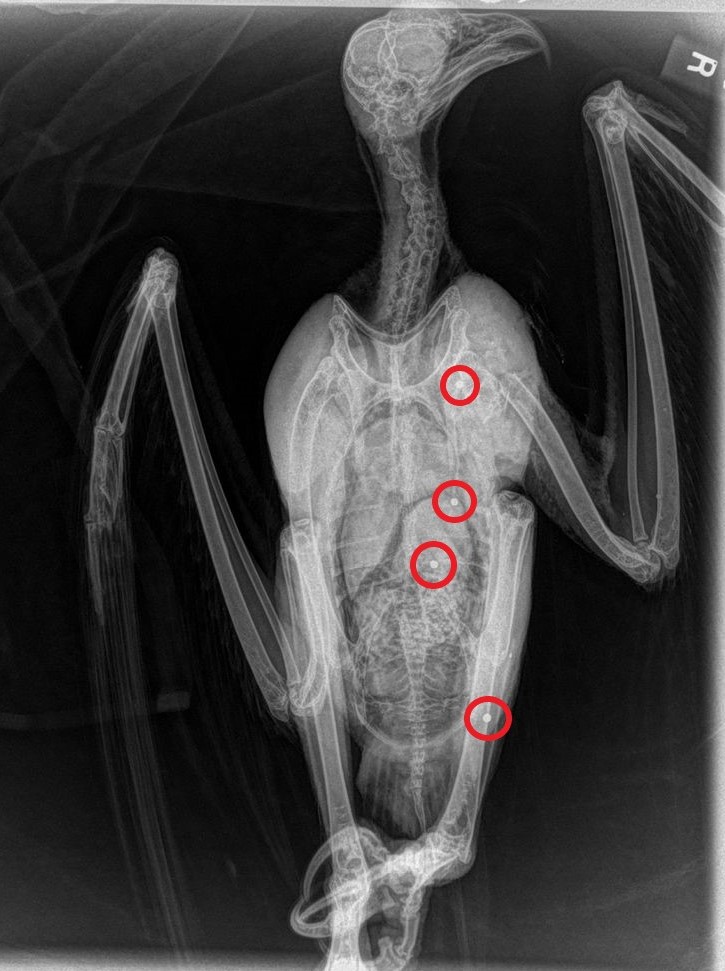
However, the article goes on to claim that the Osprey was ‘shot three times with an airgun‘, but if you look at the x-ray it’s pretty clear that the Osprey has been hit by shotgun pellets (at least four of them – I’ve circled them on the x-ray image below), and not by airgun pellets, which have a distinctively different shape.
The article also claims the Osprey had ‘a ruptured right eye, grazes to its body and a fractured left wing‘. I can’t see the left wing fracture on this particular x-ray but the image of the bird’s left ‘wrist’ area is quite distorted so it’s difficult to tell.
It’s reported that the vets who assessed the injured Osprey considered the best course of action was to euthanise it to prevent further suffering.
The RSPCA is apparently investigating and is ‘asking businesses on the estate to check their CCTV for potential information about the person responsible‘, although obviously the shooting could have taken place elsewhere and the bird could have flown some distance before crash-landing on the estate. However, if it did have a fractured wing then it’s unlikely to have been able to fly very far from the location where it was shot. But perhaps the fracture occurred when it crash landed.
This case was also covered by the BBC News website (here) but that seems to be just a condensed version of the Mercury article and repeats the claim that an airgun was used in the shooting.
The shooting of Ospreys in the UK is relatively rare these days – unlike the targeted shooting of Buzzards, Red Kites, Hen Harriers, Goshawks etc which is still so routine, especially on land managed for gamebird shooting. The last Osprey shooting that I recall in the UK was in 2010 (here).
That’s not to say that Ospreys aren’t still the victims of illegal persecution, but mostly it’s now related to nest disturbance and egg collecting (e.g. see here and here), although there was a case in Derbyshire a few years ago where an Osprey was found with two broken legs and injuries consistent with having been caught in an illegally-set spring trap (here), and an Osprey’s nest was felled with a chainsaw in North Wales two years ago just after the first egg had been laid (here).
Thankfully, these days Ospreys are usually in the headlines for all the right reasons following a series of conservation translocation projects in England (e.g. here), with nest cameras providing an opportunity for the public to follow breeding attempts online (here), Osprey visitor centres attracting thousands of visitors each year (e.g. here) and now even ‘Osprey Cruises’ to watch foraging Ospreys from boats, which sell out so quickly that more trips have now been scheduled (e.g. here). It’s clear that this particular bird of prey seems to attract a great deal of public affection.
If anyone has any information about the shot Osprey found in Tyne & Wear please contact the RSPCA but I’d also encourage you to contact the RSPB’s Investigations Team who can provide specialist and expert assistance to the investigation.
UPDATE 09.30hrs: A vet has been in touch (thank you!) with the following comment: ‘My very rusty veterinary eyes (20 years out of practice!) can see a fracture on the R proximal humerus – also the head of the humerus appears not to be in the shallow socket. Maybe the vet got the L and R markers the wrong way around. Shame there is not a better x-ray after euthanasia. I might be wrong’.
The National Parks & Wildlife Service (NPWS) is planning to reintroduce ospreys to Ireland after a 200+ year absence.
A number of individual birds are regularly recorded there each year, generally passing through on migration. However, ospreys, previously a common breeding species in Ireland, haven’t bred there since persecution caused their extirpation in the late 18th century.
The NPWS is working with colleagues in Norway and plans to bring in up to 70 young ospreys over a five-year period for release in the south-east of Ireland, hopefully starting this summer.
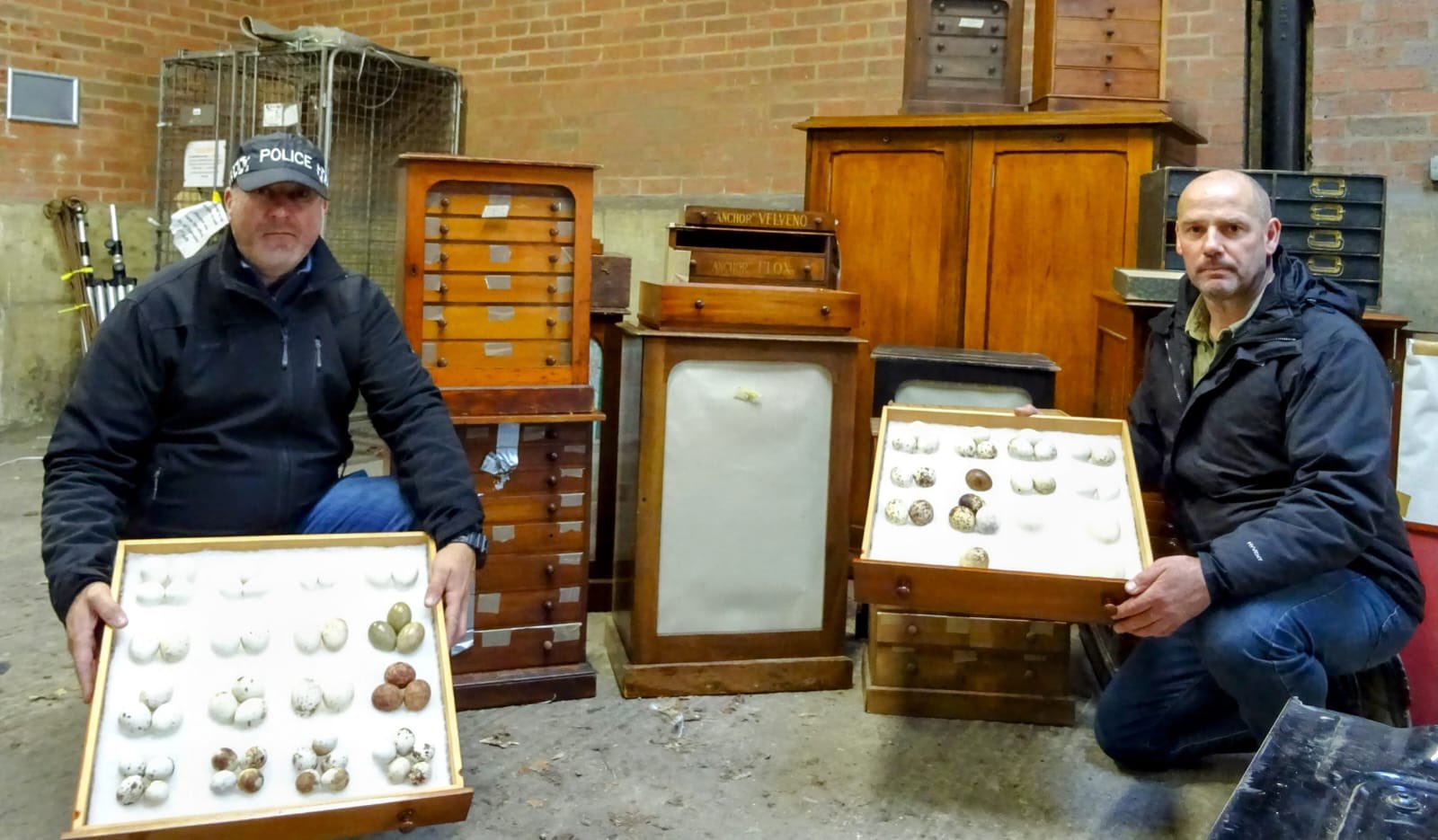
Suffolk Police’s Rural, Wildlife & Heritage Team has seized what it describes as a ‘vast’ egg collection in Halesworth. The haul is thought to include clutches of hen harrier and osprey eggs.
The police raid last Friday was part of Operation Easter, a policing initiative that began in Scotland 25 years ago (see here for background) that primarily targets wild bird egg thieves, although in recent years it has been expanded to also cover related crimes such as the online trade in eggs and the disturbance of nests for photography (see here).
This initiative is a good example of partnership-working. It’s facilitated by the National Wildlife Crime Unit that leads on intelligence reports and key partners include UK police forces and the RSPB’s Investigations Team. It’s seen some major successes over the years, with convictions often including custodial sentences, and large numbers of wild bird eggs being taken out of circulation.
More information about illegal egg collections can be found on the RSPB’s website here.
Well done to Suffolk Police’s Rural, Wildlife & Heritage Team for keeping the public informed.
This is a guest blog written by Bywyd Gwyllt Glaslyn Wildlife, a small Community Interest Company (CIC) working to protect breeding ospreys and other wildlife in the Glaslyn Valley in north west Wales.
Ospreys in the Glaslyn Valley
Thanks to concerted conservation efforts, the osprey has in recent decades made an encouraging comeback in parts of the UK, none more so than in a stunning corner of North West Wales, the Glaslyn Valley near Porthmadog, where a special success story continues to unfold.
It was in 2004 when a local man first spotted an osprey flying up the Valley carrying a fish. He later found a nest and a temporary viewing area and nest protection scheme was quickly organised.
The male osprey was a Scottish bird born in 1998, Ochre 11(98) who had been translocated to Rutland Water, before making his way to Wales. His partner was an unringed female, now known as Mrs G, who remarkably has this year returned for her 19th year and is Wales’ oldest female breeding osprey.
[Scottish osprey Ochre 11]
It wasn’t the best of starts in 2004 with the nest blowing down in a storm, killing two chicks. The nest was repaired over the winter and happily the pair returned the following year and went on to breed until 2014. Their dynasty has since spread far and wide.
Bywyd Gwyllt Glaslyn Wildlife, now in its tenth year, runs Glaslyn Ospreys and has managed the project since the RSPB’s stewardship of the project came to an end in 2013. BGGW is an entirely volunteer-run operation relying on visitor and supporter donations.
The success story of Glaslyn’s ospreys took a new turn in 2015 when 11(98) Mrs G’s partner of eleven years, failed to return.
There were various potential suitors at the Glaslyn nest including one of Mrs G’s chicks from 2012, Blue 80. After some uncertain weeks, an unringed male, thought to be around three years old, Aran, arrived on the scene and went on to breed successfully with Mrs G producing two chicks that year. By 2020 they had gone on to raise a further 13 chicks, some of which have since been resighted in the UK and Africa. A new chapter had opened in the story of Glaslyn Ospreys.
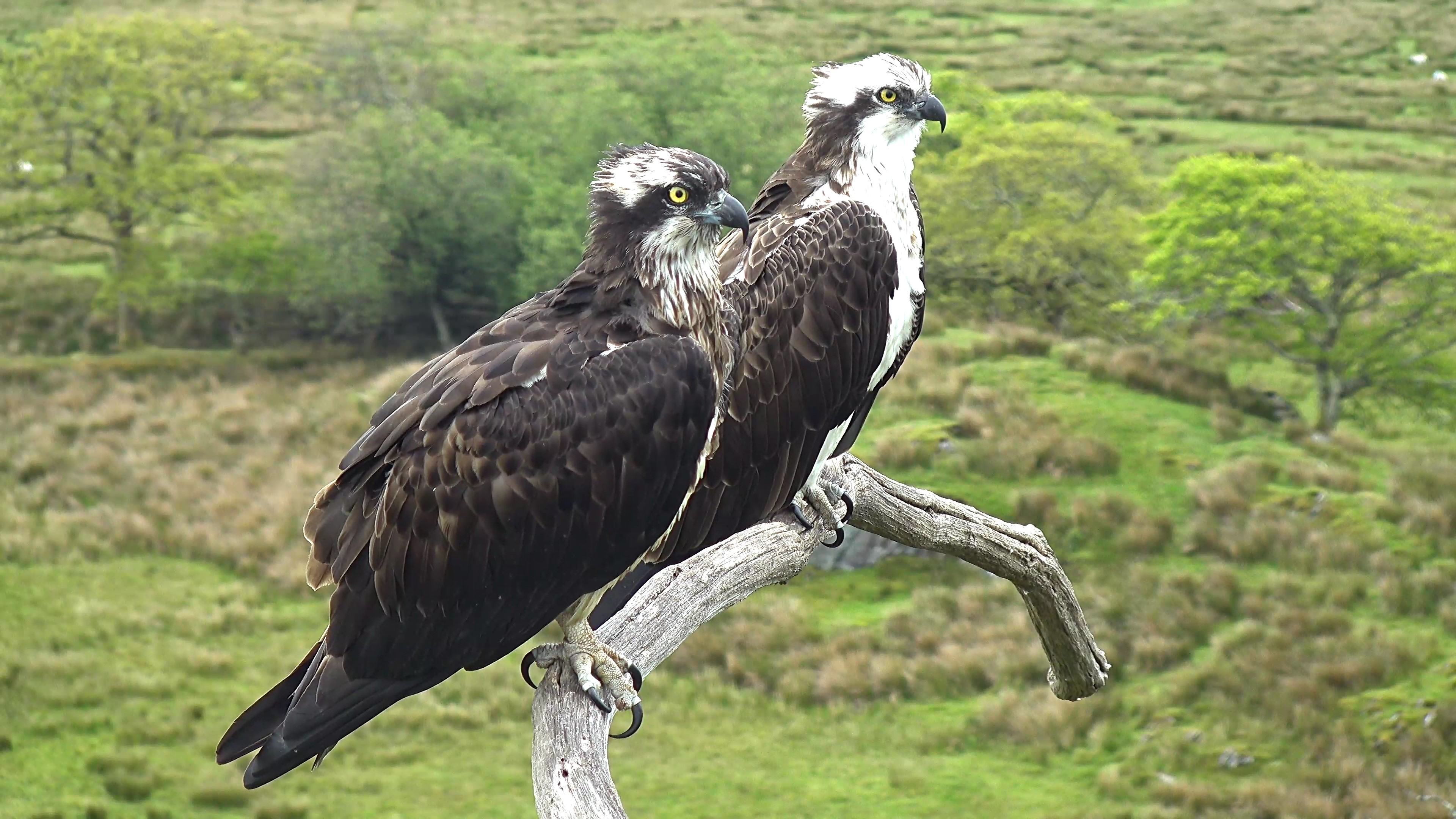
[Osprey pair Mrs G and Aran]
By 2021, forty-one of Mrs G’s chicks with her two partners had fledged and five of them were continuing to breed in the UK. Furthermore, three grand chicks were also known to be breeding in Northumberland and Scotland. In total there were 112 grand chicks and ten great grand chicks the project knew of. Offspring continue to be spotted in their winter migration grounds in Africa and in 2022, the first male chick from 2005, Yellow 37, returned to breed for the twelfth year at Kielder. A family tree produced this year illustrates the story so far.
In 2021 the Glaslyn pair returned to the nest in the Spring and three eggs were laid. Unfortunately, the hatching of the eggs coincided with a severe storm during which Aran injured his wing and, consequently, was unable to fish. Sadly, the chicks died, the first time since 2005 that none had fledged from the Glaslyn nest. It was a tremendous blow for the project, but gradually over the summer Aran went on to make a full recovery, fishing and re-enforcing his bonds to Mrs G and the nest. He returned in perfect condition from his winter migration in April this year and the pair have had three more chicks, bringing the number of the female’s offspring to 52.
[Chicks from the 2014 season – Blue 7C, 8C and 9C. Chick 9C is breeding in northern England and chick 8C was re-sighted this year at Poole Harbour in Dorset and then Loch of the Lowes in Scotland]
In the Glaslyn Valley alone, no fewer than 19 different ospreys were seen and many of them identified on the Glaslyn nest or in the surrounding area last year. Many were Welsh born returnees. In 2022 there are seven known nests in Wales, three of which are in the Glaslyn Valley.
Today, a popular Visitor Centre and a new Hide (recently opened by Iolo Williams) at Pont Croesor provide a place where people from far and wide can see these magnificent birds. Live pictures are streamed from the nest and followed by thousands. The Centre is open every day between 10.30am and 4.30pm until the birds migrate in September.
The project will be represented at Wild Justice’s forthcoming Hen Harrier Fest at Adlington Hall & Gardens in Cheshire on Sunday 24 July. Call in and see us!
Osprey chick hatches at Poole Harbour – the first in southern Britain for 200 years
A pair of wild Ospreys have hatched young at a secret nest site in Poole Harbour, which is the first to hatch in southern Britain for 200 years. The successful hatching is a result of an Osprey reintroduction programme that’s being carried out by Dorset based charity Birds of Poole Harbour and conservation organisation the Roy Dennis Wildlife Foundation.
The reintroduction which began in 2017 is aimed at restoring a population of Osprey to Southern Britain after it was historically eradicated across much of Western Europe. The large, fish eating bird of prey is a summer migrant that returns to the UK each spring having over-wintered in West Africa.
The adult pair of Poole Osprey known as female CJ7 and male 022 first met in Poole Harbour in May 2021 and instantly made a connection. CJ7 had already established a nest the previous year, but had no mate to try and breed with, meaning she spent the whole of 2020 on her own. Once met in 2021 their partnership grew in strength with continuous nest building and pair bonding over the summer, but breeding was never likely as the male was too young. With no breeding in 2021 the pair both left on migration in September that year.
The Osprey project team, as well as members of the public were on tenterhooks in the early spring of this year, eagerly awaiting the safe return of both CJ7 and 022 and after a long and agonising wait, the pair arrived back in early April and got straight down to business.
Paul Morton from the Birds of Poole Harbour charity explained:
“Words don’t even began to describe what this means to us, and of course Osprey conservation in Western Europe. We started our licence application in 2015, and the actual reintroduction in 2017, and the prospect of actually having wild hatched chicks in a nest always felt so far away. But here we are, with an official birthday of June 1st 2022, and we now have the first wild Osprey chick for Southern Britain in 200 years, right here in Poole Harbour“.
The Osprey pair had originally shown interest in a different nest in the harbour during 2020 and 2021, so when they decided to change sites to somewhere else in the harbour this spring it took the project team completely by surprise. Luckily, they had the foresight to put a makeshift webcam on the new nest a few weeks previously just in case, so all the action and this historic moment could be watched live. The pair have been thriving since their arrival back this spring, favouring species such as Grey Mullet and Flounder to feed on.
It’s thought that the pair laid three eggs in the nest during April, meaning the other two should hopefully hatch over the Bank Holiday Jubilee weekend. It’s predicted that once all three chicks have hatched safely, male 022 will become sole provider of fish until the chicks fledge after about 50 days. The chicks will stay low in the nest for the first few weeks, but by mid-June should be visible on the webcam as they grow and build in strength. Once fledged the chicks will stay for several more weeks, flying around and imprinting on the local area, learning that Poole Harbour is home, before instinct then kicks in and they’ll leave on migration. After two years, pending their safe migration down to West Africa and back the youngsters should then return to Dorset and begin thinking about starting families of their own, therefore seeing the beginnings of a new colony in Southern Britain.
Paul Morton concluded:
“The restoration of lost species and biodiversity takes time, and don’t forget, if humans hadn’t got rid of Ospreys in the first place, we wouldn’t have even needed to do a reintroduction. Now these birds are back, and successfully breeding, we hope that they can continue to build in strength as a population here on the south coast and be enjoyed by generations to come. It’s been a huge team effort getting to this point, and everyone within the project is ecstatic and the public response has been just superb. It feels great to actually have some positive news when it comes to raptor conservation here in Dorset”.
Given the furore over SNP MP Angus MacNeil’s call for a cull of white-tailed eagles in Scotland (see here), here’s a timely press release from the charity Birds of Poole Harbour:
Reintroduction programmes working: historic osprey & white-tailed eagle projects bring education and eco-tourism opportunities to the south of England
The recent arrival of a pair of Ospreys and several White-tailed Eagles into Dorset – specifically Poole Harbour – has seen new, exciting environmental education and eco-tourism opportunities arise which are set to benefit schools and the local economy.
Ospreys, which haven’t bred in Southern Britain for nearly 200 years, are on the brink of returning thanks to a reintroduction program which began in Poole Harbour in 2017. Whilst White-tailed Eagles, which haven’t bred in England for over 250 years, began regularly appearing in Poole Harbour in September last year with a young male called G461 who began exploring and making the harbour his home. The eagles, which have an 8ft wingspan, originated from the Isle of Wight reintroduction programme that’s being hosted by The Roy Dennis Wildlife Foundation and Forestry England.
The Poole Harbour Osprey reintroduction programme, which is being carried out by local charity Birds of Poole Harbour and The Roy Dennis Wildlife Foundation, received a boost this week when a male and female Osprey arrived back safely on their migration from West Africa and settled on a nest platform at a secret location in the area. The pair known as CJ7 and 022 first met last summer, although the male was too young to breed. However, they’ve now both retuned early enough meaning there’s a good chance the pair will attempt to breed this summer, which will be a historic moment for Dorset and southern Britain.
[Ospreys CJ7 (female) and 022 (male) on a nest platform in Poole Harbour, April 2022. Photo by Birds of Poole Harbour]
During the latter months of 2021, a male White-tailed Eagle known as G461 spent his days touring the harbour, being seen regularly at sites like RSPB Arne, Brownsea Island and from public bird boat tours. Local school Longfleet Primary also had a special encounter, whilst taking part in the School Bird Boat project, an initiative run by the Birds of Poole Harbour charity when they saw the massive lumbering giant over the Brownsea Lagoon, providing a nature experience never to forget.
[White-tailed eagle on Brownsea Lagoon with Poole Quay in the background. Photo by Alison Copland]
As a result of the reintroductions of both White-tailed Eagles and Ospreys in southern Britain, it’s predicted that both species will establish breeding populations on the south coast over the coming years, which will not only help re-establish the species across their native range, but bring significant economic benefits too.
A recent study called the “The Economic Impact of White-Tailed Eagles on the Isle of Mull”, published by RSPB Scotland, has revealed the scale of the economic benefits that White-tailed Eagles have in that area. Tourism inspired by these majestic birds of prey accounts for between £4.9 million and £8 million of spend every year on Mull with the money supporting between 98 and 160 full time jobs on the island, and between £2.1 million and £3.5 million of local income annually. It’s hoped that the South Coast will benefit in a similar way, with evidence already emerging that the eagles are beginning to have a positive impact in the area.
In recent weeks several other White-tailed Eagles have found their way into Poole Harbour, including two regularly visiting females known as G801 and G318. Their presence has seen excitement build even more with visits to nature reserves and bird boat bookings increasing as a result.
There are also now plans through different initiatives to use the eagle’s and Osprey’s presence as a platform to engage local schools in educating students about the process of nature recovery, reintroductions and restoration. Live webcams have been installed on several of the Osprey nests so schools and members of the public can hopefully watch this historical moment.
Paul Morton from the Birds of Poole Harbour charity stated:
“It’s been a fascinating last 6 months. Never in our wildest dreams did we ever think we’d regularly be seeing White-tailed Eagles in Poole Harbour, but here we are, thanks to the hard work and persistence of multiple teams, that dream has become a reality. Also, to now have a pair of Osprey back in the harbour looking to set up territory is a perfect scenario.
One of the highlights of my career was the school bird boat last year when we saw male eagle G461 with Longfleet School. It was a really significant moment as it highlighted how far we’ve come as a society in our understanding, acceptance and knowledge in taking on ‘big’ projects like this. It’s not just eagles either. We’re of course currently carrying out our Osprey reintroduction right here in Poole Harbour, another species that hasn’t bred here for nearly 200 years due to human persecution, and with both ‘CJ7 and 022’ now safely back, we’re on the brink of seeing them back where they should be.
We’ve seen a real increased desire from the public to learn about and experience these reintroduction stories. On our Spring Safari Cruises recently we’ve been seeing the female White-tailed Eagles from the boat and most recently displaying Osprey too. It’s just magical. It was without doubt one of the most incredible moments of my career. To witness and share these moments with like-minded people was truly special, as it symbolised hope, progress and willingness to make things better. It was a hugely positive experience, something we all need at the moment”.
The Poole Harbour Osprey reintroduction has also shown the positive economic impacts these kinds of projects have on an area with the Birds of Poole Harbour charity seeing an increase in the number Osprey boat tours they’re now hosting each year. When the reintroduction project started in 2017 they hosted just three boat tours, however, this coming August and early September they’re hosting thirty. The team have now also begun twice weekly tours to cater for the demand in interest.
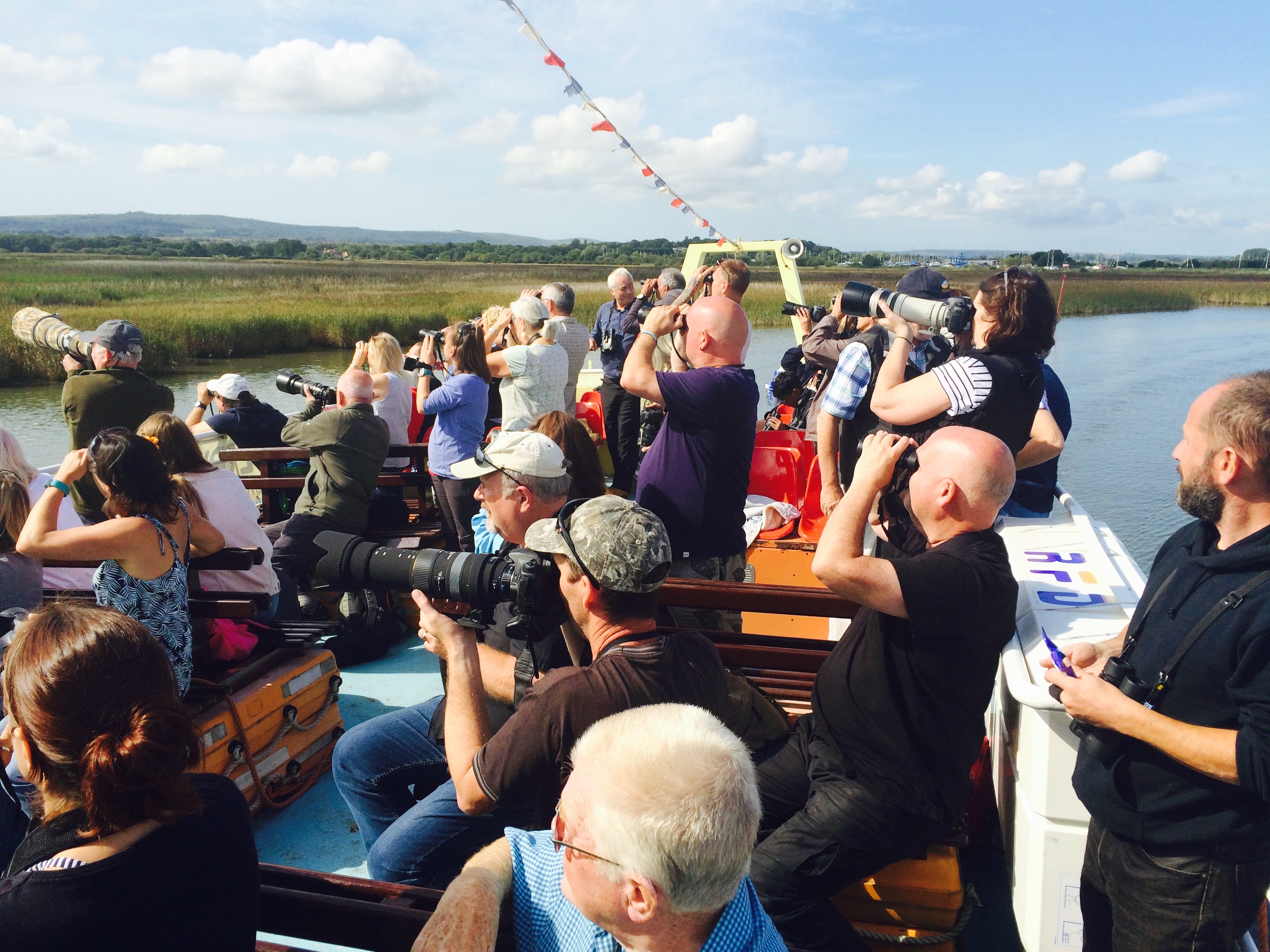
[Eager members of the public have been flocking on to the Birds of Poole Harbour ‘bird boat tours’ to have a guided view of the ospreys, eagles and other wildlife. Photo by Ruth Tingay]
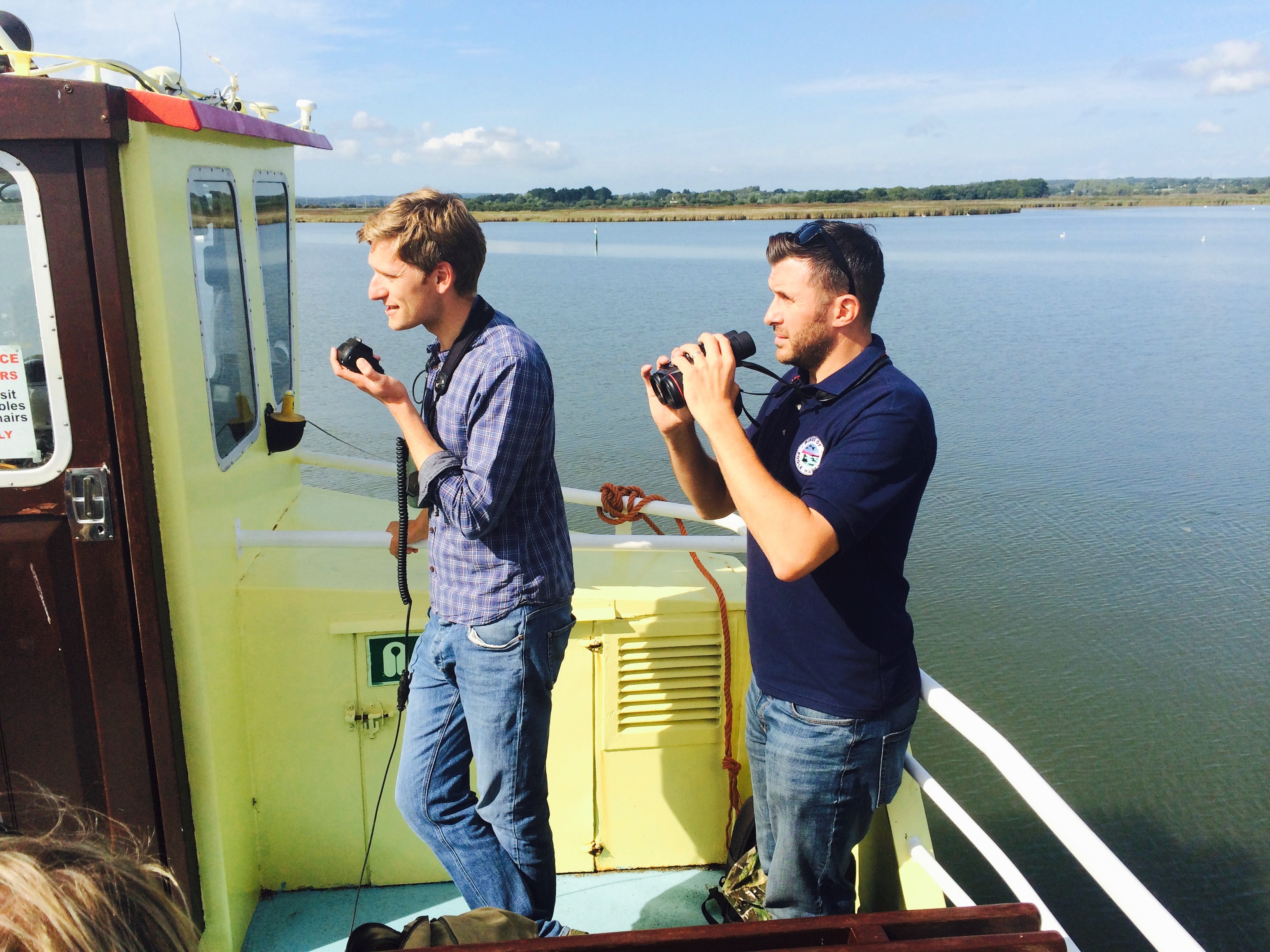
[Tim Mackrill from the Roy Dennis Wildlife Foundation and Paul Morton from the charity Birds of Poole Harbour giving a running commentary on one of the guided ‘bird boat’ trips. Photo by Ruth Tingay]
It’s not all good news as sadly, the male eagle G461 was recently found dead on a private estate in North Dorset having been confirmed by Dorset Police to have ingested high levels of a rat poison called Brodifacoum. Conservationists involved in the project have seen this a tragic loss, but are committed to persevering and completing the reintroduction despite this set back. This wasn’t only devastating for the team carrying out the project, but also the school children that saw him on their school trip and the members of the public who watched in awe as he made his way around the harbour in late 2021.
To help protect any current or future nesting attempts of Osprey in Poole Harbour, the Dorset Wildlife Crime Team have committed to supporting and advising on keeping the birds safe from disturbance.
Paul Morton added: “It’s a really fascinating time for nature conservation. There will always be challenges and the death of the male sea eagle won’t be forgotten, but it’s through close, collaborative partnership working, including with Dorset Police, that we can all make things better. For example, in 2016 we discovered there was a mass-illegal collection of gull eggs from Poole Harbour’s Black-headed and Mediterranean Gull colony. As soon as we found out we contacted Dorset Police who played pivotal role in getting the issue stopped with regular harbour patrols and liaising with us. It was so successful that the story made the national news and even featured on BBC’s Countryfile. Dorset Police have also been hugely supportive in regards to any immediate or future nesting attempts of our Ospreys making sure any nests get the best protection they can. It’s these types of partnerships and positive approaches to tackling these issues which will ultimately see success”.
Birds of Poole Harbour has said they’re committed to making sure that the pupils exciting experience last year doesn’t end on a negative, and are keen the children understand efforts are being made to look after the remaining eagles that are currently exploring the UK. With other White-tailed Eagles from the reintroduction program now beginning to visit Poole Harbour, more opportunities will be arise to see these awe-inspiring birds of prey in a wild setting.
Tim Mackrill from the Roy Dennis Wildlife Foundation explained:
“When we heard last year that the school children had seen the sea eagle from their boat trip it was really exciting because we know that experiences like that can ignite a real passion for natural history and conservation. The fact that other White-tailed Eagles are now visiting the harbour on a regular basis is an extremely encouraging sign for the future and shows what a superb place Poole Harbour is for these amazing birds. I hope that many more people, of all ages, will be able to enjoy the thrill of seeing them here and in other locations along the South Coast for many years to come”.
ENDS
The live webcam which will hopefully document the first breeding pair of ospreys in southern England in nearly 200 years can be viewed here:
HUGE congratulations to the conservationists who have spent years working on the osprey reintroduction project, particularly Roy Dennis, Tim Mackrill, Paul Morton, Brittany Maxted, Liv Cooper and Lucy Allen. They’ve had a long slog, including plenty of heartbreak, but hopefully this will be the year where their efforts finally pay off.
I have to say I’m totally unconvinced by Dorset Police’s ‘commitment to supporting and advising on keeping the birds safe from disturbance‘ after their appalling failure to conduct a proper investigation into the poisoning of a white-tailed eagle on a shooting estate in Dorset (here). Really, don’t bother.
If anyone is interested in booking on to one of the Birds of Poole Harbour Osprey Cruises in August (which I thoroughly recommend), you’ll find booking information here.
Title: Species Protection Officer (x 4 posts) Status: April 2022 – June 2022, 17.5 hours per week Salary: £17,290 pro rata per annum Location: Loch of the Lowes, Dunkeld Closing date: 31 January 2022, 12 noon
Scotland’s leading nature conservation charity is looking for enthusiastic individuals to undertake the role of Species Protection Officer (SPO) based at Loch of the Lowes. This paid role includes free accommodation, invaluable training and the opportunity to develop experience in nature conservation, working with volunteers and public engagement!
A substantial portion of Osprey Watch duties will require SPOs to work night shifts. The role will also require working closely with the Perthshire Ranger, the Volunteer Nest Protection Team and Visitor Centre staff.
During this 8-week role, candidates will focus on providing an ‘Osprey Watch’ nest protection programme based at Loch of the Lowes. This will be a combination of paid working hours and voluntary unpaid hours. Successful candidates will work under a 17.5 hour temporary employment contract, the remainder of the 35 hours each week will be under a volunteer agreement. Successful candidates will receive invaluable training, practical experience, and free accommodation, in a loch-side, wooden eco-bothy for the duration of the role.
Duties include: • Monitor and record breeding ospreys’ behaviour • Provide round the clock ‘osprey watch’ protection of resident ospreys, their nest and eggs during the critical part of the breeding season • Monitor additional webcams for beaver activity and other wildlife footage • Create interesting social media and blog posts about the osprey breeding season
Training and Support: The candidate will have the fantastic opportunity to gain experience in; • Species ID • Managing data • Use of webcam and security camera software • Use of Adobe Premier Elements editing software • Use of WordPress and other social media platforms • Working with volunteers • Public engagement
The successful candidate(s) will ideally have:
• An interest and passion in nature conservation • Good knowledge of natural history and species ID • Experience of bird monitoring or species protection work is beneficial • The willingness to live in shared accommodation with colleagues • The ability to work unsociable hours, including nightshift • A reasonable standard of physical fitness and resilience to undertake shifts in the hide in cold conditions • A positive and flexible approach to work and other team members • The ability to communicate with volunteers, staff and members of the public in a confident manner • A high level of self-motivation, personal responsibility and organisational skills • Good computer literacy skills, including a working knowledge of Excel
Please note the Species Protection Officer role is dependent on the return of breeding ospreys. Strict Covid-19 procedures will be in place, particularly with regards to the bothy accommodation.






 Raptor Persecution UK