Protest rally against mountain hare slaughter takes place at Holyrood tomorrow

Just a reminder that there will be a protest rally outside the Scottish Parliament building tomorrow, against the continued slaughter of mountain hares on Scottish grouse moors.

As many of you will know, tens of thousands of mountain hares are massacred on Scottish grouse moors, including inside the Cairngorms National Park. These killing sprees are unmonitored, unregulated and uncontrolled (see here for plenty of background information).

The rally will take place between 12-2pm and there will be various speakers including Alison Johnstone MSP, David Stewart MSP and Harry Huyton (Director of charity OneKind, the event organisers) – further details here.

The gamekeeping community is agitated about this protest rally. Last week the Scottish Gamekeepers’ Association tried to deflect attention from their hare killing sprees by drawing attention to other mountain hare culls that take place during the closed season, licensed by SNH, for the purpose of protecting forestry (see here). What the SGA actually achieved by publishing this was a massive own goal – hilariously explained in this OneKind blog here.

Not to be deterred, this week the SGA has sent a briefing note to all MSPs, ahead of the protest rally, trying to explain that the killing of tens of thousands of hares on grouse moors is for the hares’ own good. They also claim that all those dead mountain hares are destined for the human food market.

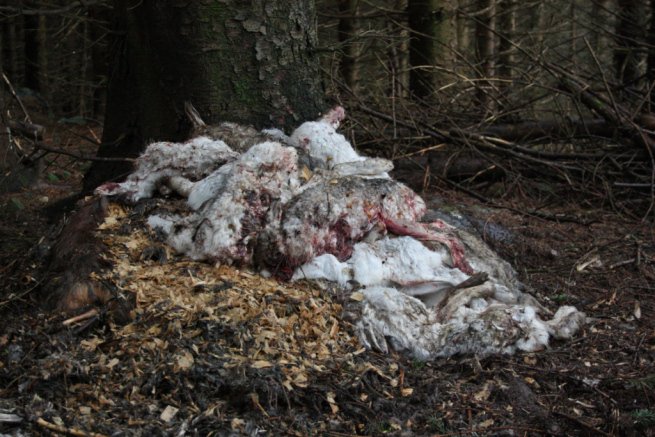
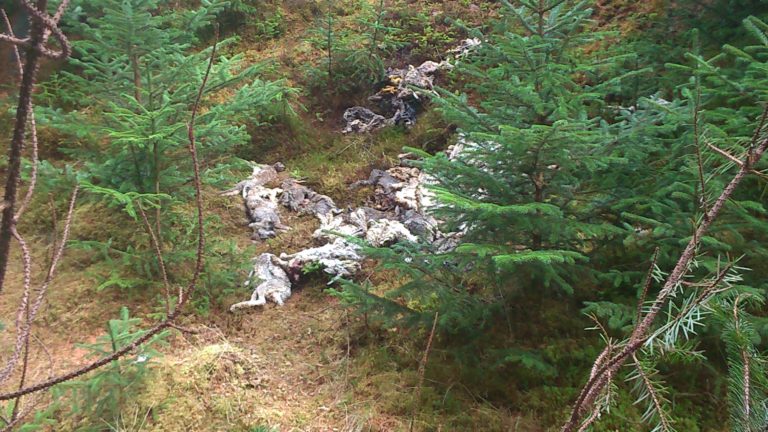
Here’s a pile of shot mountain hares that didn’t make it to the human food market. They were dumped in a stink pit on an Angus Glens grouse moor. Surrounded by a circle of snares, the odour of rotting hare flesh would have attracted predators, which were likely snared and killed, their bodies probably added to the stink pit.

If you’re disgusted by this, and think the Scottish Government is failing in its duty to protect this species, please try and get to the rally tomorrow and let MSPs know this matters to you.

Stop killing mountain hares! Protest at Scottish Parliament, 17 November 2016

As many of you will know, thousands of mountain hares are massacred on Scottish grouse moors every year, including inside the Cairngorms National Park. These killing sprees are unmonitored, unregulated and uncontrolled.

The grouse shooting industry justifies the slaughter on the following grounds:

Hares can affect fragile habitats through grazing pressure

Mountain hares can cause the failure of tree-planting schemes

Mountain hares can spread sheep tick which also affects red grouse

Shooting mountain hares is a legitimate sport

Hares_Lecht_25Feb2016 (2) - Copy

Conservationists have long raised concerns about the legality and sustainability of these culls, but all to no avail (see links to our earlier blogs on this issue below). Well now’s your chance to send a strong message to the Scottish Government that enough is enough.

The charity OneKind is organising a protest event at Holyrood on Thursday 17 November 2016, between 12 and 2pm.

Some background info about their mountain hare campaign can be read here.

To join the protest, you need to register here.

You might also want to sign their petition to stop the mountain hare massacres (here).

If you want to find out more about mountain hare massacres, the following blogs will help:

10 November 2013: Massive declines of mountain hares on Scottish grouse moors (here)

11 November 2013: The gruesome fate of mountain hares on Scottish grouse moors (here)

22 November 2013: MSP wants answers about mountain hare culling (here)

11 December 2013: SNH still licensing mountain hare culls (here)

28 September 2014: Mountain hares massacred on Lammermuir grouse moors (here)

21 October 2014: CEH scientist claims gamekeepers “protect” hen harriers and mountain hares (here)

30 December 2014: Pointless call for ‘voluntary restraint’ on Scottish grouse moor mountain hare massacres (here)

10 January 2015: New petition puts more pressure on SNH to protect mountain hares (here)

17 January 2015: “The eradication of mountain hares in eastern and southern Scotland is disgraceful” (here)

23 March 2015: Hare-brained propaganda from the grouse shooting industry (here)

14 April 2015: Ten conservation groups call for 3-year ban on grouse moor mountain hare slaughter (here)

15 February 2016: More mountain hares slaughtered in the Angus Glens (here)

13 March 2016: More mountain hares massacred in Cairngorms National Park (here)

14 March 2016: Cairngorms National Park Authority responds to mountain hare slaughter (here)

20 March 2016: Queen’s Balmoral Estate accused of mountain hare massacre (here)

30 March 2016: ‘Sustainable’ mountain hare culls – where’s the evidence? (here)

28 May 2016: Mountain hare slaughter set to continue in breach of EU regulations (here)

14 June 2016: Mountain hare massacres on Scottish grouse moors: no planned monitoring (here)

mountain-hare-cull-angus-glens-large - Copy

New blog exposing grim reality of grouse moor ‘management’ in Scotland

There’s a great new blog that’s well worth following: UPLAND EXPOSURE

Written by two professional ecologists, the blog offers an insight to the grim reality of upland management in the Scottish Highlands, and has already provided evidence of the disgraceful ‘management’ practices of driven grouse moors, including the erection of mountain hare-proof fences across the moors, ‘designed to split up mountain hare populations making them easier to eradicate because immigration of other hares is stopped’.

This photo is taken from their blog. It’s a ‘stink pit’ (or midden) containing the decomposing bodies of mountain hares. These stink pits are used to attract foxes and other predators, which are then killed in snares and added to the pile of rotting corpses. The photo was taken on the boundary of a grouse moor and forest near Inverness.

hare stink pit via UplandExposure

Mountain hare massacres on Scottish grouse moors: no planned monitoring

Last month we blogged about a series of Parliamentary questions and answers about mountain hare massacres on Scottish grouse moors and how these unregulated culls are, in our opinion, in breach of EU conservation legislation (here).

mountain-hare-cull-angus-glens-large-copy

Those Parliamentary questions had been lodged by Scottish Greens MSP Mark Ruskell. Now Alison Johnstone, a fellow Scottish Greens MSP, has lodged some more and the Government’s response to those questions is, frankly, shocking.

Question S5W-00222. Date lodged: 25/5/2016:

To ask the Scottish Government what it is doing to establish a working group to help plan the future arrangements for sustainable management of mountain hares.

Answered by Environment Cabinet Secretary Roseanna Cunningham 3/6/2016:

Under the auspices of Scotland’s Moorland Forum (which represents a range of stakeholders involved in moorland management, including the Scottish Government and Scottish Natural Heritage) it has been agreed that guidance on the management of mountain hare be produced by a selected sub-group of specialists and representatives from relevant interest groups. The inaugural meeting of this sub-group took place on 23 May 2016.

The sub-group will produce and publish interim best practice guidance in the autumn. This interim guidance will be updated after the anticipated publication (in 2017) of the findings from a study being undertaken by the James Hutton Institute, the Game and Wildlife Conservation Trust and Scottish Natural Heritage into the most appropriate methods of assessing mountain hare numbers.

The outputs of the study will be used to standardise the method of establishing mountain hare density in conjunction with the promotion of more cooperative working between estates, thus facilitating better informed decisions on sustainable hare management at regional scale.

Question S5W-00223. Date lodged: 25/5/2016:

To ask the Scottish Government what level of estate compliance Scottish Natural Heritage has recorded in relation to its 2014 position statement, ‘SNH-GWCT-SLE position on large-scale culls of mountain hares to reduce louping ill‘.

Answered by Environment Cabinet Secretary Roseanna Cunningham 3/6/2016:

The position statement issued by Scottish Natural Heritage, the Game and Wildlife Conservation Trust, and Scottish Land and Estates sets out a number of different recommendations relating to the management of mountain hares in Scotland. There are no formal arrangements for monitoring the extent to which the recommendations are being followed.

Question S5W-00224. Date lodged: 25/5/2016:

To ask the Scottish Government when SNH plans to require formal mountain hare cull returns from estates in order to inform future sustainable management practice for this species.

Answered by Environment Cabinet Secretary Roseanna Cunningham 8/6/2016:

There are no current plans to require mountain hare bag returns.

END

So ‘best practice guidance’ is to be produced in the autumn by a sub-group of the Moorland Forum. We don’t yet know which organisations have representatives on that sub-group but we can take a guess. One of them is bound to be Scottish Land & Estates – that’s the group that repeatedly says, without any supportive evidence, that widespread and indiscriminate culls are not having a detrimental effect on mountain hare populations.

And will that ‘best practice guidance’ follow the recommendations made in a recent independent review on sustainable moorland management which was submitted to SNH’s Scientific Advisory Committee in October 2015? One of the main recommendations made in that review was that the case for widespread and intensive culling of mountain hares in the interests of louping-ill control has not been made (see here). That should, technically, put a stop to mountain hare massacres on grouse moors. Why hasn’t it?

And what, exactly, is the point of producing best practice guidelines anyway? The estates involved in mountain hare massacres are not obliged to adhere to these ‘guidelines’, and, as we can see from the Government’s responses to the two other Parliamentary questions, there are no formal arrangements for monitoring estate compliance and nor are there any plans to require these estates to submit figures on how many hares they’ve massacred each year.

Why is that? How difficult is it to actually monitor estate compliance? If it is so very difficult, there is no point whatsoever in producing best practice guidelines for an industry with a reputation for long-term criminality. Guidelines can be ignored without suffering a penalty. Legislation can, and often is, ignored by many in this industry but at least there’s the (very slim) possibility of a penalty if they’re caught at it.

And what possible reason is there not to ask for annual cull figures from each estate? Why isn’t the Government demanding these figures? Surely they are obliged to do so in accordance with their obligations under the EU Habitats Directive? It can’t be that difficult for the estates to produce these figures. After all, they claim their culls are already ‘done in accordance with best practice’ and are ‘informed and balanced’ (see here). If they can make such claims then presumably they’ve already got the evidence to back them up? If they haven’t got the evidence then these claims should be treated with the contempt they deserve. It’s just another propaganda exercise to deflect attention from what’s actually going on on those grouse moors.

Hares_Lecht_25Feb2016 (2) - Copy

The Scottish Government’s lack of critical evaluation of this situation, their willingness to ignore the findings of an independent review, and their unwillingness to take any meaningful steps to prevent the ongoing extensive and indiscriminate slaughter of this so-called protected species at the hands of grouse moor managers is nothing short of disgraceful.

Mountain hare slaughter set to continue in breach of EU regulations

A couple of weeks ago, Scottish Greens MSP Mark Ruskell lodged the following parliamentary question:

Question S5W-00044, Mark Ruskell (Mid Scotland and Fife, Scottish Green Party); Lodged: 09/05/2016:

To ask the Scottish Government what its position is on the culling of mountain hares on estates practising driven grouse shooting.

mountain-hare-cull-angus-glens-large - Copy

Cabinet Secretary for the Environment, Roseanna Cunningham has now answered with this:

The Scottish Government does not support large, indiscriminate culls of mountain hares in Scotland and recognises the concerns that have been expressed about the status of mountain hare populations in Scotland. The Scottish Government acknowledges that mountain hares are a legitimate quarry species and that there may be local requirements to control mountain hares to protect gamebirds and young trees. Any control of mountain hares should be undertaken in accordance with obligations under the EU Habitats Directive.

Given the concerns about possible over-exploitation, information on the management of hares has been reviewed by independent experts from the Scottish Natural Heritage (SNH) Scientific Advisory Committee. This review was published in October 2015 and is available at: http://www.snh.gov.uk/docs/A1765931.pdf. The review identified the need for improved monitoring and data to assess national trends of mountain hare populations.

This work is underway in the form of a collaborative four year study (2014-17) involving SNH and scientists in the James Hutton Institute and the Game and Wildlife Conservation Trust, on trialling various methods of counting hares. The study has the aim of developing a reliable and cost-effective means of assessing mountain hare population density.

SNH is also working with Scottish Land & Estates to encourage greater transparency in the reasons why estates cull hares and to encourage estates to collaborate and develop a more measured and coordinated approach to sustanable hare management.

END

Oh, where to begin!

The Cabinet Secretary for the Environment says the culls should be done in accordance with obligations under the EU Habitats Directive. Yes, they should be, but they’re not, are they? They can’t possibly be because one of the obligations is a legal requirement to ensure the management of this species “is compatible with the species being maintained at a favourable conservation status“. To assess whether the species’ conservation status is favourable or unfavourable requires decent population-level data to establish the impact of these unregulated mass culls. Those data are not yet available (although Dr Adam Watson has provided long-term mountain hare counts, see below).

The Cabinet Secretary for the Environment says work is underway to get these data, but that work doesn’t finish until 2017. In the meantime, SNH should have applied the precautionary principle and placed a temporary moratorium on mountain hare culling, as they were asked to do in 2015 by ten conservation organisations (see here). SNH has chosen instead to call on sporting estates to undertake ‘voluntary restraint‘, a doomed policy already proven not to be working (e.g. see here and here). Of course this approach isn’t going to work when the estates’ representative organisation, SLE, insists, without supportive evidence, “there is no issue over population reduction” (see here).

The Cabinet Secretary for the Environment refers to an independent review of sustainable moorland management, which included information about mountain hare culling. She mentions that the review identified the need for improved monitoring and data. What she forgot to mention was that this review also included the following statement (see page 20):

Given that culling can reduce mountain hare densities to extremely low levels locally (Laurenson et al., 2003), and population trends are poorly known despite the species being listed under the Habitats Directive, the case for widespread and intensive culling of mountain hares in the interests of louping-ill control has not been made.

She also forgot to mention something else reported in this review, the availability of long-term time series data of mountain hare counts by Dr Adam Watson (see page 21):

These latter data derive from 63 moorland sites, mainly in upland Aberdeenshire, with data in some cases extending back to the 1940s. Initial examination of this remarkable data set provides a strong prima facie case for long term population declines across moorland but not arctic-alpine habitats.

The Cabinet Secretary for the Environment also says that SNH is working with SLE to encourage ‘greater transparency’ about why mountain hares are culled. That’s an interesting one. Earlier this year, SLE provided explanations for why these culls take place. Apparently it’s because “hares can affect fragile habitats through grazing pressure, can spread sheep tick which also affects red grouse, and can cause the failure of tree-planting schemes”. They also said, contradictorily, that mountain hares are culled “to conserve the open heather habitat” (see here). At the time, we took these reasons apart as follows:

Hares can affect fragile habitats through grazing pressure“. They probably can, although if their natural predators weren’t being exterminated this would lessen any pressure. And would those be the same fragile habitats that are routinely burned with increasing frequency and intensity as part of grouse moor ‘management’, causing industrial-scale environmental damage (e.g. see here and here)?

Mountain hares can cause the failure of tree-planting schemes“. They probably can, but how many tree-planting schemes are taking place on driven grouse moors? According to Doug McAdam (CEO of SLE), hare culling takes place “to conserve the open heather habitat“. So which is it? It can’t be both.

Mountain hares can spread sheep tick which also affects red grouse“. Ah, and there it is! What this all comes down to – mountain hares are inconvenient to grouse moor managers whose sole interest is to produce an absurdly excessive population of red grouse so they can be shot for fun.

Given that the independent review, referenced above by the Cabinet Secretary, states that “the case for widespread and intensive culling of  mountain hares in the interests of louping-ill control has not been made”, how come SLE and their member estates are still permitted to carry on with this slaughter?

In summary then, the Scottish Government doesn’t support large, indiscriminate culls of mountain hares, and neither do ten conservation organisations, and neither does a large proportion of the general public who responded angrily to images of this year’s massacre. The culls are in clear breach of the EU Habitats Directive because the impact of culling on the species’ conservation status is unknown, although long-term counts, dating back to the 1940s, provide a strong prima facie case showing long-term population declines of mountain hares on grouse moors.

And yet the culls are set to continue again later this year when the closed season ends on 31 July.

Massive failure by the Scottish Government and its statutory conservation agency SNH.

But watch this space – the charity OneKind is planning to launch a campaign against mountain hare culling – more details to follow later this year.

Statement from Cairngorms National Park Authority re: shot goshawk

mon-15-june-copyGrant Moir, Chief Executive of the Cairngorms National Park Authority, has today issued a statement about the recent shooting of a goshawk (here) on land within the National Park:
We are incredibly frustrated to again be putting out a statement condemning the shooting of a raptor in the National Park. We must ensure such crimes become a thing of the past. We will be working with the new Minister for Environment to consider what else we can do in the National Park, building on public support for our wildlife and finding ways of getting more eyes and ears on the ground. We encourage anyone with information relating to this incident to contact the police by calling 101”.

The condemnation is good and is the least we should expect. However, the bit about “We will be working with the new Minister for Environment to consider what else we can do….” shows good intent, but in reality amounts to little more than a PR soundbite.

Remember the Cairngorms Nature action plan, aimed at restoring raptor populations & managing mountain hares for the benefit of golden eagles within the Cairngorms National Park (CNP), launched with great fanfare in May 2013 (see here)?

A resounding failure, as evidenced in May 2013 by the mysterious ‘disappearance’ of a young sat-tagged golden eagle on a CNP grouse moor (here); in May 2013 by the alleged ‘coordinated hunting’ and subsequent shooting of a hen harrier on a CNP grouse moor (here); in April 2014 by the mysterious ‘disappearance’ on a CNP grouse moor of East Scotland’s first fledged white-tailed eagle in ~200 years (here); in May 2014 by this video of masked armed gunmen attacking a goshawk nest within the CNP (here); in October 2015 by the publication of a scientific study documenting the long term decline of breeding peregrines on grouse moors in the eastern portion of the CNP (see here); in February 2016 by the publication of a scientific study documenting the catastrophic decline of breeding hen harriers in the eastern portion of the CNP (here); in March 2016 by the discovery of a dead hen harrier ‘Lad’, suspected shot, found on a grouse moor within the CNP (here); in March 2016 by the news that mountain hares were being massacred on grouse moors within the CNP (here); and again in March 2016 by news that further mountain hare massacres were taking place on grouse moors within the CNP (here); and now in May 2016 by the news that a goshawk was shot on an estate within the CNP (here).

And also remember, the CNPA has already met with the (now former) Environment Minister in January 2015 to discuss the issue of raptor persecution and moorland management within the NP – we blogged about that meeting here. The Environment Minister said afterwards that she ‘welcomed the positive collaboration shown between the CNPA and landowners and looked forward to seeing a real difference on the ground‘.

What is the point of the CNPA having further discussions with another naive Environment Minister? It’s utterly pointless. The grouse moor managers within the Cairngorms National Park are running rings around the Park Authority, and have been doing so for years: Golden eagles poisoned, golden eagles ‘disappearing’, white-tailed eagles ‘disappearing’, hen harriers being shot, breeding hen harriers in catastrophic decline, goshawks being shot, goshawk nests being attacked, breeding peregrines in long-term decline, mountain hares massacred. All within the Cairngorms National Park, the so-called ‘jewel’ of Scottish wildlife. It’s scandalous.

What we need, urgently, from the CNPA is action, not more hand-wringing and platitudes. For a start, the CNPA could be looking at the Sandford Principle (see here and here). There’s an excellent blog called Parks Watch Scotland that has also suggested some courses of action the CNPA could take: see here and here.

The CNPA CEO said today he was ‘incredibly frustrated’. We all are, but the difference is the CNPA has the power to do something about it.

Actually, we do have some power, albeit more indirect than the powers of the CNPA. We have the power to blog about the rampant and persistent persecution of wildlife within the National Park and by doing so, raise awareness amongst an unsuspecting general public of just what is happening to THEIR wildlife within the boundary of THEIR National Park. We’re pretty sure that as more people get to hear about it, the vast majority will be outraged and will join the call for further action to be taken against those grouse moor estates.

Please sign the petition and join 35,000+ calling for a parliamentary debate on the banning of driven grouse shooting: HERE

Banning driven grouse shooting on the Scottish political agenda

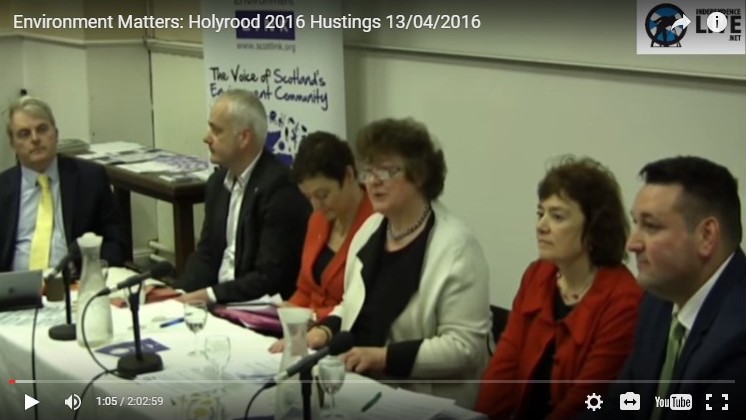
Last night Scottish Environment Link hosted an event called ‘Environment Matters’, a national hustings event in the run up to the election in May.

It was recorded and is available to watch here.

Hustings

Brilliantly chaired by Joyce McMillan (LINK President) it’s worth watching even if you have just a passing interest in general environmental issues. For us, we were particularly interested in the discussion on wildlife crime, raised as a topic by audience member Andy Myles (see 56 mins in), and specifically the response given by Scottish Green Party candidate Mark Ruskell (see 1:06 mins in).

The actual topic of banning driven grouse shooting wasn’t part of Andy Myles’ question; Andy’s question was whether the panel would be prepared to separate poaching from wildlife crime. But it was interesting (and pleasing) that in his response, Mark Ruskell immediately linked, perhaps subconsciously, the subject of wildlife crime to driven grouse shooting.

Mark Ruskell proved to be pretty well-informed, as well he should, given that one of his fellow electoral candidates (Andy Wightman) recently co-authored a report on the intensification of grouse moor management in Scotland (here) and another party colleague (Alison Johnstone) has repeatedly raised parliamentary questions about dodgy wildlife ‘management’ on grouse moors (e.g. here).

Here’s how Mark responded to Andy’s question:

I think there’s a wider issue there about the management of country estates and I think we’ve seen a lot of criticism of estates that are practicing driven grouse shooting, and we know what those environmental impacts are: the muirburn, the raptor persecution, the use of veterinary medicines spread over moorlands, the targeting of non-target species like hares as well, and I think we need to see a reform of country estates and the way they manage themselves. I think that if that can’t take place then the argument in favour of licensing will kick in, and you’ve obviously seen high profile calls and petitions for a banning of driven grouse shooting as well. I don’t think we’re quite there yet in terms of the evidence but I think there needs to be a willingness from the larger landowning interests to address the very serious environmental problems that they’re creating, and I think personally that probably lends to some form of licensing going forward“.

The bit where he said “I don’t think we’re quite there yet in terms of the evidence” [for banning driven grouse shooting] was a bit confusing, because he’d already stated that the environmental impacts were already well known. The evidence isn’t lacking at all; the question is how to deal with the evidence, i.e. wait for the landowners to get their acts together and act lawfully, or introduce licensing, or ban driven grouse shooting.

The first approach is a complete non-starter. The grouse shooting industry has had 62 years to stop illegally killing raptors and yet still it goes on. And judging by the industry’s recent fatuous responses about heather burning “It’s the same as getting your hair cut” – see here, and mountain hare massacres being “informed and balanced” – see here, then the only two options remaining are to introduce licensing or ban driven grouse shooting altogether.

So what does the electorate think? Well, according to a recent YouGov poll, 52% of polled Scottish voters agreed that driven grouse shooting should be banned (and only 19% opposed) – see newspaper article here and a more detailed report of the survey here.

And if you look at the groundswell of support from Scottish constituencies for Mark Avery’s latest e-petition to the Westminster Government to ban driven grouse shooting in England (here), then it’s pretty clear what many are thinking.

It’s great to see this issue rising up the political agenda, and it’s not going away.

Mark Avery’s e-petition to ban driven grouse shooting is less than one month old and this evening it has passed 19,000 signatures. If you want to add yours, please sign HERE

‘Sustainable’ mountain hare culls – where’s the evidence?

Hares_Lecht_25Feb2016 (2) - CopyTwo staff members from Scottish Land & Estates, the landowners’ lobby group, have been desperately trying to defend the indefensible mass slaughter of mountain hares on grouse moors.

Tim (Kim) Baynes of SLE’s Scottish Moorland Group wrote a lame article on the subject a couple of weeks ago (we blogged about it here) where he claimed mountain hare slaughtering was done “in accordance with best practice” and that these culls are “informed and balanced” and that they didn’t take place every year. He was also quoted extensively in an article in Scottish Farmer (here), where he stated that ‘voluntary restraint was exercised’ and claimed that mountain hares were culled because “hares can affect fragile habitats through grazing pressure, can spread sheep tick which also affects red grouse, and can cause the failure of tree-planting schemes“.

A similar article was published in the Sunday Herald last week (here), penned by SLE’s CEO Doug McAdam. (For those affected by the Herald’s paywall, the article is reproduced here and here). McAdam recites the exact same reasons for mountain hare culling: “hares can affect fragile habitats through grazing pressure, can spread sheep tick which also affects red grouse, and can cause the failure of tree-planting schemes“. He also states that mountain hare culls are “properly organised and humane” and also says culls don’t take place every year. He then tries to nonsensically suggest that mountain hare culling is no different to deer culling, but ‘forgets’ to mention that deer no longer have any natural predators to keep their populations in check, whereas mountain hares do, or at least they would do if some of those predators (notably golden eagles) weren’t illegally shot, trapped or poisoned on grouse moors.

Let’s just have a look at those excuses for the mass slaughtering of mountain hares.

Hares can affect fragile habitats through grazing pressure“. They probably can, although if their natural predators weren’t being exterminated this would lessen any pressure. And would those be the same fragile habitats that are routinely burned with increasing frequency and intensity as part of grouse moor ‘management’, causing industrial-scale environmental damage (e.g. see here and here)?

Mountain hares can cause the failure of tree-planting schemes“. They probably can, but how many tree-planting schemes are taking place on driven grouse moors? According to McAdam, hare culling takes place “to conserve the open heather habitat“. So which is it? It can’t be both.

Mountain hares can spread sheep tick which also affects red grouse“. Ah, and there it is! What this all comes down to – mountain hares are inconvenient to grouse moor managers whose sole interest is to produce an absurdly excessive population of red grouse so they can be shot for fun.

Both Baynes and McAdam claim that hare culling doesn’t take place every year and when it does that it’s proportionate, “typically reduce the population by 10-20% maximum“.

Compare that claim with the opinion of leading upland ecologist Dr Adam Watson, who wrote in his 2013 book Mammals in north-east Highlands:

I know of no grouse-moor estate within the range of the mountain hare that has not practiced or does not practice heavy killing of hares, with the exceptions of Edinglassie, Invermark, Glen Muick and Balmoral (but most of Balmoral is deer land rather than grouse moor). The only other heather-moorland areas that I know which are free from heavy killing are those owned by non-sporting agencies or by individuals primarily interested in wildlife conservation, such as the RSPB at Abernethy, SNH at Inshriach, the National Trust for Scotland at Mar Lodge, and Miss Walker of the Aberlour shortbread company, who owns Conval hills near Dufftown“.

He goes on to name various estates who, he alleges, “have been reducing the numbers of mountain hares greatly“, some dating back to the 1980s. His named estates include Altyre, Castle Grant, Lochindorb, Farr, Millden, Glenogil, Glen Dye, Dinnet, Invercauld, Tillypronie, Glen Buchat, Candacraig, Allargue, Delnadamph, Crown Estate, Fasque, Cabrach, Glenfiddich, Glenlochy, Gannochy, Fettercairn, Cawdor, Corrybrough, Moy, Glen Lyon.

If Baynes and McAdam are to be believed, then their claims ought to be backed up by scientific evidence. Just taking their word for it doesn’t cut it. So, let’s take several grouse moor estates from within the Cairngorms National Park (named by Dr Watson as allegedly involved in unsustainable mass hare slaughtering, some since the 1980s) and ask Baynes & McAdam to provide supporting evidence that Dr Watson is mistaken.

For the following estates within the CNP (Glenlochy Moor, Glenlivet [Crown estate], North Glenbuchat, Allargue, Delnadamph, Invercauld, Candacraig), can Baynes and McAdam provide the following information from the past ten years:

  1. In what years did mountain hare culling take place?
  2. How many hares were present on each estate before the cull in each year?
  3. What methods were used to assess population size before each cull?
  4. How many hares were culled on each estate in each year?
  5. How many hares were present after the cull on each estate in each year?
  6. What methods were used to assess population size after each cull?
  7. What acreage of grouse moor on each estate was under a tree-planting scheme in each year?

According to the Cairngorms National Park Authority, hare slaughtering within the National Park is “part of a planned annual management cull” (see here), in which case the above data should be easily at hand to share with the concerned general public.

And Tim and Doug, no fogging the figures like you did with your unsupported claims that grouse moors in the Angus Glens support 81 species of ‘breeding or feeding’ birds (see here).

We await with interest.

Meanwhile, the e-petition to ban driven grouse shooting can be signed HERE

Queen’s Balmoral Estate accused of mountain hare massacre

Following on from last weekend’s news of the mass slaughter of mountain hares on grouse moors in the Cairngorms National Park (see here and here), today sees an accusation that hares have also been massacred on Balmoral Estate, the Queen’s royal residence within the Park.

According to the article written by journalist Rob Edwards (here), two culls involving three estates were witnessed towards the end of February, one of which was said to have killed 500 hares.

The Royal household has apparently not responded to requests to comment, but others have. The article has several quotes from interested parties including one from Bill Lobban, vice-convenor of Highland Council who said:

People who visit our national parks do so for many different reasons but I would suggest that few, if any, do so to witness slaughter on the scale that has been evidenced recently“.

Indeed.

News of recent mountain hare massacres are undoubtedly a PR disaster for the grouse-shooting industry. It’s very, very hard to defend and justify this level of slaughter (some of us say it’s wholly indefensible and unjustifiable) but bless them, the landowners’ lobby group Scottish Land & Estates is trying it’s best to explain. There’s an hilariously desperate blog on their Gift of Grouse website (here) which claims hare slaughtering is done in ‘accordance with best practice’ (eh?!) and is ‘informed and balanced’ (yes, really). It’s also claimed that hare populations are ‘assessed’ prior to the cull, although so far we haven’t seen any population figures either pre or post-slaughter, we’re just expected to take their word that these massacres are sustainable. Strange, isn’t it, that SNH and other scientific bodies have for years acknowledged the difficulties of accurately assessing mountain hare population densities, and yet these Gift of Grouse gamekeepers claim to have it sussed.

Here’s one for you anagram fans: Gift of Grouse = To fog figures.

Talking of PR disasters, this week was Scottish Tourism Week and was promoted on Twitter using the hashtag #STW2016. Many businesses within the tourism sector have been tweeting about what they have to offer to visiting tourists so we and some friends thought we’d join in and show visitors some images of dead wildlife, such as heaps of shot hares and some poisoned red kites, peregrines, buzzards and eagles. It was pretty effective. Lots of people who were previously oblivious to what goes on behind the scenes on some Scottish sporting estates were re-tweeting these photographs and expressing their outrage.

eagle

This didn’t go unnoticed by the game-shooting industry and the Head of Shooting at the Countryside Alliance accused us of being ‘bigots’ (eh?) and the CEO of Scottish Land & Estates accused us of being ‘distasteful’ (no Doug, what’s distasteful is what some of your member estates do to our wildlife). Amusingly, a Police Chief Superintendent re-tweeted one of our photos of a poisoned golden eagle. We asked the Countryside Alliance bloke and SLE’s CEO if they were going to accuse the Police Chief Super of being a ‘distasteful bigot’. The response? Silence from the Countryside Alliance and SLE’s CEO blocked us!

Cairngorms National Park Authority responds to mountain hare slaughter

Following yesterday’s blog about the recent massacre of mountain hares on grouse moors within the Cairngorms National Park (see here), and the subsequent outpouring of public anger on social media, the Cairngorms National Park Authority (CNPA) has published a statement on its website (here). We’ve reproduced it below:

Our [CNPA’s] statement in response to the mountain hare cull which was reported in the media at the weekend.

Hamish Trench, Director of Conservation and Visitor Experience said  “CNPA has previously set out concerns about the balance of moorland species and habitat management and the need for better data on mountain hare populations is part of this. Observation suggests there is a good population of mountain hares in the Cairngorms and the managed moorlands provide a good habitat for them. We back the current research project which is working with estates in the National Park to establish better counts.

In this case we understand the hare cull was part of a planned annual management cull. We recognise the public concern about the scale of culls and this emphasises the need for good information on populations and restraint in line with SNH’s advice in the meantime. In particular we expect moorland managers to ensure any culls do not threaten the conservation status of mountain hares.

END

Hares_Lecht_25Feb2016 (2) - Copy

It’s really a non-statement. They had to say something, as a lot of people have been asking questions about how such a wildlife massacre can be allowed to take place inside the National Park. We thought the CNPA would come out strongly and condemn it, especially as we know they’ve previously expressed concern about how some elements of driven grouse moor management (i.e. the illegal persecution of raptors) “threatens to undermine the reputation of the National Park as a high quality wildlife tourism destination” (see here). Indeed, some people on Twitter have been saying they won’t visit the CNP while this level of wildlife killing continues.

However, far from condemning the latest mountain hare massacre, the CNPA’s statement almost suggests that this level of killing is acceptable because it was “part of a planned annual management cull“. Eh? Planned by whom? And is the use of the words ‘planned‘ and ‘management‘ supposed to imply that this wasn’t just a gang of gamekeepers off on another unregulated killing-spree but rather was a carefully-thought out cull, with mountain hare population figures rigorously and accurately assessed to ensure the cull was sustainable? If so, where are those figures, who collected them, and can we all see them, please?

Take out the words ‘planned’ and ‘management’ and you get: “The hare cull was part of an annual cull“.

The CNPA says: “We expect moorland managers to ensure any culls do not threaten the conservation status of mountain hares“. Really? Why would anyone expect moorland managers to voluntarily act in this way? This is an industry well-known for not adhering to some statutory wildlife and environmental legislation, let alone voluntary adherence to requests, as we’ve discussed before (here). How can the CNPA be so naive? Or is it just easier to put out a bland statement that really says nothing of any use than it is to properly investigate the circumstances of these mountain hare massacres?

It’s not very impressive. In fact it’s as unimpressive as SNH’s view, as reported in Rob Edwards’ piece in the Herald (here):

SNH agreed that it was difficult to judge whether the cull was excessive or not. It was aiming to improve its population estimates of mountain hares by 2017, and reiterated its call for “restraint on large-scale culls of mountain hares“‘.

In other words, SNH doesn’t have a clue about how sustainable this cull was, has no intention of trying to find out, is asking (not telling) the landowners to show some restraint, but don’t worry folks because there’ll be a better way of assessing mountain hare numbers by 2017. So until then lads, fill your boots.

Of course, these large-scale mountain hare killing-sprees should now have ended (temporarily) as we’ve entered the closed season which is supposed to prevent the lawful killing of mountain hares during certain periods of the year (1st March – 31st July). Whether the closed season will be adhered to is another matter – who is monitoring this? The same organisations monitoring the ‘sustainability’ of mountain hare massacres (i.e. nobody)?

If you’re as unimpressed with the CNPA’s reaction as we are, you might want to send an email to Hamish Trench, Conservation Director of the CNPA, to tell him what you think: hamishtrench@cairngorms.co.uk

You might also want to have your say on the future of National Parks, as suggested by Mark Avery last week (here). If the CNPA and SNH aren’t going to speak out against mountain hare massacres, you can!