Case against Stody Estate gamekeeper Allen Lambert: part 6

The trial of (now former) Stody Estate gamekeeper, Allen Charles Lambert, 65, is due to take place today at Norwich Magistrates Court.

Lambert is facing a series of charges for offences alleged to have taken place 18 months ago in April 2013.

Background to this case here.

UPDATE 18.15HRS: CONVICTED! Details here.

Case against Stody Estate gamekeeper Allen Lambert: part 5

A new trial date has been set in the case against (now former) Stody Estate gamekeeper, Allen Lambert.

At a previous court hearing in December 2013, Lambert, 64, pleaded guilty to storing Mevinphos and Aldicarb pesticides at the Stody Estate in north Norfolk on or about 4th April 2013, as well as storing them without reasonable precautions.

He also admitted a charge of failing to comply with a firearms certificate by poor storage of a .22 Mauser.

He denied further charges including intentionally killing 14 buzzards, a sparrowhawk and a tawny owl between April 1-4 2013, as well as a charge of keeping nine dead buzzards on 4th April 2013.

His trial was previously due to begin in May 2014 but it was adjourned. The new trial date is 1st October 2014.

Previous blogs about this case here, here, here and here.

Ross-shire Massacre: police confirm banned poison involved

RK7The following statement has just been released by Police Scotland:

Police Scotland Highland and Islands Division are seeking to reassure the public that enquiries are still ongoing into a wildlife crime investigation regarding the death of birds of prey in the Ross-shire area.

The 22 birds (sixteen red kites and six buzzards) were located in the Conon Bridge area and following analysis of the birds’ remains, fifteen have been confirmed as having digested an illegally-held poisonous substance (twelve red kites and three buzzards). Post mortem examinations and toxicology work continues into all the birds seized.

Police Scotland is continuing to work in close collaboration with partner agencies. Landowners and farmers in the local area are also continuing to assist police with their ongoing enquiries.

Police are keen to speak to anyone who has any information about the incident and would encourage them to contact Police on 101 or Crimestoppers anonymously on 0800 555 111 or online at http://www.crimestoppers-uk.org/. No personal details are taken, information is not traced or recorded and you will not go to court.

ends

So, finally, they’ve managed to confirm that a banned poison was involved. About time, too. They still haven’t named it, but the “illegally-held poisonous substance” will be one (or more) of those named on the Possession of Pesticides (Scotland) Order 2005. These are:

Aldicarb, Alphachloralose, Aluminium Phosphide, Bendiocarb, Carbofuran, Mevinphos, Sodium Cyanide, and Strychnine.

Now, which industry hates raptors and is known to have a close association with these banned poisons…let’s think hard….erm….

It actually doesn’t matter that the police haven’t named the poison(s). Just knowing it’s a banned poison and not a ‘mystery virus’ or an ‘accidental poisoning’ is enough to put a halt to what has recently looked increasingly like a coordinated campaign to associate the deaths with the feeding regime at the RSPB’s Tollie Kite Feeding Station rather than focus attention on the specific area where the poisoned victims, along with poisoned bait, had been found.

It’s funny, isn’t it, that of all the speculation that’s been aired, nobody seems to have wondered about whether there’s any (legal) ‘vermin control’ being done on those farms around Conon Bridge. Perhaps done on a casual basis in return for access for a spot of pheasant shooting by a small shooting syndicate? But then that’s such an obvious angle of inquiry, the police must have covered it months ago…..right?

The number of confirmed poison victims has reached 15 (it really is like pulling teeth trying to get information about this incident) and the police ‘investigation’ continues…..

Previous blog posts on the Ross-shire Massacre here

Head gamekeeper convicted of storing 5 banned poisons: gets conditional discharge

Derek Sanderson, a recently-retired head gamekeeper for a shooting syndicate on the Sledmere Estate in Yorkshire, was yesterday found guilty of storing five banned poisons in his house and in an unlocked outbuilding.

Those poisons were Carbofuran, Aldicarb, Mevinphos, Strychnine and Alphachloralose.

His sentence? A conditional discharge and a £15 victim surcharge!!!!!!!

The court apparently accepted that there was no causal link between the possession of these poisons and a dead buzzard found on Sledmere Estate in 2012 – confirmed as having been poisoned with Aldicarb.

Bob Elliot, Head of RSPB Investigations, has written an excellent blog about this, frankly, unbelievable case, here.

What sort of deterrent value is such a pathetic sentence?

SGA donor owns estate ‘among the worst in Scotland for wildlife crime’

SGA donors 2014 EdradynateThe Scottish Gamekeepers’ Association publishes a quarterly magazine for its members. The latest edition (winter/spring 2014) includes a list of recent donors. We were intrigued to see the following entry:

MDCC Campbell Edradynate Estate (Donation: £1720)

Could this be Michael David Colin Craven Campbell, who resides in Hampshire but owns Edradynate Estate? So why would this entry be intriguing? Why wouldn’t they accept funding from Mr Campbell, who was awarded an MBE in 2008 for services to charity, was appointed by the Queen to become High Sheriff of Hampshire 2008-2009 and has an entry in Debretts? No reason whatsoever to reject a generous donation from such an upstanding and distinguished gentleman whose Debrett’s entry lists ‘shooting’ and ‘escaping to Scotland’ amongst his recreational activities. Right?

Edradynate Estate near Aberfeldy in Perthshire was described in 2004 by the then RSPB Investigations Officer Dave Dick as being “among the worst in Scotland for wildlife crime” (see here).

In January 2005, the then Police Wildlife Crime officer for Tayside Police, Alan Stewart, described Edradynate Estate as follows:

Edradynate Estate, which is owned by an absentee landlord from Hampshire, has probably the worst record in Scotland for poisoning incidents, going back more than a decade. In 14 separate incidents since 1998, 16 poisoned victims (9 buzzards, 1 cat, 1 tawny owl, 2 sparrowhawks, 1 common gull, 1 polecat and 1 carrion crow) and 12 poisoned baits (rabbits, wood pigeons and a pheasant) have been found, with traces of the pesticides Mevinphos, Carbofuran and Alphachloralose” (see here, page 3).

These two prominent wildlife crime investigators were commenting following the collapse of a case against two gamekeepers from Edradynate Estate. In 2002, the Head gamekeeper and an under keeper had been charged with nine offences relating to the alleged use of poisoned baits and bird cruelty, including the use of spring traps. These charges followed a police raid on Edradynate Estate where three rabbit baits, a dead buzzard and a dead crow had been found. Lab tests detected Carbofuran and Alphachloralose. A game bag and a knife seized during the search showed traces of these poisons when swabbed.

On 22 July 2004, two years after the original arrests and 13 court hearings later, the Fiscal dropped the case following a series of adjournments called by both the defence and the prosecution. A Crown Office spokeswoman admitted that the time taken to prepare the case for trial had been a major factor in the decision to drop the case.

The 2002 raid was the second police search on Edradynate Estate. In Alan Stewart’s book, Wildlife Detective, he writes the following:

This would be our second major search of the estate under warrant and we hoped this time to find sufficient evidence to bring to an end the catalogue of poisoned baits and victims that had turned up on the estate with the worst record by far not just in Tayside but in Scotland”.

The crimes didn’t end there.
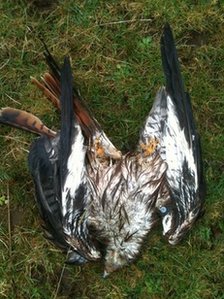
a dead red kiteIn July 2010 a poisoned red kite was discovered in the area (see here). According to Tayside Police, ‘five buzzards and a tawny owl met with the same fate in the same area in the last year’.

In September 2010, an un-named gamekeeper from Edradynate Estate, a self-proclaimed member of the SGA, talked to the Courier about the discovery of the poisoned red kite:

As a member of the Scottish Gamekeepers’ Association, I am against anything illegal. Anybody who does this should be jailed because it’s not on and I have never done anything like this in my life. To find a poisoned bird on my ground is just wrong because I don’t use poison and wouldn’t know how to.

There is something funny about this and I think someone else has killed this bird and planted it on my estate. Why they have done that, I don’t know. We have never seen a red kite, living or dead, in the Strathtay valley so I don’t know where this has come from. The laird is so upset about it, as am I, because it besmirches our reputation and it’s reflecting badly on me.

I am a professional person and I have worked hard for all these years on the estate and never had anything against my name. This is causing me a lot of stress and strain because I don’t know what is going to happen next. I’ve never been involved in anything like this before.

It’s very reassuring to know that I have the full support of the laird because this job is something I love doing.” (see here).

In March 2011 two poisoned buzzards and two poisoned crows were discovered, along with two poisoned pheasant baits. Carbofuran was detected this time. Tayside Police conducted another search (their third on this estate?) and it was reported that a 62 year old man was taken in for questioning but was released pending further enquiries (see here). We’re not aware of any other media statements about this incident.

In September 2013, the Crown deserted a case against Edradynate Estate’s Head gamekeeper on alleged firearms and explosives charges. The reason for this desertion was not made public (see here).

Nobody has ever been convicted for any of the alleged offences on Edradynate Estate.

Alan Stewart wrote about a 1995 incident on Edradynate Estate in his Wildlife Detective book, concerning the discovery of a poisoned cat belonging to the occupier of a cottage on Edradynate Estate. A search in a nearby wood had recovered a poisoned pheasant bait and a poisoned tawny owl – later all found to contain traces of Mevinphos. A further search had recovered two wood pigeon baits and a poisoned sparrowhawk, all found inside a pheasant pen. They all contained traces of Mevinphos. Stewart wrote:

I visited a number of residents on the estate and was absolutely shocked at what I learned. According to the interviews I carried out, my suspect had, at various times, set up a gun with a string attached to the trigger to pepper with wheat any intruder who brushed against the string. He had allegedly driven into Perth to the workplace of a person who lived on the estate, to remonstrate with him after a pheasant had been knocked down and killed by the person’s car. He had allegedly poisoned a tenant farmer’s collie, and also shot dead the dog of a visitor to a neighbouring estate after the dog had run off and was being pursued by its owner. I was taken aback by the vitriol these people had for my suspect but their hatred was tempered with fear and all interviews were ‘strictly off the record’. All those I spoke to were in tied houses and none wanted to become involved in a prosecution. News of my investigation had travelled fast and out of the blue I received a telephone call from a former factor for the estate. He had anticipated the reluctance of those who could potentially help, wished me the best of luck, but doubted that my enquiry would ever result in court proceedings”.

A prosecution in this case was attempted but the case was deserted after it became time-barred due to a lack of available evidence to link the individual suspect to the alleged offences.

Alan Stewart wrote:

The following week [just after the case had been deserted] I learned that another employee had borrowed the suspect’s Land Rover but it had broken down. In his search for tools to repair it, he had lifted up the passenger seat to search the compartment underneath as the most likely place for tools to be stored. Instead of tools there were three dead sparrowhawks. I am sure this would have clinched the case but naturally the employee wanted to keep his job and his house and the information came to me via a third party”.

Stewart wrote about another incident in 2001 – the discovery of a poisoned buzzard on the estate that had been killed by Carbofuran:

The usual enquiries were made and the usual suspect interviewed, but his involvement could not be established……..In the investigations on Edradynate Estate, we could prove beyond reasonable doubt that baits and dead birds and animals were being found with monotonous regularity on the estate. We could prove beyond reasonable doubt that the baits were laced with particular pesticides and that the victims had been poisoned after having consumed part of these baits. What we were so far unable to prove was who set the baits”.

Case against Stody Estate gamekeeper Allen Lambert: part 4

The case against Allen Lambert, a gamekeeper on the award-winning Stody Estate, continued in February and is now set to go to trial.

Lambert, 64, of Old Lodge House, Stody, Melton Constable in Norfolk has already pleaded guilty to storing the pesticides Mevinphos and Aldicarb, but has denied a series of further charges concerning the alleged killing and possession of 14 buzzards, 1 sparrowhawk and 1 tawny owl.

His trial will take place in May.

For previous blogs on this case see here, here and here.

Case against Stody Estate gamekeeper Allen Lambert: part 3

A case management hearing was heard today at Kings Lynn Magistrates Court regarding the remaining charges against Stody Estate gamekeeper, Allen Lambert.

In December 2013, Lambert was charged with seven alleged offences including the killing of 14 buzzards, 1 sparrowhawk and 1 tawny owl (see here).

Lambert, 64, of Old Lodge House, Stody, Melton Constable, Norfolk pled guilty to storing the pesticides Mevinphos and Aldicarb but denied killing and possessing the dead birds.

His case was adjourned today and is expected to continue in February 2014.

Case against Stody Estate gamekeeper Allen Lambert: part 2

Last week we blogged about Norfolk gamekeeper Allen Lambert who had been charged with seven alleged wildlife crime offences including the killing of 14 buzzards, 1 sparrowhawk and 1 tawny owl (see here).

The case against 64-year old Lambert, a gamekeeper on the award-winning Stody Estate, was heard last Thursday (19th December 2013) at Kings Lynn magistrates court.

It has been reported that Lambert pled guilty to keeping banned pesticides (Mevinphos & Aldicarb) but denied killing raptors and keeping some of their bodies.

His case was adjourned until 22nd January 2014.

Interestingly, the news report calls Lambert a ‘former’ gamekeeper.

News report from EDP24 here.

Norfolk gamekeeper faces series of raptor persecution charges

A Norfolk gamekeeper is facing seven charges of alleged wildlife crime.

Allen Lambert, 64, of Stody, near Melton Constable, has been charged with killing 16 wild birds (14 buzzards, 1 sparrowhawk and 1 tawny owl), possession of nine birds (buzzards), failure to comply with a firearms certificate, and four counts of possession and storage of banned poisons (Aldicarb and Mevinphos).

The alleged offences took place between January and April 2013.

Lambert is currently on bail and will appear before King’s Lynn Magistrates court on Thursday (19th Dec).

News articles here and here

Poisoned buzzards and bait reportedly found on Edradynate Estate

Following blog posts on 6, 7 and 11 April….

The name of the Perthshire sporting estate raided by Tayside Police earlier this month, following the discovery of poisoned buzzards and poisoned bait in March 2011, has been recently reported on the raptor study group website as Edradynate Estate.

Described by Tayside Police Wildlife Crime Officer Alan Stewart in 2005, “Edradynate Estate, which is owned by an absentee landlord from Hampshire, has probably the worst record in Scotland for poisoning incidents, going back more than a decade. In 14 separate incidents since 1998, 16 poisoned victims (nine buzzards, a cat, a tawny owl, two sparrowhawks, a common gull, a polecat and a crow) and 12 poisoned baits (rabbits, woodpigeons and a pheasant) have been found, with traces of the pesticides mevinphos, carbofuran and alphachloralose”.

His comments were made after the collapse of a trial concerning two gamekeepers from the estate, who were charged with various offences involving the alleged poisoning and trapping of birds of prey. The case was dropped by the Procurator Fiscal, reportedly because of the time taken for the case to be heard. Full story here: http://www.rspb.org.uk/Images/legaleagle43_tcm9-132966.pdf

Since his comments, there have been more discoveries of poisoned birds on this estate, and public denials in the media of any involvement by estate gamekeepers, who claim the dead birds must have been ‘planted’ by someone else. Nobody has ever been convicted for wildlife crime offences on this estate and still the poisoning continues. Let’s hope that Tayside Police are able to detect the perpetrator(s) of the most recent poisoning incident.

Interestingly, it is also reported on the raptor study group website that Edradynate Estate is believed to be a member of the SRPBA and that at least one gamekeeper is a self-confessed member of the SGA. This is difficult to verify though as, conveniently, neither group publicises the names of their members. Both of these groups have made many public statements about how they deplore illegal raptor persecution and how they are working hard to eradicate it. They are both also members of PAW Scotland. It was reported last year that the CEO of the SRPBA paid a visit to Edradynate Estate – perhaps to apply some much needed ‘peer pressure’. If he did, then he is to be congratulated for his efforts, although judging by recent events it would appear that peer pressure was unsuccessful. Or perhaps it was successful, and the latest deaths were attributable to those pesky carcass planters – you know, the ones who have never been seen or heard but who are managing to plant poisoned birds on sporting estates up and down the country…