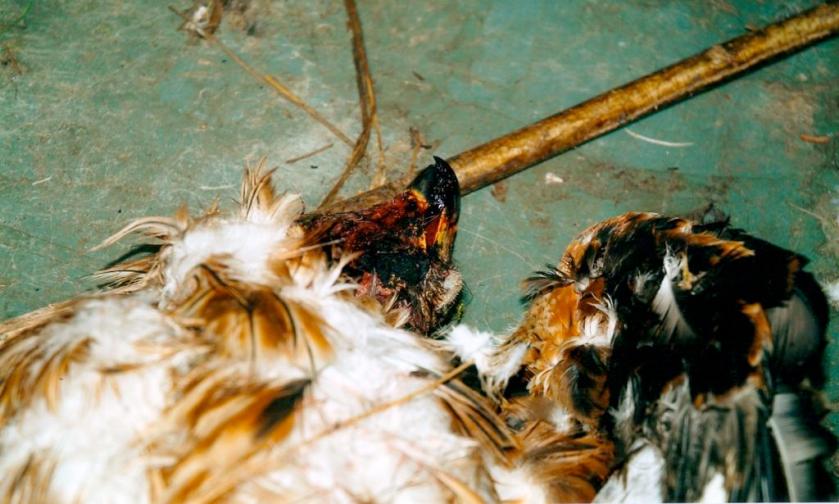
Red kite poisoned in Scotland

rk5And so it continues….

Today, the Scottish Government agency responsible for reporting on poisoned animals released the stats for the first quarter of this year (i.e. Jan-March 2013).

You will not be surprised to learn that, yet again, poisoning incidents have taken place and Police Scotland have chosen to suppress the information.

The data confirm that a poisoned red kite was discovered in March in ‘Central Scotland’ – no detailed location information given, naturally. Lab tests show it had been poisoned with Mevinphos. Four months for that information to slip out in a largely un-read government report. The level of secrecy involved in these cases is quite remarkable.

The data also show the poisoned baits that were uncovered at Leadhills in March – interestingly, they confirm the presence of Carbofuran but don’t comment on the number of baits found (which we know was a considerable number – see here) but they do say the baits were found inside gamebags. Four months on from the discovery and we’re still waiting for Police Scotland to make a public statement, not least to warn residents and visitors about the discovery of potentially fatal poison in a publicly-accessible location.

Also included in the data is the discovery of a Carbofuran-laced pigeon bait in Tayside in February 2013. Again, where was/is the public warning from Police Scotland?

It’s just bloody pathetic. Don’t tell us that the information has been suppressed for ‘operational’ reasons – that’s totally ridiculous and isn’t fooling anyone. The suppression of information benefits the landowners and gamekeepers – nobody else.

Compare this suppression of information with the work of Police Wildlife Crime Officers in Devon & Cornwall. Two of their WCOs – PC Josh Marshall and PC Paul Freestone – are so amazingly proactive that as well as having their own personal wildlife crime blogs (here and here), they’ve even set up a Wildlife Crime Group blog for their area (see here). On this blog, you’ll find information providing tips and advice about different types of wildlife crime, as well as information about specific alleged offences. For example, here they report on the recent suspected poisoning of two buzzards, and even provide photographs – all within a few days of the alleged crime being reported. Hats off to those two guys – committed, proactive, helpful and informative (although if you’re reading this Josh & Paul, you might want to revise your information about potential threats to harriers!!).

Back to Scotland….we would like to know why Police Scotland consistently fails to inform the public about alleged raptor persecution incidents, especially those involving the discovery of highly dangerous banned poisons in public areas. The public has a right to be kept informed. Sure, the Police may need a few weeks to conduct their initial investigations without letting on what they’re up to – as we’ve said over and over and over again, nobody in their right mind would want to interfere with that process and jeopardise a potential prosecution – but when it gets to three, four, five months after the incident and its bloody obvious that the investigation is dead in the water, then what possible reason is there for withholding the information, putting the lives of people and animals at risk? Here are some reasons: wanting to appease the landowners and gamekeepers on whose land the poison had been found, and wanting to appease the wider gameshooting industry who just hate to have the truth exposed about poisoning and the other methods of persecution that are being used against raptors on a regular basis.

If you’re also curious about the blanket suppression of information, you could always email the new Police Scotland Wildlife Crime Portfolio Leader, Detective Superintendent Cameron Cavin, and ask him to explain. One question to ask, as a friendly opener, nothing more, might be whether he has ever held membership in a game-shooting organisation, like, ooh, er, let’s say BASC for example, and if so, whether that membership is still held?…. Coincidentally, Det. Super. Cavin also just happens to have strong connections with central Scotland so he might also have information about the progress of the case concerning the poisoned red kite found there in March, or perhaps about the buzzard found there in March that had been caught in an illegal trap and had to be euthanised as a result of its injuries (see here). Bear in mind if you do email him, he’s obliged to reply within 20 working days so he can’t just ignore you, although obviously he can choose to fob you off without providing a satisfactory answer.

Email: Cameron.Cavin@centralscotland.pnn.police.uk

Hen harrier persecution highlighted at international art show

The plight of the UK’s hen harrier population is being brought to the attention of a whole new audience, thanks to the work of Turner Prize-winning artist, Jeremy Deller.

Deller is presenting his work in the British Pavillion for the 55th ‘Venice Biennale’, described as the art world’s most important international event.

His opening piece, entitled ‘A Good Day for Cyclists’, depicts a giant hen harrier clutching a blood-red Range Rover. Deller says his piece was inspired by the alleged illegal shooting of two hen harriers on the Queen’s Sandringham Estate in 2007 – an incident for which Prince Harry was subjected to police questioning but no charges were ever brought against anybody. 

The inclusion of the Range Rover seems to serve two purposes – watch this interview with Deller here to understand his motivations. There’s also an interesting piece in the Telegraph here.

deller3_2575036b

New hen harrier ‘initiative’ is outrageous

A new ‘initiative’ has been launched today aimed at ‘conserving’ the hen harrier in Scotland. Having read the press release, we’re almost at a loss for words.

This ‘initiative’ (pathetic window dressing designed to disguise the real issue) calls on members of the public to report sightings of hen harriers to ‘help PAW Scotland to build valuable information on these birds’.

According to Ron Macdonald, Head of Policy and Advice at SNH:

The public can be of great help by reporting sightings and helping us build a picture of the reasons why these birds aren’t doing as well as we would expect. Using sightings from the public, we can assess whether to use some of the new technology at our disposal such as satellite-tagging or camera monitoring, or even where neccessary share information with the National Wildlife Crime Unit“.

This ‘initiative’ then, suggests that all will be well for hen harriers if only we knew where they were so we could put satellite tags on them and work out what’s going wrong for them. It’s an astonishing inference! The location of hen harrier breeding sites have been known and watched for decades by raptor fieldworkers – there’s no mystery about where they’re trying to breed or why they’re failing. “Helping us build a picture of the reasons why these birds aren’t doing as well as we would expect“?! For god’s sake man, try reading the Hen Harrier Conservation Framework published in 2011 (see below for link) – you know, that report that, er, SNH commissioned. That report sets out very clearly what the main issue is: Illegal persecution is the biggest single factor affecting hen harriers and it is having a dramatic impact on the population in northern England and in Scotland:

  • The potential national hen harrier population in Scotland is estimated (conservatively) to be within the range 1467-1790 pairs.
  • The current national hen harrier population in Scotland as recorded during the most recent (2010) national survey is 505 pairs, more than a 20% decline from the numbers recorded during the 2004 national survey.
  • In Scotland, the hen harrier has a favourable conservation status in only five of 20 regions.
  • Two main constraints were identified: illegal persecution, and in one region, prey shortages.
  • The species is particularly unsuccessful in the Central Highlands, Cairngorm Massif, Northeast Glens, Western Southern Uplands and the Border Hills. There is strong evidence in these grouse moor regions that illegal persecution is causing the failure of a majority of breeding attempts.
  • A study published by Redpath et al (2010) found only five successful hen harrier nests on the estimated 3,696km2 of driven grouse moors in the UK in 2008; an area of habitat estimated to have the potential to support approx 500 pairs.
  • In 2012, only one breeding pair was recorded in England (estimated potential for over 300 pairs).

For SNH to pretend they don’t know why hen harriers are in trouble is simply outrageous. They know exactly why – the studies have been done, the birds have already been sat-tagged, we all know what happens to them.

And why on earth is this ‘initiative’ being launched by PAW Scotland? PAW is the Partnership for Action against Wildlife crime. Where’s the action on wildlife crime in this initiative? It has all the hallmarks of being the handiwork of the game-shooting ‘partners’ in PAW Scotland.

In our opinion this is a cynical attempt to persuade the general public that measures are being taken to address the hen harrier issue while deliberately ignoring the widely-known central problem: illegal persecution on driven grouse moors.

PAW Scotland press release here

Hen Harrier Conservation Framework 2011

UPDATE 2pm: Environment Minister Paul Wheelhouse gets a grilling on BBC Radio Scotland’s Good Morning Scotland programme (listen here, starts at 1.43.45). Well done journalist David Miller for asking exactly the right questions. The Minister does not cover himself in glory and seems to think this latest initiative is a novel approach to working out why hen harriers are in decline. He’s clearly unaware that there have been several national surveys (dating back to 1988!!) that have previously documented exactly the areas where hen harriers are missing and exactly why they’re missing. The Minister may not know it but his government advisors (SNH) certainly understand that this latest ‘inititative’ is nothing more than a scandalous time-wasting ploy to delay tackling the hen harrier killers.

Hen harrier caught in an illegal trap on a grouse moor

Going to the Scottish Birdfair? Read this first

PrintThere’s an article today in the Sunday Herald about the RSPB’s controversial choice of venue for next month’s Scottish Birdfair. For the second year running, the RSPB has chosen to hold this event at Hopetoun House, the stately home of Lord Hopetoun whose family also owns the Leadhills (Hopetoun) Estate in South Lanarkshire, a grouse moor that has been at the centre of raptor persecution allegations for years. Sunday Herald article here.

Regular blog readers will know we’ve commented on this issue at length: see here, here, here, here, here and especially here.

In today’s article, veteran Scottish Raptor Study Group member Ronnie Graham urges potential Birdfair attendees to “make an informed decision” about going.

The following information might help. This is a list of confirmed persecution incidents listed at Leadhills/Abington between 2003-2011. This information has been sourced from the RSPB’s own annual persecution reports, in addition to Scottish Government data. The list does not include other ‘unconfirmed’ or ‘probable’ incidents, such as the discovery of skeletal raptor bodies found buried in forestry or dead raptors found shoved inside rabbit holes. Data are only available up to 2011, so any incidents that might have occured in 2012 or the first quarter of 2013 are not included. There are 41 confirmed incidents on this list; of these, only a couple have been successfully prosecuted (see here for a good example of why prosecutions fail). The list is a good example of why conviction rates should not be used to indicate the extent of criminal activity.

2003 April: hen harrier shot

2003 April: hen harrier eggs destroyed

2004 May: buzzard shot

2004 May: short-eared owl shot

2004 June: buzzard poisoned (Carbofuran)

2004 June: 4 x poisoned rabbit baits (Carbofuran)

2004 June: crow poisoned (Carbofuran)

2004 July: poisoned rabbit bait (Carbofuran)

2004 July: poisoned rabbit bait (Carbofuran)

2005 February: poisoned rabbit bait (Carbofuran)

2005 April: poisoned buzzard (Carbofuran)

2005 June: poisoned rabbit bait (Carbofuran)

2005 June: poisoned rabbit bait (Carbofuran)

2006 February: poisoned buzzard (Carbofuran)

2006 March: poisoned buzzard (Carbofuran)

2006 March: poisoned pigeon bait (Carbofuran)

2006 April: dead buzzard (persecution method unknown)

2006 May: poisoned rabbit bait (Carbofuran)

2006 May: poisoned rabbit bait (Carbofuran)

2006 May: poisoned egg baits (Carbofuran)

2006 June: poisoned buzzard (Carbofuran)

2006 June: poisoned raven (Carbofuran)

2006 June: 6 x poisoned rabbit baits (Carbofuran)

2006 June: poisoned egg bait (Carbofuran)

2006 September: 5 x poisoned buzzards (Carbofuran)

2006 September: poisoned rabbit bait (Carbofuran)

2006 September: poisoned rabbit bait (Carbofuran)

2007 March: poisoned buzzard (Carbofuran)

2007 April: poisoned red kite (Carbofuran)

2007 May: poisoned buzzard (Carbofuran)

2008 October: poisoned buzzard (Carbofuran) [listed as ‘Nr Leadhills’]

2008 October: poisoned rabbit bait (Carbofuran) [listed as ‘Nr Leadhills’]

2008 November: 3 x poisoned ravens (Carbofuran) [listed as ‘Nr Leadhills’]

2009 March: poisoned rabbit bait (Carbofuran)

2009 March: poisoned raven (Carbofuran)

2009 April: poisoned rabbit bait (Carbofuran)

2009 April: poisoned magpie (Carbofuran)

2009 April: poisoned raven (Carbofuran)

2010 October: short-eared owl shot

2011 March: illegally-set clam trap

2011 December: buzzard shot

2013 wildlife crime conference: Duncan Orr-Ewing, RSPB

This is the third blog in our series about the 2013 Scottish Police Wildlife Crime conference. (NB: these are not being produced in the order the presentations were made at the conference). Here’s what Duncan Orr-Ewing of RSPB Scotland had to say on the topic of raptor persecution:

“Good morning everybody, I think most of you know me here, but my name is Duncan Orr-Ewing, I’m Head of Species and Land Management at RSPB Scotland, based in Edinburgh. My talk today, what I plan to do is give a bit of an outline of the issue if you like, then cover some of the sort of on-going work that is underway to try and address the problems, and then take a bit of a forward view if you like, on what the next steps might be. I should probably also confess at this point that I’m also a Director of the Langholm Demonstration Project, which Simon’s just talked about. I’m not planning to talk a lot about that but obviously as a science-based organisation the RSPB is heavily involved with that and a range of other scientific projects to try and identify solutions to some of the issues on-going in this area. I should also say, just briefly at the outset, as a science-based organisation our focus is on the conservation of raptors, we’re informed by the science, our focus is on raptor populations. We are not opposed to hunting as an organisation provided it’s carried out sustainably and legally.

Taking us back to the beginning, I think the advent of the Scottish Parliament has seen political unity break out on this issue, and I’m minded to remind you all of Donald Dewar’s statement that the persecution of birds of prey in Scotland is a national disgrace, and subsequent Environment Ministers of all political persuasions that we’ve had in power in Scotland have also pretty well taken this sort of line. This is not a political issue, this is a significant conservation issue. The RSPB is involved with this because it is a conservation issue and we’re rightly standing up for the interests of raptors. And I would also remind you at this stage that there are no enlightened countries, shall we say, in the world, that I think I can point to, where people are allowed to illegally, or, in most cases I would also say, legally kill raptors. They’re rightly protected as I’ll come on to say.

So just talking about some of the issues, this is the Skibo Estate in Sutherland taking you back a few years, in the foreground you’ll see one of three golden eagles that were found poisoned on that estate. Why should we be concerned about this? This incident, in itself, has probably resulted in a set-back for that local golden eagle population for many many years to come, that one incident. So the question we ask ourselves here is, why has this been allowed to happen? The individuals that have been involved with this, why are they involved with the hunting industry? Why haven’t they been removed by the hunting industry? Why haven’t they been marginalised? Instead, we see some of these people held up as exemplars of best practice, in particularly in the grouse moor industry, and that is very disappointing and I think that has to be addressed.

I’ll also remind you that raptors are not just important as the Minister said, on their own volition, in their own right, they’re also important because they’re important to local economies. Need I say the story of the sea eagle, a reintroduced species, its value to the local Mull economy – £5 million per annum. People come to Scotland to see our environment, they’re attracted to seeing some of these iconic species that we have here, the sea eagle is one of those.

Another example, and there are examples across the whole of Scotland, the length and breadth of Scotland, the Galloway Kite Trail, also bringing in hundreds of thousands of pounds a year to a local Dumfries & Galloway economy. And some of these benefits that come from raptor conservation, supported it has to be said by local estates and enlightened land owners, they are now very important to the economies of some of our most rural areas in Scotland.

So why are raptors protected? And this is a very fundamental point which informs very much how we think about this issue. Firstly, they’re long-lived birds with slow reproductive rates, so illegal killing can be highly detrimental to their populations. Scotland also has a particularly poor history in conserving our raptor species. We have had national extinctions, I mean even birds like the buzzards, because of what we did two centuries ago, were driven to the edge of what should be their former range and only now are some of these species recovering their populations, and indeed, some have had to be reintroduced by humans with the support of local land owners because they were driven to extinction, and the red kite and the sea eagle being those. And we still, I’m afraid, based on some of this history, still have a prejudice in the UK and Scotland towards predators, and this isn’t just raptors, this is all sorts of predators, you know, big cats, wild cats, pine martens, otters, badgers, there is prejudice against these species as well, which persists in some places.

So I want to touch now just on what the impact of illegal killing has on three raptor species and I’m taking the golden eagle, hen harrier and red kite as examples, and we now have a very good body of science to support these assertions.

Conservation status of the golden eagle in ScotlandSo I’m referring here to the SNH Golden Eagle Framework, and here the red areas that are on the map show the areas in Scotland where the golden eagle population is considered to be in unfavourable conservation status. And overlaid on that map are the incidents of illegal persecution, poisoning incidents, between 2006 and 2012. And you’ll see there’s a strong coincidence with illegal persecution of golden eagle poisoning in this case and where the bird is in unfavourable conservation status. And in 2012 alone, I’ll just highlight three cases of crime against golden eagles that were detected: one in the far north west of Scotland, one in the Angus area and the other in Dumfries & Galloway/Strathclyde border. And every time one of these cases happens, I would say, you know, the trust that should be there between land managers and conservationists takes a step back.

With hen harrier I take you back to 2000 and a case in Strathspey in Morayshire, and here was a case of a gamekeeper shooting a hen harrier at the nest, successfully convicted for this, and I’m afraid that this was the first successful conviction of a gamekeeper for killing a hen harrier, although this is considered to be widespread practice, and I’ve put this in really just to show how difficult it is to secure convictions in this kind of case because these cases occur in remote areas, in this case on a grouse moor, you know, far away from public roads, it is difficult to get access and bring these people to justice but in this case we were successful in doing that and subsequently there have also been a couple of other successful convictions. But we think this is still widespread practice, and following on from the Joint Raptor Study than Simon mentioned earlier, we do know that that resulted in an escalation of crime against hen harriers because people saw that hen harriers were blamed for suppressing grouse populations and as a result people saw justification for taking the law into their own hands. And in 2010, as a result of this, we’ve just carried out a national population survey with the Raptor Study Groups and others, into hen harriers, we have a national population decline of 20% in hen harriers. And if I tell you that on grouse moors, driven grouse moors in the UK, we only have five breeding pairs of hen harriers, and as many of you will know the hen harrier is on the verge of extinction in England as a result of human persecution. Other work that has been done by people in this room actually and GWCT and others has shown that there is room for 500 breeding pairs of hen harriers on driven grouse moors in the UK, so their population is being suppressed  and they are at very low levels. And I’ve just put this in to show that this is a species that isn’t affected really by illegal poisoning – most of the impacts on hen harriers are either by direct nest destruction, or in this case, illegal trapping. You can see a male hen harrier there, caught in a leg-hold trap.

red kite 12And red kite, a species which I have a fair bit of involvement with myself, again we’re in a unique situation here where we have an almost totally marked population of birds, because the bird was reintroduced, all the birds that were released were wing-tagged and we know the fate of these birds because we’ve been radio-tracking them and recording all the wing tag data. And we’re also in a position where we’re able to compare between two reintroduction areas so in the south of England, in the Chilterns, there was a similar reintroduction and we released the same number of birds, about 90 birds were released, also 90 birds in north Scotland and the population in 2006 of red kites in the Chilterns area, with similar productivity, same number of young produced compared roughly to north Scotland is over 300 pairs whereas in north Scotland the population has bubbled along and has stayed pretty well static at about 50 breeding pairs. Indeed the Chilterns population this year is nearly 1,000 breeding pairs whereas the north Scotland population is still stuck below 60 breeding pairs. And the main difference between these rates of growth is explained by the prevailing levels of illegal poisoning in the two countries, i.e. we have far higher levels of illegal poisoning. And last time I was here speaking to you was about red kites and I reported that since reintroduction we’d found 50 kites that had been confirmed as being illegally poisoned since reintroduction began in 1989 and that figure is now 75 in Scotland. And where is this happening? There is a strong coincidence, illegal activity in the east of Scotland in the areas shaded, which are grouse moors, hence the work we’re doing at Langholm and elsewhere to try and find some solutions to this problem. And increasingly it is looking like the driven grouse moor areas are the problem areas to focus on.

The big concern if you like with the driven grouse shooting set-up these days is that this sport seems to be moving into a new, more intensive phase. So over the past 10-15 years we’ve seen land management systems that have been employed for England for quite a number of years, coming up to Scotland, means more intensive management, more keepers, more predator control, killing as you’re aware of hares and deer tick hosts, increased burning, and we’ve mapped this and we know that there is a strong coincidence where this intensive management is coming in there is a prevalence also of illegal raptor persecution. And I would see this very much as the problem area to focus on in the forthcoming years. There have been some very notorious cases of course, that have occurred in these places where this intensification of management has taken place, in this case ‘Alma’, a golden eagle being radio-tracked and being found dead in the Angus glens a few years ago, illegally poisoned.

So is the situation improving? I think the answer is yes in some places, and this is a map of BTO data on the breeding bird survey buzzard trend, and you will see that the buzzard population, as many of you will know, has increased quite rapidly in recent years but now it’s plateau-ed off as you’d expect and we have a largely stable buzzard population but this species is still absent from some areas of its former range but I think the next breeding bird atlas, coordinated by BTO, will show that the buzzard has recovered large areas of its former range, which is good progress.

Earlier today we were talking about the illegal poisoning incidents in Scotland. This is a bar chart showing the number of reported poisoning incidents over the years since 1989, and as the Minister mentioned, over the past couple of years we have seen a significant decline in illegal poisoning and that is again very good progress. We would say this is informed by a few things perhaps as background which have helped us get to where we are today and this is work in progress, there’s no room for complacency here and we will work with Scottish Land and Estates and others to make sure that we continue to bear down on this problem.

AlmaBut the high point [on the graph] in 2009 was when Alma, the eagle that I mentioned earlier, was found poisoned. We also had a case, the Skibo case also mentioned earlier, a seizure of 10kg of Carbofuran, one of the poisons most implicated in illegal poisoning. And then again, 2011, another satellite-tagged eagle found poisoned. And of course the introduction of vicarious liability making land owners more responsible for the actions of their employees. These welcome steps, apart from the poisonings of course, are helping to move the situation onwards but as I say, we’re not complacent and we will continue to work with partners in the Partnership Against Wildlife Crime to bear down on this problem. What we’ve learned through poisoning hopefully will transfer to other types of raptor crime in due course.

Ok, this is just to remind you also that there are quite a large number of birds that have been killed since 1989 through illegal poisoning – 930 birds and animals have been discovered poisoned and hopefully in the future we can make a dent in that situation. Ultimately, consign illegal poisoning to history, that’s what we want to do.

But also worth mentioning that birds of prey are killed in other ways, they’re shot, trapped or have their nests destroyed and we need to start progressing that as well, as was stated earlier.

So what are the solutions? As we’ve heard earlier, we’re developing legal alternatives to killing birds of prey, and diversionary feeding is one such method, which in the case of the hen harrier has been shown to be pretty effective and we hope over the next few years the grouse moor sector will start adopting this technique and rolling it out across driven grouse moors across Scotland and perhaps even in the north of England. These are legal techniques to solve problems.

I think we also need a model of how grouse moors can be managed more sustainably. It’s not acceptable that this continued intensification occurs and the people that are involved with it are held up as exemplars of best practice if that involves illegal activity. We need a model that fits more with 21st century public expectations and is not predicated on ever-increasing grouse bags. Some of the moors which we see now have the highest grouse bags they’ve had for many years. You would think there would be room for raptors there. They also don’t have the grouse cycle that they used to have because we have medicated grit and other methods developed by GWCT to prevent that from happening. So why can’t these places tolerate raptors? Many of the grouse moors that we’re talking about here don’t have any breeding raptors, let alone hen harriers and eagles, they are black holes for raptors. But we also need more land owners and their employees to work with the police and marginalise those who undermine other good practice and that is happening to a large extent now, through PAW and the work of Scottish Land and Estates and others and we very much welcome that.

And of course there has to be a deterrent out there and that includes effectively robust policing, enforcement, to deal with those serious incidents when they occur.

And I throw this open, but do we need more regulation of the sporting industry? It was discussed last time, the Wildlife and Natural Environment (WANE) Act went through the Scottish Parliament. We have one of the most unregulated shooting industry anywhere in the world. Does this contribute to this problem? In Germany, North America, Scandinavia, other countries, they have quite an established system of regulation for hunting.

But what it’s all about for us, and we will measure success of all of these actions, is through improved populations of the key species, in this case goshawks, ospreys, hen harriers. That is how we will measure progress. But this will be delivered through a range of partnership arrangements as well. It’s easy to knock these partnership arrangements but they are important. They build trust, they build dialogue and in Scotland as a small country of only 5 million people we have good communication between most of the key players here, and that can only help us move this along.

I’m delighted that Scottish Land and Estates are developing their Wildlife Estates initiative; some RSPB staff are involved with helping develop this and we will help Scottish Land and Estates encourage those good land owners who want to do the right thing as we move forward with that programme.

The Langholm Demonstration Project, I won’t dwell on that in detail because Simon’s covered a lot of it – a very important project. This is the model for sustainable grouse moor management going forward. Many of you  may not see that, and Simon said, it’s not without problems, the project, but we’re working our way through those problems as partners, and this less intensive approach to grouse moor management, within the law, with protected raptor species, has to be the way forward, and a combination of hunting and conservation occurs.

And of course I should mention the Partnership Against Wildlife Crime, which over the past few years has really developed into a solid partnership and we’re all working together in the same direction. Thank you very much”.

Hawk and Owl Trust: official statement on their exit from hen harrier dialogue

HOT2Further to our blog earlier this month about the Hawk and Owl Trust becoming the third conservation group to walk out of the Hen Harrier Dialogue process (see here), soon after similar exits by the Northern England Raptor Forum (here) and the RSPB (here), the Hawk and Owl Trust have just issued the following press release to clarify their position:

The Hawk and Owl Trust (HOT) has resigned from Environment Council’s Hen Harrier Dialogue process: President of HOT, wildlife presenter Chris Packham calls for a firm stand against the persecution of birds of prey.

The Hawk and Owl Trust, as the last pro-raptor body participating in the discussion group the Hen Harrier Dialogue process, set up by the Environment Council back in 2006 to bring together those with an interest in the future of the Hen Harrier in England, have decided to leave the Dialogue process.

The Trust cite the lack of any progress or willingness of the grouse moor owners and their representatives to recognise the existence of raptor persecution in any meaningful way; despite solid scientific evidence to prove lethal persecution exists. This type of persecution is illegal under British law yet is widespread to this day. See the case of young female Hen Harrier ‘Bowland Betty’ as an example.

The Hawk and Owl Trust are joining fellow conservation organisations, the Royal Society for the Protection of Birds (RSPB) who left the dialogue last summer, and the Northern England Raptor Forum (NERF) who left recently for the same reasons.                       

Nearly seven years of dialogue and numerous meetings have resulted in the appalling fact that, due to persecution, 2012 saw only one breeding pair of Hen Harriers in the whole of England, despite the habitat being available for some 300 breeding pairs.

As President of HOT, wildlife presenter Chris Packham speaks out on behalf of the Trust:

“The Hawk and Owl Trust feels that it is completely unacceptable for any bird of prey to be killed – and should remain absolutely illegal” says Chris. “It is time for all who want to make Britain a better place for birds of prey to take a firm stand.”

Patient dialogue has failed, so HOT will be joining other conservation bodies in looking for other more effective ways to end the wholesale slaughter of our birds of prey and the Hen Harrier in particular. The illegal persecution of birds of prey must stop and those with a commercial interest in grouse moor shooting must be made to put their house in order. 

Hawk and Owl Trust website here

Well done to the Hawk and Owl Trust, as well as to NERF and the RSPB. It’s great to see these organisations taking a stand. If, like them, you want to see grouse moor owners and gamekeepers being held to account for the continuing criminal persecution of hen harriers and other raptors, you too can take a stand. Please sign this e-petition calling for a licensing scheme and get your friends to do the same: SIGN HERE

If you don’t know what happens to hen harriers on grouse moors, take a look at this photograph – this male hen harrier was caught by the legs in an illegally-set spring trap on a Scottish grouse moor. Fortunately he was discovered by raptor workers before the person who set the trap came back to kill him, perhaps by shooting him, or maybe bludgeoning him with a heavy stick, or perhaps just kicking him to death.

HH 2ndtrap6a


New legislation to protect golden eagle, hen harrier & red kite in Scotland

WCA variation schedules Scotland 2013New legislation designed to provide greater legal protection in Scotland to golden eagles, hen harriers and red kites comes into force next Saturday (16th March 2013).

The Wildlife & Countryside Act 1981 (Variation of Schedules A1 and 1A) (Scotland) Order 2013 was signed by Environment Minister Paul Wheelhouse on 4th Feb and laid before the Scottish Parliament on 6th Feb.

These Schedules (A1 and 1A) were added to the Wildlife & Countryside Act via the Nature Conservation (Scotland) Act 2004, which means that, unfortunately, this legislation only applies in Scotland.

Schedule A1 lists birds species whose nests [that are habitually used] are protected at all times from being taken, damaged, destroyed or otherwise interfered with, including outside of the breeding season. Anyone intentionally or recklessly doing any of the above has committed an offence. To date, only the white-tailed eagle has been listed on Schedule A1.

Schedule 1A lists bird species which are protected from harassment. Species listed on this Schedule are considered to be at risk of harassment that is intended to prevent them from breeding. Anyone  intentionally or recklessly harassing a species listed on this Schedule has committed an offence. To date, only the white-tailed eagle has been listed on Schedule 1A.

Following a government consultation in 2008-2009 (!), three more species will be included as of next Saturday:

Schedule A1 (protected nests and nest sites): white-tailed eagle; golden eagle

Schedule 1A (birds protected from harassment at any time, not just during breeding season): white-tailed sea eagle; golden eagle; hen harrier; red kite

It seems strange that the hen harrier hasn’t been listed on Schedule A1, given the known issues with deliberate nest destruction, as indeed with the goshawk. Nevertheless, it’s good to see greater protection for golden eagles, hen harriers and red kites, even though this is only ‘paper protection’ – the problem with enforcement of the legislation still remains.

A copy of the new legislation can be read here: Wildlife & Countryside Act 1981 (Variation of Schedules A1 and 1A) (Scotland) Order 2013

Landowners & gamekeepers claim ‘misrepresentation’ on BBC’s The One Show

One-Show-smallScottish Land and Estates and the Scottish Gamekeepers’ Association have written a letter of complaint to the BBC, claiming ‘misrepresentation’ on The One Show programme.

The programme (see here and here) included a feature on golden eagle persecution and during a studio interview, the RSPB’s Stuart Benn laid the blame firmly at the door of gamekeepers on Scottish grouse moors.

Doug McAdam, Chief Exec of Scottish Land & Estates, took great exception to that statement and wrote a hilarious letter of complaint, on behalf of SLE and SGA, to The One Show’s executive editor, Sandy Smith.

Here is his letter: SLE SGA complaint about BBC One Show

According to dear old Doug, there have only been four dead golden eagles found since 2010 and no charges [for these deaths] have been brought against anyone involved in grouse moor management. Conveniently, he failed to include the other known incidents of dead raptors turning up on grouse moors since 2010 (including white-tailed eagles, red kites, hen harriers, buzzards, short-eared owls, sparrowhawks, peregrines, kestrels), or the critically-injured golden eagle found shot and left to die on a grouse moor, or indeed the satellite-tagged raptors (particularly golden eagles and hen harriers) who have all gone ‘missing’ after their last known signal was received from, er, a grouse moor. There may well be more of these ‘missing’ birds but of course we’re no longer allowed to hear about them after the introduction of the new PAW Scotland ‘protocol’ that aims to keep these incidents away from the public’s gaze (see here).

Apart from trying to play down the extent of persecution incidents on grouse moors, and inferring that a lack of criminal convictions is a good indicator that gamekeepers are not involved with the illegal killing of golden eagles on grouse moors, Doug goes on to emphasise the SLE’s involvement with PAW Scotland, as though membership of that ‘partnership’ should be a measure of good behaviour. We’ve all seen how effective these ‘partnerships’ can be, following the near-extinction of breeding hen harriers on English grouse moors during the six-year Hen Harrier Dialogue ‘partnership’ designed to resolve the conflict. Indeed, three raptor conservation organisations have now resigned from that particular ‘partnership’ because they recognised it could be used as a convenient political cover by certain organisations with grouse-shooting interests.

Doug makes an astonishing claim about the PAW Scotland partnership: “Our combined efforts with the police, rural communities, the RSPB and over 120 other relevant stakeholders have been universally acknowledged as a key factor in reducing the number of raptor persecution incidents“.

Talk about misleading! For a start, there are not 120 ‘relevant stakeholders’ in relation to addressing raptor persecution. Many of the stakeholders have absolutely no involvement in directly addressing raptor persecution – they are there to specifically address other types of wildlife crime such as poaching, theft of freshwater pearl mussels, bat persecution and badger persecution.

Secondly, where does this notion come from that work by PAW Scotland has been ‘universally acknowledged as a key factor in reducing the number of raptor persecution incidents’? Has it been ‘universally acknowledged’? We don’t think PAW Scotland has had any demonstrable impact whatsoever on the number of raptor persecution incidents – where’s the evidence? Perhaps by ‘universal’ he means those with a vested interest in having people think that illegal raptor persecution is being dealt with effectively (e.g. the police, SNH, Scottish Government, SLE, SGA etc etc).

Doug finishes by saying, “Owners of moorland estates all over Scotland look after golden eagles” (ahem) and he invites Sandy Smith to visit a grouse moor “to find out for yourself the valuable conservation measures being implemented“. Let’s hope Sandy takes him up on his offer. Ooh, which grouse moor to choose? We could give Sandy quite a few suggestions….

Sandy Smith responded with a letter of his own: One Show’s reply to SLE

He says he’s sent an email to all One Show staff and suppliers “asking them to ensure they don’t make assumptions about gamekeepers based on out of date or inaccurate assumptions“.

Interestingly, Sandy Smith was the former executive editor of Panorama – a programme recognised for its investigative journalism and an ability to differentiate between fact and PR. Let’s hope he’s taken those qualities with him to The One Show.

We’ve sent a letter to Sandy, giving him the URL of this blog, to ensure his staff are kept up to date and are not basing their work on inaccurate assumptions (spin). You may wish to do the same – send your email, marked for the attention of Sandy Smith, to: TheOneShowEmails@bbc.co.uk

If you think grouse moor owners and their gamekeepers need to be held to account for their activities, please sign this e-petition and share it with your friends and colleagues: SIGN HERE.

Here’s a photo showing how well golden eagles are looked after on some Scottish grouse moors. This one was found critically injured on Buccleuch Estate last aututmn – he had been shot and left to die, although it is not known on whose land he was shot. He is currently recuperating with the SSPCA after undergoing life-saving surgery. Needless to say, nobody has been charged for this crime.

The shot golden eagle undergoing emergency surgery

Third group walks out of hen harrier dialogue

HOT2The tide is turning….

The Hawk and Owl Trust has become the third group to walk out of the hen harrier dialogue process, following the recent resignations of the RSPB (here) and the Northern England Raptor Forum (here).

A full statement is expected during the week.

Well done to them – it’s good to see that this particular sham ‘partnership’ process will no longer be tolerated.

If you feel the same way, please sign and share this e-petition calling for the licensing of grouse moors and gamekeepers: sign here.

Hawk and Owl Trust website here

Northern England Raptor Forum walks out of Hen Harrier Dialogue process

In the last few days, many of us have been flabbergasted (or not) at the flat denials from several game-shooting industry representatives about the issue of illegal raptor persecution. Despite years, no, decades, of overwhelming scientific evidence to the contrary, these industry leaders still refuse to accept the reality.

 In a way it’s good that they continue to display such open indifference because by doing so an increasingly-aware public are given an opportunity to see what the rest of us have been seeing for years. In the end, we firmly believe it will be the strength of public opinion that forces a change and finally puts an end to the decades of illegal killing. Nevertheless, as laughable as the industry’s excuses and explanations are, it is still frustrating to hear them because you know that as long as that’s what the leaders are thinking then the criminals within that sector won’t be inclined to stop the persecution.

nerf logo3So, take that sense of frustration you felt when you heard the latest denials, and multiply that by six years, and then add in the fact that over the same period the hen harrier breeding population has been reduced to a single pair in England, and it will come as no surprise to learn that the Northern England Raptor Forum (NERF) has resigned from the Hen Harrier Dialogue process. Indeed, you might well ask what took them so long!

For those who don’t know what the Hen Harrier Dialogue process is, you can read about it here. NERF, representing a suite of dedicated raptor study groups in northern England, has been involved in the Dialogue since day one, back in June 2006. Last summer, the RSPB were the first group to walk away from the process. Now NERF have walked, as of January 31st 2013. We understand that the Hawk and Owl Trust, the only other pro-raptor partner in the process, is still in it, for now at least.

Here are some excerpts from a NERF letter that leave no room to doubt their reasons for walking out:

Following the last meeting in June 2012, NERF members undertook a wide-ranging internal debate about continuing our involvement with the Hen Harrier Dialogue. At the conclusion of our discussions NERF members unanimously elected to resign from the Dialogue process with immediate effect. This decision has not been undertaken lightly. We believe that far from assisting the re-establishment of a viable and self-sustaining healthy English population of Hen Harriers that is free and able to share wild open spaces unmolested with red grouse the evidence reveals that the exact opposite has been achieved.

Despite many years of attempting to seek a resolution to the perceived conflict of interest between commercial driven grouse shooting and Hen Harriers, NERF can find no evidence of any progress towards that goal. Indeed the opposite is the case. In 2006 46 young fledged, four years later only 23 young fledged and in 2012 just one pair successfully reared young. Even the higher figure masks the reality that the successes are almost invariably located on the United Utilities Estate in Bowland or from nests that were guarded around the clock by volunteers. It should also be remembered that there is sufficient habitat in England to support 332 pairs. No matter how optimistic the analysis of the intervening years, this attempt at conflict resolution, from the Hen Harrier’s perspective, can only be judged to be a resounding failure.

It is the opinion of NERF members that our continued participation in the Dialogue lends an air of respectability to a process that is fundamentally flawed. The Dialogue was tasked with seeking conflict resolution to what is a shameful situation where a species is being illegally persecuted to oblivion simply because it is perceived to threaten the sporting interests of a very small minority of individuals. To achieve the required outcome NERF accepted that there needed to be compromise. However despite our best efforts we can find no evidence that some of those organisations that represent the grouse shooting industry have either a genuine intention to accept anything other than a zero upland population or the ability to guarantee that the grouse moor managers they represent will implement any strategy agreed through the Dialogue.

There is ample evidence to show this to be the case:

  • The English Hen Harrier population is so perilously low that there is no longer any conflict with commercial driven grouse shooting and yet the birds continue to be persecuted, as evidenced by the recent death of ‘Bowland Betty’ in the Yorkshire Dales.
  • The continued public denial by grouse moor managers that persecution is widespread within the industry gives NERF members no reason to believe that participation of the industry representatives is anything other than a political gesture intended to divert attention away from that very persecution being undertaken by their members.
  • The scientific modelling developed specifically to aid the search for a resolution was originally rejected by the shooting community and further modelling was undertaken at their behest. The resultant data emphatically show that two pairs of Hen Harriers can be accommodated on 5,000 acres without any commercial impact. Indeed the same data reports that the impact by three pairs is insignificant. This scientifically based model was rejected with a counter offer of one pair per 10,000 acres. This offer represents a 75% shift away from the science and it is difficult to see it as anything other than yet one more delaying tactic.
  • In an effort to reduce the potential impact of grouse chick predation diversionary feeding was trialled and shown to work. The proposed expansion to the scheme was rejected by several of the shooting organisations for no discernible reason. Once again the search for a solution was stalled.
  • The proposal to introduce a brood capture, cage and release scheme was always going to be unpalatable to raptor workers; nonetheless NERF was prepared to leave the proposal on the table for discussion once the population had returned to ‘carrying capacity’. Years after the scheme was initially proposed and with no actual progress being made the National Gamekeepers Organisation announced in 2012, the same year that only one pair nested successfully in England, that the scheme may need to be implemented as soon as two pairs, or one polygamous male and two females, attempt to breed on the same ground. Thus the brood capture, cage and release programme would be implemented when the English population reached three individuals, less than 0.5% of the ‘carrying capacity’ of 332 pairs. This is completely unacceptable not only to conservationists but to all right-minded people. Any future discussions in respect of that scheme were halted with that single statement. More years lost in a pointless discussion, but perhaps that was the intention.

NERF is no longer willing to have its reputation tarnished by involvement with a process that is, in our opinion, being deliberately frustrated by organisations that have failed to demonstrate any willingness to find a solution to what is after all an irrational and outdated belief that Hen Harrier numbers must be subjected to lethal control for the benefit of the grouse shooting industry.