This morning the European Commission has taken the first steps in legal infraction against the UK Government in relation to the burning of blanket bog in Special Areas of Conservation (SACs) in northern England.
The legal action follows separate complaints by the RSPB and Ban the Burn (from Hebden Bridge) in 2012. These complaints related to decisions made by Natural England over the management and protection of part of the South Pennine Moors SAC and Special Protection Area owned and managed by the Walshaw Moor Estate Limited for grouse shooting.
Since then the RSPB has discovered that Natural England consent to burn protected blanket bog is confined to and almost routine on grouse moors in 5 SACs in Northern England. This is part of the intensification of management of these special areas witnessed in recent years to produce increasing numbers of red grouse for driven grouse shooting. (See details of RSPB’s complaint here). These consents from Natural England are estimated to affect around 73,000 ha of deep peat soils that should be conserved as healthy blanket bog. The burning undermines the ability to restore these internationally important habitats, and protect their wildlife and associated ecosystem services.
This map shows the areas of concern: white areas show blanket bog in Special Areas of Conservation where Natural England has consented to burning; brown areas denote deep peat. The large circle denotes Walshaw Moor. Map source: RSPB (here).
While the details of the European Commission’s legal action is not yet known, it appears the Commission shares the concerns of the RSPB and Ban the Burn over bad application of the Habitats Directive and presumably the EC is not satisfied that the UK’s proposed actions would be sufficient to safeguard and restore the protected blanket bog habitats of European and global conservation importance.
The European Commission’s action is a significant step in reforming the way our hills are managed and securing the long-term conservation of these important areas. The RSPB and Ban the Burn both deserve credit and appreciation for pushing this forward and it’ll be fascinating to see how the grouse shooting industry and their friends in UK Government respond.
Martin Harper, RSPB’s Conservation Director has blogged about this news today (see here). But it’s a blog of two halves. The first half demonstrates that the RSPB has got plenty of backbone and isn’t afraid to act, undoubtedly against the wishes of DEFRA and Natural England, when it sees fit to do so. That’s brilliant.
But in contrast, the second half of the blog is utterly bewildering. Here Martin reiterates the RSPB’s softly softly approach to dealing with the illegal persecution of hen harriers on driven grouse moors. He maintains that DEFRA’s Hen Harrier Recovery Plan ‘offers a real chance of progress’. We fundamentally disagree, particularly on the subject of brood meddling, which essentially is just legalised persecution.
What we really struggle to understand is how anyone, especially a senior RSPB employee, who has seen that video of an armed man, on a grouse moor, with a decoy hen harrier, can still think that the grouse shooting industry is capable of compromise and reform. It so clearly isn’t.
Our position on the illegal persecution of birds of prey.
“There has been a great deal of comment on social media regarding the illegal persecution of birds of prey in the Peak District National Park.
Without getting into the details of the specific incident that sparked this latest debate, I want to make clear in the strongest possible terms that we are appalled by the persecution of any protected species, whatever the circumstances.
There is never any excuse for this behaviour and we will always work with the police and our other partners to support any investigation. But it is important to point out that we can only take direct action if the persecution takes place on land owned by the National Park Authority not just within the National Park boundary. In fact on land where we own the shooting rights we have not allowed shooting since 1981 allowing agreements to expire. This current incident was not on National Park Authority owned land.
We recently acknowledged the disappointing results of the Peak District Bird of Prey Initiative and we are working with our partners to reverse the fortunes of birds of prey.” Sarah Fowler, Chief Executive, PDNPA.
It came as a bit of a surprise to us that the Peak District National Park Authority doesn’t, actually, have much (any?) authority, at least on this issue. It’s good to hear they don’t permit shooting on land they own, but as that only amounts to 5% of the Peak District National Park it’ll make some difference, but not a lot.
Since reading this statement, we’ve been doing some reading-up on the role and powers of a National Park Authority, and we’re kind of left wondering ‘what’s the point’? Well, there is a point and a role for the PDNPA, but mostly, it seems, in planning. Incidentally, during our recent research we found a fascinating retrospective planning application that relates to some work that has already been carried out on a grouse moor within the PDNP. It highlights the role that the PDNPA does (or could) play in the way these grouse moors are managed, regardless of ownership…but more on that in a different blog.
We also found this amusing news item on the PDNPA website. How the hell they managed to win this award is anyone’s guess. Apparently the Peak District National Park ‘has been monitored to ensure that sensitive environments and species are being properly looked after to preserve wildlife and landscape diversity’. Er, perhaps the judges should have a read of this. It documents the complete failure of the Peak District Bird of Prey Initiative over a number of years. Having seen the video of that armed man on a grouse moor with a decoy hen harrier, it’s not hard to work out where the problem lies.
So it seems, as Mark Avery pointed out yesterday, that it’s now all eyes on the National Trust as the only organisation with any power to take direct action, subject to the findings of their investigation. Their decision on how to respond could have important ramifications. This could get very interesting indeed.
By the way, it was good to see the BBC picked up on the video of an armed man, on a grouse moor, with a decoy hen harrier, and they gave the story significant prominence on the front of their ‘England-News’ website yesterday (here).
The petition to ban driven grouse shooting has passed 33,000 signatures. Is your name on it? Do your friends know about it? Your family? Your colleagues? Don’t assume they know about it – put it in front of them! PETITION HERE.
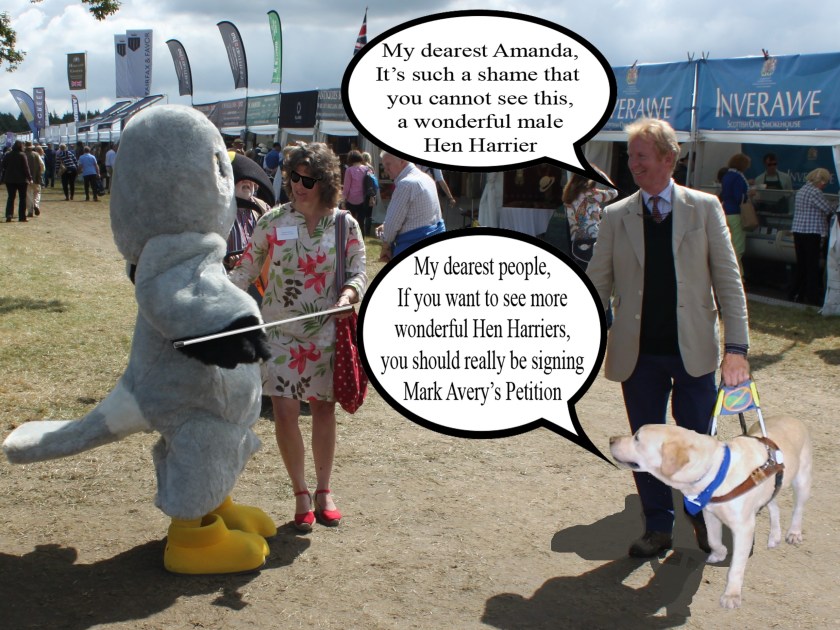
For those who don’t know, the blind lady is Amanda Anderson, Director, Moorland Association.
Her companion is Robert Benson, Chairman, Moorland Association.
Thanks to the blog reader who sent this in. Priceless!
If you want to see more hen harriers in our uplands, where they belong, take the guide dog’s advice (nothing wrong with his vision) and sign the E-petition to ban driven grouse shooting HERE
“The Moorland Association condemns all acts of wildlife crime and supports the prosecution of those who break the law.
We were not aware of the events leading to the release of this video clip but understand it is alleged to have been filmed in February. We learnt yesterday that since then the police have conducted their enquries and have decided to take no further action. We were not contacted as part of that investigation. From the clip, it is very difficult to make out any detail at all, either of a person or a decoy.
The identity of any person allegedly filmed is unknown, as is the location. No crime has been committed as far as we can see. Making judgements based on assumptions of the content of this clip, or indeed the intentions of those who have produced it, would be pure supposition and not something we are going to enter into“.
So there we have it. A predictable, complete and utter denial from the organisation representing grouse moor owners.
According to Amanda, she found it difficult to see the armed man or the decoy hen harrier. Perhaps she had a bit of medicated grit in her eye, and its toxic properties have corroded her retinal cells, because everyone else who’s seen the footage (or at least those who don’t have a vested interest in protecting the grossly damaging activities of the grouse-shooting industry) has been able to see an armed man sitting on a grouse moor, close to a decoy hen harrier.
Sure, the image quality is poor, but then it was filmed from a distance of 1km so all things considered, it’s actually pretty good. And it was good enough for the police to launch an investigation, it was good enough for the National Trust to launch an investigation, and it was good enough for the Chief Executive of the Peak District National Park Authority to tweet yesterday: “This video is alarming and suspicious“.
Perhaps we can all have a whip round to help pay for some urgent corrective eye-surgery for Amanda?
Actually, that would be pointless. No amount of surgery can help someone with wilful blindness, for that is what she, and the rest of the grouse-shooting industry, is suffering. This contrived ignorance is as deliberate as it is predictable.
We asked yesterday whether the Moorland Association’s claims about operating a zero tolerance policy towards hen harrier persecution were sincere or fake. The answer is evident.
All negotiations with this outfit should cease immediately. There’s no compromise to be had here, their intentions are clear. The Raptor Groups and the RSPB should pull out of the failed Peak District Bird of Prey Initiative charade and stop pretending that there’s any hope of effective partnership-working with these people. There isn’t.
There is hope for change though. And that comes in the form of getting a political debate on the future of driven grouse shooting. 100,000 signatures are needed to bring about that debate; we’re almost one third of the way there already. Make your voice heard, sign this petition and ask others to sign too (HERE).
Remember, this wasn’t just any old grouse moor. It was a National Trust-owned grouse moor, within the Peak District National Park, and a participant moor in the Peak District Bird of Prey Initiative.
Statement from Jon Stewart, General Manager, National Trust (Peak District):
“As part of our High Peak Moors Vision and as a conservation charity, the National Trust is committed to protecting birds of prey and working closely with partners and tenants in managing the moors. We are aware of a report of a suspicious incident being investigated by the police, which took place in February this year on land in the Peak District which we own and lease out for grouse shooting. We have been awaiting the results of their investigation before following up ourselves. We now know the police have reviewed the footage but are taking no further action, so we will now be carrying out a full investigation of our own. We are treating this very seriously and will not be commenting further pending the results of that investigation.”
It’s good that they’ve bothered to issue a statement, and it’s good that they are launching their own ‘full investigation’, although it would have been better had they launched this investigation back in February, when they were first made aware of this video. They needn’t have waited for the results of the police investigation to launch their own internal investigation.
Nevertheless, they’ve said they’re investigating and they’ve said they are treating this “very seriously”, so let’s see just how seriously they’ll manage this. They know the identity of the estate where the footage was filmed (on the Snake Moors, according to a comment given by the NT to Mark Avery this morning), and presumably they have a contract with the shooting tenant of that estate that will allow them to take action against the tenant if there is evidence to suggest the tenant has breached the conditions of the contract.
As we understand it, the National Trust re-assessed its contracts with its three grouse moor tenants within the Peak District National Park following the earlier case of raptor persecution that was uncovered on the NT Howden Moor, resulting in the conviction of gamekeeper Glenn Brown (see here). It is rumoured that the revised contracts include a clause detailing the specific type of predator control techniques permitted on NT land. We wonder if the use of a decoy raptor was specifically mentioned in the new contract?
We await the findings of their investigation, and news of what action the NT will (or won’t) take with great interest. Let’s hope they get this right.
On Wednesday 24th February 2016 at around 11am, two birdwatchers were out walking on the moors in Derbyshire hoping for a view of a ringtail hen harrier that had been reported in the area the day before.
One of these birdwatchers spotted a grey raptor with black wing tips, perched approx. 1km away and the observer believed he was looking at a male hen harrier. As he was explaining the location to his colleague so he too could see the bird, his colleague said: “An armed man dressed in camouflage has just jumped in to the heather no more than 10-20m from the bird”. Both observers scanned out from the bird and saw the armed man crouching in the heather, and they also noticed a green Land Rover parked on the moor, approx. 500m from the bird.
The two observers sat and watched for a few minutes while deciding what to do, and then managed to film some footage via digiscope. Here’s a still image from that footage:
As soon as the two observers had stopped filming, the armed man immediately ran over to the bird, picked it up and walked hurriedly away in the opposite direction to the observers.
What the two observers had witnessed was, of course, a fake hen harrier. Some might call it a decoy, but that would imply that the fake hen harrier was being used as a lure to draw in a real male hen harrier who would probably want to attack the decoy as part of his territorial defence strategy. While the real hen harrier was busy attacking the decoy, anybody crouched nearby with, say, a shotgun, would be given an easy opportunity to shoot and kill the real bird.
But surely that’s not what was happening on this moor. This isn’t just any moor. We’re not going to name the moor/estate because we need to protect the identities of the two observers and also the identity of the person who sent us the footage. However, Derbyshire Constabulary is aware of the location, as is the National Trust. What we can say is this moor is a driven grouse moor, on National Trust property, within the Peak District National Park. It is also part of the Peak District Bird of Prey Initiative.
What’s the Peak District Bird of Prey Initiative? It’s a partnership approach to restoring raptor populations in the area, established in 2011 following concerns (here and here) about declining raptor populations in the Dark Peak. The partners include the Moorland Association, Peak District National Park Authority, English Nature, National Trust, the RSPB, and more recently, Derbyshire Constabulary. So far the Initiative has failed spectacularly (see here).
But all is not lost, as according to a statement by Amanda Anderson, Director of the Moorland Association:
“We are renewing our action plan and redoubling our efforts to ensure that this brings improved results. The partnership has also agreed that this work needs to be extended to cover other species, notably goshawk and hen harrier, and to include the South West Peak.”
And Sarah Fowler, Chief Executive of the Peak District National Park Authority said:
“We will be using the new rigour and energy recently brought to the project to seek to restore breeding success of our iconic bird of prey species in the National Park. We will be seeking a greater level of commitment from partners in the Initiative to reverse the fortunes of birds of prey.”
Nope, nothing there about using a decoy hen harrier to lure in a real hen harrier so it can be killed, illegally, with ease, so there must be another explanation.
Perhaps the grouse-shooting industry will tell us that the decoy hen harrier was being used legitimately to lure in crows. Crows and other so-called ‘pest’ species would be attracted to a decoy raptor as they’d try to mob it in an attempt to harass the ‘predator’ into leaving the area. Luring in crows with a decoy would allow a gamekeeper to lawfully shoot the crows at close range. But hang on, let’s think about this. Gamekeepers already have several methods of luring crows, e.g. crow cage traps, Larsen traps, clam traps etc, all of which are effective techniques and don’t require the gamekeeper to be present for hours on end, thus freeing up his time to undertake other ‘vital conservation’ work such as torching the heather or spreading toxic veterinary medicines across the moor. And why choose a male hen harrier as the decoy species and go to all the trouble of having to make it? Why not use a readily available crow decoy that can be bought online for a couple of quid? Or a plastic eagle owl decoy, also cheap and readily available to buy at most garden centres? Nope, ‘It’s a hen harrier decoy to attract crows’ would be a wholly implausible explanation. There must be another reason why this armed man was observed crouching near a fake hen harrier and why he took off with it as soon as he realised he’d been seen.
Perhaps this armed man’s behaviour was part of DEFRA’s Hen Harrier Recovery Plan? Er, nope, can’t see anything in the plan that says sitting with a shotgun close to a fake hen harrier will contribute anything towards this species’ recovery. There must be another explanation. But what can it be?
Why don’t we ask some of the partners in the Peak District Bird of Prey Initiative, and some of the organisations signed up to DEFRA’s Hen Harrier Recovery Plan, what, exactly, they think is happening in this video?
Do they think it might show the preparation of an imminent wildlife crime? Even though the footage doesn’t show illegal activity per se, the observed scene has all the hallmarks of potentially turning in to something much more sinister. Don’t know about you, but it makes us wonder about those five male hen harriers that ‘disappeared’ last summer.
All of these partners and organisations have said, repeatedly, that they operate a ‘zero tolerance’ approach to illegal raptor persecution, so now’s their opportunity to demonstrate it. What action, if any, do these organisations intend to take in response to this footage? Their responses (which we’ll publish here) will tell us whether they’re serious about implementing a zero tolerance approach or whether they’re just faking it.
So, two questions. How do the individuals (below) explain what is happening in this video, and what action do they intend to take? Emails please to:
For those of you who share our view of what was probably going on in this video, you might want to consider joining 31,000+ people who have had enough of this disgraceful charade by signing HERE
UPDATE 11.20hrs: Mark Avery’s view on what should happen next – here
UPDATE 27th April 2016: National Trust response to video here
UPDATE 27th April 2016: Moorland Association response to video here
UPDATE 28th April 2016: BBC news has an article on this story here
UPDATE 10th June 2016: National Trust pulls grouse shooting lease in Peak District National Park (here)
Ian Botham used to be best known for his world-class reputation as an English cricketer. These days he’s better known to some of us as being the grouse-shooting industry’s teller of cock and bull stories [definition: an absurd, improbable story presented as the truth].
Cock story here (We’ll spare you the repulsive accompanying image but it looked a lot like this picture on the right).
Today’s Mail on Sunday contains another Botham-penned cock and bull story, aimed again, of course, at the RSPB. It’s a long rant that volleys off in as many directions as one of the shotgun cartridges Botham fires at game birds, with pellets spraying everywhere in the hope that one might hit the target.
He seems to think that the RSPB has it in for eagle owls, although the evidence he provides is, well, shaky to say the least. By the way, Beefy, if you’re going to pretend to be a knowledgeable ornithologist, at least learn how to express binomial nomenclature: it’s GCSE-level stuff that the genus always starts with a capital letter. Anyway, he alludes to ‘something he read’ last month about the RSPB wanting to ‘nip the colonisation [of eagle owls] in the bud’ although he doesn’t provide a link to said article. Fortunately, his friends over at the GWCT have provided a link, and it’s to an article published in the Yorkshire Post in March – we’ll come to that.
Incidentally, isn’t it strange that the GWCT blogged about eagle owls today, a Sunday, the same day as Botham’s article was published? It’s almost as if the GWCT knew Botham’s attack was coming and wanted to join in, helpfully loading the cartridges into Beefy’s gun before he squeezed the trigger. Take note, RSPB, the GWCT is one of your so-called ‘partners’.
Anyway, back to that article in the Yorkshire Post (here). In it, the journalist cites an unnamed ‘RSPB Officer’ as saying if there was a significant increase in eagle owl numbers it might be wise to ‘nip the colonisation in the bud’. This, it seems, is the basis for Botham’s rant. Yes, really, that’s it.
But who was this ‘RSPB Officer’? Was it even an RSPB employee? It seems strange that what he/she purportedly said is at odds with the ‘official’ RSPB position on eagle owls, as published on the RSPB website (here).
Now, even Botham, with his questionable judgement, must have realised that this ‘evidence’ was flimsy and nowhere near enough to justify another full-scale attack on the RSPB so he’s padded out his story with some other ‘stuff’. This consists of much of the usual guff, including his oft-repeated claim that gamekeepers ‘are putting their house in order’ and no longer killing raptors. Here’s a nice pie chart that says differently:
Before today’s article in the Mail on Sunday, many of us had been wondering what this season would hold. There are some, an optimistic few, who thought that with the publication of DEFRA’s Hen Harrier Inaction Plan, things might settle down, the sniping in the media might stop, partnership-working might do what it’s supposed to do, and hen harriers and other upland raptors might just be left alone.
Having read today’s article, many of us (so far over 27,500) believe that’s cock and bull.
Following the recent news that the Langholm Moor Demonstration Project (‘Langholm 2’) was winding down prematurely (see here), as predicted it hasn’t taken long for those within the grouse-shooting industry to start claiming it a massive failure.
On Saturday (2nd April), ‘respected journalist’ Magnus Linklater had an article about Langholm 2 published in The Times (see here for paywall version and here for free copy). The inverted commas around ‘respected journalist’ are used deliberately because not everyone agrees with this credibility rating, based on Linklater’s previous musings on raptors and grouse moors (e.g. see here, here and here).
This latest article is littered with what we’ll politely call fake facts; a common theme from Linklater. Either this ‘respected journalist’ has just made stuff up (again), or he hasn’t done the research you might expect from such a feted correspondent (and editor!).
Here are just some of those fake facts.
Linklater says: “Grouse numbers have declined to an unsustainable level” and “There are no longer enough grouse to justify commercial shooting” and “Grouse numbers have never sufficiently recovered” and “Although grouse numbers did revive from their previous low level, there were never enough to justify letting the moor for driven grouse shoots“.
So, four times in this article Linklater mentions that there aren’t enough red grouse to shoot at Langholm. It’s clearly a point he wants to drive home to the reader, but it’s just not true. As we, and others, have previously commented, the red grouse population at Langholm has recovered sufficiently, to a density which previously supported driven grouse shooting activity on this moor (see here, here, here).
Linklater says: “There are currently 14 hen harrier nests on the moor“.
Really? On 2nd April? That would be extraordinary. Blimey, climate change has really kicked in. Or, Linklater is clumsily using last year’s hen harrier breeding status and applying it to this year. But wait! There weren’t 14 hen harrier nests at Langholm in 2015. There were eight, and six of those produced fledglings. How about in 2014? There were 12 hen harrier nests in that year (the highest recorded during the Langholm 2 project) and of those, 10 nests produced fledglings. So from where has Linklater conjured up the “current 14 hen harrier nests“? Has he just made it up?
Linklater says: “More than 100 [hen harrier] pairs were fledged“.
Er, if that were true it would mean that more than 200 birds had fledged during the Langholm 2 project. Again, untrue. More than 100 individuals have fledged – half the number Linklater is claiming. It could be a simple slip of the keyboard or it could be that Linklater wants to give the impression of a moor ‘plagued’ by hen harriers. Note his phrase “uncontrolled birds of prey” earlier in the article and pair it with his repeated referral to a (supposed) lack of red grouse and it becomes apparent what he’s trying to do here.
Linklater says (when describing the results of the earlier Langholm 1 project): “Harriers multiplied until there were more than 20 pairs, and grouse became virtually extinct“.
If there were “more than” 20 pairs, why not give the exact number? Could it be that there weren’t “more than” 20 pairs after Langholm 1? Could it be that there were actually 20, which, incidentally, just happened to coincide with a peak in the cyclical vole population? Why exaggerate? Surely not to try and create an impression that there were more hen harriers than there actually were?
And what’s this about red grouse becoming “virtually extinct“?! This is made up nonsense of the highest order. Red grouse didn’t become ‘virtually extinct’ after Langholm 1. What actually happened was that raptor predation reduced the autumn grouse abundance by 50%. In other words, the ‘surplus’ birds from an artificially-high red grouse population were no longer available to be shot. The red grouse population (and the hen harrier population) dropped back down to what some would call ‘normal’ (natural) densities. That’s a very, very, very different scenario from becoming ‘virtually extinct’.
Perhaps, if you were a grouse moor owner like Linklater (well, he, his wife and their lawyer are trustees of a Trust that owns a grouse moor), you might consider the red grouse population ‘virtually extinct’ because, for all intents and purposes, if there aren’t enough to shoot then they might as well, from the grouse moor owner’s perspective, be ‘virtually extinct’.
Linklater uses two quotes just to ram home the point to any reader who hasn’t yet caught on to his notion that hen harriers need sorting out (legally, of course). The first is from Teresa Dent of the GWCT (an organisation known to promote illegal activities as ‘best practice’ – see here). She says:
“There is a lot of work to do…..to find solutions to the conflict between hen harriers and red grouse that can be applied elsewhere“.
Oh, so no mention of the successful use of diversionary feeding of hen harriers during the Langholm 2 project, which has shown that the proportion of red grouse in the diet of diversionary-fed hen harriers was a negligible 0-4% (see here)? How strange. And by the way, Teresa, the conflict isn’t ‘between hen harriers and red grouse’ – it’s between hen harriers and driven grouse shooting; hen harriers and red grouse have survived together for thousands of years, duh!
The final quote is from someone associated with the Langholm 2 project but who prefers to remain anonymous:
“If you want ground-nesting birds, including hen harriers, then you need moors to be managed [by game keepers]. The success of the harriers at Langholm has come about because of intensive and expensive management. Unfortunately, the losers are the grouse“.
Actually, the success of the hen harriers at Langholm has come about because the keepers haven’t been allowed to illegally kill them.
Here’s one worthwhile way of responding to ‘respected journalist’ Linklater’s article: Please sign the petition to ban driven grouse shooting HERE
Hen Harrier Day returns for its third year and this time takes place on Sunday 7th August 2016.
Some campaigners are already at an advanced planning stage and have confirmed that Hen Harrier Day events will take place in Dorset, Lancashire and on the Isle of Mull. Other groups are in the early preparation stages and anticipate announcing their venues in the near future.
To keep up to date with the news and to find an event near you, please bookmark the Hen Harrier Day website (here), coordinated by the fine folk at Birders Against Wildlife Crime (BAWC). If you’re planning to hold your own event and you want it listed on the Hen Harrier Day website, please contact phil@birdersagainst.org
BAWC has also been busy producing a new range of Hen Harrier Day merchandise, including a massive array of t-shirts, sweatshirts, hats, and, we’re told, much more to come! If you want to show your support for Hen Harrier Day, and by doing so help raise awareness and contribute vital funds to the campaign, please visit BAWC’s online shop here.
Remember, this is a grassroots campaign, organised entirely by volunteers, and relies on (extra)ordinary people like YOU getting involved in whatever way you can. Please show your support.
The e-petition to ban driven grouse shooting has passed 15,000 signatures in 14 days. If you’d like to sign, please click HERE.
Further to this morning’s blog where we expressed concerns about what we thought was a new RSPB media policy NOT to release timely information about hen harrier persecution this year (see here), the RSPB has responded.
Martin Harper, RSPB Conservation Director, has written a comment on this morning’s blog but for those who might have missed it we’re repeating it here:
Hi,
There is no ‘media black out’. Transparency is absolutely key. Our approach this season is aimed at avoiding the rather pointless and near unending slanging match which has unfortunately characterised recent breeding seasons and instead giving those on the ground the best possible opportunity to allow our hen harriers to succeed. As I said on my blog, we will, of course, still report something as serious as a persecution incident in the usual way.
Best wishes
Martin Harper, RSPB Conservation Director.
END
Thank you, Martin, for your swift response and reassurance. It wasn’t clear from your blog that you would publicly report instances of 2016 hen harrier persecution (except to the police) so this clarification that you will inform the public is very welcome.
Meanwhile, the e-petition calling for a ban on driven grouse shooting is fast-approaching the 10k signature mark, which will trigger a response from Westminster. If you want to help speed things along, please sign HERE



 Ian Botham used to be best known for his world-class reputation as an English cricketer. These days he’s better known to some of us as being the grouse-shooting industry’s teller of cock and bull stories [definition: an absurd, improbable story presented as the truth].
 Further to this morning’s blog where we expressed concerns about what we thought was a new RSPB media policy NOT to release timely information about hen harrier persecution this year (see
  Raptor Persecution UK