Crowdfunding appeal to help support Hen Harrier Day 2017 in Scotland

Hen Harrier Day, now in its fourth year, has quickly become established as THE day to raise awareness about the illegal persecution of hen harriers in the UK.

The idea was first mooted by Mark Avery, who suggested using the anniversary of the shot hen harriers at Sandringham to ‘stir things up’ each October  with a ‘Harrier Day’ (see page 203 in his book Fighting for Birds).

The idea was later developed by Alan Tilmouth who was working with Birders Against Wildlife Crime (BAWC), and he suggested having a Hen Harrier Day in August, just prior to the start of the grouse shooting season. This made perfect sense given that hen harrier persecution is so closely associated with driven grouse shooting.

From humble beginnings in 2014, Hen Harrier Day has grown and draws wide media attention across the country, much to the consternation of the grouse shooting industry. Last year, BAWC helped coordinate 12 events in England, Scotland and Northern Ireland (see here for an overview) and preparations are now underway for 2017.

In Scotland, Tayside and Central Raptor Study Groups are planning another Hen Harrier Day event and they need your help. They would like to be able to hire a marquee to provide a more robust venue and offer a bit of protection from inclement weather. A crowdfunding page has been set up to raise £500 to cover this cost.

If you’d like to donate, please visit the donations page HERE

If you’re unable to donate but would still like to offer support, please spread the word amongst your friends, family and colleagues.

Thanks!

UPDATE 16 January 2017: The target of £500 has been met! Many thanks to all who helped with this.

Satellite-tagged hen harrier ‘Highlander’ is probably still alive

Last spring, a satellite-tagged hen harrier called ‘Highlander’ joined the ranks of the ‘missing’ as her sat tag suddenly stopped transmitting over a grouse moor in Co Durham (see here).

When you consider the extraordinarily high disappearance rate of young, tagged hen harriers (78.7% as of 2014) and the absence of breeding hen harriers on almost every driven grouse moor in the country, it wasn’t unreasonable to conclude that she’d been illegally killed.

But in Highlander’s case, she just may be the one who got away and against all the odds, survived past her second birthday. According to the RSPB’s Skydancer blog (see here), Highlander may still be alive and the cause of her ‘disappearance’ is likely to have been a satellite tag technical failure.

Predictably, the usual suspects from within the grouse shooting industry have already taken to social media to use today’s news as an opportunity to pretend that hen harriers are not routinely killed on grouse moors but that the many hen harriers that have been reported as ‘missing’ over the last ten years have suffered from satellite tag technical faults. That may be plausible for one or two ‘missing’ birds, but unfortunately for the grouse shooting propagandists, these technical failures don’t happen very often, and nor do sat tag technical failures explain the absence of breeding hen harriers on most driven grouse moors.

We know from a study of Montagu’s harriers, fitted with exactly the same type of tag as the UK hen harriers, that technical failures amount to just 6% (n = 67 tagged birds). Highlander’s failed tag is the first technical failure the RSPB has recorded (n = 23 tagged birds) so this failure rate is well within the expected range.

Satellite tag failure rates will be further scrutinised in the forthcoming review of satellite tag data from hen harriers, golden eagles and red kites in Scotland, which is expected to be completed by March. We know the grouse shooting industry is extremely twitchy about this review because they know as well as we do what the results are likely to show, and it won’t be good news for them. So it’s unsurprising that they’ll use every opportunity presented in the run up to that report being published to discredit the data, discredit the researchers who fit the tags, and discredit the tag-fitting techniques. Interestingly, you don’t see them trying to discredit the data, researchers or techniques associated with the satellite-tracking of woodcock (GWCT) or cuckoos (BTO) – it’s only the upland raptors. Funny that.

Photograph of Highlander (right) and her sister Sky being satellite tagged at their nest in Bowland in 2014 (photo by Mick Demain).

Hen Harrier ‘reintroduction’ to southern England: Wiltshire

As part of DEFRA’s Hen Harrier Inaction Plan, we know that a ‘reintroduction’ of hen harriers is planned for southern England.

We know that a (flawed) feasibility study funded by Natural England had identified two main areas of interest: Wiltshire and Exmoor (see here). We discussed the bonkers plan for Exmoor a few days ago (here). This blog is all about the proposed reintroduction of hen harriers to Wiltshire.

In May 2016, the Reintroduction project team discussed their early communications with stakeholders in potential reintroduction areas in Wiltshire. The following notes were recorded:

TD [Teresa Dent, GWCT] has had some early conversations with people likely to be helpful/key in helping communicate the proposals in southern England in particular [redacted] who is closely involved in the Marlborough Downs NIA [Nature Improvement Area] and has an application in for the Facilitation Fund to develop a farmer cluster in the Salisbury Plain area. There may already be an opportunity to raise the subject of the reintroduction via a raptor group meeting associated with the NIA in September‘.

Here’s a general map of the area:

In July 2016 the Reintroduction project team was updated with this:

AJ [Adrian Jowitt, Natural England] and Stephen Murphy [Natural England] down to talk to a group of farmers in early October but will try to make some further proactive engagement with key people before then‘.

In October 2016, the Reintroduction project team was updated with this:

A meeting proposed for the Marlborough Downs was cancelled due to fears that it would prove unproductive due to concerns raised by some of the shoots in the area.

A meeting was held with the MoD at Salisbury Plain which was positive; they are happy to continue to work with us.

AJ [Adrian Jowitt] and [redacted] meet with the “Delta Group”; a group of MoD tenants who farm around the Plain. Although poorly attended the proposals were positively received. The farmers there are already use [sic] to Montagues [sic] Harriers. There was acknowledgement that there were some shooting interests, not present, who may have concerns and it was agreed to try and have 1-2-1 meetings with those land managers. Further AJ will look to attend the Delta Group’s AGM so that farmers could discuss the proposals with him there‘.

An action point from this October meeting was: ‘CP [Christopher Price, CLA] to have some 1-2-1 conversations with CLA members involved in the proposed reintroduction areas‘.

We were fascinated to read about the lack of support from shooting interests in the Marlborough Downs area. This area is pretty close to Salisbury Plain (the apparently favoured reintroduction area) – a distance of approx 11.5km. Do you think the IUCN guidelines would be met if hen harriers were released on Salisbury Plain, in full knowledge that known hostile shoots are in such close proximity? Seems pretty doubtful to us.

Hen Harrier ‘reintroduction’ to southern England: a bonkers proposal for Exmoor National Park

As part of DEFRA’s Hen Harrier Inaction Plan, we know that a ‘reintroduction’ of hen harriers is planned for southern England.

We know that a (flawed) feasibility study funded by Natural England had identified two main areas of interest: Wiltshire and Exmoor (see here). We’ll discuss Wiltshire in a separate blog. This blog is all about the proposed reintroduction of Hen Harriers to Exmoor National Park.

enpa

We’ve gleaned the following information from a series of FoIs:

At a Hen Harrier reintroduction project team meeting in July 2016, Adrian Jowitt (from Natural England) reported to the group that he had started conversations with Exmoor National Park Authority (ENPA), the Greater Exmoor Shoot Association (GESA), the National Farmers Union (NFU) and the National Trust (NT). Adrian told the project team that he had a further meeting planned in September but that so far ‘generally feedback has been positive although some concerns about what was in a project of this kind for the land managers, and worries over potential to have to change land management practices in the future should the birds become established. National Trust very positive at both a national and local level. It was agreed that we should invite NT to join this group‘.

The following month (10 August 2016) a ‘Hen Harrier’ meeting was held between Natural England, GESA, Exmoor National Park Authority and an unnamed consultant. What happened at this meeting is simply unbelievable.

Here are the notes from that meeting: brief-note-of-hen-harrier-meeting-aug-10_redacted

The meeting participants felt that ‘it would not be easy to reintroduce hen harriers‘ (although the rationale behind this view wasn’t given) ‘but not impossible‘.

According to the notes from this meeting, ‘the group’s main concern was around sufficient food supplies. Harriers had attempted to nest in recent years but not settled. Lack of food may have been an issue. GESA was keen to trial the reintroduction of red grouse to help secure a reliable food supply. This could have the added benefit of encouraging heathland management‘.

What a brilliant idea. Introduce some red grouse (on the pretence that reintroduced hen harriers will starve without them) and thus pave the way for the development of driven grouse shooting in Exmoor National Park. Yep, that’ll work a treat because everyone knows how well hen harriers do on driven grouse moors. It’s not like there’s ever been a conflict of interest between grouse moor managers and hen harriers. It’s not like grouse moor managers have ever killed so many hen harriers that the HH breeding population is on the point of extinction in England.

WTAF?!

Later on in this meeting, it was decided that rather than just focus solely on hen harriers, the project should be seen as ‘bringing moorland birds back to Exmoor – e.g. red (and potentially) black grouse, merlin, ring ouzel etc as well as hen harrier‘.

It was agreed that this idea would be discussed further at GESA’s annual meeting at the end of August. And it was. Here is the agenda for that GESA meeting: greater-exmoor-game-shoots-draft-agenda-aug-31_redacted

We don’t know exactly what was said at that GESA annual meeting at the end of August but we know a little bit. Adrian Jowitt reported back to the HH reintroduction project team in October 2016 and this is what was recorded in the meeting notes:

AJ and [redacted] attended a meeting with Exmoor National Park and GESA. A number of views were expressed, some very positive but one, from the shooting perspective, clearly against the idea of reintroduction. The fears raised were that a reintroduction would lead to increased scrutiny of their legal activities and if the project was unsuccessful the shoots would be blamed. They did not see Harriers as being a direct issue for the shoots‘.

Increased scrutiny of legal activities, eh? What a shocker. Although not a shocker when you start to look at some of the names involved with shoots on Exmoor….some of those names are quite familiar to us and have strong connections to certain grouse moors in northern England and Scotland. It’s no surprise that those individuals would not want increased scrutiny on Exmoor if their activities in the northern uplands are a measure of their attitude to the law.

So what next for the bonkers proposal for Exmoor National Park? Well, it looks like they’re still going for it. Here is some email correspondence from Sept 2016 between Adrian Jowitt and Sarah Bryan of Exmoor National Park Authority (she was Head of Conservation & Access at ENPA at the time these emails were written, but she’s recently been promoted to Chief Exec of ENPA): email-correspondence-sarah-bryan_adrian-jowitt-re-moorland-bird-project-exmoor

An FoI has been submitted to ENPA to find out more details about the planned ‘moorland bird project’.

Hen harrier ‘reintroduction’ to southern England: who’s funding it?

Yesterday we blogged (here) about the HH southern England ‘reintroduction’ project team and the proposed project timeline.

That project timeline, which was drafted in May 2016, made it clear that a funding bid was going to be made to the Heritage Lottery Fund (HLF). However, more recent documentation, released under FoI, suggests that an HLF bid may be trickier than the project team had first thought.

We know the project team was discussing a bid to the HLF right from the start. At a project team meeting in May 2016, Jeff Knott (RSPB) reported to the group that as far as the RSPB was concerned, there were no issues with the project team pursuing a separate LIFE bid for the southern reintroduction, but that extending the scope of the RSPB’s current HH LIFE project, or developing some other formal engagement between the two projects, was not possible.

In July 2016, Adrian Jowitt (Natural England) said that an HLF bid was the “preferred funding route”. However, by that time he’d also had discussions with Natural England’s external funding team to seek advice about the specific process and timescale needed for an HLF bid. He shared a document with the project team, summarising these discussions. That document can be downloaded here: natural-england-advice-on-hlf-application

This document provides the suggested timeline for an HLF bid, but what’s of more interest are the notes to the project team at the bottom of the document. Here’s what those notes say:

Because hen harriers are such a controversial subject HLF will be very wary of this bid. We will need to provide clear evidence that there is strong support from stakeholders for the project.”

AND

Our estimates of project cost [£500k] have so far focused on the ecological/practical elements. We need to consider the costs associated with the public engagement elements of the project – these may be quite considerable. Advice from the EF [external funding] team is that the total costs will be in excess of £2 million“.

Now, we know from the FoI material we’ve got, that there is mixed support for the project from various landowners / shoot managers in Wiltshire and Exmoor. It definitely can’t be described as being ‘strong support’ (more on that in another blog). Although, bear in mind that we are working from ‘old’ material – our FoI request covered documents from January 2016 to 28 November 2016. Things may well have moved on since then – we’ve submitted more FoI requests which may reveal that more landowners have since been talked around. We’ll see.

Anyway, back to the FoI material we do have – at a project team meeting in October 2016, the issue of funding was raised again. It would appear from what was discussed at that meeting that an HLF bid may no longer be the “preferred funding route”, perhaps because of the lack of support from certain landowners / shooters. Here’s what was said at that project team meeting in October:

A number of potential funding routes were discussed, including the possibility that some conservation trusts may be interested in funding this work. We agreed to postpone the decision on which funding route to pursue until the informal consultations were over and we had been able to fully gage the level of support‘.

As of November 2016, the likely success of an HLF bid looks decidedly ropey. We’ll see in due course if an HLF bid is still on the cards and if it is, many of us will be making contact with the HLF and asking the sort of questions that Mark Avery has suggested we ask (see his blog on this subject here).

Hen harrier ‘reintroduction’ to southern England: the project group & their timeline

Last week we blogged about the proposed ‘reintroduction’ of hen harriers to southern England (here), part of DEFRA’s Hen Harrier Inaction Plan.

In that blog we focused on the unpublished feasibility/scoping report that was being used to justify the project, and we highlighted various concerns about the scientific robustness of that report.

In this blog we’re discussing who’s in the project group and that group’s proposed timeline for project completion.

So, who’s in the project group? Through a series of FoIs, the following individuals/organisations have been identified:

Rob Cooke (Chair) from Natural England

Adrian Jowitt, Natural England

Ian Carter, Natural England (although Ian has since left NE and it looks like Richard Saunders has replaced him in this group)

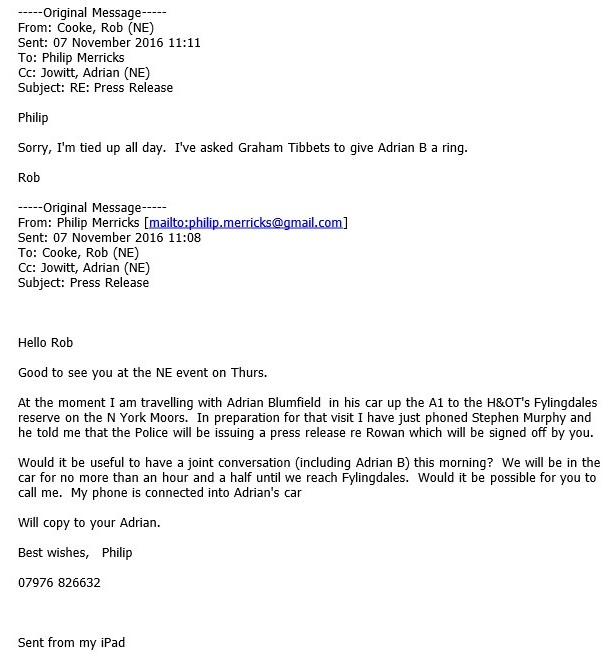
Phillip Merricks, Hawk & Owl Trust

Jemima Parry-Jones, listed as both Hawk & Owl Trust and International Centre for Birds of Prey

Steve Redpath, Aberdeen University

Teresa Dent, GWCT

Jeff Knott, RSPB (although the RSPB withdrew support for DEFRA’s Inaction Plan in July 2016 so presumably Jeff is no longer involved with this group)

Christopher Price, Country Land & Business Assocation (CLA)

Alex Raeder, National Trust (was invited to join the group in September 2016)

In May 2016, the group produced a draft timeline for the reintroduction project. Here it is:

hh-southern-reintro-timeline

If you’re struggling to read the small font size, here is the draft timeline as a downloadable PDF: draft-hh-southern-reintro-timeline

As you can see, there’s a long way to go before any hen harriers might be released in southern England (first releases planned for 2020) and there are numerous hurdles for the project group to jump over before those releases can happen. The group has to identify suitable release sites, find some birds from donor countries, get local stakeholder support for this ‘reintroduction’, meet IUCN guidelines, and find some funding.

We’ll shortly be blogging about each of these topics, and some of what we’ve discovered through FoIs will blow your minds. Watch this space.

Hen harrier ‘reintroduction’ to southern England: the feasibility/scoping report

Back in November we blogged (here) about DEFRA’s proposed ‘reintroduction’ of hen harriers to southern England, which is part of DEFRA’s Hen Harrier InAction Plan.

We had received information, via an FoI request, that Natural England had identified two potential areas for the reintroduction – Exmoor and Wiltshire.

These two areas had been identified from a ‘project scoping’ (feasibility) report, dated 2012 and cited in DEFRA’s InAction Plan as being ‘unpublished’. We were very keen to see this scoping report and we’ve now got hold of a copy, via another FoI.

The report is called The Feasibility of Translocating Hen Harriers to Southern England, and Prioritisation of Potential Translocation Sites and Strategies. It is authored by D.J. Hodgson [Exeter University], W. Schuett [Exeter University], S.M. Redpath (Aberdeen University], S.C.F. Palmer [Aberdeen University], J.P. Heinonen [Aberdeen University], J.M.J. Travis [Aberdeen University] and R. Saunders [Natural England]. The report was written in 2012, was funded by Natural England, but for unknown reasons has never been published, which seems a bit odd for a report paid for with taxpayers’ money.

You can download it here: draft-hh-reintro-to-southern-england-feasibility-study

It makes for an interesting read. It identifies four potential release areas (Exmoor, Dartmoor, Dorset Heaths and Wiltshire), based on a series of ecological data, with the highest scoring areas being Exmoor & Wiltshire. There is also mention that Scottish birds would be the most suitable for a translocation to Exmoor (based on habitat similarities) whereas birds from the Continent would be more suitable for release in Wiltshire. (Remember, we already know that hen harriers that have been removed from grouse moors as part of the brood meddling scheme cannot be used for the southern England reintroduction project (see here) and so other donor populations need to be identified).

What is most surprising about this report is how dated the reference material is that has been used to justify the project’s feasibility, and, more pertinently, the apparent exclusion of more recent data that would throw a different light on the project’s feasibility, and we wonder whether that exclusion is deliberate. Let us explain….

The whole (presumed) premise of this project is to establish a self-sustaining population of hen harriers in southern England; a population that will be unaffected by the continued persecution of hen harriers on the grouse moors of northern England/Scotland. For this to be achievable, DEFRA/Natural England would need to be sure that the hen harriers released in southern England wouldn’t disperse to the grouse moor badlands in the north, where undoubtedly they’d be killed (illegally) and thus the southern reintroduction project would fail.

So in this feasibility report, the authors have discussed the natal dispersal of hen harriers (i.e. the distance dispersed from the natal nest to the nest of the first breeding attempt). It’s a reasonable subject to include, especially if, as in the case of this project, DEFRA/Natural England are trying to show that hen harriers will attempt to breed relatively close to any proposed release (substitute natal) site. The authors of this feasibility report have cited very short natal dispersal distances, based on the findings of Etheridge et al (1997), although they do acknowledge that there is limited evidence of greater natal dispersal distances based on more recent data. The Etheridge et al paper reported on fieldwork undertaken in Scotland between 1988 – 1995 and natal dispersal distances were assessed from wing tag re-sightings. None of the birds had been radio or satellite-tagged. Natal dispersal distances for males generally fell between 14-150km and for females, 9.5-51km. So, if you’re trying to argue that reintroduced hen harriers are likely to attempt to breed close to the release site, the Etheridge et al paper is a good one to cite.

However, since that 1997 paper was published, many, many more hen harriers have been radio and satellite-tagged (99 radio tagged 2002-2006; 47 satellite tagged 2007-2015 by Natural England according to Stephen Murphy’s presentation in Sheffield last Sept) but the RSPB has also been satellite tagging hen harriers in recent years so the totals will be higher. Natural England has yet to publish the full findings of the hen harrier tagging project (well, it’s only been 15 years since it started) but seeing as though one of the authors of the feasibility report is a Natural England employee (Richard Saunders), surely those more recent data should have been available to include in the feasibility report?

Now, it’s likely that there aren’t that many hen harriers that were radio or sat-tagged since 2002 that have survived for long enough to start a first breeding attempt, so there aren’t that many more recent data on natal dispersal that the authors could have used (there are a few birds that have survived for long enough, but not that many because most radio/sat tagged birds have been killed within the first year or so of leaving the nest (e.g. see here)).

But what we do know from the hen harriers tagged since 2002 is that juvenile dispersal  (i.e. the movements made by the young birds before they settle to breed), as opposed to natal dispersal, involves huge distances of hundreds of miles across large parts of the country, with some birds even dispersing to the Continent. It is these distances that need to be taken into account in the feasibility study, not just natal dispersal distances, because the chances are, any young birds released in to southern England will travel far and wide during the period of juvenile dispersal (probably to the grouse moors of northern England and Scotland) and so the probability of them still being alive to return to breed in southern England has to be seen as pretty slim, to say the least.

It’s all very well for the authors of the feasibility report to cite short natal dispersal distances, but to ignore the period of dispersal between fledging and first breeding attempt seems a fairly fundamental flaw, especially when the report authors have acknowledged throughout that persecution in the uplands continues to be a major issue. The authors did consider juvenile dispersal distances when they modeled population spread from southern England, but again, this was flawed because, if we’ve correctly understood the feasibility report, they only used dispersal distances from the Etheridge paper AND they assumed ‘no illegal activity’ in their modelling variables!

And it’s not just the information on dispersal that is so outdated in this feasibility report. The rest is pretty old too – the most recent reference cited in the reference list is from 2009. Sure, the feasibility report was written in 2012 but there are a lot more recent data they could have used, including the Hen Harrier Conservation Framework that was published in 2011. That Framework Report (written by Fielding et al) is the most comprehensive review on the ecological requirements and status of hen harriers (if you exclude the updated HH Framework Report that was submitted to SNH in 2013 but remains unpublished, four years on, because SNH wants to keep it a secret) so why weren’t the findings of the 2011 Framework Report incorporated in to this 2012 feasibility report?

It’s possible, of course, that we’ve misunderstood the feasibility report (and we’d be very keen to hear others opinions once you’ve had a chance to read it) but if we haven’t misunderstood it, and the feasibility report is flawed, then where does that leave DEFRA’s planned hen harrier reintroduction? It surely can’t proceed if the science used to justify the project’s feasibility is so flaky and unpublished?

We’ll be blogging more about the planned hen harrier reintroduction to southern England over the coming days, including further information about specific release sites, funding, and potential hen harrier donor populations that have been revealed via FoI.

Photo of satellite-tagged hen harrier Elwood, by Adam Fraser. Elwood ‘disappeared’ last year on a grouse moor in the Monadhliaths just a few weeks after fledging (see here).

Satellite-tagged hen harrier ‘Beater’ is lost, presumed dead

Another of the 2016 cohort of satellite-tagged hen harriers has been reported as ‘lost’, presumed dead.

This time it’s a bird called ‘Beater’, a young male who hatched on the admirable Glen Feshie Estate in the Cairngorms National Park. According to the most recent blog update from Blanaid Denman (Project Manager, RSPB Hen Harrier Life Project):

Sadly, no data has been received from Beater since his tag last transmitted on 14th November. His last known location was on an area upland pasture in the central Scottish Borders. We have no information to suggest anything illegal has happened, the transmissions did not stop abruptly as in other recent cases, but we do now think it most likely that he has died” (read the full Skydancer blog here).

Photo of Beater shortly before fledging (photo by Ewan Weston)

The class of 2016 are not doing very well. In addition to Beater, here are some of the others that haven’t survived past November:

Hen harrier Elwood – ‘disappeared’ in the Monadhliaths just a few weeks after fledging.

Hen harrier Brian – ‘disappeared’ in the Cairngorms National Park just a few weeks after fledging.

Hen harrier Donald – missing in northern France, presumed dead.

Hen harrier Hermione – found dead on Mull, believed to have died from natural causes.

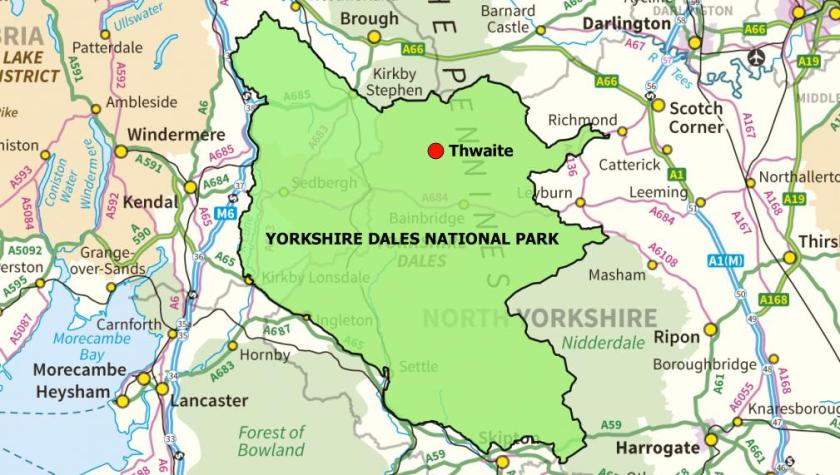
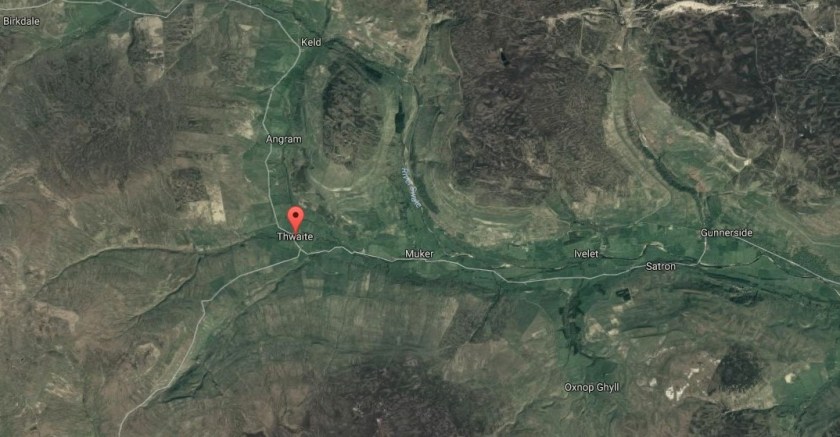
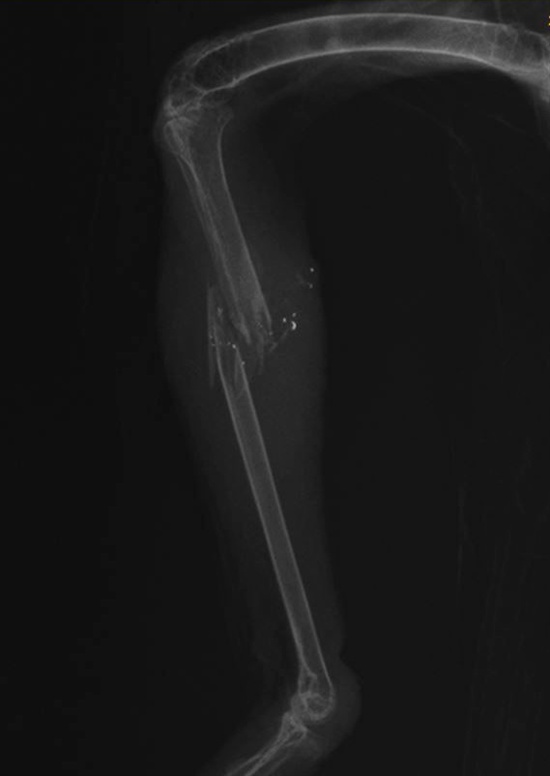
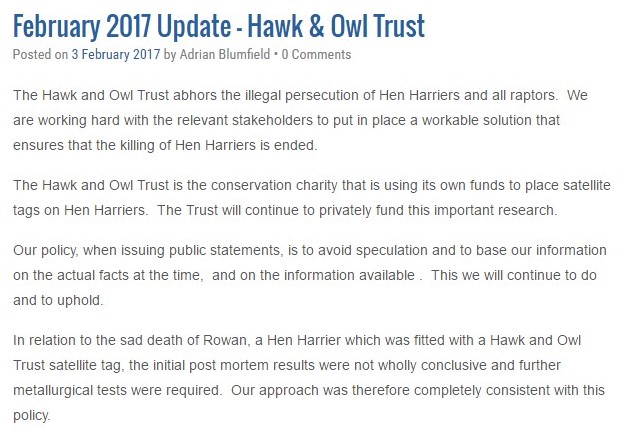
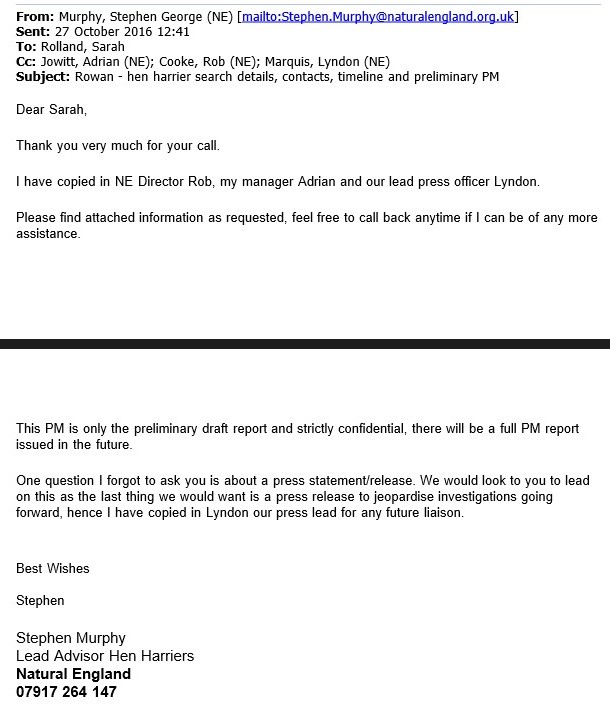
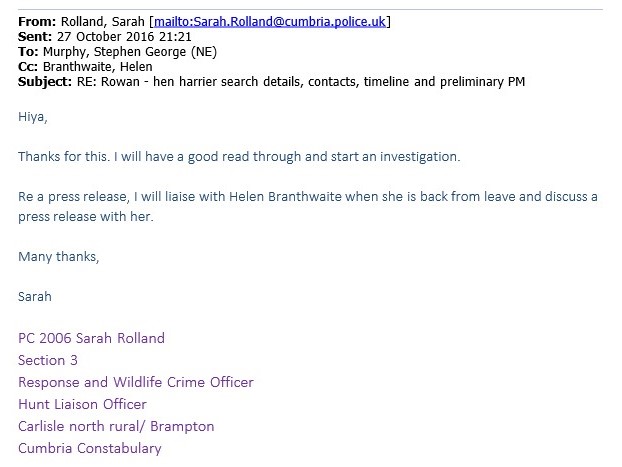
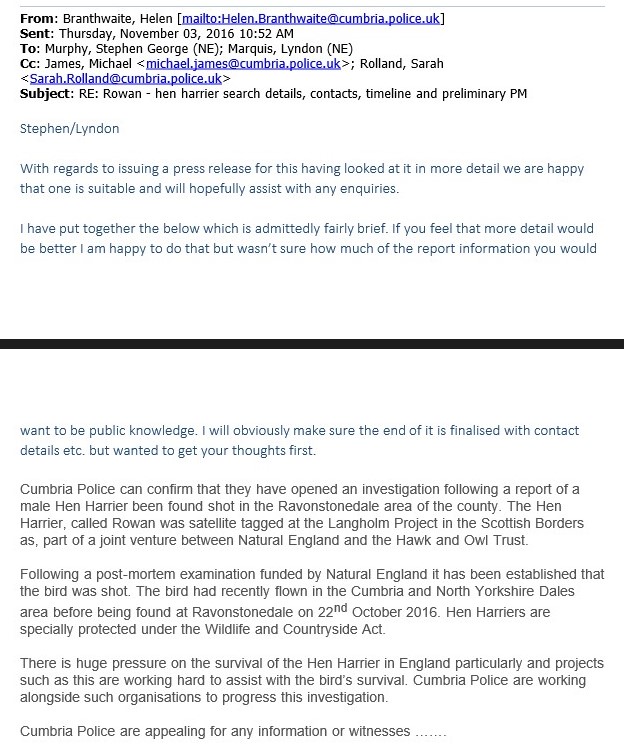
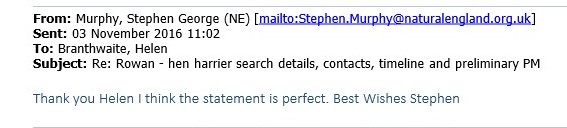
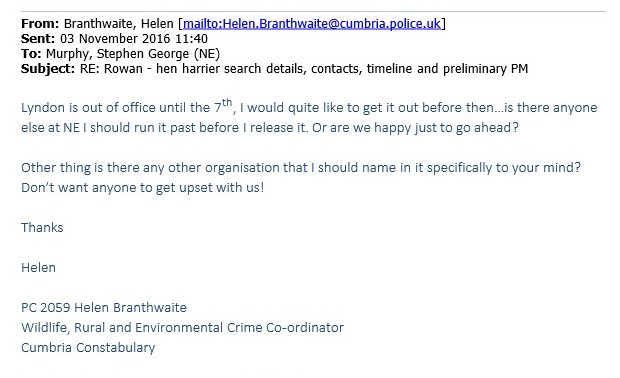
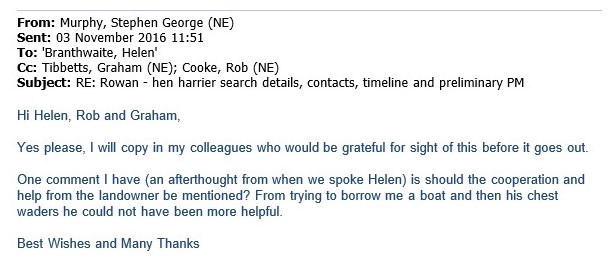
Hen harrier Rowan – found dead in Yorkshire Dales National Park. Cumbria Police said ‘likely to have been shot’. There is no ambiguity – this bird was shot (more on this soon).

Hen harrier Tarras – ‘disappeared’ in the Peak District National Park.

Also ‘lost’ this year were two birds from the 2014 cohort: Hen harrier Highlander ‘disappeared’ in Co Durham in April and Hen harrier Chance ‘disappeared’ in South Lanarkshire in May.

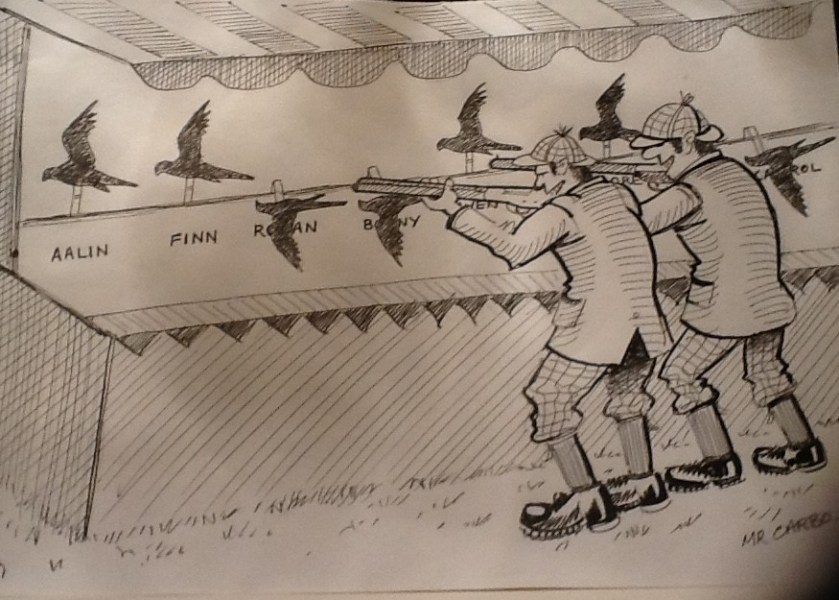
At least eight of the 2016 cohort are still alive (Aalin, Bonny, Carroll, DeeCee, Finn, Harriet, Wendy and Sorrel). Thanks to regular updates from Blanaid and her colleagues (thank you – much appreciated), these birds’ movements can be followed on the project website (here) with the exception of Sorrel, whose movements are being monitored on the Hawk & Owl Trust website (here). How many will make it to Xmas?

“Risible, make-believe tosh”: RSPB responds to Gift of Grouse propaganda

RSPB Scotland has responded to the ridiculous claim (see here) made by the Gift of Grouse that raptors are ‘thriving’ on Scottish grouse moors. Here is the RSPB’s press release (reproduced below):

RSPB SCOTLAND RESPONDS TO GIFT OF GROUSE PRESS RELEASE

RSPB Scotland has dismissed a press release issued today by the “Gift of Grouse” campaign that attempts to draw a veil over the continued persecution of birds of prey on areas of land managed intensively for driven grouse shooting. The reports on which these assertions are based are not in the public domain, and therefore have not been subject to the usual levels of public scrutiny.
However, recent peer-reviewed scientific reports published in the last 12 months link sharp declines in nesting peregrines and hen harriers in NE Scotland to illegal killing; a recently-published SNH report shows that there has been no decline in the levels of persecution of red kites in north Scotland over 25 years; and, results of the 2015 golden eagle survey show that levels of home range occupancy by golden eagles is significantly below the national average in the eastern highlands, where grouse moor management is a dominant land use. In this part of eastern Scotland, prey availability is high, and golden eagles should be more numerous and more productive than almost anywhere else in the country.
There are also ongoing concerns about the regular “disappearance” of satellite-tagged birds of prey in grouse moor areas, to the extent that a review of these incidents has been commissioned by the Cabinet Secretary for the Environment, Climate Change and Land Reform, Roseanna Cunningham MSP.
Ian Thomson, RSPB Scotland’s Head of Investigations said: “The content of today’s statement from the Gift of Grouse campaign is pure, unadulterated propaganda from an industry that, quite rightly, is under increasing public scrutiny by the Scottish Parliament. Their claims have no supporting evidence, their methodology is not explained, and to suggest that incidental observations of raptors which may merely have been flying over an estate indicate a population that is “thriving” is clearly ludicrous.
It is astonishing that the Angus Glens area is being held up as an example of good practice, given the long absence of successfully-breeding raptors over much of this region, as well as its appalling recent history of illegal killing of protected species. Walkers in the area this spring were greeted by a plethora of gas guns, inflatable decoys and strings of fireworks scattered across the hills, all designed to scare off, rather than welcome, birds of prey!
ENDS
Good, strong stuff from RSPB Scotland.
Earlier today The Times ran a story based on the Gift of Grouse propaganda entitled ‘Our conservation skills help raptors to thrive, say gamekeepers’. It includes an amusing quote from RSPB Scotland spokesman James Reynolds, who dismissed the report as “a pile of risible, make-believe tosh“. He added:
These claims by the grouse industry simply serve to show the pathological state of denial in which they are gripped. That they are prepared to pedal such nonsense, flying in the face of repeatedly proven facts and official surveys, shows the degree of desperation that they are prepared to go to in order to try and make this damaging industry respectable. Thankfully, the Scottish people aren’t so easily fooled by such contemptuous rubbish“.

Scottish landowners pretend that raptors are ‘thriving’ on driven grouse moors

Gift of GrouseWe’ve come to expect outlandish propaganda from the Gift of Grouse campaign group, designed to portray driven grouse moors as models of excellence for raptor conservation. But this time they’ve exceeded all expectation. Forget their usual unsubstantiated post-truth drivel, wholly disconnected to reality, because that’s got nothing on their latest effort, which takes the stretching of credibility to new depths.

The following press release from the Gift of Grouse is set to hit the headlines tomorrow:

ENCOURAGING NUMBERS OF BIRDS OF PREY SIGHTED ON SCOTTISH MOORLANDS

An increasing number of birds of prey are thriving on Scottish grouse moors due to gamekeepers’ conservation efforts.

More than 10 different raptor species including golden eagles, red kites and hen harriers have been identified on prominent grouse moors this year. They are among the 86 bird species that have been recorded on estates in the Angus Glens.

A snap shot from a range of estates across the Angus Glens Moorland Group highlighted encouraging evidence with gamekeepers on Invermark Estate in particular sighting nine raptor species including buzzards and golden eagles. Some of these are nesting and successfully breeding on the estate.

A number of other estates also reported healthy numbers with Ballogie Estate, Royal Deeside, revealing a total of 15 buzzards regularly hunting on the moor. Figures from the Speyside Moorland Group were equally as strong with 12 species of birds of prey recorded on Strathspey Estate alone. Atholl Estate in Perthshire are also monitoring 12 different raptor species.

Garry MacLennan, head gamekeeper on Invermark Estate, said: “Scottish grouse moors are far from being raptor deserts, as some opponents of shooting claim. We have monitored a growing number of buzzards, kestrels, golden eagles and white-tailed eagles. Keepers and estate managers do recognise there are some areas of the country where there are fewer raptor species but there is plenty of hard evidence to show that raptors are successfully nesting on grouse moors.”

The findings from Invermark are part of annual surveys undertaken using SNH guidelines.  These surveys were conducted by Taylor Wildlife, an ecological consultancy specialising in upland environments.

Richard Cooke, manager of Invermark Estate, said: “The survey is an extremely helpful way for us to monitor the biodiversity of the estate and which species are benefitting the most from our habitat management practices. Throughout the year we carry out rotational muirburn and control predation under the general licence, including foxes, stoats and other mustelids in particular.  This is to the benefit of many ground nesting birds and is reflected in the rich birdlife recorded by the annual audit.

The Tayside Moorland Group has also carried out species monitoring at a number of estates throughout the region with Glenturret Estate in Perthshire recording no less than 12 different raptor species hunting and nesting on the moorland this year. The estate tally included several breeding pairs of hen harriers, a nesting pair of peregrine fledging four chicks, short eared owls and numerous red kites.

Conservation training, conscientious moorland management and favourable weather conditions can all impact positively upon species numbers found on Scottish moorland.

Figures revealed in Wildlife Estates Scotland’s latest annual report show that 11 accredited estates reported the presence of golden eagles, with seven of these reporting 19 pairs. Eleven estates also recorded sightings of hen harriers with four reporting 18 breeding pairs. Buzzards were also reported on 20 estates, with a total estimated population of over 920 birds.

It was also recently revealed in a national survey that golden eagle numbers have surpassed 500 pairs giving them a ‘favourable conservation status’ in the UK. Eagles have made a home on several moorland estates across Scotland with Millden Estate, a member of the Angus Glens Moorland Group, recording a particularly high number of sightings.

Jason Clamp, head gamekeeper on Millden Estate, commented: “We are fortunate enough at Millden to have regular sightings of golden eagles. Seeing several of these magnificent birds on a daily basis has to be one of the highlights of my job. We are also very careful to leave a sustainable population of mountain hares for birds of prey, such as golden eagles, to hunt.

At Millden our team of gamekeepers has taken a proactive role in ensuring that we have a suitable breeding habitat for various birds of prey such the merlin, of which we currently have four nesting pairs. This has been brought about through controlled heather burning ‘muirburn’, which creates micro habitats suited to ground-nesting birds like the merlin.

We are delighted that the golden eagle, a species of conservation concern, amongst many other species, has found a safe and suitable environment in which to flourish in such impressive numbers, where careful moorland management has been imperative.”

ENDS

Wow! Where to start with this? It’s such ludicrously far-fetched bollocks it could have come straight from the mouths of gamekeepers and grouse moor managers. Oh, hang on…

Perhaps the idiots behind the Gift of Grouse campaign didn’t see the results of the latest national golden eagle survey, published just a few short weeks ago. You know, the survey that showed breeding golden eagles are still largely absent from driven grouse moors in the Eastern Highlands, just as they were in the last national survey conducted in 2003. Only 30% of known territories were occupied in this area – that’s a pathetic 34 out of 91 territories.

Perhaps the idiots behind the Gift of Grouse campaign didn’t see the results of the recent study on northern red kites, showing that illegal persecution on driven grouse moors in this region is just as bad now as it was in 1989.

Perhaps the idiots behind the Gift of Grouse campaign didn’t read the recent scientific paper showing hen harriers have suffered a ‘catastrophic decline’ on the driven grouse moors of NE Scotland.

Perhaps the idiots behind the Gift of Grouse campaign didn’t read the scientific paper showing peregrines continue to suffer a ‘long-term decline’ on the driven grouse moors of NE Scotland.

It’s all very well saying that raptors have been ‘sighted’ on grouse moors – of course they’ve been seen there – they are drawn to those areas precisely because of the absence of territorial breeding adults (as well as an abundant food supply). Nobody disputes that you can see raptors over these moors – the crucial distinction, which the Gift of Grouse idiots have carefully avoided, is how many raptors are breeding there? Remember, no breeding hen harriers in the Angus Glens for ten years!

It’s interesting that this press release refers to the grouse moors of the Angus Glens – a well known hotbed of illegal raptor persecution for over a decade. Here’s a map to illustrate the point:

Four grouse moor estates are highlighted in red (Invermark, Millden, Hunthill, Glenogil [with thanks to Andy Wightman’s Who Owns Scotland website for estate boundaries]). You see those purple dots? They represent confirmed illegal raptor persecution crimes. Are we seriously being asked to believe that raptors are ‘thriving’ in this region?

It’s also interesting to note that the ‘data’ behind the Gift of Grouse propaganda come from an ‘annual audit’ carried out by Taylor Wildlife consultancy. We’ve blogged about this group before – these are the ‘experts’ who claimed to have recorded 81 species of birds ‘feeding or breeding’ on an Angus Glens grouse moor last year. The problem is, their survey methods didn’t adhere to the usual industry standard – rather than conduct their breeding bird survey between March and June, when you’re supposed to do it, they conducted their survey between June and August, which is, er, after the breeding season!

Will we get to see this year’s report to scrutinise the methods and results? Highly unlikely – we’re still waiting to see their 2015 report but apparently it’s a secret and we’re not allowed to read it. Can’t think why.

Also of note in this latest press release is the reference to Glenturret Estate in Perthshire, another well-known driven grouse moor. We’ve blogged about this estate before, when it was claimed that Hen Harrier Day protesters might ‘disturb’ hen harriers – a species that has consistently failed to breed successfully on this moor. This year, they are claiming to have ‘several breeding pairs of hen harriers’ amongst other species. That’s interesting, because according to monitoring data from the Scottish Raptor Study Group, there was only one hen harrier breeding attempt on Glenturret this year, and, as has so often happened here in recent years, the nest failed for ‘unknown reasons’. Unfortunately it’s not possible to work out why hen harriers keep failing here because the estate has apparently refused to allow nest cameras to be installed.

Glenturret used to have lots of successfully breeding raptors, but these days, not so much. They certainly don’t have breeding golden eagles anymore because the eagle’s eyrie was burnt out last year. Here’s a photograph of the cliff face, taken in April 2015 – note the blackened hillside. Spontaneously combusting eagle eyries are a common problem on some Scottish grouse moors. Either that or golden eagles need to learn to discard their fag butts with more care.

We’ll add updates to this blog tomorrow when we see which newspapers have swallowed the Gift of Grouse guff hook, line and sinker. We’ll be particularly interested to see whether SNH issues a statement to rebutt the claims being made – SNH has access to the actual raptor breeding data via the Scottish Raptor Monitoring Scheme – let’s see them put it good use.

UPDATE 5 December 2016: “Risible, make-believe tosh”: RSPB responds to Gift of Grouse propaganda (here).