Continuing on from recent blogs (here, here) about a series of updates on the proposed ‘reintroduction’ of hen harriers to southern England, here’s some more news gleaned from the latest FoI response from Natural England.
The estimated cost of a ‘reintroduction’ of hen harriers to southern England has previously been estimated at £515k (see DEFRA’s Hen Harrier InAction Plan).
Since DEFRA’s Inaction Plan was published in January 2016, we haven’t seen any other paperwork relating to these costs, or an explanation of how they were calculated. There was some comment last year from Natural England’s external funding bid, who were asked to provide advice to the Southern Reintroduction Project Team about a potential funding application to the Heritage Lottery Fund, that the final cost was more likely to be in excess of £2 million (see here).
However, in Natural England’s most recent FoI response, the details of a 2013 cost estimate (at the lower end of the scale) has now been released: HH southern reintro estimated project costs 2013
This estimate was described by the author (Ian Carter, who has since left NE) as “back of the proverbial fag packet stuff“. That’s fair enough. With so many project unknowns, it would have been difficult to provide anything more robust at that stage.
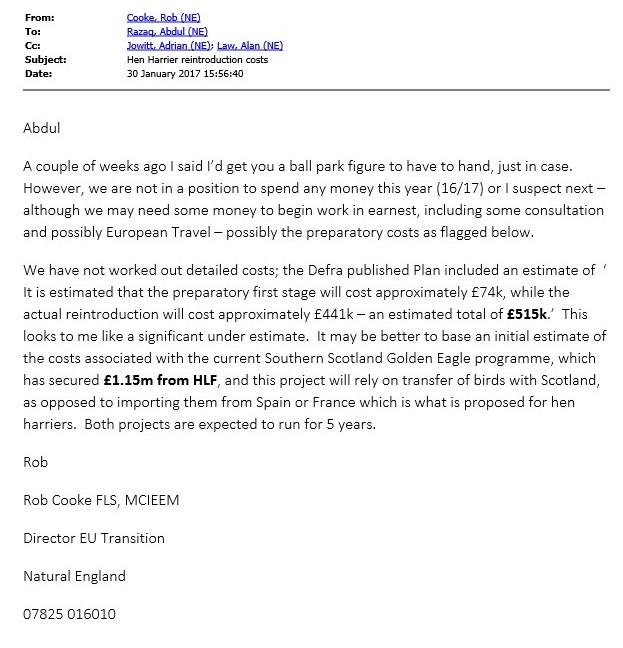
Fast forward four years and Natural England is now working to a revised cost estimate. It appears to have jumped from half a million quid to 1.15 million quid, and the only rationale, that we can see, is that this is how much the South Scotland Golden Eagle Project has just secured from the Heritage Lottery Fund:
Continuing from yesterday’s blog about a series of updates on the proposed ‘reintroduction’ of hen harriers to southern England, here’s some more news gleaned from the latest FoI response from Natural England.
We knew from previous FoIs that Natural England was looking at Wiltshire and Exmoor National Park as the two preferred release sites for translocated hen harriers. These two areas had been identified by an unpublished feasibility study (which in our opinion is a flawed study – see here). The study had initially examined four potential release areas: Dorset, Dartmoor, Exmoor and Wiltshire. Based on multiple assessment criteria, Exmoor National Park was identified as the #1 preferred choice, Wiltshire as #2, Dartmoor as #3, and Dorset was considered unsuitable.
We blogged about Exmoor National Park here and Wiltshire here and there were early signs of some local resistance to the project. The latest FoI response from Natural England reveals that there is still trouble at t’mill in both areas and so now Dartmoor National Park in Devon is being considered as a potential release site.
Local resistance in parts of Wiltshire and Exmoor National Park seems to be coming from those with shooting interests. Some of those involved with pheasant and partridge shooting in Exmoor NP appear to object to the project because it might lead to “undue scrutiny of legitimate activities“. Eh? If the shooting activities are legitimate why would they have any concerns about “undue scrutiny“?
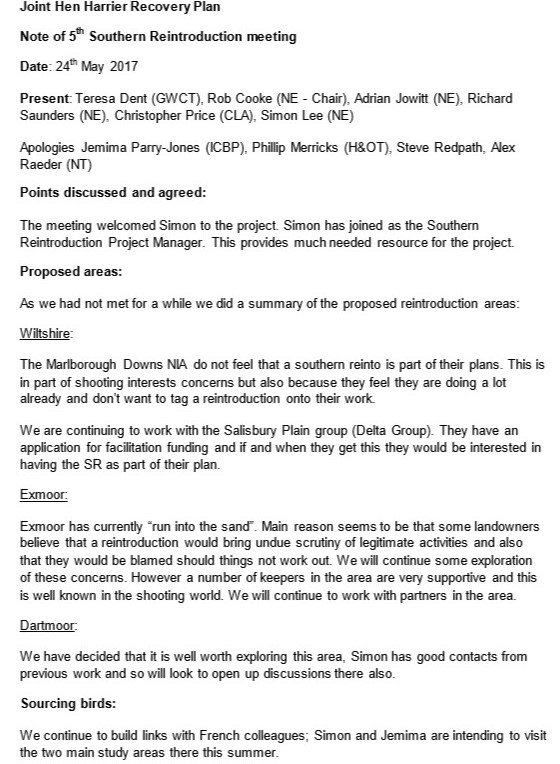
It’ll be interesting to see whether the same concerns are raised by shooting interests in Dartmoor National Park (another popular shooting area). It’s clear that Natural England is hoping that new Project Manager Simon Lee’s contacts in the area will help things along.
Here are the notes from the Southern Reintroduction Team’s last meeting in May 2017 when these issues were discussed:
We blogged recently about how this year Natural England has been refusing to release any more information about the brood meddling plan (see here). Today’s blog (and several to follow) is an update on the southern ‘reintroduction’ project, following the release of various documents under FoI that has taken us seven months to prise from NE.
As a quick recap for the benefit of new readers, here’s what we were able to find out about the southern reintroduction plan last year:
That the feasibility/scoping report being used as the scientific justification for a hen harrier reintroduction is flawed (here)
Which individuals and organisations are involved with the project group and what the group’s planned work timetable looks like (here)
The potential funding options for this project (here)
Exmoor National Park as a proposed reintroduction release site (here)
Wiltshire as a proposed reintroduction release site (here)
From which potential donor countries is NE planning to source hen harriers (here)
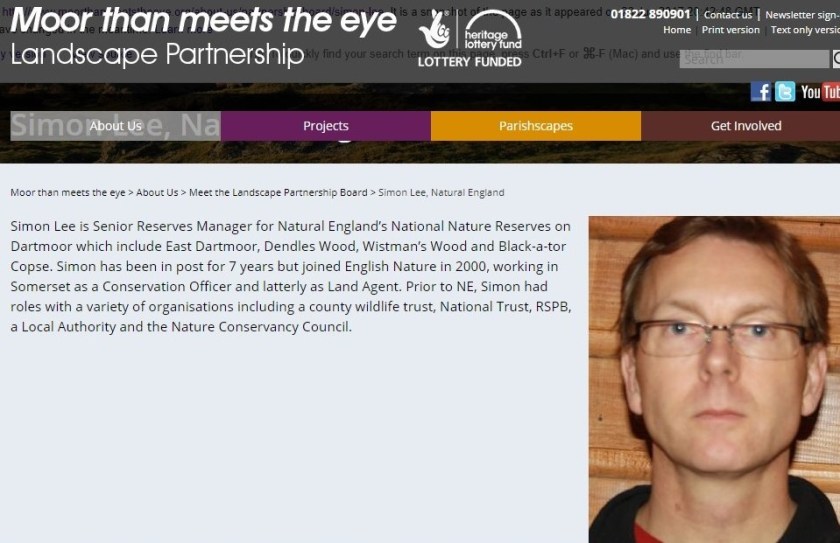
So, the first update for this year is that Natural England has appointed a Hen Harrier Southern Reintroduction Project Manager. His name is Simon Lee and he has been an NE employee since 2000, so is probably regarded as a safe, reliable option. Here’s a bit about his career history that we found on an old website:
Simon’s experience working on Dartmoor may well have been a key consideration for this new appointment (that will become clearer in a later blog).
Simon has been busy getting up to speed with the project, having interesting chats (more on this later), visiting a potential donor site in France (more on this later) and, according to this short update he wrote for a recent Natural England Board Meeting, he’ll be helping to establish a technical group to produce a technical project plan. He might be doing other things too but NE redacted the second paragraph:
It’ll be interesting to see who is invited to serve on the technical group. As Mark Avery pointed out at the beginning of the year (here), the composition of the southern reintroduction project group “hardly looks like a list of independent experts“.
Here’s the tried and tested method that Natural England has deployed in recent years to count the number of hen harrier nests in England. In fact they’ve only needed one hand to complete the task.
This year, there are so many hen harrier nests, they’ve had to deploy a super computer to cope with the figures.
We know there must be loads and loads of nests, judging by the response we received from Natural England to a recent FoI request. In early July we asked NE the following simple questions:
How many hen harrier breeding attempts in England are Natural England aware of in 2017, to date?
How many of those were successful, to date?
In which counties were the successful/unsuccessful nests?
How many of those breeding attempts were on a driven grouse moor?
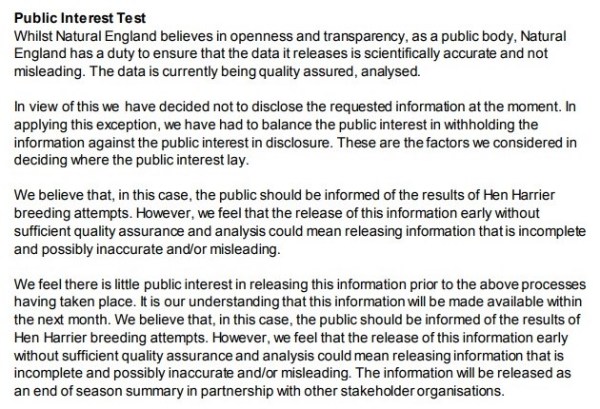
Today they responded and told us the information was being withheld for the time being. One of the reasons was a Public Interest Test, as follows:
Gosh! Soooooo many nests the data are having to be “quality assured and analysed” so as not to be misleading or inaccurate! We can hardly wait to see the results of such a challenging and complicated analysis.
Interesting to note that NE says the results “will be made available within the next month“. Will that be before or after Hen Harrier Day, which takes place in two and a half weeks?
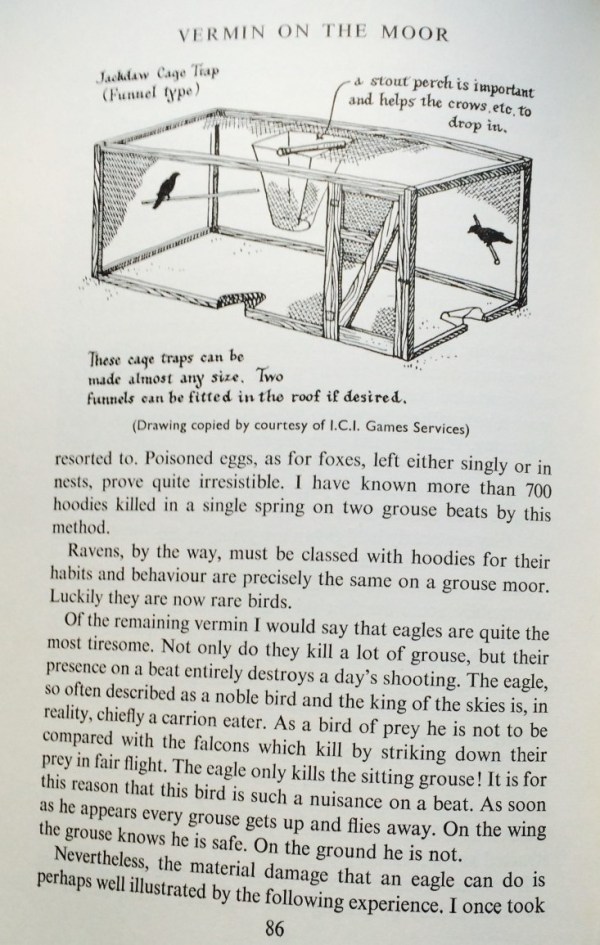
“The hen harrier….this is a nasty bird of evil habits. It quarters the moor a few feet above the ground and pounces on grouse or chicks it catches unawares. It must be got rid of at all cost”.
This is a quote. You might think it’s attributable to Amanda Anderson (Director, Moorland Association). It’s not that far off her infamous quote last year:
“If we let the harrier in, we will soon have nothing else. That is why we need this brood management plan“.
But our quote isn’t from Amanda. It’s from a book called Grouse: Shooting and Moor Management, first published in 1958 (er, four years after the Protection of Birds Act became law!) and written by Richard Waddington who had a grouse moor in what is now the eastern side of the Cairngorms National Park.
Obviously stuck in a Victorian time warp, another quote from the chapter called ‘Vermin on the Moor’:
“Eagles can very easily be trapped…..They can also sometimes be shot. However, since they are vigorously protected throughout Scotland it is perhaps wisest to say nothing on this subject. But if you want a successful grouse shoot you must find some means of ridding yourself of eagles“.
[Thanks to the blog reader who drew this book to our attention, also quoted in Mark Avery’s book Inglorious].
And here we are, well over half a century later, and not much has changed, has it? A number of grouse shooting estates are quite clearly still ‘ridding themselves of eagles’, including some on the eastern side of the Cairngorms National Park (see here), while breeding hen harriers have been eradicated from many Scottish grouse moors (see here) and virtually every English grouse moor (we heard there was a pair this year on a grouse moor in the Yorkshire Dales but apparently, we’re told, it ‘disappeared’. Presumably this will be confirmed by Natural England at some point. But then again…).
The fight back continues though. For the fourth successive year, Hen Harrier Day events will be happening throughout the UK over the weekend of 4-5 August (and an event on the Isle of Mull on 29 July 2017). Full details of each event can be found on the Hen Harrier Day website HERE
Find one near to you (or find a distant one and have a road trip) and turn up, join in and show your support. We’ll be at the Tayside event (along with other speakers) on Saturday 5 August and also at the Highland event on Sunday 6th. We look forward to seeing some of you.
Regular blog readers will know that we’ve taken a keen interest in DEFRA’s Hen Harrier Action Plan, which was published in January 2016.
We’ve been particularly interested in two of the six action points of this plan: brood meddling and the southern reintroduction.
On brood meddling, through a series of FoIs last year, we were able to find out what was being planned (here), a bit more about what was being planned (here), who was likely to be involved in the practicalities of brood meddling (here), and a bit about an even more bonkers social science survey that was to run parallel with the bonkers brood meddling scheme (here).
However, since November 2016, it all went a bit quiet so on 23 February 2017 we submitted another FoI asking for copies of all recent correspondence on brood meddling and the southern reintroduction. Natural England responded on 21 March 2017 telling us that information was being withheld “as it would prejudice the process of determining the licence application and potentially the quality of that licence”. They also told us, “The discussions are confidential up until the point the licence application has been determined. Once this has happened then details of the licence are available to the public”.
We knew that this licence application was being submitted (by Natural England, to Natural England!) in either February or March 2017, so we left it a while before we submitted another FoI.
Our second FoI asking for information was submitted on 29 May 2017. Natural England responded on 31 May 2017 with this:
‘The application you refer to is still being determined. I’m afraid that we do not have an estimate of when it will be”.
We then learned, from reading the minutes of the Natural England Board meeting held on 22 March 2017 that the brood meddling licence application had been submitted (by Natural England, to Natural England!). We also learned that the Natural England Science Advisory Committee “needed to sanction the work behind the data” but that’s about all we’ve been able to find out.
So on 2 July 2017 we put in a third FoI to Natural England, again asking for copies of all correspondence relating to the brood meddling scheme. Last Thursday (6 July 2017) Natural England responded:
“I can confirm that the licence application is still being determined and we do not have an estimate of when it will be“.
We’re finding this all quite hard to believe and suspect that Natural England is just using this as an excuse not to release any more information about their plans for brood meddling because they don’t like the criticism those plans have attracted. How would releasing notes from the brood meddling team meetings ‘prejudice the process of determining the licence application and potentially the quality of that licence‘? All this secrecy, over a highly controversial project, doesn’t inspire confidence.
On the southern reintroduction action point (although it’s not really a ‘reintroduction’ because harriers are still present in southern England), last year, again through a series of FoIs, we were able to find out about the feasibility/scoping report (here), the project group and its planned work timetable (here), potential funding options (here), Exmoor National Park as a proposed release site (here), Wiltshire as a proposed release site (here), and potential donor countries from where NE will source hen harriers (here).
Since the end of 2016, Natural England has refused to release any further information on the southern reintroduction, again, using the brood meddling licensing application to hide behind. We’ve now submitted another FoI (2 July 2017) asking for this information to be released, as this information has nothing to do with the brood meddling licence application and should therefore be available for scrutiny.
We do know, from the minutes of that NE Board meeting on 22 March 2017, that the NE Board has “considered the overall objective of the southern reintroduction and agreed this was to help relic upland populations in respect of the genetic diversity and the overall favourable conservation status of the species“.
So has the NE Board seen any scientific evidence that has assessed the genetic diversity of the UK hen harrier population and determined that its genetic diversity is in need of “help”? Have the potential donor populations been screened to assess their genetic diversity? And how will releasing hen harriers, that are likely to disperse to the uplands where this species is still routinely shot on sight, help the species achieve favourable conservation status?
Today, after a long-running court case, two members of the Jedforest Hunt in the Scottish Borders have been convicted at Jedburgh Sheriff Court of illegal fox hunting (see BBC news article here and League Scotland article here).
The prosecution case relied heavily upon covertly-filmed video footage, filmed by investigators from the League Against Cruel Sports Scotland. We have previously spoken to one of those investigators who confirmed that he was filming covertly on private land without landowner permission as part of a wider research project on the behaviour of hunts, whether the hunts were involved in alleged criminal activity at the time or not.
The video evidence was accepted as admissible by both the Crown Office and by the court. We’ve even read Sheriff Paterson’s written judgment and there is no mention whatsoever about the admissibility / inadmissibility of the video evidence. It was not deemed to be an issue.
So why the hell was the video evidence in the Cabrach hen harrier shooting deemed to be inadmissible by the Crown Office, before it got anywhere near a court? Does video evidence only become an issue if you have the word ‘gamekeeper’ associated with it?
The circumstances of the collection of video footage in both cases are remarkably similar (no landowner permission, and film work undertaken as part of a wider monitoring project) although there is an important distinction, but we think this distinction should actually have favoured the admissibility of the RSPB’s footage more so than the League Scotland’s footage.
Due to the nature of what they were filming (a fox hunt), the League Scotland investigators would reasonably expect to capture footage of individuals that presumably could be later identified. If you do that, you enter a minefield of legislation about the use of personal data / private information that is subject to the terms of the European Convention on Human Rights, as discussed recently by Dr Phil Glover of Aberdeen University Law School (here).
Whereas the investigators from RSPB Scotland had placed their camera pointing at the nest of a specially-protected hen harrier, miles from any private dwelling. Given the species’ Schedule 1 status, the investigators would not have expected to capture ANYBODY on camera unless they had a Schedule 1 disturbance licence giving permission to visit the nest.
You’d think then, based on the circumstances, that the RSPB’s video evidence would have sailed through but the League Scotland’s video evidence would have come up against more opposition. But what actually happened was the complete opposite!
Today’s judgement is a very good result for League Scotland (and well done to them) but it just throws up more questions about the inconsistency of the Crown Office when deciding whether video evidence is admissible or not.
If anybody with legal training is able to help us understand this seeming disparity, please give it a go.
So, further to our last blog about the GWCT calling for a ‘limited cull’ of hen harriers in response to the news that hen harriers have sunk further in to decline, the GWCT is now saying (on Twitter) that we have deliberately misrepresented their position and that they are NOT calling for a cull of hen harriers.
Let’s just be clear here. If we have misrepresented their views (and we don’t believe we have – see below), then it certainly wasn’t done intentionally. We’re not in that game, unlike the GWCT who are the masters of misrepresentation (e.g. see here for just one of many examples).
The GWCT argues that we “spliced together” two parts of their statement “to misrepresent our position“. It is fair comment to say we spliced together two parts – we did. But not to misrepresent the GWCT’s position – it was because we believed they were specifically referring to hen harriers in both parts of their statement.
If we were deliberately trying to misrepresent the views of the GWCT, why would we have published their entire press statement? We published it for precisely the reason NOT to misrepresent – it’s there for all our blog readers to view and to make up their own minds. Judging by the public reaction both here and on social media, we’re not the only ones who thought the GWCT was advocating a ‘limited cull’ of hen harriers.
So why did we think they WERE advocating a hen harrier cull? Well, it’s mostly down to one paragraph:
Dr Adam Smith said: “We need an adaptive approach whereby agreements are reached between landowners and government, allowing sustainable numbers of both raptors and prey to be achieved. We welcome Defra’s plan to study how to regulate the impacts of harriers on grouse in a non-lethal trial in the interests of both species. This is overseen by Natural England and supported by many organisations including the Game & Wildlife Conservation Trust, who first suggested licensed control in 1998. Grants, intra-guild effects, limited culls, target predator densities and other mechanisms should be used in this way to serve the long-term interest of raptors as well as game species and other wildlife.
In this paragraph, the GWCT are specifically discussing the management of hen harriers. They talk about DEFRA’s (ridiculous) Hen Harrier Action Plan, and in the same sentence mention that the GWCT “first suggested licensed control in 1998“. The sentence that immediately follows is where they advocate, amongst other things, “limited culls“. In our opinion, it is perfectly reasonable to conclude that they were still talking about hen harriers, especially as we know that the GWCT has previously advocated a hen harrier cull (see here).
When GWCT said on Twitter that they were NOT advocating a hen harrier cull, we asked them for which raptor species they WERE advocating a cull. They responded by saying they weren’t advocating a cull of any raptor species, but claimed, “The line refers to possible research into effects of raven population on wading birds. The line refers to all wildlife, not just raptors“.
We’ll leave the reader to decide whether this was a case of genuinely mistaken misinterpretation (on our part) of a poorly-articulated GWCT press statement, or whether this is the GWCT furiously back-pedalling in the face of a public backlash to their long-standing calls for a hen harrier cull.
The rest of our original blog remains unchallenged by GWCT (the bit about there being an over-abundance of red grouse and a lamentable lack of hen harriers) and all this argument about whether they currently want to cull or not is acting as a nice distraction from the REAL issue, which is the continued illegal killing of hen harriers on driven grouse moors.
Following this morning’s news that the UK’s hen harrier population has descended further in to decline, the Game & Wildlife Conservation Trust (GWCT) has published the following response:
The GWCT says the results of the national hen harrier survey indicate that balance in moorland conservation and management in the UK is needed more than ever.
Many birds of prey have now largely recovered their numbers, with buzzards, sparrowhawks and ravens commonplace species. Such a full recovery of numbers and range is not the case for all birds of prey. Though the hen harrier has increased in range and number from a few pairs on Scottish islands in the early 20th century to the estimated 545 pairs in 2016, there is still work to do on their conservation.
This ground-nesting species is attracted to grouse moors where gamekeepers manage the heather, the fox numbers, and provide plenty of young grouse for them to eat. The GWCT’s research has shown a cyclical relationship between harriers and keeping. With plenty food and protection from foxes, harrier numbers can increase. If predators eat too many grouse chicks, the grouse moor becomes unproductive, making the moor redundant. Without gamekeepers there is less food, heather or fox control, so the harrier population cycles down again. Declines and rises in harrier numbers are not always linked to grouse management.
The GWCT believes the UK’s objective must be to enhance the community of raptors in the country as a whole. In some species this will need improvements in food supply or nest protection. In other places reducing the predation pressure by raptors, including hen harriers, on wildlife using the most satisfactorily humane methods will encourage their protection and conservation.
Dr Adam Smith said: “We need an adaptive approach whereby agreements are reached between landowners and government, allowing sustainable numbers of both raptors and prey to be achieved. We welcome Defra’s plan to study how to regulate the impacts of harriers on grouse in a non-lethal trial in the interests of both species. This is overseen by Natural England and supported by many organisations including the Game & Wildlife Conservation Trust, who first suggested licensed control in 1998. Grants, intra-guild effects, limited culls, target predator densities and other mechanisms should be used in this way to serve the long-term interest of raptors as well as game species and other wildlife.
“The GWCT condemns crimes against wildlife. We are committed to finding an effective and practical resolution to the conflict between red grouse and raptors. Wildlife crime only serves to delay a satisfactory resolution of the conflict.”
ENDS
Are they for real?
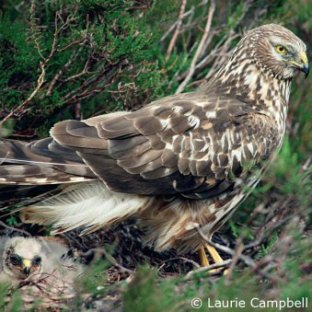
Here we have the news that in England in 2016 there were just four territorial pairs of hen harriers (resulting in just three successful breeding attempts, none of which occurred on a driven grouse moor), where there is the potential for over 300 pairs.
Compare that with the unsustainable, artificially-high density of red grouse produced on driven grouse moors (this density is between 10-100 times higher than the ‘natural’ density), and you’ve got GWCT talking about the “need to reduce the predation pressure by raptors, including hen harriers” which could be achieved by, amongst other things, “limited culls“?
What?!! Without resorting to a torrent of swear words, we’re actually lost for words. Actually, the magnitude of what they’re proposing deserves a swear word. What the actual fuck? As has been said over and over again, if a business model relies on the removal of a protected native species, it isn’t environmentally sustainable. If that business model has practically eradicated, illegally, that protected native species, the business deserves to be closed down.
GWCT are right in that “a balance in moorland conservation and management is needed more than ever” but the idea of culling a species that is just about to fall off the precipice in to breeding extinction, thanks to systematic illegal persecution, is insane.
Balance on the UK moorlands will only be restored if (a) the illegal persecution stops and (b) the clamour for ever-increasing bag sizes (# of grouse shot) stops.
UPDATE 3pm: GWCT back-pedalling on hen harrier cull idea (see here)
Hen harrier numbers have fallen by 9% in Scotland since 2010, according to the latest national survey of these birds, with the total population now estimated to be less than 500 breeding pairs.
The fifth national hen harrier survey was carried out in 2016 by the RSPB, Scottish Natural Heritage (SNH) and the Scottish Raptor Study Group, along with a range of other UK partners, and covered the whole of the United Kingdom and the Isle of Man.
In Scotland the results revealed a drop in breeding pairs to only 460, compared with 505 pairs from the previous survey in 2010. The UK population is now estimated at 545 breeding pairs.
This is the second successive decline in the Scottish hen harrier population revealed by national surveys, signalling a worrying trend. In the longer term, over the last 12 years, the number of breeding pairs has dropped by 27% in Scotland.
Known for their majestic skydancing ritual, hen harriers are one of the most threatened birds of prey in the country. Independent research has identified illegal killing as one of the main constraints on this species, along with a changing climate and the loss of heather moorland and other suitable nesting habitat to commercial afforestation and overgrazing.
Scotland is still a major stronghold for hen harriers, with 80% of the UK population. However, having a breeding population of fewer than 1000 birds makes this species vulnerable to the effects of habitat degradation and, in some areas, wildlife crime. The west Highlands continue to provide a home for the majority of Scotland’s breeding harriers (estimated 175 breeding pairs), while Orkney and the Hebrides were the only areas of the country to show a slight increase in the number of these birds.
According to the survey, similar hen harrier declines have been witnessed in all other parts of the UK as well. In England, these birds are on the brink of extinction as a breeding species, with the population falling from 12 pairs in 2010 to only four pairs last year. Meanwhile, Wales saw the number of pairs fall by more than a third over the past six years, from 57 to 35, and Northern Ireland recorded only 46 pairs in 2016 compared with 59 in 2010.
Duncan Orr-Ewing, Head of Species and Land Management at RSPB Scotland, said: “The hen harrier is an indicator of the health of our upland environment, and the fact that its population continues to decline is of major concern. The hen harrier is a high priority for our conservation work and urgent steps need to be taken to tackle illegal killing of this species and to improve their moorland breeding habitats.”
Eileen Stuart, SNH’s Head of Policy & Advice, said: “While Scotland remains the stronghold for hen harriers in the UK, the continuing decline is a serious concern particularly the low numbers found in parts of the mainland. We’re committed to continuing to work with a wide range of partners to tackle wildlife crime through PAW Scotland, including initiatives such as Heads up for Harriers, and General Licence restrictions where evidence supports such action. Scottish Natural Heritage and Forestry Commission Scotland have set up a joint Raptor Working Groupto identify and promote the opportunities of forestry for raptors, including hen harriers, to sustainably deliver Scottish Government environmental and forestry policy.”
Wendy Mattingley, from the Scottish Raptor Study Group, said: “There is a very concerning trend of a long term decline in the number of breeding hen harriers in Scotland. For the population to begin to recover and expand over all suitable habitat, the intensively managed grouse moors of east and south Scotland must produce successful breeding hen harriers again. The hen harrier is a wonderful spectacular raptor and more action must be taken to ensure that its future is secure.”
Tim Baynes, Director of the Scottish Moorland Group, said: “Scotland is still the UK stronghold for the hen harriers by a huge margin. However, it is disappointing to see any indication of decline in Scotland – and much larger drops in Wales and Northern Ireland – even though the decline is regarded by the survey team as statistically insignificant. Harrier breeding fluctuates annually for many reasons – not all associated with wildlife crime. For example, 2016 was a poor year largely due to low vole numbers in Scotland with weather and predation shown to have played their part. Fifteen of our members, covering an area of 325,000 acres, will be working with the Heads Up for Harriers project again this year to better to understand the reasons for poor harrier breeding and to help rebuild the harrier population.”
Simon Wotton, lead author of the study, said: “This survey required a monumental effort from a number of different funders, organisations and volunteers – without their help, dedication and expertise we wouldn’t be able to build up this accurate picture of these magnificent birds of prey. We hope these results will convince everyone in a position to help hen harriers to take positive steps to ensure their protection and rebuild the country’s population for people to enjoy for generations to come.”
Ends
If there’s anybody still wondering why approximately 2,000 pairs of hen harriers are ‘missing’ in the UK uplands, here’s a short yet instructive video which explains everything:
And let’s not forget, just two weeks ago Tim (Kim) Baynes of Scottish Land & Estates claimed that illegal persecution of hen harriers was an “historical controversy” and that “a better idea of current numbers [of hen harriers] will emerge when the results of the 2016 UK harrier population survey are published, but the overall picture is expected to be broadly the same in Scotland“ (here).
We’re thinking of changing his name to Duplicitous Tim.



 It’ll be interesting to see who is invited to serve on the technical group. As Mark Avery pointed out at the beginning of the year (




 Regular blog readers will know that we’ve taken a keen interest in DEFRA’s Hen Harrier Action Plan, which was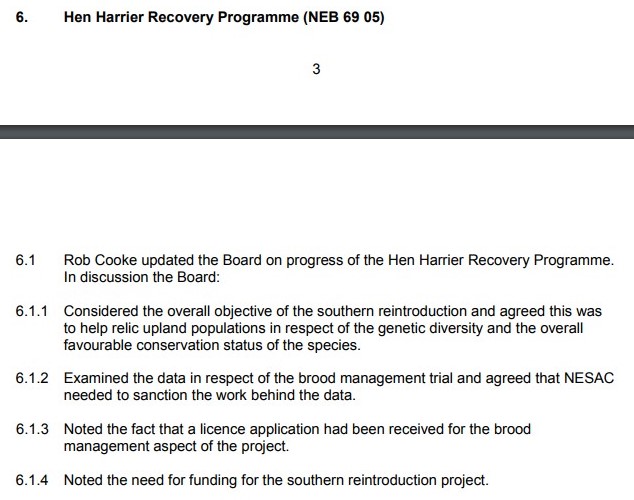
 This is just astonishing.

 Raptor Persecution UK