The RSPB is recruiting for eight seasonal fieldworkers (six in Scotland, two in Wales) for the 2023 National Hen Harrier Survey.
These temporary research assistant positions begin in March 2023, for four months, for 37.5 hours per week.
Job description:
These posts require considerable experience of conducting fieldwork in upland areas. The post holders should have a good knowledge of Hen harrier ecology and should also be able to ensure the smooth running of the survey by dealing diplomatically with all interested parties. Fieldwork will involve long and unsociable hours in the field, and will be physically demanding. Extensive travel to remote locations will also be required. If work from home is not possible the post holder will be responsible for finding their own accommodation, although the RSPB will be able to contribute towards costs. Mountain skills training course to be provided at the start of the contract, if needed.
The closing date for applications is 23.59hrs on Sunday 8th January 2023.
For further details and to apply, please click here.
Guest blog written by conservation campaigner Bob Berzins, who has featured previously on this blog here, here and here.
The Raptor Persecution UK blog recently reported the most horrific cruelty towards hen harriers with four chicks stamped to death in a nest on a grouse moor in the Yorkshire Dales National Park [here] and this was compounded by a Yorkshire Dales National Park Authority meeting where one of the Authority Board members stated the Dales is not natural country for hen harriers and red kites apparently because you don’t see them there [here]. Many readers of this blog know you don’t see these raptors because they’ve been killed and we all campaign in our own way to try to stop this happening.
In this guest blog I’ll take a look at the situation in the Peak District, the discussions within the Peak District National Park Authority (PDNPA) about birds of prey, who makes the decisions on policy and where the decision makers’ loyalties lie.
Photo by Ruth Tingay
First of all a little bit about the structure of National Park Authorities, taken from the Peak District National Park Authority’s website:
‘The National Park Authority is a public body made up of two groups of people – members and officers. The members are the people who make the decisions. They are responsible for setting policies and objectives, ensuring resources are well used and money is well spent. The officers are employees who work to the policies and carry out the decisions made by members. On routine matters members ask officers to take decisions directly, in line with agreed policies. Overall responsibility for the work of the officers lies with the Chief Executive‘.
There was a Peak District National Park Authority Meeting on 20th May 2022 where members discussed progress on delivery of the Park’s Management Plan (2018-2023). Officers were present to provide details of action taken.
Background: over the last year or so there’s been three incidents involving deaths and disappearances of hen harriers in the Peak District: The reported disappearance of a hen harrier in the Stocksbridge area in February 2022 [here], followed by the disappearance of male birds from two nest sites in the Upper Derwent Valley [here] which resulted in the nests failing. The meeting took place just after the nest failures were publicised.
One of the abandoned hen harrier nests in 2022. Photo by Peak District Raptor Monitoring Group.
Audio of the PDNPA meeting in May 2022 [listen here] 1:26:55 to 1:34.
Peak District National Park Management Plan 2018-2023 here.
During the meeting on 22nd May 2022, PDNPA Member Charlotte Farrell asked why the following target in the Management Plan is never met:
‘Restore populations of birds of prey to at least the levels present in the late 1990s, with the addition of hen harrier as a regularly successful breeding species‘.
She commented that the PDNPA needed to look at moorland management and grouse shooting and to be vocal about this.
Robert Helliwell was the PDNPA Member with responsibility for Natural Environment, Biodiversity and Farming (his term ended 30 June 2022). His response was astonishing:
“Rewilding devastates bird populations because you lose the habitat for them.”
This was from the PDNPA Member – the person making decisions in the Peak District National Park – whose area of responsibility was biodiversity. And of course, he obviously sidestepped the request to be vocal on the links between grouse moor management and raptor persecution.
Also during the meeting, PDNPA Chair Andrew McCloy mentioned a “reputational risk” for the Authority but then said it’s an issue “out of our control”.
We need to challenge this derogation of public responsibility especially due to the secrecy of meetings between the PDNPA and shooting representatives and the involvement of pro-shooting groups in the management of the National Park – more of this below.
During the meeting, the Peak Park officer with responsibility for Landscapes described the recent “Chatsworth Moorland Managers Meeting” attended by South Yorkshire Police. There are the usual platitudes about how disappointing it is that two hen harrier nests failed and a complete failure to acknowledge why birds of prey disappear from grouse moors. These Chatsworth meetings are secret – there are no minutes and no list of attendees. If the PDNPA was serious about raptor persecution they would be very open about all the actions they were taking.
The PDNPA meeting in May 2022 provided a snapshot of one lone voice speaking out against wildlife crime. What about the other PDNPA members?
There are 30 members in the PDNPA. Sixteen are appointed by county, district, city or borough councils. Fourteen are appointed by the Secretary of State, eight of these have “specialist” knowledge to help the PDNPA and six are Parish Councillors. In total, eight members register an interest in the Conservative party and the Secretary of State is in a Conservative government. It’s easy to see how a National Park Authority can become a microcosm of the ruling party of government, especially when there’s no clear process for who gets “invited” to be a National Park Authority member.
May 2022 was the final PDNPA meeting for Robert Helliwell and the new person with responsibility for Natural Environment, Biodiversity and Farming is David Chapman, who lists an interest in Bolshaw Crop Nutrition, a local company that produces Industrial Powders, mainly lime based. Limestone quarrying is one of the biggest industries in the Peak District.
David Chapman is also Chair of the Land Managers Forum which was set up in 2006 by the PDNPA and ‘partners’ [here]. Four PDNPA members attend this forum and other attendees are nominated by National Farmers Union and Country Land & Business Association, formerly Countryside Landowners Association and a partner in ‘Aim to Sustain’, a coalition of game shooting interests which promotes game shooting. The PDNPA does not provide a list of the attendees (or their affiliations), no minutes are published and meetings are secret. These meetings are attended by PDNPA members with decision making powers but there is absolutely no accountability. This is supposed to be ‘democracy’.
As far as I’m concerned, there couldn’t be a clearer link between the PDNPA and game shooting. The PDNPA is supposed to be tackling the biodiversity crisis and I’m sure they’ll produce a very nice document to that end. But in the uplands grouse moor owners will look after their own interests, as they always have done and the PDNPA will go along their wishes.
This structure is about as democratic as the pandemic VIP lane for procurements. And until it changes raptor persecution in the Peak District will continue.
The purposes of the PDNPA are to preserve the natural landscape and to help people enjoy these areas. Instead, landowners’ interests are the priority and wildlife crimes are overlooked [Ed: see previous blog on abuse of power used to shield raptor killers in the Peak District NP here]. And don’t forget, National Parks are part of our government – apparently we voted for this.
The Yorkshire Dales National Park Authority (YDNPA) held a Board meeting earlier this week to discuss proposals for determining several ‘priority species’ that need additional help to thrive within the National Park.
The draft list includes a number of raptor species, including hen harrier, red kite and peregrine. There is a long and well-documented history of the persecution of all three species within the Yorkshire Dales National Park and the neighbouring Nidderdale AONB in areas dominated by driven grouse moors (e.g. see here and here) so it’s no surprise to see these three species highlighted as needing additional conservation measures.
Photo by Ruth Tingay
The YDNPA meeting on 13th December started with a presentation by Dr Tony Serjeant, the Senior Wildlife Conservation Officer, outlining the Authority’s proposals and then Board members were invited to comment and ask questions of YDNPA staff, prior to a vote.
The comments of two Board members, Councillor Yvonne Peacock and farmer Allen Kirkbride, were astounding. And I mean absolutely gob-smacking in the extent of their ignorance. That these two individuals should be considered competent to serve on the YDNPA Board to discuss matters of environmental significance is extremely worrying. I don’t doubt that they have important experience and expertise in some other areas, but their ecological illiteracy is just embarrassing.
Some of the comments were picked up and published in an article on the website Richmondshire Today (here) but it’s worth listening to them in full and in the context of the wider discussion. Fortunately, the YDNPA records its meetings and an audio recording of this particular discussion can be heard here.
First up was Councillor Yvonne Peacock, speaking about the inclusion of the house sparrow on the list of potential priority species (recording starts at 23.25 mins):
“We’ve got the house sparrow there, and yet we’ve got these great big sparrowhawks that take every garden bird imaginable, no doubt the house sparrow as well. How do we actively, you know, preserve these birds when we have like a conflict in, well the Government’s law I should say, I just find that it is so difficult, so, that’s probably my ignorance, but it’s just a question really”.
Then we had Wensleydale farmer Allen Kirkbride, responding to Tony Serjeant’s comment that raptor persecution in the National Park needs to end, and highlighting that although red kites have been seen prospecting and flying over the National Park, there still aren’t any records of breeding attempts (recording starts at 34.23 mins):
“Hen harriers, John, is it true that there’s certain [inaudible] they breed them and let, er, I think there was four hen harriers, and let them go [Ed: I presume he means hen harrier brood meddling]. The story is that two of them were later traced to the south of Spain, another one to the south of England, and another one disappeared. The thing is about letting these birds of prey go, especially hen harriers, it’s not natural country for them, we’ve never had hen harriers up here. You can introduce them but obviously they don’t want to stay. It’s fine making, you know, a lot of noise about hen harriers but they don’t, you know, you can let them go but if they don’t want to stay they won’t stay.
Earlier this year, red kites, we did have round us up to eight and it was quite a sight, but they’ve all flown off elsewhere and you know, I don’t, you know, they say all this PR, somebody’s [inaudible] with them, I don’t think they are, I just don’t think they want to stay around this area ‘cos it’s not natural area for them, and they just fly away, on, you know, to their own accord”.
Christ on a bike! Can somebody please educate Mr Kirkbride about hen harrier dispersal strategies? And about the extent of raptor persecution inside the Yorkshire Dales National Park. Ironically, this Board meeting took place one day before North Yorkshire Police issued the appeal for information about four hen harrier chicks that had been stamped to death in their nest, on a grouse moor, inside the National Park.
All credit to Dr Tony Serjeant, who managed to respond to both Board members without any hint of frustration. There were strong similarities to the Cairngorms National Park Authority Board meeting I blogged about last year (see here) where CNPA staff had to deal with some near-hysteria Board members’ responses when they learned that tackling intensive gamebird management was in the Park’s plan.
Tony Serjeant also told Mr Kirkbride that hen harriers were currently breeding in the YDNP but he only had figures from about two years ago. He said he couldn’t provide details of the current status of hen harriers in the Yorkshire Dales National Park because “Natural England seems to be rather reticent in letting us have the latest [hen harrier] figures for what’s going on, and that’s a little bit disappointing“.
Perhaps Natural England only provides data to organisations that have ‘donated‘ some cash??
Anyway, the outcome of the YDNPA Board meeting was that the approach taken to identify the priority species was approved by the Board and a final list will be published in June 2023 (see YDNPA press release here).
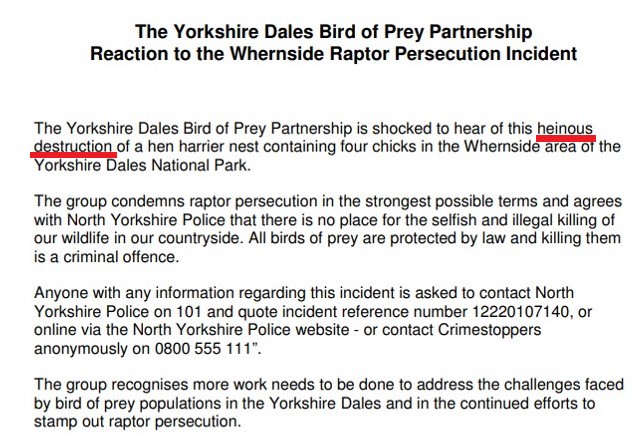
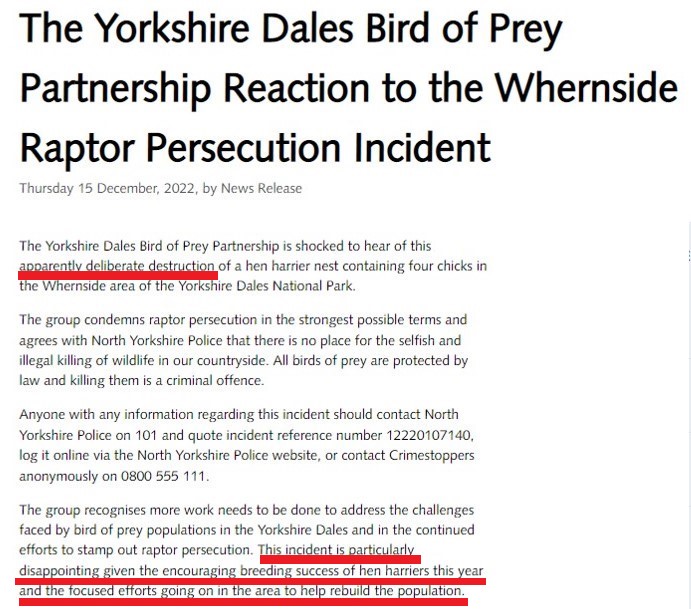
Further to the news this week that four hen harrier chicks were stamped to death in their nest on an unnamed grouse moor inside the Yorkshire Dales National Park (see here), the Yorkshire Dales Bird of Prey ‘partnership’ has published the following statement:
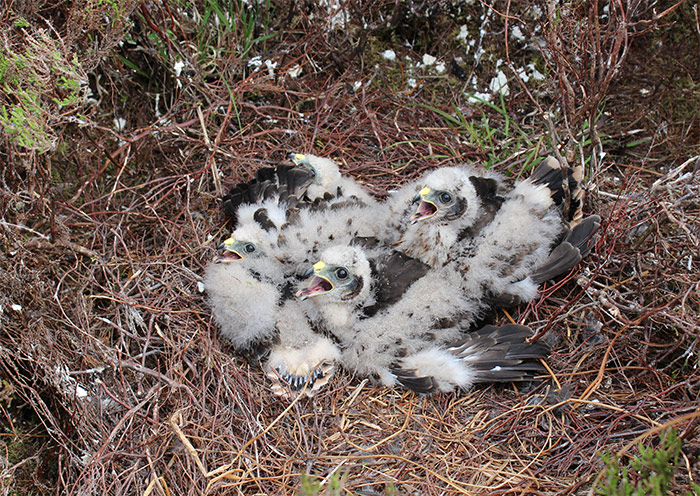
Young hen harriers in a nest (not the nest in this current police investigation). Photo by Ian Newton
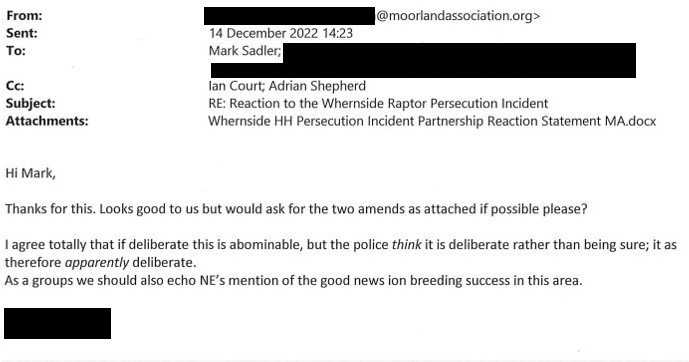
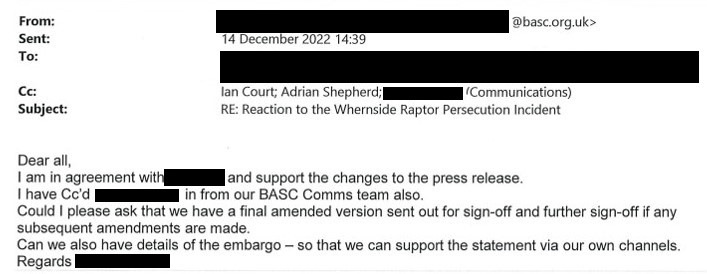
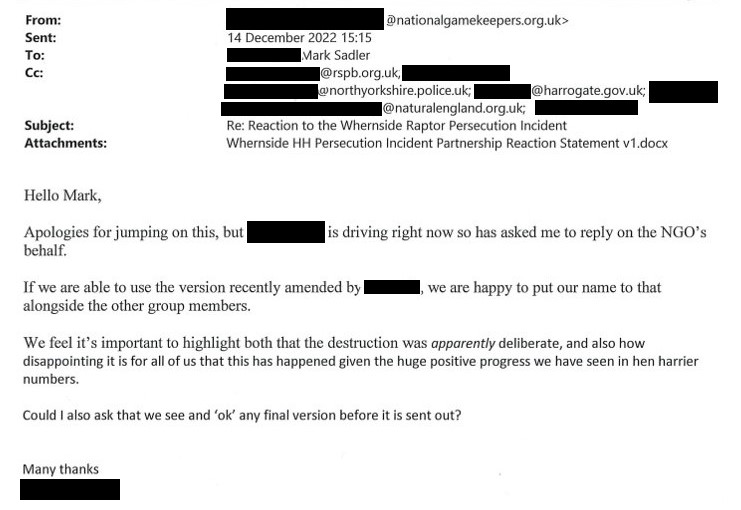
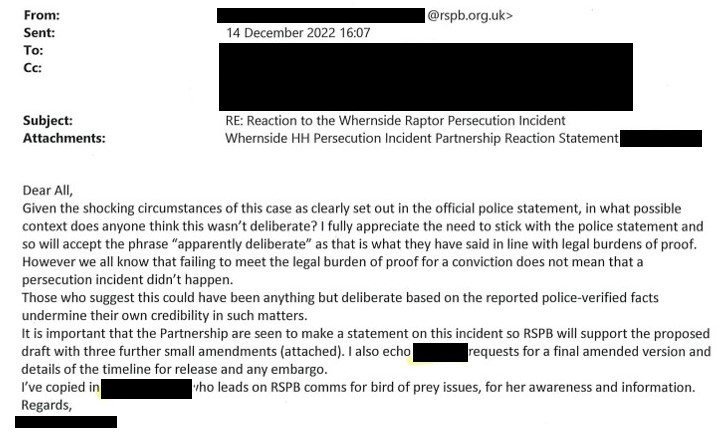
The Yorkshire Dales Bird of Prey Partnership is shocked to hear of this apparently deliberate destruction of a hen harrier nest containing four chicks in the Whernside area of the Yorkshire Dales National Park.
The group condemns raptor persecution in the strongest possible terms and agrees with North Yorkshire Police that there is no place for the selfish and illegal killing of wildlife in our countryside. All birds of prey are protected by law and killing them is a criminal offence.
Anyone with any information regarding this incident should contact North Yorkshire Police on 101 and quote incident reference number 12220107140, log it online via the North Yorkshire Police website, or contact Crimestoppers anonymously on 0800 555 111.
The group recognises more work needs to be done to address the challenges faced by bird of prey populations in the Yorkshire Dales and in the continued efforts to stamp out raptor persecution. [Ed: ‘….the continued efforts to stamp out raptors’ would be more fitting in this case].This incident is particularly disappointing given the encouraging breeding success of hen harriers this year and the focused efforts going on in the area to help rebuild the population.
ENDS
There are some notes for editors at the end, as follows:
The Yorkshire Dales National Park and Nidderdale Area of Outstanding Natural Beauty Management Plans include objectives to tackle the illegal persecution of birds of prey and owls. This involves working closely with landowners, moorland managers, the Police and other key stakeholders to devise and implement a local approach to end illegal persecution of raptors.
Given the comparable management plan objectives, the same issues affecting bird of prey populations in both protected landscapes, and the two areas comprising a contiguous area of similar upland habitat, a joint steering group was established in 2019 comprising a broad coalition of partners with a shared commitment to bird of prey conservation.
The group includes representatives from British Association for Shooting & Conservation, Country Land & Business Association, Cumbria Constabulary, The Moorland Association, National Gamekeepers Organisation, Natural England, Nidderdale AONB, North Yorkshire Police, Northern England Raptor Forum, Royal Society for the Protection of Birds, and Yorkshire Dales National Park Authority.
Natural England is the lead organisation for the delivery of the management plan objective in the National Park. The Yorkshire Dales National Park Authority provides the Chair and Secretariat for the steering group as a whole.
The group aims to publish an annual report summarising bird of prey population status, monitoring and protection efforts, and confirmed persecution incidents in the Yorkshire Dales National Park and Nidderdale Area of Outstanding Natural Beauty. The first report was published in March and provides a baseline from which progress can be measured over the coming years.
Finally, the Yorkshire Dales National Park Management Plan can be viewed here, and the Nidderdale Area of Outstanding Natural Beauty Management Plan can be viewed here.
ENDS
For those of us who’ve been around for a while, this so-called ‘partnership‘ is yet another greenwashing sham, very similar to the ‘partnership’ in the Peak District National Park (an absolute failure) and the national Raptor Persecution Priority Delivery Group (RPPDG, also an absolute failure).
I’ve no doubt that the Yorkshire Dales National Park Authority is as genuinely angry about ongoing illegal raptor persecution as the rest of us; you only have to read previous statements by the Chair (e.g. see here and here) to see that.
However, that line in the latest press statement, ‘…a joint steering group was established in 2019 comprising a broad coalition of partners with a shared commitment to bird of prey conservation‘ isn’t fooling anybody.
It is plain to see which organisations in the Yorkshire Dales Bird of Prey ‘partnership’ are committed to bird of prey conservation, and which are not. There are clear conflicts of interest and members of some of these organisations have been, and still are, under police investigation for alleged raptor persecution offences. It’s bonkers that they are invited to sit at this table.
Why do we have to continue with this charade? It isn’t working, as is evident by the brazen stamping to death of those young hen harrier chicks in their nest – a disgusting crime, committed by someone who knows full well the chances of prosecution are negligible at best, even with a nest camera in place!
I’ve written before about why I think the Moorland Association (the grouse moor owners’ lobby group) shouldn’t be allowed anywhere near these raptor protection schemes (see here), and yet here we are, four years later, and it’s the same old, same old. Raptors are still being killed, the criminals are not being prosecuted, and the grouse shooting lobbyists can grandstand by pointing to their membership of these ‘partnerships’ as a way of pretending it’s all being sorted out.
For anyone who still wants to pretend that the grouse shooting industry isn’t responsible for the systematic extermination of hen harriers on grouse moors across the UK, here’s the latest catalogue of crime that suggests otherwise.
[This male hen harrier died in 2019 after his leg was almost severed in an illegally set trap that had been placed next to his nest on a Scottish grouse moor (see here). Photo by Ruth Tingay]
This is the blog I now publish after every reported killing or suspicious disappearance.
“They disappear in the same way political dissidents in authoritarian dictatorships have disappeared” (Stephen Barlow, 22 January 2021).
Today the list has been updated to include the most recently reported victims, four young hen harriers stamped to death in their nest, on a grouse moor, inside the Yorkshire Dales National Park, on 20th June 2022 (see here).
I’ve been compiling this list only since 2018 because that is the year that the grouse shooting industry ‘leaders’ would have us believe that the criminal persecution of hen harriers had stopped and that these birds were being welcomed back on to the UK’s grouse moors (see here).
This assertion was made shortly before the publication of a devastating new scientific paper that demonstrated that 72% of satellite-tagged hen harriers were confirmed or considered likely to have been illegally killed, and this was ten times more likely to occur over areas of land managed for grouse shooting relative to other land uses (see here).
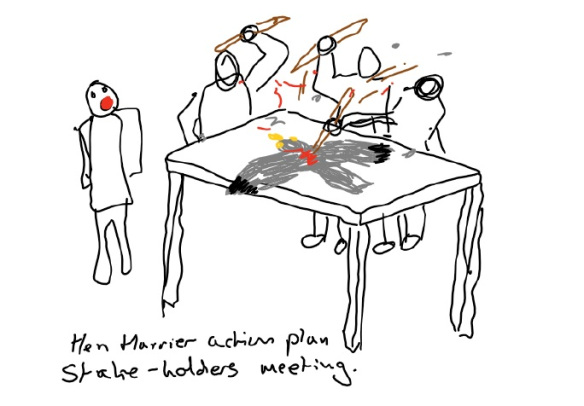
2018 was also the year that Natural England issued a licence to begin a hen harrier brood meddling trial on grouse moors in northern England. For new blog readers, hen harrier brood meddling is a conservation sham sanctioned by DEFRA as part of its ludicrous ‘Hen Harrier Action Plan‘ and carried out by Natural England (NE), in cahoots with the very industry responsible for the species’ catastrophic decline in England. For more background see here.
Brood meddling has been described as a sort of ‘gentleman’s agreement’ by commentator Stephen Welch:
“I don’t get it, I thought the idea of that scheme was some kind of trade off – a gentleman’s agreement that the birds would be left in peace if they were moved from grouse moors at a certain density. It seems that one party is not keeping their side of the bargain“.
With at least 77 hen harriers gone since 2018, I think it’s fair to say that the grouse shooting industry is simply taking the piss. Meanwhile, Natural England pretends that ‘partnership working’ is the way to go and DEFRA Ministers remain silent.
‘Partnership working’ according to Natural England appears to include authorising the removal of hen harrier chicks from a grouse moor already under investigation by the police for suspected raptor persecution (here) and accepting a £75k bung from representatives of the grouse shooting industry that prevents Natural England from criticising them or the sham brood meddling trial (see here). This is in addition to a £10k bung that Natural England accepted, under the same terms, in 2021 (here).
[Cartoon by Gerard Hobley]
So here’s the latest gruesome list. Note that the majority of these birds (but not all) were fitted with satellite tags. How many more [untagged] harriers have been killed?
February 2018: Hen harrier Saorsa ‘disappeared’ in the Angus Glens in Scotland (here). The Scottish Gamekeepers Association later published wholly inaccurate information claiming the bird had been re-sighted. The RSPB dismissed this as “completely false” (here).
5 February 2018: Hen harrier Marc ‘disappeared’ on a grouse moor in Durham (here).
9 February 2018: Hen harrier Aalin ‘disappeared’ on a grouse moor in Wales (here).
March 2018: Hen harrier Blue ‘disappeared’ in the Lake District National Park (here).
March 2018: Hen harrier Finn ‘disappeared’ near Moffat in Scotland (here).
18 April 2018: Hen harrier Lia ‘disappeared’ in Wales and her corpse was retrieved in a field in May 2018. Cause of death was unconfirmed but police treating death as suspicious (here).
8 August 2018: Hen harrier Hilma ‘disappeared’ on a grouse moor in Northumberland (here).
16 August 2018: Hen harrier Athena ‘disappeared’ on a grouse moor in Scotland (here).
26 August 2018: Hen Harrier Octavia ‘disappeared’ on a grouse moor in the Peak District National Park (here).
29 August 2018: Hen harrier Margot ‘disappeared’ on a grouse moor in Scotland (here).
29 August 2018: Hen Harrier Heulwen ‘disappeared’ on a grouse moor in Wales (here).
3 September 2018: Hen harrier Stelmaria ‘disappeared’ on a grouse moor in Scotland (here).
24 September 2018: Hen harrier Heather ‘disappeared’ on a grouse moor in Scotland (here).
2 October 2018: Hen harrier Mabel ‘disappeared’ on a grouse moor on the edge of the Yorkshire Dales National Park (here).
3 October 2018: Hen Harrier Thor ‘disappeared’ next to a grouse moor in Bowland, Lanacashire (here).
23 October 2018: Hen harrier Tom ‘disappeared’ in South Wales (here).
26 October 2018: Hen harrier Arthur ‘disappeared’ on a grouse moor in the North York Moors National Park (here).
1 November 2018: Hen harrier Barney ‘disappeared’ on Bodmin Moor (here).
10 November 2018: Hen harrier Rannoch ‘disappeared’ on a grouse moor in Scotland (here). Her corpse was found nearby in May 2019 – she’d been killed in an illegally-set spring trap (here).
14 November 2018: Hen harrier River ‘disappeared’ on a grouse moor in the Nidderdale AONB (here). Her corpse was found nearby in April 2019 – she’d been illegally shot (here).
16 January 2019: Hen harrier Vulcan ‘disappeared’ in Wiltshire close to Natural England’s proposed reintroduction site (here).
7 February 2019: Hen harrier Skylar ‘disappeared’ next to a grouse moor in South Lanarkshire (here).
22 April 2019: Hen harrier Marci ‘disappeared’ on a grouse moor in the Cairngorms National Park (here).
26 April 2019: Hen harrier Rain ‘disappeared’ on a grouse moor in Nairnshire (here).
11 May 2019: An untagged male hen harrier was caught in an illegally-set trap next to his nest on a grouse moor in South Lanarkshire. He didn’t survive (here).
7 June 2019: An untagged hen harrier was found dead on a grouse moor in Scotland. A post mortem stated the bird had died as a result of ‘penetrating trauma’ injuries and that this bird had previously been shot (here).
5 September 2019: Wildland Hen Harrier 1 ‘disappeared’ on a grouse moor nr Dalnaspidal on the edge of the Cairngorms National Park (here).
11 September 2019: Hen harrier Romario ‘disappeared’ on a grouse moor in the Cairngorms National Park (here).
14 September 2019: Hen harrier (Brood meddled in 2019, #183704) ‘disappeared’ in the North Pennines (here).
23 September 2019: Hen harrier (Brood meddled in 2019, #55149) ‘disappeared’ in North Pennines (here).
24 September 2019: Wildland Hen Harrier 2 ‘disappeared’ on a grouse moor at Invercauld in the Cairngorms National Park (here).
24 September 2019: Hen harrier Bronwyn ‘disappeared’ near a grouse moor in North Wales (here).
10 October 2019: Hen harrier Ada ‘disappeared’ on a grouse moor in the North Pennines AONB (here).
12 October 2019: Hen harrier Thistle ‘disappeared’ on a grouse moor in Sutherland (here).
18 October 2019: Member of the public reports the witnessed shooting of an untagged male hen harrier on White Syke Hill in North Yorkshire (here).
November 2019: Hen harrier Mary found illegally poisoned on a pheasant shoot in Ireland (here).
14 December 2019: Hen harrier Oscar ‘disappeared’ in Eskdalemuir, south Scotland (here).
January 2020: Members of the public report the witnessed shooting of a male hen harrier on Threshfield Moor in the Yorkshire Dales National Park (here).
23 March 2020: Hen harrier Rosie ‘disappeared’ at an undisclosed roost site in Northumberland (here).
1 April 2020: Hen harrier (Brood meddled in 2019, #183703) ‘disappeared’ in unnamed location, tag intermittent (here).
5 April 2020: Hen harrier Hoolie ‘disappeared’ on a grouse moor in the Cairngorms National Park (here)
8 April 2020: Hen harrier Marlin ‘disappeared’ on a grouse moor in the Cairngorms National Park (here).
19 May 2020: Hen harrier Fingal ‘disappeared’ on a grouse moor in the Lowther Hills, Scotland (here).
21 May 2020: Hen harrier (Brood meddled in 2019, #183701) ‘disappeared’ on a grouse moor in Cumbria shortly after returning from wintering in France (here).
27 May 2020: Hen harrier Silver ‘disappeared’ on a grouse moor on Leadhills Estate, Scotland (here).
2020: day/month unknown: Unnamed male hen harrier breeding on RSPB Geltsdale Reserve, Cumbria ‘disappeared’ while away hunting (here).
9 July 2020: Unnamed female hen harrier (#201118) ‘disappeared’ from an undisclosed site in Northumberland (here).
25 July 2020: Hen harrier Harriet ‘disappeared’ on a grouse moor in the Yorkshire Dales National Park (here).
14 August 2020: Hen harrier Solo ‘disappeared’ in confidential nest area in Lancashire (here).
7 September 2020: Hen harrier Dryad ‘disappeared’ on a grouse moor in the Yorkshire Dales National Park (here).
16 September 2020: Hen harrier Fortune ‘disappeared’ from an undisclosed roost site in Northumberland (here).
19 September 2020: Hen harrier Harold ‘disappeared’ on a grouse moor in the Yorkshire Dales National Park (here).
20 September 2020: Hen harrier (Brood meddled in 2020, #55152) ‘disappeared’ next to a grouse moor in North Yorkshire (here).
24 February 2021: Hen harrier Tarras ‘disappeared’ next to a grouse moor in Northumberland (here)
12th April 2021: Hen harrier Yarrow ‘disappeared’ near Stockton, County Durham (here).
18 May 2021: Adult male hen harrier ‘disappeared’ from its breeding attempt on RSPB Geltsdale Reserve, Cumbria whilst away hunting (here).
18 May 2021: Another adult male hen harrier ‘disappeared’ from its breeding attempt on RSPB Geltsdale Reserve, Cumbria whilst away hunting (here).
24 July 2021: Hen harrier Asta ‘disappeared’ at a ‘confidential site’ in the North Pennines (here). We learned 18 months later that her wings had been ripped off so her tag could be fitted to a crow in an attempt to cover up her death (here).
14th August 2021: Hen harrier Josephine ‘disappeared’ at a ‘confidential site’ in Northumberland (here).
17 September 2021: Hen harrier Reiver ‘disappeared’ in a grouse moor dominated region of Northumberland (here)
24 September 2021: Hen harrier (Brood meddled in 2021, R2-F-1-21) ‘disappeared’ in Northumberland (here).
15 November 2021: Hen harrier (brood meddled in 2020, #R2-F1-20) ‘disappeared’ at the edge of a grouse moor on Arkengarthdale Estate in the Yorkshire Dales National Park (here).
19 November 2021: Hen harrier Val ‘disappeared’ in the Lake District National Park in Cumbria (here).
19 November 2021: Hen harrier Percy ‘disappeared’ in Lothian, Scotland (here).
12 December 2021: Hen harrier Jasmine ‘disappeared’ on a grouse moor (High Rigg Moor on the Middlesmoor Estate) in the Nidderdale AONB in North Yorkshire (here).
9 January 2022: Hen harrier Ethel ‘disappeared’ in Northumberland (here).
26 January 2022: Hen harrier Amelia ‘disappeared’ in Bowland (here).
10 February 2022: An unnamed satellite-tagged hen harrier ‘disappeared’ in a grouse moor dominated area of the Peak District National Park (here). One year later it was revealed that the satellite tag/harness of this young male called ‘Anu’ had been deliberately cut off (see here).
12 April 2022: Hen harrier ‘Free’ (Tag ID 201121) ‘disappeared’ at a ‘confidential site’ in Cumbria (here).
May 2022: A male breeding hen harrier ‘disappeared’ from a National Trust-owned grouse moor in the Peak District National Park (here).
May 2022: Another breeding male hen harrier ‘disappeared’ from a National Trust-owned grouse moor in the Peak District National Park (here).
14 May 2022: Hen harrier ‘Harvey’ (Tag ID 213844) ‘disappeared’ from a ‘confidential site’ in the North Pennines (here).
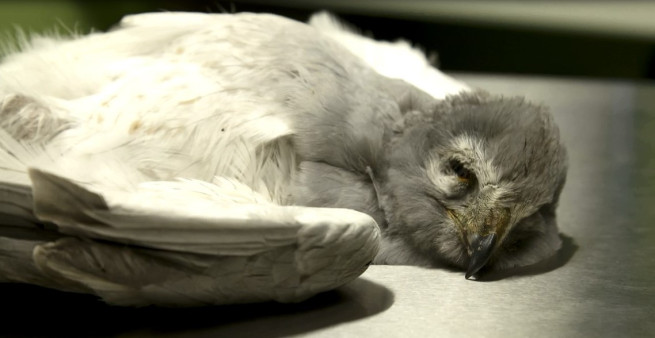
20 June 2022: Hen harrier chick #1 stamped to death in nest on a grouse moor in the Yorkshire Dales National Park (here).
20 June 2022: Hen harrier chick #2 stamped to death in nest on a grouse moor in the Yorkshire Dales National Park (here).
20 June 2022: Hen harrier chick #3 stamped to death in nest on a grouse moor in the Yorkshire Dales National Park (here).
20 June 2022: Hen harrier chick #4 stamped to death in nest on a grouse moor in the Yorkshire Dales National Park (here).
10 October 2022: Hen harrier ‘Sia’ ‘disappeared’ near Hamsterley Forest in the North Pennines (here).
To be continued……..
Not one of these 77 incidents has resulted in an arrest, let alone a prosecution. I had thought that when we reached 30 dead/missing hen harriers then the authorities might pretend to be interested and at least say a few words about this national scandal. We’ve now reached SEVENTY SEVEN hen harriers, and still Govt ministers remain silent. They appear not to give a monkey’s. And yes, there are other things going on in the world, as always. That is not reason enough to ignore this blatant, brazen and systematic destruction of a supposedly protected species, being undertaken to satisfy the greed and bloodlust of a minority of society.
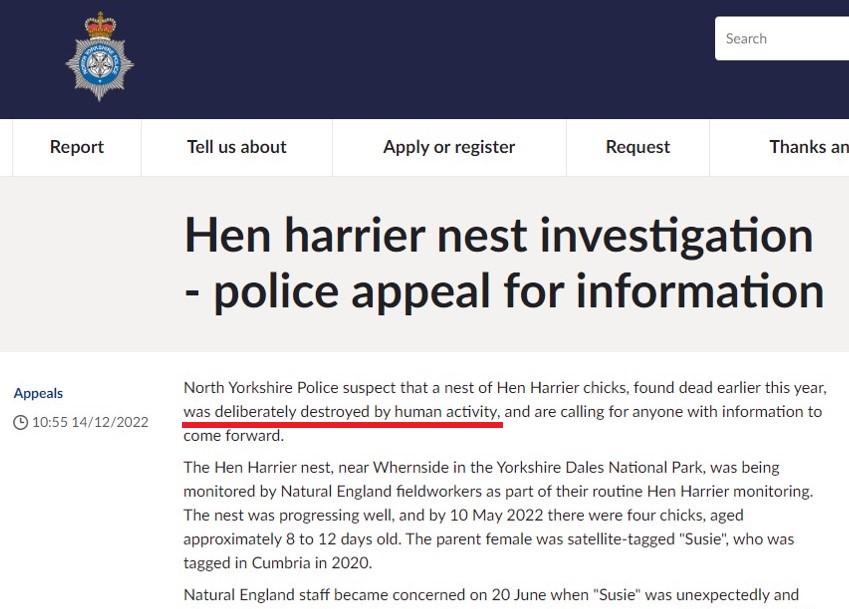
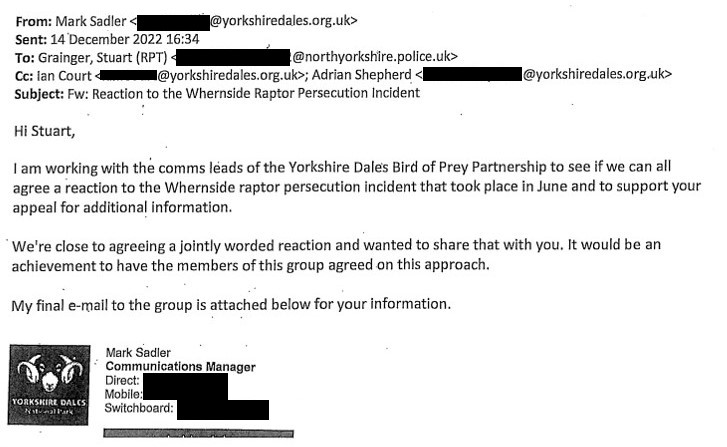
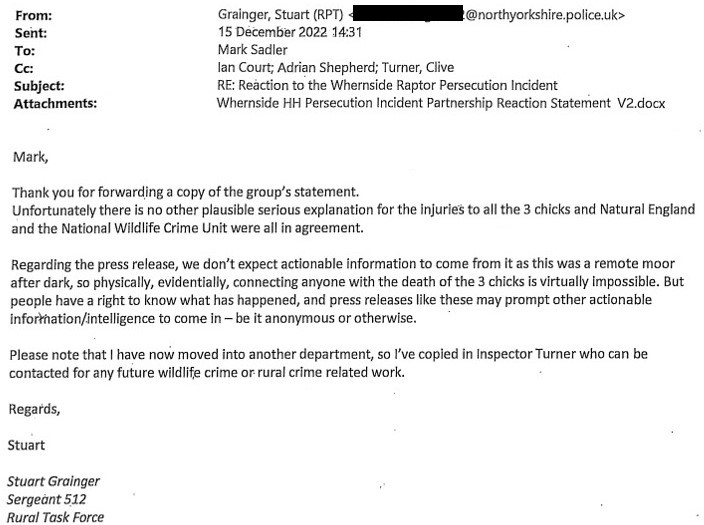
North Yorkshire Police has issued the following appeal for information this morning:
Hen harrier nest investigation – police appeal for information
North Yorkshire Police suspect that a nest of Hen Harrier chicks, found dead earlier this year, was deliberately destroyed by human activity, and are calling for anyone with information to come forward.
The Hen Harrier nest, near Whernside in the Yorkshire Dales National Park, was being monitored by Natural England fieldworkers as part of their routine Hen Harrier monitoring. The nest was progressing well, and by 10 May 2022 there were four chicks, aged approximately 8 to 12 days old. The parent female was satellite-tagged “Susie”, who was tagged in Cumbria in 2020.
Young hen harriers in a nest (not the nest in this current police investigation). Photo by Ian Newton
Natural England staff became concerned on 20 June when “Susie” was unexpectedly and abruptly shown tracking approximately 35km away from her nest. An adult female should be attentive and close to her nest during this period. Her sudden exit from the nest area was worrying.
For this reason, on 21 June, Natural England field staff acting under licence checked the nest – and made the grim discovery of three dead Hen Harrier chicks.
There were no clear signs that the chicks had been killed by a predator. The situation was suspicious and so the Police were informed.
Natural England staff retrieved nest camera footage which confirmed that there were four chicks in the nest before the incident, that they were well fed and provisioned by the parents, and looked fit and well.
After dark, at 9.54pm on 15 June, the camera showed the nest site appeared normal with “Susie” settled in the nest with chicks. However, at 9.59pm a sudden irregular ‘whiteout’ of the camera occurred, blinding the camera.
The camera used is movement-activated, and it was not triggered again until the following morning when footage captured apparently dead chicks in the nest and “Susie” attempting to feed them.
She can then be seen removing her dead chicks from the nest. Three of these were found just outside the nest, and it is not known where she deposited the fourth.
A ‘whiteout’ has not occurred with a Natural England nest camera before, and the camera itself continued to operate normally since then, and once “Susie” returned to her nest the following morning her movement triggered further recording of images.
There was no trace on the ground that a vehicle had driven over the nest, nor did the nest camera footage indicate that this had happened. There was, however, a footmark impression in the vegetation at the nest site, strongly indicating that a person had approached the nest. Natural England staff are careful to approach using known routes – the footprint observed was believed to be recent, and not made by Natural England staff.
Post-mortem examinations of the three chicks were subsequently conducted and showed that each suffered with multiple fractured bones including humerus in one chick, both femurs in the second chick, and in the third chick, the humerus and a crushed skull. The fractures were complete and showed a considerable trauma had taken place for each chick.
Although avian flu H5N1 virus was detected in one of the chicks, the post-mortem examinations also showed that the birds had been eating up until their deaths. This implies that deaths were sudden rather than a result of a chronic disease process.
North Yorkshire Police have considered all the evidence, and strongly suspect that someone approached the nest after dark and deliberately killed the chicks.
A predator would normally be expected to return and remove the dead chicks. Stoats can kill without rendering much obvious damage, but as the chicks were within the nest, it would be reasonable to expect nest camera footage of a predation or other event.
The living status of the chicks, followed by a ‘whiteout’ of the nest camera (possibly by a bright lamp, or something placed in front of the camera) – followed by all chicks being lifeless on the next footage – together with the post-mortem results showing broken bones in all the chicks and a crushed skull, suggests human illegal persecution activity.
The Hen Harrier is listed on Schedule 1 of the Wildlife and Countryside Act 1981 and is protected under Annex 1 of the EU Birds Directive (2009/147/EC) as it is considered vulnerable within Europe. It is on the red-list of birds of conservation concern in the UK.
A North Yorkshire Police spokesperson said: “Despite there being encouraging news this spring regarding the numbers of successful Hen Harrier nests this year, we sadly continue to be regularly called upon to investigate cases of illegal persecution of Hen Harriers and other birds of prey. There is no place for the selfish and illegal killing of our wildlife in our countryside.“
Paul Cantwell, Investigative Support Officer with the Police UK National Wildlife Crime Unit, said: “This incident unfortunately shows that despite more recent breeding success in Hen Harriers, people still appear to be determined to cause harm to this vulnerable species through cruel criminal acts.
“We urge anyone with information about this matter to report it to the Police or Crimestoppers.”
John Holmes, Natural England Strategy Director, said: “The evidence points to this being one of the most clear-cut and brutal cases of Hen Harrier persecution we’ve ever found, and we would urge anyone with information to come forward.
“We were diligently monitoring this nest and moved quickly to ensure collection of forensic and other evidence to support a police investigation as soon as persecution was suspected.
“We have recently seen welcome increases in Hen Harrier numbers, but despite our best efforts there are still those who are set on disrupting this progress. We will continue to work to monitor Hen Harrier nests, to increase understanding of Hen Harriers and to support our enforcement and forensic partners where foul play is suspected, following every evidential lead possible.
“We call for all landowners and managers to help police identify and prosecute anyone who commits these horrific crimes against birds of prey.”
Anyone with any information regarding this incident is asked to contact North Yorkshire Police on 101 and quote incident reference number 12220107140, online via the North Yorkshire Police website, or contact Crimestoppers anonymously on 0800 555 111.
ENDS
Although this appeal for information includes a detailed commentary of the known facts, I note with interest that the words ‘grouse moor’ have been excluded. According to my well-placed sources, this crime definitely took place on a grouse moor.
I would argue that North Yorkshire Police, in cahoots with Natural England, has deliberately excluded this detail.
I also note that this crime took place six months ago, in June. Why has it taken until December for the police to issue an appeal for information?
What we’re seeing here is nothing less than blatant censorship of raptor persecution crime data, designed to minimise media coverage to allow the grouse-shooting industry’s narrative of ‘hen harrier breeding success’ to be the strongest.
You only have to look at all the media propaganda we saw in August, from both the grouse shooting industry and Natural England, about the so-called ‘success’ of the hen harrier brood meddling trial. It was timed to coincide with the start of the grouse-shooting season (12th August) to paint grouse shooting in a positive light. It is absolutely bloody outrageous that Natural England knew about this heinous crime in August but said nothing about it; instead allowing the grouse shooter’s narrative to run unimpeded in the national press.
They did exactly the same with the news about the hen harrier called ‘Asta’, whose wings had been ripped off so her satellite tag could be attacked to a crow in an attempt to deceive researchers that Asta was alive and well (see here). That crime took place in spring 2021 but the news about it only emerged this summer because someone tipped me off and I blogged about it.
I’d like to know whether this latest sadistic crime, stamping to death four young, helpless hen harrier chicks in their nest, took place on the same Whernside grouse moor where a gunman was filmed next to a tethered eagle owl in a hen harrier’s breeding territory in 2020 (see here). It later emerged that Natural England had permitted hen harrier brood meddling on this estate, even though the estate was under police investigation for suspected raptor persecution (see here).
I’m sick to the back teeth of the raptor-killing criminals in the grouse shooting industry getting away with these crimes, aided and abetted, it would appear, by the police and the statutory nature conservation agency. Something has to change.
UPDATE 15th December 2022: 77 hen harriers confirmed ‘missing’ or illegally killed in UK since 2018, most of them on or close to grouse moors (here)
UPDATE 16th December 2022: Yorkshire Dales Bird of Prey ‘partnership’ responds to news of hen harriers stamped to death in nest (here)
UPDATE 27th January 2023: Hen harrier chicks stamped to death in nest: how the shooting industry manipulated the narrative (here)
UPDATE 15th August 2023: Killing the Skydancer: new podcast from the Guardian about raptor persecution on grouse moors (here)
For anyone who still wants to pretend that the grouse shooting industry isn’t responsible for the systematic extermination of hen harriers on grouse moors across the UK, here’s the latest catalogue of crime that suggests otherwise.
[This male hen harrier died in 2019 after his leg was almost severed in an illegally set trap that had been placed next to his nest on a Scottish grouse moor (see here). Photo by Ruth Tingay]
This is the blog I now publish after every reported killing or suspicious disappearance.
“They disappear in the same way political dissidents in authoritarian dictatorships have disappeared” (Stephen Barlow, 22 January 2021).
Today the list has been updated to include the most recently reported victim, a young satellite-tagged hen harrier called ‘Sia’ that ‘disappeared’ on 10th October 2022 and is the subject of a police investigation (see here).
I’ve been compiling this list only since 2018 because that is the year that the grouse shooting industry ‘leaders’ would have us believe that the criminal persecution of hen harriers had stopped and that these birds were being welcomed back on to the UK’s grouse moors (see here).
This assertion was made shortly before the publication of a devastating new scientific paper that demonstrated that 72% of satellite-tagged hen harriers were confirmed or considered likely to have been illegally killed, and this was ten times more likely to occur over areas of land managed for grouse shooting relative to other land uses (see here).
2018 was also the year that Natural England issued a licence to begin a hen harrier brood meddling trial on grouse moors in northern England. For new blog readers, hen harrier brood meddling is a conservation sham sanctioned by DEFRA as part of its ludicrous ‘Hen Harrier Action Plan‘ and carried out by Natural England (NE), in cahoots with the very industry responsible for the species’ catastrophic decline in England. For more background see here.
Brood meddling has been described as a sort of ‘gentleman’s agreement’ by commentator Stephen Welch:
“I don’t get it, I thought the idea of that scheme was some kind of trade off – a gentleman’s agreement that the birds would be left in peace if they were moved from grouse moors at a certain density. It seems that one party is not keeping their side of the bargain“.
With at least 73 hen harriers gone since 2018, I think it’s fair to say that the grouse shooting industry is simply taking the piss. Meanwhile, Natural England pretends that ‘partnership working’ is the way to go and DEFRA Ministers remain silent.
‘Partnership working’ according to Natural England appears to include authorising the removal of hen harrier chicks from a grouse moor already under investigation by the police for suspected raptor persecution (here) and accepting a £75k bung from representatives of the grouse shooting industry that prevents Natural England from criticising them or the sham brood meddling trial (see here). This is in addition to a £10k bung that Natural England accepted, under the same terms, in 2021 (here).
[Cartoon by Gerard Hobley]
So here’s the latest gruesome list. Note that the majority of these birds (but not all) were fitted with satellite tags. How many more [untagged] harriers have been killed?
February 2018: Hen harrier Saorsa ‘disappeared’ in the Angus Glens in Scotland (here). The Scottish Gamekeepers Association later published wholly inaccurate information claiming the bird had been re-sighted. The RSPB dismissed this as “completely false” (here).
5 February 2018: Hen harrier Marc ‘disappeared’ on a grouse moor in Durham (here).
9 February 2018: Hen harrier Aalin ‘disappeared’ on a grouse moor in Wales (here).
March 2018: Hen harrier Blue ‘disappeared’ in the Lake District National Park (here).
March 2018: Hen harrier Finn ‘disappeared’ near Moffat in Scotland (here).
18 April 2018: Hen harrier Lia ‘disappeared’ in Wales and her corpse was retrieved in a field in May 2018. Cause of death was unconfirmed but police treating death as suspicious (here).
8 August 2018: Hen harrier Hilma ‘disappeared’ on a grouse moor in Northumberland (here).
16 August 2018: Hen harrier Athena ‘disappeared’ on a grouse moor in Scotland (here).
26 August 2018: Hen Harrier Octavia ‘disappeared’ on a grouse moor in the Peak District National Park (here).
29 August 2018: Hen harrier Margot ‘disappeared’ on a grouse moor in Scotland (here).
29 August 2018: Hen Harrier Heulwen ‘disappeared’ on a grouse moor in Wales (here).
3 September 2018: Hen harrier Stelmaria ‘disappeared’ on a grouse moor in Scotland (here).
24 September 2018: Hen harrier Heather ‘disappeared’ on a grouse moor in Scotland (here).
2 October 2018: Hen harrier Mabel ‘disappeared’ on a grouse moor on the edge of the Yorkshire Dales National Park (here).
3 October 2018: Hen Harrier Thor ‘disappeared’ next to a grouse moor in Bowland, Lanacashire (here).
23 October 2018: Hen harrier Tom ‘disappeared’ in South Wales (here).
26 October 2018: Hen harrier Arthur ‘disappeared’ on a grouse moor in the North York Moors National Park (here).
1 November 2018: Hen harrier Barney ‘disappeared’ on Bodmin Moor (here).
10 November 2018: Hen harrier Rannoch ‘disappeared’ on a grouse moor in Scotland (here). Her corpse was found nearby in May 2019 – she’d been killed in an illegally-set spring trap (here).
14 November 2018: Hen harrier River ‘disappeared’ on a grouse moor in the Nidderdale AONB (here). Her corpse was found nearby in April 2019 – she’d been illegally shot (here).
16 January 2019: Hen harrier Vulcan ‘disappeared’ in Wiltshire close to Natural England’s proposed reintroduction site (here).
7 February 2019: Hen harrier Skylar ‘disappeared’ next to a grouse moor in South Lanarkshire (here).
22 April 2019: Hen harrier Marci ‘disappeared’ on a grouse moor in the Cairngorms National Park (here).
26 April 2019: Hen harrier Rain ‘disappeared’ on a grouse moor in Nairnshire (here).
11 May 2019: An untagged male hen harrier was caught in an illegally-set trap next to his nest on a grouse moor in South Lanarkshire. He didn’t survive (here).
7 June 2019: An untagged hen harrier was found dead on a grouse moor in Scotland. A post mortem stated the bird had died as a result of ‘penetrating trauma’ injuries and that this bird had previously been shot (here).
5 September 2019: Wildland Hen Harrier 1 ‘disappeared’ on a grouse moor nr Dalnaspidal on the edge of the Cairngorms National Park (here).
11 September 2019: Hen harrier Romario ‘disappeared’ on a grouse moor in the Cairngorms National Park (here).
14 September 2019: Hen harrier (Brood meddled in 2019, #183704) ‘disappeared’ in the North Pennines (here).
23 September 2019: Hen harrier (Brood meddled in 2019, #55149) ‘disappeared’ in North Pennines (here).
24 September 2019: Wildland Hen Harrier 2 ‘disappeared’ on a grouse moor at Invercauld in the Cairngorms National Park (here).
24 September 2019: Hen harrier Bronwyn ‘disappeared’ near a grouse moor in North Wales (here).
10 October 2019: Hen harrier Ada ‘disappeared’ on a grouse moor in the North Pennines AONB (here).
12 October 2019: Hen harrier Thistle ‘disappeared’ on a grouse moor in Sutherland (here).
18 October 2019: Member of the public reports the witnessed shooting of an untagged male hen harrier on White Syke Hill in North Yorkshire (here).
November 2019: Hen harrier Mary found illegally poisoned on a pheasant shoot in Ireland (here).
14 December 2019: Hen harrier Oscar ‘disappeared’ in Eskdalemuir, south Scotland (here).
January 2020: Members of the public report the witnessed shooting of a male hen harrier on Threshfield Moor in the Yorkshire Dales National Park (here).
23 March 2020: Hen harrier Rosie ‘disappeared’ at an undisclosed roost site in Northumberland (here).
1 April 2020: Hen harrier (Brood meddled in 2019, #183703) ‘disappeared’ in unnamed location, tag intermittent (here).
5 April 2020: Hen harrier Hoolie ‘disappeared’ on a grouse moor in the Cairngorms National Park (here)
8 April 2020: Hen harrier Marlin ‘disappeared’ on a grouse moor in the Cairngorms National Park (here).
19 May 2020: Hen harrier Fingal ‘disappeared’ on a grouse moor in the Lowther Hills, Scotland (here).
21 May 2020: Hen harrier (Brood meddled in 2019, #183701) ‘disappeared’ on a grouse moor in Cumbria shortly after returning from wintering in France (here).
27 May 2020: Hen harrier Silver ‘disappeared’ on a grouse moor on Leadhills Estate, Scotland (here).
2020: day/month unknown: Unnamed male hen harrier breeding on RSPB Geltsdale Reserve, Cumbria ‘disappeared’ while away hunting (here).
9 July 2020: Unnamed female hen harrier (#201118) ‘disappeared’ from an undisclosed site in Northumberland (here).
25 July 2020: Hen harrier Harriet ‘disappeared’ on a grouse moor in the Yorkshire Dales National Park (here).
14 August 2020: Hen harrier Solo ‘disappeared’ in confidential nest area in Lancashire (here).
7 September 2020: Hen harrier Dryad ‘disappeared’ on a grouse moor in the Yorkshire Dales National Park (here).
16 September 2020: Hen harrier Fortune ‘disappeared’ from an undisclosed roost site in Northumberland (here).
19 September 2020: Hen harrier Harold ‘disappeared’ on a grouse moor in the Yorkshire Dales National Park (here).
20 September 2020: Hen harrier (Brood meddled in 2020, #55152) ‘disappeared’ next to a grouse moor in North Yorkshire (here).
24 February 2021: Hen harrier Tarras ‘disappeared’ next to a grouse moor in Northumberland (here)
12th April 2021: Hen harrier Yarrow ‘disappeared’ near Stockton, County Durham (here).
18 May 2021: Adult male hen harrier ‘disappeared’ from its breeding attempt on RSPB Geltsdale Reserve, Cumbria whilst away hunting (here).
18 May 2021: Another adult male hen harrier ‘disappeared’ from its breeding attempt on RSPB Geltsdale Reserve, Cumbria whilst away hunting (here).
24 July 2021: Hen harrier Asta ‘disappeared’ at a ‘confidential site’ in the North Pennines (here). We learned 18 months later that her wings had been ripped off so her tag could be fitted to a crow in an attempt to cover up her death (here).
14th August 2021: Hen harrier Josephine ‘disappeared’ at a ‘confidential site’ in Northumberland (here).
17 September 2021: Hen harrier Reiver ‘disappeared’ in a grouse moor dominated region of Northumberland (here)
24 September 2021: Hen harrier (Brood meddled in 2021, R2-F-1-21) ‘disappeared’ in Northumberland (here).
15 November 2021: Hen harrier (brood meddled in 2020, #R2-F1-20) ‘disappeared’ at the edge of a grouse moor on Arkengarthdale Estate in the Yorkshire Dales National Park (here).
19 November 2021: Hen harrier Val ‘disappeared’ in the Lake District National Park in Cumbria (here).
19 November 2021: Hen harrier Percy ‘disappeared’ in Lothian, Scotland (here).
12 December 2021: Hen harrier Jasmine ‘disappeared’ on a grouse moor (High Rigg Moor on the Middlesmoor Estate) in the Nidderdale AONB in North Yorkshire (here).
9 January 2022: Hen harrier Ethel ‘disappeared’ in Northumberland (here).
26 January 2022: Hen harrier Amelia ‘disappeared’ in Bowland (here).
10 February 2022: An unnamed satellite-tagged hen harrier ‘disappeared’ in a grouse moor dominated area of the Peak District National Park (here).
12 April 2022: Hen harrier ‘Free’ (Tag ID 201121) ‘disappeared’ at a ‘confidential site’ in Cumbria (here).
May 2022: A male breeding hen harrier ‘disappeared’ from a National Trust-owned grouse moor in the Peak District National Park (here).
May 2022: Another breeding male hen harrier ‘disappeared’ from a National Trust-owned grouse moor in the Peak District National Park (here).
14 May 2022: Hen harrier ‘Harvey’ (Tag ID 213844) ‘disappeared’ from a ‘confidential site’ in the North Pennines (here).
10 October 2022: Hen harrier ‘Sia’ ‘disappeared’ near Hamsterley Forest in the North Pennines (here).
To be continued……..
Not one of these 73 incidents has resulted in an arrest, let alone a prosecution. I had thought that when we reached 30 dead/missing hen harriers then the authorities might pretend to be interested and at least say a few words about this national scandal. We’ve now reached SEVENTY THREE hen harriers, and still Govt ministers remain silent. They appear not to give a monkey’s. And yes, there are other things going on in the world, as always. That is not reason enough to ignore this blatant, brazen and systematic destruction of a supposedly protected species, being undertaken to satisfy the greed and bloodlust of a minority of society.
Please consider sending a copy of this list of dead/missing hen harriers to your elected representative. Ask them for their opinion, tell them your opinion, and demand action (politely please). We know where these crimes are happening and we know why they’re happening. The Government’s own data, published three years ago, have provided very clear evidence (see here). MPs need to know how many of us care about this issue and how we will not be fobbed off by disingenuous platitudes from DEFRA Ministers (e.g. see here, here, here and here for repeated recent examples of this).
Don’t be put off by thinking, ‘Well my MP is a grouse shooter, he/she won’t bother responding so why should I bother?’. Do not give these politicians an easy option out. As your elected representative they have a duty to listen to, and respond to, constituents’ concerns, whether they agree with them or not.
If you use social media, please share this post.
If you fancy scribbling a few sentences to your local newspaper or even a national one, please do.
Please talk to friends, family and colleagues about these 73 birds. They will be horrified about what’s being allowed to go on.
We MUST increase public awareness. It’s up to all of us.
Durham Constabulary have reported the suspicious disappearance of a young satellite-tagged hen harrier called ‘Sia’.
[‘Sia’ after being satellite-tagged in southern Scotland earlier this year. The tag was sponsored by the Lothian & Borders Raptor Study Group]
This is the press statement issued yesterday (4th November 2022):
Officers team up with partners in search for missing hen harrier
Officers have teamed up with partner agencies to investigate a suspected case of raptor persecution.
Led by Wildlife Officer, PC Dave Williamson, members of the Barnard Castle Neighbourhood Policing Team, RSPB, the National Wildlife Crime Unit and Police Scotland carried out a search in an area close to Hamsterley Forest on Wednesday morning (November 2).
The activity came after a 2022 female hen harrier called Sia, from Southern Scotland, went missing in the area on October 10 when her tag stopped transmitting.
It is believed the protected species could have been shot down or killed unlawfully.
PC David Williamson, who led the operation, said: “We will always do everything we can to act on information received about alleged criminal activity.
“I would encourage anyone with information about this suspected crime to get in touch.”
If you have any information call 101 quoting incident reference number 79 of October 19, email PC Williamson at david.williamson@durham.police.uk or contact Crimestoppers on 0800 555 111.
ENDS
There’s no detail provided about the last known location of Sia, nor of the area searched last Wednesday, but it’ll come as no surprise to anyone to see that the area next to Hamsterley Forest is intensively managed for driven grouse shooting:
A scientific study published in 2019 showed that hen harriers are ten times more likely to disappear/be killed over areas of land managed for grouse shooting relative to other land uses.
Sia isn’t the first satellite-tagged hen harrier to ‘disappear’ in suspicious circumstances in the North Pennines. Just looking at the data since 2018, there have been seven others:
5 February 2018: Hen harrier Marc ‘disappeared’ on a grouse moor in Durham (here)
14 September 2019: Hen harrier (Brood meddled in 2019, #183704) ‘disappeared’ in the North Pennines (here)
23 September 2019: Hen harrier (Brood meddled in 2019, #55149) ‘disappeared’ in North Pennines (here)
10 October 2019: Hen harrier Ada ‘disappeared’ on a grouse moor in the North Pennines AONB (here)
12th April 2021: Hen harrier Yarrow ‘disappeared’ near Stockton, County Durham (here)
24 July 2021: Hen harrier Asta ‘disappeared’ at a ‘confidential site’ in the North Pennines (here). We learned 18 months later that her wings had been ripped off so her tag could be fitted to a crow in an attempt to cover up her death (here).
14 May 2022: Hen harrier ‘Harvey’ (Tag ID 213844) ‘disappeared’ from a ‘confidential site’ in the North Pennines (here).
And of course, it’s not just the North Pennines where they ‘vanish’. Since 2018, at least 72 hen harriers are known to have either been killed or to have ‘disappeared’ in suspicious circumstances, mostly on or close to grouse moors across the UK. I’ll now have to update that list to 73, and counting.
Why does it keep happening? Simple. Nobody has been caught or prosecuted in any of these 73 cases, the chances of anyone being caught or prosecuted are virtually none existent, and so there is absolutely no deterrent whatsoever to stop this happening again and again and again.
In addition, this systemic criminality is being enabled by a series of DEFRA Ministers who repeatedly and resolutely display wilful blindness at every opportunity (e.g. see here).
For anyone who wants to learn more about the life history and ecology of the hen harrier, but has been put off by dry, academic scripts, this is the book for you.
Ian Carter has done a wonderful job of assimilating the scientific knowledge about the hen harrier and presenting it in such an engaging format that you’re left deciding whether to turn the page or grab your coat to go in search of this precious species.
The book’s title is an accurate reflection of the content, explaining what the hen harrier is likely to be doing during each month of the year. The text is beautifully and copiously illustrated by Dan Powell’s watercolours, with additional field notes from Dan.
No book about the hen harrier would be complete without a commentary on the illegal persecution it suffers at the hands of the grouse-shooting industry and Ian provides a good overview of this with a whole chapter entitled ‘Conflict on the Grouse Moor’, cleverly sandwiched between the months of June and July when young hen harriers should be fledging and dispersing had their parents not been targeted by the gamekeepers.
As an aside, prior to this book the main text available for those seeking to learn about the hen harrier was Donald Watson’s classic Poyser monograph, published in 1977, where he, too, wrote about the illegal persecution wrought on this species. It’s very telling that 45 years later, the carnage continues and at such a scale that Ian’s figures on it are already out of date:
“Since 2018, more than 50 birds have been killed or have disappeared in suspicious circumstances (based on reliable data from their tags)” (p.99).
Presumably Ian wrote this text in 2021. One year later and the current number of hen harriers known to have been killed or to have disappeared in suspicious circumstances is 72 (see here).
I’ve followed Ian on Twitter for several years and have admired his clarity of thought and reasoning. This book mirrors that style and he writes with the understated, gentle authority of someone who’s not only read widely, but has also spent time in the field. His description of the ‘appealing ritual’ of attending a communal winter roost in search of harriers in December (p.145-147) will resonate with those who have congregated on the bone-chilling edges of saltwater mashes and fens in the hope of catching a glimpse of the elusive grey ghost.
The Hen Harrier’s Year by Ian Carter and Dan Powell is now available from Pelagic Publishing (here) for £26.
Many thanks to several blog readers who attended Leadhills Estate’s ‘Information Day‘ yesterday and sent reports.
[Grouse moor on Leadhills Estate. Photo by Ruth Tingay]
A number of people have told me that the rumours about the sale of the estate and/or the estate’s shooting rights were ‘categorically denied’ by Lord Andrew Hopetoun himself.
Hmm. Personally, I have zero confidence in anything this former Director of Scottish Land & Estates says after his previous statements about the relationship between the Hopetoun Estate in Edinburgh and the Hopetoun (Leadhills) Estate in South Lanarkshire (see here, here and here for previous blogs on this).
And given some of the statements published on information boards at yesterday’s meeting (see below), it’d hard to keep a straight face when you know that Leadhills Estate is currently serving not one, but TWO General Licence restrictions after the police found ‘clear evidence’ of wildlife crime (see here & here), just the latest in an astonishingly long list (at least 70 reports of alleged raptor persecution there since the early 2000’s).
Obviously, people can draw their own conclusions about what might be going on. Equally, I can draw my own and I can state with absolute certainty that Leadhills Estate will remain high on my watch list.
Here are the display boards from yesterday’s meeting:
Here is the map showing the areas of the estate that have been made available to forestry companies: