“Raptors are thriving on gamekeepered ground”, claims the SGA

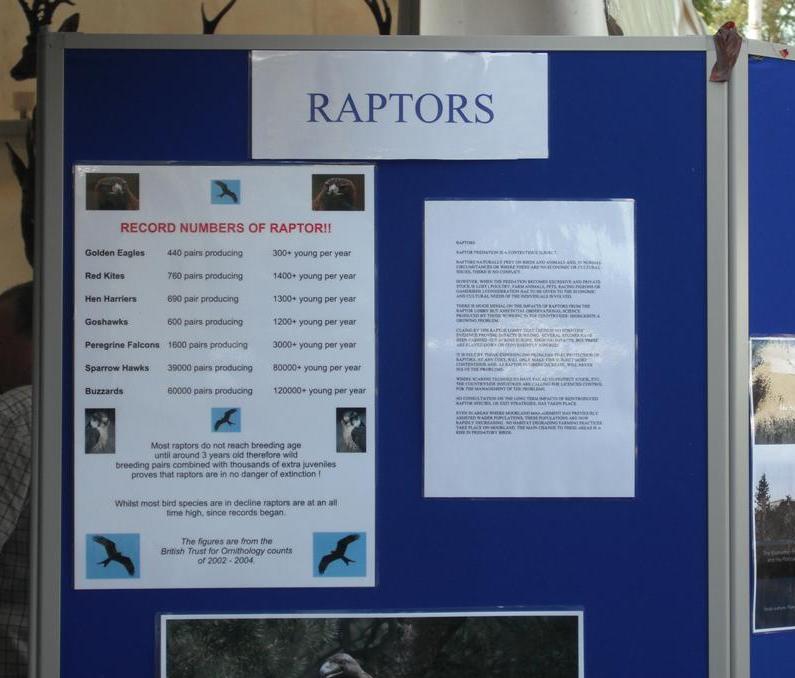
There were some interesting sights at the 2013 Scottish Game Fair in early July, including this poster on the Scottish Gamekeepers’ Association stand, entitled “Record Numbers of Raptor!!”[sic].

SGA Gamefair 005a

Any casual visitors to the SGA stand could be forgiven for thinking that raptors are doing just fine and there’s no cause for concern; that’s the message the SGA clearly wanted to portray. But let’s just look a bit more closely at their ‘information’, shall we?

You might think, given that this was the Scottish Gamekeepers’ Association at the Scottish Game Fair, their raptor figures would just relate to raptors in Scotland. You’d be wrong. Rather disingenuously, they used data relating to raptor figures in the UK as a whole, not just Scottish data, thereby potentially misleading the public to believe that Scotland holds a significantly higher number of breeding raptors than it actually does.

For example, the SGA claims there are 760 pairs of red kites producing 1400+ young per year. Actually, the number of breeding pairs monitored in Scotland in 2012 was 214, with 314 fledged. This is thought to be ‘close to an accurate population estimate’ according to the Scottish Raptor Study Group.

Another example: the SGA claims there are 600 pairs of goshawks producing 1200+ young per year. Actually, the number of breeding pairs in Scotland is more like 150, with an estimated 200 occupied territories in total.

And another example: the SGA claims there are 1600 pairs of peregrines producing 3000+ young per year. Actually, the last national survey of peregrines in Scotland showed 542 breeding pairs, an 8% decline from the previous national survey.

And here’s yet another example: the SGA claims there are 690 pairs of hen harriers producing 1300+ young per year. Actually, the last national survey of hen harriers in Scotland showed 505 pairs, a 20% decline from the previous national survey.

In fact, the data they’ve provided for every species on this list, with the exception of the golden eagle, are a gross exaggeration of the respective Scottish populations of these birds. Did they choose these figures to deliberately mislead the public? Surely not.

In addition to using potentially misleading population figures, the SGA also chose to use data from 2002-2004. That’s a bit odd given that far more up to date data for many species (i.e. from as recently as 2011) are freely available in the public domain (see here). Now, what possible reason could they have for ignoring the more recent facts and figures? Surely nothing to do with the fact that these more recent data directly contradict the following SGA statement:

That whilst most bird species are in decline raptors are at an all time high, since records began”.

Conveniently, this statement fails to mention the 20% decline in the Scottish hen harrier population, and the 8% decline in the Scottish peregrine population, not to mention the severely constrained Scottish populations of red kites, golden eagles and goshawks, all linked to the effects of illegal persecution taking place on gamekeepered land across Scotland. Funny that, isn’t it?

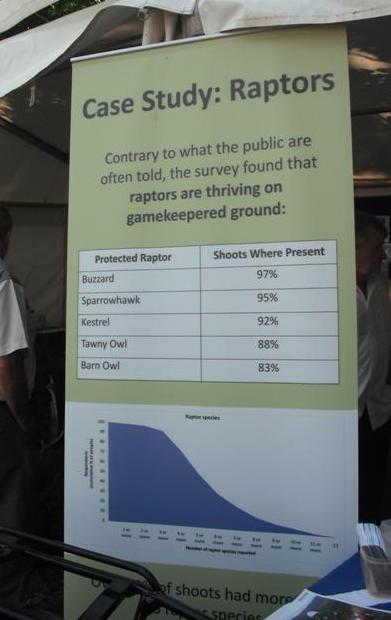
Even funnier is this photo (below), also pictured at the SGA stand. According to this, ‘Raptors are thriving on gamekeepered ground’. Conveniently (again), the list of raptor species they chose to illustrate this lie statement does not include hen harriers, peregrines, red kites, golden eagles or goshawks. Their statement is right up there with another SGA classic: “Professional gamekeepers do not poison raptors” (see here).

SGA Gamefair 006a


Misleading guff from Scottish Land and Estates

scotsman_logo_200The following letter has appeared in The Scotsman in the continuing ‘debate’ on grouse moor management (see here to read the earlier articles).
“Logan Steele’s letter (14 Jan) which alleges that driven grouse shooting is only viable with the persecution of birds of prey, particularly the hen harrier, is misleading.

First, official statistics demonstrate a clear decline in the number of incidents of raptor persecution.

Second land management for driven grouse shooting delivers a huge benefit for other protected wildlife, especially waders, and sustains employment and communities in remote rural areas. This is something the suggested alternative of walked-up grouse-shooting would not do.

Of particular significance is clear evidence that where grouse and hen habitat and vermin management have declined in some hen harrier “special protection areas”, this has actually resulted in lower harrier populations, as well as declines in other species such as waders.

This is a more complex situation than some make out.

The Langholm Moor Demonstration Project, set up in partnership with the government to bring back driven grouse shooting in the presence of sustainable numbers of hen harriers, is where the best hopes of progress on this issue lie.

Results at Langholm so far are that neither harriers nor grouse have recovered – not what anyone expected, but each year scientific understanding improves and practical solution gets closer.

Making progress will involve compromise on all sides.

Organisations representing grouse moor managers such as SLE are fully behind this process and it is unfortunate that RSPB has pulled out of the mediation process in England. Perhaps Scotland provides the best opportunity to make progress now.  Douglas McAdam, Scottish Land & Estates, Musselburgh”

[Link to the letter here].

And he accuses Logan Steele’s letter as being misleading!

First, which “official statistics demonstrate a clear decline in the number of incidents of raptor persecution” is Doug McAdam referring to? The ones we know of only relate to known poisoning incidents, although they are limited to poisoned birds; they do not include the discovery of poisoned baits and nor do they include suspected poisoning incidents or unreported poisoning incidents. More to the point, they do not relate to other types of raptor persecution, such as shooting, trapping, nest destruction, ‘disappearing’ birds etc. The only statistics that account for all types of raptor persecution incidents are those compiled annually by the RSPB; statistics that have never been accepted by SLE or any other game-shooting organisation.

Second, McAdam says “land management for driven grouse shooting delivers a huge benefit for other protected wildlife, especially waders, and sustains employment and communities in remote rural areas“. Another misleading statement. Land managed for driven grouse shooting is not only bad for protected wildlife (golden eagles, white-tailed eagles, hen harriers, goshawks, red kites, buzzards, peregrines, ravens, pine martens, mountain hares etc etc) but it is catastrophic for other species too (foxes, weasels, stoats, crows etc etc). And that’s without even touching on the landscape-level environmental damage.

McAdam goes on to suggest that “making progress will involve compromise on all sides“. No it won’t. Making progress will depend entirely on whether the grouse-shooting industry will accept that they have to work within the law and put an end to illegal persecution. If they do, all well and good. If they won’t, then they face a direct action campaign to ban driven grouse shooting by those of us who are sick of waiting for the government to act on our behalf. Hollow promises just don’t wash anymore. Time’s up.

McAdam’s penultimate sentence is laughable. He’s trying to suggest that the RSPB are the unreasonable ones in this 20+ year saga, for walking away from the six-year long Hen Harrier Dialogue process (see here). They are definitely not the unreasonable ones – they recognised a sham process and got out. Until SLE start to publicly expel their member estates where raptor persecution is rife (and we all know who they are, and so should McAdam – if he doesn’t, he’s in the wrong job), then the credibility of SLE’s involvement in ‘making progress’ will be viewed with as much contempt as it deserves.

RSPB Scotland: 2011 persecution report published

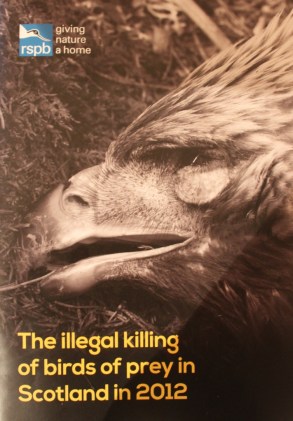
RSPB Scotland has just published its latest report, The Illegal Killing of Birds of Prey in Scotland in 2011. You probably won’t be surprised or shocked by the content, especially if you’ve read the previous 17 annual reviews. In fact, when you read this 18th review, you might get a strong sense of déjà vu.

It opens with a Foreword by Stuart Housden, Director of RSPB Scotland. Apart from the new photo, this foreword looks like a cut and paste job from the 2010 report, with a few words or sentences added or adjusted. To be fair, not much has changed since the 2010 report was published so perhaps he felt justified in repeating what he’d written the previous year.

Then there are RSPB Scotland’s strategic recommendations for addressing raptor persecution. Again, these show a remarkable similarity to the recommendations made in the 2010 report, and also in the 2009 report. The recommendations were / are still good and to see them repeated again is a useful indicator of how little progress has been made by those with the power to push them forward.

Next come the tables showing the confirmed and probable persecution incidents recorded by the RSPB during 2011. It’s these tables that the game-shooting lobby usually object too – they’re especially reluctant to accept the ‘probable’ incidents although to date, they’ve failed to provide a convincing argument to account for any of them.

The data in the 2011 tables demonstrate once again that illegal raptor persecution is widespread, with incidents reported in Perthshire, Angus, South Lanarkshire, Aberdeenshire, Dumfries-shire, East Ayrshire, Borders and Inverness-shire. We counted 15 very familiar-sounding locations within these regions, although there are a few notable absentees this time. Have they stopped their criminal activities or have they just got better at covering up? Time will tell.

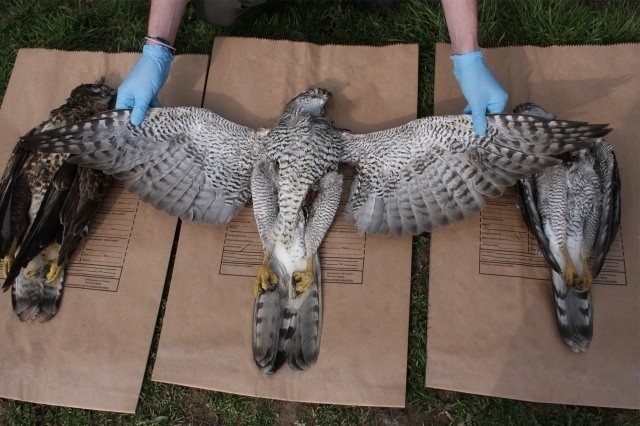
Just focusing on the confirmed incidents, in total 17 incidents of deliberate poison abuse were confirmed during 2011, involving 20 victims: 7 buzzards, 4 red kites, 1 golden eagle, 2 peregrines, 2 ravens and 4 other bird species. Sixteen other illegal incidents relating to shooting, nest destruction, and the use of uncovered spring traps or cage traps were confirmed. The victims included 8 buzzards, 2 peregrines, 1 goshawk, 1 sparrowhawk, 2 kestrels and 1 short-eared owl. As in previous years, not all of these incidents were publicised at the time they occurred. It’s a continual disappointment that several years have to pass before the public learns of these appalling crimes.

Once again the occupations and interests of those convicted for illegal raptor persecution crime have been analysed (data from 2003-2011 inclusive). 87% of them were gamekeepers (7% pigeon racers, 3% pest controllers, 3% farmers).

The report includes an interesting case study of poisoned raptors that have been found in recent years on the Glen Kyllachy and Farr Estate near Inverness. Very little of this information has been previously published and certainly this is the first time these photographs have been published. It’s a shame it’s taken several years for the info and images to reach the public domain but nevertheless it’s very encouraging to see RSPB Scotland highlight these cases, especially as Northern Constabulary hasn’t bothered.

All in all the report makes for grim reading, but nobody should be surprised by that. We all owe a large debt of gratitude to the RSPB’s Investigations Team for meticulously collecting these data and especially for making them publically available.

TO DOWNLOAD A COPY OF THE REPORT CLICK HERE

Here’s some media coverage:

RSPB Scotland press release here

BBC news article here

STV news article here

Herald Scotland article here

Scottish Gamekeepers Association: statement here

Scottish Land and Estates: nothing yet

@SNHMedia: “SNH report finds vast majority of gamekeepers highly qualified”. Link to this.

PAW Scotland: nothing yet

Police wco earns well-deserved recognition

For the benefit of those not on Twitter…

Devon & Cornwall Police Wildlife Crime Officer P.C. Josh Marshall has received a Commander’s Commendation at the South Devon Police Awards for his work on Operation Wilderness.

According to the RSPB’s recently published 2011 Birdcrime report, Devon had the worst record for bird of prey persecution in England last year, when fifteen goshawks, peregrines and buzzards were found poisoned or shot.

We’ve previously blogged about Josh’s innovative and successful Operation Wildnerness (see here, here, here, here and here) and it’s fantastic that his efforts have been recognised at the top police level. The word we’ve most often used to describe his work is ‘pro-active’, and his approach is even more impressive when you realise his role as a Police Wildlife Crime Officer is only part-time; something he has to fit in alongside his other policing duties.

Congratulations, Josh, on your very well-earned award! Hope you don’t mind that we’ve nicked your photo from Twitter!

Josh’s blog here

Crow traps: what you should know part 2

Following on from our earlier blog – Crow traps: what you should know part 1 (here)

The following information concerns the use of crow cage traps in Scotland; they are also used in other parts of the UK although the terms of use differ slightly (see here for information on their use in England, here for Wales and here for Northern Ireland).

What is a crow trap and why should we be concerned about them?

There are various types of animal traps in use in the countryside but the two we focus on in this article are the ‘ladder’ and ‘funnel’ crow cage traps. These are large, walk-in traps usually constructed with a wooden frame and wire mesh netting. A decoy bird (often a carrion crow but certain other decoy species are also permitted) is placed inside the trap to attract corvids or other target species. Birds that are attracted to the trap can enter via the roof, either through the horizontal slots of the ‘ladder’ or via a ‘funnel’. Once inside the trap it is virtually impossible for the birds to escape unaided. These trapped birds are usually destined to certain death at the hands of the trap operator who is legally authorised to kill them, subject to certain conditions (discussed in Part 3). In some rare circumstances, raptor workers deploy temporary crow cage traps to capture buzzards for marking projects, such as wing-tagging etc. Obviously these buzzards are released as soon as they’ve been marked; they aren’t killed by the trap operator!

There are many concerns surrounding the use of crow cage traps (some we’ll discuss below) but the over-riding concern is the indiscriminate nature of these traps, which means that species other than the target species can be, and often are, caught by gamekeepers, e.g. buzzards, goshawks, golden eagles etc. It is not illegal to (accidentally) trap these non-target species, but it is an offence for the trap operator not to release them, unharmed, at the earliest opportunity. More on this in Part 3.

Crow trap use is governed by a general licence, issued annually by Scottish Natural Heritage (see here). These licences are issued for the purpose of either (a) the conservation of wild birds, (b) to prevent serious damage to livestock, foodstuffs for livestock, crops, vegetables and fruit, and (c) to protect public health, public safety and prevent the spread of disease. Trap operators need not ‘apply’ for an individual licence, hence the name ‘general’ licence. Each general licence is subject to strict conditions (discussed in Part 3). If the trap operator complies with all the conditions of the general licence then the use of the crow trap is legal. However, in practice some of these conditions are ambiguous at best, and this is recognised by SNH who undertake regular consultations aimed at clarifying the terms of use (e.g. see here for their latest consultation plans).

Before we get in to the nitty gritty of how to recognise a legal trap from an illegal trap it’s worth mentioning that the RSPB (and other groups such as OneKind) has long campaigned for a more thorough review of the legal framework concerning these general licences for crow traps, particularly in relation to potential breaches of European legislation, including the EC Birds Directive. For anyone interested in the RSPB’s position, this document from 2007 (here) is informative.

Other concerns include the fact that there isn’t any effective monitoring of the impact these traps have on both target and non-target species. Crow traps are in use across Scotland year-round but are especially associated with upland grouse moors. It isn’t known exactly how many crow traps are in operation in Scotland but a conservative estimate would be in the hundreds, but probably nearer the thousands. There is currently no requirement for trap operators to record and/or report the number of target and non-target species caught and killed inside a trap (and even if there was such a requirement, who would believe the submitted figures? No gamekeeper is going to admit to illegally killing a protected species!). So how can the regulatory body (SNH) monitor the impact of crow trap use when they haven’t got a clue just how many traps are in use and how many birds and of what species are being killed each year? The follow-on question is, how can these general licences still be issued when the regulatory body cannot justify, in quantifiable terms, the need for lethal control measures?

Some may argue that there is now a record of the number of traps in use because recent changes to the general licences now require that a sign is attached to each trap with a unique identifying code issued by the local police force. However, this unique code is not assigned to an individual trap or to an individual trap operator, but rather to a landowner (or occupier) such as a sporting estate or a farm. This means that an estate owner can use the same code for multiple traps on his/her land (e.g. they may have just one trap or they may have 50+ traps depending on the size of the estate); the point is that the authorities do not have any means of knowing how many traps are in use on a particular estate because they only issue one code per estate.

From a law enforcement perspective, this use of a single identifying code for multiple traps makes it almost impossible to prosecute an individual for illegal use of the trap. For example, if a golden eagle is found dead inside a trap, and it’s obviously been there for a long time, then an offence has probably been committed (because traps must be checked at least once in every 24 hour period – see Part 3). Investigators may attend the scene but find that the trap is located on a large estate that employs multiple gamekeepers. None of the gamekeepers admit responsibility, so how does the investigator identify the individual responsible? A prosecution cannot commence unless an individual suspect is identified. It’s the same loophole we’ve seen used so many times when poisoned bait has been found on a large estate; nobody admits responsibility for laying the bait and thus the perpetrator(s) escape justice. It is only when the trap is located on a smaller estate where a single gamekeeper is employed that there is any chance of a prosecution.

Talking of loopholes….we’ve touched on this briefly in previous posts….in 2008 a new condition was added to the terms of use of the general licences. That new condition was that anyone who had a previous wildlife crime conviction was not allowed to use the general licence unless their conviction was considered ‘spent’, i.e. after five years from conviction. (Although even if you did have a recent conviction you could still apply for use of the licence and each case would be considered on merit, so it’s not quite the draconian condition that some imply). However, in 2009 the condition (of being banned for five years) was modified and we don’t recall any consultation about the insertion of this modification! The new modification says that you can still use the general licence if the sentence you received for your wildlife crime was an ‘admonishment’. Talk about a get-out clause! You might think this modification was quite reasonable, after all, an admonishment (effectively a telling off) is only given for minor offences, right? WRONG!!! Because there aren’t any mandatory sentences for wildlife crime offences in Scotland, a sheriff can choose a sentence at will (within the boundaries of sentencing limits at a Sheriff court, of course). In 2010, a sheriff imposed an admonishment on Graham Kerr, a gamekeeper on the Redmyre Estate, for possession of the banned pesticides Carbofuran and Alphachloralose (see here). The maximum penalty available was a £5000 fine and/or a six month prison term, reflecting the gravity of this type of offence. Had Kerr not also been handed a £400 fine for shooting a buzzard on the Redmyre Estate, his admonishment would have allowed him to continue using the general licence to operate a crow cage trap. In our opinion this is outrageous. What’s the point of having a condition of a five-year ban for a wildlife criminal if that condition is modified based on the whim of a sheriff’s sentencing choice rather than the nature of the actual criminal offence committed? It’s total nonsense. Why was this modification added to the terms of the general licence and who instigated its inclusion in 2009 and who approved it? Was anyone given the opportunity to object to its inclusion? Perhaps a Freedom of Information request is called for here…

This leads on to another concern…who is actually monitoring the trap operators? How do we know that someone with a recent criminal conviction (who was given a stronger sentence than an admonishment) is not still operating a crow cage trap? We know that many estates don’t sack their gamekeepers following a wildlife crime conviction, and we know of at least one estate where a previously convicted gamekeeper (guilty of raptor persecution) is now employed as a ‘gardener’!!

The potential for the misuse of crow traps is well known amongst raptor workers.  Previous reports on this issue have been produced by the RSPB (e.g. see here). Although this 2004 report is now fairly dated and some of the report’s recommendations have since been implemented, there is still a great deal of concern that crow traps are still being deliberately used to target raptor species, particularly buzzards and goshawks and in some areas, golden eagles.

So what can we do about it? In Part 3 we’ll explain the basics of what makes a crow cage trap legal, what makes one illegal, and the blurred line in between the two. We’ll also explain what members of the public should and shouldn’t do if you find a crow trap that you suspect is being operated illegally.

Outrage at (more) Peak District bird of prey persecution

The RSPB and Severn Trent Water have today expressed their outrage at the ‘wanton destruction’ over the last few days of the nest of one of Britain’s most persecuted raptors. Goshawk eggs, only days from hatching, were found smashed underneath a nest in the Upper Derwent Valley on land managed by Severn Trent Water.

It is the latest in a long line of raptor persecution incidents in the Peak District (see here for a 2006 RSPB report aptly named Peak Malpractice, and here for a 2007 updated report). The last reported incident was the case of gamekeeper Glenn Brown, who was convicted last year after RSPB investigators filmed him using a caged pigeon to lure raptors into a trap on National Trust-owned Howden Moor (see here). This latest incident demonstrates just how ineffective Brown’s sentence was (100 hours community service ‘ain’t gonna deter anybody – sure, he also had to pay costs but do you really think he’ll be paying those from his own pocket?). That this latest attack has happened at all should come as no surprise to anybody.

The RSPB says this now leaves only one known active goshawk nest in the entire Derwent Valley, which previously had held six pairs. The RSPB is offering a £1,000 reward for information leading to a conviction.

RSPB press release here

Nest cameras to protect raptors in south west England

In a bid to tackle increasing levels of wildlife crime, Devon & Cornwall Police have teamed up with the RSPB to launch ‘Operation Wilderness’, a new scheme that will see 24 hr nest cameras installed at vulnerable sites across the region.

This is a proactive response to the spate of raptor persecution incidents last year, which included the illegal poisoning (with Carbofuran) of four goshawks and a buzzard (see here) and three peregrines (see here and here). There is also concern about egg collectors and pigeon fanciers in the area.

The cameras have been paid for by the Devon Bird Watching and Preservation Society, and Operation Wilderness is being led by Police Wildlife Crime Officer PC Josh Marshall.

Well done to everyone involved  – this is an impressive  joint effort.

BBC news article here

Eight month prison sentence for illegal sale of stuffed birds of prey

A Bedfordshire man has been sentenced to eight months in prison for the illegal sale of stuffed birds of prey.

Greg Turner, 32, of St Peter’s Court, Ashwood Close, Potton, described as ‘an unemployed stuffed bird enthusiast’, was reported to have illegally sold over 100 birds on Ebay, netting £22,000. The species included red kite, marsh harrier, goshawk, peregrine, kestrel, barn owl, tawny owl and hawk owl. When officers from the National Wildlife Crime Unit raided his home, they found stuffed birds, two dead birds in his freezer waiting to be stuffed, and forged paperwork.

Kudos to the National Wildlife Crime Unit for their investigation and special mention to Judge Stuart Bridge, who said the following at Luton Crown Court:

In my judgement this was your livelihood, illegally trading in stuffed specimens. It was pre-planned, blatant and calculated and put live birds at risk. You took a risk hoping you would not be noticed. I am told that you have ceased trading and are in work but the seriousness of the offence can only be adequately reflected by immediate custody“.

An excellent result – finally, here’s a judge willing to use the full force of his sentencing powers. Well done to all involved.

BBC news article here

Hertfordshire Advertiser article here

Repeat after me: there are too many raptors

I looked for Kim Jong-il’s name listed on the editorial board of Modern Gamekeeping and was surprised not to find it nestled between the names of Peter Carr and James Marchington. I thought he might have been a guest editor in the final weeks before his death. It seems a reasonable explanation for what looks to be obviously editorial-led comments from their four guest gamekeepers in the January issue.

Each month, Modern Gamekeeping invites guest keepers from across Britain to comment about what has kept them busy during the previous month. In the latest issue, keepers from Northamptonshire, Gloucestershire and North Yorkshire all discuss suspiciously similar topics – Is it a coincidence that three of the four keepers mention ‘fox-dumping’ in their articles (a subject prominently covered on the front page of this month’s Modern Gamekeeping), even though all of them admit it’s not a current problem for them? As it seems to have absolutely nothing to do with what has kept them busy during December, why would three of the four keepers mention it at all, unless they’d been ‘influenced’ by the editorial team?

Predictably, all four of the keepers also write about what they perceive to be ‘the raptor problem’. Is this also a coincidence, or have they taken direction from the editorial staff, given that the magazine’s January editorial is all about how raptors need to be [legally] culled (see here)?

Here’s what the keepers had to say about ‘the raptor problem’:

Keeper on Ashby St Ledgers shoot:The vermin haven’t really been a problem as we stay on top of them, but the buzzards and sparrowhawks are getting out of hand, they’re everywhere, and are a real worry“.

Keeper on Ozleworth Park:We have a lot of buzzards that give us some problems early on in the season when birds go to pen. They are also sometimes a bother when we want to move pheasants across the valley when they show themselves and the birds flush the wrong way. Thankfully we don’t get goshawks very often, and when we do they seem to move on quickly, which is good as they could be a real problem“.

Keeper on Shortwood Estate:Sparrowhawks and buzzards are out of control. Eight years ago you were lucky to see a pair of buzzards round here, now it’s a bad day if you don’t see five circling over your woods. There are far too many, and we also had a pair of goshawks this year that have caused me no end of trouble with the partridges“.

Keeper on Spaunton Moor:The biggest threat to game management has to be increasing numbers of birds of prey. The North York Moors in particular have massive blocks of forestry and unkeepered farmland, and every week we’re seeing more and more of every raptor species. What people forget is that 20 years ago, there wasn’t a buzzard, red kite or goshawk up here. Now there are plenty of all of them, and they’ve got to eat something. So the biggest threat, I think, is the increasing number of birds of prey and not being able to address that increase“.

Perhaps I’m being unfair. Perhaps these keepers have not been indoctrinated at all and they all genuinely believe that raptors in their areas are ‘out of control’. Although if that’s the case, their claims are difficult to understand given that they also all wrote about how well their seasons have gone this year!! So, either keepers have been illegally killing raptors to get the fantastic bags that have been reported this year, or, raptors don’t actually have such a high impact on bags as the shooting industry would have us believe. If we believe certain organisations, it’s ‘only a few rogues’ that illegally kill raptors, so logically then, the latter explanation must be accurate. Therefore, there’s no need for licences to be issued to legally cull raptors. Sorted.

Kim Jong-il is dead but the art of propaganda lives on

North Korean despot Kim Jong-il may be dead but the art of propaganda is alive and kicking here in the UK. A fine example of this is displayed in the latest [January 2012] edition of Modern Gamekeeping, the monthly rag for UK gamekeepers, where there are more calls for the introduction of licences to cull raptors.

It begins in the editorial at the front. Peter Carr dedicates a whole page to the issue of raptor persecution, starting off with condemnation of illegal raptor poisoning [good], but quickly moving on to ‘justify’ the need for legal raptor culling [not so good]. Part of this ‘justification’ includes the following statement:

Buzzards, sparrowhawks, goshawks, hen harriers, and tawny owls are the raptor species that cause us the most problems, though the little owl’s destructive power should not be discounted. All are doing well in most areas of the UK…

Oh dear. But when did facts ever get in the way of 100 year-old anti-raptor propaganda? And here is evidence, should any more be needed, that gamekeepers will not stop at licensed buzzard killing. Sparrowhawks, goshawks, tawny owls and little owls are all apparent targets, and hen harriers too, if they can find any left to kill.

Carr goes on to rally the troops, calling for more strenuous lobbying and “the need for a sensible balance in our countryside“. Presumably that ‘sensible balance’ includes the continued annual release of 40+ million non-native gamebirds into our countryside  and the (mis)management of our uplands to produce artificially-high densities of red grouse, all to the detriment of any native predators that share the habitat?

His editorial ends with this: “Raptor control licences will come, but we must hasten the process with valid argument and an impeccable record of keeping our own house in order“. If these two premises are the ones that will dictate whether raptor culling licences are issued, then conservationists need not fear that they’ll be issued any time soon.

The propaganda continues later in the rag….more on this in the next post…