Young golden eagles actively avoid wind turbines in Scotland: new scientific research paper

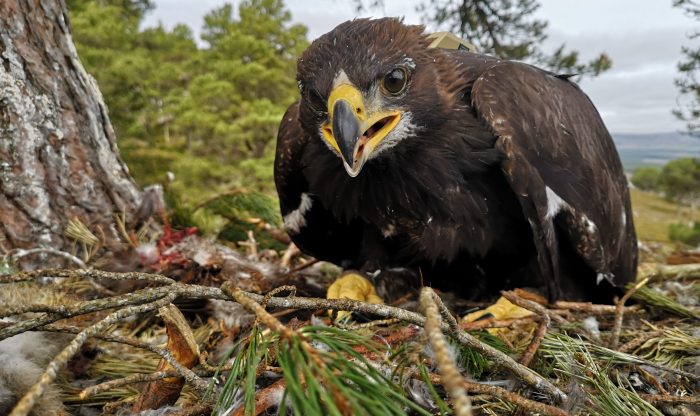
There’s a fascinating new scientific research paper just published in Ibis, the journal of the British Ornithologists’ Union, relating to the flight behaviour of young satellite-tagged golden eagles in Scotland in and around windfarms.

Authored by a number of experts from Scotland’s Golden Eagle Satellite Tag Group (GESTG), this study demonstrates how young golden eagles actively avoid operational wind turbines.

Here is the abstract:

The notion that young dispersing golden eagles in Scotland appear to avoid wind farms was discussed in the Government-commissioned report published in 2017: Fielding & Whitfield, Analyses of the Fates of Satellite Tracked Golden Eagles in Scotland (see Chapter 8), when the authors were examining whether any of the tagged eagles that had ‘disappeared’ in suspicious circumstances were within the vicinity of a wind farm.

The report concluded that no, they weren’t, and it was recommended that further detailed research be undertaken to examine the movements of young satellite-tagged eagles in and around operational vs non-operational windfarms, which is the focus of this latest paper.

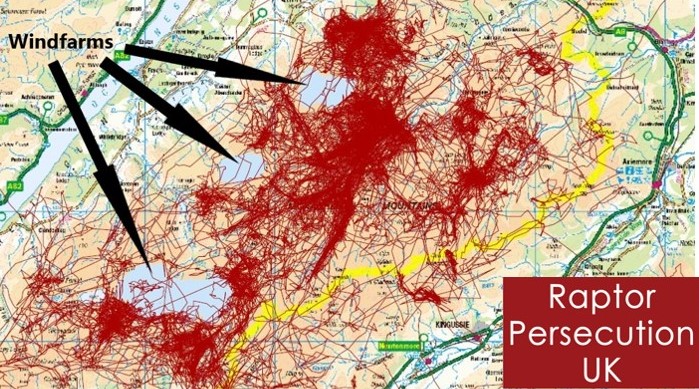
Unfortunately this paper is behind a paywall (a particular gripe of mine but that’s for another day) so I can’t post the full paper on here. However, I do have a related graphic that I think helps to illustrate some of the research findings of the paper.

This map shows the flight lines (red) of one of the young satellite-tagged golden eagles that Chris Packham and I are monitoring. It shows, quite clearly, how this young eagle is generally avoiding flying over / through the footprints of three large windfarms (blue) in the Monadhliath Mountains (thanks to Alan Fielding for the data analysis).

Why this avoidance technique seems so prevalent in young Scottish golden eagles, in sharp contrast to findings in some other countries where certain raptor species have been recorded in high incident turbine collisions, is really interesting.

Raptor collision with turbines depends on a wide number of variables including site and habitat-related issues as well as the behaviour and ecology of the particular raptor species. It is a well-studied subject in a number of countries and has demonstrated that just because one raptor species has been killed at one wind farm at one location, it doesn’t automatically mean that every raptor is threatened by every wind farm, everywhere. I’m afraid that’s just simplistic nonsense, trotted out by those who are either (a) anti-wind farm or (b) desperate to deflect attention away from the continued illegal poisoning, shooting and trapping of raptors by gamekeepers in the UK (e.g. see here and here).

In their discussion about why young Scottish golden eagles might be avoiding wind turbines, in addition to the finding that habitat suitability inside and outside of the wind farm is important, the authors in this latest paper refer to a concept known as ‘the ecology of fear’ and discuss the evolutionary history of golden eagle persecution in the UK and how this may be leading to a genetic predisposition to wariness of humans, with wind turbines being used as the ‘cue’ for eagles to express their fear (i.e. by avoidance).

This latest paper from the Golden Eagle Satellite Tag Group is yet another significant contribution to our understanding of how golden eagles use the landscape and, along with this earlier paper from the GESTG, will greatly help planners and statutory agencies to make decisions that will have the least impact on this protected species and its preferred habitat.

It shouldn’t be necessary but apparently it is, to point out that this research is conducted by highly experienced conservationists, under licence, whose sole motivation is the protection of the golden eagle. They sacrifice time with their families and volunteer an enormous amount of personal time, personal funds and technical expertise to undertake this research. In any other country their efforts would be celebrated, applauded and appreciated (as indeed they have been in Spain!). But in Scotland, they are slandered, abused and attacked (e.g. here) by those who are desperate to corrode public and political confidence in raptor satellite-tagging because they know how incriminating these satellite tag data can be, exposing time and again the areas where birds of prey are being illegally killed.

There are a number of other peer-reviewed scientific papers from the Golden Eagle Satellite Tag Group, due imminently.

Golden eagle festival (Scotland) – programme announced

Earlier this year it was announced that Moffat was to be named an ‘eagle town’ as part of a celebratory golden eagle festival planned to boost eco-tourism in south Scotland (see here).

Moffat had been chosen as it was close to the original release site for the South Scotland Golden Eagle Project, where young golden eagles were being translocated from sites further north and released in to south Scotland to boost the tiny population there that had previously been ravaged by illegal persecution (and there is still evidence that that persecution continues in some areas – e.g. see here).

The golden eagle festival is scheduled to take place between 19th – 26th September 2021, funded by the National Lottery Heritage Fund, and the programme for the event has just been announced – you’ll find details on the South Scotland Golden Eagle project website here.

The project partners have issued the following press release:

The full programme for the UK’s first ever Golden Eagle Festival has been revealed by a groundbreaking conservation charity initiative. The programme contains a number of fun and engaging events to help people understand how they can take an active role in increasing numbers of golden eagles in the south of Scotland.

One of these events will look at the development of Selcoth Forest, one of the area’s newest forests that has been designed to play a supportive role for a number of species and raptors including golden eagles. The event will explore how good woodland management can play a vital role in supporting conservation efforts.

The Moffat Eagle Festival, led by The South of Scotland Golden Eagle Project and funded by The National Lottery Heritage Fund, will take place between 19 and 26 of September 2021 to support the charity’s conservation efforts and celebrate the vibrant town of Moffat becoming Scotland’s first Eagle Town.

With a keynote speech by one of the country’s leading wildlife film makers Gordon Buchanan, a family fun day, a Big Tree Climb and live music sessions, the festival will also showcase pioneering ways in which landowners and managers, residents and visitors can help golden eagles to flourish in southern skies once again.

Speaking about the Festival, and the significance of the talk by the team at Selcoth Forest, Colin Edwards, Environment Policy Adviser for Scottish Forestry said: “The Moffat Eagle Festival is a fantastic and important addition to the wildlife calendar. We’re particularly delighted to see that some of the Selcoth Forest team will be speaking at the event. They have been consulting closely with organisations like South of Scotland Golden Eagle Project and Scottish Raptor Study Group so that they can create a landscape in which woodlands  play a positive role to increase golden eagle foraging habitat, helping to establish and sustain a local population. Their work is an excellent example of how sustainable forest management can support conservation efforts, while also delivering social and economic goals for landowners and the wider local community.”

The privately owned Selcoth Burn Woodland Creation is designed to strengthen forest habitat networks, protect local views , improve biodiversity, protect water quality and provide a sustainable timber resource for the owners. Scottish Forestry has approved plans for the woodland creation, which are in line with The UK Forestry Standard and Scotland’s Forestry Strategy, and work is now underway. Consideration has been given to how the woodland can provide the ideal habitat for golden eagles to forage in. The development includes a permanent native birch woodland, alongside productive broadleaves, conifers and large areas of open ground, which will enable the site to have multiple benefits and create a good habitat for golden eagles. It its envisioned that as the scheme develops, prey species will become more abundant for eagles which will help to sustain a growing local population.

Cat Barlow, Project Manager for the South of Scotland Golden Eagle Project added: “Last year, a pioneering sustainable forest development led to breeding success for a pair of golden eagles in a Highland estate, so we are absolutely thrilled to be consulting with the team at the Selcoth Forest on this development in the south of Scotland, and we’re excited to see how this can support our charity’s conservation work.

“Support from forestry and land managers, local communities, funders, volunteers, raptor specialists and other participants is absolutely vital in helping us to ensure golden eagles continue to grow in numbers and thrive in the area.

“We’re really looking forward to attending the Moffat Eagle Festival so that we can thank our supporters and help even more people understand how they could support our work.”

Gordon Buchanan will deliver the festival’s first virtual keynote speech about golden eagles and other Scottish wildlife on Friday 24 September. Speaking of his involvement, he said: “I’m delighted to be part of the South of Scotland Golden Eagle Project’s first ever Golden Eagle Festival and to support their important conservation work to ensure golden eagles once again flourish in southern skies.

“The thrill of seeing a golden eagle soaring over a Scottish hillside is an unbeatable experience. Each glimpse of this magical bird is special, but they should and could be more common in the south of Scotland.”

The full Moffat Eagle Festival programme includes events and activities delivered by a range of leading wildlife groups including RSPB Scotland, NatureScot, Scottish Forestry, Scottish Land & Estates, Scottish Wildlife Trust, Saving Scotland’s Red Squirrels, Wild Eskdale, and the Scottish Raptor Study Group. There will even be a workshop delivered by a leading wildlife photographer.

Caroline Clark, Director Scotland of The National Lottery Heritage Fund, said: “The Golden Eagle Festival is yet another innovative way in which The South of Scotland Golden Eagle Project is helping communities learn about this awe-inspiring bird of prey and the role it plays in Scotland’s biodiversity. Thanks to funding from players of the National Lottery, not only will the Festival bring new visitors to discover this beautiful part of Scotland, but it will help safeguard the golden eagle’s existence for future generations.”

Welcoming their town’s role in supporting the project and hosting the festival, Leys Geddes chair of Visit Moffat said: “Less than a mile from the motorway, we are ideally situated to become Scotland’s First Eagle Town, to host the first Eagle Festival, and to celebrate the golden eagle – one of Scotland’s most iconic species.

“The Moffat Hills are often described as mini-highlands, owing to our 300 square kilometres of hills, outstanding scenery and rich wildlife, so the perfect area for golden eagles to thrive. It would be wonderful to ensure they become a regular sighting for visitors to the area.”

South of Scotland Golden Eagle Project partners include NatureScot, RSPB Scotland, Scottish Land & Estates, Scottish Forestry, and the Southern Uplands Partnership.  The project has been funded by The National Lottery Heritage Fund, project partners, Scottish Power Renewables, the Scottish Government and local LEADER Programmes. The initiative is a key project under the Scottish Government’s 2020 Challenge for Scottish Biodiversity (which has a route map to protect and restore Scotland’s biodiversity).

ENDS

Rare breeding success for sea eagles in Cairngorms National Park but outlook for chick is bleak

The Cairngorms National Park Authority has issued the following press release today (6th July 2021). My commentary on this news is below the press release:

Raptor breeding successes for East Cairngorms Moorland Partnership

The productivity of breeding raptors in the east of the Cairngorms National Park this season is encouraging and includes the hatching of a sea eagle chick on Balmoral, the first time that the species has successfully bred on the estate.

The breeding pair of sea eagles – also known as white-tailed eagles – have been observed on Balmoral for the last few years. Both adult birds carry satellite tags and close collaboration with the Royal Society for the Protection of Birds (RSPB) has allowed the Balmoral Ranger Service to follow their weekly movements during the breeding season. A healthy male chick has now hatched and been ringed. Three golden eagle chicks have also recently been ringed as part of long-term monitoring on Balmoral.

Balmoral Estate is a member of the East Cairngorms Moorland Partnership (ECMP) which has seen breeding success for golden eagles, hen harriers, red kite, osprey, peregrine and merlin, as well as short-eared owls, in 2021, across the various land holdings.

[The young white-tailed eagle chick on the nest at Balmoral. Photo by North East Scotland Raptor Study Group, a member of the Scottish Raptor Study Group]

Richard Gledson, Estate Manager at Balmoral Estate said: “All at Balmoral Estate are delighted that sea eagles have nested successfully for the first time. A previous nesting attempt in 2017 on the same site sadly failed and we have had our fingers crossed since then. The birds have been with us for a couple of years, and we have been working closely with the North East Scotland Raptor Study Group who ringed the chick last week and with the RSPB who have been sending data from their satellite tags.”

Glenavon Estate – which is home to three pairs of golden eagles, including one of the highest nesting sites in Scotland – has had a golden eagle chick satellite tagged for the first time in recent years. Satellite tags are used by biological researchers on a variety of species including eagles and harriers, and provide valuable insight into their movement and survival. Golden eagle chicks have also been tagged on the Glenlivet Estate and Mar Lodge Estate.

Furthermore, Mar Lodge has hosted six hen harrier nests in 2021. One pair failed early in the season, but the other five nests all have chicks. Two hen harrier chicks have been satellite-tagged in collaboration with the RSPB. Evidence from satellite tags fitted to some of the harriers which are now breeding shows that the birds range widely, foraging across ground on neighbouring ECMP estates.

Last year, Mar Estate witnessed the first successful breeding attempt of sea eagles in Deeside for 200 years, but the relatively inexperienced pair failed this season at the hatching stage, with poor weather likely a contributing factor, however hopes are high for success with continued breeding efforts next season and beyond.

Dr Ewan Weston of the North East Scotland Raptor Study Group, who has carried out much of the satellite tagging on ECMP estates, commented: “This year’s raptor tagging on ECMP estates builds on a positive collaboration with the estates over recent years. Despite a very wet, snowy May, the general picture in the area is that raptors, particularly golden eagles, red kites and hen harriers have done well.”

The East Cairngorms Moorland Partnership is a landscape-scale collaboration between five sporting estates and the Cairngorms National Park Authority. The partnership seeks to deliver private interests alongside public benefits, including improving the conservation status of raptors, demonstrating best practice muirburn management, expanding areas of woodland and scrub and peatland restoration. Partners have been collaborating with a wide range of ecologists in the National Park.

Xander McDade, Convenor at the Cairngorms National Park Authority, said: “We are delighted to hear that productivity of raptors in the east of the National Park looks good for 2021. However, we know that we can still do more for the birds and are committed to finding ways of improving the conservation status of moorland raptors, along with other red and amber moorland bird species. This includes working closely with the five estates that make up the ECMP on a range of conservation measures.”

ENDS

First of all, the breeding success of this pair of white-tailed eagles on Balmoral Estate is obviously very good news and long, long over due.

Norway donated 85 sea eagles for a reintroduction project in eastern Scotland between 2007-2012, although over a quarter of those didn’t survive (the main known causes of death included illegal poisoning, illegally shot, accidentally electrocuted and being hit by trains). The East Coast reintroduction was the third phase of a national reintroduction project that started back in 1975 on the west coast of Scotland, after the species was extirpated from Britain thanks to persecution in the late 1800s and early 1900s.

The first successful breeding attempt in east Scotland in 2013, the first for over a century, was an historic milestone in the project and was hoped to be the beginning of a new and vibrant population in the east, mirroring the successful population growth in the west.

So far though, progress has been incredibly slow and ongoing persecution has been at the centre of that (e.g. see here for the news that a sea eagle’s nest tree was deliberately felled on a grouse moor in the Angus Glens, also in 2013-nobody was prosecuted).

A number of young satellite-tagged sea eagles have ‘disappeared’ in suspicious circumstances on or next to grouse moors since then, and only last year a young sea eagle was found dead, illegally poisoned, on another grouse moor inside the Cairngorms National Park (see here). Nobody was prosecuted for that crime.

[A police officer examines the corpse of the illegally poisoned sea eagle found dead on a grouse moor in the Cairngorms National Park in 2020. Photo by Police Scotland].

So yes, it’s excellent news that Balmoral Estate has hosted a successful breeding attempt this year – well done to the team there – but it’s only half of the story. What happens when that young eagle fledges and disperses from Balmoral later this year?

Will it meet the same fate as this young golden eagle, which fledged from a nest site in the eastern Cairngorms last year and was found dead, ‘deliberately poisoned’ on a grouse moor on Invercauld Estate earlier this year?

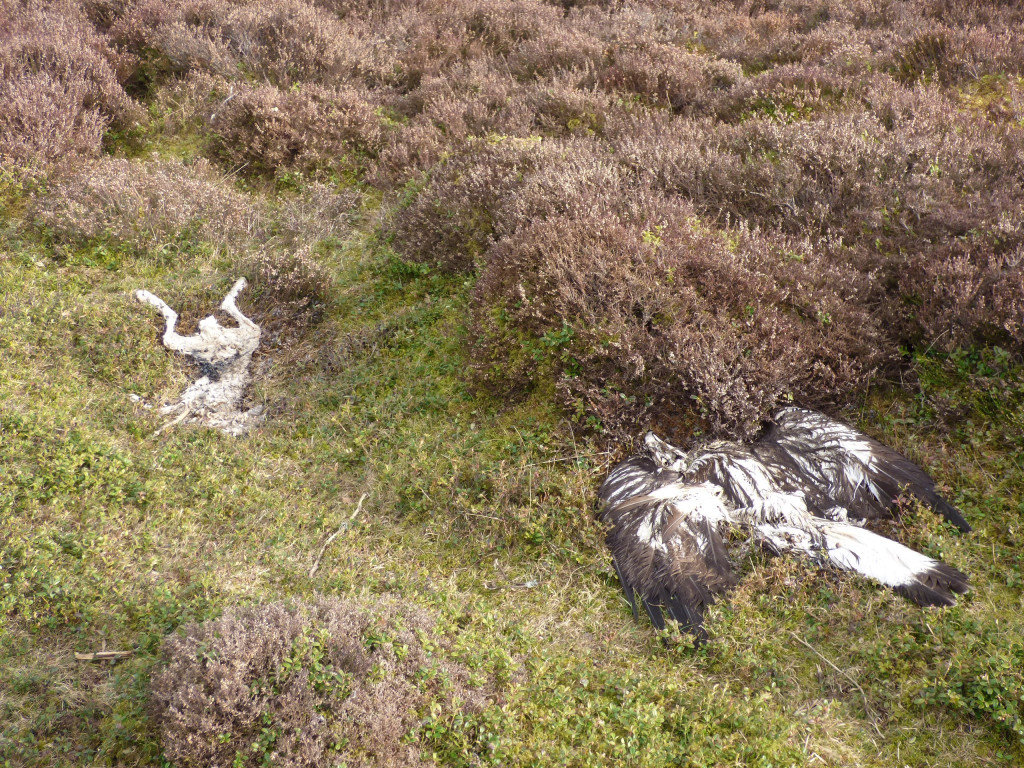
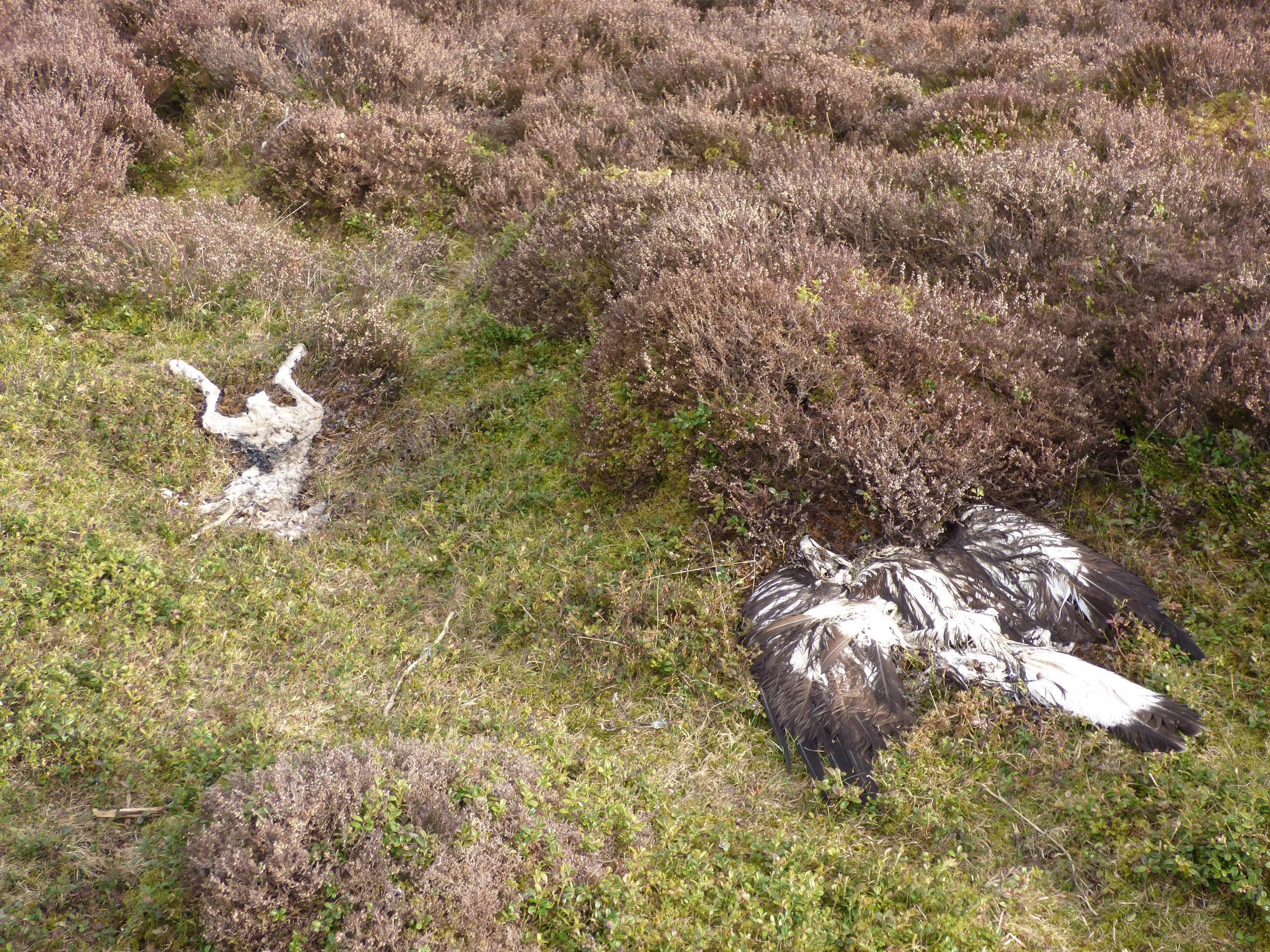
[An illegally poisoned golden eagle, laying next to a poisoned mountain hare bait, found dead on a grouse moor in the Cairngorms National Park in 2021. Photo by RSPB Scotland]

I can see why the Cairngorms National Park Authority would want to issue this press release – not just to deservedly celebrate the successful breeding attempt on Balmoral Estate but probably more cynically, to try and undo some of the reputational damage that has been caused to the Park Authority and to its Eastern Cairngorms Moorland Partnership (ECMP) after the discovery of the poisoned golden eagle earlier this year on one of the ECMP’s partner estates (now no longer a partner) and the deserved criticism that the Park Authority has received for refusing to publish the correspondence it had had with the ECMP about the future of Invercauld Estate as a member of the ECMP following the discovery of the poisoned eagle (see here). This is the same tactic the Park Authority employed a few years ago when illegally-set traps were found on Invercauld Estate (here).

The ECMP can thank its lucky stars that one of its (now five) member estates is Mar Lodge, owned by the National Trust for Scotland, and with a glowing reputation for raptor conservation, especially for breeding hen harriers. Without Mar Lodge’s efforts, the ECMP’s raptor conservation efforts would be looking pretty feeble to date.

Although I noted the irony of the statement in the Park Authority’s press release that, ‘Evidence from satellite tags fitted to some of the harriers which are now breeding shows that the birds range widely, foraging across ground on neighbouring ECMP estates‘.

Er, yeah, but they forgot to mention how many of those hen harriers subsequently ‘disappear’ in suspicious circumstances on grouse moors in the ECMP and beyond (e.g. see here).

It doesn’t matter how far the Park Authority tries to spin the very welcome but too infrequent ‘good news’ stories like the breeding white-tailed eagles on Balmoral – the bottom line remains that large areas of the Cairngorms National Park are still raptor persecution hotspots and until that changes, the outlook for this young sea eagle is bleak.

Poisoned golden eagle: Cairngorms National Park Authority refuses to publish correspondence with Invercauld Estate

In March this year, a golden eagle was found dead, next to a poisoned hare bait, on a grouse moor on Invercauld Estate in the Cairngorms National Park.

Toxicology results showed the eagle had been illegally poisoned with a banned pesticide. Police Scotland conducted a multi-agency search, under warrant, of various properties on Invercauld Estate in May 2021 (here) and issued an appeal for information on what they described as a ‘deliberate’ poisoning (here).

The Cairngorms National Park Authority issued a statement condemning the deliberate poisoning (here).

Invercauld Estate also issued a statement, supporting the police investigation and denying that the deliberately poisoned eagle was found on land managed for grouse shooting – even though, er, it seems that it was (see here and here).

[The deliberately poisoned golden eagle, next to the poisoned hare bait, on a grouse moor on Invercauld Estate, March 2021. Photo by RSPB Scotland]

The following week, the Cairngorms National Park Authority published a further statement, this time on behalf of the East Cairngorms Moorland Partnership (ECMP), a consortium of six estates, including Invercauld, supposedly working in partnership with the Park Authority since 2015 to deliver ‘coordinated and sustainable moorland management’.

The statement from ECMP (read in full here) confirmed that Invercauld Estate ‘had left the group‘. There was no indication whether Invercauld had been expelled or had resigned of its own accord or what process, if any, had been undertaken to reach a decision.

So I submitted an FoI to the Cairngorms National Park Authority to try and find out.

Here’s part of the response I received:

This response came as no surprise to me because the Cairngorms National Park Authority has form for covering up the consequences of alleged criminal behaviour on Invercauld Estate – e.g. see here, here and here. The Park’s Board also has a number of members with a clear association with Invercauld Estate – whether this had any bearing on the Park’s decision about what to release and what not to release can only be open to speculation, obviously, because the information is being withheld. Again.

Still, as long it’s being withheld to allow Police Scotland to ‘complete their investigation’, which of course the CNPA will know (or at least can predict) to be going absolutely nowhere, just like the other ~80+ raptor persecution crimes uncovered in the Cairngorms National Park since 2003 that, with a single exception, haven’t resulted in a prosecution.

Part of the material that the CNPA did release suggests that Invercauld Estate resigned and wasn’t pushed (see below) although without seeing the full correspondence between the estate and the CNPA I’d be wary of drawing any conclusion because it just doesn’t add up, given Invercauld’s protestations when the news first broke that this eagle had been found poisoned on that estate.

This is a copy of an email sent from the CNPA’s Chief Executive, Grant Moir, to the Board. It’s a bit difficult to read with such a tiny font so it’s transcribed below:

Dear Board Member

The East Cairngorms Moorland Partnership will shortly be putting out the attached statement following a meeting of the partnership yesterday. At the meeting the partnership heard from Invercauld estate and Invercauld estate tendered their resignation from the partnership. After a good discussion the partners agreed to the resignation and have all agreed to the wording of the attached statement. It was also clear from the meeting that the remaining members are determined to make the partnership work.

NatureScot have also released a statement today which indicates they are looking at general licence restrictions for Invercauld Estate.

Throughout I have been keeping the Convenor of the Board up to speed on the issues and I will update the board further on Friday if there is any further information.

All the best

Grant

Grant Moir, Chief Executive, Cairngorms National Park Authority

So what of the Police’s ongoing investigation in to this deliberately poisoned golden eagle? No further news (but I trust they’ll be asking the CNPA for copies of the unpublished correspondence between Invercauld and the Park Authority because apparently it’s relevant to the police investigation).

Will NatureScot decide to impose a General Licence restriction on Invercauld Estate? No news.

What of the future of the East Cairngorms Moorland Partnership? A recent blog addressing this very issue from Nick Kempe writing for ParkswatchScotland is well worth a read (here).

And what of the Scottish Government’s promise to get to work on drafting the terms and conditions of a grouse shooting licensing scheme, whereby estates can lose their licence if raptor persecution crimes continue? No further news.

Game-shooting industry called out on raptor persecution by one of its own

It’s been almost four weeks since we learned that a deliberately poisoned golden eagle was found on a grouse moor on Invercauld Estate in the Cairngorms National Park (see here).

This abhorrent wildlife crime is just about as serious and high profile as it gets.

[The poisoned golden eagle and the poisoned bait. Photo by RSPB Scotland]

The golden eagle (along with the white-tailed eagle) has the highest level of protection of any bird species in Scotland (not just the bog standard protection given to all bird species, but the gold standard that includes protection of its nest site and protection from harassment all year round).

It’s an iconic species, loved by millions and on most wildlife lovers’ list of ‘must-sees’ when they visit Scotland.

The Cairngorms National Park is supposed to be the UK’s jewel in the crown and again is on the list of ‘must-sees’ for many visitors to Scotland.

It’s no wonder then, that when one of those wild golden eagles is found slumped and cold in the heather on a prestigious estate in the Cairngorms National Park, right next to a poisoned mountain hare bait deliberately placed to kill wildlife, the news is going to be both shocking and prominent.

And it was.

So how come the game-shooting industry has, on the whole, remained silent about this disgraceful crime? The only statement from a shooting organisation that I could find was from Scottish Land & Estates, the landowner’s lobby group. The statement was vague and short on detail (no mention that the golden eagle had been illegally poisoned and no mention that the eagle’s corpse and the poisoned bait had been discovered on a grouse moor on Invercauld Estate, an SLE member, no less, and that this isn’t the first time the estate has been under investigation).

Still, at least SLE published something. As far as I can tell, almost four weeks on there is no statement of condemnation on the websites of the Scottish Gamekeepers Association, BASC, GWCT, Countryside Alliance, or Scottish Association for Country Sports.

Doesn’t that silence speak volumes?

I’ve thought a lot about why these organisations, with their vociferous claims of having ‘zero tolerance’ for raptor persecution, should remain silent on such a high profile crime when all eyes are upon them. I haven’t been able to come up with a reasonable explanation because there simply isn’t one. There’s no reasonable explanation, or excuse, for not condemning this crime. None at all.

But where there is ground to benefit is in plausible deniability. In that, if nobody acknowledges that this crime even happened, then the constant denials that there’s even an issue, let alone that it’s an out of control issue, can continue. Think about it. The denials can’t continue if the organisations have previously acknowledged and condemned a recent raptor persecution crime. So the strategy seems to be, shut up, say nothing and it’ll all blow over soon and then we can get back to pretending how much we love raptors whilst simultaneously campaigning for licences to kill them and turning a blind eye every time another one gets taken out on land managed for gamebird shooting.

I’m not the only one to notice the silence and the denial.

The following letter was published in this week’s Shooting Times:

The recent disturbing news of a police raid on Invercauld estate after the discovery of a poisoned golden eagle next to a bait should disgust and anger all in the shooting community. Sadly, for quite a few members of that community, these feelings of revulsion will not be felt.

If any readers can steel themselves to check out the Raptor Persecution UK blog they will find a sickening list [here] of illegally killed raptors from all around the Cairngorms.

If, as shooting’s representative organisations keep telling us, “it’s a few bad apples”, I would suggest that this area of Scotland could well contain the orchard.

Invercauld is one of the most prominent sporting estates in Scotland, with a reputation to uphold around the world, yet this is not the first time it has been investigated in recent years.

This begs the question, how many similar crimes go undiscovered? More pertinently, when they are discovered, how often is the burden of proof insufficient to bring a prosecution?

This fact is well known to the perpetrators, and should be borne in mind when the relative scarcity of successful prosecutions is used by the industry’s representatives to deny the scale of the problem.

Paul Tooley, by email.

I don’t know who Paul Tooley is, but I wouldn’t be surprised to learn this Paul Tooley (above) is the same as this Paul Tooley or this Paul Tooley (scroll down to comments section).

Whoever he is, bloody well done for calling out these organisations.

Although as a campaigner I shouldn’t really mind the industry’s silence. In my view it’s indicative of complicity / covering up / shielding the guilty and that just means we’re another step closer to toppling this filthy ‘sport’.

Hysteria from Scottish gamekeepers as SNP and Greens formalise talks to cooperate

Earlier this week it was announced that First Minister Nicola Sturgeon was in formal talks with the Scottish Greens over a ‘co-operation agreement’ designed to seal a pro-independence majority at Holyrood. Falling short of a formal coalition, the agreement could in future lead to Green MSPs becoming Ministers as part of the current Scottish Government (see Scottish Greens statement here, BBC news article here and an analysis from the Guardian’s Scotland Editor Sev Carrell here).

This proposed agreement is of huge interest to many environmentalists and although the specific policy areas of potential cooperation have not yet been agreed (see here), tackling the climate emergency (and by default, surely, the nature emergency) should be a prominent feature.

The news of these talks has triggered the Scottish Gamekeepers Association (SGA) to publish a typically over-the-top scaremongering response about perceived job losses, presumably as a ploy to keep its less well-informed members ready to join a protest at short notice: [Update 16.30hrs – see foot of blog!]

Job losses are of concern to everyone, of course, but as I’ve written previously, the SGA is once again accusing the Scottish Greens of doing something they haven’t done.

The Scottish Greens have made it an aspiration to abolish our members’ jobs‘, says the SGA.

Actually, the Greens have done no such thing. In fact in their election manifesto the Scottish Greens have committed to creating jobs in the countryside, promising ‘at least £895M over the next five years in restoring nature whilst investing in rural communities, creating over 6,000 green jobs’.

The Greens are also committed to ensuring that the licencing of grouse moors ‘is properly resourced and well enforced’ – how does that equate to rural job losses if grouse moor managers are abiding by the law?

A spokesperson from the Scottish Greens is cited today in another article about the proposed cooperative agreement amid concerns from fish farmers and National Farmers Union Scotland (NFUS):

A spokesman for Scottish Green MSPs responded that it was too early to say which issues would arise in talks with the SNP.

He said that environmental harm and fish welfare was a higher priority than phasing out caged fish farms altogether.

He explained that the party’s intention was to support industries in finding alternatives to harmful and polluting activities, and not to force sudden change‘.

Perhaps if the SGA had spent less time and money sponsoring adverts against the Scottish Greens (that went well – great use of members’ funds, not), less time complaining to the electoral commission (how did that go?) and more time reading and engaging with the Greens instead of excluding them from hustings, they’d have a better grasp of what was going on and be in a stronger position to contribute to discussions instead of constantly throwing their toys out of the pram and howling, ‘It’s so unfair’.

Actually, if they’d got any sense at all they’d realise that these talks are not their greatest immediate threat – it’s the continued illegal killing of birds of prey on land managed for gamebird shooting that’s pushing them further and further in to the corner and away from public support.

That poisoned golden eagle, found dead next to a poisoned bait on Invercauld Estate, sent shockwaves through the public, many of whom had no idea this sort of barbarity still goes on.

The SGA’s response? Well I can’t see any statement of condemnation on their website, can you?

[The poisoned golden eagle found lying on a grouse moor next to a poisoned bait on Invercauld Estate. Photo by RSPB Scotland]

UPDATE 16.30hrs:

Right on cue, the Scottish Gamekeepers Association has just published this:

Golden eagles breeding again in Orkney after almost 40 years

RSPB press release (26 May 2021)

Golden eagles breeding again in Orkney after almost 40 years

Golden eagles have returned to Orkney and are breeding here once again after an absence of almost 40 years. Earlier this year local RSPB Scotland staff were delighted to spot a pair nesting at the organisation’s nature reserve in Hoy, and can confirm that they now have chicks. The pair have been seen flying about as they forage.

[One of the breeding pair. Photo by Christine Hall]

These majestic birds used to be a common sight and breed across Orkney but persecution by humans meant just a single pair was left by 1848 in Hoy. Orkney had to wait 116 years until 1966 to see the return of breeding golden eagles. This pair had a long and successful partnership in Hoy raising many chicks together until one of the adults died in the winter of 1982. As these birds pair for life the surviving eagle continued to return to Hoy for three years but there were no further nesting attempts.

The RSPB Scotland staff have been keeping a watchful eye on the new pair to see how they are faring. As golden eagles are very sensitive to disturbance the location of the nest is not being disclosed, and the number of chicks isn’t known as those watching it having been keeping a safe distance away. The species typically has one or two chicks at a time, so the local team are looking forward to when the young fledge to see how many emerge.

Lee Shields, RSPB Scotland’s Hoy warden, said “It is wonderful to see these magnificent eagles return to Orkney and we’re delighted that they are nesting in Hoy. Golden eagles are one of the most iconic birds in Scotland and they have been missing here for too long.

We want to give these birds the best chance of success which is why it’s so important to not reveal where the nest is. It is an inspiring sight to see the male and female soaring over the Hoy hills, and we’re eagerly awaiting finding out how many chicks they have.”

Hoy appears to be the go to place for returning eagles to breed in Orkney, likely due to the terrain in uninhabited areas of the island being well suited for them. Back in 2018 Orkney’s first white-tailed eagle chicks for over 140 years hatched in Hoy. Then RSPB Scotland ran “Eaglewatch” events to allow people to catch a glimpse of the birds but given the heightened sensitivity of golden eagles and as the white-tailed eagles have not bred this year is not doing so here.

Golden eagles are one of the largest birds in Scotland. They are more than twice the size of a buzzard, with a wingspan of 1.8 – 2.3m. Their lifespan is typically over 20 years. All of the UK’s breeding golden eagles are found in Scotland, with the most recent national survey in 2015 putting their numbers at 508 pairs.  

Lee added: “This golden eagle pair are at an early stage of their breeding life and as they are long-lived birds we hope not only that they will be as successful as their predecessors, but that they are the beginning of this species re-establishing itself in Orkney. These birds are an integral part of Orkney’s history and with this pair and their young we’re keeping our fingers crossed we can look forward to them being part of its future once again.” 

ENDS

Fergus Ewing out, Mairi Gougeon in – Scottish Cabinet reshuffle revealed

Well this is very very very good news indeed.

Nicola Sturgeon has announced her reshuffled Cabinet team; former Rural Affairs Cabinet Secretary Fergus Ewing is no longer in the Cabinet at all and former junior Rural Affairs Minister Mairi Gougeon has been promoted to the position of Cabinet Secretary for Rural Affairs and Islands.

There is likely to be some cross-over with Mairi’s role and that of Michael Matheson who is the new Cab Sec for Net Zero, Energy & Transport, which will include working on the climate emergency (think muirburn).

I’m absolutely delighted and judging by the number of texts I’ve received this morning, I’m not alone.

I don’t intend to comment on the departure of Fergus ‘friend of the Scottish Gamekeepers Association‘ Ewing other than to say, goodbye.

Mairi Gougeon is a brilliant choice for Cab Sec. She is an intelligent, dynamic and often thoughtful politician who has not been afraid to speak out against the persecution of the hen harrier in her role as a junior Minister and Hen Harrier Species Champion. She has taken an active role, even prior to her appointment as a junior Minister, asking questions about the Government’s commitment to tackling raptor persecution (here), attending and speaking at Hen Harrier Day events (e.g. here), taking the time to accompany raptor fieldworkers in to the field to understand more about this species’ ecology and its perilous conservation status (e.g. here and here), has initiated Parliamentary debates on hen harrier conservation (e.g. here) and has supported the Scottish Raptor Study Group at Holyrood gatherings (e.g. here).

[Mairi Gougeon beaming after a visit to watch hen harriers with members of the Scottish Raptor Study Group a couple of years ago in her role as Hen Harrier Species Champion]

I haven’t always agreed with her earlier thinking on how raptor persecution should be tackled (e.g. see here, and here) and I have criticised her for her silence in response to some brutal, sadistic crimes against birds of prey on Scottish grouse moors (here) but her delivery of the Government’s response to the Werritty Review back in November 2020 revealed an increased understanding of the issues and a sign of a genuine commitment to changing the status quo (here).

Last week, author Jim Crumley wrote an excellent piece about the need for a new Environment Secretary ‘who will act’ (here). I have high hopes that Mairi Gougeon will be that Cab Sec (albeit under a new title).

Congratulations, Mairi, there are many of us looking forward to supporting your efforts.

The new junior Ministerial team, working in support of the Cabinet Secretaries, is expected to be unveiled shortly.

Poisoned golden eagle: will a General Licence restriction now be imposed on Invercauld Estate?

Earlier this month it was reported that police had conducted a raid, under warrant, on several properties on the Invercauld Estate following the discovery in March of a deliberately poisoned golden eagle and some poisoned bait (see here).

I’ve since blogged about why I think the golden eagle killer will evade criminal prosecution (see here) and a little bit about NatureScot making noises about considering a potential General Licence restriction on this estate (see here). A General Licence restriction is nowhere near as serious as a criminal prosecution but it is, in the words of former Environment Minister Paul Wheelhouse who worked hard to get this apparent sanction introduced, a ‘reputational driver’ (see here).

It’s my view that a General Licence restriction is long overdue here, given the history of alleged wildlife crime offences, and a blog that was published yesterday has further strengthened that view, of which more in a minute.

This area around Ballater in the Cairngorms National Park has been at the centre of a number of alleged wildlife crime offences over many years.

[Estate boundaries based on data from Andy Wightman’s Who Owns Scotland website]

There was the discovery of three poisoned buzzards on Invercauld Estate in 2005 (here), the discovery of an illegally shot peregrine at the Pass of Ballater in 2011, the reported coordinated hunt and subsequent shooting of an adult hen harrier at Glen Gairn on the border of Invercauld and Dinnet Estates in 2013, the illegally-set traps that were found near Geallaig Hill on Invercauld Estate in 2016, the suspicious disappearance of satellite-tagged hen harrier Calluna ‘on a grouse moor a few miles north of Ballater’ on 12 August 2017, the opening day of the grouse shooting season (here) although it’s not clear whether this was on Invercauld Estate or neighbouring Dinnet Estate, the suspicious disappearance of satellite-tagged white-tailed eagle ‘Blue T’ on Invercauld Estate in May 2018 (see here), the suspicious disappearance of satellite-tagged hen harrier Stelmaria ‘last recorded on grouse moor a few miles north west of Ballater, Aberdeenshire on 3rd September 2018 (see here), the suspicious disappearance of satellite-tagged hen harrier (Wildland 2) on Invercauld Estate on 24 September 2019 (here) and now the discovery of a deliberately poisoned golden eagle and poisonous baits on a grouse moor on Invercauld Estate in March 2021 (see here).

The suspicious disappearance of three satellite-tagged hen harriers and one white-tailed eagle in one small area managed for driven grouse shooting should raise lots of eyebrows given the unequivocal scientific pattern that has been identified for such occurrences (e.g. see here and here) and especially in an area where the alleged hunting and subsequent shooting of a hen harrier was witnessed and reported several years earlier.

However, according to NatureScot’s current Framework for how it makes decisions on whether to impose a General Licence restriction, the suspicious disappearance of a satellite-tagged raptor is not, in itself, considered sufficient evidence, even when there’s an emerging pattern in one particular area:

Unexplained ‘stopped no-malfunction’ satellite tags may be considered by NatureScot as supporting information in making a decision, particularly where multiple losses have occurred on the same land. However such instances will not be considered as evidence under the terms of this Framework unless recorded as a crime by Police Scotland‘.

The most significant, and indeed tangible, wildlife crime incident that could be linked to Invercauld Estate was the discovery of illegally-set traps on the estate in 2016, which led to the horrific suffering of a Common Gull whose legs were caught in two of the traps (see here).

[Photo of the Common Gull after being released from the traps. Photo by Graeme Rose]

Long-term blog readers may recall this incident and the farcical non-existent enforcement measures that ensued. The SSPCA attended in the first instance and had to euthanise the gull due to the extent of its injuries but because of their ridiculously restricted investigatory powers, they were not permitted to search the area for more traps – this had to be done by the police, who conducted a search several days later where it was discovered that other traps (i.e. evidence of potential crime) had been recently removed prior to the police search (here).

Then there was an odd statement of denial from Invercauld Estate, bizarrely issued by the GWCT on behalf of the estate (a strange activity for a so-called independent wildlife conservation charity, see here) and incidentally, this denial is not that dissimilar to the one we saw recently from the estate in relation to the deliberately poisoned golden eagle – see here.

I challenged the estate’s claim that Police Scotland had not found any evidence of illegal activity back in 2016 and Police Scotland issued a statement in response (see here).

I then submitted a series of FoIs that revealed what looked like some very odd goings on between the estate, the Cairngorms National Park Authority and the Scottish Government, which resulted in ‘secret action‘ apparently being taken against a gamekeeper but no prosecution followed, and nor did NatureScot impose a General Licence restriction for this incident (and NatureScot has refused to discuss its decision saying ‘it’s not in the public interest‘ to tell us).

I did wonder whether NatureScot had not imposed a General Licence restriction due to a technical issue – the fact that the SSPCA, not the police, attended the scene and found the evidence of the illegally-trapped gull. If you look again at NatureScot’s Framework for decision-making on restrictions, it says that evidence must be provided by the police. It doesn’t say anything about evidence from the SSPCA being acceptable. I hope I’m wrong on that because as a statutory reporting agency, the SSPCA’s evidence should be considered just as robust as any evidence put forward by Police Scotland – I’ll check with NatureScot about it.

However, yesterday a blog was published on the excellent ParksWatchScotland blog, written by Graeme Rose, one of the guys who had actually found the critically-injured gull on Invercauld Estate in 2016. It’s a harrowing tale, but it’s incredibly enlightening in that he pursued the enforcement authorities for several years after the incident and by doing so uncovered all sorts of shenanigans. He says he received a text in July 2020 from the former Convenor of the Cairngorms National Park Authority who told him that a gamekeeper had indeed ‘been let go’ after the gull incident in 2016, despite the estate’s protestations at the time that any offence had even taken place. I believe this is the information that was deliberately redacted by the CNPA and the Scottish Government when I’d asked them about it in those FoIs.

What a pitiful state of affairs.

Will we see anything different in response to the discovery of the deliberately poisoned golden eagle? Well, we’ve already seen that Invercauld Estate has ‘left’ the Eastern Cairngorms Moorland Partnership, although there was absolutely zero indication whether the estate was expelled or left of its own accord (see here) so it looks like the Cairngorms National Park Authority is staying true to form and not wanting to be explicit about any action that may or may not have been taken. Why is that, do you think? Could it be anything to do with who sits on the CNPA’s Board? There are some interesting characters with some interesting connections to the grouse-shooting world, and even to Invercauld Estate itself.

And what about NatureScot and its deliberations about whether there is sufficient justification for a General Licence restriction on Invercauld Estate? That’s going to be VERY interesting and is something I’ll definitely be tracking. Watch this space.

“Another poisoned golden eagle? If the SNP are serious about protecting wildlife we need an Environment Secretary who will act” – Jim Crumley

Jim Crumley has written a brilliant opinion piece for the Courier (published 10th May 2021) in response to the discovery of the deliberately poisoned golden eagle found on Invercauld Estate in March.

The article is reproduced below:

THERE is a job of some urgency for the new Environment Secretary at Holyrood.

You may have read about the golden eagle found poisoned at Invercauld estate in the Cairngorms National Park.

The guiding principles for a national park should centre around the wellbeing of the landscape and its ecology. Nothing else. Otherwise, why bother to have a national park at all?

But what Scotland has instead is two national parks obsessed by tourism and the rural economy.

As it happens, I have just been reading a book called “A Life in Nature”, a collection of writings by Peter Scott, founder of the Wildfowl and Wetlands Trust and the Worldwide Fund for Nature. He wrote this:

“For conserving wildlife and wilderness there are three categories of reason: ethical, aesthetic, and economic, with the last one (at belly level) lagging far behind the other two.”

And this:

“Conservationists today are involved in a gigantic holding operation – a modern Noah’s Ark to save what is left of the wildlife and wild places, until the tide of new thinking begins to flow all over the world.”

Long wait for tide to turn

He wrote that 60 years ago.

But because I read it at the same time as Nicola Sturgeon’s astonishing election achievement was playing out, I began to think that there is an opportunity right here, right now.

If we are on a tide of new thinking, it has never been more important that the Scottish Government appoints an Environment Secretary with a radical agenda.

And please don’t let Fergus Ewing anywhere near it, because he is far too chummy with the Scottish Gamekeepers Association.

The golden eagle found poisoned at Invercauld this spring is the latest in a breathtaking catalogue of around 80 crimes against wildlife in the national park’s young life

The first thing I think the new Environment Secretary should do is to familiarise himself or herself with the track record of the Cairngorms National Park in conserving wildness and wildlife, and then to consider how the land within the park is managed.

The result of that familiarising process should be cause for a great deal of concern for the new Environment Secretary.

If it isn’t, the Scottish Government will have appointed the wrong person, because the golden eagle found poisoned at Invercauld this spring is but the latest in a breath-taking catalogue of around 80 crimes against wildlife in the national park’s young life (it was established in 2003).

Twelve golden and white-tailed eagles have been killed in that time along with 24 buzzards; and 10 hen harriers in the last five years alone.

A sea eagle nest tree was deliberately felled and nests of peregrine and goshawk were destroyed.

All that inside the national park, in the last 18 years, and all of these birds have the highest level of legal protection.

Victorian values

That alone should be enough to persuade the new Environment Secretary that the situation calls for new thinking.

The estates’ attitudes towards birds of prey are symptomatic of a far wider contempt for those species of nature which they judge to be inconvenient for what remains a depressingly Victorian attitude to land and wildlife.

The Cairngorms National Park Authority’s response to the eagle-killing was dismal. A statement on its website says: “The CPNA condemns this senseless and irresponsible behaviour and condemns it in the strongest possible terms. Raptor persecution has no place in 21st century Scotland and no place in this national park.”

How can you revere a landscape when the principal management tools of its private owners are fire and guns and poisons, burning the land, killing the wildlife?

No, it doesn’t condemn it in the strongest possible terms.

If it had done, the park authority would be screaming down the phone to the Scottish Parliament that grouse moor and deer forest should have no place in 21st century Scotland or inside the national park.

They are completely incompatible with thoughtful conservation of a landscape that should be revered for its wildlife and wild landscape.

How can you revere a landscape when the principal management tools of its private owners are fire and guns and poisons, burning the land, killing the wildlife. And why aren’t national parks owned by the nation?

That might have amounted to something like the strongest possible terms.

The other problem with the park authority’s statement is that, alas, there IS a place for raptor persecution in 21st century Scotland, in many places, and one is the Cairngorms National Park.

Reality doesn’t match ambition

The first words you read on the home page of the Cairngorms National Park Authority website are these: “An outstanding national park, where people and nature thrive together.”

It is a very worthwhile ambition, but it is a long way from the reality on the ground.

The new Environment Secretary might also like to consider that one of the reasons for such a toll of wildlife is that as things stand, the estates know they will almost certainly get away with it, for there are hardly ever prosecutions.

If our newly-elected government wants to project the image of a forward-thinking independent Scotland on the European stage – and I sincerely hope it does given my lilac and yellow votes for the SNP – then the tide of new thinking should perhaps begin by blowing away that embarrassing Victorian stain from the face of the land.

ENDS