A fascinating new study has been published today in the peer-reviewed scientific journal Diversity, providing an in-depth analysis of the movements of young satellite-tagged golden eagles in Scotland and an examination of the physical barriers (water and unsuitable terrestrial habitat) that may restrict movement between different regions of Scotland.
Here’s the citation: Fielding, A.H. Anderson, D., Barlow, C., Benn, S., Reid, R., Tingay, R., Weston, E.D. and Whitfield, D.P. (2024). Golden Eagle Populations, Movements & Landscape Barriers. Diversity, 16(4), 195.
It is the latest in a long line of scientific papers produced by the Golden Eagle Satellite Tag Group (GESTG), a formal collaboration of scientists and researchers from several organisations that are involved with golden eagle research in Scotland who share tag data & other information for the purpose of furthering golden eagle research and conservation. I’ll try and blog about the other papers soon.
Golden eagle adult & nestling. Photo by Chris Packham
Using over 7 million dispersal records from satellite tags fitted to 152 golden eagle nestlings between 2007-2022, this research found that there were no movements by young golden eagles tagged in the Highlands to the southern uplands.
Similarly, there were no movements from eagles tagged in south Scotland to the Highlands, with the exception of one young eagle in 2015 which flew north to the Highlands in 2016 but was later probably illegally killed in the notorious Eastern Highlands in May 2016.
Fig.3 from the paper showing golden eagle flight lines during natal dispersal across Scotland & Northern England. Map copyright Fielding et al. 2024
These results provide justification for the bolstering of the vulnerable south Scotland golden eagle population by translocating chicks and juveniles from further north. Natural recolonisation by golden eagles from the Highlands is quite clearly unlikely.
The study also demonstrates the reluctance of golden eagles to undertake large sea crossings, as evidenced by the already-known genetic isolation of the golden eagle sub-population in the Outer Hebrides. No satellite-tracked eagles tagged as nestlings moved between the Outer Hebrides and the Inner Hebrides or mainland Highlands, in either direction. Three tagged eagles from the Outer Hebrides made several possible but apparently aborted attempts to fly towards the mainland Highlands.
Flights across smaller water bodies were less problematic with frequent movement of golden eagles between the Inner Hebrides and the Highland mainland. However, eagle flights between Lewis/Harris and the Uists in the Outer Hebrides were surprisingly rare.
The paper concludes that the Scottish golden eagle population appears to be composed of three relatively isolated sub-populations. The largest is in the Inner Hebrides and in the mainland (Highlands) north of the Highland Boundary Fault; the second is the large Outer Hebridean sub-population; and the third, and much smaller and more vulnerable, is the southern Scotland sub-population. The authors suggest that recolonisation of golden eagles in northern England is likely to occur from terrestrial flights from south Scotland as opposed to flights over water into NW England.
This study, along with all the others the GESTG has produced, highlights the importance of satellite-tagging golden eagles in Scotland and puts to bed the ridiculous claims made by the grouse shooting industry that ‘tag data serve no purpose other than to try and entrap gamekeepers‘ and there’s no need to satellite tag golden eagles because ‘we know all we need to know‘.
Of course we don’t know all there is to know about golden eagles in Scotland – indeed the research undertaken by the GESTG is revealing just how little we previously understood and how much more there is to learn. What is more certain is understanding why the grouse shooting industry is so against any form of raptor tracking (see here, here, here, here and here). Indeed, it was the result of satellite-tracking golden eagles and uncovering patterns of widespread illegal persecution on some driven grouse moors that played a significant part in the Scottish Parliament’s decision last week to introduce a grouse moor licensing scheme to tackle ongoing illegal persecution.
Thanks to generous funding from Natural Research, the paper is available free of charge and can be read/downloaded here:
The Scottish Parliament’s Rural Affairs & Islands Committee met again on Wednesday 21st February to undertake its second day of consideration of the Stage 2 amendments of the Wildlife Management (grouse moor reform) Bill.
For new readers, this is proposed new legislation to regulate grouse shooting and its associated management practices by way of licensing schemes, introduced because of the continued illegal persecution of birds of prey on many Scottish grouse moors.
A report on what happened during the first day of consideration that took place two weeks ago can be found here.
Newly appointed Agriculture Minister Jim Fairlie MSP was in the hot seat. Screengrab from Scottish Parliament TV, 21 Feb 2024
Two separate sessions were required on Wednesday (one in the morning and one in the evening) to get through all the amendments, bringing Stage 2 of this Bill to a close.
Newly-appointed Agriculture Minister Jim Fairlie MSP led the Government’s response, taking over from Gillian Martin MSP whose Ministerial responsibilities have been moved elsewhere after the recent mini-reshuffle.
There were two other new faces on the Committee – Emma Harper MSP (SNP) who replaces former Committee member Jim Fairlie, and Elena Whitham MSP (SNP) who replaces former Committee member Karen Adam MSP who left after taking on commitments on a different Committee.
Other MSPs in attendance were Edward Mountain MSP (Conservative), Jamie Halco Johnstone MSP (Conservative, representing Stephen Kerr MSP) and Colin Smyth MSP (Labour), none of whom were eligible to vote on the Stage 2 amendments but who were present to speak to amendments they had lodged.
Wednesday’s two sessions were straight forward and once again there weren’t any big surprises with Committee members mostly voting along party lines, which meant that the numerous wrecking amendments put forward by the Conservatives, designed to weaken the Bill, were not supported by the majority. It also meant that various amendments put forward by Colin Smyth MSP (Labour), designed to strengthen the Bill, were also unsupported by the majority. Overall, the Bill passed Stage 2 pretty much in the format that the Government had introduced it, which is what had been anticipated.
I won’t go through the amendments one by one because there were too many. For those interested in proceedings the archive video of the two meetings are linked below, as is the meeting transcript.
The big ‘wins’ from our perspective were as follows:
There was majority support for Ministers to be given the power to add additional gamebird species to the licence if there is evidence that wildlife crime, such as raptor persecution, is taking place to facilitate the management of gamebirds such as pheasants and red-legged partridge. Ministers will have the authority to take evidence, consult and then vote on adding those species to the licence at a later date, if deemed appropriate.
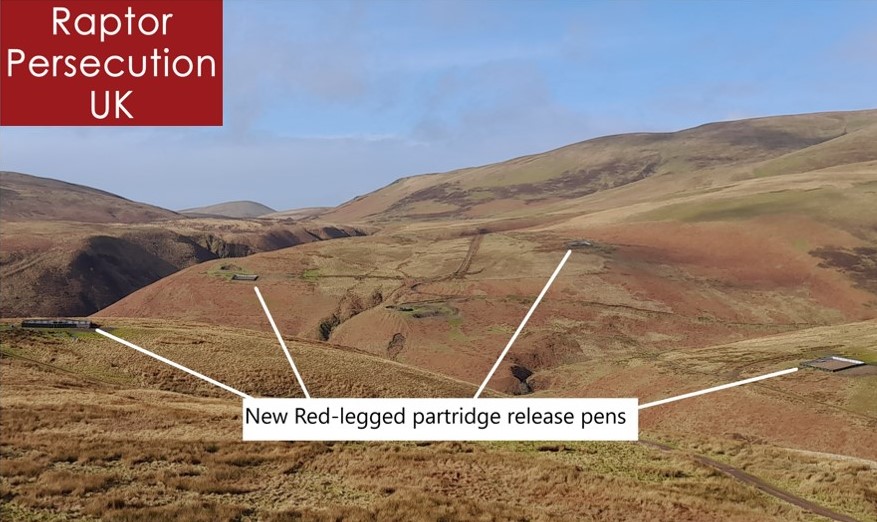
This is a very important amendment especially given the recent trend in the release of red-legged partridge on grouse moors where shooting red grouse is no longer a viable commercial activity. Red-legged partridge and/or pheasants may be used by some grouse shooting estates as an alternative quarry if their licence for shooting red grouse has been revoked so having the power to include these additional species on the licence will close the loophole that some grouse moor managers may have sought to exploit in order to continue killing raptors without consequence. Amendments seeking to exclude this provision were lodged by Conservatives Edward Mountain and Rachael Hamilton but they were not supported.
Red-legged partridge pens placed on a moor in south Scotland
There was support for an amendment that provides a requirement for the use of medicated grit to be included in the Code of Practice being developed to support the new legislation. This is a timely amendment given the research published last week by the League Against Cruel Sports and Wild Justice that demonstrated widespread bad practice and the complete lack of monitoring of medicated grit use (see here).
REVIVE, the coalition for grouse moor reform has just released a campaign video to highlight those findings:
The details of what requirements will be made in the Code of Practice in relation to the use of medicated grit are still to be determined but the Government’s support for medicated grit use to be included is very good news indeed, especially when some grouse shooting organisations have been arguing against its inclusion.
The Minister discussed his intention to introduce a requirement in the Bill to undertake monitoring and reporting of raptor populations – specifically golden eagle, hen harrier and peregrine, species identified in the Werritty Review as being significantly impacted by raptor persecution crimes on grouse moors.
This monitoring would provide a key measure of success (or failure) of the Bill to tackle raptor persecution, which is one of its primary objectives, and whether the new legislation has been effective in this respect. The Minister said he would return to this issue at Stage 3 after discussions with NatureScot and the Scottish Raptor Study Group about the resources required to undertake monitoring and reporting. Rachael Hamilton lodged an amendment that called for a limit on the reporting of some raptor persecution incidents – she wanted to only include crimes that had been proven by conviction. In other words, to exclude incidents described as ‘suspicious’ such as those relating to the suspicious disappearance of satellite-tagged raptors on grouse moors. Her amendment was not supported.
One of the most significant ‘wins’ came from the majority vote to support the introduction of additional powers for the Scottish SPCA to allow them to investigate offences under the Wildlife & Countryside Act – an extension of their current powers to investigate offences under the Animal Health & Welfare Act. As regular blog readers will know, this issue has been kicked down the road repeatedly by the Scottish Government over a 13-year period (see here for timeline) so getting support after so long is particularly satisfying.
Of course there were the usual inaccurate and non-sensical objections from the Conservatives, with Edward Mountain claiming this “would give powers to people who have never had such powers before” and “It should be the police, not other people, who implement the law” and “It would give powers to third parties who I do not believe are qualified or have the legal training to exercise such powers“.
These continued claims about the SSPCA’s supposed inexperience and inability to investigate wildlife crime are laughable, given that they’re already an official specialist reporting agency to the Crown Office so know all about due process, they already work in partnership with Police Scotland and other agencies in raptor persecution investigations, and through their skill, experience and expertise routinely bring some of the most sadistic wildlife-abusers to justice, including badger baiters such as the recent case against a depraved gamekeeper employed on the Millden Estate in the Angus Glens (here). Edward Mountain should be thanking the Scottish SPCA for its tireless and often challenging work, and its willingness to undertake even more of it under this new legislation at no cost to the tax payer. Seriously, who would want to oppose the addition of more expert professionals to bring the wildlife criminals to justice?
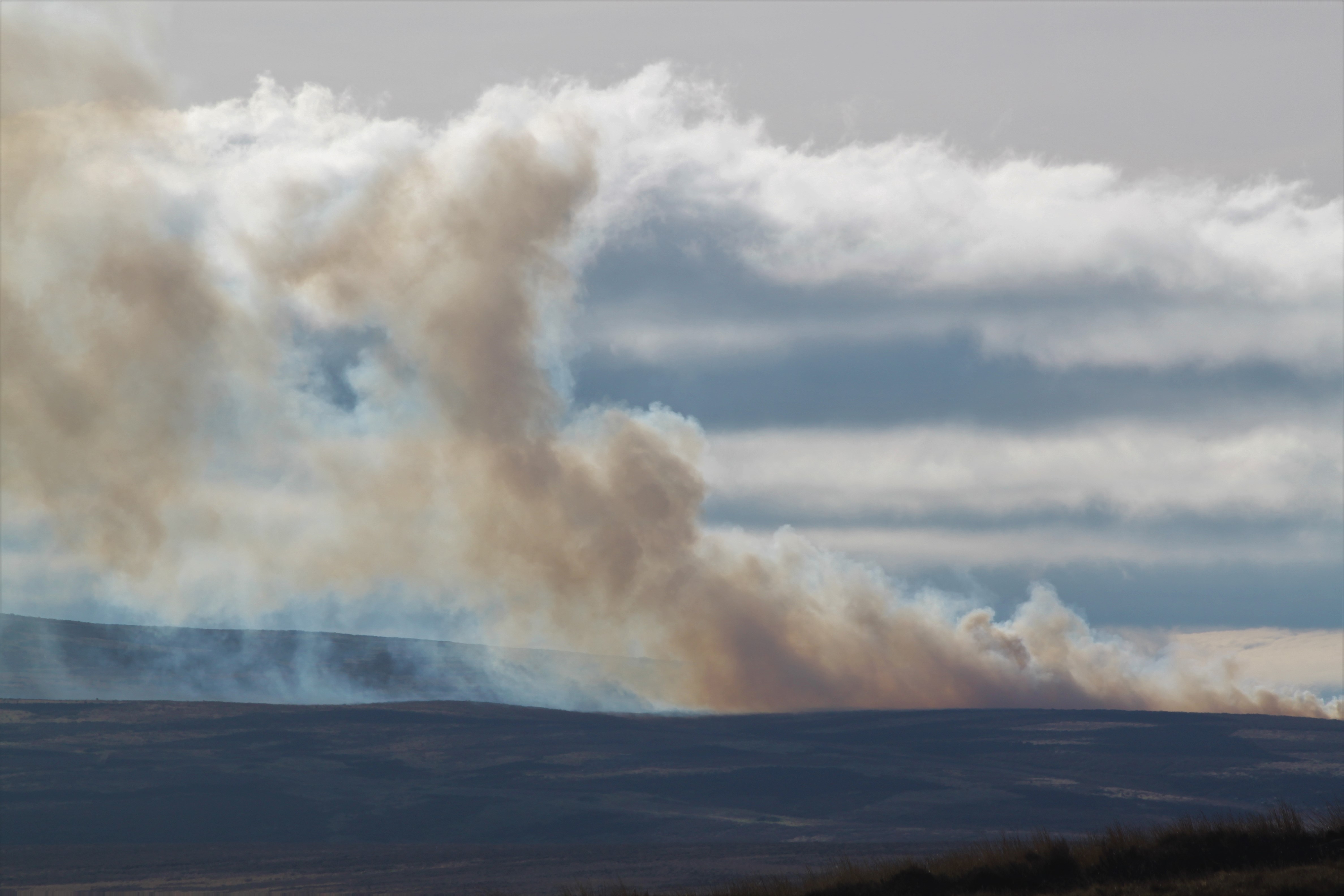
Another big win came via Kate Forbes’s amendment to see the closing of the muirburn season brought forward to 31st March. Currently, gamekeepers can burn heather up until 15th April, and in some cases even to the 30th April where landowner discretion allows. This late season burning overlaps with the breeding season of various moorland bird species, and when that breeding season is predicted to get earlier in response to climate change it’s obviously idiotic to allow burning to continue during that period, just on the precautionary principle alone.
Grouse moor muirburn. Photo: Ruth Tingay
The 31st March was seen as a compromise as Conservatives Edward Mountain and Rachael Hamilton wanted burning to be permitted until 30th April whereas Green MSP Ariane Burgess suggested 15th March. There will be powers in the Bill to allow Ministers to review the 31st March cut off date to take account of future research findings.
Given that the majority of muirburn in Scotland currently takes place in April, the grouse shooting industry will not be at all happy with this new restriction. They’ve lobbied hard against it, including taking the newly-appointed Minister Jim Fairlie out to visit a muirburn site at the beginning of the week, but their lobbying influence is clearly not as powerful as they like to suggest it is.
They do have some influence, of course. Bizarrely, Kate Forbes found support amongst the Committee for another, related amendment, which will allow the beginning of the muirburn season to start two weeks earlier (i.e. 15th September as opposed to the current start date of 1st October). There is no justification for this other than to appease the grouse shooters by not shortening the overall muirburn season. In a climate emergency, this is bonkers. It suggests that the Scottish Government thinks that burning the moors to facilitate excessively large numbers of red grouse for a few selfish people to shoot for fun is more important than the global climate crisis. Actually it does more than suggest it – the Scottish Government was clear in its argument against Colin Smyth’s amendment (#143) that it thinks muirburn is acceptable for the sole purpose of maintaining & increasing red grouse so they can be shot for ‘sport’.
Although how much muirburn will actually take place in September remains to be seen – the heather will still be green-ish so won’t burn well and grouse shooting will be well underway so gamekeepers may have limited time to run around lighting fires. Let’s see.
A ‘sort-of’ win came with the acceptance of a change to the definition of ‘peatland’ as being ‘land where the soil has a layer of peat with a thickness of more than 40 centimetres’ (where “peat” means soil which has an organic content of more than 60%). The current definition of peatland in the Muirburn Code is peat with at least 50 centimetres depth, so dropping this down to 40cm is obviously good news as it means a larger area of peatland will now be protected (landowners will not be issued a licence to undertake muirburn for the purpose of grouse moor management where the peat depth is 40cm or greater). Edward Mountain’s amendment to increase the definition of peatland to 60cm peat depth, and Rachael Hamilton’s amendment for it to remain at 50cm, were unsupported. The Bill will also include a provision for Ministers to keep the definition of peatland under review as further research emerges.
The new peatland definition of 40cm peat depth will probably have a significant impact on the management practices of many grouse moors, particularly in Eastern Scotland where new research has shown a widespread disregard by grouse moor managers for the Muirburn Code restriction of burning on peatland with a 50cm depth (see here). The difference going forward will be that if they disregard the new 40cm depth restriction it will lead to the revocation of their muirburn licence. Having a serious consequence like that should encourage behavioural compliance (again, let’s see!).
I’ve described this one as a ‘sort-of’ win because although the change in definition is welcome (and long overdue), it could have gone so much further. The new definition of peatland could have been lowered to 30cm depth in line with the UK Peatland Strategy‘s definition (also followed by many countries internationally). Or, the definition of peatland could have removed the artificial construct of any peat depth altogether, as eloquently argued by Green MSP Ariane Burgess. There’s a very strong argument against using peat depth as a valid definition of peatland, to properly protect all peatland, including critically important shallow peatland, as explained recently in an excellent guest blog (here). However, the Minister didn’t support this approach.
Other amendments that passed during Wednesday’s sessions included a decision that falconers will not need to apply for a licence to hunt red grouse – that seems reasonable given the low number of people engaged in this sport and the lack of associated raptor persecution offences linked to it.
There was also a decision that grouse moor licences should be issued for a five-year period instead of the one-year period originally suggested in the Bill. The grouse shooting industry wanted a ten-year licence but five years was seen as more suitable to provide oversight and review capability by the regulating authority. In essence, the length of the licensing period is pretty inconsequential to us because the most important aspect is that the regulator (NatureScot) will still have the capacity to suspend or revoke a grouse moor management licence at any time during that five period if offences occur.
So, Stage 2 of the Bill is now complete and it moves on to the final Stage 3. This is when further amendments can be lodged and some will be selected (by the Presiding Officer) for a debate by the whole Parliament in the main chamber. Until Stage 3 is complete we won’t know for sure how strong this Bill is but it’s reasonable to think that there won’t be any catastrophic changes given the dominant voting power of the SNP and Greens. A date hasn’t yet been set for the Stage 3 debate but it is anticipated that it’ll take place in March.
After that, the development of the various Codes of Practice designed to support the new legislation will pick up speed and the details of those will take on great significance. A watchful eye will be kept on these to ensure that they are robust and fit for purpose.
Here is a copy of the Bill as amended after Stage 2:
The Scottish Government’s Wildlife Management & Muirburn (Scotland) Bill is making its way through the parliamentary process. For new readers, this is proposed new legislation to regulate grouse shooting and its associated management practices by way of licensing schemes, introduced because of the continued illegal persecution of birds of prey on many Scottish grouse moors.
Poisoned golden eagle next to a poisoned bait found on a grouse moor in Cairngorms National Park. Photo by RSPB Scotland
The Rural Affairs and Islands Committee was due to scrutinise and vote on the Stage 2 amendments tomorrow but a notice has just gone around that this has now been delayed until Wednesday 7 February 2024 (no reason for the delay was provided).
This also means that more amendments are now allowed to be lodged, up until 12 noon on Thursday 1st February 2024.
So far, the lodged amendments are predictable with no real surprises (e.g. see here for commentary on some earlier ones).
Let’s see what else gets lodged between now and 1st February and I’ll try and provide an overview shortly afterwards.
UPDATE 22.15hrs: Political shenanigans with Stage 2 of Wildlife Management Bill – back on tomorrow? (here)
The trial of prominent falconer and eagle breeder Andrew Knowles-Brown from Elvanfoot, Scotland continued at Lanark Sheriff Court last week where leading international avian vet Neil Forbes DipECZM(Avian), FRCVS was called as an expert witness for the prosecution.
This is the second trial Knowles-Brown has faced – in February 2023 he was cleared of all charges at Lanark Sheriff Court in relation to the alleged mistreatment of ten imported White-bellied sea eagles at the Scottish Eagle Centre (see here).
The current trial is separate to the first one and is concerned with alleged welfare offences relating to 90 eagles kept at Knowles-Brown’s breeding facility in Scotland. Knowles-Brown has denied all the charges.
Knowles-Brown is a prominent figure in the falconry world, having served as the Chair of the Scottish Hawk Board and Vice-Chair of the UK Hawk Board. The Hawk Board, which includes a representative from the Countryside Alliance, represents falconers, hawk-keepers and falconry clubs and provides welfare guidelines for those keeping raptors in captivity. It also engages in political lobbying (e.g. it was against the Scottish Government’s decision to afford the Mountain Hare full legal protection) and Knowles-Brown himself has provided evidence to the Scottish Parliament’s Rural Affairs Committee when it was considering its draft Protection of Wild Mammals (Scotland) Bill.
This second trial began last summer (see here) and looks set to continue for some time. The next expert witness for the prosecution is due in court on 27 February 2024.
Please note: as the case is still live, comments won’t be accepted on this blog until proceedings have concluded. Thanks for your understanding.
UPDATE 15 October 2024: Prominent falconer & eagle breeder Andrew Knowles-Brown guilty of welfare offences relating to approx 90 eagles in Scotland (here)
Press release from Yorkshire Dales National Park Authority (1st December 2023)
Reaction to the RSPB Birdcrime Report
The RSPB recently published its latest ‘Birdcrime’ report.
David Butterworth, Chief Executive Officer of the Yorkshire Dales National Park Authority, said: “It is yet again hugely embarrassing that this part of the country has been shamed as being the worst for proven and suspected bird of prey persecution in the UK.
“An end to the illegal killing of birds cannot come soon enough. Some of the instances of criminality this year beggar belief. The stamping to death of 4 young Harrier chicks and one Harrier having its head pulled from its body while still alive. Truly shocking levels of depravity.
Hen harrier ‘Free’, found on moorland in the Yorkshire Dales National Park and whose post mortem revealed that the cause of death was the head being twisted and pulled off while the body was held tightly. His leg had also been ripped off whilst he was alive. Photo by Natural England via RSPB’s 2022 Birdcrime report.
“It’s all the more galling because there are signs of positive change. Some local land managers are doing great work to conserve birds of prey in the National Park.
“We are currently preparing a new evidence report on bird of prey populations in the National Park on behalf of the Yorkshire Dales Bird of Prey Partnership. We hope this report will be published in the coming weeks. Sadly all of this will count for little whilst the persecution of Birds of Prey continues“.
ENDS
Bravo, David Butterworth, for this very public and unequivocal condemnation of the ongoing raptor persecution in this so-called National Park.
But isn’t it time the pretend Yorkshire Dales Bird of Prey ‘Partnership’ was closed down? The RSPB has already left because it recognised the futility of trying to ‘partner’ with the likes of the Moorland Association – how much more time, money and effort is going to be pumped into this pseudo-union, whilst the crimes against birds of prey just carry on and on and on?
Partnerships and coalitions only work when objectives are shared. In the case of the Yorkshire Dales Bird of Prey ‘Partnership’, the Chair of the Moorland Association doesn’t even accept that hen harrier persecution is happening (see here), let alone that it’s an issue that needs to be addressed. What’s the point of continuing this ‘partnership’ charade?
As an aside, the RSPB’s 2022 Birdcrime report was published ten days ago and it contains a lot of material that I want to blog about. I’ve been distracted by events in Scotland (more golden eagle persecution, more peregrine persecution, and a landmark vote by the Scottish Parliament to agree to the general principles of a grouse moor licensing scheme) but I haven’t forgotten about the Birdcrime report and will come back to it shortly….
Ten days ago the Rural Affairs & Islands Committee published its Stage 1 report on the Wildlife Management & Muirburn (Scotland) Bill (here).
The Committee’s report contained requests for further detail / clarification from the Scottish Government on many aspects of the Bill, prior to today’s Stage 1 debate in the Scottish Parliament.
Those information requests included more information on the level of threat to raptors on grouse moors and the levels of ‘recovery’ of raptor populations, the provisions of NatureScot to suspend / revoke a grouse shooting licence, the range of relevant offences that would trigger a suspension / revocation, various questions about muirburn, various questions about the proposed ban on snares, and various questions about the proposed extension of powers for the SSPCA.
Yesterday, Environment Minister Gillian Martin MSP responded to the Committee with the following letter (see below), in which she provides a summary of the status of several raptor species whose populations have been affected by ongoing illegal persecution on grouse moors (regular blog readers won’t learn anything new – it’s all information that’s been in the public domain for some time). She also answers the unfounded and arrogant criticism from some in the grouse shooting industry that her speedy decision to ban snares was made fast because (a) the Committee had pushed her for a speedy response ahead of its deliberations for the Stage 1 report and (b) because the grouse shooting industry’s proposals for a licensing scheme for snare use didn’t contain any evidence that the Government hadn’t heard before.
Here’s her letter – well worth a read. She’s standing firm on the fundamental issues of importance but is prepared to consider her position on some of what I would consider minor, less important issues such as potentially changing the length of the licence period from an annual licence to one that is issued for a three to five year period. It’s also worth noting her cover letter to the Committee in which she points out that, unusually, the Committee’s Stage 1 report does not indicate whether the Committee supports or rejects the general principles of the Bill!
It’ll be all eyes on the Scottish Parliament this afternoon as the Stage 1 report is debated in the main Chamber, followed by a vote on whether the Bill can progress to Stage 2.
You can watch live on Scottish Parliament TV from 2.30pm HERE
Thank you to all of you who sent emails to your MSPs and to the three Ministers ahead of this debate, urging their attendance and support of the Bill following the news that one of the South Scotland golden eagles has ‘disappeared’ and which Police Scotland ‘believe has come to harm‘. It’s been important for MSPs to understand ahead of this debate the extent of public anger that these criminal atrocities against birds of prey continue.
Today’s news that yet another golden eagle (‘Merrick’) has ‘disappeared’ in an area dominated by driven grouse shooting, and that Police Scotland has reason to “believe she has come to harm” (see here and here), won’t be a surprise to anyone who follows this blog. The eagle killers have been at it for years (e.g. here).
The only surprise is that it took this long for an eagle from the high profile South Scotland Golden Eagle Project to be targeted. Although I daresay that the project’s convention of notifying estates when any of the eagles were present over their land has helped to delay the inevitable.
Golden eagle Merrick visiting northern England. Photo: Gordon MacPherson
The reason the eagle killers have been getting away with it for years (and years and years – nobody ever successfully prosecuted) is because the evidential threshold to charge a named individual is so very high. So even when, for example, three golden eagles were found poisoned on a grouse moor in the Highlands a few years ago, and a massive stash of the banned poison Carbofuran was found locked in the gamekeeper’s shed, to which only he had the key, there still wasn’t sufficient evidence to prosecute him for poisoning those eagles because the police/Crown Office couldn’t prove that that individual was the person who laid the poison that killed those three eagles.
This Bill proposes to introduce a licensing scheme for all grouse shooting in Scotland, and that licence could be suspended/revoked based on the civil burden of proof (i.e. ‘on a balance of probabilities’ that someone associated with the grouse shoot was responsible for an offence) rather than the much harder to achieve criminal burden of proof (i.e. where the prosecution has to prove ‘beyond reasonable doubt’ that a named individual was culpable).
The general principles of the Bill, furiously opposed by the grouse shooting industry, is due to be debated in the Scottish Parliament this Thursday (30 November 2023). If it passes, it will progress to Stage 2 where the finer details will be picked over.
It is vitally important that this Bill passes to Stage 2. It has been a long, long fight to get this Bill on the table and even though it’s not perfect, it offers the best opportunity to date to make the eagle-killers pay for their crimes.
If you’re angry about the loss of Merrick (and all the other golden eagles, hen harriers, white-tailed eagles, buzzards, goshawks, red kites, sparrowhawks, peregrines etc) that have been illegally killed before her, please consider channelling that anger into something positive.
If you’re a citizen of Scotland, please email your MSP, right now, and urge them to (a) attend the parliamentary debate on Thursday and (b) vote to pass the general principles of the Bill so it can progress to the next stage.
If you’re not sure who your MSP is, you can find them HERE.
For those who don’t live in Scotland but who care just as deeply about this issue (and let’s not forget, Merrick spent some time exploring parts of northern England so it’s not just Scotland who’s being robbed of these eagles), please send an email to the following Ministers and urge them to continue pressing on with this legislation without watering it down just to appease the eagle-killers:
Further to today’s news that Police Scotland believe a ‘missing’ satellite tagged golden eagle “has come to harm” in the Scottish Borders (see here), the South Scotland Golden Eagle Project has just issued the following press release:
Pioneering project responds to disappearance of Merrick the golden eagle
Representatives for a ground breaking conservation initiative, which attributes its success to overwhelming support from the public, raptor workers and land managers, have today expressed their shock, sadness and disappointment at the disappearance of Merrick, a female golden eagle translocated by the project in 2022. Police Scotland today confirmed they “believe the bird has come to harm and are treating its disappearance as suspicious.”
Screen grab from South Scotland Golden Eagle Project website in January 2023
Responding to the news and backing calls for anyone with any information to report it to Police Scotland, Chair of the South of Scotland Golden Eagle Project, Dumfriesshire farmer Michael Clarke said: “The disappearance of any golden eagle is extremely upsetting, but particularly when there is evidence to suggest that they have come to harm under suspicious circumstances. The project’s translocated eagles have captured the hearts and minds of many people, including children, who will all share in our utter shock, disappointment and sadness at the nature of Merrick’s disappearance.
“Indeed, the huge support our project has had for many years from tens of thousands of people in the community, raptor workers, conservation and the land management sectors, makes it all the more devastating makes it all the more devastating to learn that she may have come to harm at the hands of someone who has disregarded the legal protection of the bird and the vital importance of a restored golden eagle population to protecting biodiversity and reversing nature’s decline.
“The South of Scotland Golden Eagle Project’s success in quadrupling the local population is absolutely testament to the overwhelming community support, faith and trust that we have had in our work to date. For over six years our passionate and dedicated project team have worked painstakingly round the clock, in partnership with raptor workers, vets, estates, land managers, game keepers and the wider community, to ensure the health and safety of the birds we translocate. Continued support such as this is vital to saving Scotland’s nature for future generations.
“We are more resolved than ever to do our supporters justice and ensure the golden eagle population in the south of Scotland continues to thrive.
“We’re grateful to Police Scotland for support and using all the resources at their disposal to establish the full circumstances. To ensure due process is followed, we cannot comment further at this stage. We will do so when Police Scotland shares more detail.
“We thank everyone for their support at this tough time and urge anyone with information to assist Police Scotland by contacting them on 101, quoting incident number 1193 of 18 October 2023.”
Merrick (F43), named after the highest peak in the Southern Uplands, originated from Rottal estate near Kirriemuir in the Angus Glens, a traditional sporting estate, which is accredited by Wildlife Estates Scotland (WES) for its commitment to protecting and restoring wildlife and biodiversity.
Merrick was the fifth eagle collected in the summer of 2022, the last to leave the aviaries, and the heaviest eagle translocated that summer at 5.2 kg. She was named by the South of Scotland Golden Eagle Project’s host charity, the Southern Uplands Partnership (SUP).
Camera trap photo of golden eagle Merrick, from South Scotland Golden Eagle website
Before her disappearance, the South of Scotland Golden Eagle Project team’s round-the-clock surveillance of the golden eagles, showed that Merrick was thriving and exploring all over south of Scotland and Northern England in the south of Scotland. Merrick was photographed on her trip in Weardale and filmed in Nidderdale Area of Outstanding Natural Beauty.
The South of Scotland Golden Eagle Project partners the Southern Uplands Partnership, RSPB Scotland, Scottish Land & Estates, Scottish Forestry and NatureScot all share in the disappointment of today’s news. They worked on the project together for more than 11 years before releasing the first eagle chicks in 2018. Funded by The National Lottery Heritage Fund, project partners and the Scottish Government, the initiative is a key project under the Government’s ‘Challenge for Scotland’s Biodiversity’.
ENDS
More comment to follow…
UPDATE 19.00hrs: If you’re angry about the loss of golden eagle Merrick, here’s something you can do (here)
UPDATE 1 May 2024: Police believe golden eagle ‘Merrick’ was shot and killed in south Scotland (here)
Police Scotland have issued the following appeal for information this afternoon:
APPEAL FOR INFORMATION ON MISSING GOLDEN EAGLE IN SCOTTISH BORDERS
Detectives are continuing their enquiries and now appealing for any help the public can give after a satellite-tagged Golden Eagle was reported missing in the Scottish Borders on Wednesday, 18 October.
Detective Sergeant David Lynn, Police Scotland Wildlife Crime Coordinator, said: “Since the report was made, officers have been working with a range of partner agencies to establish more details and gather further information to establish the circumstances.
“The bird was last seen in the area to the west of Fountainhall, between Heriot and Stow on Thursday, 12 October. A full search of this area was carried out and officers believe the bird has come to harm and are treating its disappearance as suspicious.
“We are determined to protect these magnificent birds. We work closely with a number of partners to tackle wildlife crime, which can be challenging and complex to investigate. As our enquiry continues I would urge anyone with any information that may assist to contact us through 101 quoting reference number 1193 of 18 October. Alternatively, please contact Crimestoppers though 0800 555 111, where anonymity can be maintained.”
ENDS
More comment on this in due course…
UPDATE 16.45hrs: ‘Missing’ golden eagle is from South Scotland Golden Eagle Project (here)
UPDATE 19.00hrs: If you’re angry about the loss of golden eagle Merrick, here’s something you can do (here)
UPDATE 1 May 2024: Police believe golden eagle ‘Merrick’ was shot and killed in south Scotland (here)
UPDATE 11 August 2025: 16 months (& waiting) for NatureScot to make decision on General Licence restriction relating to ‘shooting and killing’ of sleeping Golden Eagle called Merrick (here).
The Scottish Parliament’s Stage 1 debate of the Wildlife Management and Muirburn (Scotland) Bill will take place in the Chamber this Thursday, 30 November 2023, from 2.30pm.
This debate provides all MSPs with the opportunity to discuss the general principles of the Bill and vote to either throw it out or allow it to proceed to Stage 2, which is when the finer details would be debated and amended.
The Stage 1 debate follows the publication last week of the Stage 1 scrutiny report written by the Rural Affairs & Islands Committee which has been taking evidence for the last six months.
Lobbying of MSPs continues apace, from both conservationists and from the grouse-shooting industry. I read the other day a quote from BASC Scotland Director Peter Clark, who wrote that BASC was urging MSPs, “…to work with us to make the enormous yet vital changes to the Bill to avert the decimation of the rural economy, biodiversity and conservation“.
Quite how a licensing scheme designed to regulate a supposedly lawful industry will ‘decimate the rural economy, biodiversity and conservation’ is anyone’s guess. It’s almost as if Peter thinks the industry is so reliant on criminality that it can’t possibly function under a licensing framework and will thus collapse.
This level of hysterical fearmongering is nothing new. Here’s an excerpt from a blog I wrote three years ago when a similar outcry was heard from the grouse-shooting sector in response to the announcement that the Scottish Government intended to introduce a grouse shooting licence scheme:
This hysterical scaremongering about so-called threats to the rural economy from the introduction of a grouse moor licensing scheme is nothing new from this lot (e.g. see here, here, here and here for previous histrionics).
Nor is it the first time we’ve heard the claim that any sort of enforced regulation will ‘threaten’ or ‘damage’ the rural economy.
When the Land Reform Bill was being debated [in 2003] the Scottish Landowners Federation (which later re-branded to call itself the Scottish Rural Property & Business Association (SRPBA) and then re-branded again to its current name of Scottish Land & Estates) warned that the legislation would do irreversible damage to rural economies and they threatened to block the legislation at the European Court of Human Rights (see here).
Scottish Land & Estates also bleated about further land reform measures [in 2015] when the Scottish Government proposed removing the two-decades-old exemption from business rates enjoyed by shooting estates. SLE claimed that, “We believe that there would be a negative impact on rural jobs, tourism and land management” (see here).
And then there was more bleating when the Scottish Government brought in vicarious liability to tackle the continued illegal persecution of birds of prey. David Johnstone, the then Chair of Scottish Land & Estates claimed this would introduce another layer of bureaucracy “When the Government should be doing what it can to help landowners and the rural economy” (see here).
Has the rural economy fallen flat on its arse as a result of these measures? Not according to the grouse shooting industry, which is still declaring itself indispensable to the Scottish economy (a claim strongly contested by others, e.g. see here).
As has been said before on this blog, the grouse shooting industry should be thanking its lucky stars that a licensing scheme is all it’s getting. The case for a ban on driven grouse shooting has been made many times over.
There are those of us who don’t believe for one second that a licensing scheme will be effectively enforced, although we’ll do our bloody level best to ensure it is enforced when breaches have been detected and are fully evidenced. And if/when the licensing scheme is shown to be failing, there’s only one place left to go.
It seems to me that the grouse shooting industry should be welcoming a licensing scheme, which should protect those who are complying with the law and remove those who are not. Gosh, a world where there are consequences for criminality. Imagine that! Is that really what this backlash is all about?
Meanwhile, lobbyists from the conservation sector will this week be reminding MSPs that even in the midst of all this political scrutiny and threat, there are still some in the grouse-shooting industry that simply refuse to stop killing birds of prey, as evidenced in last week’s RSPB Birdcrime report where we learned that as recently as July this year yet another satellite-tagged golden eagle ‘vanished’ in suspicious circumstances on a grouse moor in the Monadhliaths and as recently as September this year yet another satellite-tagged hen harrier ‘vanished’ on a grouse moor in the Angus Glens.
These are in addition to the suspicious disappearances of a further 35 satellite-tagged birds of prey on Scotland’s grouse moors between 2017-2022, including including 8 golden eagles, 21 hen harriers and 5 white-tailed eagles (here).
The time for pretending that this is all ‘historical’ and no longer an issue is well and truly over and I hope that the Scottish Parliament finally makes a stand on Thursday.
Proceedings in the main Chamber can be watched live on Scottish Parliament TV from 2.30pm on Thursday, here.





 Raptor Persecution UK