Latest poisoning figures are just a smokescreen

So, SGA Chairman Alex Hogg is “hugely encouraged” by the forthcoming 2012 poisoning statistics, due to be released by the government agency SASA in the next few days (see here for STV news story and here for SGA press release). The figures are expected to show just two confirmed raptor poisonings in the first half of 2012, a considerable drop from the figures of previous years.
Unfortunately, these figues are just a small part of the story, as many regular readers will already be aware. We’ve blogged about this before, back in March when the poisoning figures for 2011 were published (see here for our previous post). As we said then, these figures look promising on a superficial level but do they really reflect the true extent of illegal persecution?

The lower poisoning figures may well be a true indicator that fewer people are still poisoning raptors. That’s what the SGA and friends clearly think and would like the rest of us to think. However, another equally plausible explanation is that the poisoners are just getting better at hiding the evidence. We’ve always known that the published poisoning figures just show a tiny fraction of actual poisoning incidents; these poisonings usually take place in vastly remote areas where few people are around to find the evidence. The poisoned birds that have been discovered have usually been discovered by chance. More recently, they’ve been discovered because more raptors are now fitted with satellite tags so it’s easier to follow their movements and to find the locations where they die.

There is another plausible explanation, too. As we’ve also said before, poisoning is not the only method of illegally killing raptors. Perhaps the lower poisoning figures reflect a substantial shift in the methods used to persecute raptors. Are more raptors being shot at the nest? Are more raptors being shot at roost sites? Are more nests and eggs being destroyed? Are more raptors being caught in traps and being bludgeoned to death? The persecutors know very well that the government doesn’t record these types of incidents; only reported poisoning incidents are published. What better way to make it look like you’ve cleaned up your act than by reducing the poisoning but increasing the other techniques that you know will never be officially reported? (Except by the RSPB who always publish these other persecution incidents in their annual reports, but which are then dismissed as being ‘unofficial’ and ‘exaggerated’ by the game-shooting lobby).

Is it plausible that other persecution methods have now taken precedence over poisoning? Let’s look at the hen harrier situation. The UK’s hen harriers continue to spiral towards oblivion and the main cause has been identified as illegal persecution. Everyone knows it and even the government has acknowledged it. But how many hen harriers do you see listed in the annual poisoning figures? Very few indeed. Mainly because poison is rarely used to kill harriers – they’re not typically a scavenging species that depends on carrion so they’re harder to poison. But just because they don’t feature on the annual list of poisoned raptors doesn’t mean they’re not persecuted! Of course they are; the national hen harrier survey results say it all.

If anyone is still in any doubt about whether the latest poisoning figures are an accurate reflection of the extent of illegal raptor persecution, then consider this. Will the figures for Jan-June 2012 include this ‘missing’ satellite-tagged golden eagle (here), or this ‘missing’ satellite-tagged golden eagle (here), or this dead golden eagle found with substantial injuries (here), or this dead golden eagle found in what was described as ‘suspicious circumstances’ here? Or just the one confirmed poisoned golden eagle found dead in Lochaber (here)?

Glen Orchy farce continues

The Glen Orchy case against Tom McKellar continued at Oban Sheriff Court last Friday (27 July) with yet more legal argument.

You won’t be surprised to learn that sentencing has once again been deferred. Next court date is in early September.

Glen Orchy gamekeeper tries to change his plea

Here’s some insight into what is causing the delay in the sentencing of Tom McKellar in the Glen Orchy poison case. From yesterday’s Press & Journal:

An Argyll farmer is attempting to take back his plea of guilty to having a deadly poison which has been banned after being linked to the killing of birds of prey.

Tom McKellar, 50, of Fir Park Cottage, Auch Estate, Bridge of Orchy, originally pleaded guilty at Oban Sheriff Court to possessing the pesticide Carbofuran, a pesticide outlawed for more than 10 years, at his home in June 2009.

At a hearing in May his defence solicitor David McKie, in his plea in mitigation, said that his client did not realise the poison was Carbofuran.

Sheriff Douglas Small then queried if McKellar should be pleading guilty, and he continued the case for legal debate until yesterday [Wednesday 25 July 2012].

But when the case called yesterday McKellar had new legal representation in the form of solicitor Cameron Tait who sought permission from Sheriff Small to withdraw the guilty plea and replace it with a not guilty one.

This motion was “strenuously opposed” by fiscal Kate Fleming and a day-long legal debate took place.

Mr Tait said: “He advised police that he thought the poison was Wetex. He said he didn’t know what Carbofuran was. He had been supplied with it by the estate”.

Miss Fleming argued that this was not a defence. She said there was an absence of language such as “knowingly” possessing Carbofuran in the charge.

Sheriff Small adjourned the case until tomorrow [today, Friday 27 July 2012] to hear more legal arguments from the Crown and the defence.

It emerged at previous court hearings that police were investigating the death of a golden eagle in Glen Orchy in June 2009 when they obtained a search warrant for McKellar’s house. They found granules of Carbofuran in a game bag in his porch. Police also found the carcases of a sheep and a fox laced with Carbofuran.

Miss Fleming previously told the court that since 1988, there have been 240 fatal poisonings of wildlife by Carbofuran, mostly birds of prey.

The case resumes today. If the Sheriff accepts McKellar’s not guilty plea then presumably this case could go to trial at a later date.

For background information on this case, click on the ‘Glen Orchy’ tag at the top of this post.

Thank you to the contributor who sent us the Press & Journal clipping.

Glen Orchy sentencing update #2

Another delay….adjourned, again. Next hearing will be Friday (27 July).

Tick tock.

Glen Orchy sentencing update

It looks like McKellar’s sentencing has been delayed again. Now apparently scheduled for Wednesday (25th July).

Glen Orchy poison case: sentence due today

It’s been a long time coming. A very long time. Over three years. But today is the day Tom McKellar is sentenced for possession of Carbofuran, found at his house in June 2009 during a police investigation into the poisoning of a golden eagle (see here, here, here and here).
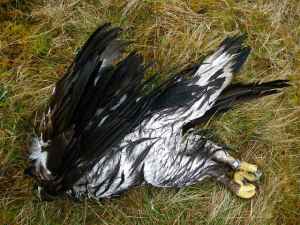
McKellar wasn’t charged in relation to the dead eagle, just for possession of a banned pesticide, to which he pleaded guilty. There’s a lot more to this case than has previously been reported, and once sentencing has finished we’ll have a few things to say.

So what do you think his punishment will be? Six hours on the naughty step?

Yet another dead golden eagle: poisoning suspected, again

The Press and Journal is reporting the following story:
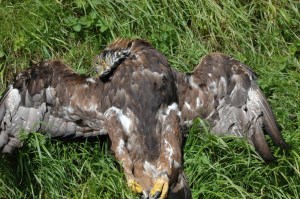
Another dead golden eagle: poisoning suspected.

Poison fears after golden eagle found dead in prime island habitat.

Police are investigating another suspicious golden eagle death- this time in one of the heartlands of the species.

The bird of prey was found at Loch Langabhat on Harris at the end of last month. Scotland’s first year round observatory to allow the public to view golden eagles opened on the island earlier this year.

It is understood that the creature was found by rangers working for the North Harris Trust, which runs the observatory.

The area has one of the highest breeding concentrations of the bird in Europe. About 20 pairs of golden eagles are resident on the island.

A police spokesman said: “We are investigating the death of a golden eagle. Its carcase has been sent for analysis to see if it had been poisoned.”

The same day as the Harris eagle was found, tests confirmed that a golden eagle found dead near Morar in Lochaber had been poisoned.

The Royal Society for the Protection of Birds Scotland said it was the third known poisoning incident in the area in 10 years. Two white tailed sea eagles were previously found poisoned.

The latest death in Lochaber was discovered in March and the results of a post mortem examination have now been released. They show banned pesticides were used.

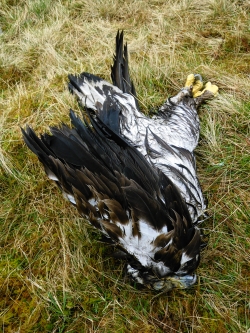
So, if this latest dead golden eagle is found to have been poisoned, it will be the third illegally-killed golden eagle reported in the last three weeks. The first one was the incident we reported on 18 June in the Tayside/Grampian region (see here), which, incidentally, still has not been the subject of a formal press release by either the police or the RSPB. The second one was reported by the RSPB and the police on 28 June and related to a poisoned golden eagle found dead in Lochaber three months earlier (see here) [This is the eagle pictured above].

It seems that ‘someone’ has leaked the story of the Harris dead eagle to the Press and Journal as there doesn’t appear to be any formal press release on any of the other news sites or the Northern Constabulary website. Well done to whoever alerted the P&J. We’ll await the SASA lab tests with interest. It’s quite possible of course that this eagle hasn’t been poisoned, although pesticide-poisoned birds generally exhibit diagnostic signs (like clenched feet and dead insects on the body) – signs with which investigators will be very familiar.

North Harris Eagle Observatory webpage here

Pick a number, any number

It seems to be the in thing to do….pick a random number, insert the name of an animal (e.g. pigeon, lamb, pheasant, grouse) and then insert the name of a predator (e.g. buzzard, sea eagle, peregrine, sparrowhawk, golden eagle) and bingo! You have a totally unsubstantiated ‘fact’ about the effect of raptor predation that can be used to further demonise birds of prey.

Following hot on the heels of Alex Hogg’s flawed mathematical equation on buzzard predation on his estate (see here), an Aberdeenshire farmer is claiming that golden eagles were responsible for 180 missing lambs [presumably on her farm] this year alone (see here). To support her claim, she posted a video on YouTube under the heading ‘Golden eagle attacking ewe and lamb’. What the video actually shows is a young golden eagle taking a curious look at a lamb and ewe – not exactly what you’d call evidence of an eagle attack! (See video here).

Of course this isn’t the first time, nor will it be the last, that  farmers blame eagles for killing absurd numbers of lambs. In 2010 SNH completed a costly study (at the taxpayer’s expense) to investigate the effect of white-tailed eagle predation on lambs. This followed claims by local crofters that the eagles were consuming ‘200 lambs’ per year in Gairloch. Unsurprisingly, the scientific study found differently (see here).

The question of raptor ‘attacks’ was recently raised in the Scottish Parliament by Alex Johnstone MSP (who happens to be the local MSP of the Aberdeenshire farmer mentioned above). Johnstone wanted to know how farmers might be compensated for ‘what I believe are increasing losses’ [from raptor attacks]. Environment Minister Stewart Stevenson responded by saying that any potential action would need to be ‘evidence-based’. Well said that man. Video footage of the parliamentary question & answer here.

Golden eagle poisoned in Lochaber

A golden eagle is poisoned with banned pesticides in Lochaber and the police/RSPB wait for three months before appealing for information. What’s the point? Can anyone explain the purpose of this delay? Even the Scotsman comments on it (here). Can anyone think of another type of crime where these reporting delays are common?

RSPB press release here

Please note: this dead golden eagle is not the same dead golden eagle we reported on the 18 June (see here). We’re still waiting for an official press release about that one. But anyway, that’s two known illegally-killed golden eagles reported in the space of 10 days, and we understand that at least two others have been ‘missing’ since May, according to their sat tag data. Looks like we’re going to have to update our dead eagle page (here).

What aren’t they telling us and why aren’t they telling us?

It seems blogger Alan Tilmouth was much more astute than us. Last week we blogged about Alan’s FoI to DEFRA to find out which Northumberland shoots were set to host the DEFRA buzzard ‘study’. DEFRA wrote back to Alan to ask whether he still wanted to proceed with his FoI even though the ‘study’ had now been cancelled. Alan saw this as a ‘concealment’ attempt by DEFRA – we saw it as just a delaying tactic (see here). We were wrong!

DEFRA has now written to Alan again, this time to tell him that yes, they hold the information he requested but no, they aren’t going to reveal it for ‘public safety’ reasons!!! See Alan’s blog here for their full statement.

Public safety my arse! Does anyone else smell the rancid odour of a cover up? Time to write to the Information Commissioner, Alan!

It seems DEFRA aren’t very good at responding to FoI requests, especially those relating to the game-shooting industry. Mark Avery has also been having trouble getting DEFRA to respond to his FoIs about Walshaw grouse moor (see here).

Talking of cover ups, still no official word from Tayside Police, Grampian Police or the RSPB on that dead golden eagle that we reported on Monday (see here). Hmmm…