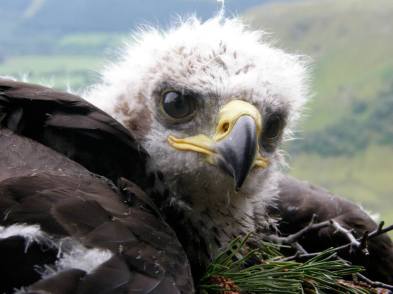
Environment Minister dismisses calls for more action against raptor killers

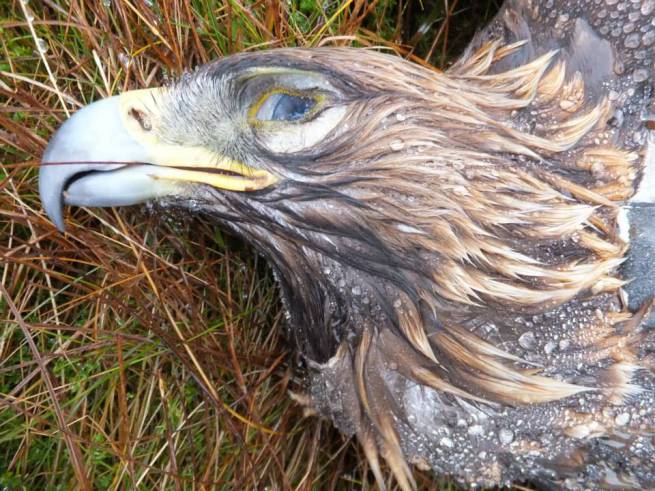
Fearnan Angus Glens Dec 2013Over recent weeks we’ve blogged about the increased calls on the Scottish Government to do more in the fight against raptor persecution.

First there were the hundreds of emails sent by the general public following the discovery of poisoned golden eagle Fearnan, found dead on an Angus grouse moor in December (see here). This was followed by a parliamentary motion condemning the illegal killing of birds of prey in Scotland (see here), closely followed with an amendment calling for sufficient resources to tackle raptor persecution and a review of game management legislation to assess whether further measures could be introduced (see here). Shortly afterwards came calls from the RSPB, the Scottish Raptor Study Group and the Scottish Ornithologists’ Club for estate licensing to be introduced (see here and here).

This was a prime opportunity for our Environment Minister, Paul Wheelhouse, to take advantage of such overwhelming public backing and really put his money where his mouth is. Instead, we got this, his generic response sent out by his aide towards the end of January:

Dear Sir or Madam,

Thank you for your recent letter to the Minister for Environment and Climate Change, Mr Paul Wheelhouse. I have been asked to respond.

Mr Wheelhouse was appalled to hear that the young golden eagle Fearnan had been illegally poisoned in Angus. This was particularly disappointing coming as it did at the end of the Year of Natural Scotland, which had seen the golden eagle voted as Scotland’s favourite of the ‘Big Five’ species in an exercise conducted by Scottish Natural Heritage. While it is entirely understandable that there is a strong public interest in knowing more about the case, the Minister hopes you will understand that as there is a live and ongoing police investigation, it would be inappropriate for Scottish Ministers to comment further.

Clearly this has focused the attention of all who care about our wildlife on raptor persecution issues more generally. In recent years we have made some progress in reducing the number of raptor poisonings – down to three in 2012, but at the time of publication the Minister made it abundantly clear there would be no room for complacency, given the risk of a change to other forms of persecution. However, while the final numbers for 2013 have not yet been published, it does appear that there was an increase in confirmed poisonings. There were also a number of illegal shooting and trapping incidents involving raptors last year.

Mr Wheelhouse believes that these crimes have only served to reinforce the need for the new measures he announced in July 2013. These new measures were:

  • Scottish Natural Heritage to restrict the use of General Licences on holdings of land where there is reason to believe that wildlife crime has taken place. The 2014 General Licenses now contain an enabling paragraph making it clear to users that SNH can act where they believe it is appropriate to do so.
  • A review of the penalties associated with wildlife crime. The aim here is to ensure that the penalties for these offences are an adequate deterrent and that they properly reflect the damage that can be caused to ecosystems. The Minister will shortly announce further detail on the nature and scope of this review.
  • To encourage the use of the full range of investigative techniques at their disposal by Police Scotland, to identify and bring to justice the criminals responsible for wildlife crimes in Scotland, a measure fully and publicly supported by the Lord Advocate. A number of meetings have taken place involving the Lord Advocate in ensuring this is delivered.

Tackling raptor persecution remains a key priority for the Scottish Government and we will monitor the impact of these new measures. We believe there is a strong legal framework in place in Scotland. The key now to defeating wildlife crime is effective and robust enforcement action and we will work hard to ensure support and encouragement for those involved in law enforcement to put an end to this blight on Scotland’s reputation. Yours sincerely,

Karen Hunter

Wildlife Crime Policy Officer

Paul-Wheelhouse-MSP So here we have a situation where the Minister actually admits that the measures are not working (he acknowledges an increase in the reported poisoning figures from 2012-2013) but claims ‘we have made some progress’. Let’s just be clear – no, we haven’t made any progress. Raptor persecution continues on land used for game-shooting, just as it has for decades, and most of the criminals are still getting away with it without any fear of being prosecuted, with just a handful of exceptions. How that can be dressed up as ‘progress’ is unfathomable.

Wheelhouse still claims that the latest measures need to be given time to take effect (see here for his comments to the BBC two weeks ago). One of the measures he’s talking about is the introduction of vicarious liability. VL was introduced from 1st January 2012 – that’s more than two years ago – and still there hasn’t been a single prosecution. A more recent measure is one he suggested last July that has just come in to effect (as of Jan 1st) – the power given to SNH to restrict the use of general licenses on land where they suspect illegal persecution has taken place. Can anyone actually see landowner-loving SNH enforcing this restriction? Time will tell – and given that we’ve already had the first reported illegal poisoning incident this year (see here) it’ll be a good test. We’re not holding our breath.

For how much longer does Wheelhouse expect us to stand by and watch as our raptors are poisoned, trapped, shot and bludgeoned to death while he’s still dicking around saying ‘we need more time, more time’? Conveniently, he hasn’t actually stipulated a time frame.

We don’t need more time at all. NOW is the time to get hold of these filthy criminals and he’d find he has the support of thousands of people if only he had the guts to do what he knows is needed.

Ironically, he also told the BBC this: “Robust and effective law enforcement is the next step in the continued efforts made here in Scotland to tackle ongoing crime“.

He knows fine well that the most effective and robust law enforcement will come by increasing the investigatory powers of the SSPCA. We’ve been waiting for three years now for the promised public consultation on this important issue – here’s the timeline:

Feb 2011: The consultation was first suggested by former MSP Peter Peacock as an amendment during the WANE Bill debates. The then Environment Minister Roseanna Cunningham rejected it as an amendment but suggested a consultation was in order.

Sept 2011: Seven months later MSP Elaine Murray lodged a parliamentary motion that further powers for the SSPCA should be considered.

Nov 2011: Elaine Murray MSP formalised the question in a P&Q session and the next Environment Minister, Stewart Stevenson, then promised that the consultation would happen in the first half of 2012.

Sept 2012: 9 months later and nothing had happened so we asked Paul Wheelhouse, as the new Environment Minister, when the consultation would take place. The response, in October 2012, was:

 “The consultation has been delayed by resource pressures but will be brought forward in the near future”.

 July 2013: 10 months later and still no sign so we asked the Environment Minister again. In August 2013, this was the response:

 “We regret that resource pressures did further delay the public consultation on the extension of SSPCA powers. However, I can confirm that the consultation document will be published later this year”.

Sept 2013: At a meeting of the PAW Executive Group, Wheelhouse said this:

The consultation on new powers for the SSPCA will be published in October 2013“.

Jan 2014: In response to one of our blog readers who wrote to the Minister to ask why the consultation had not yet been published:

We very much regret that resource pressures have caused further delays to the consultation to gain views on the extension of SSPCA powers. It will be published in the near future“.

Does anyone still believe that tackling raptor persecution is a Scottish Government ‘key priority’?

The SOC joins call for game-shooting regulation

soc-logoColourThe Scottish Ornithologists’ Club (SOC) has joined the voices rising against raptor persecution in Scotland. In a significant move, the President of the SOC has written to Environment Minister Paul Wheelhouse about the continuing levels of crime against raptors, despite all the ‘new measures’ designed to combat the killing, and has asked him to consider introducing further measures to regulate the game-shooting industry. Read his letter here. Why is this significant? Well, the SOC is a long-established organisation, well known and respected for its long-term bird monitoring activities and publications and for keeping its own counsel. It is not an organisation known for political campaigning on conservation policies.

The catalyst for change? The same catalyst that triggered similar recent moves by the RSPB, various MSPs, the Scottish Raptor Study Group, and hundreds of members of the public who wrote to the Minister over the Xmas period – the illegal poisoning of golden eagle Fearnan, found dead on a grouse moor in December. But not just the death of Fearnan – the SOC has recognised the other persecution incidents recorded during 2013, referring to them as ‘the catalogue of appalling wildlife crimes against birds of prey’. Indeed.

Last week we said we’d be blogging about the Minister’s response to all these calls for stronger action – that blog is coming shortly….

Does this bird remind you of the Nazis?

Fearnan2This isn’t a spoof, although you would be forgiven for thinking it was.
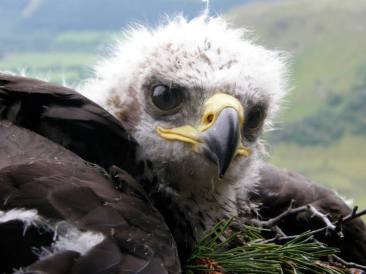
A Tory MSP today attacked the RSPB’s petition to have the golden eagle formally recognised as our national bird because apparently this species is symbolic of the Nazis.

You really couldn’t make this up.

When Duncan Orr-Ewing (RSPB Scotland) and wildlife cameraman Gordon Buchanan were preparing for possible questions at today’s petition hearing at Holyrood, they probably never envisaged such a bizarre, aggressive and frankly absurd attack from Jackson Carlaw MSP, a member of the Public Petitions Committee. They handled it remarkably well.

Carlaw, who bears a striking similarity to Jim Davidson in more ways than one, is a member of the Scottish Conservative and Unionist Party, representing West Scotland (see here).

We’re still waiting for the video of today’s proceedings to be published but when it is, we’ll add a link here so you can watch it yourself.

Meanwhile, just google ‘Jackson Carlaw eagle’ to get a flavour of how the press are reporting it.

The petition itself will now lead to a public consultation in due course.

UPDATE 29th JANUARY 2014: THE VIDEO IS NOW AVAILABLE TO WATCH FOR ONE MONTH. VIEW IT HERE!

Golden eagle as Scotland’s national bird: petition hearing today

Fearnan2Back in November 2013, the golden eagle was voted the nation’s favourite wild animal by a landslide majority (see here).

Shortly afterwards, RSPB Scotland launched an on-line petition to have the golden eagle formally recognised as Scotland’s national bird (see here).

The petition (#PE01500) collected 1,836 signatures and was lodged with the Scottish Parliament on 7th December 2013 (see here).

Today, the Scottish Parliament’s Public Petitions Committee will take evidence in support of the petition from RSPB Scotland and from wildlife cameraman Gordon Buchanan.

You can watch these proceedings live on Scottish Parliament TV at 09.30hrs by clicking this link.

For those of you unable to watch the live proceedings, we’ll add a link to the archive video when it becomes available (usually within 24 hours of being filmed). This archive video will be available to view for one month. Check back to this post later to find the link.

Photo: Golden eagle Fearnan before he left the safety of his nest. Found poisoned on a grouse moor before reaching his 3rd birthday and a week before this petition was submitted to parliament. Photo by Keith Brockie.

UPDATE 29th JANUARY 2014: See here to find out what happened during this hearing. Unbelievable!

Environment Minister faces more calls for grouse shoot licences

SRSGWell now this is interesting.

The Scottish Raptor Study Group (SRSG) has called for the Scottish Government to introduce grouse-shooting licences. Many of us have been asking for this action for some time, but to hear it from the SRSG is quite something.

The SRSG, which has been monitoring raptor populations in Scotland since the 1980s, is typically quite a restrained yet highly respected organisation, preferring to work quietly behind the scenes rather than make bold policy statements. You know that things are pretty dire when the SRSG is calling for grouse shooting licencing.

So what’s forced their hand? Well, if you read their letter to the Environment Minister (see here, scroll down to 18th January), it seems that the illegal poisoning of golden eagle Fearnan was the catalyst, as it has been for so many of us. But there’s more to it than that…

Take a closer look at their letter. They refer to a claim made by the Scottish Gamekeepers Association last July that gamekeepers are good for golden eagle conservation. We blogged about that claim here, and you really should read it to understand the context of what the SRSG is saying.

The SGA published a map that attempted to portray the notion that golden eagles were doing ok on keepered grouse moors in the East and Central Highlands (notorious raptor black spots). What the SRSG has done is provide some much-needed context to that map.

According to the SGA, there are ‘at least 55 active golden eagle nests’ in these ‘keepered grouse areas’; the SRSG is saying that there are 52 ‘active nests’ in the area, and of those 52, only 8 are on driven grouse moors. Crucially, the SRSG also includes information about the vacant golden eagle territories in the area – information that the SGA conveniently ‘forgot’ to include. According to the SRSG, there are an additional 57 ‘non-active’ golden eagle nests in this area, and 31 of them (54%) happen to be on driven grouse moors.

Hmm. The picture doesn’t look quite so rosy now, does it?

What also impressed us about the SRSG’s letter is their well-thought-out approach to licensing. They haven’t taken the usual route of calling for a blanket ‘estate-licensing’ system. Instead, they’ve proposed a system whereby the licensing would cover individuals as well as land-holdings (estates), thus side-stepping the predictable ploys that would probably be used by the grouse-shooting industry to avoid being licensed.

The BBC has covered this news story today (see here), and it looks like the RSPB has also called on the government to consider further sanctions.

The pressure is mounting.

Naturally, the SGA and Scottish Land & Estates (SLE) have responded against the proposed licensing sanctions (read the BBC article). Predictably, SLE claim that raptor persecution is in ‘significant decline’ – they are, of course, referring to 2012 figures which did show a drop in reported poisoning figures – and conveniently ignored the 2013 figures which show a 100% increase in poisoning. To be fair, the 2013 ‘official’ figures have not yet been released, but they know fine well what they show and they seem determined to ignore them for as long as possible (i.e. until they’re actually published, which will take place at some point this year).

The SGA meanwhile, suggest that there is ‘perpetual over-regulation’ (of estates) – the truth is somewhat different – game-shooting is probably one of the least regulated industries and what regulation is in place is rarely enforced.

Environment Minister Paul Wheelhouse has responded to the SRSG’s letter and while he hasn’t ruled out licensing, he still seems to be clinging on to previous measures and wanting to give them time to take effect.

We’ll be blogging next week about Mr Wheelhouse’s response to the SRSG’s letter and his response to all those emails he received over Xmas about the death of golden eagle Fearnan. It won’t make for comfortable reading.

MSP wants review of legislation concerning game management

Claire Baker MSPTen days ago we blogged about a new parliamentary motion (see here) that had been lodged by MSP James Dornan, concerning the illegal poisoning of golden eagle Fearnan, found dead on an Angus grouse moor in early December.
Yesterday, an amendment to that motion was made by MSP Claire Baker, calling for sufficient police and COPFS resources to address raptor persecution.

She also called for a review of the laws that cover game management to assess whether further measures could be taken against the criminals within the game management industry.

The original motion, along with the amendment, can be viewed here.

Well done, Claire Baker MSP. Hmm, the first step on the road to estate licensing? It’s long overdue.

Talking of long overdue (although technically he has until 31st Jan so it’s not overdue, it just feels like a very long time), has anyone yet had any response from the Environment Minister regarding the illegal poisoning of golden eagle Fearnan? We understand that hundreds of people bombarded his inbox just before Xmas, and indeed over the Xmas break, following the news of Fearnan’s death (see here). We’re looking forward to hearing what he has to say…or more to the point, what he intends to do.

Fearnan Angus Glens Dec 2013

Farmers taking aim at sea eagles, again

Scottish Farmer eagle eaction call front pageRepresentatives of NFU Scotland are meeting with SNH today in a ‘call for action’ against white-tailed eagles.

They haven’t exactly specified what ‘action’ they want from the government although the words ‘control measures’ are mentioned. These words are the more palatable version of  ‘kill/cull’.

Why do they want sea eagles to be ‘controlled’? Ah, the usual arguments – the sea eagle population is out of control, sea eagles are out-competing golden eagles, sea eagles are eating all the lambs, sea eagles are eating everything else as well as all the lambs, sea eagles might eat a child, sea eagles are ‘impacting’ on the wider biodiversity, sea eagles are eating all the hares, sea eagles are eating all the goats, sea eagles are causing emotional damage…. Oh, and the government’s ‘eagle-damage’ compensation scheme for farmers/crofters just happens to have ended.

The NFU Scotland ‘call for action’ features on the front page of the Scottish Farmer today (see here).

Unfortunately, the article doesn’t include any information about the findings of previous studies looking at the so-called impact of reintroduced sea eagles on lambs (answer = negligible, see here and here).

Nor does it include any reference to two recent scientific studies looking at the presumed competitive effect of white-tailed eagles on neighbouring golden eagles. Both concluded no evidence of effect:

Evans et al. (2010). Comparative nest habitat characteristics of sympatric White-tailed and Golden Eagles in western Scotland. Bird Study 57 (4): 473-482 (read it here).

Whitfield et al. (2013). Breeding season diets of sympatric white-tailed eagles and golden eagles in Scotland: no evidence for competitive effects. Bird Study 60 (1): 67-76 (read it here).

baby-and-eagleOf course, this is just the latest in a long line of alarmist nonsense from both farmers and gamekeepers (who can forget the SGA’s recent claim that sea eagles might eat children – see here!) and then there was this, and perhaps best of all, this.

Not to be deterred by scientific evidence, or even just plain common sense, the editor of the Scottish Farmer, Mr Alasdair Fletcher, has set up a survey to ask whether the sea eagle population should be ‘controlled’ (in his opinion the answer should be ‘yes’). You, too, can take the carefully considered, unbiased survey here!

UPDATE 26th JANUARY 2014 – POLL RESULTS HERE!

Parliamentary motion about poisoned golden eagle Fearnan

Fearnan Angus Glens Dec 2013The Scottish Parliament is taking note of the illegal killing of golden eagle Fearnan, who was found poisoned on an Angus grouse moor in December.

The following parliamentary motion has been lodged:

Motion S4M-08715: James Dornan, Glasgow Cathcart, Scottish National Party, Date Lodged: 07/01/2014

No Place for Wildlife Crime

That the Parliament notes the poisoning of the golden eagle named Fearnan and believes that the killing of birds of prey has no place in modern Scotland; believes that the golden eagle population is of national interest, as demonstrated by a recent poll in which the species was voted the country’s favourite animal; supports efforts by Police Scotland to bring wildlife criminals to justice, and commends the Scottish Government’s commitment to end raptor persecution.

Supported by: Joan McAlpine, Stuart McMillan, Chic Brodie, Adam Ingram, Christina McKelvie, Mike MacKenzie, Bill Kidd, Patrick Harvie, Kenneth Gibson, David Torrance, Aileen McLeod, Colin Keir, John WilsonR, Roderick Campbell, Nigel Don, Dennis Robertson, Liam McArthur, Colin Beattie, Fiona McLeod, John Finnie, Jean Urquhart, Rob Gibson, Richard Lyle, Christine Grahame, Graeme Dey, Maureen Watt, Kevin Stewart, Sandra White, Mark McDonald

What’s significant about this motion is not necessarily that one has been lodged – there was a similar motion lodged in 2012 by Nigel Don MSP following the discovery of the now infamous dead ‘Deeside Eagle’ (see here), with an amendment to that motion made by Claudia Beamish MSP following the shooting of a golden eagle in South Lanarkshire (see here).

James Dornan MSPThe significance of this latest motion is that it’s been lodged by an MSP that doesn’t live in the region where Fearnan was killed and isn’t especially well-known for addressing raptor persecution issues – James Dornan MSP, representing  Glasgow Cathcart. We view this as an important indication that the raptor persecution issue is being brought to the attention of people who may previously have been unaware.

Well done, James Dornan. Let’s see how many more MSPs sign up to support this motion. Has yours signed?

Subtle editing of Angus gamekeeper poison article: at whose request?

Courier originalOn Wednesday we blogged about an article that had appeared in the Courier that morning. The article was all about a retired Angus gamekeeper, Colin Gair, who claimed that gamekeepers were being put under pressure to use poison baits to protect grouse stocks. Here is what we wrote in that blog.

The Courier article seemed to cause quite a stir and was soon being cited all over social media sites like Facebook and Twitter. That’s not surprising – it’s not very often that you get a gamekeeper willing to admit that illegal practices such as poisoning are still taking place so of course, people would be interested in reading about that.

We didn’t think anything more of it until Thursday morning. After reading one of the comments left on our blog it became apparent that the original article in the Courier appeared to have been edited with some material removed and some new material added.

That’s not so unusual – many on-line news articles are edited, often adding new quotes from different sources when they become available; we even do that on our own lowly blog. However, not many news articles are edited in such a radical way as to change the original information into something completely different. Bizarrely, that is exactly what looks like has happened with the Courier article.

After some digging, we have been able to find a cached version of the original Courier article, which was published on-line at 9.07 am on Weds 8th Jan 2014. Here is the text:

Gamekeepers are being put under pressure to use illegal poison to protect grouse stocks, a retired keeper has claimed.

Colin Gair, who worked across a variety of Angus estates during a 50-year career, has hit out at the use of poisoned baits, which claimed the life of a golden eagle in Angus in November.

Fearnan’s death is the latest in a series of incidents — several other eagles and other raptors having been shot, poisoned or trapped on sporting estates.

Mr Gair, 66, claimed the situation in Angus had deteriorated in the past two years and is urging gamekeepers to speak out if they are being asked to use poison.

He said: “Grouse have to be reared naturally on the heather moors, therefore vermin must be controlled, but legally all the keeper can do is trap and shoot.

“If you are a gamekeeper who is a married man with wife and family and the very nature of the job entails living in a tied house, pressure can be applied to you.

“If you are asked by a landowner or the tenant to use poison it is not easy for a keeper to say ‘I refuse to do this’ when his house, job and future might be at risk.”

The Tayside division of Police Scotland said their inquiries into the death of Fearnan are continuing.

Fearnan Angus Glens Dec 2013Now, compare the original version of the Courier article with the edited version that appeared on-line five hours later at 2.07 pm on Weds 8th Jan 2014. Here is the text:

Gamekeepers are being urged to contact police if they are asked by landowners or tenants to use illegal poisons to protect grouse stocks.

Retired keeper Colin Gair made the plea in the wake of the death of the golden eagle Fearnan, which died after being poisoned in Angus in November.

The type of poison used has not been revealed by police, but website Raptor Persecution Scotland, which has been tracking the series of killings in Angus, claim the poison was the illegal pesticide carbofuran.

In the past five and a half years, four eagles, a red kite and seven buzzards have been shot, poisoned or trapped on sporting estates in the Angus glens.

Mr Gair said he didn’t have pressure applied to him to use poison during his career, but was aware of the practice taking place.

He claimed young keepers who are fearful of losing their job could easily be coerced into using poison by unscrupulous tenants.

“I am certain many moors do not use poison, but some do and there are areas of Angus which are regarded as raptor black holes,” he claimed.

“If you are a young keeper with a wife and kids you dare not stick your head above the parapet, but I hope that someone will come forward and report that they have been asked to use poison to police.”

Mr Gair, 66, said the agricultural poisons used would be very difficult to obtain by gamekeepers and speculated that they were more likely to be supplied by corrupt traders to one or two shoot managers before being passed down to keepers.

He added: “Who is the real criminal in the poisoning cases? Is it the keeper who knowingly uses the chemical or is it another person who deliberately buys the chemical and passes it on to keepers with instructions to use it for vermin control?

“With most of these concentrated agricultural chemicals you would just need a few drops on an animal’s carcase and it would be deadly for anything that eats it.”

Tayside Raptor Study Group expert and wildlife artist Keith Brockie has called on the Scottish Government to licence shooting estates, a move Mr Gair said he would not oppose.

However, if licensing did come in, he said there would have to be some “give and take” and that the killing of certain raptors be allowed.

He added: “If gamekeeping and shooting interests are to face a licencing system, then we should be given something in return.”

Anyone with information that could assist police inquiries regarding the death of Fearnan is asked to contact 101, or speak to any officer.

That’s quite a different story being told in the edited version. What struck us the most was the change in the opening paragraph. In the original version, Mr Gair’s claim is crystal clear:

Gamekeepers ARE BEING put under pressure to use illegal poison to protect grouse stocks“.

In the edited version, this claim has been considerably diluted to this:

Gamekeepers are being urged to contact police IF they are asked by landowners or tenants to use illegal poisons to protect grouse stocks“.

Suddenly the article has gone from ‘they are being put under pressure’ to ‘if they are being asked’.

Another  significant change is the removal of Mr Gair’s claim that ‘the situation in Angus has deteriorated in the past two years‘. That statement does not appear in the edited version.

New material in the edited version includes: a reference to this blog, Mr Gair’s claims that he was never asked to poison anything throughout his career, his claim that ‘young keepers could easily be coerced’ [into poisoning], his view that ‘many moors do not use poison’, his view on the ‘difficulty’ of obtaining poisons, the reference to Keith Brockie and Keith Brockie’s view that estate licensing should be on the cards, and Mr Gair’s view of estate licensing.

We are intrigued by the scale of the editing that took place on the original article, and we’re particularly interested in who or what might have prompted such fundamental changes to the original article. Who might not have been happy with the claims made in the original article, that gamekeepers were being pressurised by landowners to use poison to protect grouse stocks? And who might have the power and influence to instruct those editorial changes? Hmmm….

Meanwhile, the landowners’ organisation Scottish Land & Estates has written a letter to the Courier to complain about the [edited] version of the article. Here’s what they had to say:

Sir,

The article by Rob McLaren “Gamekeepers urged to report unscrupulous owners” (January 8) repeats some very dangerous assumptions.  The death of the golden eagle “Fearnan” has been subject to police investigation for over a month and there has been no indication that it resulted from the actions of a gamekeeper or that it was related to grouse moor management. Anything more than was included in the police press release of 19th December is speculation.

The gamekeeper Colin Mair [sic], whose purely personal comments are repeated in the article, admits that he “didn’t have pressure applied to him to use poison during his career” and merely speculates that others might have done. To be quite clear, landowners do not put pressure on gamekeepers to use poison or break the law, indeed any gamekeeper would have full protection of employment legislation if that should happen. In the few cases where gamekeepers have been convicted for using poison to control predators, there has been no indication that they were told by their employers to do so and particularly no evidence that poisons were supplied by shoot managers, as the article alleges.  Since 2011, the already strong laws on employer liability have been tightened further by a “vicarious liability” offence whereby a land owner, manager or employer can be held liable for wild bird offences carried out by another person even if he was not aware of them.  Any estate employing gamekeepers now has to make it doubly clear that no illegal activity can be condoned.

If anyone, including a gamekeeper, has specific evidence as to who was responsible for the death of the golden eagle, it should be reported to the police immediately.  This case needs to be resolved as soon as possible, not least to put an end to speculative comment of the kind repeated in this article.

Tim Baynes

Director, Scottish Land & Estates Moorland Group 

Gamekeepers put under pressure to use poison, claims retired Angus keeper

A retired gamekeeper whose 50-year career included working on Angus sporting estates has claimed that gamekeepers are being put under pressure to use illegal poison to protect grouse stocks, according to an article in today’s Courier (see here).

Colin Gair, 66, says the situation in Angus has deteriorated in the past two years and he is encouraging other gamekeepers to speak out if they are being asked to use poison.

His comments come after the discovery of ‘Fearnan’, the golden eagle found poisoned on a grouse moor in the Angus Glens in December. Fearnan is the latest victim in a long line of alleged poisoning incidents in the area (see here).

Mr Gair deserves a great deal of credit for his willingness to speak out on a subject that is usually vehemently denied by all connected with the game-shooting industry, despite the overwhelming evidence to the contrary, and we applaud his courage.

It’ll be interesting to see whether there’s any response to his claims from certain game- shooting industry organisations that are usually at the forefront of the denials.

UPDATE 10th January 2014: see here