32 eagles, 8 years, 0 prosecutions

In April 2012, we wrote an article called ’21 eagles, 6 years, 0 prosecutions’ (see here).

In September 2012, we updated it and called it ’26 eagles, 6 years, 0 prosecutions’ (see here).

In July 2013 we updated it again. This time, ’27 eagles, 7 years, 0 prosecutions’ (see here).

In December 2013 we had to do another update: ‘31 eagles, 7 years, 0 prosecutions’ (see here).

It’s now April 2014 and another ‘lost’ eagle means another update: ’32 eagles, 8 years, 0 prosecutions’.

28 of these 32 eagles have either been found dead or have ‘disappeared’ on Scottish grouse moors.

This article should provide some context the next time you hear someone (usually from the game-shooting industry or from the government) say that “We’re making real progress in the fight against raptor persecution”. So much ‘progress’ in fact that 24 of these eagles have been lost in the last 4 years. As this shameful list continues to grow, the Environment Minister is still insisting that more time is needed to see whether enforcement measures are working. How many more eagles need to be added to this catalogue of horror before he decides to act?

As before, a number of eagles included in this list (8 of them, to be precise) may not be dead. However, they are included here because their satellite tags unexpectedly stopped functioning (i.e. they’d been transmitting perfectly well up until the eagles’ last known location, often a known persecution hotspot). Two further satellite-tagged eagles (‘Angus’ and ‘Tom’) are not included in this list as although their transmitters stopped functioning, there had been recognisable problems with their tags prior to the final transmissions and so the benefit of the doubt has been applied.

Many of these listed eagles from recent years have only been discovered because the eagles were being satellite-tracked. Much kudos to the dedicated teams of fieldworkers who have put in hours and hours of skilled hard work to allow this to happen. Obviously there are many other eagles out there that have not been sat-tagged and on the balance of probability will have been killed at the hands of the game-shooting industry. 32 eagles in the last 8 years is the bare minimum. The number of prosecutions (zero) is indisputable.

MAY 2006: A dead adult golden eagle was found on the Dinnet & Kinord Estate, near Ballater, Aberdeenshire. Tests revealed it had been poisoned by the illegal pesticide Carbofuran. Grampian Police launched an investigation. Seven years and 11 months later, nobody has been prosecuted.

JUNE 2006: A dead golden eagle was found on Glen Feshie Estate in the Cairngorms. Tests revealed it had been poisoned by the illegal pesticide Carbofuran. Northern Constabulary launched an investigation. Seven years and 10 months later, nobody has been prosecuted.

AUGUST 2007: A dead adult female golden eagle was found on an estate near Peebles in the Borders. She was half of the last known breeding pair of golden eagles in the region. Tests revealed she had been poisoned by the illegal pesticide Carbofuran. Lothian & Borders Police launched an investigation. Six years and 8 months later, nobody has been prosecuted.

NOVEMBER 2007: Tayside Police received a detailed tip-off that a young male white-tailed eagle (known as ‘Bird N’) had allegedly been shot on a grouse moor estate in the Angus Glens. The timing and location included in the tip-off coincided with the timing and location of the last-known radio signal of this bird. Six years and 5 months later, the bird has not been seen again. With no carcass, an investigation isn’t possible.

MAY 2008: A one year old male white-tailed eagle hatched on Mull in 2007 and known as ‘White G’ was found dead on the Glenquoich Estate in the Angus Glens. Tests revealed he had been poisoned by an unusual concoction of pesticides that included Carbofuran, Bendiocarb and Isofenphos. A police search in the area also revealed a poisoned buzzard, a baited mountain hare and 32 pieces of poisoned venison baits placed on top of fence posts on the neighbouring Glenogil Estate. Laboratory tests revealed the baited mountain hare and the 32 poisoned venison baits contained the same unusual concoction of highly toxic chemicals that had killed the white-tailed eagle, ‘White G’. Five years and 11 months later, nobody has been prosecuted.

JUNE 2009: An adult golden eagle was found dead at Glen Orchy, Argyll, close to the West Highland Way. Tests revealed it had been poisoned by the illegal pesticide Carbofuran. Strathclyde Police launched a multi-agency investigation. Three years and 3 months later, estate employee Tom McKellar pled guilty to possession of Carbofuran stored in premises at Auch Estate, Bridge of Orchy and he was fined £1,200. Four years and 10 months on, nobody has been prosecuted for poisoning the golden eagle.

JULY 2009: A two year old female golden eagle known as ‘Alma’ was found dead on the Millden Estate in the Angus Glens. Tests revealed she had been poisoned by the illegal pesticide Carbofuran. Alma was a well-known eagle  – born on the Glen Feshie Estate in 2007, she was being satellite-tracked and her movements followed by the general public on the internet. Tayside Police launched an investigation. Four years and 9 months later, nobody has been prosecuted.

AUGUST 2009: A young white-tailed eagle was found dead on Glenogil Estate in the Angus Glens. Tests revealed it had been poisoned by the illegal pesticide Carbofuran. Tayside Police was criticized in the national press for not releasing a press statement about this incident until January 2010. Four years and 8 months later, nobody has been prosecuted.

MAY 2010: #1 of three dead golden eagles found on or close to Skibo Estate, Sutherland. Tests revealed they had been poisoned; two with Carbofuran and one with Aldicarb. Northern Constabulary launched a multi-agency investigation. One year later (May 2011), Sporting Manager Dean Barr pled guilty to possession of 10.5 kg of Carbofuran stored in premises at Skibo Estate. Three years and 11 months later, nobody has been prosecuted for poisoning this eagle.

MAY 2010: #2 of three dead golden eagles found on or close to Skibo Estate, Sutherland. Tests revealed they had been poisoned; two with Carbofuran and one with Aldicarb. Northern Constabulary launched a multi-agency investigation. One year later (May 2011), Sporting Manager Dean Barr pled guilty to possession of 10.5 kg of Carbofuran stored in premises at Skibo Estate. Three years and 11 months later, nobody has been prosecuted for poisoning this eagle.

MAY 2010: #3 of three dead golden eagles found on or close to Skibo Estate, Sutherland. Tests revealed they had been poisoned; two with Carbofuran and one with Aldicarb. Northern Constabulary launched a multi-agency investigation. One year later (May 2011), Sporting Manager Dean Barr pled guilty to possession of 10.5 kg of Carbofuran stored in premises at Skibo Estate. Three years and 11 months later, nobody has been prosecuted for poisoning this eagle.

JUNE 2010: #1: Leg rings with unique identification numbers that had previously been fitted to the legs of four young golden eagles in nests across Scotland were found in the possession of gamekeeper James Rolfe, during a multi-agency investigation into alleged raptor persecution at Moy Estate, near Inverness. It is not clear how he came to be in possession of the rings. The bodies of the eagles from which the rings had been removed were not found. No further action was taken in relation to the discovery.

JUNE 2010: #2: Leg rings with unique identification numbers that had previously been fitted to the legs of four young golden eagles in nests across Scotland were found in the possession of gamekeeper James Rolfe, during a multi-agency investigation into alleged raptor persecution at Moy Estate, near Inverness. It is not clear how he came to be in possession of the rings. The bodies of the eagles from which the rings had been removed were not found. No further action was taken in relation to the discovery.

JUNE 2010: #3: Leg rings with unique identification numbers that had previously been fitted to the legs of four young golden eagles in nests across Scotland were found in the possession of gamekeeper James Rolfe, during a multi-agency investigation into alleged raptor persecution at Moy Estate, near Inverness. It is not clear how he came to be in possession of the rings. The bodies of the eagles from which the rings had been removed were not found. No further action was taken in relation to the discovery.

JUNE 2010: #4: Leg rings with unique identification numbers that had previously been fitted to the legs of four young golden eagles in nests across Scotland were found in the possession of gamekeeper James Rolfe, during a multi-agency investigation into alleged raptor persecution at Moy Estate, near Inverness. It is not clear how he came to be in possession of the rings. The bodies of the eagles from which the rings had been removed were not found. No further action was taken in relation to the discovery.

JUNE 2010: A golden eagle was found dead on Farr & Kyllachy Estate, Inverness-shire. Tests revealed it had been poisoned by the illegal pesticide Carbofuran. Northern Constabulary apparently did not search the property until July 2011. Three years and 10 months later, nobody has been prosecuted.

JUNE 2010: A white-tailed eagle was found dead on Farr & Kyllachy Estate, Inverness-shire. Tests revealed it had been poisoned by the illegal pesticide Carbofuran. Northern Constabulary apparently did not search the property until July 2011. Three years and 10 months later, nobody has been prosecuted.

DECEMBER 2010: A decomposing carcass of a white-tailed eagle was found and photographed on Logie (Lochindorb) Estate, Morayshire. It was reported to Northern Constabulary. By the time the police arrived to collect it, the carcass had disappeared. The police said they couldn’t investigate further without the body.

FEBRUARY 2011: The signal from a young satellite-tracked golden eagle ( ‘Lee’, hatched in 2010) unexpectedly stopped transmitting after a final signal from the North Angus Glens. A technical malfunction or another mysterious ‘disappearance’?

MARCH 2011: The body of a young golden eagle was discovered on North Glenbuchat Estate, Aberdeenshire. Tests revealed it had been poisoned by the illegal pesticide Carbofuran. Grampian Police launched an investigation and raided the property in May 2011. A poisoned buzzard, a poisoned bait and a shot short-eared owl were found. Three years and 1 month later, nobody has been prosecuted.

APRIL 2011: The body of a white-tailed eagle was found at the base of cliffs on Skye. The person who discovered it (a professional medic) considered it to have been freshly shot with a rifle, decapitated with a sharp implement and thrown from the cliff top. He took photographs and alerted Northern Constabulary and RSPB. There was a delay of two weeks before the now probably decomposed carcass was collected. A post-mortem was inconclusive. This incident was not made public until one year later after a tip off to this blog. Three years later, nobody has been prosecuted.

SEPTEMBER 2011: The signal from a satellite-tracked young golden eagle (‘Strathy’, hatched in 2010) unexpectedly stopped transmitting after a final signal from an Aberdeenshire grouse moor. A technical malfunction or another mysterious ‘disappearance’?

MARCH 2012: The body of a young golden eagle being tracked by satellite was discovered in Lochaber. Tests revealed it had been poisoned with the banned pesticides Aldicarb and Bendiocarb. Information about this incident was not made public until three months later. Two years and 1 month later, nobody has been prosecuted.

MARCH 2012: The signal from a satellite-tracked young golden eagle (‘Angus 26′, hatched in 2011) unexpectedly stopped transmitting after a final signal from a grouse moor in the Angus Glens. This bird’s suspiciously damaged sat tag was found in the area. Two years and 1 month later, nobody has been prosecuted.

MAY 2012: The signal from a young satellite-tracked golden eagle (#32857) unexpectedly stopped transmitting when the bird was north-east of the Cairngorms National Park. A technical malfunction or another mysterious ‘disappearance’?

MAY 2012: The dead body of a young satellite-tracked golden eagle (hatched in 2011) was discovered near a lay-by in Aboyne, Aberdeenshire. The data from its satellite tag & the injuries the bird had when found (2 broken legs) suggested it had been caught in an illegal trap on a grouse moor in the Angus Glens and then removed, under cover of darkness, to be dumped in another area where it was left to die, probably a slow and agonising death. Information on this incident was not released until almost five months later, by the RSPB. It appears the police failed to properly investigate this incident as we understand that no search warrants were issued and no vehicles were searched. One year and 11 months later, nobody has been prosecuted.

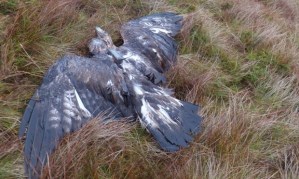
OCTOBER 2012: An adult golden eagle was found shot and critically injured on grouse moor at Buccleuch Estate, near Wanlockhead, South Lanarkshire. The bird was rescued by the SSPCA and underwent surgery but it eventually succumbed to its injuries in April 2013. One year and 6 months later, nobody has been prosecuted.

MAY 2013: The signal from a two-year-old satellite tracked golden eagle (‘Angus 33′, hatched in 2011) unexpectedly stopped transmitting after its last signal from North Glenbuchat Estate in Aberdeenshire. A technical malfunction or another mysterious ‘disappearance’?

JUNE 2013: A dead golden eagle was found under power lines on an RSPB reserve on Oronsay. This bird had been shot although it is not known whether this was the cause of death or an historical injury.

JULY 2013: The signal from a young satellite tracked golden eagle (‘Cullen’, hatched 2010) unexpectedly stopped transmitting after its last signal in Aberdeenshire. A technical malfunction or another mysterious ‘disappearance’?

DECEMBER 2013: A two year old satellite tracked golden eagle (‘Fearnan’) was found dead on a grouse moor in the Angus Glens. Tests revealed he had been poisoned with the banned pesticide Carbofuran. Four months later, we are not aware of any pending prosecutions.

APRIL 2014: The signal from a young satellite tracked white-tailed eagle (the first fledged sea eagle chick in East Scotland in ~200 years) unexpectedly stopped transmitting after its last signal from the North Glenbuchat Estate in Aberdeenshire. Police raided the property a couple of weeks later. We are not aware of any pending prosecutions.

THE UNTOUCHABLES: 32; JUSTICE: 0

Wanlock Head GE Oct 2012

Behind the scenes with the poisons forensics team at SASA

There’s an interesting article published today by the BBC, looking at the behind-the-scenes work of the poisons forensics team in Scotland.

The government’s Science and Advice for Scottish Agriculture (SASA) team is the one that detects poisons in the carcasses of raptors (and other species) and identifies the type of poison which has killed the bird.

This is a highly-specialised field and the SASA team’s work is well-respected by both sides of the poisoning issue  – conservationists and the game-shooting industry alike. Their work forms the basis for the government’s annual ‘poisoning maps of shame’, which depict confirmed poisoning incidents (but still inexplicably exclude the locations of confirmed poisoned baits).

The BBC article can be read here.

The last sentence is interesting: “But visitors can, at least, be assured that the team of scientists here are doing all they can to help the police secure convictions in cases of raptor persecution“. Unfortunately, despite the expert toxicology results provided by SASA, very few convictions are secured against those who poison our birds. Even when SASA has managed to identify the poison, and the same poison is found in the possession of a suspect, the resulting prosecution is usually (with a handful of exceptions) for the lesser offence of ‘possession’ [of a banned poison], as opposed to the offence of actually poisoning a protected species.

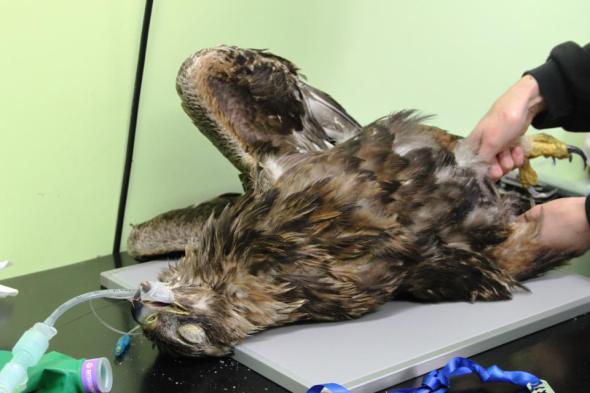
The BBC article is illustrated with an image of a dead golden eagle on the post-mortem table. To date, there has not been a single conviction for the illegal poisoning (nor shooting or trapping) of an eagle in Scotland. Our current figures show 31 eagles, 7 years, 0 prosecutions (see here).

SASA ge

Raptor poisoning incidents doubled in 2013

The Partnership for Action against Wildlife Crime (PAW Scotland) has published the latest ‘official’ maps showing the distribution of reported raptor persecution incidents in Scotland during 2013.

Remember 2013? That was the government’s much heralded Year of Natural Scotland.

How disgraceful then, to see that reported incidents of raptor poisoning in 2013 doubled from the previous year. The victims this time around included a golden eagle, a red kite and four buzzards. And these were just the ones that were discovered – how many went undiscovered?

Not only did the reported poisoning incidents double, but other methods of illegal persecution were also reported, including disturbance, nest destruction, shooting and trapping, and these incidents numbered nearly three times the number of reported poisoning incidents.

It is clear, once again, that despite all the claims to the contrary, the illegal persecution of birds of prey in Scotland is still taking place with impunity. This has been vividly illustrated by the unfolding news from Ross-shire this week that at least 11 raptors have been found dead, including at least 8 red kites, all strongly suspected to be the victims of illegal poisoning. We fully expect this figure to rise…

This year, for the first time, the maps are now not just restricted to showing reported poisoning incidents; also included are the other types of persecution. This approach has to be applauded, especially as there is a real concern that the raptor killers are changing tactics in an attempt to show that the game-shooting industry is cleaning up its act (i.e. if they can keep poisoning figures low, they can point to this as an indication that persecution is dropping because they know that poisoning is the only method that is regularly mapped and monitored). Not any more, so well done to the Environment Minister for ensuring the other methods are also now ‘officially’ mapped and monitored.

However, the new and improved maps are still not showing the full picture.

For example, the recorded incidents shown on the new maps are limited to those where a dead or dying raptor has also been discovered:

The maps DO NOT show incidents where other birds/animals have been found poisoned with banned substances that have been categorised by SASA as ‘abuse’. Why not?

The maps DO NOT show incidents where an illegally-set trap has been found without an injured or dead raptor in/on it. Why not?

The maps DO NOT show the locations where satellite-tracked raptors have ‘mysteriously disappeared’ without trace. Why not?

But most significantly of all, the maps DO NOT show incidents where poisoned baits have been discovered, and have been categorised by SASA as ‘abuse’, unless a poisoned raptor was also found at the scene. Why not?

In our view, this is the most serious of all the omissions. The Scottish Government explains this away by saying that if there isn’t a dead/dying raptor at the scene then the discovery of poisoned baits can’t be classified as ‘raptor persecution’. Eh? Everybody knows that these poisons are routinely used to target birds of prey. To deliberately leave them off these poisoning maps is astonishing. In whose interest is it to exclude these incidents?

A good example of this sort of incident came last year when a massive stash of pre-prepared poisoned baits was found inside two game bags in woodland next to a grouse moor on Leadhills estate. Leadhills has a long and sorry history of poisoned baits and poisoned raptors having been found there, dating back several decades. A Leadhills gamekeeper was convicted in 2010 for er, laying out a poisoned bait on the moor. There were 36 baits in total in the 2013 stash; chopped up into bite-size pieces and sprinkled with Carbofuran. What on earth does the Government think those baits were going to be used for if not for poisoning raptors?

We think this particular stash of pre-prepared poisoned baits is the largest ever discovered in Scotland. The Leadhills baits are not included in the latest maps. Why? Because no poisoned raptors were found at the scene. Probably because the police failed to conduct any level of search when they turned up, in marked vehicles, to collect the baits.

If we, the BBC and Project Raptor had not reported on that incident, nobody would be any the wiser to it today. The police failed to issue a press release and now we find that the incident has been excluded from the ‘official’ poisoning maps. There’s now no doubt at all that the incident will also be excluded from the Scottish Government’s ‘official’ raptor persecution report that they’ll publish later this year.

‘Discovery of a massive stash of poisoned baits on a sporting estate? Where? When? Nope, we can’t find it in the ‘official’ statistics, you must be mistaken, it can’t have happened’.

Compare this approach with that used by the government/police to report on drug seizures. They regularly report on the recovery of big stashes of heroin, whether the heroin has actually found its way onto the street or not. They don’t say, ‘Oh, we can’t include that in our official stats because we didn’t find a junkie laying next to the stash”, do they? No, it all gets recorded as part of their official drug crimes statistics. What’s so different about the discovery of big stashes of banned poisons that are known to be used to illegally target birds of prey?

So, all in all then, situation normal in Scotland. Reported poisoning incidents have doubled from the previous year, other methods of killing raptors are being utilised with disturbing regularity, the game-shooting industry is still trying to spin the story into something positive (Doug McAdam is quoted in the Scotsman article as saying: ‘Good progress has been made on reducing illegal poisoning incidents’!!), the Scottish Government is still trying to spin the story into something positive (by comparing the 2013 figures with  figures from 2009 [the highest reported poisoning figures in 20 years] rather than focusing on the doubling of reported incidents from 2012 to 2013) and the ‘official’ statistics are still not showing the full scale of the problem.

See you all same place, same time, next year, when, judging by the recent Ross-shire news, once again we’ll be reporting that raptor poisoning incidents have increased over the last year. The only surprise will be by how much.

To view the ‘official’ maps on the PAW Scotland website see here.

Article in the Scotsman ‘Birds of prey spared poison – to be stamped to death’ – see here.

Article on BBC website ‘Number of birds of prey poisoned in Scotland doubles’ – see here.

Article on STV news ‘Rise in number of birds of prey illegally poisoned ‘very worrying” – see here.

Correspondence between SLE and Scot Gov re: poisoned eagle Fearnan

McAdam 2A freedom of information request has revealed some interesting correspondence between Doug McAdam, the CEO of the landowners’ organisation Scottish Land and Estates, and Paul Wheelhouse, the Scottish Environment Minister, on the subject of ‘Fearnan‘, the poisoned golden eagle found dead on a grouse moor in the Angus Glens in December 2013.
McAdam wrote to the Minister in January, setting out SLE’s “total condemnation” of the poisoning incident. He went on to say that SLE members in the area where Fearnan’s corpse was found were “perhaps more keen than anyone” that the culprit was found and prosecuted. He assured the Minister that these landowners had conducted their own enquiries and were sure that none of their staff were involved. He said that gamekeepers were “helping the police in all aspects of the investigation” (presumably this doesn’t mean giving a “no comment” response to any questions they are asked, as recommended by official SGA policy!). McAdam also emphasised how the introduction of vicarious liability had had an impact on best practice sporting management and besides, that gamekeepers love golden eagles, so much so that plans were under way to initiate ‘a golden eagle monitoring or conservation project’ in the Angus Glens.

You can read his letter here: SLE letter to Wheelhouse re Fearnan Jan 2014

Environment Minister Paul Wheelhouse, to his credit, wasn’t convinced.

In what we would call a fairly robust response, Wheelhouse told McAdam that he was going to be frank with him. He pointed out that the illegal poisoning of Fearnan was just one of “a catalogue of incidents associated with the Angus Glens area“. He went on: “I understand in fact that there has been something like a dozen incidents in this area since 2008“. [We actually know of at least 26 incidents since 2008, (36 if you go back to 2004) and we also know that several others have never been publicised: see here].

Wheelhouse continued: “In the absence of any other credible explanation, I can only conclude that, despite all our efforts, there remains an element of sporting managers and owners who continue to flout the law and defy public opinion for their own selfish ends…”.

He also pointed out that any carcasses or baits that were discovered were probably representative of “only a fraction” of those put out by the criminals (in other words, he agrees with the long-held view that what is discovered is just the tip of a very large iceberg).

He warned McAdam that if persecution didn’t stop he would be put under increasing pressure to impose further measures and he suggested that the game-shooting industry would do well to stop issuing media statements of condemnation [about persecution] that give the impression of being defensive and resentful.

You can read his letter here: Wheelhouse response to SLE Fearnan letter Feb 2014

We were quite pleased with Wheelhouse’s response – a definite baring of the teeth – but as we’ve often said, it’s his actions that count, not just words. We’re waiting to see whether he can bite.

It’s interesting that he hasn’t yet made a public comment about the discovery of those five red kites and one buzzard that was all over the news yesterday, suspected to have been poisoned. We understand the death toll has since risen but more on that later. We’ll be watching with very close interest to see whether SNH will now enforce the new enabling clause to restrict the use of General Licences on the land where these corpses were found. A conviction is not required for them to exercise this new clause; SNH must just have ‘reason to believe that wild birds have been taken or killed by such persons and/or on such land other than in accordance with the general licence’ (see here).

Shooting Times publishes astonishing denials about eagle persecution on grouse moors

Eagle eyed keepers shooting times March 2014Talking of very, very stupid people….

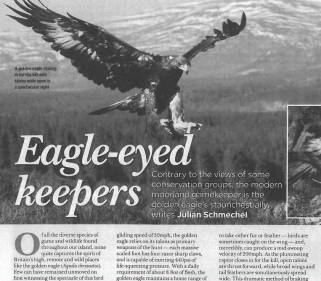
An article has appeared in the latest edition of the Shooting Times & Countryside Magazine that once again repeats the ludicrous notion that gamekeepers on Scottish grouse moors are a force for good as far as eagle conservation goes, and suggests that accusations to the contrary are ‘unfair’.

We’ve provided a PDF of the article here: Eagle-eyed keepers Shooting Times March 2014

Really? How many times do we have to go over this? The evidence is there for all to see. These continuous denials just serve to further entrench positions and frankly make a laughing stock of those pumping out this clearly inaccurate guff.

So, let’s lay out the facts once again for the benefit of those new to the issue.

Scotland’s golden eagle population is not ‘stable’. On a superficial level it appears to be stable, but the overall population figure (estimated at ~430 pairs, give or take a few) masks some very big differences in regional abundance. For example, there has been a substantial increase of golden eagles in the Western Isles over the last ~20 years, largely thanks to a reduction in illegal persecution in that region. In contrast, there has been a significant decrease in the number of golden eagles in the central, eastern and southern uplands (hence all those vacant territories), thanks largely to illegal persecution on driven grouse moors. That is a fact, backed up by a suite of scientific peer-reviewed studies. That’s why the population appears to be ‘stable’ – because all the losses in the east are being counterbalanced by the gains in the west. We’ve blogged about this in greater detail here.

posioned GE Lethnot 2013The golden eagle in Scotland does face a variety of threats or potential threats, including afforestation and the construction of wind farms. We don’t dispute that. However, the main scientific report on this issue has shown that the single biggest threat to golden eagles in Scotland is illegal persecution on driven grouse moors. That is a fact, backed up by scientific peer-reviewed evidence (see link above).
The article says: “Unfortunately, even in recent times, a handful of Scottish golden eagles have been found dead as a result of poisoning“. What the article fails to say is that the majority of those poisoned birds have been found on driven grouse moors. And not only poisoned, but shot and trapped as well. In addition, plenty of satellite-tagged golden eagles have ‘disappeared’ – unsurprisingly their last signals emitted from driven grouse moors. Oh, and it’s more than ‘a handful’. Our latest count is 31 eagles in 7 years, either illegally persecuted or mysteriously ‘disappeared’, with the majority of them on driven grouse moors (see here). And those are only the birds we know about because the majority of them were wearing satellite tags. How many more are being killed that we don’t know about? Plenty more if you look at the population figures and the rather telling ‘gaps’ in distribution.

The article says it is “unfortunate and unfair” to blame sporting estates when these illegally-killed eagles are discovered on, er, grouse moors. It is neither unfortunate nor unfair. The blame is fairly and squarely put at the feet of those involved with grouse moor management based on decades of scientific evidence. The link between driven grouse moors and raptor persecution (not just of eagles but of several raptor species) has been clearly established as this suite of scientific papers demonstrates (see here for a recent blog on this).

The article cites the SGA’s recent claims of ’55 active eagle nests on keepered grouse moors in eastern and central Scotland’ as evidence that golden eagles are doing just fine on driven grouse moors. We blogged about that claim here. We also blogged about the Scottish Raptor Study Group’s research into that claim (see here). Here’s part of what we wrote:

According to the SGA, there are ‘at least 55 active golden eagle nests’ in these ‘keepered grouse areas’; the SRSG is saying that there are 52 ‘active nests’ in the area, and of those 52, only 8 are on driven grouse moors. Crucially, the SRSG also includes information about the vacant golden eagle territories in the area – information that the SGA conveniently ‘forgot’ to include. According to the SRSG, there are an additional 57 ‘non-active’ golden eagle nests in this area, and 31 of them (54%) happen to be on driven grouse moors.

Hmm. The picture doesn’t look quite so rosy now, does it?”

GE conservation status 2003The article goes on: “It is interesting to note that eagle numbers are highest in eastern Scotland, where grouse moors are actively managed“. Er, no, they’re not. Try looking at the scientific data (see here especially) and pay particular attention to territory occupancy rates:

Western Isles = 91%

Western Highlands = 89.5%

Argyll West & Islands = 81.5%

Central Highlands = 48%

Cairngorms Massif = 42.4%

North East Glens = 17.6%

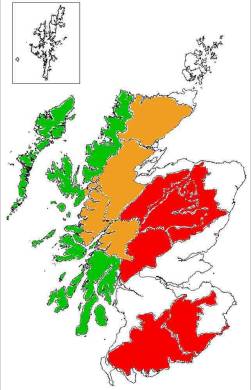
Also pay particular attention to the map which shows the species’ conservation status across Scotland. You’ll find that the golden eagle only has favourable conservation status (green colour on the map) in three of sixteen regions, and those three regions are nowhere near the driven grouse moors of the eastern and central uplands.

This incredible article finishes with this: “The fact remains, however, that far from being the purveyor of poison and pole traps – so often portrayed in the popular press – the 21st century moorland keeper is probably the golden eagle’s staunchest ally“. Aye, right.

You carry on chucking out this fantastical image of the raptor-friendly moorland keeper and we’ll keep publishing the facts which show that the majority of them are anything but.

Wildlife protection laws have had little impact on driven grouse moors

Fearnan Angus Glens Dec 2013There’s an excellent article in the Scotsman today, written by Duncan Orr-Ewing, Head of Species and Land Management at RSPB Scotland.

He discusses the failure of wildlife protection laws to aid the recovery of several raptor species, including the hen harrier, golden eagle, red kite and peregrine, on land managed for driven grouse shooting.

Read the article here.

On a related issue, Mark Avery’s blog today is all about the e-petition for the licensing of grouse moors and gamekeepers (which ends today) – and hints at the growing frustration of those who have been relying on the authorities to ‘sort out’ the illegal persecution of raptors on driven grouse moors. There’s a particularly pertinent comment from Pete Cosgrove:

Has anyone assessed what other criminal enterprises get ignored by Government in this kind of way?

There’s a definite ‘something’ in the air…


SNH refuses to recommend golden eagle as national bird

Fearnan2Last month, the Scottish Parliament’s Public Petitions Committee took oral evidence on the petition to designate the golden eagle as Scotland’s National Bird.

Evidence in support of the petition was provided by Duncan Orr-Ewing (RSPB Scotland) and wildlife cameraman Gordon Buchanan. The hearing descended into farce when Tory MSP committee member Jackson Carlaw suggested that the eagle was an unsuitable candidate as it was symbolic of the Nazi regime (see our blog here).

The hearing was available to watch on Scottish Parliament TV but for those who missed it, you can read the official report here: Public Petitions Committee official report 28 Jan 2014

The hearing ended with the Petitions Committee agreeing to seek written advice from key organisations including the Scottish Raptor Study Group and SNH.

That written advice has now been submitted.

SNH advice: SNH response to petition 1500 Feb 19 2014

SRSG advice: SRSG response to petition 1500 Feb 23 2014

SNH, the Government’s statutory conservation agency, has refused to recommend the golden eagle to be Scotland’s National Bird. They say it is a contender, but suggest that other species are also worthy of consideration, such as the Scottish crossbill, crested tit, various sea birds, golden plover, curlew, osprey, white-tailed eagle, and wait for it….the red grouse.

Yeah, brilliant suggestion – let’s have the red grouse, a species that is intensively managed on an industrial scale (kept at artificially high densities and repeatedly dosed with toxic medications) across wide swathes of the Central, Eastern and Southern uplands at the expense of every predator with teeth, claws or a hooked beak. Predators that are ruthlessly and systematically killed, both legally and illegally, just so some grouse moor owner can impress his cronies with a large ‘bag’ of dead red grouse.

In stark comparison, the Scottish Raptor Study Group expressly supports the designation of the golden eagle as Scotland’s National Bird and makes clear that this designation would go some way to reducing the current illegal persecution of this species.

SNH (who quite tellingly didn’t once mention persecution in their response) has missed an important opportunity to promote the conservation of the golden eagle and send out a clear message to those who continue to poison, trap and shoot this species as part of grouse-management activities. They have actually sent out a message, just not one that’s fitting of a conservation agency that knows, through its own commissioned research, that this species needs all the help it can get.

The next stage of the petition process will likely be a public consultation. We’ll post links in due course.

Photo of young golden eagle ‘Fearnan‘ taken in his Perthshire nest by Keith Brockie. Two years later (Dec 2013) he was found dead on an Angus grouse moor. He had been illegally poisoned.

Link between grouse moors & raptor persecution based on ‘ill-informed rumours’, apparently

Fearnan Angus Glens Dec 2013Last month a letter written by Logan Steele was published in the Scotsman, urging the government to introduce a licensing system for grouse shooting estates (see here).

This came on the back of the news that the Scottish Raptor Study Group and RSPB Scotland had written to the Environment Minister to call for estate licensing (see here) following the discovery of poisoned golden eagle ‘Fearnan’, found dead on an Angus grouse moor in December 2013 – the latest in a very long line of victims.

This month, the Scotsman published a response letter, penned by Tim Baynes, the Director of Scottish Land & Estates Moorland Group (a group chaired by Lord Hopetoun [Leadhills Estate] and comprising moorland owners and representatives of GWCT and the SGA – see here).

It’s perhaps then of little surprise to read the content of Mr Baynes’ letter – read it here. Basically, Mr Baynes is suggesting that Logan Steele’s assertions of a strong link between grouse moor management and the illegal persecution of raptors is ‘probably based on ill-informed rumours’.

GE Cons FrThose ‘ill-informed rumours’ no doubt include the following peer-reviewed scientific publications, some dating back over ten years (so the results have been available for a long time), which have all shown a direct link between driven grouse moor management and raptor persecution (and this list is by no means exhaustive – it’s just the ones we have to hand):

Etheridge et al (1997). The effects of illegal killing and destruction of nests by humans on the population dynamics of the hen harrier in Scotland. Journal Applied Ecology 34: 1081-1105.

Stott (1998). Hen harrier breeding success on English grouse moors. British Birds 91: 107-108.

Green & Etheridge (1999). Breeding success of the hen harrier in relation to the distribution of grouse moors & the red fox. Journal Applied Ecology 36: 472-483.

Whitfield et al (2003). The association of grouse moors in Scotland with the illegal use of poisons to control predators. Biological Conservation 114: 157-163.

Hardey et al (2003). Variation in breeding success of inland peregrine falcon in three regions of Scotland 1991-2000. In Thompson et al [Eds] Birds of Prey in a Changing Environment. SNH.

Whitfield et al (2004). The effects of persecution on age of breeding and territory occupation in golden eagles in Scotland. Biological Conservation 118: 249-259.

Whitfield et al (2004). Modelling the effects of persecution on the population dynamics of golden eagles in Scotland. Biological Conservation 118: 319-333.

Whitfield et al (2007). Factors constraining the distribution of golden eagles in Scotland. Bird Study 54: 199-211.

Whitfield et al (2008). A Conservation Framework for Golden Eagles: Implications for their Conservation & Management in Scotland. SNH.

Summers et al (2010). Changes in hen harrier numbers in relation to grouse moor management. In Thompson et al [Eds] Birds of Prey in a Changing Environment. SNH.

Redpath et al (2010). People and nature in conflict: can we reconcile hen harrier conservation and game management? In Baxter & Galbraith [Eds] Species Management: Challenges and Solutions for the 21st Century. SNH.

Smart et al (2010). Illegal killing slows population recovery of a reintroduced raptor of high conservation concern – the red kite. Biological Conservation 143: 1278-1286.

McMillan (2011). Raptor persecution on a large Perthshire estate: a historical study. Scottish Birds 31: 195-205.

Amar et al (2012). Linking nest histories, remotely sensed land use data and wildlife crime records to explore the impact of grouse moor management on peregrine falcon populations. Biological Conservation 145: 86-94.

Watson (2013). Golden eagle colonisation of grouse moors in north-east Scotland during the Second World War. Scottish Birds 33: 31-33.

Those ‘ill-informed rumours’ must also include all the reported incidents of illegally-killed or illegally-injured birds of prey that have been discovered on grouse moors over the last few decades (see here for a list of reported persecution incidents in the Angus Glens and here for a list of reported persecution incidents in South Lanarkshire).  These lists relate to reported incidents from grouse moors at Glenogil, Invermark, Millden, Airlie and Leadhills but don’t include other grouse moors in other parts of the country where illegally-killed raptors have been discovered, such as Farr & Kyllachy, Moy, Skibo, Cawdor, Corrybrough, Glenbuchat, Cabrach, Raeshaw, Invercauld, Glenlochy, Dinnet & Kinord, Glenfeshie, Dunecht, Strathspey and Glenturret, for example. And again, this list is by no means exhaustive.

Mr Baynes is being disingenuous at best to point to the  fact that two months on from the illegal death of Fearnan there is no evidence to link the crime to anyone on a grouse moor. While his assertion is technically correct, it is not an indication that anyone on a grouse moor was NOT responsible. Viewing one incident in isolation is also misleading – and the results of this police ‘investigation’ are more reflective of ineffective policing than anything else – there are many many examples of this ineptitude and include police actions such as delayed appeals for information (often up to 4-6 months after the discovery of a crime against raptors), issuing cryptic police statements about the type of crime and its location, arriving at scenes of crime in highly visible marked police vehicles instead of a covert entry, and failing to undertake timely follow-up searches of associated land, vehicles and buildings to search for evidence. This police ineptitude, followed by plea bargaining and failures to accept evidence by the Fiscals, means that few of the incidents listed above have resulted in a prosecution (although there are some notable exceptions including convictions of gamekeepers at Skibo, Moy, Dinnet & Kinord, Invercauld and Leadhills).

Added to this mix is the legal advice given to gamekeepers should they find themselves at the centre of a police investigation. This legal advice undoubtedly thwarts any attempt by the police to investigate an alleged raptor persecution crime. This from the SGA to their members:

Accordingly, it is the advice normally given by solicitors to clients that they need make no reply to any allegation and that they should not in fact give any further information than their name, address and date of birth in answer to any police questions“.

This advice is technically correct but is it what the public would expect from an organisation that is purportedly committed to partnership working to stamp out illegal raptor persecution?

We would suggest that Mr Baynes takes some time to read the above peer-reviewed scientific publications that demonstrate a clear and unequivocal link between driven grouse moor management and the illegal persecution of raptors, as well as taking the time to read up on the many reported incidents of raptor persecution on grouse moors, before he writes any more embarrassingly ignorant statements of denial in the national press.

Some comments on that Channel 4 News report

Channel-FourFor those who missed it, the Channel 4 News report on the illegal persecution of raptors on Scottish grouse moors can be watched here for a few days.

First of all, we need to be celebrating that raptor persecution has been featured on a national mainstream TV news channel. What a long way this subject has come. The awareness-raising power of a news report like this should not be underestimated. Since the programme aired four hours ago, we’ve already been contacted by three journalists whose interest has been piqued. Well done Channel 4 News.

There were excellent interviews with Ian Thomson, Head of Investigations at RSPB Scotland, who referred to “an absolute catalogue of illegal killing” over the last few years in the Angus Glens (e.g. see here), and Logan Steele of the Scottish Raptor Study Group, someone who has decades of first-hand experience recording the deaths of illegally-killed raptors in this area and beyond.

But perhaps the best interview was that with Scottish Gamekeepers’ Association Chairman, Alex Hogg. We couldn’t have wished for a better performance. Telling lies on national telly is never a good strategy. Especially when you deny that gamekeepers are involved with the poisoning, shooting and trapping of raptors, knowing full well that there is a public record of gamekeepers who have been convicted for doing just that, as well as committing other wildlife crimes. Here is a quick list of 14 convicted gamekeepers just covering the last two years (full details of each case can be found elsewhere on this blog) –

Jan 2012: Gamekeeper David Whitefield convicted of poisoning 4 buzzards.

Jan 2012: Gamekeeper Cyril McLachlan convicted of possessing a banned poison.

April 2012: Gamekeeper Robert Christie convicted of illegal use of a trap.

June 2012: Gamekeeper Jonathan Smith Graham convicted of illegal use of a trap.

Sept 2012: Gamekeeper Tom McKellar convicted of possessing a banned poison.

Nov 2012: Gamekeeper Bill Scobie convicted of possessing and using a banned poison.

Jan 2013: Gamekeeper Robert Hebblewhite convicted of poisoning buzzards.

Feb 2013: Gamekeeper Shaun Allanson convicted of illegal use of a trap.

Feb 2013: Gamekeeper (un-named) cautioned for illegal use of a trap.

May 2013: Gamekeeper Brian Petrie convicted for trapping offences.

June 2013: Gamekeeper Peter Bell convicted for poisoning a buzzard.

July 2013: Gamekeeper Colin Burne convicted for trapping then battering to death 2 buzzards.

Sept 2013: Gamekeeper Andrew Knights convicted for storing banned poisons.

Dec 2013: Gamekeeper Wayne Priday convicted for setting an illegal trap.

There are a further six cases either currently under way or due to start, all involving gamekeepers and all accused of alleged persecution including the poisoning, shooting, trapping and battering to death of birds of prey.

After lying about the involvement of gamekeepers in raptor persecution crimes, Hogg then went on to say that gamekeepers want a system in place whereby “if the populations [of raptors] are too high all over the United Kingdom” then a decision needs to be taken as to whether the species needs to be culled on grouse moors. But, “We don’t want to cull them; we’d rather the government done it”.

If anyone can explain to us (a) what is a “too high” population? and (b) why a species’ national population size should have any bearing on a proposed cull of that species on a particular grouse moor, please do enlighten us.

The final interview was a very short one with the Environment Minister, who was asked why he won’t “just fully regulate the [game-shooting] industry like other countries”?

His answer: “We want to avoid putting in place something that might be seen as a draconian response, or too restrictive a response. We’re not saying we wouldn’t do this, eventually…”

In other words, giving current measures ‘time’ to take effect (without actually defining the time scale) is just an excuse to do nothing and appease the mighty landowners.

Raptor persecution to feature on Channel 4 News tonight

Channel-FourAs HRH Prince Charles & HRH Prince William prepare to host an international summit on tackling wildlife crime, Channel 4 News will take a closer look at crimes against wildlife in the UK, with a particular focus on the illegal persecution of golden eagles on Scottish moors managed for driven grouse shooting.

We’re expecting film footage from the Angus Glens, a notorious raptor persecution hotspot (e.g. see here) and interviews with several key players.

Channel 4 News, tonight at 7-8pm.

UPDATE 17.30hrs: Watch the preview video clips here!

UPDATE 23.55hrs: Our comments on the programme here