
 The season of mince pies may be upon us but the SGA is feasting on a hefty pile of pork pies.
An article has appeared on the BBC news website today (see here) based on a claim by the SGA that grouse moors are good for golden eagles, and they justify this by saying their ‘survey’ (whatever that entailed) had found golden eagles nesting in 58 areas managed for grouse shooting.
This may sound familiar to some of you. They made a similar claim back in 2013 (see here), although that time they’d found 55 nesting pairs; a claim we took apart here and here. Rather than having to go over the same old ground, again, please read these previous two blogs on this.
To say that the SGA’s latest claim is disingenuous is putting it mildly. They’ve chosen some of their words wisely, by saying “areas managed for grouse shooting”. This, of course, includes both driven and walked up grouse moors. Had their ‘survey’ included only intensively managed driven grouse moors, their results would look quite different.
As we’ve said before, golden eagles do nest successfully on some driven grouse moors, but these tend to be the exception rather than the rule. The number of vacant, unoccupied breeding territories on driven grouse moors is a bit of a giveaway to the overall picture.
What’s also misleading about their latest figures is that they haven’t included any data about the age of those pairs attempting to breed in areas managed for grouse shooting. Perhaps this was a deliberate exclusion, or perhaps they didn’t collect those data. Why is the age of the birds important? Well, if one or both of the breeding pair just happens to be a juvenile, that’s also a strong indicator that all is not well with the local golden eagle population. We’ve explained this before (see here) but this bit is worth repeating:
‘According to several scientific studies, the occurrence of breeding subadult eagles should actually be used as an early-warning of potential population decline. The reason these Scottish golden eagles are attempting to breed at three years of age is because there is little or no competition for that vacant territory. Why is there little or no competition? Because one or both of the territorial adults have been killed and there are very few non-breeding adults (known as ‘floaters’) around to challenge for the territory. If the population was healthy, it would be these breeding-age floaters that would move in to the territory, not an immature three-year old bird.
An excellent study (Whitfield et al. 2004 – see below) has also demonstrated that subadult and mixed-age breeding golden eagle pairs in Scotland have lower breeding success than adult pairs – a result of inexperience and persecution, seeing as most golden eagle territories in Scotland with subadult breeders are in areas associated with illegal persecution’.
According to a presentation at this year’s recent SOC conference, there is evidence from a number of golden eagle territories on driven grouse moors in Perthshire that show either one or both of the pair attempting to breed is a juvenile. These closely-monitored sites (subject to long-term monitoring by experts from the Scottish Raptor Study Group) are showing an unusually high turnover rate of adult golden eagles. This situation is easily masked by superficial SGA claims that golden eagles are breeding there. To the unsuspecting reader, it will sound like all is rosy but to get to the actual truth you need to look a bit more closely.
Also included in today’s BBC article are the following statements:
“The SGA said numbers of golden eagles were recovering from declines in the 1960s caused by pesticides”
and
“It [the SGA] said the management of grouse moors had helped to increase Scotland’s population of the large raptors”.
This is contrary to decades of peer-reviewed science that shows unequivocally that golden eagle recovery is severely limited in areas managed for driven grouse shooting. It’s outrageous that the BBC website has published these statements without providing an opportunity for any organisation to contest their validity. These statements amount to lies and the BBC should not have published them.
If you’d like to complain to the BBC, and ask them to retract these statements, please contact them here (click on ‘make a complaint’) – http://www.bbc.co.uk/complaints/complain-online/
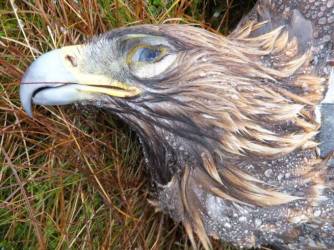
The photograph shows a dead golden eagle called ‘Fearnan’ who was found poisoned on a grouse moor in the Angus Glens in 2013.
UPDATE 5PM: The BBC article has now been updated with a quote from RSPB Scotland, who also dispute the SGA’s findings.
Duncan Orr-Ewing said: “We are not sure where the SGA have got their information, however, if correct their survey highlights only 53% occupancy of known traditional golden eagle territories in the central and eastern Highlands, far below the natural carrying capacity and continues to indicate that the species is in unfavourable conservation status in this area“.
To read what else he had to say see updated BBC article here
 As part of the
 There’s an article on the BBC News website today about a proposal to take golden eagle chicks from the Highlands and release them in southern Scotland in an attempt to boost the tiny, depleted population currently clinging on by its talons (BBC report


 The Scottish Government has today released the annual poisoning and persecution maps relating to crimes against raptors in 2014.
 Raptor Persecution UK