More on ‘missing’ golden eagle #338, North Glenbuchat Estate

On Saturday 1 April 2017, we blogged about a satellite-tagged golden eagle (#338) that the RSPB reported had ‘disappeared’ after its last sat tag signal pinged in from the North Glenbuchat Estate in the Cairngorms National Park in early March (see here).

The estate, via PR company Media House, issued a robust statement in response and posted a video clip of a young eagle, purportedly filmed on the estate on 30 March, that the estate’s head gamekeeper “firmly believed” to be golden eagle #338.

We commented at the time that the video footage was very poor quality and it was difficult to see whether the eagle in the video was even carrying a satellite tag. We also pointed out that other sat-tagged golden eagles are currently flying around Scotland so even if this eagle in the video was carrying a tag, it would have been virtually impossible for the head gamekeeper to know whether it was eagle #338 or one of the others.

Since then, various expert field ornithologists both in the UK and the USA, all of whom specialise in golden eagles, have contacted us about the video. All of them said that although the video quality was poor, the plumage characteristics of the eagle in the video were not consistent with that of a nine-month old male golden eagle, but appeared to be consistent with what they’d expect of a second year female golden eagle.

On Sunday 2 April 2017, Media House issued another press statement on behalf of North Glenbuchat Estate and published a second video, purportedly of eagle #338, filmed on the estate on Saturday 1 April 2017. The quality of this second video is even worse than the first video (you could be looking at a flying cabbage) so it’s not much use as the supplementary evidence it was clearly intended to be.

The text of this second press release via Media House is well worth a read: North Glenbuchat Estate press release_2

In it, Media House states that the RSPB staff who were involved in the police search of the estate last week (at the invitation of Police Scotland – good, partnership working) “were hooded and kept their faces covered“.

This sentence has been widely abused by the nasty brigade on social media and has been turned into phrases such as ‘Masked intruders‘, ‘Masked RSPB thugs‘ and ‘RSPB representatives conducting themselves like hunt saboteurs wearing intimidating hoods and masks‘. Doubtless spurred on by the following inflammatory commentary from Bert Burnett (Scottish Gamekeepers’ Association) on his facebook page:

So yet again, the focus of attention is dragged away from the issue at hand (the disappearance of yet another satellite-tagged raptor on a grouse moor) and moved on to the usual anti-RSPB rhetoric in an attempt to discredit anybody or anything that might point to on-going concerns about the frequency with which satellite-tagged raptors seem to ‘disappear’ in areas where intensive grouse moor management takes place.

This abuse of the RSPB is nothing new, of course, but it’s interesting that the false claims about the efficiency of satellite tags, the false claims that the RSPB does not follow PAW raptor protocols, and the attempted denigration of raptor workers and those who fit these satellite tags, has been extremely prevalent since August last year when the Cabinet Secretary announced her decision to undertake an independent review of raptor satellite tag data. The abuse will no doubt have not gone unnoticed by the Scottish Government.

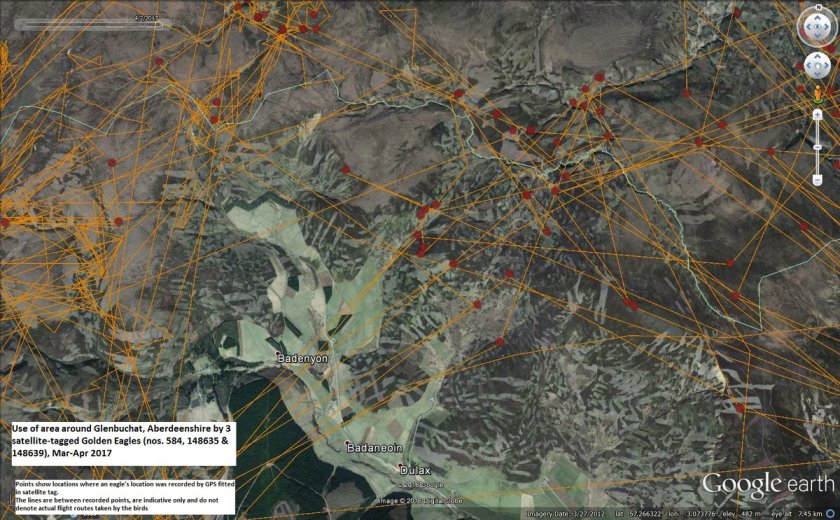
But back to the missing golden eagle #338. As we’ve been writing this blog, a very interesting map has appeared on Twitter (see @Ian_M_Thomson). It’s a map showing the recent movements of three other satellite-tagged golden eagles around Glenbuchat in March – April 2017:

Clear evidence that the eagle filmed by the head gamekeeper could have been any one of these other eagles so his “firm belief” that he was filming eagle #338 may have been his genuine belief but in fact is nothing more than hopeful optimism.

Nice try, but no cigar.

Meanwhile, the satellite tag signal from golden eagle #338 remains silent.

UPDATE 5 April 2017 14.38hrs: Ian Thomson (Head of RSPB Investigations Scotland) has just tweeted the following:

@Ian_M_Thomson: ‘Regarding missing eagle #338, Police Scotland has provided clarification to @PAWScotland partners that have contacted them that @RSPBScotland staff assisting them on a search in Glenbuchat last week did NOT have covered faces. We look forward to @PAWScotland partners disseminating this information to their memberships’

UPDATE 31 May 2017: North Glenbuchat Estate identified in Government-commissioned report as one of several hotspots where satellite-tagged golden eagles have regularly ‘disappeared’ in suspicious circumstances (here).

Satellite-tagged golden eagle ‘disappears’ on North Glenbuchat Estate in Cairngorms National Park

RSPB Scotland has released the following press statement:

APPEAL FOR INFORMATION AFTER ANOTHER SATELLITE-TAGGED GOLDEN EAGLE “DISAPPEARS”

RSPB Scotland has today issued an appeal for information following the disappearance of a satellite tagged golden eagle near Strathdon in Aberdeenshire.

The young male eagle was fitted with a transmitter by a licensed raptor study group member, before it fledged from a nest in Deeside in the summer of 2016. Data received from the tag allowed conservationists to study the movements of the bird, known as “338”, as it explored north-east Scotland’s countryside.

As with most young eagles, the bird spent the first few weeks after fledging in the area around its nest, before moving further away as it matured and was more able to fend for itself, spending much of its time on the eastern side of the Cairngorms National Park.

Overnight on Sunday 5th/Monday 6th March, the tag fitted to 338 inexplicably stopped working, having being functioning perfectly up to that point. The bird’s last recorded position was in Glenbuchat just before nightfall on 5th March. No further data has been received.

Ian Thomson, RSPB Scotland’s Head of Investigations said: “As soon as we became aware of this bird’s disappearance, we notified Police Scotland, in line with PAW Scotland protocols, who concurred that the circumstances were suspicious. These tags are very reliable, and the sudden cessation of transmissions strongly suggests the bird has died. Had the bird succumbed to natural causes, we would expect to continue to receive data and to be able to locate and recover the body of the eagle with ease”.

Follow up enquiries on the North Glenbuchat Estate by police officers, assisted by RSPB staff, yielded no sign of the bird.

In 2011, a satellite-tagged golden eagle was found illegally poisoned on the same estate, with a shot short-eared owl and poisoned buzzard also discovered. Another satellite-tagged golden eagle disappeared here in September 2011, with further such tagged birds also vanishing in the same area, in February 2012 and May 2013. In April 2014, the first young white-tailed eagle to fledge from a nest in the east of Scotland in one hundred years also disappeared here.

Ian Thomson continued “The circumstances surrounding the disappearance of eagle 338 are similar to a number of previous cases currently being considered by an independent review of satellite-tagged birds of prey commissioned by the Scottish Government. If this review reveals a geographical pattern to disappearing golden eagles, we will be pressing the Scottish Government for firm action, including the introduction of a licensing system for driven grouse shooting, with sanctions for licence removal from land where there is evidence of illegal practices. In the meantime, we appeal for any information about the disappearance of this bird to contact the police”.

Ends

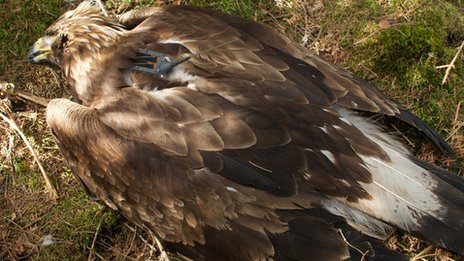
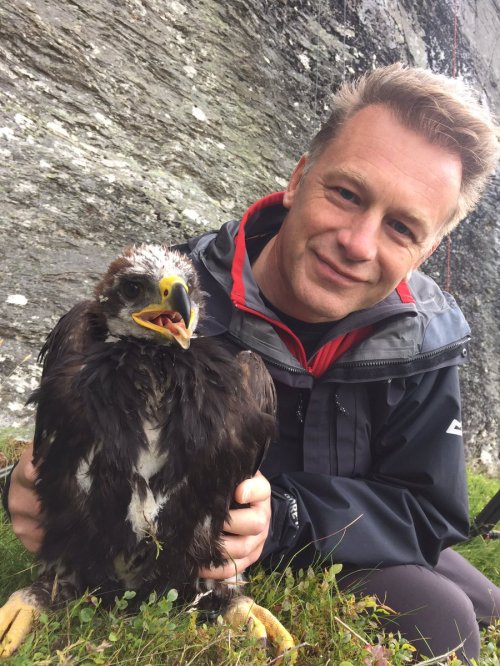
Eagle 338 successfully fledged from a nest in Deeside in 2016. Photo copyright Scottish Raptor Study Group.

As the RSPB Scotland statement says, eagle 338 is not the first to ‘disappear’ on the North Glenbuchat Estate.

In March 2011 a satellite-tagged eagle (#57319) was found poisoned on North Glenbuchat Estate (toxicology tests confirmed the banned poison Carbofuran had been used). A follow up police search, under warrant, recovered the remains of a short-eared owl under a rock – a post mortem confirmed it had been shot; a poisoned bait (rabbit) laced with Carbofuran; and a poisoned buzzard (Carbofuran). Nobody was prosecuted.

In September 2011 a satellite-tagged eagle (#95065, named Strathy) ‘disappeared‘ on North Glenbuchat Estate. Its tag had been functioning perfectly well before it suddenly and inexplicably stopped.

In February 2012 a satellite-tagged eagle (#57111) ‘disappeared’ on North Glenbuchat Estate. Its tag had been functioning perfectly well before it suddenly and inexplicably stopped.

In May 2013 a satellite-tagged eagle (#84133, named Angus 33) ‘disappeared‘ on North Glenbuchat Estate. Its tag had been functioning perfectly well before it suddenly and inexplicably stopped.

In April 2014 a satellite-tagged white-tailed eagle (White 1) ‘disappeared‘ on North Glenbuchat Estate. Its tag had been functioning perfectly well before it suddenly and inexplicably stopped.

That’s a lot of catastrophic tag failures all in one small area, over a six year period, isn’t it? And it’s patterns like this that the forthcoming raptor satellite tag data review will be exploring. What’s the betting that similar patterns will be seen in other areas in Scotland where the land is managed intensively for driven grouse shooting (e.g. Monadhliaths, Angus Glens)?

Interestingly, two press releases have so far been issued in response to this RSPB Scotland press release. One is from the landowners’ lobby group Scottish Land & Estates and the other one is from the North Glenbuchat Estate. It’s interesting to note that both press releases came via ‘public relations and crisis management’ experts, Media House.

The statement from Scottish Land & Estates appears to be supportive of the RSPB’s appeal for information. Read it here: Scottish Land & Estates press release North Glenbuchat eagle

The statement from North Glenbuchat Estate is very different. Read it here: North Glenbuchat Estate press release North Glenbuchat eagle

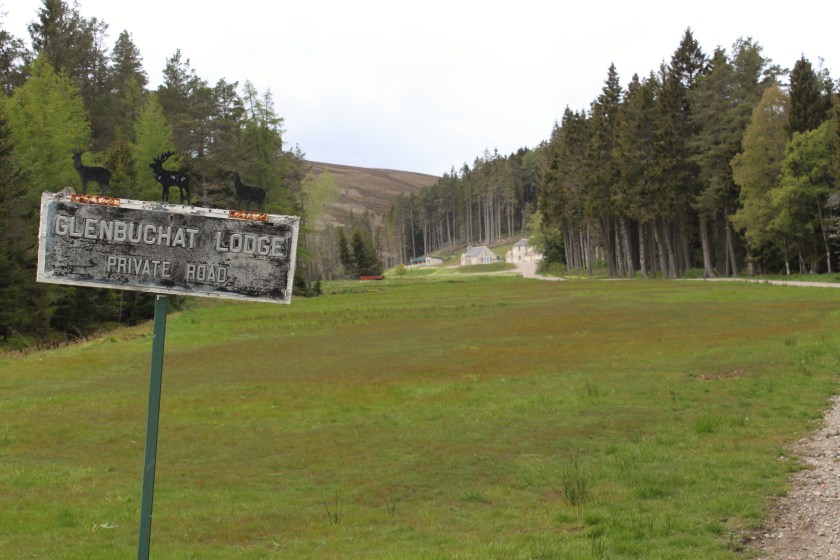
The estate’s statement includes the following claim: “The estate head gamekeeper filmed what he firmly believes to be the eagle in question yesterday afternoon” (March 30 2017) and there is an accompanying video of this eagle (here). It’s well worth a look. It’s definitely a juvenile golden eagle and it’s definitely been filmed on Glenbuchat Estate. However, it’s not known when the footage was taken and it’s extremely difficult to see whether this eagle is even carrying a satellite tag. But even if it is carrying a tag, how on earth can the keeper “firmly believe” that this is eagle 338? Surely he / the estate knows that there are plenty of satellite-tagged eagles flying around Scotland at the moment and it could be any one of those!

It all looks a little bit lame and a teensy bit desperate, but maybe that’s just us. Maybe eagle 338 is still flying around the Cairngorms National Park, along with all the other ‘missing’ satellite tagged eagles. Perhaps, having learned to use jamming technology to block the signal from their satellite tags, they’re now hanging around the Co-op car park in Grantown on Spey, using their skills to block remote-locking car keys with criminal intent so they can steal the vehicles and go joy riding around the National Park.

There are bound to be further responses to today’s news over the coming days and we’ll be reviewing those as and when they appear, but the one response we’re really keen to hear is the one from the Environment Cabinet Secretary, Roseanna Cunningham. We don’t plan to bombard her with outraged emails this time. She knows the score, she knows exactly what’s going on, and she knows that there is high expectation for her / the Scottish Government to finally address this issue with the full force it demands.

She will be considering the findings of the raptor satellite tag review over the next couple of weeks so while we wait to hear what action she intends to take, you can amuse yourselves by reading this article about the ownership of North Glenbuchat Estate, written by Andy Wightman in 2014.

(Photos by RPUK)

UPDATE 4 April 2016: More on missing golden eagle #338, North Glenbuchat Estate (here)

South Scotland Golden Eagle Project receives £1.3M lottery funding

The South Scotland Golden Eagle Project, which proposes to translocate eagles from the Highlands to boost the tiny eagle population in Dumfries & Galloway and the Borders, has been awarded over £1.3 million from the Heritage Lottery Fund (see here).

This means the project can now move forward by submitting a licence application to SNH and, if the licence is approved, the plan is to start collecting eaglets from Highland nests during the 2018 breeding season, with the intention of releasing between five and ten young eagles in southern Scotland each year until 2022.

We’ve blogged about this project before, back in 2015 when the planned translocation was first announced. We had mixed feelings about it then (see here) and we still do now.

On the one hand, the south Scotland golden eagle population is on its knees and has been for some time (see here). If nobody intervenes, the last few pairs remain extremely isolated and vulnerable and there’s every chance this sub-population will disappear. For this reason, intervention by way of releasing more birds seems like a good idea.

However, unless the cause of this sub-population’s decline has been identified and removed or sufficiently reduced, it is absolutely pointless bringing in new birds that are likely to suffer the same fate.

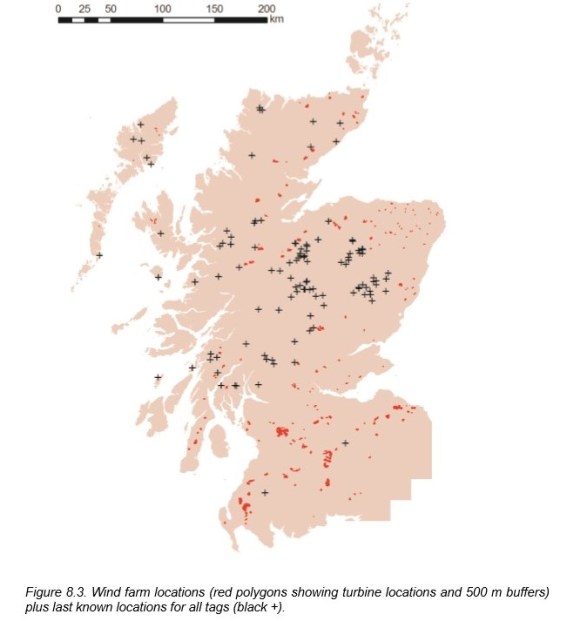
One of the biggest constraints on golden eagle population recovery in southern Scotland is persecution. Raptor persecution in southern Scotland has definitely not been removed, nor sufficiently reduced. It has been argued (by Scottish Land & Estates) that raptor persecution in southern Scotland ‘may have been an historical factor’ in the demise of the south Scotland eagle population, but apparently it isn’t an issue any more. Unfortunately, the evidence doesn’t support that claim. Here’s a map from the 2008 Golden Eagle Conservation Framework showing the conservation status of golden eagles in Scotland (red = unfavourable conservation status), overlaid with ten years of raptor persecution data (all species, 2005-2015) gleaned from ‘official’ persecution maps. Does it look to you like raptor persecution isn’t an issue in southern Scotland?

The 2014 SNH-commissioned report on the status of golden eagles in southern Scotland also identified several areas where persecution is an ongoing concern, including the Lowther Hills, the Lammermuirs and the Moorfoots (all driven grouse moor areas – what a surprise), and stated that persecution needed to be brought under control in those regions if golden eagles were to thrive in southern Scotland once again.

On the basis of this evidence, we would argue that translocating golden eagles to southern Scotland in the immediate future is not a wise decision. But, there is a counter argument. Young golden eagles travelling around the Highlands during their early years are just as likely to be illegally killed in the north as they are in south Scotland (e.g. see here). So, if the risk is just as great in the north, why not bring those eagles to the south, where, under the intense public attention that this project will generate, the young birds may actually have a better chance of survival because the would-be raptor killers will know they’re under close scrutiny (each eagle will be satellite-tagged). Although that’s assuming the young birds remain in southern Scotland during their formative years – we know that a young eagle that fledged from the Dumfries & Galloway nest in 2015 ‘disappeared’ on a grouse moor in the Monadhliaths just after her first birthday in 2016 (see here).

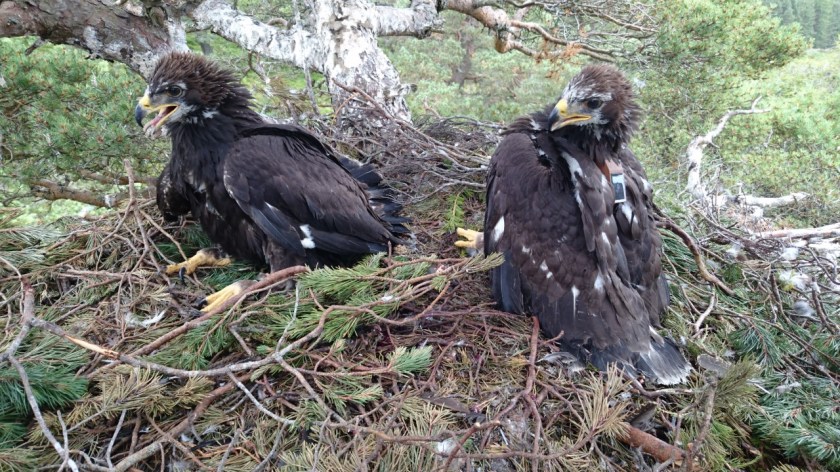
Others have commented that prey availability will pose a problem for an increasing eagle population in the south, but a recent report (here) has shown that ‘the region possesses a sufficient prey base to sustain a breeding population of golden eagles of 12-16 pairs’. Here is a photo of a young golden eagle at the one remaining productive breeding site in the Borders. Judging by the nest contents, prey availability doesn’t appear to be a problem.

Whatever the concerns may be, it looks like this project is going ahead (pending the licence application) and let’s be honest, at least the primary motivation for this scheme is NOT to appease the grouse-shooting lobby, unlike the ludicrous Hen Harrier brood meddling scheme in England, but to help improve the sustainability of this important sub-population. Our misgivings haven’t yet been allayed, but we still have fingers crossed for its success because inaction (i.e. waiting for illegal raptor persecution to stop) is no longer an option if this sub-pop is to survive.

‘Official’ 2016 raptor persecution maps are a misleading distraction

Today the Partnership for Action against Wildlife Crime (Scottish PAW Raptor group) has published the so-called ‘official’ annual raptor persecution maps showing details of recorded raptor persecution crimes for 2016.

Once again, Police Scotland has withheld information about several incidents ‘for operational reasons’ and as such these are not included on the ‘official’ map. Some details have been included in the accompanying summary data tables but even information as basic as the species affected has not been published.

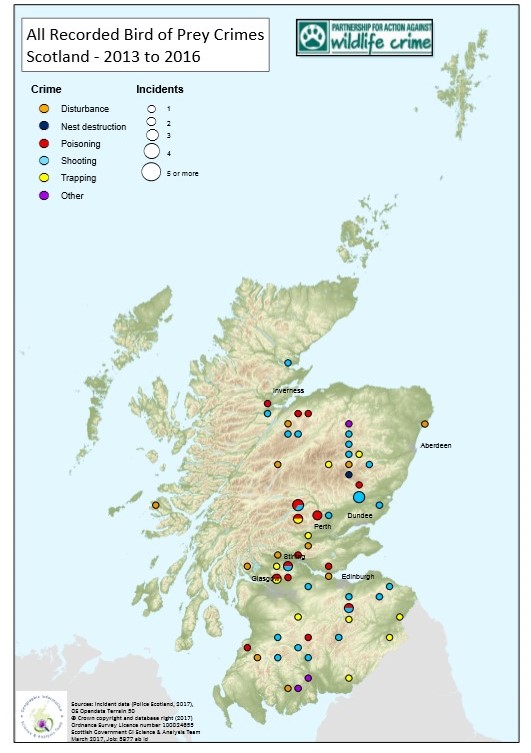
Here’s the ‘official’ map purportedly showing ‘ALL’ recorded bird of prey crimes in Scotland from 2013 to 2016:

However, just as last year, some incidents are not shown and so the title of this map is totally misleading. As we’ve said before, there is no point whatsoever publishing these maps if Police Scotland is going to keep some of these crimes a secret. Seriously, what is the point?

The PAW Raptor group is headlining today’s news as a “26% drop in recorded bird of prey offences during 2016“. No doubt this supposed ‘good news’ will be used by the game-shooting industry as evidence that things are improving. On a superficial level this looks like a reasonable conclusion, but as well as the withholding of known poisoning offences, other information has also been excluded.

For example, there is no mention at all about the four satellite-tagged golden eagles that are known to have ‘disappeared’ in suspicious circumstances in 2016: three of them ‘disappeared’ on grouse moors in the Monadhliaths and one ‘disappeared’ on a grouse moor in the Angus Glens.

There is also no mention of the three satellite-tagged hen harriers that are also known to have ‘disappeared’ in suspicious circumstances in 2016: ‘Chance‘ disappeared on a South Lanarkshire grouse moor in May 2016; ‘Elwood‘ vanished on a Monadhliaths grouse moor in August 2016;  and ‘Brian‘ vanished on a grouse moor in the Cairngorms National Park in August 2016.

PAW Scotland will argue that these data have not been included because they do not represent confirmed persecution crimes. Technically, that’s fair comment, but given the frequency with which satellite-tagged raptors are ‘disappearing’ on Scottish grouse moors, they point to a much more sinister picture, as recognised by the Environment Cabinet Secretary when she ordered a review of raptor sat tag data last year. She also mentions that review in her comments about today’s supposed ‘good news’.

As far as we’re concerned, the PAW Scotland raptor persecution maps are a misleading distraction from what is actually going on in the Scottish uplands. All eyes should be on the forthcoming raptor satellite tag review for a more meaningful and revealing picture.

PAW Scotland press release here

PAW Scotland persecution maps and data here

41 eagles, 10 years, 0 prosecutions

Regular blog readers will know that from time to time we publish a list of eagles that are known to have been illegally killed, or have ‘disappeared’ (i.e. their satellite tag suddenly stops functioning) in Scotland.
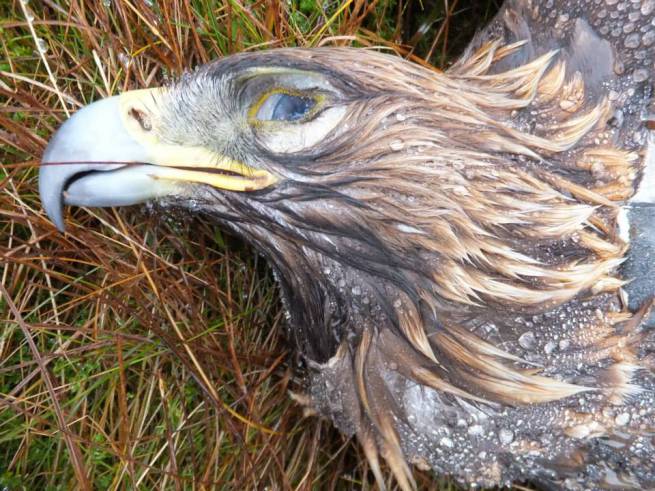
The last update was in August 2016 when the RSPB revealed that eight satellite-tagged golden eagles had ‘disappeared’ on grouse moors in the Monadhliaths between 2011 and 2016.

Last week we blogged about another ‘disappearing’ golden eagle, this time a young bird that had been tagged in Perthshire in 2014 and whose satellite signal suddenly stopped functioning two years later when the eagle was visiting an Angus Glens grouse moor. It’s time to add that eagle to our list.

As before, a number of eagles included in this list (17 of them, to be precise) may not be dead. However, they are included here because their satellite tags unexpectedly stopped functioning (i.e. they’d been transmitting perfectly well up until the eagles’ last known location, often a known persecution hotspot). Two further satellite-tagged eagles (‘Angus’ and ‘Tom’) are not included in this list as although their transmitters stopped functioning, there had been recognisable problems with their tags prior to the final transmissions and so the benefit of the doubt has been applied.

It’s also worth reiterating that the following eagles are only the ones we know about. How many un-tagged eagles are illegally killed each year?

MAY 2006: A dead adult golden eagle was found on the Dinnet & Kinord Estate, near Ballater, Aberdeenshire. Tests revealed it had been poisoned by the illegal pesticide Carbofuran. Grampian Police launched an investigation. No prosecution.

JUNE 2006: A dead golden eagle was found on Glen Feshie Estate in the Cairngorms. Tests revealed it had been poisoned by the illegal pesticide Carbofuran. Northern Constabulary launched an investigation. No prosecution.

AUGUST 2007: A dead adult female golden eagle was found on an estate near Peebles in the Borders. She was half of the last known breeding pair of golden eagles in the region. Tests revealed she had been poisoned by the illegal pesticide Carbofuran. Lothian & Borders Police launched an investigation. No prosecution.

NOVEMBER 2007: Tayside Police received a detailed tip-off that a young male white-tailed eagle (known as ‘Bird N’) had allegedly been shot on a grouse moor estate in the Angus Glens. The timing and location included in the tip-off coincided with the timing and location of the last-known radio signal of this bird. The eagle has not been seen again. With no carcass, an investigation wasn’t possible.

MAY 2008: A one year old male white-tailed eagle hatched on Mull in 2007 and known as ‘White G’ was found dead on the Glenquoich Estate in the Angus Glens. Tests revealed he had been poisoned by an unusual concoction of pesticides that included Carbofuran, Bendiocarb and Isofenphos. A police search in the area also revealed a poisoned buzzard, a baited mountain hare and 32 pieces of poisoned venison baits placed on top of fence posts on the neighbouring Glenogil Estate. Laboratory tests revealed the baited mountain hare and the 32 poisoned venison baits contained the same unusual concoction of highly toxic chemicals that had killed the white-tailed eagle, ‘White G’. No prosecution.

JUNE 2009: An adult golden eagle was found dead at Glen Orchy, Argyll, close to the West Highland Way. Tests revealed it had been poisoned by the illegal pesticide Carbofuran. Strathclyde Police launched a multi-agency investigation. Three years and 3 months later, estate employee Tom McKellar pled guilty to possession of Carbofuran stored in premises at Auch Estate, Bridge of Orchy and he was fined £1,200. No prosecution for poisoning the golden eagle.

JULY 2009: A two year old female golden eagle known as ‘Alma’ was found dead on the Millden Estate in the Angus Glens. Tests revealed she had been poisoned by the illegal pesticide Carbofuran. Alma was a well-known eagle  – born on the Glen Feshie Estate in 2007, she was being satellite-tracked and her movements followed by the general public on the internet. Tayside Police launched an investigation. No prosecution.

AUGUST 2009: A young white-tailed eagle was found dead on Glenogil Estate in the Angus Glens. Tests revealed it had been poisoned by the illegal pesticide Carbofuran. Tayside Police was criticized in the national press for not releasing a press statement about this incident until January 2010. No prosecution.

MAY 2010: #1 of three dead golden eagles found on or close to Skibo Estate, Sutherland. Tests revealed they had been poisoned; two with Carbofuran and one with Aldicarb. Northern Constabulary launched a multi-agency investigation. One year later (May 2011), Sporting Manager Dean Barr pled guilty to possession of 10.5 kg of Carbofuran stored in premises at Skibo Estate. No prosecution for poisoning the golden eagle.

MAY 2010: #2 of three dead golden eagles found on or close to Skibo Estate, Sutherland. Tests revealed they had been poisoned; two with Carbofuran and one with Aldicarb. Northern Constabulary launched a multi-agency investigation. One year later (May 2011), Sporting Manager Dean Barr pled guilty to possession of 10.5 kg of Carbofuran stored in premises at Skibo Estate. No prosecution for poisoning the golden eagle.

MAY 2010: #3 of three dead golden eagles found on or close to Skibo Estate, Sutherland. Tests revealed they had been poisoned; two with Carbofuran and one with Aldicarb. Northern Constabulary launched a multi-agency investigation. One year later (May 2011), Sporting Manager Dean Barr pled guilty to possession of 10.5 kg of Carbofuran stored in premises at Skibo Estate. No prosecution for poisoning the golden eagle.

JUNE 2010: #1: Leg rings with unique identification numbers that had previously been fitted to the legs of four young golden eagles in nests across Scotland were found in the possession of gamekeeper James Rolfe, during a multi-agency investigation into alleged raptor persecution at Moy Estate, near Inverness. It is not clear how he came to be in possession of the rings. The bodies of the eagles from which the rings had been removed were not found. No further action was taken in relation to the discovery.

JUNE 2010: #2: Leg rings with unique identification numbers that had previously been fitted to the legs of four young golden eagles in nests across Scotland were found in the possession of gamekeeper James Rolfe, during a multi-agency investigation into alleged raptor persecution at Moy Estate, near Inverness. It is not clear how he came to be in possession of the rings. The bodies of the eagles from which the rings had been removed were not found. No further action was taken in relation to the discovery.

JUNE 2010: #3: Leg rings with unique identification numbers that had previously been fitted to the legs of four young golden eagles in nests across Scotland were found in the possession of gamekeeper James Rolfe, during a multi-agency investigation into alleged raptor persecution at Moy Estate, near Inverness. It is not clear how he came to be in possession of the rings. The bodies of the eagles from which the rings had been removed were not found. No further action was taken in relation to the discovery.

JUNE 2010: #4: Leg rings with unique identification numbers that had previously been fitted to the legs of four young golden eagles in nests across Scotland were found in the possession of gamekeeper James Rolfe, during a multi-agency investigation into alleged raptor persecution at Moy Estate, near Inverness. It is not clear how he came to be in possession of the rings. The bodies of the eagles from which the rings had been removed were not found. No further action was taken in relation to the discovery.

JUNE 2010: A golden eagle was found dead on Farr & Kyllachy Estate, Inverness-shire. Tests revealed it had been poisoned by the illegal pesticide Carbofuran. Northern Constabulary apparently did not search the property until July 2011. No prosecution.

JUNE 2010: A white-tailed eagle was found dead on Farr & Kyllachy Estate, Inverness-shire. Tests revealed it had been poisoned by the illegal pesticide Carbofuran. Northern Constabulary apparently did not search the property until July 2011. No prosecution.

DECEMBER 2010: A decomposing carcass of a white-tailed eagle was found and photographed on Logie (Lochindorb) Estate, Morayshire. It was reported to Northern Constabulary. By the time the police arrived to collect it, the carcass had disappeared. The police said they couldn’t investigate further without the body.

FEBRUARY 2011: The signal from a young satellite-tracked golden eagle ( ‘Lee’, hatched in 2010) unexpectedly stopped transmitting after a final signal from the North Angus Glens. A technical malfunction or another mysterious ‘disappearance’?

MARCH 2011: The body of a young golden eagle was discovered on North Glenbuchat Estate, Aberdeenshire. Tests revealed it had been poisoned by the illegal pesticide Carbofuran. Grampian Police launched an investigation and raided the property in May 2011. A poisoned buzzard, a poisoned bait and a shot short-eared owl were found. No prosecution.

APRIL 2011: The body of a white-tailed eagle was found at the base of cliffs on Skye. The person who discovered it (a professional medic) considered it to have been freshly shot with a rifle, decapitated with a sharp implement and thrown from the cliff top. He took photographs and alerted Northern Constabulary and RSPB. There was a delay of two weeks before the now probably decomposed carcass was collected. A post-mortem was inconclusive. This incident was not made public until one year later after a tip off to this blog. No prosecution.

SEPTEMBER 2011: The signal from a satellite-tracked young golden eagle (‘Strathy’, hatched in 2010) unexpectedly stopped transmitting after a final signal from an Aberdeenshire grouse moor. A technical malfunction or another mysterious ‘disappearance’?

NOVEMBER 2011: The signal from a one-year-old satellite-tracked golden eagle (#57124) unexpectedly stopped transmitting after a final signal from a grouse moor in the Monadhliaths. A technical malfunction or another mysterious ‘disappearance’?

MARCH 2012: The body of a young golden eagle being tracked by satellite was discovered in Lochaber. Tests revealed it had been poisoned with the banned pesticides Aldicarb and Bendiocarb. Information about this incident was not made public until three months later. No prosecution.

MARCH 2012: The signal from a satellite-tracked young golden eagle (‘Angus 26′, hatched in 2011) unexpectedly stopped transmitting after a final signal from a grouse moor in the Angus Glens. This bird’s suspiciously damaged sat tag was found in the area. No prosecution.

MAY 2012: The signal from a young satellite-tracked golden eagle (#32857) unexpectedly stopped transmitting when the bird was north-east of the Cairngorms National Park. A technical malfunction or another mysterious ‘disappearance’?

MAY 2012: The dead body of a young satellite-tracked golden eagle (hatched in 2011) was discovered near a lay-by in Aboyne, Aberdeenshire. The data from its satellite tag & the injuries the bird had when found (2 broken legs) suggested it had been caught in an illegal trap on a grouse moor in the Angus Glens and then removed, under cover of darkness, to be dumped in another area where it was left to die, probably a slow and agonising death. Information on this incident was not released until almost five months later, by the RSPB. It appears the police failed to properly investigate this incident as we understand that no search warrants were issued and no vehicles were searched. No prosecution.

JULY 2012: The signal from a one-year-old satellite-tracked golden eagle (‘Foinaven’) unexpectedly stopped transmitting after a final signal from a grouse moor in the Monadhliaths. A technical malfunction or another mysterious ‘disappearance’?

OCTOBER 2012: An adult golden eagle was found shot and critically injured on grouse moor at Buccleuch Estate, near Wanlockhead, South Lanarkshire. The bird was rescued by the SSPCA and underwent surgery but it eventually succumbed to its injuries in April 2013. No prosecution.

MAY 2013: The signal from a two-year-old satellite tracked golden eagle (‘Angus 33′, hatched in 2011) unexpectedly stopped transmitting after its last signal from North Glenbuchat Estate in Aberdeenshire. A technical malfunction or another mysterious ‘disappearance’?

JUNE 2013: A dead golden eagle was found under power lines on an RSPB reserve on Oronsay. This bird had been shot although it is not known whether this was the cause of death or an historical injury.

JULY 2013: The signal from a young satellite tracked golden eagle (‘Cullen’, hatched 2010) unexpectedly stopped transmitting after its last signal in Aberdeenshire. A technical malfunction or another mysterious ‘disappearance’?

DECEMBER 2013: A two year old satellite tracked golden eagle (‘Fearnan’) was found dead on a grouse moor in the Angus Glens. Tests revealed he had been poisoned with the banned pesticide Carbofuran. No prosecution.

MARCH 2014: The signal from a one-year-old satellite-tagged golden eagle (#129002) unexpectedly stopped transmitting after a final signal from a grouse moor in the Monadhliaths. A technical malfunction or another mysterious ‘disappearance’?

APRIL 2014: The signal from a young satellite tracked white-tailed eagle (the first fledged sea eagle chick in East Scotland in ~200 years) unexpectedly stopped transmitting after its last signal from the North Glenbuchat Estate in Aberdeenshire. Police raided the property a couple of weeks later. No prosecution.

OCTOBER 2014: The signal from a one-year-old satellite-tagged golden eagle (#107133) unexpectedly stopped transmitting after a final signal from a grouse moor in the Monadhliaths. A technical malfunction or another mysterious ‘disappearance’?

OCTOBER 2014: The signal from a two-year-old satellite-tagged golden eagle (#119886) unexpectedly stopped transmitting after a final signal from a grouse moor in the Monadhliaths. A technical malfunction or another mysterious ‘disappearance’?

MARCH 2016: The signal from a satellite-tagged golden eagle (tagged in Perthshire 2014) unexpectedly stopped transmiting after a final signal from a grouse moor in the Angus Glens. A technical malfunction or another mysterious ‘disappearance’?

MAY 2016: The signal from a less-than-one-year-old satellite-tagged golden eagle (#00000583) unexpectedly stopped transmitting after a final signal from a grouse moor in the Monadhliaths. A technical malfunction or another mysterious ‘disappearance’?

JUNE 2016: The signal from a two-year-old satellite-tagged golden eagle (#129010) unexpectedly stopped transmitting after a final signal from a grouse moor in the Monadhliaths. A technical malfunction or another mysterious ‘disappearance’?

JULY 2016: The signal from a two-year-old satellite-tagged golden eagle (#129015 ‘Brodie’) unexpectedly stopped transmitting after a final signal from a grouse moor in the Monadhliaths. A technical malfunction or another mysterious ‘disappearance’?

37 of the listed 41 eagles have either been found dead on, or have ‘disappeared’ on, Scottish grouse moors. (The other 4 have either died or have ‘disappeared’ in other habitat types).

Four of these 41 eagles ‘disappeared’ in 2016. So much for the grouse-shooting industry claiming that they’ve cleaned up their act and that persecution is a thing of the past. The tactics of how to kill an eagle have clearly changed (see here) but the persecution continues.

Last summer, in response to the news that eight tagged golden eagles had ‘disappeared’ in the Monadhliaths over a five year period, Environment Cabinet Secretary Roseanna Cunningham ordered a review of satellite tag datato discover if there is a pattern of suspicious activity“.

We are expecting the review to be published some time in April and we expect it to show what decades of scientific research has already clearly demonstrated: that golden eagles (and several other raptor species) are routinely killed or suspiciously ‘disappear’ on land intensively managed for driven grouse shooting.

We expect this review to be a seminal piece of research and if it shows what we anticipate it will show, the Scottish Government can expect to be put under enormous pressure to respond appropriately.

A few sandwiches short of a picnic

As we mentioned yesterday, some individuals within the game shooting industry have recently been doing their level best to discredit the work of raptor fieldworkers, and particularly anything associated with tagging raptors, be it leg rings, wing tags or satellite tags. As usual, their level best falls way short of the mark.

Some of it amounts to libel (so we won’t be discussing that here as legal action is being considered), some of it is quite disturbing (distributing images of children without parental consent and without any attempts to pixelate faces) and some of it is either a complete fabrication or a gross distortion of the truth. All of it is being done as a crude and cynical attempt to undermine the findings of the forthcoming raptor satellite tag review, which we anticipate will provide damning evidence of the extent of satellite tagged raptors that ‘disappear’ on Scottish grouse moors.

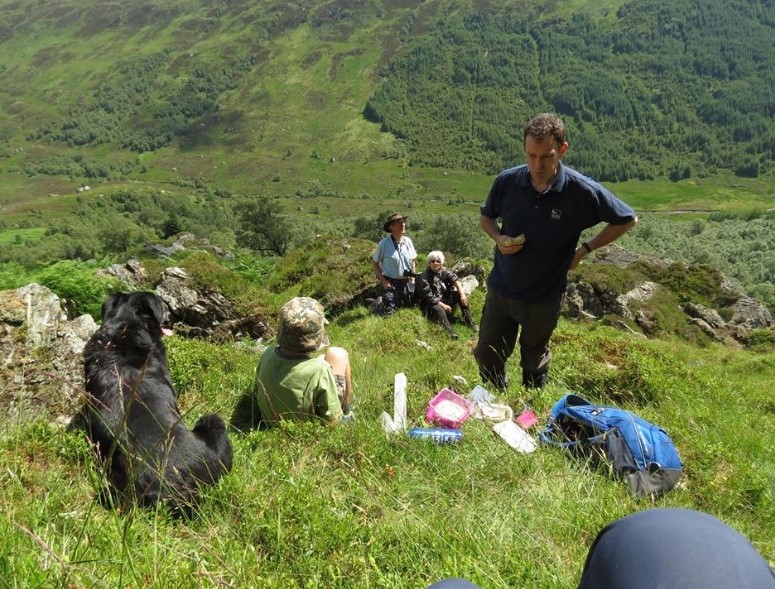
Here’s a good example of some of the propaganda being peddled by the game shooting industry. This photograph has been repeatedly posted on Facebook and other social media platforms as an example of ‘bad practice’ at a raptor tagging event. It shows a group of people at an eagle nest site in Perthshire in 2014. According to Bert Burnett of the Scottish Gamekeepers’ Association, who has posted this image several times, these people, including Duncan Orr-Ewing of RSPB Scotland, are “having a picnic underneath an eagle nest” for several hours and thus by implication are causing unnecessary disturbance at the site and causing the adult birds to desert.

What’s actually happening here is a group of people, including four licensed experts and their invited guests, have climbed to an eagle nest site and while the climbers have gone to retrieve the eaglet from the nest so its satellite tag can be fitted in safety on the ground, Duncan is eating a sandwich. That’s it. It’s a few sandwiches short of a picnic, or is that just Bert?

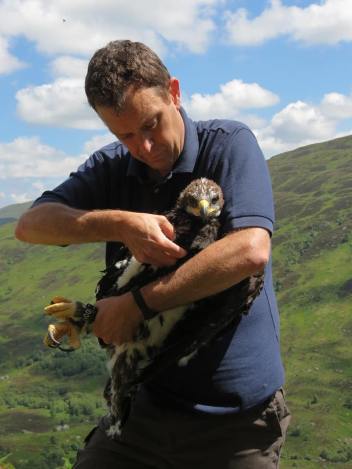
Another photograph that Bert has circulated was also taken at this site on the same day. It shows Duncan quite rightly checking the fit of the young eagle’s sat tag harness before the bird is put back in its nest.

This photograph elicited all sorts of comments on social media, with suggestions that sat tagging golden eagles is harmful to the birds, that it’s detrimental to their survival and one person even claiming that “they [the raptor fieldworkers] are a far greater threat to birds than any shooting interests“.

He posted another photograph (which we won’t post here for legal reasons) that shows a woman and her son on the nest ledge after the eagle had been returned to its nest. Bert said this about it: “What happens to birds after tagging is very questionable. Allowing your families and friends to climb up intae the nest just for photo shoots is totally out of order and shows no concern for the birds future welfare“. On a later post he also claimed the woman had been “hoisted in to the nest“. What the photo actually shows is a Schedule 1 licence holder and her son who have just climbed to the nest to return the eagle after tagging. It’s probably hard for Bert to comprehend that a woman might actually be a Schedule 1 licence holder and that she’d be capable of climbing to the nest without being “hoisted in” (surely her breasts would get in the way?) but when your mindset is firmly stuck in the 18th century then it’s probably no surprise at all.

As for Bert’s comment, “What happens to birds after tagging is very questionable“, well, it’s not questionable in this case. This eagle was satellite tagged in Perthshire in 2014. The bird fledged successfully and its movements were tracked until 2016 when its tag signal suddenly stopped transmitting and the eagle ‘disappeared’ on a grouse moor in Perthshire. We’d respectfully suggest that this eagle’s disappearance (probable death) was not caused by Duncan eating a sandwich at its natal site two years earlier nor by it being put back in to the nest by a woman, but was more than likely caused by illegal poisoning, illegal trapping or illegal shooting on or near a grouse moor in the Highlands.

A week ago, Bert again posted the photograph of Duncan eating a sandwich and he wrote the following on his Facebook page:

Once again, Bert hasn’t checked his facts. This eagle territory has NOT been deserted since Duncan and his colleagues safely fitted the satellite tag to the young eagle in 2014. On the contrary, the breeding pair has remained on territory and produced chicks every year since. In fact last year’s chick, ‘Freya’, was seen by millions of viewers as she was filmed being satellite tagged for the BBC’s SpringWatch programme!

Now, we can take the mick out of Bert all day and as long as he continues to spout nonsense we’ll continue to call him out – it’s actually quite enjoyable and he’s helping our cause no end. But there’s a darker side to what’s going on, with the targeted harassment of certain named individuals, and we’ll be blogging about that shortly.

In the meantime, have a look at a blog written by Duncan today (see here) for a more serious view on raptor tagging procedures and also check out this statement from the BTO which details the stringent requirements that must be met before anyone gets a licence to ring and tag birds in the UK: Overview of BTO Ringing Scheme training and licensing procedure

UPDATE 30th September 2020: The eagle’s satellite tag found in the river: poetic injustice (here)

Raptor persecution data & golden eagle conservation status – anyone see a pattern?

This first map will be familiar to many of you. It’s from the excellent Golden Eagle Conservation Framework report (2008) and shows a summary of the golden eagle’s conservation status in Scotland.

Conservation status was assessed by looking at the data from three national golden eagle surveys (1982, 1992, 2003) and applying a series of regional-based tests such as occupancy, adult survival, sub-adult survival, reproductive output and predicted population projections.

Green = favourable conservation status

Amber = unfavourable conservation status (marginal, with failure in only one test)

Red = unfavourable conservation status (with failure in more than one test)

The results were pretty unambiguous (unless you suffer from willful blindness). In fact, the results were stark. Only three of 16 regions, where golden eagles have occupied territories since 1982, were considered to be in favourable conservation status (the green bits). The most serious failures to meet favourable conservation status tests were in areas largely dominated by grouse moor management (the red bits).

Now, since the Golden Eagle Framework was published there has been another national golden eagle survey (2015) and although the results have yet to be formally published, we do know that there has been an improvement in some areas and perhaps some of the map previously shaded in amber can now be turned to green. However, we also know that the 2015 survey results showed that golden eagles in the eastern highlands and southern uplands are still in serious trouble.

Now have a look at this map. We thought it’d be interesting to take the golden eagle conservation status map and overlay ten years worth of raptor persecution data, gleaned from the various ‘official’ persecution maps (such as those from PAW Scotland). It’s been done at a crude scale, because that’s how the official raptor persecution data have been presented over the years, but nevertheless it’s really quite interesting. Can anyone see a pattern?!

ECCLR session 2: the SGA and their ‘alternative facts’

Two weeks ago the Scottish Parliament’s Environment, Climate Change & Land Reform (ECCLR) Committee held an evidence session to scrutinise the Government’s 2015 annual wildlife crime report.

The evidence session was divided in to two parts – we’ve blogged about session 1 [evidence from Police Scotland and the Crown Office] here.

This blog is about session 2, where witnesses from RSPB Scotland, Scottish Gamekeepers’ Association (SGA), Scottish Badgers and the Bat Conservation Trust were invited to speak.

The video of the session can be watched here and the full transcript can be read here.

This session was fascinating and we’d really encourage you to read the transcript – and even better, watch the video. There’s too much to blog about here so we’ll just focus on the SGA’s ‘evidence’, which turned out to be a series of ‘alternative facts’, which perhaps isn’t all that surprising although it is of concern when you realise Andy Smith, the SGA rep, was a former police officer for 30 years and so he should be well versed in dealing with actual facts, not made-up ones.

Here are some of the SGA’s alternative facts. This is not an exhaustive list, just the ones that amused us the most:

Alternative Fact #1

According to Andy Smith, the SGA doesn’t support the proposal that the SSPCA should be given increased powers to help investigate wildlife crime because he was told that the SSPCA’s Chief Superintendent traveled to London to listen to the Westminster debate on driven grouse shooting, which, according to Andy Smith, means the SSPCA has an anti-shooting agenda.

The logic Andy Smith used to reach this conclusion is, well, illogical, because plenty of people attended the Westminster debate, including GWCT staff members, who most definitely are not anti-shooting. Anyway, as it turns out, the SSPCA’s Chief Superintendent did NOT travel to London to attend the debate, as he clearly explains in a recent letter to the ECCLR Committee that has been published on the Scottish Parliament’s website:  20170111_mike_flynn_to_convener_regarding_ecclr_meeting_10_january_2017

Alternative Fact #2

According to Andy Smith, “There are places in this country that should have birds of prey – raptors – but do not have them. That includes some RSPB reserves that have the perfect conditions. For example, I do not think that there are very many in Abernethy“.

Oops. There are at least eight species of breeding raptors at the RSPB’s Abernethy Reserve (perhaps more, we haven’t checked), including, er, the world famous ospreys at Loch Garten.

Alternative Fact #3

According to Andy Smith, “We should remember that the Cairngorms National Park has the highest density of eagles in the world“. [Interruption]. “Am I not right in thinking that?“.

Ian Thomson (RSPB Scotland): “No, you are not“.

Andy Smith: “It is certainly where the highest density of eagles is in the UK“.

Ian Thomson: “Harris has the highest density of golden eagles“.

Another commonly repeated myth from Andy Smith. It’s nothing new (e.g. see here, and it was also repeated in the SGA’s most recent edition of its in-house rag Scottish Gamekeeper), but it doesn’t matter how many times it’s repeated, it doesn’t make it factual. The Cairngorms National Park does NOT have the highest density of eagles in the world, nor in the UK. As Ian Thomson correctly pointed out, golden eagle density in the Western Isles (i.e. nowhere near a driven grouse moor) is among the highest recorded, although a few populations in North America have an equally high density.

The truth is that golden eagles in the Cairngorms National Park have one of the lowest rates of site occupancy in the whole of Scotland. Sure, there are breeding golden eagles in the CNP, but as was described in the authoritative Golden Eagle Conservation Framework, the vast majority of those sites are associated with open woodland (i.e. deer forest) where they are generally left alone; they are, with a handful of exceptions, absent from the extensive areas of open moorland managed for driven grouse shooting.

ge-vacant-territories-2003The data in the above table were derived from the 2003 national golden eagle survey. Since then, a 2015 national survey has been undertaken and we await publication of the detailed results, although the preliminary findings have shown that there have been improvements in occupancy in some regions, but not, unfortunately, in the Eastern Highlands, which includes large parts of the Cairngorms National Park and North East Glens, where intensively managed moorland for driven grouse shooting remains the dominant land practice and where illegal persecution continues to constrain the golden eagle population, as well as a number of other raptor populations including peregrine and hen harrier.

The SGA should watch out. With a performance like Andy Smith’s, the Trump administration may well try to headhunt him to join The White House press team.

Minutes of meeting between Cairngorms National Park Authority & Scottish Gamekeepers’ Association

ALMDLast month we blogged about a comment that had been made during an official meeting between the Cairngorms National Park Authority (CNPA) and the SGA. The comment came from a CNPA Board member (Eleanor Mackintosh) who was advising the gamekeepers to ‘cover up’ dead mountain hares so that photographs of the corpses couldn’t be published on social media (see here).

That meeting between the CNPA and the SGA was triggered by the SGA’s anger over a blog that had been written by Will Boyd Wallis (CNPA’s Head of Land Management & Conservation) in August, where Mr Boyd Wallis had raised legitimate concerns about some aspects of intensive grouse moor management (see here).

The SGA was furious about that CNPA blog, for a number of reasons (see below). The SGA asked for a meeting with the CNPA to discuss these concerns and the meeting was arranged, apparently after the ‘intervention‘ of Fergus Ewing MSP, who is Cabinet Secretary for the Rural Economy & Connectivity, but whose remit does not cover the National Parks (Cabinet Secretary Roseanna Cunningham has responsibility for the National Parks).

Chairman of the SGA, Alex Hogg, wrote to the CNPA requesting a meeting. We got a copy of his letter via an FoI request and here it is: sga-letter-requesting-mtg-with-cnpa-sept-2016

It’s an entertaining read. In it, Alex claims there’s no need for concern about the potential environmental harm of dumping tonnes of medicated grit on to the grouse moors because there’s no scientific evidence to show any damage. He also suggests that if the CNPA was concerned about potential environmental damage then the CNPA would be looking at the issue of dogs and livestock (which have also been wormed) defecating all over the Park. Hmm. If dogs and livestock had been wormed every day with a drug that was 10-20 x the strength permitted for use in the UK, and those piles of faeces were placed at every 100 metres across the grouse moor, for up to eight months of the year, as are piles of medicated grit put out for red grouse, then he might have had a valid point. Unfortunately for Alex, there is growing scientific evidence that the drug used in medicated grit (Flubendazole) is actually highly toxic to some aquatic organisms (e.g. see here) and, given the extent of its use on intensively managed grouse moors, this is exactly why Leeds University is offering a PhD scholarship to examine this issue in more detail (see here).

Anyway, on to the actual meeting itself. This took place on 29 September 2016 at Glenlochy in the National Park (an interesting choice of venue given the raptor persecution crimes that have been recorded in the area). In attendance were several representatives of the CNPA, several from the SGA, including Bert Burnett, some gamekeepers, and local SNP councillor Geva Blackett, who used to work as the SGA’s Parliamentary Officer many moons ago and who is married to Simon Blackett, the (now retired) Estate Factor at Invercauld Estate.

The minutes can be downloaded here: minutes-cnpa-sga-mtg-29-sept-2016

These minutes are well worth a read, not just because they expose the buffoonery of the SGA, but also because they provide an insight to the astonishing display of deference from the CNPA officials towards the SGA.

The meeting covered many topics and we won’t go in to all of them here because you can read them for yourselves and have a good giggle (whatever you do, don’t diss red grouse by calling them willow grouse!). The main thing we want to focus on is the discussion about gamekeepers getting licences to monitor and ring raptors and waders within the National Park.

Geva Blackett is pushing the CNPA to support this idea, and according to Bert Burnett, “no training is needed”. He really doesn’t have a clue, does he?!  The CNPA seems equally as ignorant, claiming that they’d like to support this initiative because they’d like to know about raptor numbers within the Park. Er, have they not heard of the award-winning Scottish Raptor Monitoring Scheme? A multi-partner scheme that holds all the raptor monitoring data collected across Scotland? Apparently not.

What’s even funnier about the SGA’s demands to get licences is that just this week, Bert Burnett and a couple of his cronies (including a convicted falcon thief) have launched a social media campaign designed to portray raptor fieldworkers in a negative light. They’ve trawled the internet and come up with some old photographs of raptor tagging activities (one photo is at least 13 years old!) and have made wholly unsubstantiated allegations about the behaviour of those featured in the photographs (unbeknownst to Bert, one of the photographs is actually from a project in North America, not from Scotland!). Apparently, these nest visits cause birds to desert. Hmm. And the evidence for that is where, exactly?

Bert has also claimed that raptor monitoring, ringing and tagging is “completely unregulated and those doing it are totally non accountable for their actions”. This exposes Bert’s lack of knowledge about the training and qualifications needed for this work, and also his ignorance about the high level of reporting required by the licensing authorities.

Strange, isn’t it, that if Bert thinks all this monitoring and ringing is ‘bad’, that at this meeting with the CNPA he is pushing for gamekeepers to be issued with licences to do the same work!

And if Bert/the SGA and co are so upset about satellite-tagging, why are they not kicking off about the GWCT’s woodcock satellite-tagging project?

And if Bert/the SGA and co are so upset about the ‘welfare’ of satellite-tagged golden eagles, why do we never see them kicking off about eagles that have been found poisoned, shot or trapped on driven grouse moors?

What is obviously going on here is a desperate little smear campaign designed to coincide with the forthcoming review of raptor satellite tag data, as requested by Cabinet Secretary Roseanna Cunningham (see here). This review, due out in the spring, is expected to be damning. We already know that many satellite-tagged raptors ‘disappear’ on grouse moors, and we also know that many satellite-tagged raptors have turned up either poisoned, shot or trapped on grouse moors. This review will pull all of those data together and it is predicted to be a shocking read.

The SGA knows this, hence these latest tactics to try and discredit the raptor workers.

Now, what was it that Tim (Kim) Baynes of the Scottish Moorland Group told that parliamentary committee last week? Ah yes, it was this:

We would very much like to see greater cooperation between ourselves, the Raptor Study Groups and the RSPB“.

It’s pretty clear the SGA has not received this message, or if it has, it’s chosen to ignore it.

But you carry on, Bert, because what you’re doing is political suicide. By asking your cronies to send (no doubt illiterate, baseless rants) to Roseanna Cunningham, complaining about Scottish Raptor Study Group members, she will see that the SGA is trying to undermine her review of the satellite tag data, and she’ll also recognise that the SGA’s claims of ‘partnership working’ with other members of the PAW Raptor Group are nothing more than lip service. PAW partners? Piss-poor partners, more like.

Photograph: dead golden eagle ‘Alma’, found poisoned on a grouse moor on Millden Estate in the Angus Glens. Her corpse was only found because she was wearing a satellite tag, fitted by Scottish Raptor Study Group member and internationally-recognised expert Roy Dennis. It’s no surprise then, that the SGA wants to put a stop to satellite-tagging.

“Risible, make-believe tosh”: RSPB responds to Gift of Grouse propaganda

RSPB Scotland has responded to the ridiculous claim (see here) made by the Gift of Grouse that raptors are ‘thriving’ on Scottish grouse moors. Here is the RSPB’s press release (reproduced below):

RSPB SCOTLAND RESPONDS TO GIFT OF GROUSE PRESS RELEASE

RSPB Scotland has dismissed a press release issued today by the “Gift of Grouse” campaign that attempts to draw a veil over the continued persecution of birds of prey on areas of land managed intensively for driven grouse shooting. The reports on which these assertions are based are not in the public domain, and therefore have not been subject to the usual levels of public scrutiny.
However, recent peer-reviewed scientific reports published in the last 12 months link sharp declines in nesting peregrines and hen harriers in NE Scotland to illegal killing; a recently-published SNH report shows that there has been no decline in the levels of persecution of red kites in north Scotland over 25 years; and, results of the 2015 golden eagle survey show that levels of home range occupancy by golden eagles is significantly below the national average in the eastern highlands, where grouse moor management is a dominant land use. In this part of eastern Scotland, prey availability is high, and golden eagles should be more numerous and more productive than almost anywhere else in the country.
There are also ongoing concerns about the regular “disappearance” of satellite-tagged birds of prey in grouse moor areas, to the extent that a review of these incidents has been commissioned by the Cabinet Secretary for the Environment, Climate Change and Land Reform, Roseanna Cunningham MSP.
Ian Thomson, RSPB Scotland’s Head of Investigations said: “The content of today’s statement from the Gift of Grouse campaign is pure, unadulterated propaganda from an industry that, quite rightly, is under increasing public scrutiny by the Scottish Parliament. Their claims have no supporting evidence, their methodology is not explained, and to suggest that incidental observations of raptors which may merely have been flying over an estate indicate a population that is “thriving” is clearly ludicrous.
It is astonishing that the Angus Glens area is being held up as an example of good practice, given the long absence of successfully-breeding raptors over much of this region, as well as its appalling recent history of illegal killing of protected species. Walkers in the area this spring were greeted by a plethora of gas guns, inflatable decoys and strings of fireworks scattered across the hills, all designed to scare off, rather than welcome, birds of prey!
ENDS
Good, strong stuff from RSPB Scotland.
Earlier today The Times ran a story based on the Gift of Grouse propaganda entitled ‘Our conservation skills help raptors to thrive, say gamekeepers’. It includes an amusing quote from RSPB Scotland spokesman James Reynolds, who dismissed the report as “a pile of risible, make-believe tosh“. He added:
These claims by the grouse industry simply serve to show the pathological state of denial in which they are gripped. That they are prepared to pedal such nonsense, flying in the face of repeatedly proven facts and official surveys, shows the degree of desperation that they are prepared to go to in order to try and make this damaging industry respectable. Thankfully, the Scottish people aren’t so easily fooled by such contemptuous rubbish“.