National golden eagle survey 2015: low occupancy on Eastern Highland grouse moors remains a concern

Every year a proportion of the Scottsh golden eagle population is surveyed by licensed experts from the Scottish Raptor Study Group. This phenomenal voluntary effort (currently 373 home ranges [approx 53% of known ranges] monitored by 150 eagle experts) provides invaluable data that are submitted to the Scottish Raptor Monitoring Scheme and are used to inform conservation policy at local, regional and national level.

In addition to this annual monitoring, a national survey is periodically undertaken with both paid and voluntary experts in an effort to visit every known home range throughout Scotland.

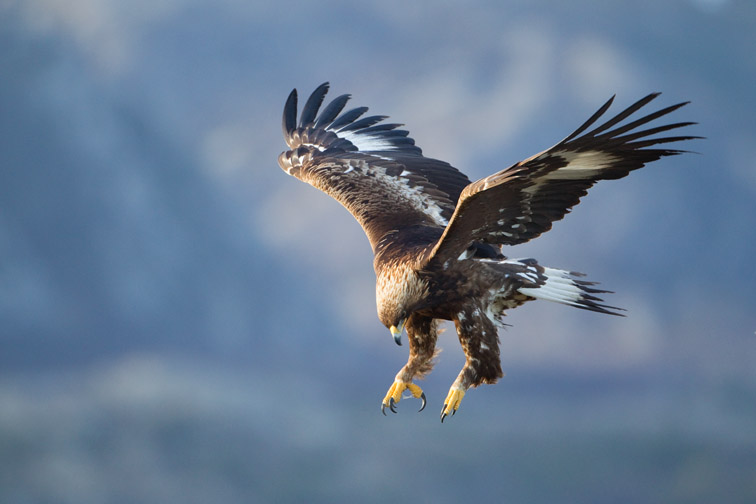
Photo by Mark Hamblin

The latest national golden eagle survey took place in 2015 and the interim results were announced in November 2016. The main headline was that overall, the national population had increased by 15%, rising from 442 pairs recorded during the last national survey in 2003, to 508 territorial pairs in 2015, and the species was now considered to be in favourable conservation status.

This was excellent and welcome news, but as we pointed out at the time, the headline masked a more sinister situation. Although the national population had surpassed 500 territorial pairs, the magic number needed to upgrade the species’ national conservation status from ‘unfavourable’ to ‘favouable’, it was still well below the estimated capacity of 700 pairs. This meant that approx 200 pairs of golden eagles were still ‘missing’.

Unsurprisingly, the national survey revealed that golden eagle populations in the driven grouse moor areas of eastern and southern Scotland were still being suppressed and had not shown any significant sign of recovery since the previous national survey in 2003. Illegal persecution has been identified time and time again as the main constraint on population growth in these regions.

The formal scientific peer-reviewed results of the 2015 national survey were published last week in the journal Bird Study [Hayhow, D., Benn, S., Stevenson, A., Stirling-Aird, P. and Eaton, M. (2017). Status of golden eagle Aquila chrysaetos in Britain in 2015. Bird Study].

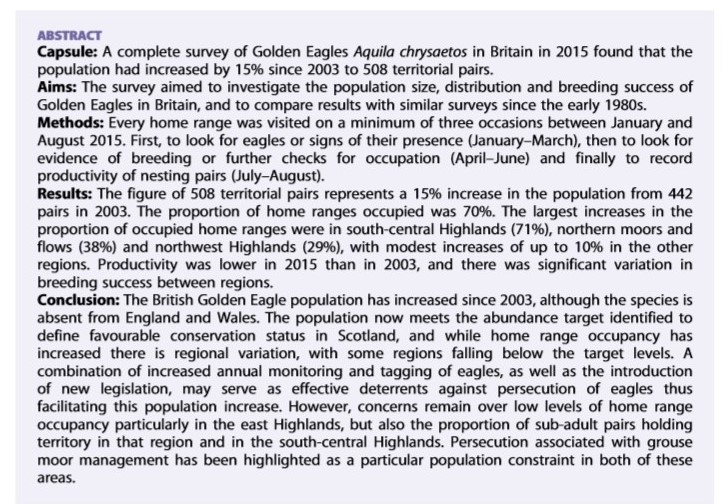
Unfortunately publishing restrictions do not permit us to upload the full paper (you’ll have to subscribe to Bird Study for full access) but here is the abstract:

[UPDATE: This paper is now fully available online, free access, thanks to the BTO. Click here]

In additon to details about the continued low occupancy on grouse moors in the eastern Highlands, the paper also provides information that dispels a couple of myths that are frequently claimed as ‘facts’ by the SGA and co.

You might remember the SGA giving evidence to a parliamentary committee earlier this year where they claimed that “the Cairngorms National Park held the highest density of eagles in the world“. They might want to have a look at this map. This is the distribution of pairs of golden eagles in 2015 and shows the densities of occupied home ranges by 10 x 10 km squares. As you can see, the highest densities of golden eagles were recorded in the Outer Hebrides and on Mull (no grouse moors in these areas):

Another commonly-heard myth, usually trotted out to support calls for the ‘control’ of white-tailed eagles, is that re-introduced white-tailed eagles are displacing golden eagles and taking over their territories/nest sites, even though recent research has demonstrated that these two species partition their habitat and prey preferences in western Scotland. In this latest paper, the authors comment:

Although we have not assessed this in the current study, we report increases in golden eagles numbers in regions such as the Hebridean Islands in which there has been a rapid increase in white-tailed eagles (Holling 2016), which suggests that, at least at current population levels, there has been no major impact“.

The authors do acknowledge that the white-tailed eagle population is predicted to continue its expansion and this may, potentially, create competition between the two species in the future but right now, based on the currently available data, there is no evidence to suggest this is a population-level concern.

The main current threat to Scottish golden eagles is the same as it was following the previous national survey, fourteen years ago. And that is illegal persecution on some driven grouse moors in the eastern Highlands and south Scotland. The grouse-shooting representatives can continue to deny it, but this latest paper is yet another nail in the coffin of this filthy industry.

Imagine that! Satellite tags continue to function after non-suspicious deaths of two hen harriers

This morning the RSPB announced that two of this year’s satellite-tagged hen harriers, Mannin & Grayse, had died in non-suspicious circumstances.

Both had been tagged at a nest on the Isle of Man in July 2017. Grayse was discovered dead on the island on 9th August. Her brother Mannin left the island on 14th August and made a failed attempt to cross the sea to the Galloway coast in SW Scotland. After ten days at sea, his body was found washed up on the Scottish shoreline on 24th August 2017.

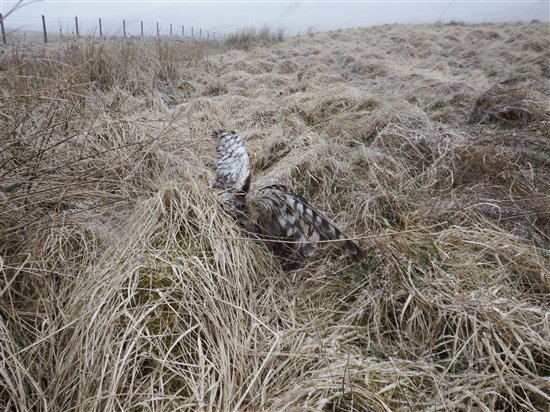
Photo of Mannin & Grayse before they fledged (photo by James Leonard).

The bodies of both birds were submitted for post mortems, neither of which indicated their deaths were suspicious.

Although the deaths of these two harriers is disappointing, natural mortality is, well, natural and not unexpected.

What’s unusual about these two harriers is that their satellite tags continued to transmit data after the birds had died. That shouldn’t be a surprise, because that’s how these tags are designed to work and in most countries, that is how they work. Researchers are routinely able to use the data from the still-transmitting tags to locate the dead body and work out what happened to cause the animal’s death.

It seems it’s only in the UK, and particularly on grouse moors, where satellite tags on dead raptors routinely and abruptly stop transmitting, and vanish off the radar, along with the raptor’s corpse.

Funny, that.

The recent Golden Eagle Satellite Tag Review found that this happened much more often in Scotland than in any other countries where the same tags are deployed (England was not included in the analysis because Natural England is still sitting on the tag data – probably because NE knows just how devastatingly embarrassing a data analysis of tagged hen harriers will be).

Cabinet Secretary Fergus Ewing’s constituency a hotspot for ‘disappearing’ sat-tagged raptors

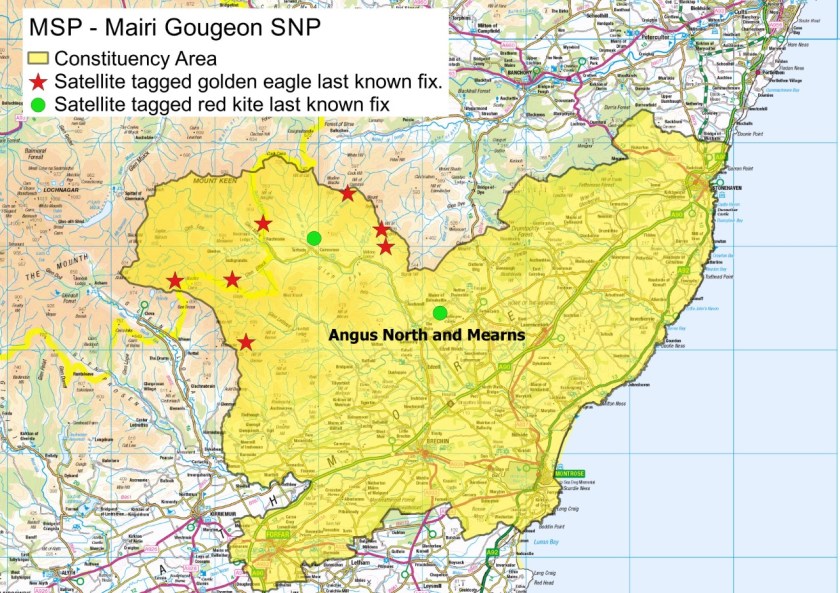
A few weeks ago we created a map for Mairi Gougeon MSP (Angus & Mearns, SNP) to show her the areas of her constituency where satellite-tagged raptors had either been found illegally killed or had ‘disappeared’ in suspicious circumstances. Unsurprisingly, the main hotspot area was centred on the grouse moors of the Angus Glens.

Mairi, as the Hen Harrier Species Champion, attended this year’s Hen Harrier Day at Loch Leven where she acknowledged the issues and spoke passionately about the need to address illegal raptor persecution. We welcomed her interest and enthusiasm and look forward to seeing her use her position to good effect.

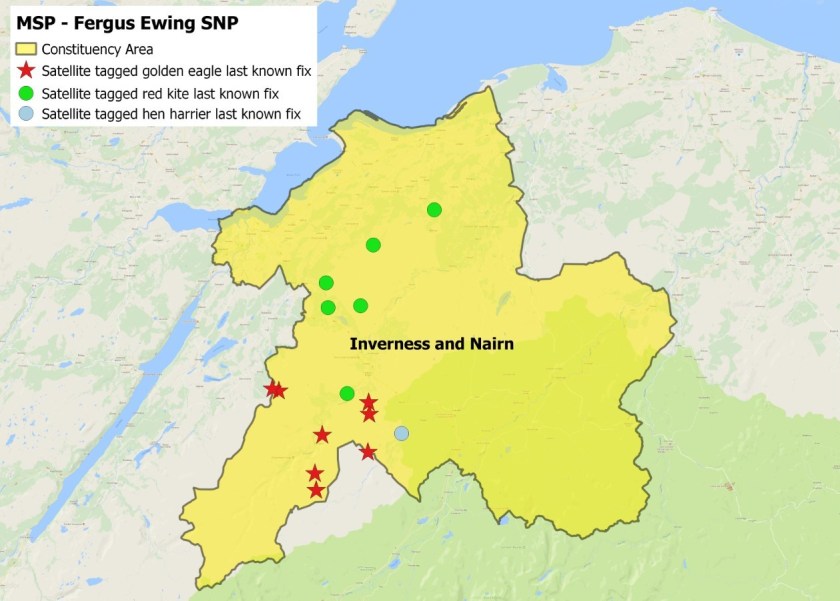
We’ve now created another map, this time for MSP Fergus Ewing’s constituency of Inverness and Nairn. For new readers, Fergus also holds a senior position in the Scottish Government – he is Cabinet Secretary for the Rural Economy and Connectivity.

This latest map is based on data from the recent expert review of golden eagle satellite tag data and also from the RSPB’s recent map showing the locations of ‘disappeared’ or illegally killed satellite-tagged hen harriers and red kites. Here it is, showing the locations of 15 satellite-tagged raptors (8 x golden eagles, 6 x red kites, 1 x hen harrier) that were either illegally killed in Fergus’s constituency or ‘disappeared’ in suspicious circumstances in his constituency:

And just like the map we created for Mairi, the hotspot areas within Fergus Ewing’s constituency all just happen to be on land managed for driven grouse shooting. Imagine that!

Unlike Mairi Gougeon MSP, as far as we can tell, Cabinet Secretary Fergus Ewing has never publicly spoken out about the illegal persecution of raptors on grouse moors, either within his own constituency or beyond (if anyone has any evidence to the contrary we’ll be happy to post it here).

He did, sort of, hint at it in a statement he made about grouse shooting in 2015 when he was Minister for Business, Energy and Tourism:

I am very pleased to be able to extend support to all of those who make a success of fields sports in a professional and responsible fashion. Their efforts bring to Scotland a number of visitors who are very welcome and make a significant financial contribution to the sector”

but you’ll note that he very carefully avoided mentioning raptor persecution crimes or any of the other environmentally damaging effects of intensive grouse moor management.

And he can’t claim that he’s unaware of what’s going on – we’ve contacted him on social media many times about this issue, especially when persecution incidents have been detected in his constituency (most recently in July – see here). He has chosen to ignore us at every turn and has given his full public support to grouse moor management in well known raptor persecution hotspots including the Angus Glens and the Monadhliaths.

If you live in Fergus Ewing’s constituency of Inverness and Nairn, you might want to contact him to ask him what he’s doing about the illegal killing of raptors on grouse moors in this area. He has a responsibility to respond to the concerns of his constituents. Email: Fergus.ewing.msp@parliament.scot

If you don’t live in Inverness and Nairn but wish to raise concerns about the level of illegal raptor persecution on the grouse moors of this Cabinet Secretary’s constituency, please use this email address: Scottish.Ministers@gov.scot [and mark it for the attention of Fergus Ewing].

For far too long we’ve allowed certain politicians to get away with wilful blindness about this ongoing criminality. It’s up to all of us to hold these elected representatives to account.

A shedload of golden eagles satellite tagged in new RPUK/Chris Packham project

At last weekend’s British Birdfair at Rutland Water we joined with Chris Packham to launch a new joint project.

Privately funded by a pair of extraordinarily generous and supportive philanthropists, this project has been in development since the New Year. We are grateful not only to our funders, but also to a number of people without whose help the project would have been a non-starter.

This year our project has focused on fitting satellite tags to young golden eagles across Scotland. At this stage we’re not announcing how many eagles have been tagged, or where, exactly, they’ve been tagged (the location of nest sites must remain confidential for obvious reasons), but let’s just say we’ve tagged a shedload. Here’s a small subset:

The tags were fitted in June and July by highly experienced & appropriately licensed fieldworkers, with the support of several landowners, some of whom came along on tagging days. All the tagged eagles have fledged successfully and they are all hanging out in their natal territories, as expected.

Researchers have been satellite-tagging golden eagles in Scotland since 2004. This new technology has revolutionised our ability to better understand golden eagle ecology, and particularly the birds’ early years of life when they leave their parents’ territory and wander around the country before they attempt to settle in a territory of their own and join the breeding population at between 3 to 5 years of age. For an excellent first-hand and simple explanation of how the technology works in practice, have a read of this blog written last week by Stuey Benn of the RSPB.

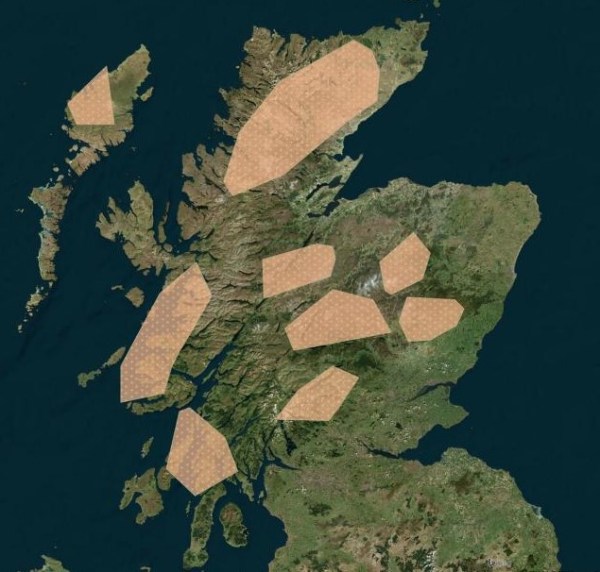
Understanding golden eagle juvenile dispersal behaviour has important conservation implications because at present, Special Protection Areas designated specifically for golden eagles are based on the number of breeding pairs present in a particular area, and not on the number of juvenile eagles present. Research on 36 satellite-tagged golden eagles, undertaken by Ewan Weston for his PhD (published in 2014), identified nine distinct areas, known as Temporary Settlement Areas (TSAs) where these young birds tended to spend a lot of time during certain months of the year. Here’s a map we’ve created, based on data published in Ewan’s PhD, of these nine TSAs.

The identification of these areas would have been virtually impossible without the use of satellite tags. The data collected from our tagged eagles will contribute to this ongoing scientific research to help determine the importance of these, and perhaps other yet-to-be-discovered TSAs, which may lead in future to some areas being newly designated / protected for golden eagle conservation purposes.

Of course, along with the invaluable scientific data generated by these satellite tags, showing us how golden eagles utilise different landscapes, we are also learning a lot about how one type of land-use, intensively managed driven grouse moors, is impacting negatively on the golden eagle population. This has been known for some time, but the recently published Golden Eagle Satellite Tag Review clarified in which particular grouse moor areas satellite-tagged eagles are being illegally killed or are ‘disappearing’ in suspicious circumstances.

When the Review was published in May this year, we created this map to show the significant clustering of satellite-tagged eagles that had either been confirmed as illegally killed or the tags had suddenly stopped working in suspicious circumstances and the tags and eagles had ‘disappeared’ off the face of the earth:

The clusters around the Cairngorms National Park, including the Monadhliaths to the NW and the Angus Glens to the SE, are all areas where the land is intensively managed for driven grouse shooting.

Interestingly, when you overlay these data of killed or ‘missing’ satellite tagged eagles on to the map showing the Temporary Settlement Areas utilised by juvenile golden eagles, this is what you get:

[Yellow stars = satellite-tagged eagles confirmed as illegally killed; red stars = satellite tags that suddenly stopped functioning in suspicious circumstances and the tag & eagle nowhere to be found].

It’s quite clear then, that in some driven grouse moor areas, particularly in the Angus Glens, the Monadhliaths, and the NE and SW areas of the Cairngorms National Park where young golden eagles are spending a lot of time, illegal persecution is an ongoing threat.

Obviously we don’t yet know where our tagged eagles will disperse to, and whether they might head for some of these dangerous TSAs, but we’re about to find out.

We’ll be providing updates on our eagles’ movements over the coming months and if the tag data indicate that any of our birds have come to any harm, we’ll first be reporting it through the proper channels to the Police and then we’ll be publishing appropriate details on this blog.

Stay tuned!

Species Champion Mairi Gougeon MSP speaks up for hen harriers

‘Species Champions’ are members of the Scottish Parliament who have agreed to provide political support and awareness for Scotland’s threatened wildlife, under a scheme organised by Scottish Environment LINK.

Mairi Gougeon (nee Evans) MSP is the Species Champion for the hen harrier, and it was fantastic to see her attend Hen Harrier Day at Loch Leven a couple of weeks ago. She wasn’t the only MSP present – also in attendance was Alexander Stewart MSP (Scottish Conservatives) and Andy Wightman MSP (Scottish Greens) – Andy had cycled from Edinburgh and broke his pedal 5 miles away but still managed to make it on time – impressive!

It was gratifying to see all three of these politicians giving up their Saturday to come along. And they didn’t just turn up for the photo call and then clear off; they spent a considerable amount of time talking with the public, asking pertinent questions (and listening to the responses!) and they all stayed to hear the presentations throughout the afternoon. Mairi even gave a short but very encouraging presentation – you can watch it here (it’s only 4 mins long – well worth a listen, thanks to Guy Shorrock for recording it):

Perhaps of all three politicians in attendance, Mairi had the most cause to be there. Not just as the Hen Harrier Species Champion, but also because her SNP constituency is Angus North & Mearns, which includes the Angus Glens grouse moors, a notorious raptor persecution hotspot.

The history of illegal raptor persecution in this area is well known (see here for a long list of incidents), and it’s also known for its lack of breeding hen harriers – not a single recorded breeding attempt on these grouse moors for 11 years, although there was one breeding attempt in the area this year, but it wasn’t on a driven grouse moor. It’s clear from Mairi’s speech that she is well informed about the situation there.

Here’s a map we’ve created for Mairi to study. It’s a map of her constituency and includes data from the recent expert review of golden eagle satellite tag data and also from the RSPB’s recent map showing the locations of ‘disappeared’ or illegally killed satellite-tagged hen harriers and red kites. It’s quite clear that it’s the grouse moor areas of the Angus Glens that are bringing her constituency in to such disrepute.

Thanks to all three MSPs for their genuine interest in protecting the hen harrier and particular thanks and good luck to Mairi – we hope blog readers will support her endeavours to draw political attention to this species’ plight.

More illegal raptor persecution hotspots revealed in new map

Ian Thomson, Head of RSPB Investigations Scotland has written an interesting blog examining the ‘disappearance’ and/or illegal killing of satellite tagged red kites and hen harriers – see here.

It’s well worth a read. And take a close look at this map, illustrating the locations of suspicious disappearances as well as where the corpses have been found:

Here’s a direct quote from Ian:

It is clear from this map that, like golden eagles, the distribution of illegally killed or suspiciously disappeared satellite-tagged red kites and hen harriers is far from random, and shows clear clusters in some upland areas. As with the “hotspots” for eagles, these clusters are almost entirely coincident with land dominated by driven grouse shooting management, again including areas like the northern Monadhliaths and the Angus Glens. But, harriers and kites have clearly being targeted in other regions – notably, but not exclusively, upper Strathspey, Strathnairn and the Lowther Hills of S Lanarkshire‘.

Following the recent news that the RSPB, in partnership with LUSH, has satellite-tagged a record number of hen harriers this year, we can expect many more dots to appear on this map, most of them will be added before Xmas.

We’ll be undertaking some finer analyses of this map, probably next week, and we’ll be asking blog readers to get involved. More on that soon.

There’s one other point in Ian’s blog that is worth highlighting here, in response to the unsubstantiated yet repeated claims by some that raptors do better on driven grouse moors than they do on RSPB reserves:

More pairs of hen harriers bred successfully on one RSPB reserve on Islay in 2017, than on the grouse moors of Aberdeenshire, Kincardineshire, Angus and the Scottish Borders put together. In fact, RSPB nature reserves hold 10% of Scotland’s breeding population of hen harriers, with 46 pairs in 2016‘.

How many hen harriers do you think bred successfully on Scottish grouse moors in 2016 (where driven shooting took place – not on moors which are currently not being shot)?

Photo of hen harrier Annie, who was found shot on a grouse moor in South Lanarkshire in 2015. (Image: RSPB Scotland).

“The hen harrier…..this is a nasty bird of evil habits. It must be got rid of at all costs”

The hen harrier….this is a nasty bird of evil habits. It quarters the moor a few feet above the ground and pounces on grouse or chicks it catches unawares. It must be got rid of at all cost”.

This is a quote. You might think it’s attributable to Amanda Anderson (Director, Moorland Association). It’s not that far off her infamous quote last year:

If we let the harrier in, we will soon have nothing else. That is why we need this brood management plan“.

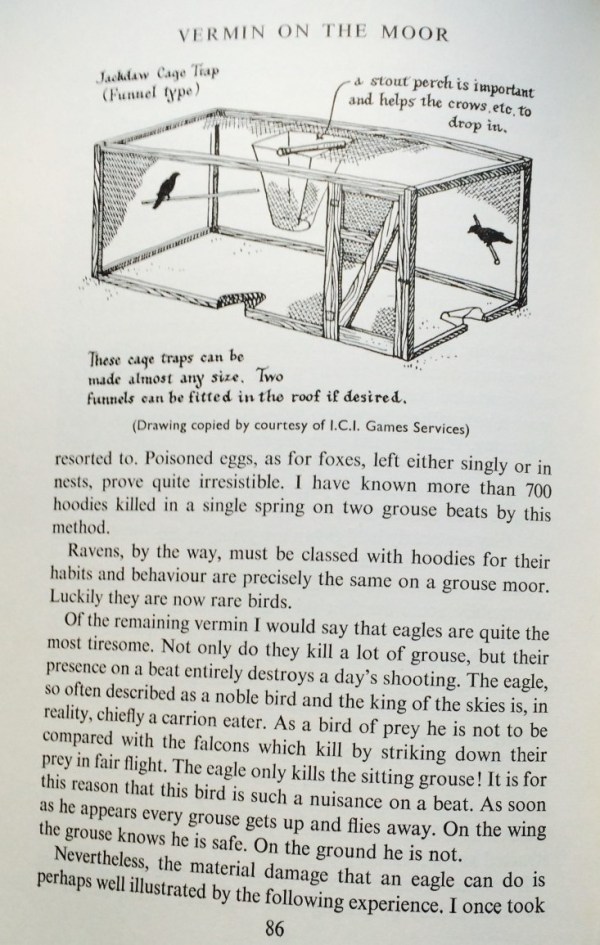
But our quote isn’t from Amanda. It’s from a book called Grouse: Shooting and Moor Management, first published in 1958 (er, four years after the Protection of Birds Act became law!) and written by Richard Waddington who had a grouse moor in what is now the eastern side of the Cairngorms National Park.

Obviously stuck in a Victorian time warp, another quote from the chapter called ‘Vermin on the Moor’:

Eagles can very easily be trapped…..They can also sometimes be shot. However, since they are vigorously protected throughout Scotland it is perhaps wisest to say nothing on this subject. But if you want a successful grouse shoot you must find some means of ridding yourself of eagles“.

[Thanks to the blog reader who drew this book to our attention, also quoted in Mark Avery’s book Inglorious].

And here we are, well over half a century later, and not much has changed, has it? A number of grouse shooting estates are quite clearly still ‘ridding themselves of eagles’, including some on the eastern side of the Cairngorms National Park (see here), while breeding hen harriers have been eradicated from many Scottish grouse moors (see here) and virtually every English grouse moor (we heard there was a pair this year on a grouse moor in the Yorkshire Dales but apparently, we’re told, it ‘disappeared’. Presumably this will be confirmed by Natural England at some point. But then again…).

The fight back continues though. For the fourth successive year, Hen Harrier Day events will be happening throughout the UK over the weekend of 4-5 August (and an event on the Isle of Mull on 29 July 2017). Full details of each event can be found on the Hen Harrier Day website HERE

Find one near to you (or find a distant one and have a road trip) and turn up, join in and show your support. We’ll be at the Tayside event (along with other speakers) on Saturday 5 August and also at the Highland event on Sunday 6th. We look forward to seeing some of you.

More distorted facts from Scottish Moorland Group Director Tim Baynes

We’ve all learned by now how Tim (Kim) Baynes, Director of SLE’s Scottish Moorland Group, likes to spin the facts; we only wrote about it last week (see here).

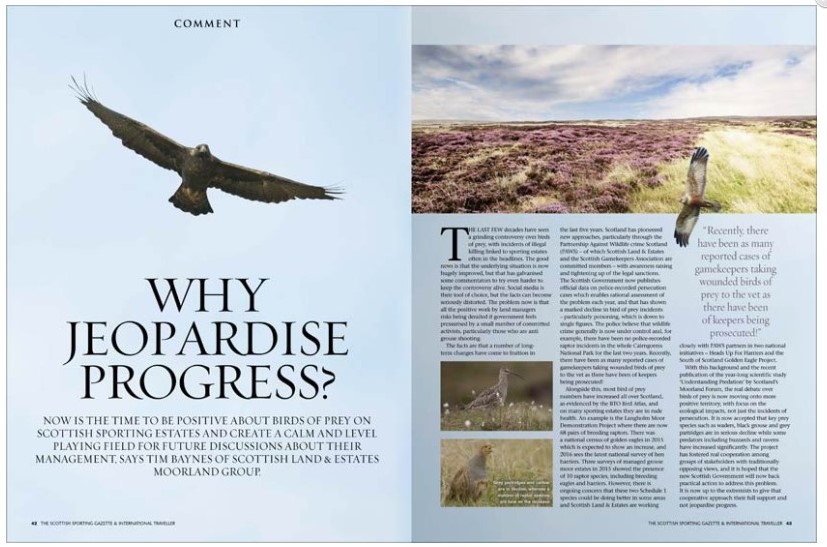
Here’s another well-spun article. We missed it when it was published in the Scottish Sporting Gazette (Summer 2016) but someone has kindly sent through. It’s classic Tim (Kim), pretending that illegal persecution is no longer an issue and also pretending that most conservationists (apart from us so-called ‘extremists’) now support the idea of some form of raptor ‘control’.

“The last few decades have seen a grinding controversy over birds of prey, with incidents of illegal killing linked to sporting estates often in the headlines. The good news is that the underlying situation is now hugely improved, but that has galvanised social commentators to try even harder to keep the controversy alive. Social media is their tool of choice, but the facts can become seriously distorted. The problem now is that all the positive work by land managers risks being derailed by a small number of committed activists, particularly those who are anti-grouse shooting.

The facts are that a number of long-term changes have come to fruition in the last five years. Scotland has pioneered new approaches, particularly through the Partnership Against Wildlife Crime (PAWS) – of which Scottish Land & Estates and the Scottish Gamekeepers’ Association are committed members – with awareness training and tightening up of legal sanctions.

The Scottish Government now publishes official data on police-recorded persecution cases which enables national assessment of the problem each year, and that has shown a marked decline in bird of prey incidents – particularly poisoning, which is down to single figures. The police believe that wildlife crime generally is now under control and, for example, there have been no police-recorded raptor incidents in the whole Cairngorms National Park for the last two years. Recently, there have been as many reported cases of gamekeepers taking wounded birds of prey to the vet as there have been keepers being prosecuted!

Alongside this, most bird of prey numbers have increased all over Scotland, as evidenced by the BTO Bird Atlas, and on many sporting estates they are in rude health. An example is the Langholm Moor Demonstration Project where there are now 68 pairs of breeding raptors. There was a national census of golden eagles in 2015 which is expected to show an increase, and 2016 sees the latest national survey of hen harriers.

Three surveys of managed grouse moor estates in 2015 showed the presence of 10 raptor species, including breeding eagles and harriers. However, there is ongoing concern that these two Schedule 1 species could be doing better in some areas and Scottish Land & Estates are working closely with PAWS partners in two national initiatives – Heads Up for Harriers and the South of Scotland Golden Eagle Project.

With this background and the recent publication of the year-long scientific study ‘Understanding Predation’ by Scotland’s Moorland Forum, the real debate over birds of prey is now moving onto more positive territory, with focus on the ecological impacts, not just the incidents of persecution. It is now accepted that key prey species such as waders, black grouse, and grey partridges are in serious decline while some predators including buzzards and ravens have increased significantly. The project has fostered real cooperation among groups of stakeholders with traditionally opposing views, and it is hoped that the new Scottish Government will now back practical action to address this problem. It is now up to the extremists to give that cooperative approach their full support and not jeopardise progress”.

END

We could spend all day pointing out the spin in Tim’s (Kim’s) claims, such as there being no police-recorded raptor persecution incidents in the Cairngorms National Park for two years (not quite true – see here), or that there are more reported cases of gamekeepers taking wounded raptors to the vets than there are of gamekeepers being prosecuted, implying that gamekeepers are no longer committing alleged offences (not quite true – see here), or implying that eagles and harriers were successfully breeding on three surveyed grouse moor estates in 2015 (not quite true – see here), or that most bird of prey numbers have increased all over Scotland (not quite true – see here, here, and incidentally both these scientific papers were published before Tim (Kim) wrote this tripe), or implying that all stakeholders, with traditionally opposing views, are now supportive of backing what Tim (Kim) calls ‘positive action’ against raptors (what he means is licenced ‘control’) – again, this is not true. Name one conservation NGO that doesn’t have a vested interest in game shooting who supports this idea?

One year on from Tim’s (Kim’s) world of fantasy, and our so-called ‘extremist’ claims that illegal persecution is still rife on many driven grouse moors has been validated by the findings of the recently published golden eagle satellite tag review. It is now apparent even to the Scottish Government that illegal raptor persecution continues, albeit very well hidden (apart from if the targeted raptor victim happens to be wearing a satellite tag) and on the basis of this overwhelming evidence, we are finally set to see some action.

Thank goodness the policy makers haven’t listened to Tim’s (Kim’s) distorted point of view.

UPDATE 22 June 2017: Retired Police Wildlife Crime Officer Alan Stewart has blogged about this article here

Technology challenge launched to solve problem of finding hidden or destroyed satellite tags

The Cairngorms National Park Authority has joined forces with Scottish Natural Heritage to co-sponsor a new CivTech challenge aimed at finding a creative and innovative technology-based solution to the problem of finding ‘disappearing’ satellite tagged raptors.

As you’ll be aware, satellite-tagged raptors are ‘disappearing’ in Scotland and England with increasing frequency. There was a time, in the early years of satellite tagging raptors, that illegally-killed birds would be found as their tags were still emitting signals allowing researchers to pinpoint the location of the corpse and thus evidence of the crime (e.g. poisoned golden eagle Alma whose corpse was found on Millden Estate in the Angus Glens in 2009). However, the raptor-killing criminals got wise to this and in recent years have been making more effort to destroy and hide the tag at the same time as killing the bird.

This lack of hard evidence causes problems for the wildlife crime enforcement agencies because it becomes very hard to prove that the bird has actually been killed. In a small number of cases, the satellite tag could just have malfunctioned, and we have seen evidence of this (e.g. hen harrier Highlander here), although the expected frequency of this happening is very low (the recent golden eagle satellite tag review identified tag reliability, based on studies of the same tags deployed in the US and Europe, as around 98%). Nevertheless, even with the high number of ‘disappearing’ tagged raptors in Scotland but little hard evidence of criminality, researchers have still been able to identify unusual concentrations / spatial clusters of where these birds have ‘disappeared’ in suspicious circumstances.

For example, here is a map showing the significant spatial clustering of ‘disappeared’ tagged golden eagles that just happen to be concentrated in several areas of driven grouse moors in and around the Cairngorms National Park, as identified in the golden eagle satellite tag review:

This identification of ‘suspicious’ persecution hotspots is excellent, and has contributed significantly to the Scottish Government finally accepting that this is an on-going problem that needs addressing, but it doesn’t provide enough information to instigate criminal proceedings against those involved. More hard evidence is required for that.

CivTech is a Scottish Government-led initiative, first piloted in 2016, which challenges creative technologists to come up with a solution to public sector problems. Some of the first challenges included improving flood forecasting and ensuring it is better used, and improving air quality in urban areas.

The joint Cairngorms National Park Authority / Scottish Natural Heritage challenge invites technologists to look at the problem of ‘disappearing’ satellite-tagged raptors and to devise a solution to find those tags, or at least provide ‘indestructible’, real-time information about the tag’s last location before it was tampered with. This probably won’t overcome the long-term problem of identifying an actual individual criminal, especially on an estate that employs multiple gamekeepers, but it might just be enough to create a deterrent. At the very least, it should provide enough information for the Scottish Government to impose civil sanctions on that estate – sanctions that are currently being discussed after Roseanna Cunningham’s announcement last month.

Opening up this challenge to the CivTech community is a very clever idea as it will reach an audience that probably knows nothing of this issue, and who may well come up with a solution that is beyond the expertise of the typical conservationist. Who knows what the technology geeks will come up with? The two instigators of the challenge (Grant Moir from CNPA and Keith Duncan from SNH) are open-minded as to what the solution might look like, e.g. a software-based solution that can be applied remotely to tags that are already deployed, or a new hardware solution that involves fitting a new gadget on to new raptors. Any new solution may be trialled in the Cairngorms National Park, a massive raptor persecution hotspot, and if successful, could be rolled out across the UK.

The closing date for applications has already passed (1 June 2017) and a ‘pitch day’ has been set for 26 July 2017.

Well done Grant and Keith. We look forward to hearing more about this later in the year.

Scottish Gamekeepers’ Association’s response to eagle satellite tag review

We’re slowly making our way through the recently published Golden Eagle Satellite Tag Review.

What an incredible piece of research! It goes far deeper than answering the simple question, ‘Is there a pattern of suspicious activity surrounding the ‘disappearance’ of many satellite tagged golden eagles?‘ (Answer: an unequivocal YES). The authors, Dr Phil Whitfield & Dr Alan Fielding, deserve much credit not only for their forensic analysis and clarity of presentation, but also for the extent of their review, demolishing long-held myths about the supposed unreliability of satellite tags, the supposed harmful effect of satellite tagging golden eagles (at an individual and population level), and the notion that wind farms are responsible for the ‘disappearance’ of many satellite-tagged golden eagles in Scotland. If you have the time to read beyond the headlines in this review, you’ll be rewarded with some really useful information that exposes the grouse shooting industry’s interminable denial about what’s been going on, some of which we discuss below.

Last Wednesday, the day the review was published, the Scottish Gamekeepers’ Association responded with this official statement:

Statement (in full, as given to media early today): SNH Report into missing tagged eagles

A Spokesman for the Scottish Gamekeepers Association said: “Losing, on average, 4 tagged eagles per year across Scotland is totally unacceptable. The illegal killing of any eagle is condemned wholeheartedly by the SGA and all law abiding gamekeepers.

Although this study assimilates 12 years of evidence and makes difficult reading, it does acknowledge recent improvements in some grouse moors areas previously associated with suspected persecution. This change has contributed to the overall betterment of the golden eagle’s conservation status, as recently reported.

That said, problems clearly still exist in some hotspot areas and, in our view, this can only be tackled by all partners having access to the same telemetry data in order to arrive at shared and targeted solutions. If this had been happening over the past decade, there is a high likelihood these problems could have been tackled satisfactorily before now.

The SGA does not believe the report adequately tackles the threat wind farms pose to raptor species as there is a significant amount of published data from other countries which show a negative correlation between bird survival and turbine strike.

However, that is not an attempt in any way to detract from the report’s findings“.

END

The SGA says the report “made difficult reading“. It’s apparent, from their official statement, that the report also made for difficult comprehension (for them). They refer to recent improvements in some grouse moor areas which led to the golden eagle’s national conservation status changing from ‘unfavourable’ (largely due to illegal persecution) to ‘favourable’, as we blogged about here. However, what the SGA has conveniently forgotten to mention is the following statement from the golden eagle satellite tag review:

We also expect that there may have been some recovery in some parts of the central and eastern Highland regions where the species’ conservation status was previously unfavourable due largely to illegal persecution. These regions, however, still yield evidence of continued illegal persecution in parts, and so we would not expect recovery to the full capability of breeding birds being evident‘.

In other words, the recent improvements in some areas do not off-set the continued illegal persecution that is, quote, “still hampering overall recovery from historic, widespread persecution“.

The SGA does acknowledge that “problems still clearly exist in some hotspot areas” but then claim that “this can only be tackled by all partners having access to the same telemetry data in order to arrive at shared and targeted solutions. If this had been happening over the past decade, there is a high likelihood these problems could have been tackled satisfactorily before now”.

Eh? Are they suggesting that before the publication of this review, they were totally unaware of where these hotspot areas were? Talk about disingenuous. They’ve been made fully aware, for many years, of where these persecution hotspots are (some intensively managed grouse moors in the Monadhliaths, eastern Cairngorms, Angus Glens and parts of north Perthshire), through their participation in the PAW Scotland Raptor Group and also from widespread media coverage every time a sat tagged raptor has ‘disappeared’ or every time a raptor has been found illegally poisoned, shot or trapped in these, and other areas. Their feigned ignorance is ludicrous.

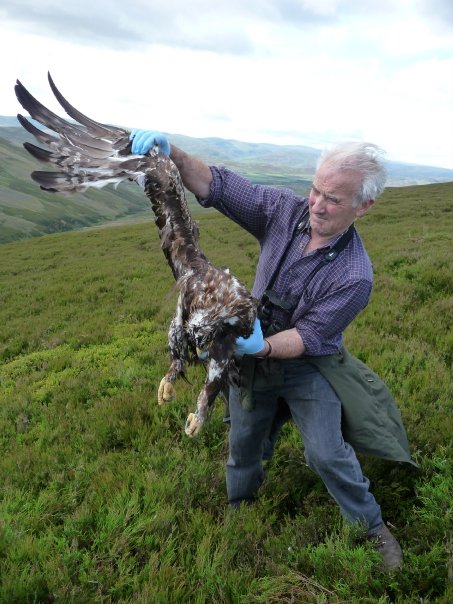
They argue that if they’d had access to the sat tag data, the illegal killing “could have been tackled satisfactorily before now“. How? By telling gamekeepers on the ground which tagged eagles are in the area so don’t shoot those ones? It’s worth remembering how the SGA reacted when they were given access to detailed information about one tagged golden eagle, that was illegally trapped on a grouse moor in the Angus Glens, suffering two broken legs as a consequence (both almost severed, according to the Golden Eagle Sat Tag Review), and then was moved, while still alive, in the middle of the night to be dumped in a lay by on Deeside 15km away and left to suffer an excruciating and miserable death (see here). Did the SGA accept the findings of the independent expert veterinary pathologist and come down like a tonne of bricks on the estate? No, they concocted the most outlandish explanation for what might have happened to that eagle and then slagged off the RSPB for suggesting a crime might have taken place (see here). If that’s the SGA’s idea of ‘tackling the problem satisfactorily’ then it’s no wonder the illegal killing continues.

Photo of the ‘Deeside’ golden eagle (RSPB)

This sat tag review has validated the long-held concerns of conservationists that parts of the grouse shooting industry are out of control, aided and abetted by the blind-eye turning of industry representatives, and this example is just one of many that shows the industry’s inability to self-regulate and why licensing is now very much on the cards.

The SGA’s response to the satellite tag review then comes back to one of their old favourites, wind farms. Not for the first time have wind farms been cited as being a more serious threat to Scottish raptors than illegal persecution (a myth we’ve debunked at least twice, see here and here). In the SGA’s latest statement it says:

The SGA does not believe the report adequately tackles the threat wind farms pose to raptor species as there is a significant amount of published data from other countries which show a negative correlation between bird survival and turbine strike”.

Dear God. Do they not understand that the potential collision risk of a wind farm will be calculated on innumerable variables (e.g. topography, altitude, wind speed, wind farm size, turbine size, species behaviour, etc etc etc) so just because a wind farm in one country has proven disastrous for some raptor species, it doesn’t then mean that all wind farms, wherever they are sited, are going to have the same negative impact. Of course there are issues, and these are well documented, but had the SGA bothered to read the in depth chapter on wind farms in this sat tag review, they’d have realised that wind farms have been ruled out for causing the ‘disappearance’ of so many satellite-tagged golden eagles. And not ruled out on a whim, but ruled out based on almost half a million location ‘fixes’ of 112 tagged eagles.

In fact, the review has more than adequately tackled the threat of wind farms to golden eagles in Scotland, and in addition to the review’s headline that ‘Wind farms were not associated with any recorded golden eagle deaths‘ the report also includes some startling revelations. Here are some direct quotes:

  • No ‘stopped no malfunction’ last fixes [i.e. abruptly ‘disappearing’ eagles] were within 1 km of an operational wind farm [see map below]. It is difficult to envisage a situation whereby a trauma sufficient to suddenly destroy a tag would allow a bird to travel afterwards for more than 1 km.
  • Moreover, records of tagged eagles close to wind farms were rare with only 0.005% of 360,711 fixes being within 150 m of an operational turbine. This indicated that even the risk of collision with a turbine blade was miniscule. Furthermore, it would add no support to a notion that technicians visiting turbines were discovering and then ‘covering up’ victims of collision, including moving dead birds away from the wind farm before, or then, curtailing the operation of the tag.
  • Overall, there was no evidence that wind farms were a direct or indirect agent of anthropogenic influence on the sudden tag failures of many young golden eagles. The reverse was more evidentially likely – that young golden eagles appeared to avoid operational wind farms.
  • Addressing the frequently heard accusation that wind farm technicians are removing and thereby ‘covering up’ the deaths of raptors that have been struck by a turbine blade, the report says: In Scotland this possibility seems remote given that: a) on incentive, the continued operation of no wind farm in Scotland is conditional on operational monitoring feedback in planning; b) technicians are not employed directly by the developer and are contracted independently by the turbine manufacturer and according to the projected lifespan of the wind farm; c) independent checks on reporting fatalities can be conducted at several wind farms by other contractors, and at least some developers (P. Robson pers. comm.) further blind-check these in staged exercises due to additional baseline legal requirements on environmental liability reporting; and d) many dead birds of prey (including tagged birds) have been routinely recorded incidentally by technical engineers and reported through several channels (e.g. Sansom et al. 2016, Urquhart & Whitfield 2016). In other words there are several checks and balances in Scotland to circumvent the possibility that carcasses of dead birds of prey would not be reported at wind farms and not disposed of once discovered (and even when relatively few birds will have been tagged). Nevertheless, our analyses were grounded to consider such a possibility; however remote.
  • Interestingly, and by contrast, from the many data sources we have received and examined, we are not aware of dead tagged raptors having being reported by managers or employees of game bird shooting estates in Scotland.

So, after trying to muddy the water with commentary about the potential impact of wind farms, even though the review has clearly shown wind farms are not implicated in the ‘disappearance’ of over 40 satellite-tagged golden eagles, the SGA’s official response to the sat tag review concludes with the line:

However, that is not an attempt in any way to detract from the report’s findings”. 

Really? That’s exactly what it looks like to us.

Presumably, then, now the SGA has been made fully aware of where the persecution hotspots are (certain grouse moors in the Angus Glens, Monadhliaths, eastern Cairngorms and north Perthshire), not to mention the other well-known persecution hotspots that didn’t feature in this golden eagle report (e.g. certain grouse moors in the Moorfoots, Lammermuirs and Lowther Hills), we can now expect to see the SGA setting up some ‘targeted solutions’ in these areas? Can’t wait.