‘Effective regulation required for excesses of driven grouse shooting in Scotland’

Duncan Orr-Ewing, Head of Species and Land Management at RSPB Scotland, has written a blog discussing the state of raptor conservation in Scotland, how certain species are still suffering due to the ongoing illegal killing associated with land managed for driven grouse shooting, and how the Scottish Government needs to bring about significant change.

Duncan’s blog is reproduced here:

EFFECTIVE REGULATION MUST BE PUT IN PLACE IN SCOTLAND TO TACKLE THE EXCESSES OF “DRIVEN” GROUSE SHOOTING

Most people accept that the conservation prospects for many raptor species in Scotland have improved in recent decades, and since full protection of these birds in the UK from the 1950s. This is most apparent in the rise in the common buzzard population. This bird of prey species has made a welcome return and can now be seen in almost all of the countryside of lowland Scotland, and even in some of our main towns and cities. Like the common buzzard, various other raptor species have re-established their populations naturally,  particularly when the main constraint of human persecution has ceased or been significantly reduced. Red kite and white-tailed eagle have been given a helping hand by conservationists, working with landowners, through well planned reintroduction programmes, and are also on the way back.

Raptor species are now amongst the most studied birds in Scotland, much of this work prompted by the effects of organochlorine pesticides on their populations from the 1960s. We have good information on the population distribution of most raptor species, as well as a clear scientific understanding of the main threats to their conservation status. There are a number of native raptor species whose populations have not recovered, and these include the hen harrier. National surveys of this species have shown that the population of hen harriers in Scotland has declined between 2004 and 2016 from 633 to 460 breeding pairs, or by 27%. When you scrutinise the data more carefully there are significant geographical differences; the breeding hen harrier population is doing relatively well on Orkney and the Western Isles but is struggling in the eastern and central Highlands and southern uplands. The authoritative Conservation Framework for Hen Harriers in the UK (Fielding et al. 2011. JNCC) estimated that the Scottish breeding population of this species should be between 1467 and 1790 breeding pairs based on the availability of suitable nesting habitat. So what is happening?

What is now becoming clearer is that many raptor populations in Scotland are held below their potential population levels and range because of continuing illegal human persecution on land managed for “driven” grouse shooting. For the raptor species that have got commoner, it is clear to those who monitor them that even these species are largely absent from “driven” grouse moor areas as breeding birds. Equally, the raptor populations that hang on in these areas do not behave as you would expect – traditional nesting sites become occupied periodically, and then breeding birds disappear or nesting attempts routinely fail in mysterious circumstances. Young birds attempt to breed that would normally be excluded from good sites by adult birds. For those species, like the hen harrier, where grouse moors are their most suitable breeding habitat, and where populations remain heavily persecuted , it is held that their populations simply cannot increase without changes in land management culture and behaviours. Population “sinks” occur where the best habitats are repeatedly attracting nesting birds and these birds are repeatedly killed illegally. Most recently, new technological advances in the study of the survival and dispersal of birds, in the form of GPS satellite tagging, have reinforced the point that many of these marked raptors simply vanish without trace in grouse moor areas. The report “Analyses of the fate of satellite tagged golden eagles in Scotland” (Whitfield et al. 2017. SNH) highlighted that a third of a large sample of marked golden eagles disappeared in precisely this way.

[RPUK map, derived from data in the golden eagle sat tag review, showing the last known location of satellite-tagged golden eagles that had disappeared in suspicious circumstances on or close to driven grouse moors]

Sadly, it is now clear to many people involved with raptor conservation efforts that progress has stalled. Until now, the Scottish Government has made important, but piecemeal changes, to raptor protection laws. These measures have had the desired impact in large parts of Scotland. However, on land managed for “driven” grouse shooting, it is equally evident that raptor persecution is such an entrenched part of their business model, that tougher measures are now urgently required. Our RSPB Investigations team report that ever more extreme measures are being deployed by grouse moor gamekeepers to kill birds of prey and avoid detection, including the use of thermal imaging gear and night vision equipment to kill raptors at night. Many in the grouse moor community will tell you quite openly that they do not believe that they can manage their estates to deliver high grouse bags for sporting clients without breaking wildlife protection laws. This appalling situation has been further compounded in recent decades by the arrival on the scene of a new breed of sporting manager, and the proliferation of more intensive grouse moor management methods, involving ever increasing grouse bags for clients to shoot. This type of operator has commercialised grouse shooting. They have the resources to disregard public opinion; they have little concern for Scotland’s international reputation; and feel safe in the knowledge that it is very hard for the public authorities to bring the perpetrators of these wildlife crimes to justice.

From a RSPB Scotland perspective, we have put significant investment over many years into working with responsible landowners. We recognise that many landowners understand the harm that is being done to their sector by the more extreme grouse moor interests, but are apparently powerless to stop this momentum. We have engaged with conflict resolution processes, including the Langholm Moor Demonstration Project, designed to investigate ways that grouse moors can be managed both legally and sustainably. However, we have reluctantly concluded that amongst the “driven” grouse moor sector at least, there is little appetite to adapt businesses in line with modern day expectations. We simply do not think that further piecemeal changes to wildlife protection laws will be adequate.

The current independent Grouse Moor Management Review Group, commissioned by Scottish Government, is due to report in May 2019. This could be an important milestone if we are prepared to accept that a significant change must occur if we are to tackle the deeply embedded cultural issues concerning the current model of “driven” grouse moor management. This is also why the RSPB supports the licensing of “driven” grouse moors, including proportionate sanctions to remove such licences to operate, where the public authorities have good evidence of illegal activities taking place.

ENDS

More on proposed reintroduction of golden eagles to Wales

Last month we blogged about conflicting approaches to the proposed reintroduction of golden eagles to Wales (see here).

One group (Eagle Reintroduction Wales Project, ERW) being led by researchers at Cardiff University is part-way through conducting a careful scoping exercise to properly consider all the factors that need to be addressed before permission for a reintroduction would be granted, e.g. biological and environmental considerations, social and political considerations, and comprehensive risk assessments and an exit strategy.

The other group (Wilder Britain) is a newly registered Community Interest Company being led by Dr Paul O’Donoghue of Wildcat Haven and Lynx Trust UK ‘fame’. A press release from Wilder Britain stated that an application to release golden eagles would be submitted this summer, which appears to us to be premature.

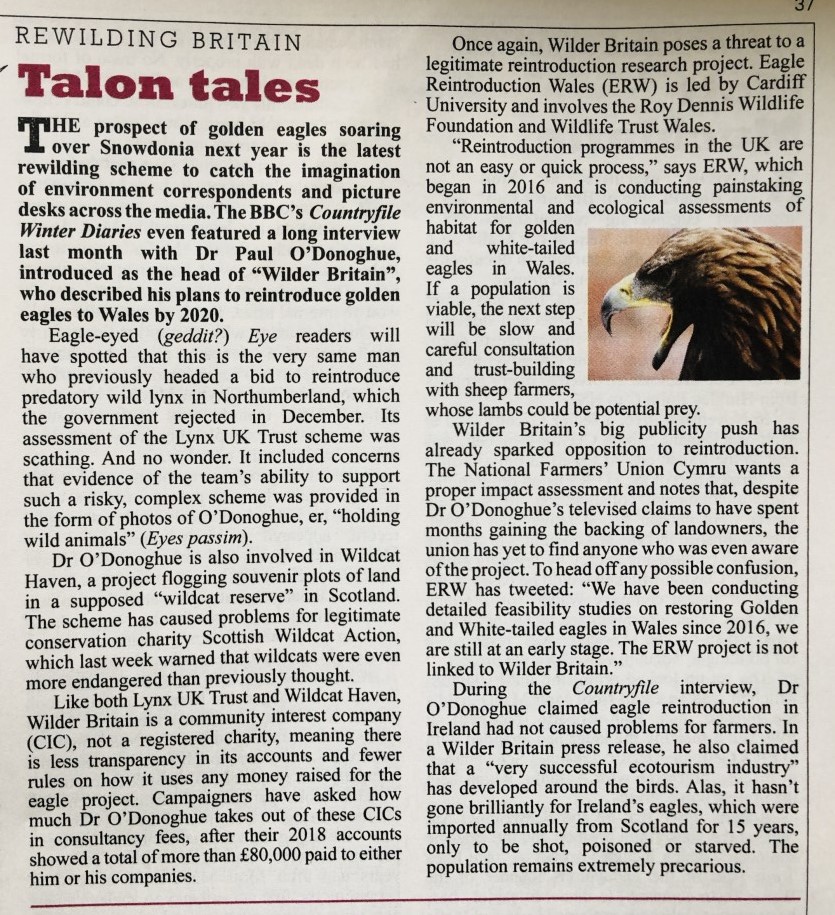
Private Eye picked up on this news and have published a piece in their latest edition:

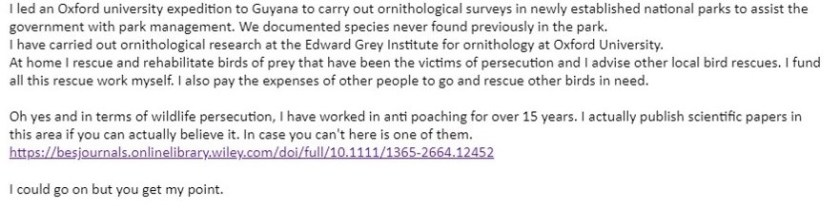
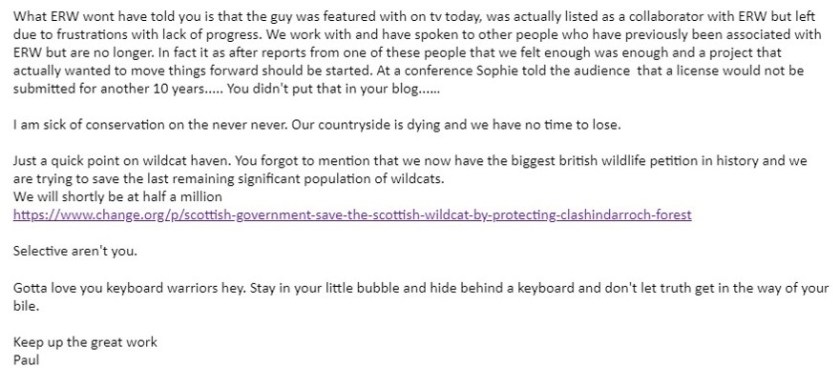
Meanwhile, Dr O’Donoghue wrote to RPUK to complain about last month’s blog. Unfortunately Dr O’Donoghue’s email went straight to the spam folder so it’s only just been discovered but in the interests of transparency it’s published here so that everyone has the opportunity to view his extensive ornithological expertise:

Just a couple of points from us.

When we wrote, “We’re not aware of Dr O’Donoghue’s experience or expertise in ornithology or in the field of raptor research and conservation” in our earlier blog, we did not ‘seek to lead the reader to believe that I [Paul O’Donoghue] have no relevant ornithological experience‘. If that’s what we had wanted to say, that is what we would have said! We said we were not aware of Dr O’Donoghue’s experience or expertise in ornithology or in the field of raptor research and conservation, simply because we weren’t aware of it. His name is not a familiar one in the scientific journals we read.

Having now become aware of Dr O’Donoghue’s ornithological experience and expertise, based on the information he provided, we maintain our support for the Cardiff University ERW Project’s robust approach to assessing the feasibility of a reintroduction of golden eagles to Wales.

Meanwhile, Dr O’Donoghue has been the subject of more media attention, this time at a public meeting to discuss his proposal to reintroduce the Lynx to various sites in Scotland. It didn’t end well, according to the Scottish Farmer (see here).

‘Eagles are being slaughtered as part of serious organised crime’

Revive, the coalition for grouse moor reform held its first ever fringe event at a party political conference yesterday, at the Scottish Labour conference in Dundee.

The event was chaired by Claudia Beamish MSP and three speakers from Revive joined the panel (Dr Ruth Tingay of RPUK, Max Wiszniewski, Revive Campaign Manager, and Dr Craig Dalzell, Head of Policy & Research at Common Weal) with another coalition member (Dr Richard Dixon, Director of Friends of the Earth Scotland) in the audience.

[Photo by Louise Robertson]

Each speaker gave a ten minute presentation followed by approx 20 minutes of questions from the floor.

It was brilliant to see a number of journalists in the audience, resulting in some good coverage in the papers today.

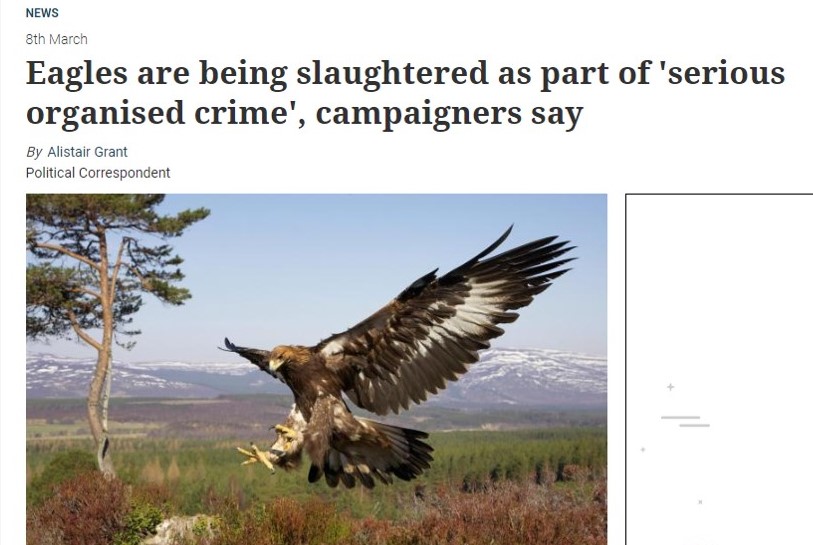
The Herald focused on the illegal persecution of golden eagles and hen harriers on or close to driven grouse moors and journalist Alistair Grant got the message loud and clear that, in our opinion, the extent of this persecution on many driven grouse moors is such that it amounts to serious organised crime. [Definition by the National Crime Agency: ‘Serious crime planned, coordinated and conducted by people working together on a contuining basis. Their motivation is often, but not always, financial gain‘]

Here’s the text from The Herald article:

GOLDEN eagles and other protected birds of prey are being illegally slaughtered in what amounts to “serious organised crime”, a leading expert has said.

Dr Ruth Tingay of Raptor Persecution UK said birds are being killed on or near grouse moors across Scotland before the evidence is then removed to avoid prosecution.

She spoke out during a fringe meeting at the Scottish Labour conference in Dundee.

Claudia Beamish MSP, the party’s environment spokeswoman, said it backed strict new rules for estate owners – including a total ban on the use of lead shot and the large-scale cull of mountain hares.

She said: “In order for grouse moors to continue, if indeed they do, there needs to be very robust licensing.”

Labour delegates heard grouse moors cover almost a fifth of Scotland, with estates handed more than £300,000 a year in public subsidies.

Revive, a coalition of organisations calling for change, insisted estates should be stripped of this cash as part of a crackdown aimed at encouraging radical land reform.

It said the intensive land management associated with driven grouse shooting causes environmental damage.

Meanwhile, there is evidence scores of birds have been illegally killed on or near estates, it said.

Dr Tingay, a leading raptor ecologist, said: “My argument is that what we are seeing here – not just with golden eagles but with other birds of prey, particularly hen harriers, which are also persecuted on driven grouse moors – is serious organised crime.

If the Government accepted this, we would see a lot more resources coming in to deal with this issue.”

She said some estimates suggest 50 eagles a year are disappearing.

Revive is made up of Raptor Persecution UK, Friends of the Earth Scotland, animal charity Onekind, the League Against Cruel Sports Scotland and think tank Common Weal.

Craig Dalzell, head of policy and research at Common Weal, said estates should be opened up to other uses.

He said grouse moors in Scotland had an annual economic impact of £32 million and were responsible for around 2,640 jobs.

In comparison, forestry boasts an annual economic impact of £973m and creates 26,000 jobs, he said.

ENDS

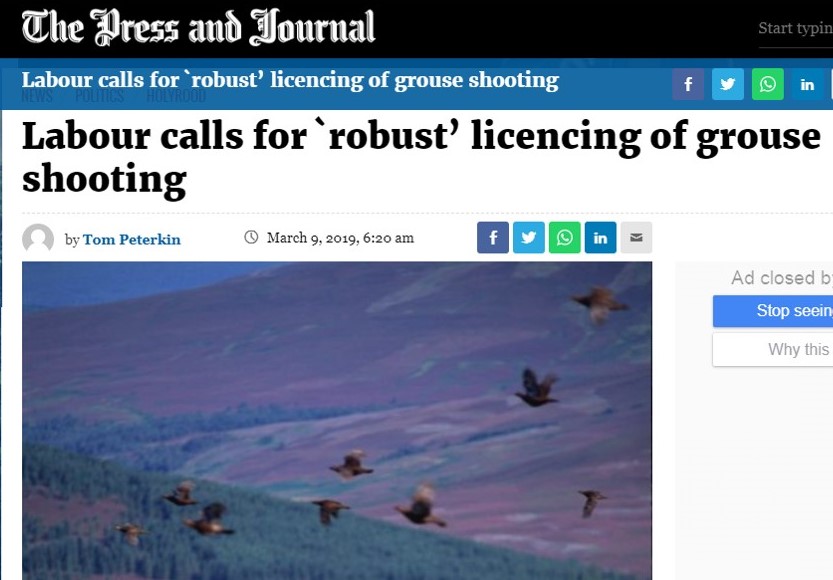
The Press & Journal also covered this fringe event and journalist Tom Peterkin headlined with this:

Here’s the text of the P&J article:

Labour has said there should be robust licencing of grouse shooting amid claims that illegal wildlife killing on sporting estates amounted to “serious organised crime”.

The call was made by Shadow Environment Secretary Claudia Beamish at a Labour conference fringe meeting where she cast doubt on the survival of the pastime in the long-term.

The meeting was hosted by Revive, an organisation campaigning for the reform of the country sport and whose agenda includes stripping grouse moor landowners of public subsidies.

Speaking at the meeting, Ms Beamish said it would be “valid” for a licencing system to take into account issues raised by Revive.

Ms Beamish said: “I think that in order for grouse moors to continue – if indeed they do – there needs to be very robust licencing and robust monitoring.”

Ms Beamish made her remarks after campaigners claimed grouse moors only supported 3,000 jobs on an average salary of £11,500 despite accounting for almost one fifth of Scottish land.

Ruth Tiingay of Raptor Persecution UK, drew attention to golden eagles killed on Scottish moors, arguing it was “serious organised crime”.

Max Wiszniewski of Revive said his organisation was “not going for a ban” on grouse shooting “however understandable that would be”.

Rather Revive’s focus was to reform it as much as possible, including an end to government subsidies, heather burning limits, a lead ammunition ban, a ban on snares and more action against wildlife crime.

He said: “The question may come about if the industry can’t survive after the necessary reforms, it possibly has to reflect on itself.”

ENDS

This was a very worthwhile event. Revive signed up more supporters to its pledge for grouse moor reform (you can sign online here if you haven’t already done so), it was an opportunity to interact with a number of politicians who were keen to learn more about the Revive campaign and the media was interested in what we had to say.

Well done to Max (Revive Campaign Manager) for organising this event and many thanks to Claudia Beamish MSP for her interest and support.

Revive will be at other party political conferences later this year.

Conflicting approaches to reintroducing golden eagles to Wales

The prospect of potentially reintroducing golden and white-tailed eagles to Wales has been on the cards for many years.

The most serious effort to examine whether this might be feasible and appropriate is being undertaken by a team of researchers at Cardiff University under the auspices of the Eagle Reintroduction Wales (ERW) Project (view their website here).

The ERW team’s approach to considering an eagle reintroduction is exemplary. It has involved several years of carefully conducting a scoping exercise, to properly consider all the factors that need to be addressed before a reintroduction licence would be granted, e.g. biological and environmental considerations, social and political considerations, and comprehensive risk assessments and an exit strategy.

The project lead is a 2nd year PhD student, Sophie-Lee Williams, who spent her first year researching and mapping the core historical ranges of both species in Wales and is currently habitat mapping and assessing prey availability etc. She has a cracking powerpoint presentation available here from a talk she gave last summer at an environmental management conference. Not only has Sophie-Lee been coordinating the research, but she’s also been busily building a genuine partnership approach, working with Wildlife Trust Wales and the highly experienced raptor reintroduction expert, Roy Dennis. This is exactly how proposed reintroductions should be managed, especially when the species is an apex predator that is likely to be both welcomed and despised in equal measure by different members of the local community.

You might have seen news of the ERW’s work in the media yesterday (e.g. BBC news here and Wales Online here). It was all over the place, and we couldn’t understand what the hook was. There was nothing new to report, other than the research project was ongoing but still a long way from drawing any conclusions, so a news release seemed a bit premature.

But then late last night we received an embargoed press release, via a colleague, about another, different project that was planning on reintroducing golden eagles to Wales. Suddenly it was clear why the ERW team had wanted to talk publicly about their own research in this area, because here comes a ‘Johnny-come-lately’ whose involvement doesn’t appear to include working in partnership with the ERW team.

The new guy on the block is Dr Paul O’Donoghue, who is apparently working under the name of a newly registered Community Interest Community (CIC), ‘Wilder Britain‘ (and see website here) and whose press release made it to publication this morning (e.g. see here). Of course, Dr O’Donoghue isn’t really a ‘new guy’ at all – he’s been around for several years and many will know of him through his connection with Wildcat Haven and the Lynx UK Trust. We don’t intend to comment further on either of those two projects for reasons that should be obvious if you know some of the history (if you don’t know, google it).

We’re not aware of Dr O’Donoghue’s experience or expertise in ornithology or in the field of raptor research and conservation.

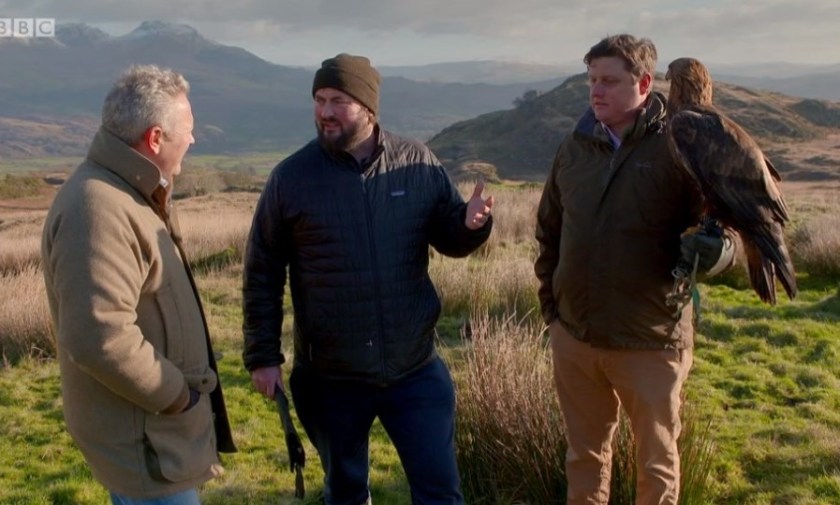
Dr O’Donoghue was featured on BBC Breakfast this morning (see here, at various points through the programme – only available until 09.15hrs Weds morning) and again on the BBC’s Countryfile Winter Diaries this morning (see here, starts at 02.17hrs, available for 29 days).

[Screengrab from Countryfile Winter Diaries]

Dr O’Donoghue talked about the need to consider the concerns of local landowners and farmers and the need to undertake research to inform a decision about the feasibility of a successful reintroduction but it was suggested in the programme (by the presenter) that the hope was to have golden eagles back in the wild in Wales by 2020, and in the Wilder Britain press release it was stated that a licence application to release eagles would be submitted this summer.

That sounds particularly premature, and unless Dr O’Donoghue has already completed a lot of the prior scoping research required for such an application, it may well lead to a resounding refusal on similar grounds to those cited by the UK Government when it recently decided to refuse an application for the reintroduction of Lynx to Kielder Forest (see here).

This looks set to become messy.

For the sake of the eagles and a viable long-term future in Wales, let’s hope the ERW team’s efforts have not been in vain.

UPDATE March 2019: More on proposed reintroduction of golden eagles to Wales (here)

UPDATE November 2019: No application lodged to reintroduce golden eagles to Wales (here)

UPDATE March 2020: Andy Wightman successfully defends defamation case (here)

UPDATE June 2020: New paper documents history of eagles in Wales (here)

UPDATE 4 September 2020: Proposed golden eagle reintroduction to Wales: genuine intent or just a publicity stunt? (here)

More on the SGA’s “completely false” claim that hen harrier Saorsa has been re-sighted

Last Friday we blogged about how the Scottish Gamekeepers Association (SGA) had published a statement claiming that a satellite-tagged hen harrier (‘Saorsa’) had been “re-sighted in Perthshire” after the RSPB reported it as having disappeared in suspicious circumstances from the Angus Glens last year.

RSPB Scotland issued a statement in response which said the SGA’s claim was “completely false” (here).

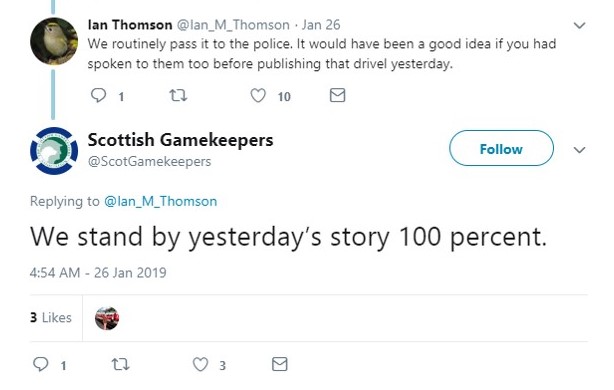
Despite being told “there isn’t a shred of evidence to support the claim that it [Saorsa] has reappeared“, the following day the SGA was still promoting its fake news on Twitter:
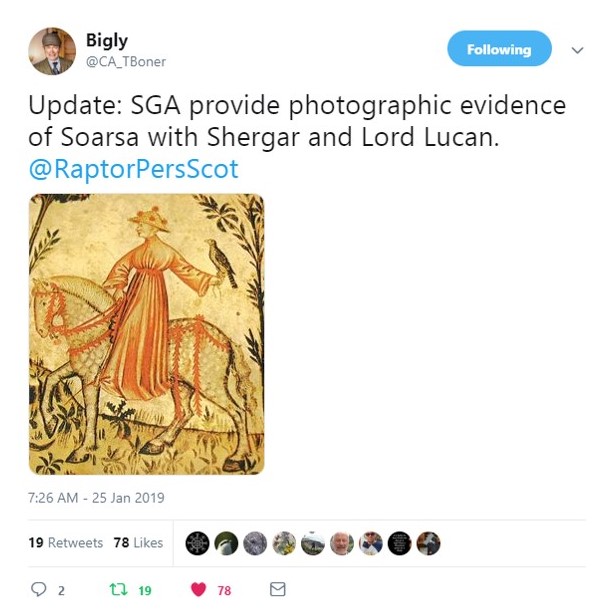
Other Twitter users offered equally conclusive evidence that Saorsa was alive and well, along with Shergar:

It’s also worth revisiting the SGA’s statement made when Saorsa was first reported missing last year, especially an extraordinary claim made by Bert Burnett of the SGA, who suggested that the RSPB had peverted the course of justice by finding Saorsa’s body and ‘secreting it away because it had died of natural causes’ (here).

On last Friday’s blog we said we’d return to the SGA’s latest press release about Saorsa to discuss some of the other inaccurate claims made about the satellite-tagging process. Many of the myths have been dealt with before, on this blog and elsewhere, and yet still the SGA churns out this guff, either too stupid to grasp the basics or deliberately trying to discredit the technology that’s revealing so much about the widespread extent of illegal raptor persecution.

So, here’s the SGA’s original press release (Friday 25 January 2019) and our commentary in italics:

GAMEKEEPERS SEEK ACCOUNTABILITY OVER SATELLITE TAGGED RAPTORS

Scotland’s gamekeepers are calling for accountability regarding satellite tags fitted to wildlife.

The call comes after The Scottish Gamekeepers Association learned that a tagged Hen Harrier, reported as disappearing ‘suspiciously’ in Angus last May, was re-sighted in Perthshire afterwards, according to investigators.

[RPUK: Nope, she hasn’t been “re-sighted” since she vanished in the notorious Angus Glens in Feb 2018].

Anti-grouse moor campaigners who owned the tag’s data publicly blamed the grouse industry, urging Scottish Government to license the sector.

[RPUK: Nope, the RSPB are not “anti-grouse moor campaigners”, they are simply calling for the regulation of grouse moor management. And nope, when Saorsa disappeared the RSPB did not “publicly blame the grouse industry” – the SGA has fabricated this claim – you can read the RSPB’s press statement about Saorsa’s disappearance in Feb 2018 here and you won’t find a single word of accusation against anyone or any industry].

However, no media statements were issued to correct the accusations, leaving local estate employees living with the burden of criminal suspicion.

[RPUK: No media statements were issued (by the RSPB) because, er, Saorsa is still missing from the Angus Glens. And again, to repeat ourselves, the RSPB did not make a single accusation against any industry, estate or estate employee when reporting Saorsa’s disappearance].

The SGA has also learned of a sea eagle currently flying around Grampian with a tag dangling from its body, potentially endangering its welfare.

[RPUK: Are we seriously expected to believe that the SGA is concerned over a sea eagle’s welfare?!! Isn’t this the group that has repeatedly lobbied for licences to enable the legal killing of this and other raptor species in Scotland? Ah yes, here. And isn’t this the group that’s lobbied the Scottish Government in abject hysteria about sea eagles potentially eating babies? Ah yes, here and here. And hasn’t this species been relentlessly persecuted on Scottish grouse moors, notably the victim of illegal poisoning (e.g. here), as well as having its nest tree illegally felled on an Angus grouse moor? Ah yes, here].

The female sea eagle, pegged with yellow wing markings and the letter ‘E’, has been spotted by concerned land managers.

In recent times, four golden eagles have also been independently photographed in the Angus glens with displaced tags; one clearly hanging from a bird’s neck.

Another eagle was observed in Perthshire last week with the bird’s feathers completely obscuring the tag; something manufacturers acknowledge will distort readings.

[RPUK: If a tag’s solar panel has been covered by a feather the tag won’t charge and the steady decline in battery voltage will be revealed in the tag’s engineering data. This means the tag operator can correctly identify battery drainage as the cause of the loss of data rather than the sudden and unexpected loss of data that is caused when someone kills the eagle and destroys the tag and hides the evidence of the crime].

Gamekeepers believe tags are now being deployed by campaigners as political weapons, aware there is no independent scrutiny.

[RPUK: Gamekeepers believe many things, such as white-tailed eagles being a threat to babies and toddlers, but it doesn’t mean there’s any truth in that belief. The SGA needs to read up on the strict regulations governing the deployment of satellite tags in the UK, which includes researchers quite rightly having to provide a proposal to the licensing authority that includes the detailed scientific justification for fitting a tag. Anybody seeking permission to fit tags as “a political weapon” will be laughed out of the door by the, er, independent scientific committee that scrutinises every single application].

Whilst the SGA is not advocating a ban, they believe Scottish Government must act to make fitting and monitoring of the devices accountable.

[RPUK: See above response]

An FOI to Scottish Natural Heritage by SGA revealed that the heritage body currently holds no information from satellite tags in Scotland, despite hundreds being operational.

Similarly, tag reliability cannot be independently verified as there is no duty for tag owners to disclose information regarding malfunction.

[RPUK: Incorrect. There is actually a duty for tag operators to report on tag status. In addition, concientious researchers are publishing data on tag malfunctions to enable tag manufacturers to constantly update and overcome any technical glitches in tag design. In addition, in the interest of transparency details of golden eagle tag malfunction were made publicly available in the Scottish Government-commissioned review in 2017. The number of tags known to have malfunctioned were insignifcant in relation to the number of tags that suddenly stopped and then vanished in suspicious circumstances, the vast majority of those occurring on driven grouse moors].

“At the moment, satellite tags are like the wild west,” said SGA Chairman Alex Hogg. “Anyone with funding can buy one, have it fitted to a protected bird, and retain its data. They can then release interpretations to the media, if the tag stops. We saw this with the choreographed ‘Fred the Eagle’ case near Edinburgh, which remains unexplained despite a concerted attempt to finger a grouse moor.

[RPUK: Incorrect. See above response on the rigorous licensing regulations for tag deployment in the UK. As for golden eagle Fred, we reported that he disappeared in suspicious circumstances right next to a grouse moor, in an area where other raptor persecution crimes had been discovered, just like all the other sat-tagged golden eagles that have disappeared in almost identical circumstances. We did not, at any time, accuse the grouse moor owner or his employees of any involvement. The SGA didn’t like the reports, which incidentally were all published with police approval, because Chris Packham’s involvement in the reports created a media storm. Too bad, the SGA had better get used to that – watch this space].

“Although tag fitters are approved, we have seen basic ‘granny knots’ used to fit tags and we have just heard of two tagged Harriers in Perthshire being killed by foxes within three days, with only one tag and body recovered. A tagged adult Harrier lost on National Trust ground this year was never found, neither was its tag, and a predated youngster was only discovered by chance. These are stories the public never hear and it is a shame they have to come out behind a veil of secrecy.

[RPUK: Could Alex Hogg explain how the SGA has been close enough to a sat-tagged raptor to identify a supposed ‘granny knot’? (The skilled fieldworkers who fit sat tags have had a long laugh about the depth of ignorance revealed by that claim, by the way). And as for Hogg’s claim that the public ‘never hear’ of tagged raptors dying from natural causes (it’s hardly news, Alex), perhaps he should pay more attention to RSPB blogs – here’s one from just a few weeks ago which, again in the interest of transparency, details, er, the natural deaths of several tagged hen harriers, but again these natural losses are heavily outnumbered by those that have vanished in suspicious circumstances on driven grouse moors].

“Despite claims these devices are almost infallible, failure rates and unexplained loss are high and there have been numerous examples of lost birds turning up alive or birds re-appearing miles or days from last tag signals.

[RPUK: These tags have a high rate of proven reliability but of course there will be a few exceptions to the rule  – nobody has ever denied that. The point is, these ARE exceptions to the rule and no matter how hard the SGA tries to deny it, the suspicious clustering of ‘missing’ tagged raptors, as repeatedly shown in the 2017 golden eagle sat tag review, is overwhelming evidence of continued widespread illegal persecution. We expect a similar pattern when the English hen harrier satellite tag data analysis is finally published (any time now?) and when the Scottish hen harrier satellite tag data analysis is finally published (hopefully soon). It’s strange that the SGA isn’t clamouring for these studies to be published].

“If this information was held independently, all this could be scrutinised transparently by experts and the relevant authorities could act accordingly.”

[RPUK: Er, the golden eagle sat tag data WERE scrutinised transparently by independent experts, and the relevant authority (Scot Gov) DID act accordingly by instigating a comprehensive review of grouse moor management and asking for recommended options for regulation, including estate licensing! Has Alex been smoking something?]

Late last year the SGA commissioned a legal opinion of SNH’s report into the fates of satellite tagged golden eagles, a paper which sparked the present review of grouse shooting.

[RPUK: Ah yes, the legal opinion that everybody dismissed, including the Scottish Government, not least because it was written by a lawyer with no scientific expertise].

The opinion, authored by QC Ronald Clancy, made a strong case for independent scrutiny of tags as the report relied entirely on manufacturer data for its conclusions.

“The present tagging system gives rise to accusation but no prosecutions.

“If tags are to be used to identify crime then the information must be held independently so it may lead to court action.

“If independent data monitoring makes things more difficult for people committing wildlife crime, that surely is in everyone’s interest,” added SGA Chairman Alex Hogg.

ENDS

It’s quite clear that the game-shooting industry, and especially the SGA, has spent considerable time and effort in recent years trying to undermine the satellite-tagging of raptors, either by launching disgusting personal & abusive attacks against those involved in the projects, or by arguing that raptor satellite-tagging should be banned because it’s ‘cruel’ and the tag data serve no purpose other than to try and entrap gamekeepers, or by claiming the raptors have been killed by imaginary windfarms, or by claiming conservationists have killed the raptors to set up gamekeepers, or by misapplying scientific results from failed saltwater turtle tags in the Indian Ocean to golden eagles in Scotland in the hope that nobody would notice! The industry knows how incriminating these raptor sat tag data are and so is desperately trying to do everything in its power to corrode public and political confidence in (a) the tag data and (b) the justification for fitting sat tags to raptors.

Fortunately, Scottish Environment Minister Roseanna Cunningham is no fool and neither is the public. Every time another satellite-tagged raptor disappears in suspicious circumstances, another nail gets hammered in to the coffin.

“They can hide the tags. They can hide the bodies. But they can’t hide the pattern“ (Dr Hugh Webster).

UPDATE 30 January 2019: A sketch from Mr Carbo

Obituary: Dr Adam Watson

Renowned biologist, ecologist and mountaineer Dr Adam Watson passed away earlier this week at the age of 88. Appropriately and fondly known as ‘Mr Cairngorms’, he produced an incredible body of work including 23 books, 287 peer-reviewed scientific papers and 178 technical reports.

Not surprisingly, many tributes have appeared in the national media and on the internet in the last few days. Here’s one of them, penned by some of his collaborators at RSPB Scotland:

Born in Turriff, Aberdeenshire, Dr Adam Watson was unique, and in many ways defined a special era of field natural history. A polymath, he was a master of many things – first class scientist, Fellow of the Royal Society of Edinburgh, accomplished ski mountaineer, expert on Gaelic place names and the north-east’s history, geography and weather. He was arguably the most knowledgeable Scottish naturalist and ornithologist of the last century. The international authority on the Cairngorms, and on golden eagles (his is the longest study in Europe), ptarmigan, red grouse, dotterels, snow buntings, waders, corn buntings and mountain hares, Adam was closely involved in long-term and detailed studies of all these species and more.

His scientific output was prolific through a long lifetime of work associated with the former Institute of Terrestrial Ecology (now Centre for Ecology and Hydrology), and in his later years he published many books which captured his lifetime’s experience in subjects as diverse as Scotland’s mammals, Scottish mountain snow patches, hill walking and climbing, expeditions to the Arctic and using trained dogs for biological research. A winner of numerous accolades, including the RSPB President’s Award, Adam was a staunch conservationist, fiercely criticising what he saw as bad land management in Scotland. He worked tirelessly against raptor persecution and led the establishment of Scotland’s first Raptor Study Group, in the north-east. He gave freely of his expertise to those supporting the conservation of birds of prey and other species and vulnerable habitats, and was always someone that RSPB staff could ask for context and background when help was needed.

In recent years, we have been proud to work with Adam to assist him in publishing his long-term studies of corn buntings, and over 70 years of surveys of mountain hares, and these papers have contributed immensely to improving the conservation prospects of both these species. His wide-ranging expertise and penetrating thinking is impossible to replace, and we feel his loss deeply as a friend, collaborator and wise critic.

Ian Francis, Hywel Maggs, Allan Perkins & Jeremy Wilson

Adam’s research made the headlines last year when analysis of his long-term scientific data revealed mountain hare numbers on moorlands in the eastern Highlands had declined to less than one per cent of their initial levels (here), a decline linked to the continued mass slaughter of mountain hares on intensively driven grouse moors across the region.

Adam was also a founding member of the North-East Scotland Raptor Study Group and spent a lifetime studying golden eagles (in his own time) since he saw his first pair on Deeside in 1943 when he was just thirteen. His early studies were pioneering and led to a series of scientific papers, somehow produced in and around his hundreds of other commitments. These papers included:

Watson, A. (1957). The breeding success of golden eagles in the north east Highlands. Scottish Naturalist 69: 153-169.

Brown, L.H. and Watson, A. (1964). The golden eagle in relation to its food supply. Ibis 106: 78-100.

Watson, A. (1982). Work on golden eagle and peregrine in north east Scotland in 1981. Scottish Birds 12: 54-56.

Payne, S. and Watson, A. (1983). Work on golden eagle and peregrine in north east Scotland in 1982. Scottish Birds 12: 159-162.

Payne, S. and Watson, A. (1984). Work on golden eagle and peregrine in north east Scotland in 1983. Scottish Birds 13: 24-26.

Watson, A. and Rothery, P. (1986). Regularity and spacing of golden eagle nests used within years in northeast Scotland. Ibis 128: 406-408.

Watson, A., Payne, S. and Rae, R. (1989). Golden eagles: land use and food in northeast Scotland. Ibis 131: 336-348.

Watson, A., Rae, S. and Payne, S. (2012). Mirrored sequences of colonisation and abandonment by pairs of golden eagles. Ornis Fennica 89.

Watson, A. (2013). Golden eagle colonisation of grouse moors in north east Scotland during the Second World War. Scottish Birds 33: 31-33.

Adam was reported to be particularly chuffed last summer when Golden Eagle Species Champion Andy Wightman MSP named a young satellite-tagged eagle in honour of Adam’s influence during Andy’s early years on the hill.

Watch out for a new book on Scottish golden eagles, co-authored by Adam Watson, due out at the end of 2019:

Glasgow school kids learn golden eagle persecution still a thing in their country

How poignant are these?

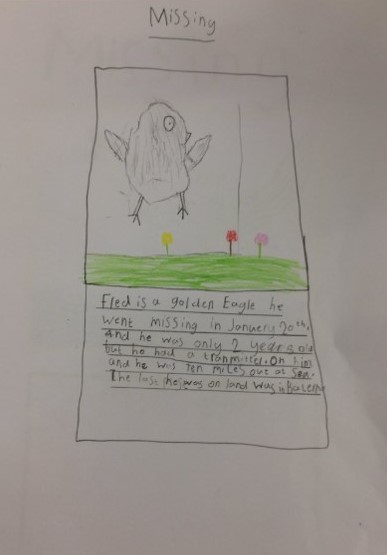
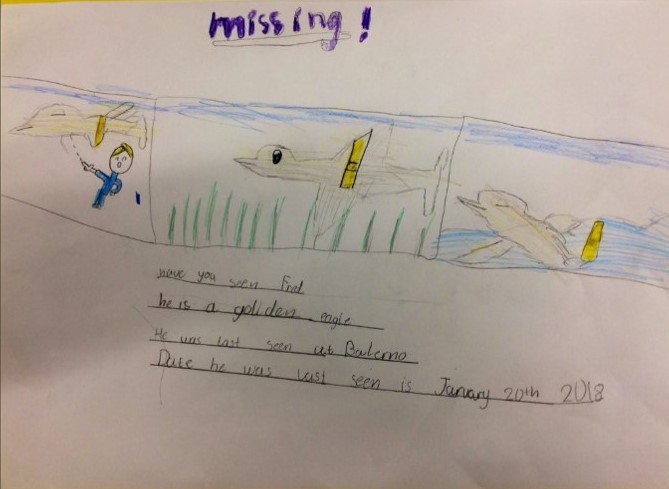
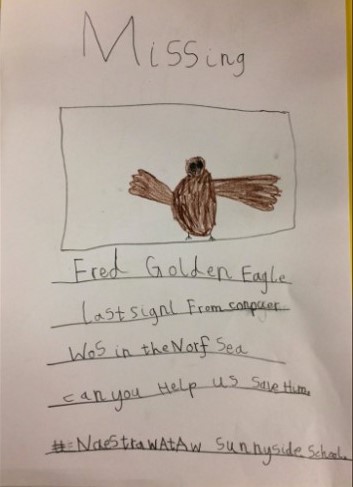
‘Missing’ posters drawn by P4 school children (aged 7-8 years old) from Sunnyside Primary School in Glasgow after learning of the suspicious ‘disappearance’ of golden eagle Fred earlier this year.

Two of the four missing satellite-tagged hen harriers ‘disappeared’ on grouse moors in Cairngorms National Park

Earlier this month RSPB Scotland announced that four of this year’s satellite-tagged hen harriers had ‘disappeared’ in suspicious circumstances on Scottish grouse moors (see here).

[RPUK map showing approximate last known locations of four satellite-tagged hen harriers]

We said at the time that we’d be coming back to this subject as we were interested in the locations from where the birds had vanished.

Two of those hen harriers (Margot and Stelmaria) both hatched on the National Trust for Scotland’s Mar Lodge Estate in the Cairngorms National Park earlier this summer, and both of them subsequently vanished, also inside the Cairngorms National Park.

[RPUK map showing approximate last known locations of hen harriers Margot & Stelmaria]

We’ll be coming back to have a closer look at these locations tomorrow.

It should be shocking that two hen harriers, a high priority red-listed species, have vanished in suspicious circumstances inside the world-renowned Cairngorms National Park (CNP). But it isn’t. Because this isn’t the first time.

In August 2016 satellite-tagged hen harrier Brian ‘disappeared’ inside the CNP (see here).

In August 2017 satellite-tagged hen harrier Calluna ‘disappeared’ inside the CNP (see here).

In August 2015 satellite-tagged hen harrier Lad didn’t ‘disappear’ but he was found dead, suspected shot, inside the CNP (see here).

But it’s not just satellite-tagged hen harriers. At least 15 satellite-tagged golden eagles have also ‘disappeared’ in suspicious circumstances in recent years inside the CNP (see here). In 2014 the first white-tailed eagle chick to fledge in East Scotland in approx 200 years also ‘disappeared’ in suspicious circumstances inside the CNP (see here) and earlier this year another white-tailed eagle also ‘disappeared’ in suspicious circumstances inside the CNP (see here).

We’ve searched the Cairngorms National Park Authority’s website for a comment/statement about the latest two hen harrier disappearances but we didn’t find anything.

We’ve also searched the Scottish Government’s website for a comment/statement about the latest two hen harrier disappearances inside the CNP but we didn’t find anything there either.

Probably because it’s all a bit embarrassing.

In 2017, following the damning findings of the Golden Eagle Satellite Tag Review, the Scottish Government announced it was to establish a 12-month pilot scheme, funding five police special constables to work in the CNP to focus on deterring and detecting wildlife crime. This scheme was launched in March this year (see here).

This pilot scheme was the Government’s alternative to extending the powers of the SSPCA to allow it to investigate a wider suite of wildlife crime (including raptor persecution) – a decision made after six years of Governmental deliberation under five different Environment Ministers.

It also emerged earlier this year that this pilot scheme was also an alternative to the Government’s 2016 manifesto pledge to establish a Wildlife Crime Investigation Unit as part of Police Scotland – a pledge on which it has now reneged (see here). The idea is that the police special constable scheme could be rolled out across Scotland “if judged to be successful” in the CNP.

We’re not sure what the criteria will be for judging ‘success’ but we can be quite sure that the continued suspicious ‘disappearance’ of satellite-tagged raptors within the CNP cannot possibly be indicative of success.

UPDATE 22 Nov 2018: Did hen harrier Margot ‘disappear’ on a Royal grouse moor? (Here)

UPDATE 23 Nov 2018: From which grouse shooting estate did hen harrier Stelmaria ‘disappear’? (here)

Scottish Government dismisses SGA’s attempt to discredit Golden Eagle Satellite Tag Review

Last week we blogged about the Scottish Gamekeepers Association’s (SGA) feeble attempt to undermine and discredit the findings of the damning Golden Eagle Satellite Tag Review by commissioning an opinion from a lawyer who, as far as we can tell, has no scientific expertise or qualifications (see here).

This is the Golden Eagle Satellite Tag Review that demonstrated, with “exemplary and thorough” scientific rigour according to actual scientists, that almost one third of satellite-tagged golden eagles had ‘disappeared’ (almost certainly illegally killed) on a number of Scottish grouse moors over a number of years, in the same areas that had contemporaneous records of illegal raptor persecution (i.e. known wildlife crime hotspots).

[Satellite-tagged golden eagle ‘Alma’ who was found poisoned on a grouse moor in the Angus Glens. Photo by Scottish Raptor Study Group]

In response to the SGA’s attempt to erode confidence in the Sat Tag Review, Mark Ruskell MSP (Scottish Green Party) lodged the following parliamentary question:

S5W-19641 (date lodged 26/10/18)

To ask the Scottish Government what its response [is] to the legal opinion that has been published by the Scottish Gamekeepers’ Association, which disputes some of the conclusions of the Scottish Natural Heritage-commissioned report, Analyses of the Fates of Satellite Tracked Golden Eagles in Scotland, and, in light of this, whether it plans to review the report’s conclusion that the disappearances of some satellite-tracked golden eagles and other birds of prey were “suspicious”.

This question was answered by Environment Cabinet Secretary Roseanna Cunningham on 7/11/18 as follows:

The Scottish Government is satisfied that the Scottish Natural Heritage report, “Analyses of the fates of satellite tracked golden eagles in Scotland”, was produced and peer-reviewed in line with accepted scientific standards. The Scottish Government has no plans to review any aspects of the report.

That’s a parliamentary equivalent of sticking up two metaphorical fingers.

Nice try, SGA, but no cigar.

Well done and thanks, Mark Ruskell MSP.

They can hide the tags. They can hide the bodies. But they can’t hide the pattern“ (Dr Hugh Webster).

Golden eagle satellite tag review “exemplary” and “thorough”

A new scientific peer-reviewed paper, authored by a group of highly-respected award-winning ecologists, commends the “exemplary” and “thorough” scientific approach of the golden eagle satellite tag review.

The paper has just been accepted for publication but due to publishing restrictions we’re unable to publish it here (although we’ve read it in full). When it finally becomes available it’ll be a must-read for researchers involved in animal satellite-tracking projects where being able to distinguish between actual death and transmitter failure is important to understanding threats to that species.

Sergio, F., Tanferna, A., Blas, J., Blanco, G. and Hiraldo, F. (2018). Reliable methods for identifying animal deaths in GPS – and satellite-tracking data: review, testing and calibration. Journal of Applied Ecology. doi: 10.1111/1365-2664.13294.

The authors have devised a system, based on the interpretation of various tag data, which correctly distinguished between actual death and transmitter failure in their sample. They found this system worked perfectly for their GPS tags but was not so reliable for tags using only Doppler locations.

[Fig. 3 from the paper]

Using this system, the authors suggest that the highly suspicious disappearance of golden eagles in Scotland as identified in the Golden Eagle Satellite Tag Reviewwould be most likely confirmed as deaths by our method, thus strengthening the suspicion of illegal killings (Branch 3b, Fig 3)”.

For the reader with a limited understanding of different tag types and the quality of technical data associated with different tags, this paper probably won’t make much sense at all. However, we’ve highlighted it here for good reason.

A couple of weeks ago some extraordinary claims were made about the Golden Eagle Satellite Tag Review. Ronnie Clancy QC, a senior lawyer, claimed that the review contained “significant shortcomings” and that there was evidence of “unconcious bias“. His rationale for these comments is apparently contained in a report he was commissioned to write by the Scottish Gamekeepers Association (SGA), although this report has not been released in the public domain and the story was only run on the BBC News website (here), so we’ve been unable to see the context of these selective quotes.

However, when you look at the quotes that were published by the BBC, it’s not difficult to tear them apart. On the allegation of supposed “unconcious bias”, the BBC reports that Mr Clancy QC said the report authors (Drs Whitfield and Fielding) looked like they had “manipulated” the study “to obtain a desirable result“. This opinion was further fuelled in the BBC report by the SGA’s Chairman Alex Hogg, who claimed that the report’s findings were initially insignificant “until the authors (Whitfield & Fielding) shifted the parameters and extended the boundaries of the moors by up to 4km“.

Dear oh dear. Had they paid attention to the Sat Tag Review they would have read the discussion about why the parameters were extended – which is a perfectly acceptable scientific method known as hypothesis testing – to 4km. Initially, Drs Whitfield & Fielding had used the presence of strip muirburn as a simple way of mapping the location of grouse moors. However, as they explained in the review, grouse moor management extends beyond the boundaries of strip muirburn, often to a considerable distance (e.g. predator control to benefit red grouse takes place in forestry and woodland beyond the actual moors) so to capture the full extent (and impact) of grouse moor management requires extending the search boundary beyond the actual moor. They illustrated this point with this map (we have added the yellow arrow for clarity) showing the last known locations of three satellite-tagged golden eagles. One of these (yellow arrow) ‘disappeared’ on land that wasn’t a grouse moor, per se, but was surrounded by grouse moor. Had they stuck rigidly to using strip muirburn as the grouse moor proxy, this eagle, and several others that ‘disappeared’ when roosting in forestry close to a grouse moor, would not have been classified even though it’s blindingly obvious that the location was associated with grouse moor management.

Quite why the SGA asked a lawyer to opine on a piece of scientific research is anyone’s guess. No doubt, Mr Clancy is a skilled lawyer – you don’t gain QC status without demonstrating legal excellence. But is Mr Clancy a scientist? Does he have experience and expertise in assessing scientific rigour? Is he familiar with satellite tag technology? Is he an expert in golden eagle ecology? Does he have a detailed understanding of the ~100 scientific references cited in the review? Has he authored any scientific papers himself? Why didn’t the SGA commission a review by a qualified scientist? Couldn’t they find one who’d say what they wanted to say? And why has this opinion piece only just emerged, some 17 months after the Golden Eagle Satellite Tag Review was published?

The more you think about this, the more intriguing it becomes. Our guess is that the SGA, realising how comprehensively damning were the findings of the Sat Tag Review, sought advice on making a legal challenge against the Scottish Government for accepting the review’s findings. Why else consult a lawyer? However, although the Cabinet Secretary commissioned the current grouse moor management (Werritty) review on the back of the Sat Tag Review’s findings, there have been no legislative changes based explicitly on the Sat Tag Review, which makes a legal challenge untenable. And even if legislative change (e.g. licensing) does occur after the Werritty Review, the Sat Tag Review will only have played a small role – it just happened to be the final straw in a giant haystack of evidence against the unsustainable and environmentally damaging aspects of grouse moor management.

If this is what happened, then rather than waste the money they spent seeking legal advice (unless Mr Clancy worked pro bono), perhaps the SGA thought they’d make the best of a bad job and simply present the advice as legal opinion in an attempt to undermine the evidence being presented to the ongoing Werritty Review.

Sadly, the SGA hasn’t published Mr Clancy QC’s report – and that is their perogative, as it is, after all, a privately-commissioned piece of work – but it’s a real shame because we would have been very interested in reading Mr Clancy’s opinion on the contemporaneous records of illegal raptor persecution associated with the various geographic clusters of ‘disappearing’ eagles on or close to grouse moors, and the ever-increasing pile of peer-reviewed scientific research that has linked grouse moor management to illegal raptor persecution, all documented and referenced in the Sat Tag Review. Oh, and not to mention the long list of golden eagles whose bodies have previously been found shot and poisoned on, er, grouse moors.

[Golden eagle ‘Fearnan’ found illegally poisoned on an Angus Glens grouse moor. Photo by RSPB]

We understand Mr Clancy’s report has been submitted to the Werritty Review as ‘evidence’. We welcome this. Professor Werritty, as a senior academic of some repute, will no doubt treat it with all the regard deserving of a non-scientific opinion commissioned by an organisation that has repeatedly sought to deny the link between grouse moor management and golden eagle persecution.