‘Key moment’ as Scottish Government considers grouse moor licensing

It’s been three months since the Government-commissioned Werritty Review on grouse moor management was published (see here) and we’ve been waiting for the Scottish Government’s official response, which is due this spring.

We did hear from Nicola Sturgeon at First Ministers Questions in December that shortening the timescale for which grouse moor licensing may be introduced was ‘a serious consideration’ (here) which was very welcome news, although not to all.  Grouse moor trustee Magnus Linklater argued in a Times opinion piece that licensing threatened gamekeepers jobs (here), although he didn’t manage to explain how being law-abiding and not killing protected birds of prey would cost a gamekeeper his employment.

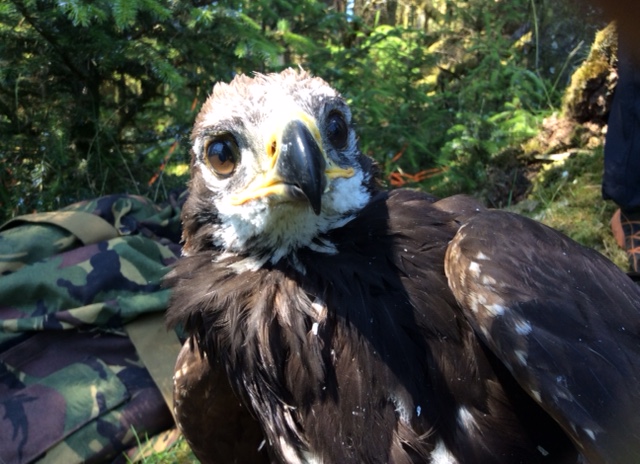
[An illegally-poisoned golden eagle in the Cairngorms National Park. Photo by Dave Dick]

As a follow up to the First Minister’s comments in December, Andy Wightman MSP (Scottish Greens) recently lodged this Parliamentary question:

S5W-27631: To ask the Scottish Government, further to the comments by the First Minister on 19 December 2019 (Official Report, c. 21), what its timescale is for reconsideration of the introduction of a licensing scheme for grouse shooting.

Environment Minister Mairi Gougeon has now responded:

We are giving very careful consideration to the recommendations in the report by the Grouse Moor Management Group (the ‘Werritty Review’).

We will set out our response to the report in due course, which will cover the recommendation on introducing licensing of grouse moor businesses.

Earlier this week Duncan Orr Ewing, RSPB Scotland’s Head of Species and Land Management wrote a very good blog (here) discussing the Werritty Review’s primary recommendation that grouse moor licensing be introduced but that the review had suggested a five-year delay. He goes on to explain what options are available to the Scottish Government as they consider the Werritty Review recommendations. Well worth a read.

Duncan describes this as a ‘key moment which could help safeguard some of Scotland’s most spectacular wildlife’ if the Scottish Government chooses to finally do what it’s been threatening for years and years and introduce a grouse moor licensing scheme.

He urges members of the public to contact their MSPs and ask them to encourage the Scottish Government to make grouse shooting both legal and more sustainable through a licencing system for grouse moors.

You can find contact details for your MSPs by entering your postcode on the “Find Your MSP” tool on the Scottish Parliament website here.

For those who don’t live in Scotland please contact Scottish Ministers at scottish.ministers@gov.scot.

Top ten most read RPUK blogs in 2019

Thanks for all your continued interest and support in 2019….it’s been another very busy year.

Here are the top ten most read RPUK blogs over the last 12 months:

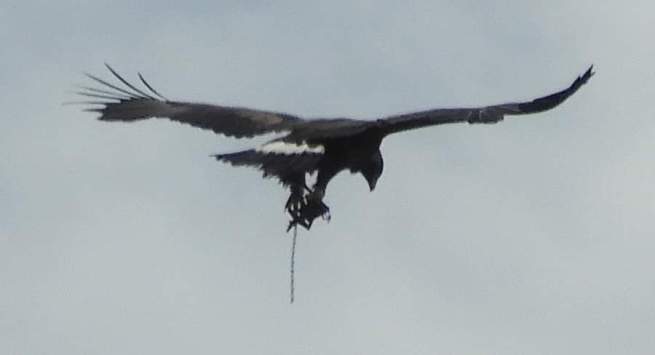
  1. Young golden eagle flying around Cairngorms National Park with an illegal trap clamped to its leg (here)
  2. Two more golden eagles go ‘missing’, on the same morning, on the same Scottish grouse moor (here)
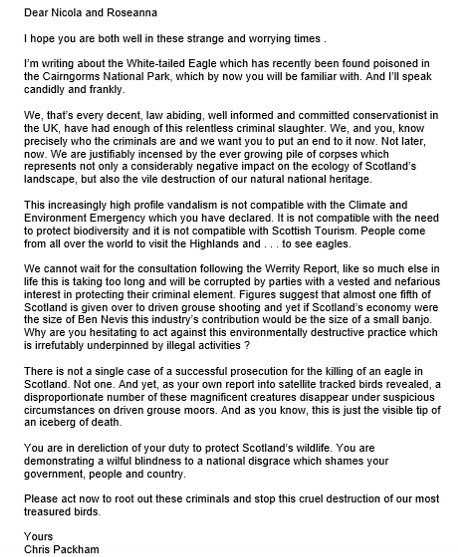
  3. Chris Packham targeted (here)
  4. Hen harrier suffers savage brutality of an illegally-set trap on a Scottish grouse moor (here)
  5. Convicted Scottish gamekeeper Alan Wilson and his litany of wildlife crimes (here)
  6. More detail emerges about SSPCA/Police Scotland raid at Millden Estate (here)
  7. Disgusting display of savagery on Yorkshire grouse moor (here)
  8. Monumentally inadequate sentence for convicted Scottish gamekeeper Alan Wilson (here)
  9. Hen harrier reintroduction to southern England: Natural England suggests persecution not an issue (here)
  10. At least 72% satellite tagged hen harriers presumed illegally killed on grouse moors (here)

The blog will reach its ten year milestone in March 2020.

Happy New Year!

Werritty Review: encouraging response from Environment Cabinet Secretary Roseanna Cunningham

Further to the publication of the Werritty Review on grouse moor management this morning (here), Environment Cabinet Secretary Roseanna Cunningham has made an encouraging statement in a Scot Gov press release, as follows:

GROUSE MOOR MANAGEMENT: LICENSING OPTION UNDER CONSIDERATION

A review into grouse moor management has recommended the introduction of a shooting licensing scheme if breeding populations of raptors show no marked improvement.

The review, which was chaired by Professor Alan Werritty, Professor Emeritus of Physical Geography at University of Dundee, was asked to examine how we can ensure that grouse moor management continues to contribute to the rural economy while being environmentally sustainable.

As well as the recommendation that a licensing scheme is introduced for the shooting of grouse if there is no marked improvement in the ecological sustainability of grouse moor management, the report also makes a number of other recommendations relating to common grouse moor practices, such as the use of medicated grit and muirburn.

Environment Secretary Roseanna Cunningham said:

I would like to thank Professor Werritty and the other members of the Grouse Moor Management Group for undertaking this important review and for their extensive work over the last two years.

As well as the issue of raptor persecution, the review was asked to look at grouse moor management practices including muirburn, the use of medicated grit and mountain hare culls and also to examine regulatory options including possible licensing of grouse shooting businesses.

It is important that we give careful consideration to the recommendations, alongside other evidence, before issuing a response. An important part of this will involve meeting key stakeholders to discuss the findings of the review, and we will publish a full response to the report in due course. At this early stage, however. I believe the option of a licensing scheme will need to be considered and – if required – implemented earlier than the five-year timeframe suggested by the review group.”

[Photo insert by RPUK – in 2018 after the suspicious disappearance of golden eagle Fred in the Pentland Hills Roseanna Cunningham told Chris Packham in an interview that grouse shoot licensing had been talked about by the Scottish Government since 2009. It’s ten years on – time for action now, not in another five years. Photo by Ruth Peacey].

Professor Werritty said:

When I accepted the invitation from the Scottish Government to lead an expert review on grouse shooting, I had not fully appreciated the complexity of the issues involved, the passion with which contrasting views were held, or the length of time the review would require.

Our remit invited us to make recommendations to reduce the illegal killing of raptors but at the same time to give due regard to the socio-economic contribution that grouse shooting makes to Scotland’s rural economy. Both topics have proved complex and problematic.

In order to have a unanimous recommendation on this key issue with the authority that implies, the Group proposes a five year probationary period for specified raptors on or near grouse shooting estates to recover to a favourable conservation status. Should this target fail to be achieved, licensing should be introduced immediately. We all agree that it is the only way forward in that situation“.

Background

The Grouse Moor Management Group was established in November 2017. It was commissioned by the Scottish Government in response to a report from Scottish Natural Heritage (SNH) which showed that around one third of tagged golden eagles had disappeared on or around driven grouse moors.

The group’s report can be found on the Scottish Government website.

ENDS


Special Constables pilot scheme in Cairngorms National Park a waste of time & money

Two and a half years ago, Environment Cabinet Secretary Roseanna Cunningham announced a pilot scheme whereby Police Special Constables would be deployed in the Cairngorms National Park to tackle wildlife crime.

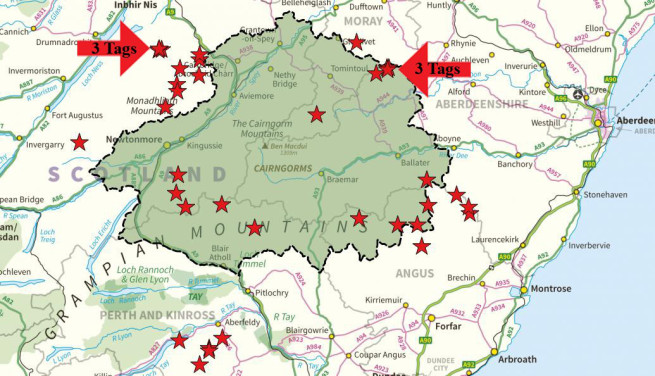
This initiative was one of a number of measures announced in May 2017 in response to the findings of the golden eagle satellite tag review which showed clear evidence of deliberate and sustained illegal raptor persecution, particularly on some driven grouse moors in and around the Cairngorms National Park (CNP).

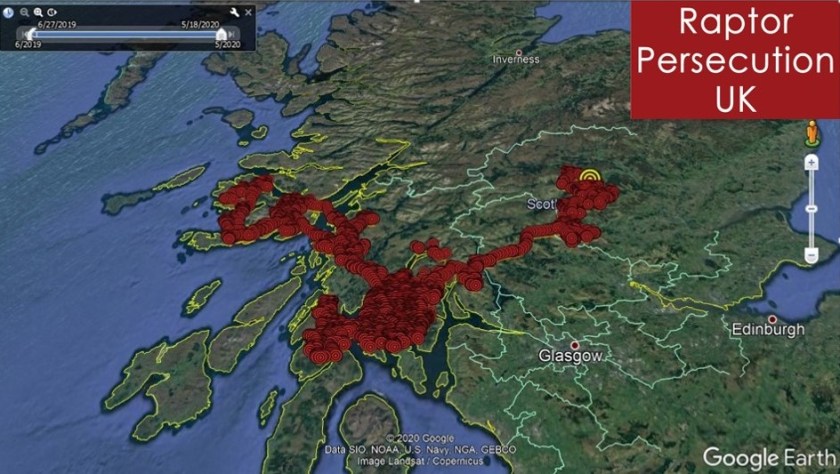
This RPUK map shows the last known location of satellite-tagged golden eagles that were either found illegally killed or had disappeared in suspicious circumstances in and around the CNP (data from the golden eagle satellite tag review):

Golden eagles are not the only victims of wildlife crime in and around the CNP. This RPUK map below, based mostly on RSPB data, shows raptor persecution incidents between 2005-2016. Only one of these (just outside the CNP boundary on Kildrummy Estate) has resulted in a successful prosecution. With such clear evidence of wildlife crime it’s easy to see why the CNP was chosen as the first location for this pilot scheme.

This pilot scheme was the Government’s alternative to extending the powers of the SSPCA to allow it to investigate a wider suite of wildlife crime (including raptor persecution) – a decision made after six years of Governmental deliberation under five different Environment Ministers.

It also emerged in 2018 that this pilot scheme was an alternative to the Government’s 2016 manifesto pledge to establish a Wildlife Crime Investigation Unit as part of Police Scotland – a pledge on which it has now reneged (see here).

The idea was that the police special constable scheme could be rolled out across Scotland “if judged to be successful” in the CNP, but we weren’t told the criteria that would be used to judge this ‘success’.

The scheme was formally launched in March 2018 (see here) and nothing more was heard of it.

Just over a year later in April 2019 we asked the Cairngorms National Park Authority the following questions about the scheme:

Here’s the response:

So basically after a year of operation, one of the main project partners couldn’t tell us anything about the scheme.

Fast forward six months to November 2019 and Scottish Greens MSP Mark Ruskell thought it was time more questions were asked. Here are his two Parliamentary questions and Roseanna Cunningham’s answers:

S5W-26349 Mark Ruskell (Mid Scotland and Fife) (Scottish Green Party): To ask the Scottish Government how much funding (a) it and (b) the Cairngorms National Park Authority allocated each year to the Wildlife Special Constables pilot project.

Roseanna Cunningham: The Scottish Government agreed to contribute £18,000 and the Cairngorms National Park Authority agreed to provide £10,000 for the Wildlife Special Constables pilot project.

S5W-26346 Mark Ruskell (Mid Scotland and Fife) (Scottish Green Party): To ask the Scottish Government what the outcome was of the Wildlife Special Constables pilot project; how many constables participated each month in this, and how many suspected crimes they reported, also broken down by how many led to subsequent (a) arrests, (b) charges, (c) prosecutions and (d) convictions.

Roseanna Cunningham: a)The Scottish Government is currently undertaking an evaluation of the Special Constable Pilot Project in conjunction with Police Scotland and the Cairngorms National Park Authority. We will announce a decision on the future direction of the project in due course.

b) There were five special constables in the project, employed on a part-time basis.

c) and d) From the information gathered in the review conducted by Police Scotland, there were no recorded crimes reported by the Special Constables during their patrols in the 12 month trial period. However, Special Constables were involved in meeting stakeholders and partners operating within the Cairngorms National Park to build relationships and understand the needs and demands of National Park users which will aid future intelligence gathering.

Gosh, it’s easy to see why the Scottish Government’s evaluation of the pilot scheme is taking so long, what with having to count ZERO reported wildlife crimes.

Meanwhile satellite tagged raptors continue to disappear in suspicious circumstances in the Cairngorms National Park (white-tailed eagle here; hen harrier here; hen harrier here and hen harrier here); birds are still being illegally poisoned in the Cairngorms National Park (here) and birds of prey are still being caught by illegally-set traps in the Cairngorms National Park (golden eagle here).

But it’s ok, nothing to worry about because £28K has just been spent on ‘building relationships and understanding the needs and demands of National Park users’.

FFS.

Tabloid hysteria over ‘giant psycho eagle’

We’re often asked by colleagues overseas why attitudes in the UK towards birds of prey are so ignorant and outdated.

Here’s one explanation – sensationalist nonsense being published in the media. We’ve seen this many times before, including here and here when the Scottish Gamekeepers Association were writing to the Scottish Government fearing that white-tailed eagles might eat children.

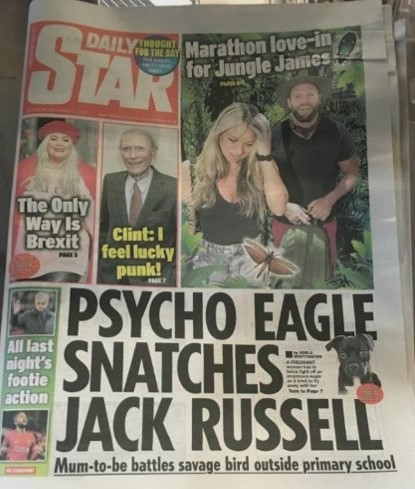
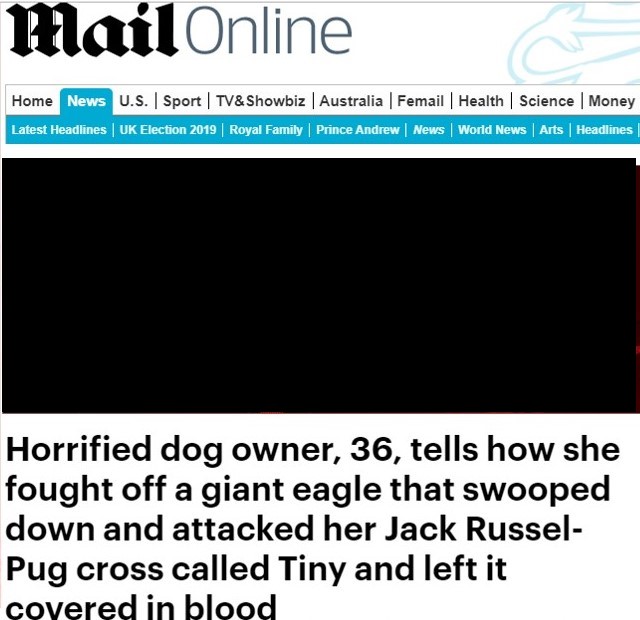
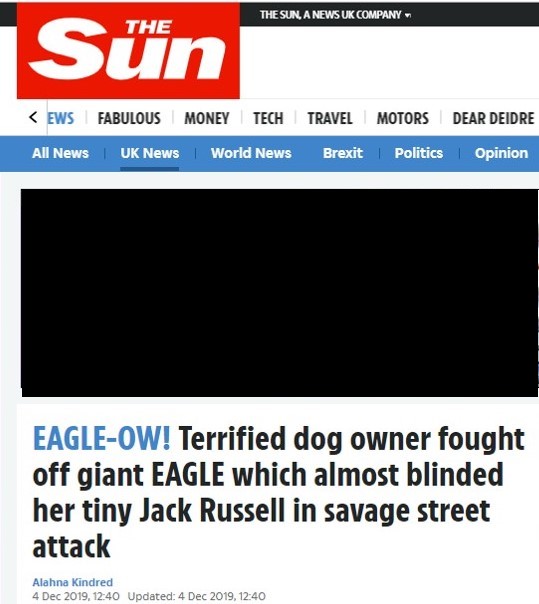
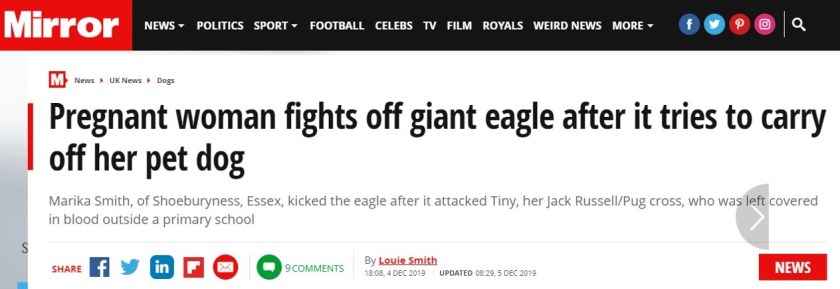
Here’s another classic example of unfounded hysteria from the last few days. This is an unsubstantiated story about an alleged eagle attack on a dog in Essex and unbelievably it made front page news! (Thanks to the blog reader who sent this photo).

At least three other tabloids also covered it:

Note the telling hallmarks of a tabloid story – the woman was pregnant, the alleged incident happened near a primary school, there was blood, the eagle was ‘giant’, it ‘almost blinded’ the dog and it was a ‘savage attack’.

The fact that there was no photographic evidence nor credible ID of the bird matters not, apparently. Some of the tabloids have illustrated the news article with a stock photo of a white-tailed eagle and others have mentioned golden eagles.

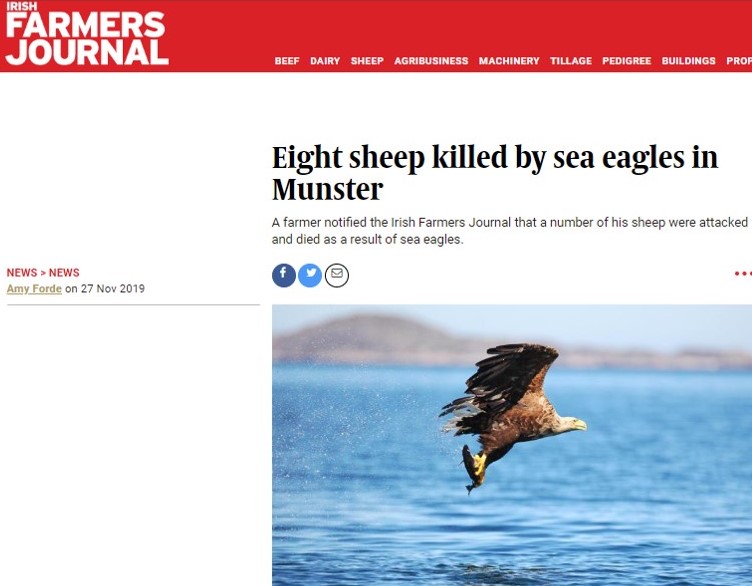
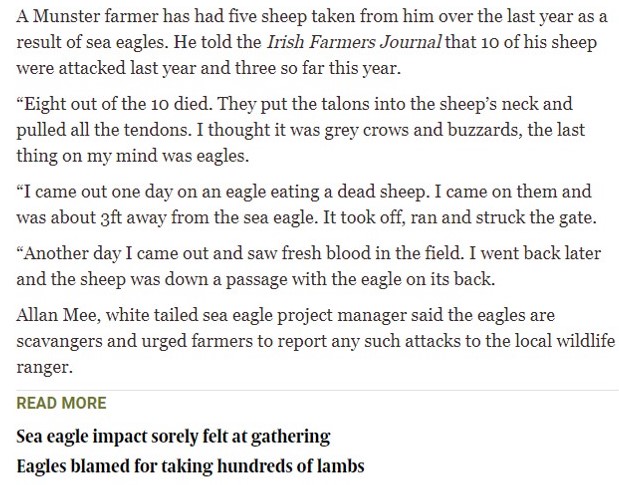
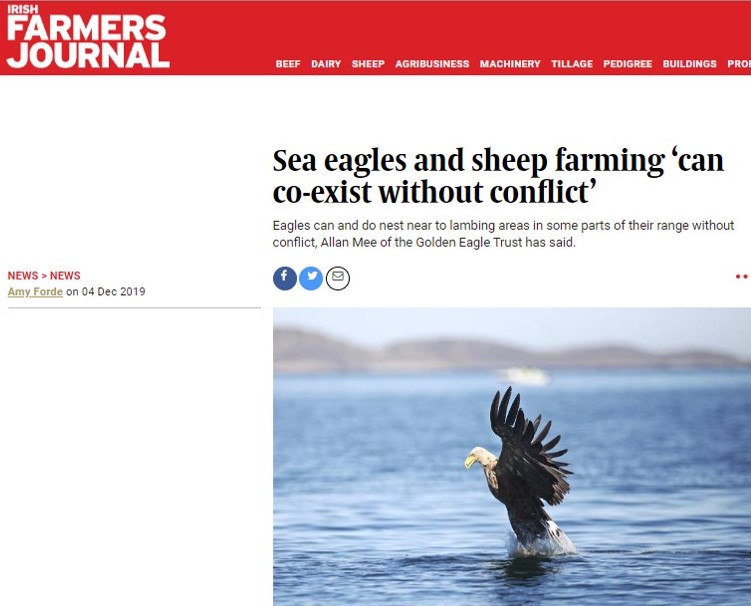
Meanwhile, the Irish Farmers Journal ran with an article recently, claiming that white-tailed eagles had been killing sheep:

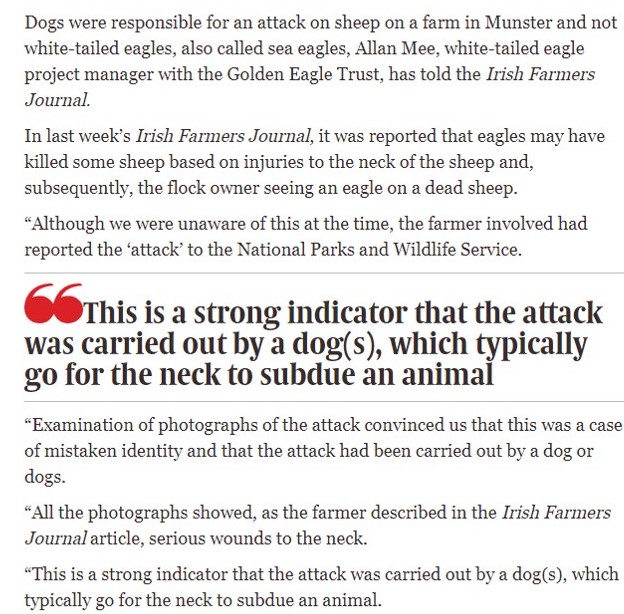
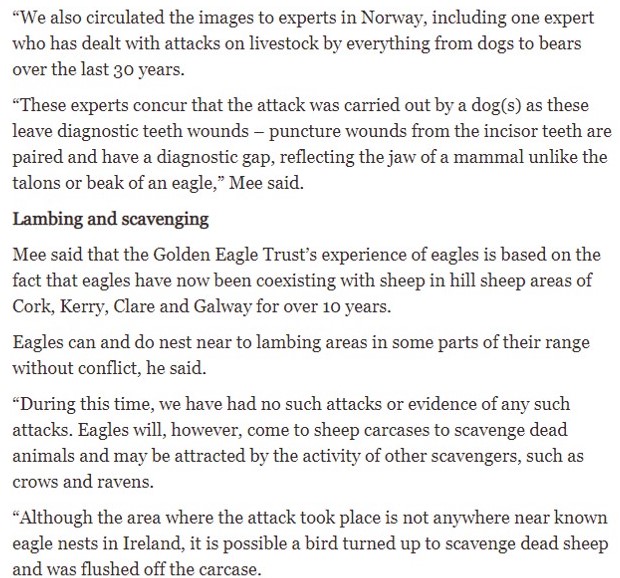
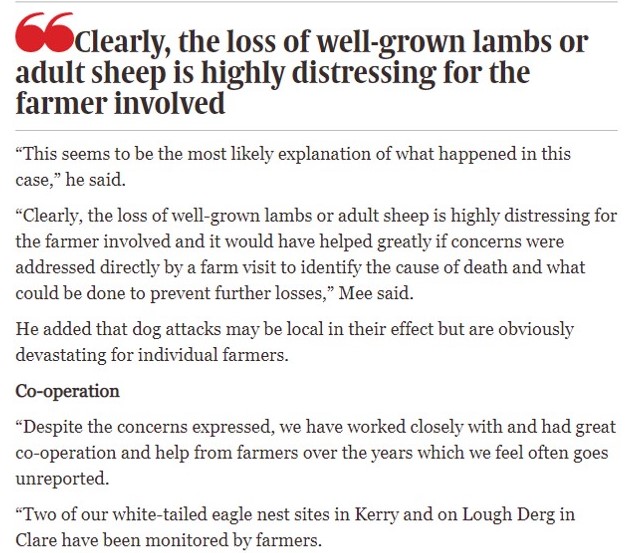
In an unusual but welcome u-turn, the paper then ran with this follow-up article a couple of days ago after being contacted by Dr Allan Mee who has led the white-tailed eagle reintroduction project in Ireland since 2007. Well done, journalist Amy Forde and the editor of the Irish Farmers Journal for more measured, responsible reporting.

Satellite tagging golden eagles in Scotland: fact vs fiction

In September 2019 the Scottish Gamekeepers Association (SGA) lodged a petition at the Scottish Parliament calling for the ‘independent monitoring of satellite tags fitted to raptors’.

You can read the petition here: SGA petition PE01750 Independent monitoring raptor satellite tags

It’s the latest in a long line of efforts to undermine and discredit the use of satellite tags, simply because the unintended consequences of tagging raptors like golden eagles, hen harriers, white-tailed eagles and red kites has exposed the previously hidden extent of illegal raptor persecution on many grouse moors and has led the Scottish Government to scrutinise grouse moor management practices by commissioning a review.

[The satellite tag fitted to this golden eagle led researchers to a grouse moor in the Angus Glens where the bird was found to have been illegally poisoned. Photo by RSPB Scotland]

Raptor persecution crimes attract huge media attention because it’s hard to believe that people are still poisoning golden eagles in Scotland in the 21st century. As a result of this ongoing publicity, the game-shooting industry has spent considerable time and effort trying to undermine the satellite-tagging of raptors, either by launching disgusting personal & abusive attacks targeted against named individuals involved in the projects, or by blaming disappearances on imaginary windfarms, faulty sat tags fitted to turtles in India & ‘bird activists‘ trying to smear gamekeepers, or by claiming that those involved have perverted the course of justice by fabricating evidence, or by claiming that raptor satellite-tagging should be banned because it’s ‘cruel’ and the tag data serve no purpose other than to try and entrap gamekeepers. There have also been two laughable attempts to discredit the authoritative golden eagle satellite tag review (here and here), thankfully dismissed by the Scottish Government. The industry knows how incriminating these sat tag data are and so is trying to do everything in its power to corrode public and political confidence in (a) the tag data and (b) the justification for fitting sat tags to raptors, hence this latest petition from the SGA.

[Young satellite-tagged golden eagles on a nest ledge in Scotland. Photo by Dan Kitwood]

The SGA’s petition is badly written, incoherent and completely misinformed. We actually dealt with a lot of the issues it raises in previous blogs (here, here and here) but as the SGA has chosen to ignore the evidence we welcome the opportunity to present the facts to the Scottish Parliament, should they decide to examine the petition further.

The petition was heard by the Petitions Committee on 10th October and it was agreed to pass it on to the Environment, Climate Change and Land Reform (ECCLR) Committee for consideration. You can read the transcript of the Petitions Committee’s deliberations here: Petitions_committee_10_Oct_SGA_sat_tags

If the ECCLR Committee does decide to progress the petition, we look forward to providing the evidence that dismantles the SGA’s fictional claims. As a bare minimum, evidence will be provided on the following:

Golden eagles in Scotland have been satellite-tagged as part of a long-term collaborative research effort involving multiple organisations (at least seven) who share data to further conservation aims. Some of this research has already been published, some is currently under-going peer-review and some of it is on-going. We’ve blogged about this research before (see here) and we’ll be blogging further about some of the specific projects in the near future. If you want to get an insight in to the science behind the golden eagle satellite tag review, this slide show by the report’s authors is well worth a look.

The scientists have created a formal research group (Golden Eagle Satellite Tag Group, GESTG) as a forum for data exchange, tagging coordination and general cooperation. The GESTG has agreed a central nexus on tag data coordination (there are now, literally, millions of tag records and it’s important they are held centrally to facilitate their use in future analyses).

Members of the GESTG have developed strong, positive relationships with many landowners who are working cooperatively on the ground to facilitate tagging efforts and protection of golden eagles.

Members of the GESTG have participated in the training of police officers across the UK to help them understand and interpret satellite tag data (e.g. this workshop organised by SNH and the National Wildlife Crime Unit was particularly beneficial to both the researchers and the police. A similar workshop was also run in England and again included input from the GESTG).

Members of the GESTG have developed an excellent relationship with the police National Wildlife Crime Unit (NWCU) leading to the routine sharing of satellite tag data and regular detailed discussions on interpretation. This has led to a much-improved understanding for both parties and has helped build trust and confidence in what we consider to be a genuine partnership. In addition, NWCU staff have been provided with daily access to the data from several tagged golden eagles to help them learn about golden eagle ecology and behaviour, both of which are important facets of interpreting eagle tag data.

Oh, and as for those claims that satellite tag data have been withheld from the police (why would anyone want to do that?!), here’s a clear statement in response from Police Supt Nick Lyall (Head of the Raptor Persecution Priority Delivery Group):

We’re not the only ones to consider the SGA’s petition wholly inaccurate and misinformed. Last month Ian Thomson (Head of Investigations at RSPB Scotland) wrote a damning blog to challenge some of the SGA’s myths (see here).

The bottom line is, contrary to the SGA’s lies, there is already plenty of cooperative partnership working between eagle satellite taggers and landowners and the police. We collaborate and share our data in order to improve conservation benefits for this iconic species across Scotland. What we don’t do is share data with those who would use the information to disturb and/or kill eagles.

We expect to be blogging further on this subject as the petition reaches the ECCLR Committee.

UPDATE 1st July 2022: Scottish Parliament sees sense & closes SGA’s petition seeking ‘Independent monitoring of satellite tags fitted to raptors’ (here)

No application lodged to reintroduce golden eagles to Wales

In February this year, amidst a blaze of publicity and fanfare, it was claimed that plans to reintroduce golden eagles to Wales were well underway and that a licence application to Natural Resources Wales (NRW) would be lodged by July.

The claim was made by Dr Paul O’Donoghue of ‘Wilder Britain‘, also the individual behind last year’s failed application to reintroduce Lynx to Kielder (Lynx UK Trust) and the individual involved with recent legal action against Andy Wightman MSP for alleged defamation (Wildcat Haven Enterprises CIC).

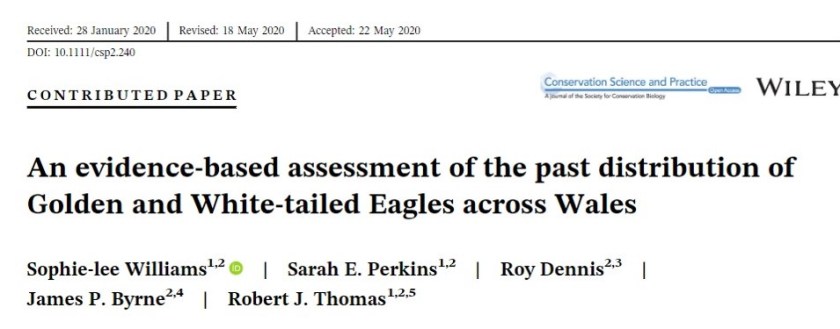
We blogged about O’Donoghue’s golden eagle plans in February and how they contrasted with the legitimate reintroduction plans of a different group, Eagle Reintroduction Wales (see here) and this story was later picked up by Private Eye (see here).

Nine months on and we were curious to read Dr O’Donoghue’s licence application to reintroduce golden eagles to Wales and even more curious to see how NRW had responded, so we submitted a Freedom of Information request for the details.

NRW has responded with this:

How interesting.

Meanwhile, Dr Rob Thomas (@RobThomas14) from the alternative Eagle Reintroduction Wales Project told us, “We are increasingly well supported by the Wildlife Trusts of South and West Wales but we feel we are several years away from any possible licence application, with the biological phases nearing completion but much still to do next in terms of engagement with farmers, shooters, tourism interests and other stakeholders“.

Werritty Review submitted to Scottish Government?

Rumour has it, Professor Alan Werritty has submitted his long-awaited review on grouse moor management to the Scottish Government, two and a half years after it was first announced by Environment Cabinet Secretary Roseanna Cunningham following the devastating findings of the golden eagle satellite tag review, which showed the extent and scale of ongoing golden eagle persecution on some driven grouse moors.

To be fair, Professor Werritty wasn’t actually commissioned until two years ago in November 2017. Nevertheless, the report is still six months overdue, partly due to ill-health (fair enough) but partly due to….well, we don’t know.

There hasn’t been any official announcement about the submission of Professor Werritty’s Review, and thus no indication of when the Scottish Government might publish it, nor when it might respond to the report’s recommendations.

Still waiting for Werritty

Autumn is here; Werritty’s report is not.

For new readers, the long anticipated and long overdue Werritty Review is a Government-commissioned report on grouse moor management in Scotland. Environment Cabinet Secretary Roseanna Cunningham commissioned it following the publication of the authoritative, ‘exemplary and thorough‘ Golden Eagle Satellite Tag Review in May 2017, which revealed the magnitude of ongoing raptor persecution on some Scottish grouse moors (read that report here).

The Werritty Review Group was announced in November 2017 and we were told to expect the report by spring 2019.

Spring 2019 came and went, the report didn’t appear, but we were told that Professor Werritty was ill and the report would be delayed by two months (new expected date: June 2019). Fair enough.

June 2019 came and went, the report didn’t appear.

Then we heard it would arrive in July 2019.

July 2019 came and went, the report didn’t appear then we heard from Professor Werritty himself that it’d be submitted ‘during the summer‘.

At the end of July, in response to public fury about on-going illegal raptor persecution on Scottish grouse moors, a Government spokesperson told us the report ‘was due in the next few weeks’ (see here).

It’s now mid-October and the report still hasn’t appeared. According to Environment Cabinet Secretary Roseanna Cunningham, writing to an MSP in response to a query about the publication date by a constituent (and blog reader!), the report is “expected within the next couple of weeks“!!

To be perfectly frank, events this year have overtaken whatever recommendations Professor Werritty might suggest – the discovery of this spring-trapped hen harrier on a grouse moor in Perthshire, this spring-trapped hen harrier caught next to his nest on a grouse moor in South Lanarkshire, this spring-trapped golden eagle photographed flying above a grouse moor in Royal Deeside, and the suspicious disappearance of two more satellite-tagged golden eagles from a grouse moor in Perthshire have demonstrated that we now need a radical approach to bring this to an end.

Nevertheless, we’re still keen to see the Werritty report appear because until it does, the Scottish Government has the perfect excuse, that it has used repeatedly since May 2017 when the review was first commissioned, to do absolutely naff all to tackle these ongoing serious organised crimes.

It is right and sensible that Scottish Government should wait for that report“, says Roseanna Cunningham. How can it possibly be “right” or “sensible” that the Government should continue to sit on its hands and watch these atrocities taking place, suggesting it’s powerless to act?


RSPB challenges misinformation about satellite tags

This is an excellent blog written by Ian Thomson, Head of Investigations at RSPB Scotland, countering the misinformation (that’s being kind) about satellite tags that is being touted by some in the game shooting industry.

We’ll be writing more on this shortly.

We’ve reproduced Ian’s blog here:

Challenging misinformation about satellite tags

RSPB Scotland’s Head of Investigations Ian Thomson outlines our thoughts on claims made accompanying the launch of a petition regarding satellite tags fitted to raptor species.

One of the greatest conservation tools to emerge in recent years has been satellite-tagging technology. Whether following the journeys of migrating cuckoos or shedding light on the dangers facing UK birds of prey, these tiny pieces of technology are becoming increasingly valuable in the conservationist’s mission to save nature.

As you read this, satellite tags are helping scientists monitor a handful of recently released captive-reared white-rumped vultures in Nepal after the species almost went extinct. It allowed the finding of a turtle dove nest in Suffolk this August, crucial for a species which has declined in the UK by 97% since 1970. Another tag’s data led us to the body of a hen harrier, Rannoch, lying in the heather, her leg caught in an illegal spring trap on a Perthshire grouse moor.

[Hen harrier Rannoch was fitted with a satellite tag at a nest in Perthshire in summer 2017]

A couple of weeks ago the Scottish Gamekeepers Association (SGA), lodged a petition “calling on the Scottish Parliament to urge the Scottish Government to introduce independent monitoring of satellite tags fitted to raptor species, to assist the police and courts in potential wildlife crime cases and to provide data transparency.”

The Scottish Parliament Information Centre (SPICe) briefing about the petition gives a rounded picture of the context.

However, the supporting information provided by the SGA to support their petition contains misleading information which appears to be part of an ongoing and concerted attempt to undermine the credibility of these scientifically-approved tags and the integrity of those monitoring them.

In recent years, various statements the SGA have made in the media (eg. as discussed here) are symptomatic of an organisation in complete denial about the extent of raptor persecution and it’s association with grouse moor management. Indeed, every story about a dead or disappeared satellite-tagged bird of prey on a grouse moor is met with denials, obfuscation or conspiracy theories.

[Rannoch was killed by an illegal trap on a grouse moor in November 2018. Had she not been tagged, this crime would have remained undiscovered]

The RSPB has been involved in the fitting of satellite transmitters, using experienced, trained and licenced taggers, to a wide variety of birds of prey and other species, both in the UK and abroad, for the last 15 years. As a key adviser and contributor to a number of high-profile conservation research projects involving the tagging of bird species across the world, we thought it important to share our experience to put the SGA’s claims into context.

In the UK, all tagging projects require approval from the independent British Trust for Ornithology (BTO)’s Special Methods Panel, who rigorously scrutinise all such proposals on behalf of the UK statutory conservation agencies, including SNH in Scotland, to check their scientific validity and that the welfare of the birds tagged is ensured. The BTO’s process also ensures all projects meet Home Office requirements.

All practitioners must demonstrate experience and capability to undertake this work and this is heavily scrutinised by the Special Methods Panel. Most of those involved with this technique are experienced bird ringers and handlers. An annual licence return is supplied to the BTO by all satellite practitioners for their records, and this is a condition of receiving further licences in the future.

The RSPB also has considerable experience in monitoring the data coming from our own transmitters and in working closely with other individuals and organisations involved in similar projects, notably with regard to development of tag technology, sharing good practice and the analysis of satellite tag data.

We lead on police training on the interpretation of tag data, recently attending key events in Perthshire and Yorkshire in 2019 to ensure that the police and officers from the National Wildlife Crime Unit are equipped to carry out independent scrutiny of tag data. We have also helped ensure that, where satellite-tagged birds of prey are suspected of being illegally killed, relevant tag data is provided to investigating officers as required.

We have assisted the police in numerous follow-up investigations where tagged birds have been illegally killed or have been suspected to have been victims of criminality – as with Rannoch, mentioned above.

In 2017, the government-commissioned review of the fates of satellite-tagged golden eagles concluded that almost a third of young tagged eagles “disappeared (presumably died) under suspicious circumstances” and that “areas managed as grouse moors were strongly associated with the disappearance of many of the tagged eagles”. This independently peer-reviewed study was underpinned by data from tags that researchers from RSPB and several other organisations and agencies had fitted to Scottish golden eagles, and is key evidence that scientifically highlights the ongoing problem of raptor persecution on Scotland’s grouse moors.

Satellite transmitters, all fitted as part of projects licensed by the BTO, have revolutionised the study of bird ecology. They have proved invaluable research tools in understanding the movements of birds, from Asian vultures to English turtle doves, Welsh hen harriers and Scottish golden eagles. They have allowed us to identify important migration staging areas, key nest and roost site locations, allowing us to further protect these birds. They have also allowed recovery of dead birds, enabling post-mortem examinations to take place and identify causes of death which would otherwise remain a mystery. Indeed, they are shining a very bright light on those areas of upland Scotland where raptor persecution continues unabated.

It is unfortunate that the SGA, which has consistently attempted to undermine the veracity of tag data, has also refused to take part in meetings of the partnership for action against wildlife crime (PAW Scotland) since the government’s satellite-tag review was published. Had it done so, perhaps many of the inaccurate statements contained in the briefing document, or in their recent members’ magazine, prepared to accompany the petition would not have appeared.  One can only question their motives.

ENDS

UPDATE 1st July 2022: Scottish Parliament sees sense and closes SGA’s petition seeking ‘Independent monitoring of satellite tags fitted to raptors’ (here).