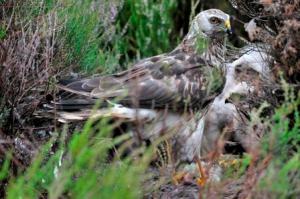
Gamekeeper convicted of poisoning offences on North Glenbuchat Estate, Aberdeenshire

 At Aberdeen Sheriff Court on 12 July 2006, the head gamekeeper on the North Glenbuchat Estate, Strathdon, Aberdeenshire, was found guilty of three offences: killing a wild bird, possession of birds’ eggs, and possession of a proscribed pesticide under the Wildlife & Countryside Act 1981.

The 56 year old head keeper, Hector McNeil, of Whitehillock, Glenbuchat, had worked as a gamekeeper on the Estate for 30 years. He was fined £850.

The RSPB claimed this was one of many cases but a spokesman for the Scottish Gamekeepers Association had said the case was not typical of the profession.


gamekeeper not guilty of poisoning on Clova Estate, Aberdeenshire

At Aberdeen Sheriff Court in 2007, a 34 year old gamekeeper of Lumsden, Huntley, was accused of killing a peregrine at Clova Estate, Huntley, Aberdeenshire in October/November 2006. He was also accused of having a bottle of poison at his home address and at Tomatin Estate (Invernesshire), and further accused of having an illegal pesticide (Carbofuran) in his possession at his home address and elsewhere.

After long court delays, in early 2009 he was found not guilty of a charge under Section 15(A) of the Wildlife & Countryside Act 1981.

Gamekeeper sentenced for poisoning buzzard at Frogden Farm, Kelso

14 December 2006.

Dead buzzard

A gamekeeper who laced a carcass with poison which killed a wild buzzard has been given 100 hours community service by Sheriff Kevin Drummond. Jedburgh Sheriff Court heard how the 62-year old keeper set a poisoned bait at Frogden Farm, Kelso, where he looked after a pheasant shoot.

The first-time offender, who reportedly lives in one of the farm cottages, also admitted possession of three dangerous pesticides, which he claimed he had inherited from his predecessor. Sheriff Drummond said the keeper was an experienced gamekeeper who had closed his eyes to environmental issues.

http://news.bbc.co.uk/1/hi/scotland/south_of_scotland/6180203.stm

Gamekeeper convicted for dead peregrine on Glenfiddich and Cabrach Estate

According to a report in the Scotland on Sunday newspaper, raids on the Glenfiddich & Cabrach Estate in NE Scotland in February and March 1998 revealed widespread poisoning across the 41,500-acre estate owned by London property tycoon, Christopher Moran. Ten rabbits, six pigeons, six grouse and two hares were reportedly laced with the lethal pesticide Carbofuran and left out on the hill. Three illegal pole traps and an owl whose legs had been smashed by a trap were also reportedly found, along with a dead peregrine inside an estate landrover. Tests revealed the peregrine had been poisoned with carbofuran.

The head gamekeeper was convicted at Elgin Sheriff Court in October 1998 and fined £700.

The estate is owned by multi-millionaire Christopher Moran, a businessman with an interesting past: see here and here.

Gamekeeper receives pitiful fine for poisoning offences on Fairnington Estate, Kelso

In August 2003, dead pheasant poults covered in blue granules were found on the Fairnington Estate, Kelso (owned by Mr Nigel Salvesen), close to a pen used to rear pheasants for shooting. Later tests showed the blue granules contained the banned pesticide, Carbofuran. Further searches revealed more carbofuran in a vehicle and in an unsecured shed, as well as alphachloralose and strychnine. The gamekeeper was charged with 48 offences under the Wildlife & Countryside Act 1981, the Food and Environment Protection Act 1985 (FEPA), and the Firearms Act.

At Jedburgh Sheriff Court in June 2005, after plea-bargaining, the keeper admitted just 4 offences under FEPA and the Firearms Act. His pitiful fine was £190, after reference was made to his poor health and that it was his first known offence.

http://campaignwithus.rspb.org.uk/Images/legaleagle46_tcm9-132969.pdf

Farr Estate gamekeeper’s conviction quashed

A gamekeeper on the Farr Estate, Tomatin, Inverness-shire was fined £1,500 for attempting to trap rare birds of prey. The keeper was found guilty of laying traps to catch peregrine falcons and goshawks. The 37-year-old was convicted at Inverness Sheriff Court in January 2005 at the end of a trial which lasted two years.

Sheriff Donald Booker-Milburn found the keeper, of  Strathdearn, Tomatin, guilty of two charges under the Wildlife and Countryside Act 1981.

The first charge stated that he set a crow cage funnel trap in Kyllachy with the intention of trapping peregrine falcons and goshawks. He used the trap with the funnel open, the door wired shut and two live feral pigeons set within the trap as bait.

The second accused him of possessing nine illegal gin traps, which can be used to trap wild birds and mammals such as foxes and wild cats, for criminal purposes.

RSPB Species Protection Officer Keith Morton said at the time: “We are very encouraged that the sheriff imposed a substantial penalty, as this will highlight the seriousness of this offence”. He added: “It will be interesting to see the reaction of the estate, we suspect there is a great deal of support about this activity among some employers.”

http://news.bbc.co.uk/1/hi/scotland/4217109.stm

The keeper’s conviction was quashed by the Court of Appeal later in 2005.

Gamekeeper fined for shooting short-eared owl on Leadhills Estate, South Lanarkshire

A gamekeeper was convicted of shooting a short-eared owl on a Lanarkshire grouse moor in May 2004.

The 23 year old gamekeeper (name removed under the Rehabilitation of Offenders Act 1974) who works for a shoot on Abington Farms Estate (often known as the Leadhills Estate), appeared at Lanark Sheriff Court on 31 July 2005. Two local bird of prey workers told the court how they had seen a short-eared owl fly up from the heather as the keeper drove across the moor on a quad bike. They saw the keeper stop the bike, take out his shotgun and walk towards the spot where the owl had settled on the hillside. When it flew up, he fired three shots at it and it fell to the ground. He collected the spent shotgun cartridges, but failed to find the owl.

After a search of the heather, the two witnesses found the bird, still alive but badly injured. It died a few minutes afterwards. They had recognized the keeper, and used a mobile phone to call Police Wildlife Crime Officer Phil Briggs. Within minutes the Strathclyde Police helicopter was searching the moor, but no one could be found. The keeper was later detained at his home, where clothing was recovered matching the description provided by the witnesses.

The keeper was convicted of killing a short-eared owl under section 1(1)(a)of the Wildlife and Countryside Act, and fined £500. It was his first conviction.

He remained employed on the estate. The area has a long history of confirmed and alleged cases of bird of prey poisoning and persecution.

Short-eared owls nest on the ground and feed almost exclusively on small mammals such as voles. They pose no threat to game birds.

Gamekeeper guilty of poisoning at Blythe Farm, nr lauder, Scottish Borders

In August 2006, a police raid on Blythe Farm, near Lauder in the Scottish Borders, led to the discovery of pheasant baits laced with poison (carbofuran) as well as several illegal cage traps baited with live pigeons to lure in birds of prey.

In April 2007, gamekeeper George “Doddie” Aitken was found guilty at Selkirk Sheriff Court. Sheriff Kevin Drummond sentenced him to 220 hours community service. A gamekeeper for 20 years, Aitken, who had turned up to court wearing a black balaclava, was allowed to keep his job. http://news.bbc.co.uk/1/hi/scotland/south_of_scotland/6719505.stm

In January 2008, the owner of Blythe Farm, James McDougal, became the first landowner to be punished for the crimes committed by his gamekeeper. His agricultural subsidies were cut by £7,919 for his failure to protect wildlife. http://www.guardian.co.uk/uk/2008/jan/07/ruralaffairs.scotland

Golden eagle & buzzard found poisoned on West Glenalmond Estate, Perthshire

In October and December 1998, a dead golden eagle and a buzzard were found on the Glenalmond Estate in Perthshire. The carcass of a red grouse was found close by, and tests later showed it had been used as a poisoned bait. The golden eagle had been killed by ingesting the illegal pesticide, Yaltox.

In Perth Sheriff Court in December 2000, a local gamekeeper was acquitted of all charges. He was also acquitted of further charges related to laying poisoned baits for either a peregrine or a golden eagle.

News story here

gin traps and a poisoned buzzard found on balmanno estate, perthshire

After several poisoning incidents in the Glenfarg area of Perthshire over a number of years, a buzzard poisoned by carbofuran was found on the Balmanno Estate in November 2001.

Tayside Police, the Scottish Executive Environment and Rural Affairs Department and the RSPB searched the shooting estate, as well as the premises of the gamekeeper, on 15 March 2002, under powers of the Food and Environment Act. On the estate, they found a freshly dead crow, which was later found to contain carbofuran. At the keeper’s premises they found a small quantity of carbofuran, a small egg collection and several gin traps with pieces of fur on the jaws. The keeper was detained and admitted that he had used the gin traps to take fox cubs. Admissions were also made in relation to the buzzard’s egg.

A poisoned buzzard

After many hearings, stretching back to an original trial date of 19 November 2002, the keeper changed his pleas to guilty. On 12 November 2003, at Perth Sheriff Court, he pleaded guilty to charges of possession of carbofuran in an unlabelled container, possession of several gin traps for use against foxes and possession of one buzzard egg.

The Procurator Fiscal accepted a ‘not guilty’ plea to poisoning a crow with carbofuran. The keeper was fined £250.


In Scotland, gin traps were only banned for use against foxes in 1974; in England and Wales, they were banned in 1958.

http://www.rspb.org.uk/Images/23-0617-03-04_legal%20eagle40%20v2_tcm9-132963.pdf