
More on convicted Derbyshire gamekeeper Glenn Brown’s case

It was good to see so much media coverage following the conviction of criminal gamekeeper Glenn Brown on Monday. It made local, regional, national and international news, probably because he committed his crimes on National Trust property – which isn’t somewhere you’d normally expect to hear about wildlife crime taking place. Let’s hope that the National Trust are reviewing the lease of their land to the ‘un-named third party’ as we speak.

Despite the broad media coverage, very few articles mentioned the dead sparrowhawk that was found close to one of the traps that criminal gamekeeper Glenn Brown was operating.  Also found close by was the body of a white pigeon. Mark Thomas, one of the RSPB investigators involved with catching Brown at it, has written an excellent little piece about the investigation here, alluding to what might have happened to the dead sparrowhawk and dead pigeon.
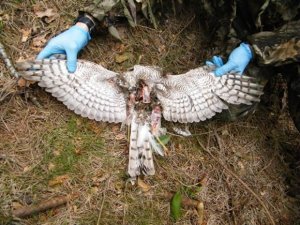
Thomas also writes that since 2006, goshawk and peregrine productivity in the Derwent Valley has collapsed. By coincidence, gamekeeper Brown is reported to have been employed as a gamekeeper since 2006. Amazing.

Thomas and his colleagues from the RSPB Investigations team deserve a great deal of credit, especially for the innovative techniques they used to catch Brown. So too does Derbyshire Constabulary and the CPS. The resulting punishment for Brown, convicted of seven offences – 100 hours community service – delivered by District Judge Caroline Goulborn (famed for the recent cat-in-the-bin-case) is pathetic, especially when you consider the sentencing options available, which include fines up to £5,000 and a six month prison term for each offence. Had Brown not been ordered to pay £10,000 costs, some might have concluded that he had got off very lightly. Depending on who pays for these costs, and whether he keeps his job as a gamekeeper, some may be certain he got off lightly.

Derbyshire gamekeeper guilty of using illegal trap

The long-running trial that began over two months ago against Derbyshire gamekeeper Glenn Brown concluded today, and he was found guilty of using an illegal trap to try and catch birds of prey on the National Trust’s Howden Moor in the Peak District. The court heard that he was interested in protecting the grouse where he worked. The trial began on 11 April 2011 at Chesterfield Magistrates Court.
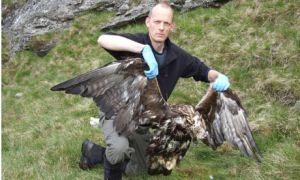
Brown was caught after RSPB investigators installed covert cameras overlooking a trap and filmed him over a period of time visiting the trap. He was unlawfully using a pigeon as a lure bird – this is illegal and is an indication that birds of prey were the target species he was trying to catch. He operated traps on land in the Upper Derwent Valley owned by the National Trust but leased by another party between 14 April and 25 May 2010.

Brown was found guilty of seven offences under the Wildlife & Countryside Act 1981 and the Animal Welfare Act 2010.

He was given 100 hours community service and ordered to pay £10,000 costs.

BBC news story here including video

More on this story later. Congratulations to the RSPB investigators for catching another criminal gamekeeper at it, and to Derbyshire Police and the Crown Prosecution Service for seeing the case through to trial. In the BBC news video, it is reported that Brown is the 100th gamekeeper to be convicted of crimes against birds of prey. So, Alex Hogg, Chairman of the Scottish Gamekeeper’s Association, still think it’s “unfair to accuse gamekeepers of wildlife crime“?

Poisoned golden eagle at Glen Orchy – two years on…

Two years ago today, this dead golden eagle was discovered by hill walkers in Glen Orchy, Argyll. Government tests later showed it had been poisoned by the illegal pesticide Carbofuran. This poisoning incident made the national press (e.g. here).
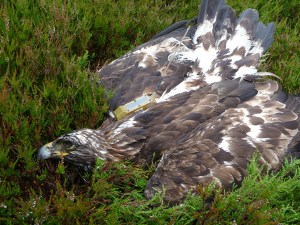
Several days later, a multi-agency search was conducted in and around Glen Orchy. The police-led operation included the Oban Community Policing Team, specialist wildlife crime officers from three police forces (Strathclyde, Lothian & Borders and Central), experts from the National Wildlife Crime Unit, pesticide experts from the Scottish Government and representatives from the RSPB and Scottish SPCA. The police said afterwards that they were following a positive line of inquiry.

Meanwhile, during the police search two handguns were found in gamekeeper Tom McKellar’s loft. Eighteen months later in December 2010, McKellar was convicted at the High Court in Glasgow for having prohibited weapons. However, he avoided the usual mandatory five year custodial sentence and instead received 300 hours community service. Story here

So what happened to that ‘positive line of inquiry’ in the eagle poisoning investigation? Good question.

Bird boycott

Here is a letter that was published in today’s edition of The Scotsman:

I recently had another holiday in Scotland – my third visit this year – principally to do bird and wildlife watching.

Like many others I have always wanted to go bird watching in Malta and Cyprus, but have boycotted these islands on principal because of their hunting and persecution of birds.

On each visit to Scotland I learn of more illegal poisoning and persecution of raptors – including a major tourist attraction, the iconic golden eagle.

I am beginning to think that my patronage of your tourist industry is somewhat hypocritical in view of my stance on the European countries I mentioned.

It appears that wildlife crime detection is grossly underfunded and that penalties are woefully inadequate.

What good is a fine of a few thousand pounds to a gamekeeper whose multi-millionaire lord and master will pay the fine anyway?

I think a universal boycott by wildlide enthusiasts would be damaging to the economies of Scotland, and I implore the Scottish Government to make a concerted effort to stamp out these crimes.”

P. Bateson, Halifax.

The Scotsman letter here

‘Unfair to accuse gamekeepers of wildlife crime’, says gamekeeper Alex

In an article published in The Courier on 30 May 2011, Ian Thomson, an investigator for the RSPB, expressed his concern about the high number of wild birds illegally killed in Tayside. 14 incidents were recorded there between March 2010 and March 2011.  In the same article, it is reported that PC Bryan Prestwood, a wildlife crime officer based in Angus, ‘believes the biggest problem is with gamekeepers and land managers’. Full article here

In an angry response published on 6 June 2011, Alex Hogg suggested it was ‘unfair to accuse gamekeepers of wildlife crime’. His letter here

I think people will make up their own minds Alex, based on the factual evidence and government statistics. You’ve even said yourself, on many occasions, that if gamekeepers were to be given licences to kill protected raptors then illegal raptor poisoning would stop. This notion was also repeated last week by David Hendry of Cardney Estate in his BBC 2 Landward interview. Quite a strange prophecy from a ‘profession’ that claims not to be involved with wildlife crime, don’t you think?

For those still in any doubt whether some gamekeepers are involved in willdife crime, and specifically raptor persecution, here’s a link to a piece we wrote on the issue last year, including some revealing statistics provided by the RSPB. Here’s a link to another piece we wrote last year, with the most recently-published RSPB statistics. These show clearly that 85% of people who were convicted of illegally killing birds of prey between 2003-2008 were gamekeepers!

Sleeping gamekeeper fined over guns on table

A GAMEKEEPER who was found asleep in a chair in his kitchen with a shotgun and rifle lying on the kitchen table was fined £160 at Inverness Sheriff Court this week.

Martin MacKenzie has been suspended from his job and also faces losing his firearms licence.

Depute Fiscal Karen Smith said police had to attend the house at Mains of Aberarder and found Mackenzie asleep at the kitchen table.

The rifle and shotgun were lying on the table, she told Sheriff Ian Abercrombie.

Mackenzie (36) of Craggan Valley, Kiltarlity, admitted on May 18 last year failing to comply with conditions of his firearms certificate that he failed to keep the guns in a secure designated place.

Craig Wood, solicitor, said Mackenzie was married with two children, and had been a keeper at Arberarder for 10 years. “Since this incident he has been suspended by his employers.”

Mr Wood added that a letter had been received from the Chief Constable asking for Mackenzie’s certificate to be revoked, but this was the subject of an appeal.

He had been using his guns and intended to clean them,” said Mr Wood. “He took several phone calls and when the police attended he accepts he should have dealt with it more expeditiously. He is a perfectly reasonable human being.”

So, it appears that Northern Constabulary consider falling asleep in your home in charge of unsecured firearms an offence serious enough to revoke a certificate. No complaints here and well done to the newly-appointed Chief Constable of Northern Constabulary, Mr George Graham. It follows then surely that the Moy and Skibo gamekeepers, convicted last week, should also have their firearms certificates revoked given the seriousness of their crimes? If you measure seriousness in terms of the court’s punishment, then both James Rolfe (Moy Estate) and Dean Barr (Skibo Estate) committed crimes far more serious than the one committed by Martin MacKenzie at Aberarder:

Rolfe = £1500 fine; Barr = £3300 fine; MacKenzie = £160 fine.

I also wonder whether MacKenzie is a member of the SGA, and if so, whether he faces sanctions in light of his firearms conviction? Incidentally, there’s still no public statement of condemnation from the SGA over last week’s convictions of the Moy & Skibo keepers. They also haven’t said whether Rolfe or Barr are SGA members and if so, whether their SGA membership has been terminated after their criminal convictions. Hopefully the SGA’s bed-fellows at PAW Scotland will be asking these questions.

Many thanks to the contributor who brought this article to our attention.

Highland News

More on the Moy case

According to an article published in The Scotsman (view here), a post mortem carried out on the dead red kite discovered in the vehicle used by gamekeeper James Rolfe on Moy Estate last June, revealed it had broken legs and had died as a result of a blow to the head. Rolfe was convicted for being in possession of the dead kite. Why weren’t charges brought against anyone for the unlawful killing of this bird?

In the same article, it is reported that over a five-week period, the remains of a further two dead red kites, six illegal baited spring traps, a trapped hen harrier, and a poison bait laced with a banned agricultural pesticide (poison) were also recovered from the estate. No arrests or charges have been made in connection with these incidents.

Why not?

In an article in Birdwatch Magazine, further gruesome details are revealed about the discovery of a severed red kite leg and wing tags belonging to a red kite that was being followed by satellite tracking, all hidden in holes covered by moss. The article also reports that four golden eagle leg rings were discovered in Rolfe’s possession. No arrests or charges have been made in connection with these incidents.

Why not?

You may wish to ask the following people:

Crown Office and Procurator Fiscal Service: pn_copfs@scotland.gsi.gov.uk

Northern Constabulary Force Wildlife Crime Co-ordinator, Chief Inspector Matthew Reiss: matthew.reiss@northern.pnn.police.uk

Environment Minister for Scotland, Stewart Stevenson MSP: msp@stewartstevenson.net

Moy Estate results

Today at Inverness Sheriff Court, gamekeeper James Roderick Rolfe, 20, was convicted of being in possession of a dead red kite which was found in his vehicle during a police raid on the Moy Estate in June last year. Rolfe said he had found the kite caught in a trap set for stoats. It had not been poisoned. Rolfe was fined £1,500 for possession of the dead bird.

The images here show the dead kite in the back of his vehicle. No explanation has been given to account for the obvious injury this bird suffered to its head area. According to the Inverness Courier, Rolfe claimed the bird was already dead when he found it.
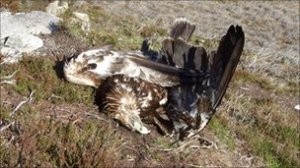
Another gamekeeper working on Moy Estate was accused of being in possession of 56 gull eggs. The court accepted his plea of not guilty.

Northern Constabulary press statement

Inverness Courier news report

Skibo Estate results

Dean Barr, a gamekeeper (and reported elsewhere as being the sporting manager) on the Skibo Castle Estate, has been convicted of having enough illegal poison “to wipe out the entire Scottish golden eagle and red kite populations several times over”. Barr, 44, of East Lodge, Clashmore, Dornoch, admitted possessing 10kg of the banned pesticide Carbofuran. He admitted carrying the poison from his previous job as head gamekeeper on the Raeshaw Estate to Skibo Castle Estate in 2008, because he had ‘not known how to safely dispose of it’.

The Carbofuran haul was discovered in a locked store on the Skibo Castle Estate, for which Barr had the keys. According to the Northern Times and Northern Constabulary, the poison was discovered within premises operated and solely accessed by Barr on Skibo Estate land.

Today he was fined £3,300 “to mark the court’s disapproval”. This was apparently reduced from a £5,000 fine for his early plea.

Despite this conviction, the Crown accepted he had ‘no part’ in the deaths of two poisoned golden eagles and a sparrowhawk (killed with Carbofuran) found on the estate in May 2010 (along with a dead buzzard and a third poisoned golden eagle killed by Aldicarb).

Barr’s defence lawyer said Barr was well regarded personally and professionally by his current and previous employers. “If it was thought that he was involved in the use of this material, they would not be so supportive”.

This is not the last we will write on this case.

The Scotsman news story

BBC news story

STV news story

Adjournment #4 in case against Moy gamekeepers

The case against Moy gamekeepers James Roderick Rolfe and Wayne Grant was heard at Inverness Sheriff Court today. No plea was taken and the case has been adjourned for the 4th time. It will continue on 26 May 2011.

Both men face charges under the Wildlife & Countryside Act 1981. Rolfe is accused of possessing a dead red kite at the Gate Lodge, Moy on 3 June 2010. Grant is accused of having 56 black-headed gull eggs in an outbuilding at his home on the same date.

For background info on this case please see blog posts 3 June 2010, 4 June 2010, 23 March 2011, 8 April 2011 and 5 May 2011.