Re-discovery of hen harrier Rosie not quite as it’s being portrayed

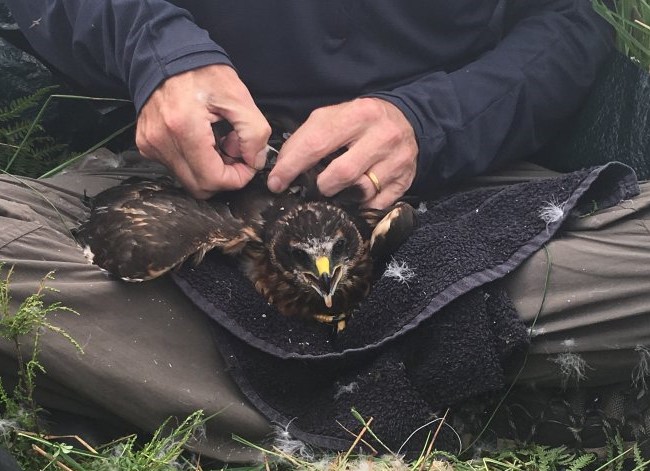
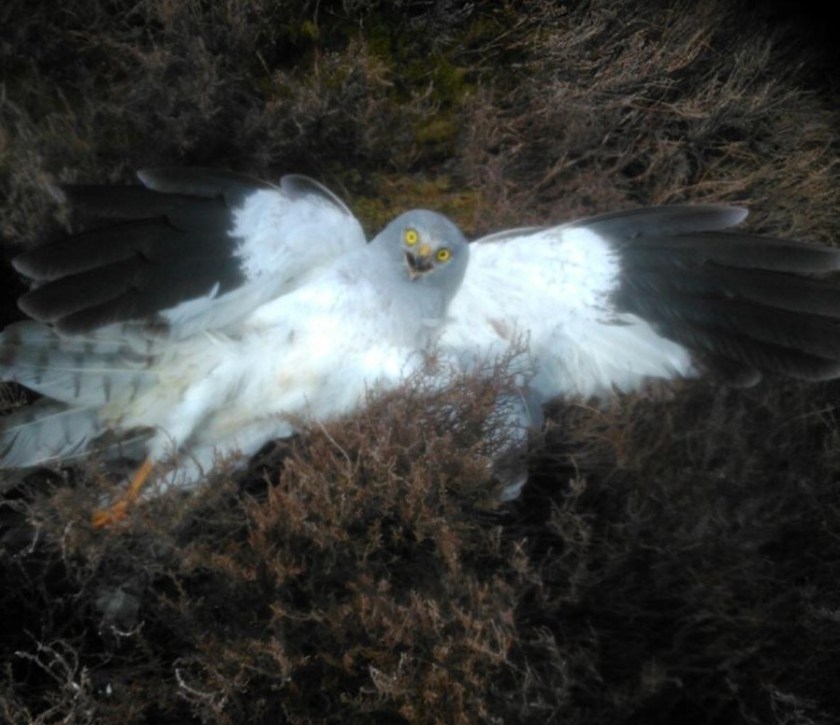
You’ll recall that satellite-tagged hen harrier Rosie was reported as being the fourth young hen harrier to disappear this autumn, in a vague statement issued by Northumbria Police on 17th October 2019 (see here).

Rosie was not one of the brood meddled hen harriers but was a 2019 bird satellite tagged by Natural England in Northumberland. We were not told the date of her tag’s last transmission nor the location of the tag’s last known position other than ‘near Whittingham’.

Three days later on the evening of 20th October 2019, Supt Nick Lyall tweeted to say “Rosie is alive and well“. It was not reported whether Rosie’s tag had come back online or whether she’d been observed and identified in the field by other means, e.g. the unique code on her leg ring.

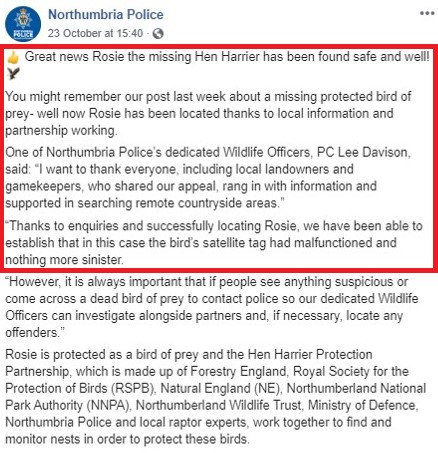
On 23rd October 2019 Northumbria Police posted the following statement on social media:

You’d be forgiven for reading this statement, particularly the part we’ve highlighted in red, and thinking that Rosie’s tag had failed and she was only re-discovered thanks to the extraordinary efforts of local landowners and gamekeepers.

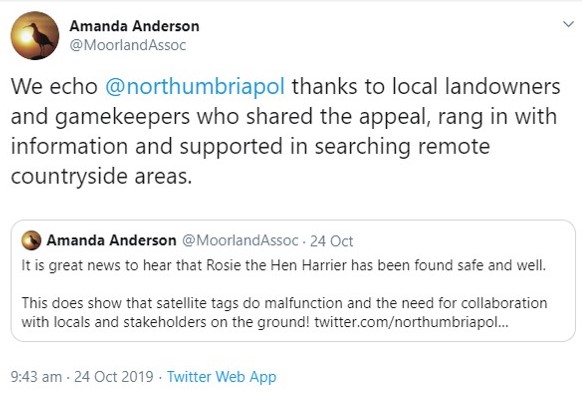
Indeed, Amanda Anderson of the Moorland Association has been quick to exploit this view on her social media accounts:

Isn’t it all fantastic? We don’t need ‘unreliable’ technology to protect this species – we can simply rely on lovely landowners and gamekeepers, working in partnership with the police, and the hen harrier will be kept safe.

The thing is, this version of events is complete bollocks.

When Nick Lyall tweeted that Rosie was ‘alive and well’, we contacted him to ask for more detail. He told us that Rosie’s tag had come back online and that’s how she’d been relocated, and this was ground-truthed by an experienced Natural England fieldworker who confirmed the sighting. (Thanks for being upfront, Nick).

So why the hell is Northumbria Police stating that “Rosie has been located thanks to local information and partnership working” and inferring that she was found thanks to the efforts of local landowners and gamekeepers, when actually she was found because her tag came back online?

Was this police press statement issued with the blessing of Natural England?

And if it wasn’t, why hasn’t Natural England since clarified the details of Rosie’s re-discovery?

What sort of shambles is this? How are we supposed to have any confidence in what we’re being told?

This blurring of the facts isn’t the only issue of concern. We’d like Natural England to be much more upfront about the type of tag Rosie is carrying….and you’ll understand our concern about that when we blog about the tags that were fitted to the brood meddled hen harriers……

Is SNH about to impose a General Licence restriction on Leadhills Estate?

Last week RSPB Scotland published a blog called ‘Why vicarious liability is failing to have an impact in Scotland‘.

Written by Duncan Orr-Ewing, Head of Species & Land Management, it’s the latest in a series, following on from the excellent blog challenging the Scottish Gamekeepers’ ignorance on satellite tags, written by Ian Thomson, Head of Investigations at RSPB Scotland.

Duncan’s blog is well worth a read. It questions the Crown Office’s recent decision not to prosecute anyone for alleged vicarious liability following the conviction of Scottish gamekeeper Alan Wilson for a series of barbaric wildlife crimes on the Longformacus Estate in the Scottish Borders.

It also considers the potential benefits of having the threat of a vicarious liability prosecution, and how this may have driven down the use of illegal poisons as a method of killing raptors, but been replaced by shooting and trapping methods which are much harder to detect.

The really interesting part of the blog, as far as we’re concerned, is the section on the Leadhills Estate in South Lanarkshire. Blog readers will recall this is where a male hen harrier was found with an almost severed leg caught in an illegally-set spring trap next to his nest earlier this summer. Despite the heroic efforts of a number of experts, he didn’t survive. The estate denied all knowledge and responsibility and nobody has been charged.

[The trapped hen harrier found on Leadhills Estate. Photo by Scottish Raptor Study Group]

Regular blog readers will know this poor hen harrier is not the only victim reported from the Leadhills Estate. The list is long and goes back more than a decade (e.g. scroll down this page). Duncan’s blog discusses some of the most recent incidents including the witnessed shooting of a hen harrier in May 2017; the witnessed shooting of a short-eared owl just a few weeks later and whose body was recovered; the discovery of a buzzard in 2018 that was found to have been shot twice; and the filmed buzzard that according to the RSPB was likely killed in a crow trap in January 2019.

Nobody has been charged for any of the above, but significantly, Duncan’s blog says this:

“We are advised that only now is an Open General Licence restriction, another sanction in the public authority wildlife crime “toolbox”, to be imposed here”.

SNH has had the power to impose General Licence restrictions since 1 January 2014. This was instigated by former Environment Minister Paul Wheelhouse in response to continuing difficulties of securing criminal prosecutions and was an instruction to SNH to withdraw the use of the General Licence (available for legal predator control) on land where crimes against raptors are believed to have taken place but where there is insufficient evidence to instigate criminal proceedings. The decision to withdraw the licence is based on the civil standard of proof which relates to the balance of probability as opposed to the higher standard of proof required for a criminal conviction.

This measure is not without its limitations, particularly as estates can simply apply for an individual licence instead which allows them to continue predator control activities but under slightly closer scrutiny.

SNH has only imposed four such restrictions since 2014 – a pathetically small figure when we are aware of at least a dozen other cases where a restriction should have been applied. SNH has claimed it is ‘not in the public interest‘ to explain those failures.

We’ve looked on the SNH website to see whether Leadhills Estate has been listed as having a General Licence restriction imposed (SNH does publicise the details when it imposes the restriction) but so far Leadhills Estate is not named. Potentially the estate has been notified and is currently in the period where it may challenge SNH’s decision, as per the framework for a General Licence restriction.

Watch this space.

UPDATE 26 November 2019: SNH imposes General Licence restriction on Leadhills Estate (here)

More detail emerges about SSPCA/Police Scotland raid at Millden Estate

A couple of weeks ago the Scottish SPCA, assisted by Police Scotland, conducted a pre-dawn raid on properties in Angus and Aberdeenshire as part of an investigation in to suspected animal fighting (see here).

This story has attracted huge media attention and more details have been emerging as journalists begin to dig.

The first insight came when journalist David Leask from The Herald exclusively revealed that the property raided in Angus was the Millden Estate, a grouse shooting estate in the Angus Glens (see here). We learned that as a result of the raid, the estate had suspended an employee pending further investigation.

We’ve now learned that the suspended employee was apparently a gamekeeper, according to this article by Charlie Parker in The Times, published two days ago: (see copy of article at foot of this blog)

Some may already have made the assumption that the suspended employee was a gamekeeper but this wasn’t previously clear; Millden Estate employs multiple people in multiple roles and they’re not all gamekeepers (e.g. in the Millden Estate 2011 sales brochure 16 employees were listed).

We’ve also learned something else about this raid. It had previously been reported that the SSPCA had seized dogs during the raid at Millden but their condition was unreported. However, according to this article by Jim Millar in The Courier, an SSPCA spokesperson is quoted as follows:

We were made aware of animal fighting and secured a warrant to investigate further. This has been a successful raid and we are happy with the outcome. We have seized a number of dogs, which have injuries consistent with animal fighting and taken them into our care where they are getting all the love and attention they need“.

There is still no further detail about the dead buzzards that were reportedly recovered by the police/SSPCA, nor any indication of how they died.

We’ll await further information as and when the investigating authorities publish it. At this stage we are not aware of anyone being charged with any offences.

Sorry but as this is a live investigation we won’t be accepting any comments on this post.

UPDATE: Here is the text of the article in The Times:

A gamekeeper at Scotland’s most prestigious shooting estate is the subject of an investigation into organised animal fighting, The Times has learnt.

The Scottish SPCA last week led raids at two private lodgings on the £17.5 million Millden Estate in the Angus Glens. Specialist officers, backed by police, recovered computer equipment and dead buzzards among other evidence after obtaining warrants to search the properties.

They were said to be acting on intelligence gathered on animal fighting activities. Dogs and several other animals are understood to have been rescued in the operation.

Sources familiar with the raids said a gamekeeper was being investigated as part of the inquiry but no arrests have been made.

Millden Estate confirmed it immediately suspended a staff member after being contacted by officers but stressed that the investigation concerned an individual and not the estate itself.

The estate was recently visited by Alan Werritty, who is leading a Scottish government review of grouse shooting. He looked at Millden as an example of best practice for managing moors.

Robbie Marsland, director of the League Against Cruel Sports, which assisted the Scottish SPCA in its investigation, said: “We look forward to anyone found responsible experiencing the full weight of the law.”

A spokesman for Millden Estate said it was carrying out its own internal investigation. He added: “The estate will continue to liaise with the appropriate authorities. It has a robust system of compliance with the law including a zero tolerance approach to any wildlife offences or animal welfare issues.”

The Scottish Gamekeepers Association said: “If the allegations are correct, this type of abhorrent organised activity will not be condoned by anyone associated with gamekeeping.”

The Scottish SPCA issued a formal statement on Monday saying it had conducted raids in Angus and Aberdeenshire after intelligence led to concerns for the safety of dogs and wild animals. An undercover officer in its special investigations unit said: “We uncovered intelligence to suggest illegal animal fighting was taking place at these locations.”

ENDS

UPDATE 3 December 2020: Animal cruelty charges follow SSPCA/Police raid at property on Millden Estate (here)

UPDATE 2 November 2021: New trial date for Millden Estate gamekeeper accused of animal fighting offences (here)

Pre-Werritty propaganda from grouse shooting industry

As we all continue to wait for the publication of Professor Werritty’s report on driven grouse shooting, the usual suspects have been busy putting together a damage limitation programme to save their sorry necks.

An ‘informal alliance’ has been created under the banner of RELM (Rural Environment Land Management) ‘to help co-ordinate and streamline responses and communications ahead of the publication of the final report‘ and its first offering is this briefing document for MSPs which was distributed by Scottish Land & Estates a couple of weeks ago:

Here’s the intro blurb:

Grouse moor management has been the subject of much attention during the summer period across a range of issues such as the environment and species conservation, satellite tagging and wildlife crime, mountain hares and the start of the season on August 12.

With the Scottish Government’s review into grouse moor management due to be published shortly, rural organisations wished to provide the following update to parliamentarians. We would be pleased to provide additional detail where required.

Ah, how thoughtful. Amusingly, several MSPs have sent us a copy of this briefing document with comments along the lines of ‘You might want to say a few things about this’.

We’re grateful to those MSPs because yes, we do want to say a few things about the document’s contents and we wouldn’t otherwise have had an opportunity had they not shared the briefing with us.

We’re not posting the full briefing document here, yet. Instead we intend to blog about different aspects of it in turn.

Today we’re looking at the page entitled ‘Wildlife Crime’ and its five paragraphs of propaganda:

Propaganda paragraph 1:

Yes, significant media attention does remain focused on wildlife crime, and particularly illegal raptor persecution because everyone else finds it abhorrent and can’t understand why it still goes on and why the grouse shooting industry continues to shield the criminals involved. It’d be interesting to know what, exactly, these five organisations have done to crack down on raptor persecution as part of their claimed ‘full commitment to improving prevention, detection and prosecution’.

Propaganda paragraph 2:

No surprises here. This is a blatant attempt, yet again, to discredit the RSPB’s annual Birdcrime Report which was published a couple of weeks ago and showed that confirmed raptor persecution crimes in Scotland in 2018 had doubled from those recorded in 2017. These cases included a peregrine poisoned in the Pentland Hills, near Edinburgh; a buzzard found to have been shot twice, in South Lanarkshire; a buzzard caught in an illegal trap, in Inverness-shire; and a hen harrier caught in a spring trap in Perthshire. All of these incidents occurred on, or close to, land being managed intensively for driven grouse shooting.

With this level of relentless criminality, it’s no wonder the grouse shooting industry apologists want to infer that the RSPB’s data are ‘unofficial’. Fine. We’ll come back to this later this autumn when the Government publishes its annual wildlife crime report, which we know will include all of the confirmed incidents already reported by the RSPB.

Propaganda paragraph 3:

This is perhaps the most cynical of attempts to downplay the disgusting reality of the criminality still being committed on some driven grouse moors. And the first sentence of paragraph 3 is actually a lie. Not being pursued by Police Scotland? Er, ALL the cases of alleged raptor persecution that have been reported from grouse moors over the last few months are still considered to be live criminal investigations by the Police, according to the investigations officer we spoke to yesterday.

So, the satellite-tagged hen harrier that was found dead on a grouse moor in Strathbraan with an illegal spring trap clamped to its leg – it’s still the subject of a criminal investigation by the police.

The two satellite-tagged golden eagles (Adam and Charlie) that ‘disappeared’ in suspicious circumstances on another grouse moor in Strathbraan, on the same morning as each other – they’re still the subject of a criminal investigation by the police (as are several other alleged offences uncovered during the police search).

The hen harrier that was found caught by its leg in a spring trap that had been set illegally next to its nest on a grouse moor in South Lanarkshire – it’s still the subject of a criminal investigation by the police.

The buzzard that was caught inside a legal cage trap on the same South Lanarkshire grouse moor but was then allegedly beaten to death by someone arriving on a quad bike after dark and using a key to open the padlocked door of the cage – it’s still the subject of a criminal investigation by the police.

The young golden eagle that was photographed flying around in the Cairngorms National Park with an illegal trap clamped to its leg – it’s still the subject of a criminal investigation by the police.

And as for the claim that estates have issued ‘unprecedented and emphatic rebuttals’ – er, there’s nothing unprecedented about that! Estates have always denied any involvement in any of the wildlife crimes that have been uncovered on their land – it’s what they do!

Propaganda paragraph 4:

Ah yes, convicted gamekeeper Alan Wilson, dubbed by the press as ‘Scotland’s worst wildlife killer‘. Yet again, the link between Wilson’s filthy criminal activity uncovered at Henlaw Wood and driven grouse shooting is kept well hidden. Yes, the Longformacus Estate was managed for low ground pheasant shooting but it was also managed for driven grouse shooting – a fact that Scottish Land & Estates doesn’t like to mention!

And speaking of Scottish Land & Estates and it’s so-called ‘full commitment’ to tackling wildlife crime, it still hasn’t said whether the Longformacus Estate was a member at the time these crimes were committed and if so, whether that membership has now been terminated? We asked SLE this question on 22 August 2019. Still waiting for an answer….

Propaganda paragraph 5:

Of course they continue to call for tougher penalties – how can they not? But they know as well as we do that the severity of the penalty is utterly irrelevant if the perpetrators of these crimes can’t even be identified, let alone prosecuted.

And as long as evidence continues to be destroyed and employers continue to shield their criminal employees by instructing them to give ‘no comment’ interviews to the police, nothing will change.

Fortunately, there are more and more savvy MSPs in the Scottish Parliament who have seen through the greenwash and know exactly what’s going on. If you think your MSP isn’t one of those, it’d be worth dropping them an email with a link to this blog.

Golden eagle with trap dangling from its leg: statement from Environment Cabinet Secretary

In August Police Scotland published a photograph of a young golden eagle that had been seen flying in the Cairngorms National Park with an illegally-set trap clamped to one of its legs.

This photograph, along with the Police’s appeal for information, went viral and was reported on news channels around the world (e.g. here), highlighting Scotland’s shameful record of illegal raptor persecution.

There’s been no further update on the fate of this eagle. Undoubtedly it’ll be dead and if it had been found by anyone associated with the criminal element of the game-shooting industry the corpse and trap will be long gone….nothing to see, deny, deny, deny, it was all a set up, fake news, it never happened, etc etc.

Meanwhile, those who aren’t fooled by the propaganda and know exactly what goes on on game shooting estates have been asking pertinent questions.

Step up Colin Beattie MSP (SNP: Midlothian North & Musselburgh) who lodged the following written question on 2 September 2019:

Question S5W-25069 – 

To ask the Scottish Government, in light of reports of a golden eagle found with an illegal trap on its legs, what action it is taking to protect wild birds as a matter of urgency ahead of the publication of the findings of the Grouse Moor Management Group (the Werritty report).

A brilliant question. Forget ‘waiting for Werritty‘ which has been the Scottish Government’s default response to every single raptor persecution crime since May 2017, Colin wants to know what action is being taken NOW.

The Government’s response came from Environment Cabinet Secretary Roseanna Cunningham on 12 Sept, as follows:

The Scottish Government is strongly committed to safeguarding the welfare of all animals, including wild birds such as raptors.

The illegal persecution of our birds of prey is an extremely serious issue and, as we announced in our Programme for Government for 2019-2020, we will bring forward a Bill increasing the maximum penalties for certain wildlife offences, including those associated with illegal killing or injuring of wild birds. This will deliver a commitment to implement the recommendation to increase wildlife crime penalties in the review undertaken by Professor Poustie.

We also committed in the Programme for Government that we will respond to the independent review on grouse moor management. The review is examining how we can ensure that grouse moor management is sustainable and complies with the law and it would not be appropriate to make decisions in advance of its report. We will carefully consider the recommendations in the report and other relevant evidence when deciding our response.

The measures on wildlife crime penalties build upon a range of other work we have undertaken to tackle this issue, including: supporting the use of satellite tags to monitor birds of prey; introducing new offences for harassing birds of prey or damaging their nesting places; setting up a poisons disposal scheme to remove poisons used to kill wild birds; strengthening Police Scotland wildlife crime resources, including in the Cairngorms; and introducing vicarious liability so that landowners can be held responsible for crimes against wild birds committed by their employees.

Roseanna’s response carefully avoids answering Colin’s question directly. Colin asked what Scot Gov was doing ‘as a matter of urgency ahead of the publication of the Werritty report’. Roseanna’s response confirms, in effect, that Scot Gov is doing absolutely nothing at all in advance of the Werritty report.

Splendid.

And guess what? We’re still waiting for Werritty, despite being told by Scot Gov at the end of July that the report was due ‘in the next few weeks’. What an embarrassing fiasco it has become.

Whoever wrote Roseanna’s response was surely having a laugh, judging by the last paragraph. Yes, Scot Gov has introduced new offences for harassing birds of prey or damaging their nesting places but as far as we’re aware, there have been no prosecutions for these offences even though there have been a number of reports of raptor nests being deliberately burned out on grouse moors.

And yes, Scot Gov set up a poisons disposal scheme (two, in fact) to remove poisons used to kill wild birds and yet still we’re seeing raptors being illegally poisoned and still gamekeepers are being found guilty of possessing these illegal poisons.

And yes, Scot Gov did support a pilot scheme for a number of police special constables (essentially volunteers working in their own time) in the Cairngorms National Park but there has been no (public) assessment of the scheme’s impact and raptor persecution crimes were still reported in the National Park during the scheme’s duration.

And yes, Scot Gov did introduce vicarious liability so that landowners could be held responsible for crimes against wild birds committed by their employees but so far this has only resulted in two successful convictions in 7.5 years and only last month yet another landowner avoided any charges of alleged vicarious liability and the Crown Office chose not to explain this decision to the public.


No vicarious liability prosecution for Longformacus Estate

Ten days ago Scottish gamekeeper Alan Wilson was sentenced for a catalogue of wildlife crime offences, including possession of the banned poison Carbofuran and the shooting of protected raptors, badgers and an otter on the Longformacus Estate in the Scottish Borders (see here).

[Criminal gamekeeper Alan Wilson, photo by Daily Record]

Very early on in this case we were aware that two individuals had been charged in relation to the crimes uncovered at Longformacus Estate (see here) and it was rumoured that the second man was facing a charge of alleged vicarious liability for Wilson’s crimes, although we were unable to verify this.

As a quick re-cap, vicarious liability was a measure introduced by the Scottish Government on 1 January 2012 as a direct and specific response to ongoing illegal raptor persecution, whereby somebody (e.g. a landowner or a sporting agent) may be held responsible for the criminal actions of an employee – see here for a more detailed explanation.

Following Wilson’s conviction and then subsequent sentencing earlier this month, we were keen to find out whether the Crown Office was now pursuing a charge of alleged vicarious liability against any individual associated with the management of Longformacus Estate. Last week we wrote to the Crown Office for clarification and this is the response received yesterday:

So, here we are yet again.

No prosecution for anyone associated with the management of Longformacus Estate where gamekeeper Alan Wilson was able to commit crime after crime after crime after crime, apparently without his boss(es) noticing.

For a defence of a charge of alleged vicarious liability, the gamekeeper’s boss(es) would need to show that (a) s/he/they did not know the offence was being committed; AND (b) that s/he/they took all reasonable steps AND exercised all due diligence to prevent the offence(s) being committed. Without knowing the full facts and circumstances of this case it is impossible for us to judge whether the Crown Office’s decision not to pursue a charge was sensible, but it has to be said that given the extent and duration of Wilson’s criminal activities, it would have been very interesting indeed to have heard his bosses’ interpretation and explanation of ‘all due diligence’.

We’ll probably never know why the Crown Office chose not to proceed – it is under no obligation to offer any explanation to the public. However, this latest decision really shouldn’t come as any surprise to anybody – remember, this is the same Crown Office that dropped five prosecutions for alleged raptor persecution in quick succession in 2017 (see here), even including several cases where RSPB video footage had captured the crimes on camera! Those decisions not to proceed with prosecutions hailed the start of what has now become complete exasperation at the authorities’ failure to take on many cases linked to wildlife crime on game-shooting estates.

The Crown’s decision not to pursue criminal proceedings in relation to the crimes committed at Longformacus Estate also further entrenches the view that vicarious liability as a measure for tackling ongoing raptor persecution is a resounding failure. Introduced seven and a half years ago on 1 Jan 2012, only two successful prosecutions have been secured: one in Dec 2014 (here) and one in Dec 2015 (here). A third case in Oct 2015 was dropped because the authorities couldn’t identify the estate’s management structure (here) and a fourth case was abandoned in April 2017 because the Crown said ‘it wasn’t in the public interest to continue’ (here).

Who thinks that two successful cases in 7.5 years is a measure of success? Perhaps if raptor persecution crimes weren’t still being committed then vicarious liability might have been viewed as a success in terms of its deterrent value but it’s quite clear, given the ongoing reports of persecution, that landowners and sporting agents are probably increasingly confident of evading prosecution and the Crown’s decision on the Longformacus Estate will only strengthen that view.

The question now is, for how many more years do we have to sit and watch the pathetic failure of vicarious liability as a measure to combat raptor persecution? The Scottish Government can no longer rely on this as an indication of its commitment to tackling these crimes. Sure, when introduced in 2012 it was done in good faith and with the best of intentions but it is quite clear for all to see that, for whatever reason, it isn’t working, and the Scottish Government needs to acknowledge this failure and find out why it’s failing and get it fixed.

It’s not just convicted gamekeeper Alan Wilson sticking up two fingers to our law-abiding society.

The topic of vicarious liability was raised at the recent SNP Conference Fringe meeting on grouse moor reform (here) as well as the Revive Coalition’s conference in Perth (here) and caused quite a stir amongst delegates and panellists at both events. It’s an issue we’re likely to follow up with several interested MSPs.

Meanwhile, Chris Packham’s petition calling for a ban on driven grouse shooting is doing exceptionally well, just two weeks after launching. It has now attracted over 81,000 signatures but is likely to fall if it doesn’t reach 100,000 signatures by Sept 9th, thanks to the current shenanigans at Westminster (if Parliament is suspended all unfinished business, including live petitions, will fall). If you haven’t yet signed, please do so HERE. Thank you.


Eagle owl treated cruelly by gamekeeper Alan Wilson now safely re-homed

Scottish gamekeeper Alan Wilson, sentenced last week for a litany of vile wildlife crimes on the Longformacus Estate (see here), also had a previous conviction from 2018 when he pleaded guilty to an animal welfare offence.

That conviction related to the cruel mistreatment of an eagle owl, which had been kept in ‘utterly unacceptable living conditions‘ in a pigsty outside his cottage. The owl was confiscated by the SSPCA.

Last week the Daily Record reported that the confiscated owl had now been successfully re-homed by a guy called Keith in West Lothian.

The Daily Record article appeared to include a few exaggerations, such as:

Wooey was used to lure raptors including buzzards and endangered hen harriers so that Wilson, 61, could blast them out of the sky with his shotgun on the Longformacus Estate in Berwickshire‘.

Really? I’m not sure there was any evidence of Wilson using the owl to lure hen harriers or any other raptors, although it’s obviously a strong possibility. But that’s not the same as saying it did happen.

The article also claimed that this image (attributed to the Daily Record) showed Wooey before he was rescued:

Actually, this image was taken on a different grouse moor in 2017 and was sent to us by a blog contributor (see here). It might have been Wooey, but it’s just as likely to be another eagle owl being tethered (illegally) by another gamekeeper. This is a well known (illegal) practice on some grouse moors.

Probable exaggerations aside, this is a good news story – well done to the SSPCA and to Keith (re-homer) and to the Daily Record for covering the story.

It’s also a reminder to anyone who sees a tethered owl out on a grouse moor to take photos if possible and report the sighting to both the police (Tel: 101) AND the RSPB’s Raptor Crime Hotline (Tel: 0300 999 0101).

If you’re sick to the back teeth of hearing about wildlife and animal welfare crimes taking place on grouse moors, please consider signing this petition calling for a ban on driven grouse shooting: PLEASE SIGN HERE


180 schoolchildren put at risk on visit to Longformacus Estate

Criminal gamekeeper Alan Wilson was recently convicted for crimes he committed on the Longformacus Estate in the Scottish Borders between March 2016 and June 2017. In amongst the long list of offences, Wilson pleaded guilty to the possession of banned poisons.

According to the Crown Office (here):

Officers also found a bottle of the banned pesticide Carbofuran and another bottle containing a mix of Carbofuran and Carbosulfan. Carbofuran is a highly toxic pesticide and a single grain the size of a poppy seed can kill a bird. A quarter of a teaspoonful can be fatal to humans‘.

We know from crime scene photographs that Wilson had one large bottle of poison in his workshop and a smaller bottle of poison that he carried inside a bum bag.

[The large bottle of banned poison found on the premises at Longformacus Estate. Note the protective clothing worn by the investigator. Photo by SSPCA]

[The smaller bottle of poison in the front pouch of Wilson’s bum bag. Photo by SSPCA]

It is reasonable to presume that Wilson dispensed the poison in to a smaller container for ease of distribution around the estate. Although he wasn’t charged with actually using the poison (just possession of it), it’s probably fair to say he probably wasn’t just taking the bottle of poison out for a walk every day.

It is with some shock then, that we’ve learned at least 180 schoolchildren were put at risk by being taken on an ‘educational’ visit to Longformacus Estate in June 2016, exactly the time when Wilson was busily committing his crimes on the estate.

Thanks to the blog reader who sent us the following report of the school visit, organised by landowner Mr Charles and the Royal Highland Education Trust (RHET):

Good grief, this should be a massive wake-up call for all those teachers thinking of taking schoolchildren on educational visits to game-shooting estates.

Not that the teachers or RHET staff could have known what they were walking in to when they turned up at Longformacus Estate – all RHET field visits are ‘fully risk assessed‘ and they probably wouldn’t have dreamt that a fatally toxic poison was being carried in the gamekeeper’s bum bag. Most decent-thinking people assume that illegal practices like poisoning wildlife is a thing of the past, not part of 21st century estate management!

Incidentally, we’ve asked the Crown Office to confirm whether they anticipate a charge of alleged vicarious liability in relation to the landowner and/or sporting agent at Longformacus Estate. We’re hearing all sorts of rumours but it would be best to get an answer direct from COPFS. So far we’ve been told by the COPFS media team that they can only answer questions from journalists so our request has been sent to the general enquiries team.

We’ve also asked Scottish Land & Estates whether Longformacus Estate is/was a member and if it was, has the estate now been expelled following Wilson’s convictions for wildlife crime? So far we’ve been told that this question has been passed to the Senior Management Team and that they’ll respond in due course.

South Yorkshire Police Chief urged to improve responses to wildlife crime

Stephen Watson, the Chief Constable of South Yorkshire Police is coming under increasing pressure to improve responses to reports of wildlife crime in the region.

In July this year, Liz Ballard, Chief Executive of Sheffield & Rotherham Wildlife Trust held a meeting with Stephen Watson along with local MP Angela Smith (Hen Harrier Species Champion), Mark Thomas (RSPB Investigations) and Supt Nick Lyall (Chair, Raptor Persecution Priority Delivery Group) to discuss concerns about South Yorkshire Police’s apparent failure to follow up on a number of wildlife crime investigations, especially on grouse moors in the Dark Peak area of the Peak District National Park, a national raptor persecution hotspot.

One such apparent failure involved the poisoning of a raven that had been found on a grouse moor in the Dark Peak. It was reported that Natural England refused to have the corpse tested for toxicology, so the RSPB paid for it to be done privately, and when the results were given to the police they did nothing for a year (see here).

Earlier this year there was also concern about the behaviour of a police officer reportedly working with gamekeepers from the Moscar Estate and who later had to apologise to a member of Sheffield & Rotherham Wildlife Trust for his actions (see here).

The July meeting with Chief Constable Stephen Watson was an opportunity for a frank exchange of views and this included letting him know that the perception is that South Yorkshire Police ‘are not interested or active in tackling wildlife crime as there is a conflict of interest between the officers leading on wildlife crime and their personal involvement in the shooting industry‘. CC Watson responded by saying it was ‘helpful for the police to have good community links with the shooting industry to be better able to tackle wildlife crime‘.

As a follow-up to the meeting, where a number of action points were identified, Liz Ballard and Mark Thomas have written an open letter to Stephen Watson as follows:

It’ll be interesting to see how Stephen Watson responds.

Kudos to Liz Ballard and her team at Sheffield & Rotherham Wildlife Trust for their determination to tackle wildlife crime in the region. Liz is one of several new faces to express an interest in joining the Raptor Persecution Priority Delivery Group (RPPDG) earlier this year and she told us recently that having now attended several meetings she is keen to have the Trust’s membership of that group formally ratified without any further delay.

As further evidence of the Trust’s commitment to this issue, Supt Nick Lyall has been invited to speak at the Trust’s AGM in September. This event is open to the public and further details/tickets can be found here.

UPDATE 9 September 2019: South Yorkshire Police commit to improved responses to wildlife crime (here)

Scottish Gamekeepers Association fails to influence the criminals within its membership

Gamekeeper Alan Wilson, 61, sentenced yesterday for his appalling crimes against protected raptors and mammals on the Longformacus Estate in the Borders (here) was a member of the Scottish Gamekeepers Association (SGA).

As an SGA member, Wilson cannot possibly claim that he wasn’t aware of the laws protecting birds of prey and mammals such as badgers and otters, nor that the deadly poison he had in his possession, Carbofuran, has been banned for approx 14 years, because although the SGA can be viewed as a bunch of raptor-hating Victorian throwbacks who lobby to have birds of prey added to the lists of ‘vermin’ that can be killed with impunity (e.g. see here), it has always made it clear that the illegal killing of these species is unacceptable. It wants to kill raptors, yes, to stop them interfering with game bird stocks, but acknowledges that so far, this is still unlawful unless the Scottish Government decides to issue licences to kill birds of prey.

Wilson carried what looks to be his SGA member’s log book in the same bag as he kept one of his bottles of Carbofuran.

Here’s his bag, with the bottle of Carbofuran in the front pouch [SSPCA photo]

Here’s the small bottle of Carbofuran (remember only a few granules are enough to kill a human) [SSPCA photo]

Here’s his SGA member’s log book, contained in the side pouch [photo SSPCA]

The irony of this is not lost on us.

The SGA issued a statement yesterday, after months of refusing to say anything, confirming that Wilson was indeed a member and his membership has now been terminated. Expelling criminals from within its ranks is a relatively recent endeavour by the SGA (in the last five or so years) and undoubtedly is a result of public and political pressure. The organisation has to at least make an effort to appear civilised and expelling criminal members is one way of doing this.

It begs the question, though, how many more criminals are hiding in plain sight within the SGA’s membership? It’s worth bearing in mind that, despite the industry’s claims, gamekeeping is not a profession in the sense that potential candidates don’t have to pass a formal qualification process to enter the ‘profession’ (although increasingly they do need to be certified in certain areas of their work) and absolutely anybody can become a member of the SGA unless, it seems, you have a recent conviction for wildlife crime. There’s no independent register of gamekeepers and nor is there a professional body to whom members of the public can complain about a gamekeeper’s behaviour or conduct, which when you think about it is pretty odd, given the job mostly involves killing things. Those responsible for caring for animals have to be highly qualified and are answerable to their professional bodies (e.g. vets) and yet those who kill animals for a living can do so without any professional oversight.

It’s pretty clear from the criminal activities of SGA member Alan Wilson that the SGA had absolutely no influence or control over his behaviour whatsoever. Did the SGA know about Wilson’s crimes? It seems unlikely, given the risk he posed to the SGA’s reputation.

So how many more Alan Wilsons are out there, fully-signed-up members of the SGA but with a huge appetite for killing protected wildlife with impunity?

How can the SGA possibly claim that gamekeepers are law-abiding members of society (e.g. see here) when the SGA hasn’t actually got a clue what its members are up to?

We won’t know, of course, until the next time. And there will be a next time, and another one, and another one, and another one….

Meanwhile, the SGA will be kept busy on a damage limitation exercise for the next few months trying to counter the media coverage of Wilson’s atrocities: