Moorland Association Chair in poor attempt to undermine RSPB ahead of damning Birdcrime report

Last week the RSPB revealed that yet another satellite-tagged hen harrier, this one called ‘Reiver’, had disappeared in suspicious circumstances in September on a grouse moor in Northumberland (see here).

Reiver is the 57th hen harrier known to have been killed or disappeared in suspicious circumstances on or close to a grouse moor since 2018 (see here). And actually there are more than 57, it’s just that some of the cases have yet to be made public by the police. There hasn’t been a single prosecution for any of these.

The suspicious disappearance of Reiver has attracted significant media coverage, although I didn’t see any of the shooting organisations posting an appeal for information on their websites – which speaks volumes in itself.

Part of the media coverage included an item on BBC Radio Newcastle on Weds 20th October, where radio broadcaster Alfie Joey interviewed Howard Jones (RSPB Investigations Team) and Mark Cunliffe-Lister (Lord Masham of Swinton Estate, also current Chair of the Moorland Association and with a reputation for being a forgetful silly billy, here).

The interview is only available for another 25 days so if you intend to listen do so sooner rather than later, although to be honest you’ll not be missing very much at all. It’s just a repeat of the usual strategy from the Moorland Association – deny everything and do as much as possible to divert attention from the ongoing killing of raptors on grouse moors, preferably by slagging off the RSPB and trying to undermine their status and authority on this issue.

In fact, the last time I heard the Moorland Association on BBC Radio Newcastle the then Moorland Assoc secretary claimed there was ‘no evidence’ of gamekeepers being involved in the persecution of hen harriers (yes, really – see here). Eight years on and not much has changed, with Lord Masham arguing with a straight face that there is still a need to ‘try and understand the cause of these crimes’ and claiming that ‘…clearly as an industry we’re all about welcoming hen harriers and working with them…’

You can listen to the latest radio interview here, starts at 1:39:07

Here are a few other choice quotes from Lord Masham:

The problem is, the RSPB will just do their own investigations, publish their own information online, with their own conclusions, which is not helping anybody

and

I would suggest that we work better with the police and the authorities, try and understand the cause of these crimes, then to take action with them, rather than trying to go out independently as the RSPB seem to do, do their own investigations, publish all their stuff online and seem to avoid the police and the authorities and the law“.

I like listening to radio interviews because it’s fun trying to spot the key words and phrases that the interviewee is trying to shoehorn in to the discussion, no matter what conversational contortions this requires. It tells you quite clearly what the interviewee thinks is the most important, take-home message to get across to listeners.

Some interviewees are seasoned professionals and have mastered this trick with ease. Others, not so much. The funniest example I’ve heard was Nick Halfhide, then Director of Sustainable Development at SNH, who had clearly been briefed to deflect attention from the raven-killing licence SNH had issued and instead talk about saving waders. It was hilariously bad – see here.

In a similar vein, Lord Masham’s obvious intention during this interview was to undermine the work of the RSPB’s investigations team. Unfortunately for him, his disingenuous claim that the RSPB ‘seem to avoid the police and the authorities and the law‘ is not only unfounded, but is easily dismantled with masses of available evidence.

Anyone who has been following this blog recently will have seen the string of multi-agency police-led raids this year, jointly investigating, with the RSPB, suspected raptor persecution crimes on land managed for gamebird shooting, up and down the country (e.g. see here). Indeed, RSPB Investigator Guy Shorrock has just written a blog (here) where he says that in his 30-year career with the RSPB’s investigations team:

I have to say the partnership working during the last 12 months or so to tackle raptor persecution has been some of the best I can ever remember. We have had fantastic responses from many police forces including Cheshire, Dorset, Devon, Durham, Lincolnshire, Norfolk, Nottinghamshire, North Yorkshire, North Wales, Suffolk, West Mercia, Wiltshire, and Police Scotland.

Some of the work by police Wildlife Crime Officers in these cases has been outstanding, and the support from the NWCU, Natural England, Welsh Government, CPS and HSE has been genuinely heart-warming. RSPB have been supporting all these enquiries, and have indeed generated several of them, and most are now progressing to court. They include some very serious allegations of extensive persecution which will no doubt cause significant public alarm when the full details and graphic imagery come to light‘.

Does that sound like the RSPB is ‘avoiding working with the police, the authorities and the law’?

No, it doesn’t.

So just what is Lord Masham’s game?

Could it be that the RSPB’s annual Birdcrime report is due to be published any day now, and this latest report will cover the period of lockdown in 2020 when the RSPB has previously reported ‘a surge’ in raptor persecution crimes (e.g. here and here)?

Could it be that the Moorland Association, knowing full well that the damning content of this new report will expose the shooting industry’s so-called claim of ‘zero tolerance for raptor persecution’ as the pathetic, untruthful marketing ploy we all know it to be, is now desperately trying to portray the RSPB as an unreliable source to try and diminish the impact of the new Birdcrime report?

57 hen harriers confirmed illegally killed or ‘missing’ on or close to UK grouse moors since 2018

For anyone who still wants to pretend that the grouse shooting industry isn’t responsible for the systematic extermination of hen harriers on grouse moors across the UK, here’s the latest catalogue of crime that suggests otherwise.

[This male hen harrier died in 2019 after his leg was almost severed in an illegally set trap that had been placed next to his nest on a Scottish grouse moor (see here). Photo by Ruth Tingay]

This is the blog I now publish after every reported killing or suspicious disappearance.

They disappear in the same way political dissidents in authoritarian dictatorships have disappeared” (Stephen Barlow, 22 January 2021).

Today the list has been updated to include the most recently reported victim, a young hen harrier called Reiver who hatched on Langholm Moor earlier this year and whose tag suddenly and inexplicably stopped transmitting on 17th September 2021 in a grouse moor area of Northumberland (see here).

The disgraceful national catalogue of illegally killed and ‘missing’ hen harriers will continue to grow – I know of at least one more on-going police investigation which has yet to be publicised.

I’ve been compiling this list only since 2018 because that is the year that the grouse shooting industry ‘leaders’ would have us believe that the criminal persecution of hen harriers had stopped and that these birds were being welcomed back on to the UK’s grouse moors (see here).

This assertion was made shortly before the publication of a devastating new scientific paper that demonstrated that 72% of satellite-tagged hen harriers were confirmed or considered likely to have been illegally killed, and this was ten times more likely to occur over areas of land managed for grouse shooting relative to other land uses (see here).

2018 was also the year that Natural England issued itself with a licence to begin a hen harrier brood meddling trial on grouse moors in northern England. For new blog readers, hen harrier brood meddling is a conservation sham sanctioned by DEFRA as part of its ludicrous ‘Hen Harrier Action Plan‘ and carried out by Natural England (NE), in cahoots with the very industry responsible for the species’ catastrophic decline in England. For more background see here.

Brood meddling has been described as a sort of ‘gentleman’s agreement’ by commentator Stephen Welch:

I don’t get it, I thought the idea of that scheme was some kind of trade off – a gentleman’s agreement that the birds would be left in peace if they were moved from grouse moors at a certain density. It seems that one party is not keeping their side of the bargain“.

With at least 57 hen harriers gone since 2018, I think it’s fair to say that the grouse shooting industry is simply taking the piss. Meanwhile, Natural England pretends that ‘partnership working’ is the way to go.

‘Partnership working’ appears to include authorising the removal of hen harrier chicks from a grouse moor already under investigation by the police for suspected raptor persecution (here) and accepting a £10K bung from representatives of the grouse shooting industry that prevents Natural England from criticising them (see here).

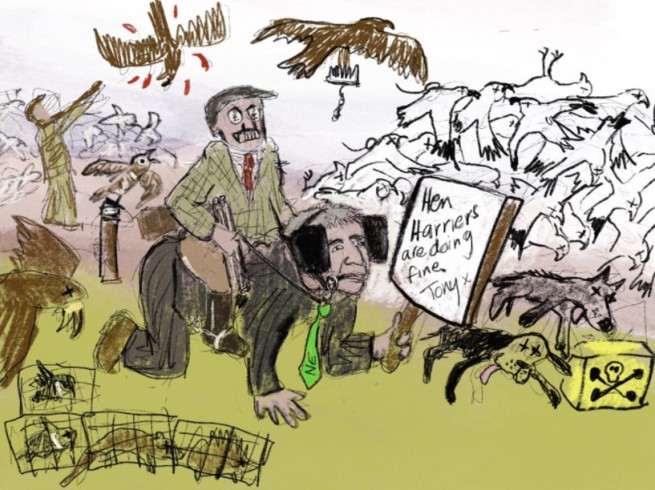
[Cartoon by Gill Lewis]

So here’s the latest gruesome list:

February 2018: Hen harrier Saorsa ‘disappeared’ in the Angus Glens in Scotland (here). The Scottish Gamekeepers Association later published wholly inaccurate information claiming the bird had been re-sighted. The RSPB dismissed this as “completely false” (here).

5 February 2018: Hen harrier Marc ‘disappeared’ on a grouse moor in Durham (here)

9 February 2018: Hen harrier Aalin ‘disappeared’ on a grouse moor in Wales (here)

March 2018: Hen harrier Blue ‘disappeared’ in the Lake District National Park (here)

March 2018: Hen harrier Finn ‘disappeared’ near Moffat in Scotland (here)

18 April 2018: Hen harrier Lia ‘disappeared’ in Wales and her corpse was retrieved in a field in May 2018. Cause of death was unconfirmed but police treating death as suspicious (here)

8 August 2018: Hen harrier Hilma ‘disappeared’ on a grouse moor in Northumberland (here).

16 August 2018: Hen harrier Athena ‘disappeared’ on a grouse moor in Scotland (here)

26 August 2018: Hen Harrier Octavia ‘disappeared’ on a grouse moor in the Peak District National Park (here)

29 August 2018: Hen harrier Margot ‘disappeared’ on a grouse moor in Scotland (here)

29 August 2018: Hen Harrier Heulwen ‘disappeared’ on a grouse moor in Wales (here)

3 September 2018: Hen harrier Stelmaria ‘disappeared’ on a grouse moor in Scotland (here)

24 September 2018: Hen harrier Heather ‘disappeared’ on a grouse moor in Scotland (here)

2 October 2018: Hen harrier Mabel ‘disappeared’ on a grouse moor on the edge of the Yorkshire Dales National Park (here)

3 October 2018: Hen Harrier Thor ‘disappeared’ next to a grouse moor in Bowland, Lanacashire (here)

23 October 2018: Hen harrier Tom ‘disappeared’ in South Wales (here)

26 October 2018: Hen harrier Arthur ‘disappeared’ on a grouse moor in the North York Moors National Park (here)

1 November 2018: Hen harrier Barney ‘disappeared’ on Bodmin Moor (here)

10 November 2018: Hen harrier Rannoch ‘disappeared’ on a grouse moor in Scotland (here). Her corpse was found nearby in May 2019 – she’d been killed in an illegally-set spring trap (here).

14 November 2018: Hen harrier River ‘disappeared’ on a grouse moor in the Nidderdale AONB (here). Her corpse was found nearby in April 2019 – she’d been illegally shot (here).

16 January 2019: Hen harrier Vulcan ‘disappeared’ in Wiltshire close to Natural England’s proposed reintroduction site (here)

7 February 2019: Hen harrier Skylar ‘disappeared’ next to a grouse moor in South Lanarkshire (here)

22 April 2019: Hen harrier Marci ‘disappeared’ on a grouse moor in the Cairngorms National Park (here)

26 April 2019: Hen harrier Rain ‘disappeared’ on a grouse moor in Nairnshire (here)

11 May 2019: An untagged male hen harrier was caught in an illegally-set trap next to his nest on a grouse moor in South Lanarkshire. He didn’t survive (here)

7 June 2019: An untagged hen harrier was found dead on a grouse moor in Scotland. A post mortem stated the bird had died as a result of ‘penetrating trauma’ injuries and that this bird had previously been shot (here)

5 September 2019: Wildland Hen Harrier 1 ‘disappeared’ on a grouse moor nr Dalnaspidal on the edge of the Cairngorms National Park (here)

11 September 2019: Hen harrier Romario ‘disappeared’ on a grouse moor in the Cairngorms National Park (here)

14 September 2019: Hen harrier (Brood meddled in 2019, #183704) ‘disappeared’ in North Pennines (here)

23 September 2019: Hen harrier (Brood meddled in 2019, #55149) ‘disappeared’ in North Pennines (here)

24 September 2019: Wildland Hen Harrier 2 ‘disappeared’ on a grouse moor at Invercauld in the Cairngorms National Park (here)

24 September 2019: Hen harrier Bronwyn ‘disappeared’ near a grouse moor in North Wales (here)

10 October 2019: Hen harrier Ada ‘disappeared’ on a grouse moor in the North Pennines AONB (here)

12 October 2019: Hen harrier Thistle ‘disappeared’ on a grouse moor in Sutherland (here)

18 October 2019: Member of the public reports the witnessed shooting of an untagged male hen harrier on White Syke Hill in North Yorkshire (here)

November 2019: Hen harrier Mary found illegally poisoned on a pheasant shoot in Ireland (here)

January 2020: Members of the public report the witnessed shooting of a male hen harrier on Threshfield Moor in the Yorkshire Dales National Park (here)

23 March 2020: Hen harrier Rosie ‘disappeared’ at an undisclosed roost site in Northumberland (here)

1 April 2020: Hen harrier (Brood meddled in 2019, #183703) ‘disappeared’ in unnamed location, tag intermittent (here)

5 April 2020: Hen harrier Hoolie ‘disappeared’ on a grouse moor in the Cairngorms National Park (here)

8 April 2020: Hen harrier Marlin ‘disappeared’ on a grouse moor in the Cairngorms National Park (here)

19 May 2020: Hen harrier Fingal ‘disappeared’ on a grouse moor in the Lowther Hills, Scotland (here)

21 May 2020: Hen harrier (Brood meddled in 2019, #183701) ‘disappeared’ on a grouse moor in Cumbria shortly after returning from wintering in France (here)

27 May 2020: Hen harrier Silver ‘disappeared’ on a grouse moor on Leadhills Estate, Scotland (here)

day/month unknown: Unnamed male hen harrier breeding on RSPB Geltsdale Reserve, Cumbria ‘disappears’ while away hunting (here)

9 July 2020: Unnamed female hen harrier (#201118) ‘disappeared’ from an undisclosed site in Northumberland (here).

25 July 2020: Hen harrier Harriet ‘disappeared’ on a grouse moor in the Yorkshire Dales National Park (here)

14 August 2020: Hen harrier Solo ‘disappeared’ in confidential nest area in Lancashire (here)

7 September 2020: Hen harrier Dryad ‘disappeared’ on a grouse moor in the Yorkshire Dales National Park (here)

16 September 2020: Hen harrier Fortune ‘disappeared’ from an undisclosed roost site in Northumberland (here)

19 September 2020: Hen harrier Harold ‘disappeared’ on a grouse moor in the Yorkshire Dales National Park (here)

20 September 2020: Hen harrier (Brood meddled in 2020, #55152) ‘disappeared’ next to a grouse moor in North Yorkshire (here)

24 February 2021: Hen harrier Tarras ‘disappeared’ next to a grouse moor in Northumberland (here)

12th April 2021: Hen harrier Yarrow ‘disappeared’ near Stockton, County Durham (here)

18 May 2021: Adult male hen harrier ‘disappears’ from its breeding attempt on RSPB Geltsdale Reserve, Cumbria whilst away hunting (here)

18 May 2021: Another adult male hen harrier ‘disappears’ from its breeding attempt on RSPB Geltsdale Reserve, Cumbria whilst away hunting (here)

17 September 2021: Hen harrier Reiver ‘disappears’ in a grouse moor dominated region of Northumberland (here)

To be continued……..

Buzzard caught in primitive illegal trap set inside pheasant pen in Shropshire

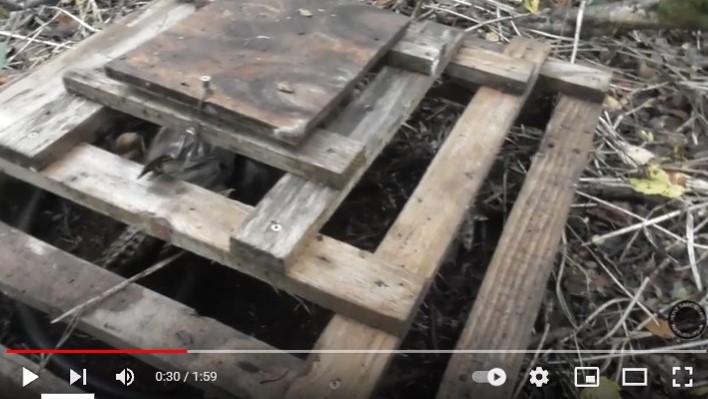
Video footage has emerged, filmed in mid-September, of two primitive and illegal traps that had been set inside a pheasant pen in woodland near the village of Chelmarsh, just south of Bridgnorth, Shropshire.

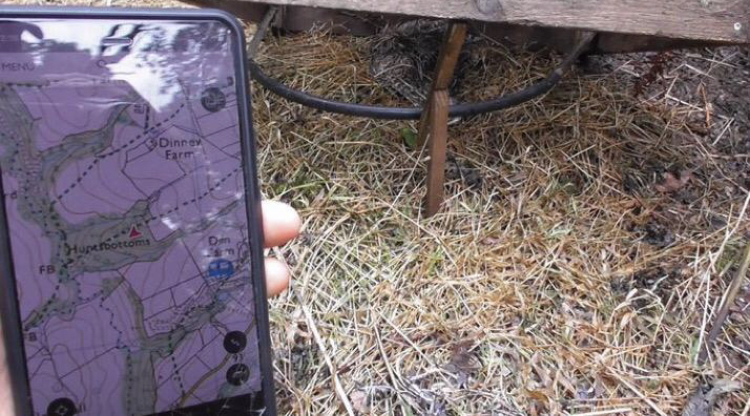
One of the traps had been triggered and had caught a buzzard. The other trap had been baited with a dead pheasant but had not been triggered.

[Screen grab from the video, showing the trapped buzzard inside the illegal trap]

[A photo of the second illegal trap, baited with the dead pheasant. The map shows the location:

The trapped buzzard was released by a member of the public and subsequent covert video evidence shows a man entering the pheasant pen, attending the trap and removing all evidence of it.

I understand that a report has been made to the police.

There is a write-up about this criminal activity on the Hunt Saboteurs Association website (here), where it is claimed the man attending the trap is a gamekeeper. I don’t have any information that can support or refute that claim.

The video can be watched here:

Freedom of information documents highlight gamekeepers, fox hunting and raptor persecution in 3 public forests

The Scottish animal welfare charity OneKind has today revealed that Forestry Land Scotland (FLS) is still permitting the use of fox-hunting foot packs in several public forests, partly for the benefit of privately-owned grouse shooting estates. These public forests also happen to be in well-known raptor persecution hotspots.

In a freedom of information response, FLS admitted allowing the fox-hunt foot packs to operate in three public woodlands near Inverness: Loch Farr Wood, Farr Wood and Meall Mor near Moy.

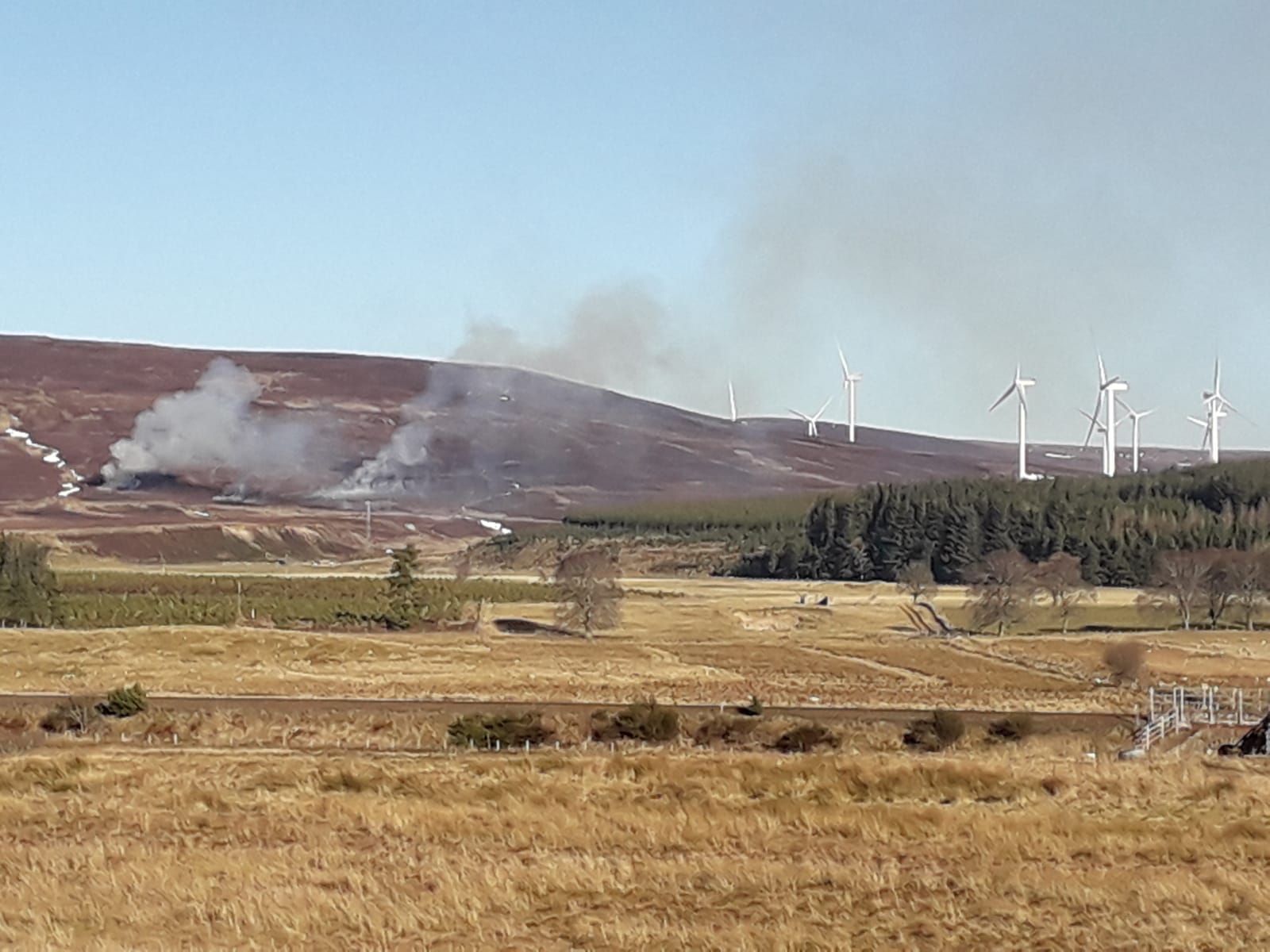
[Moy has long been of interest to this blog, mostly for the frequency of illegal raptor persecution incidents recorded there for over a decade. And then there’s this: a photo to illustrate the stupidity of setting fire to the moor for grouse management, a few hundred yards from some publicly-subsidised wind turbines!]

The FoI documents also reveal that FLS staff suspected that gamekeepers were visiting the forests to look for fox dens to block up, which also happened to be beside Schedule 1 raptor nests, some of which have been repeatedly attacked in previous years.

For example, in 2016 Police Scotland issued an appeal for information after one goshawk and four buzzard nests were abandoned in suspicious circumstances in Moy Forest (see here).

In 2017, also in Moy Forest, masked gunmen were caught on camera underneath a goshawk nest. The nest, containing a clutch of eggs, was mysteriously abandoned shortly afterwards (see here and here).

In July this year, Police Scotland appealed for information after a dead goshawk was found in Loch Farr Wood – this bird had been shot (see here).

The issue of fox-hunting is beyond the remit of this blog although I’d question whether a Scottish Government agency should be complicit in supporting the eradication of native predators for the benefit of driven grouse shooting, which is what appears to be happening here.

If you’d like to read more about OneKind’s freedom of information request and FLS’s response about fox-hunting, gamekeepers and raptor persecution in these public forests, please see the OneKind blog (here) and an article in today’s National (here).

Meanwhile, as the authorities seem unable to tackle raptor persecution in public forests, we’re all still waiting to see whether NatureScot will impose a General Licence restriction on Moy Estate following the discovery of a poisoned satellite-tagged red kite found on the grouse moor almost a year ago, in October 2020 (see here).

Trial date set for Suffolk gamekeeper accused of poisoning buzzard

A couple of days ago I blogged about a gamekeeper who was due in court this week to face allegations that he was responsible for the alleged poisoning of a buzzard in Suffolk (see here).

This prosecution resulted from a multi-agency investigation and raid conducted at premises in January this year involving Suffolk Police, National Wildlife Crime Unit, Natural England and the RSPB’s Investigations team (see here).

[Police seized guns and pesticides during the multi-agency raid in January 2021. Photo via Suffolk Police]

News from the court today (via the RSPB) is that this gamekeeper has pleaded guilty to some charges but not guilty to others, so this case will now proceed to trial.

The gamekeeper pleaded guilty to six charges relating to firearms and pesticide storage.

He pleaded not guilty to two further charges relating to the illegal buzzard poisoning.

The trial is due to begin on 8th November 2021.

Please note, as this is a live case no further detail will be provided here until the case has concluded or there is official commentary from the court. Comments on this particular blog also won’t be accepted until the case concludes so as not to prejudice proceedings. Thanks for your understanding.

UPDATE 9th November 2021: Gamekeeper convicted for pesticide and firearms offences but buzzard-poisoning charge is dropped (here)

Another gamekeeper in court for alleged poisoning of buzzard

Earlier this month I blogged about a gamekeeper in Nottinghamshire who is facing trial after he pleaded not guilty to the alleged killing of several buzzards (see here).

Now there’s another case to report. This time it’s a gamekeeper in Suffolk who is due in court on Thursday in relation to the alleged poisoning of a buzzard.

This latest prosecution relates to the joint raid undertaken by Suffolk Police, Natural England and the RSPB’s Investigations Team in January this year (see here).

[Police seized guns and pesticides during the multi-agency raid in January 2021. Photo via Suffolk Police]

Tomorrow’s court hearing will provide an opportunity for the defendant to enter a plea.

If he pleads not guilty, the case is expected to continue to go to trial at a later date.

If he pleads guilty, he may be sentenced tomorrow or the magistrate may ask for background reports before sentencing at a later date.

Please note, as this is a live case no further detail will be provided here until the case has concluded or there is official commentary from the court reporter. Comments on this particular blog also won’t be accepted until the case concludes so as not to prejudice proceedings. Thanks for your understanding.

UPDATE 26th August 2021: Trial date set for Suffolk gamekeeper accused of poisoning buzzard (here)

Golden eagles have been illegally killed on Scottish grouse moors for 40+ years but apparently we shouldn’t talk about it

In response to the news that Police Scotland are investigating the circumstances of five eagles found dead in the Western Isles earlier this month (see here), Scottish Land & Estates (SLE), the grouse moor owners’ lobby group has issued what I’d call a staggeringly disingenuous statement, where the blame for ongoing raptor persecution appears to be being projected on to those of us who dare to call out the shooting industry for its ongoing war against birds of prey.

Here’s SLE’s statement in full, dated 20 August 2021:

Response to raptor fatalities should not depend on location or landuse

Reports of five eagles being found dead on the Western Isles are very serious. 

Police Scotland has said that officers are investigating and it is to be hoped that the facts of these potentially shocking incidents are established as quickly as possible.

The birds – four golden eagles and a white-tailed sea eagle – were found at separate locations on Lewis and Harris and it is said that, at this stage, they are not linked.

No grouse shooting takes place on the Western Isles and we wholeheartedly support the police’s appeal for information and anyone who can help should call Police Scotland on 101, or make a call anonymously to the charity Crimestoppers on 0800 555 111.

It has been suggested that intraguild predation – where one species predates on another – may be one possible explanation in these cases but equally we accept there is the prospect that a terrible wildlife crime has been committed to protect livestock.

If that is the case, outright condemnation is the only rightful response.

That applies wherever raptor persecution takes place.

The response from some quarters thus far to the incidents on the Western Isles is in sharp contrast to what happens over alleged incidents that occur in areas where land is managed for grouse shooting. In these cases organisations and campaign groups are very quick off the mark to point fingers. If a wildlife crime takes place on land managed for shooting, livestock farming or any other land use (and such incidents are thankfully rare, becoming more so all the time) then it must be investigated and the culprits should face the full force of the law. It can be difficult to prosecute but Scotland now benefits from some of the most stringent laws against raptor persecution in Europe. A lot more could be achieved with less finger pointing and more constructive collaboration on the ground. Scotland is fortunate to have historically high numbers of golden eagles and we want to see even more of them.

ENDS

So SLE is unhappy that campaigners keep ‘pointing fingers’ at the grouse-shooting industry whenever an illegally shot / poisoned / trapped bird of prey is discovered dead or critically injured on, er, a driven grouse moor?!!!!!!!!!

Or when satellite-tagged hen harriers and golden eagles keep ‘disappearing’ in suspicious circumstances, on or close to driven grouse moors.

If these crimes were just a one-off, once-in-a-blue-moon occurrence then yes, perhaps SLE would have a point. However, the connection between the driven grouse shooting industry and the illegal persecution of birds of prey has been clear for decades, and backed up with endless scientific papers and Government-commissioned reviews (here are the latest for golden eagle and for hen harrier).

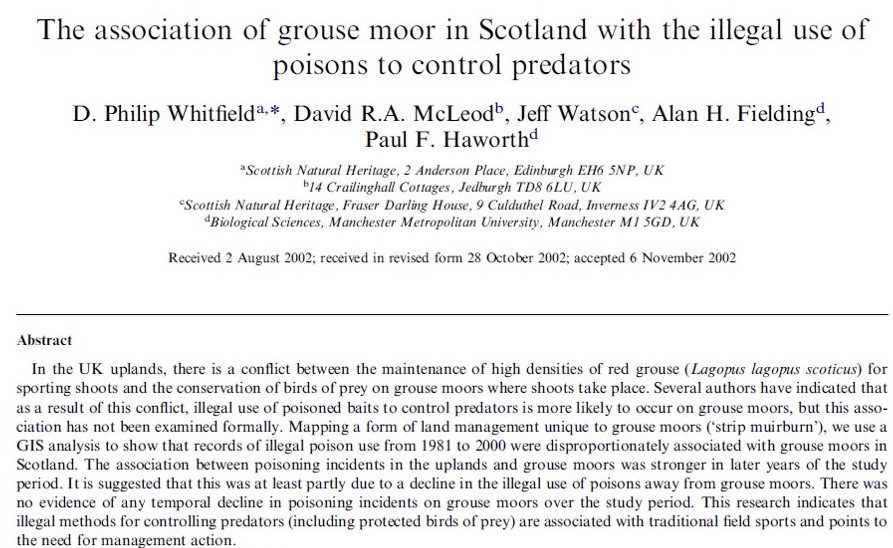
Here’s an example of how long this has been going on – a scientific paper published in 2002, using data from 1981-2000 – demonstrating an indisputable link between grouse moors and illegal poisoning:

1981 – that was 40 years ago!!

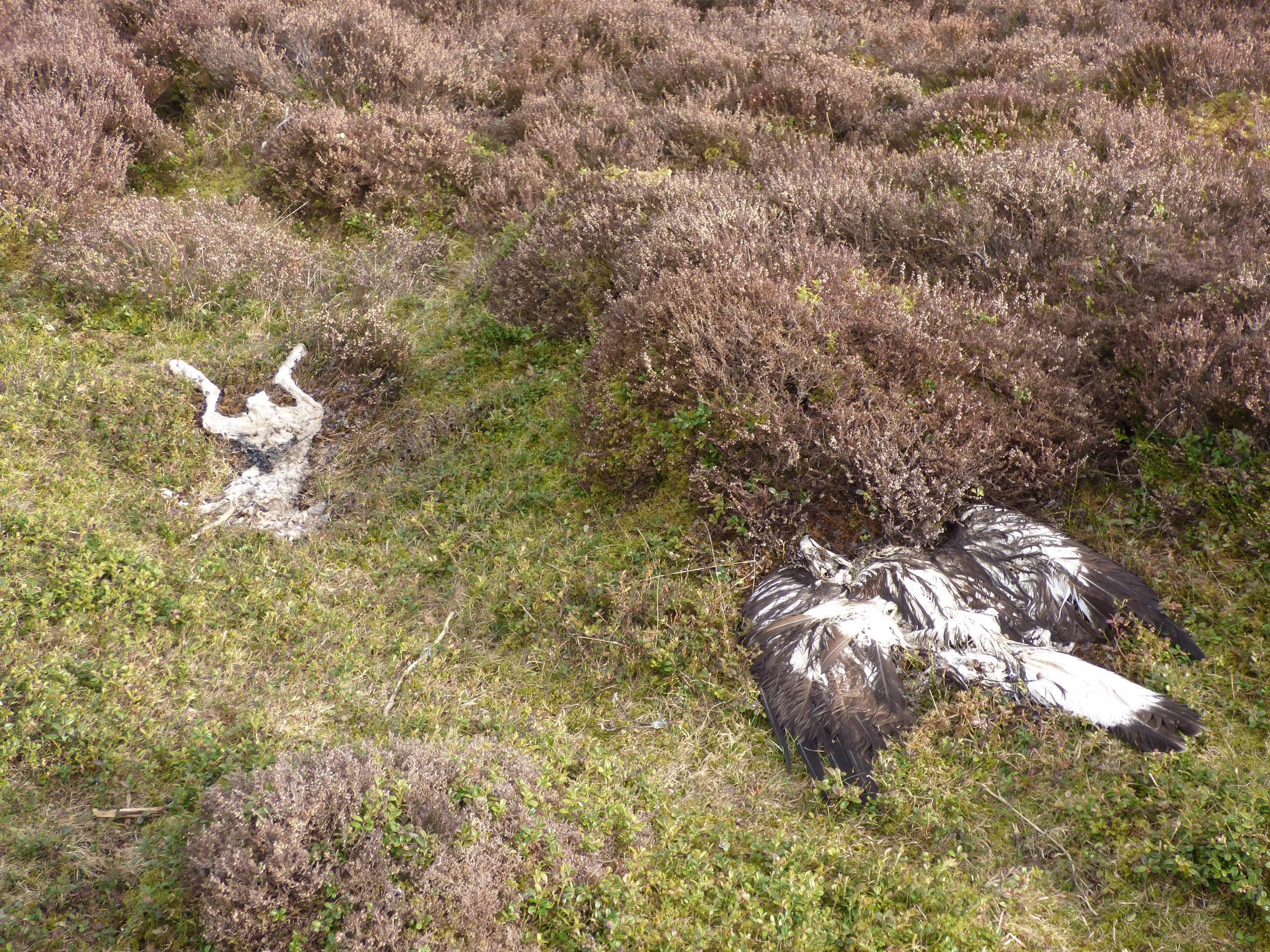
And yet here we are in 2021 and still illegally poisoned golden eagles are being found dead on grouse moors and still nobody has ever been successfully prosecuted in Scotland for killing a golden eagle. The most recently confirmed poisoned eagle was this one inside the Cairngorms National Park, right next door to the royal estate of Balmoral. In fact this eagle is believed to have fledged on Balmoral a few months before it flew to neighbouring Invercauld Estate (an SLE member, no less) where it consumed a hare that had been smothered in a banned pesticide and laid out as a poisoned bait. The person(s) responsible for laying this poisoned bait have not been identified.

[Poisoned golden eagle laying next to poisoned mountain hare bait, Invercauld Estate, Cairngorms National Park. Photo by RSPB Scotland]

Such is the extent of illegal persecution on some driven grouse moors, it is having (and continues to have) a population-level effect on some species, including golden eagles, hen harriers, red kites and peregrines.

And such is the extent and quality of this scientific evidence, the Scottish Government has committed to implementing a licensing scheme for grouse shooting in an attempt to try and rein in the criminal activity that underpins this so-called ‘sport’ because Ministers recognise the grouse-shooting industry is incapable of self-regulation.

I don’t know what SLE means when it says it wants ‘more constructive collaboration on the ground‘. Perhaps it means that gamekeepers will step forward and provide more than ‘no comment’ interviews when the police are investigating the latest crime on a grouse-shooting estate, instead of offering the usual wall of silence?

Perhaps it means the estate owners will refuse to employ the sporting agents and head gamekeepers whose methods are well known to include routine raptor persecution? (These individuals are well known – it’s no secret within the industry who they are).

Or perhaps it means that the shooting industry itself, including the game-shooting organisations, the shooting press etc will blacklist those estates known to still be killing birds of prey, instead of accepting funding donations from them and pretending that they don’t know what’s going on there?

That’d be useful, constructive collaboration, wouldn’t it?

Until all of that happens, SLE and the rest of the grouse shooting cabal can expect people like me and my colleagues in the conservation field to continue shining a bloody great big megawatt spotlight on this filthy industry.

Police to undertake social media checks for gun licence applicants after Plymouth mass shooting

The news that police forces in England and Wales will be checking the social media accounts of gun licence applicants is very welcome news, especially as abuse by gamekeepers and other gun holders against conservationists intensifies (e.g. see here, here, here, here, here).

According to an article in The Times this weekend, the Westminster Government will publish statutory guidance this autumn outlining how police forces handle firearm and shotgun licence applications. This is in the wake of the horrific mass shooting in Plymouth last week by a 22-year old, who despite having a history of posting violent and misogynistic abuse on social media, was still approved to have a weapon, which he went on to use with utterly tragic consequences.

In another article, Former Metropolitan Police Commissioner Lord Stevens told the Telegraph this weekend that UK police forces should perform thorough online checks into people applying for firearms licences following the shooting on Thursday. He called for a more in-depth ‘trawl’ of internet posts to try to establish whether people trying to get police approval for a gun have a history of making hateful comments online.

The gunman was clearly a dangerous man – there is no doubt he was a threat. The videos he made should have been taken into account when he applied for a shotgun licence.

There needs to be trawling of online content for an in-depth assessment of who these people are and what they think. We need to ensure that guns do not fall into the hands of dangerous people“.

Referring to the highly misogynistic posts made by incels [involuntary celibates] on forums and chat rooms, he said: “I would suggest people posting these kinds of comments clearly pose a concerning threat“.

According to the Telegraph, Jonathan Hall QC, the Government’s independent reviewer on terrorism legislation, also supported calls for considering the social media profiles of those looking to get hold of a gun.

Obviously we don’t want to live in a society where what we do online is routinely looked at by the state, but I see the force of the point that social media may be a valuable source of information about risk in the context of firearm licensing“, he said.

Police Scotland are apparently ahead of the game. Three years ago a review by HM Inspectorate of Constabulary in Scotland (HMICS) concluded that online activity is a key source of information when deciding whether someone is suitable to own a gun.

In response to the report, Police Scotland Assistant Chief Constable Mark Williams said: “Where concerns are raised, we may use social media as one of a number of sources of information during our checks. Looking to the future, we are considering expanding this approach as part of the national licensing process.”

Hopefully the new statutory guidance of checking social media accounts won’t be restricted to just incidences ‘where concerns are raised’ [about an applicant] but rather this becomes a standard, routine examination for all applicants. The cost of this increased scrutiny should be placed firmly at the door of the gun licence applicants, and not be heavily subsidised by the tax payer as current gun licensing is.

It’ll also be interesting to see how the police deal with abusive and aggressive gun owners who maintain a hidden identity on social media. There are quite a few of those claiming to be from the game-shooting world, some of whom hide their identities quite successfully, others not so well, and none of whom are called out by the mainstream game-shooting organisations (indeed, some of those organisations even share the abuser’s posts!).

If you have any concerns about the suitability of someone who you believe is a firearms / shotgun certificate holder, whether they’re from the game-shooting world or not, please don’t hesitate to report him/her to the relevant police station.

‘Persistent intimidation’ – raptor conservationists face ongoing harassment from gamekeepers

Award-winning investigative journalism website The Ferret published an article last week with an account of how raptor conservationists are facing ongoing harassment from gamekeepers and supporters of the grouse-shooting industry.

Thanks to journalist Stuart Spray for the invitation to contribute to this piece.

It’s reproduced here in full:

Conservationists working to protect rare birds of prey claim they are being abused online and intimidated in the field by gamekeepers and supporters of the grouse shooting industry.

Logan Steele, communications secretary for the Scottish Raptor Study Group (SRSG), made up of conservationists working to protect rare birds of prey, told The Ferret that he is regularly contacted by workers who say they have been targeted in the line of their work.

Steele says members report incidents such as being surrounded by armed gamekeepers – often in 4x4s or on quad bikes – being followed for hours on end whilst out monitoring, being abused verbally, having tyres let down, having police called on them and even being spat at whilst drinking in the local pub.

He claims the intimidation is widespread, but most raptor workers are not prepared to go on record for fear of reprisals.

The SRSG, set up in 1980, has more than 350 voluntary members monitoring the vast majority of the 6,000 plus raptor territories checked annually as part of the Scottish Raptor Monitoring Scheme.

The scheme supplies data to organisations like the British Trust for Ornithology (BTO), RSPB and NatureScot – the Scottish Government’s wildlife watchdog – to help understand population dynamics and inform conservation priorities. Members of SRSG also gather information on raptor persecution.

Gamekeepers have also previously claimed to be subjected to abuse. In a survey last November by the BASC, Countryside Alliance, Game Farmers Association and National Gamekeepers Association 64 per cent of Scottish gamekeepers said they had experienced threatening behaviour or abuse from members of the public at least once every year.

The study, which surveyed 152 gamekeepers, also found the majority (79 per cent) felt ‘less optimistic’ due to ‘targeted anti-shooting campaigns and the negative portrayal of shooting in the public domain’.

But Steele said conservationists were suffering. He added: “Our members on some driven grouse moors continue to be subjected to persistent levels of intimidation and abuse from gamekeepers. It is patently clear that raptor workers and indeed the wider public are not always welcome on some driven grouse moors“.

Steele has himself been trolled online several times. “On one occasion an ex-gamekeeper boasted online that he had fitted a tracking device to my car and knew I was at home“, he said. Concerned that he was being followed he got the car checked over but no tracking devices were found.

An image Steele posted of himself online with a hen harrier chick in 2006 was allegedly downloaded and regularly reposted on two ex-gamekeeper’s social media pages along with claims accusing him of professional malpractice without evidence.

Consultant ecologist, Andrea Hudspeth – who along with Steele received an RSPB award in 2017 for raptor campaign work – claimed she also felt threatened on shooting estates.

She added: “I have been monitoring raptors on a grouse shooting estate for a number of years now and have always been made to feel unwelcome, so much so that I don’t feel safe going there on my own.

She claimed the experience could be intimidating. Of one estate she said: “Having phoned the day before to let the estate know I was coming, I was told where I could and couldn’t go as they were shooting foxes that day. He [the head gamekeeper] told me that if I strayed into the wrong area, it wouldn’t be his fault if I got shot. At the time, that sounded like a veiled threat“.

Dr Ruth Tingay, an award-winning conservationist and director of Wild Justice, a not-for-profit organisation set up with broadcaster Chris Packham and environmental campaigner Mark Avery to ‘fight for wildlife in the courts and in the media’, told The Ferret she was subjected to online abuse on an almost daily basis.

Tingay, who runs the Raptor Persecution UK blog, claimed she received comments online that were routinely misogynistic and homophobic and involved personal slurs on her appearance and character.

My personal telephone number has been published online and folk have been incited to make abusive phone calls. I have also received abusive text messages,”, added Tingay.

My home address has been published and shared on social media. Photographs of my home have been published and shared on social media. I have been followed and photographed on grouse moors and these have been published on social media with accompanying defamatory comments.

I have been accused of fabricating evidence, of perverting the course of justice, of inflicting cruelty to wildlife, of killing eagles, of planting evidence, and conversely, and bizarrely, of withholding evidence from the police, of lying to the police, of lying to ministers, of lying to supporters, of lying in general“.

Tingay says the targeted harassment has been going on for the last six years and shows no signs of stopping. Earlier this week she was described by one shooter as “absolute poison” and another shooter opened a discussion titled: ‘Is Tingay a witch?’

These individual comments are, of course, pathetic and laughable and are easy to shrug off, so obvious is the desperation behind them”, she said. “But it’s the accumulation of the comments, that’s when the problem starts.

It’s relentless, and I think that’s very, very dangerous. That constant tide of abuse would take its toll on even the most resilient person. I’ve put measures in place to deal with it and I’m fortunate to be working with a world-class mental health coach. That’s not what I expected to need when I decided to work in the field of raptor conservation“.

However, Steele also insisted that most conservationists and grouse shooters, landowners, stalkers, ghillies and gamekeepers had a “very good working relationship”. He claimed those behind the abuse were trying to create a “false, them-and-us situation”.

The issue really resides with a small number of driven grouse shooting businesses”, he added. “In recent years we have seen some estates beginning to moderate their attitudes to raptor persecution which is very encouraging“.

The Ferret contacted the Scottish Gamekeepers Association, the landowners’ representative group Scottish Land & Estates and the Countryside Alliance. None of the organisations replied to requests for comment.

However, Scottish Gamekeepers Association chairman Alex Hogg has previously said gamekeepers are currently being “undervalued” and called for action to be taken on the abuse they have faced.

ENDS

Trial date set for gamekeeper accused of killing buzzards

A gamekeeper appeared in court on 12th August 2021 accused of the alleged killing of a number of buzzards in Nottinghamshire in January 2021.

He was charged after a joint investigation by Nottinghamshire Police and the RSPB’s Investigations Team (see here).

The gamekeeper pleaded not guilty so this case will now progress to trial.

Trial dates have been set for 6th-7th January 2022.

Please note, as this is a live case no further detail will be provided here until the case has concluded or there is official commentary from the court reporter. Comments on this particular blog also won’t be accepted until the case concludes so as not to prejudice proceedings. Thanks for your understanding.