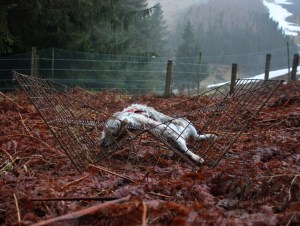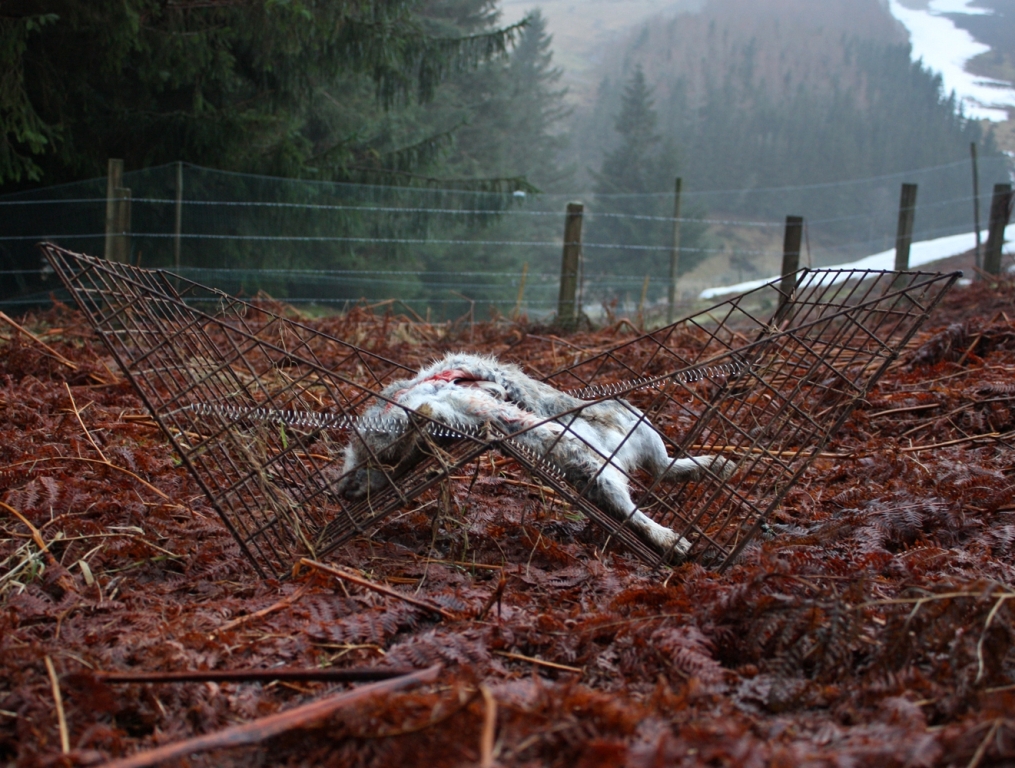
Traps in our countryside: a walker’s guide

Thanks to Steve from the animal protection charity OneKind who has advised that his 2010 article, ‘Traps in our countryside: a walker’s guide’ has now been updated.

This excellent illustrated guide provides detailed information for the general public on how to distinguish a legal trap from an illegal trap. The updated version also includes information about a new trap which is known by several common names: clam trap, snapper trap, butterfly trap and Larsen mate trap. This particular trap is causing controversy: the game-shooting industry argues it is legal and safe whereas others strongly disagree and some have even suggested its use could be an offence under animal welfare legislation, although this has yet to be tested in a court of law. It is understood that SNH is still consulting about the lawfulness of this trap and more information should be forthcoming in the near future (see here).

The SGA’s views on the clam trap can be read here and here. A copy of their consultation response to SNH on the use of clam traps can be read here.

A copy of the SRPBA’s (now called Scottish Land and Estates) consultation response to SNH on the use of clam traps can be read here. Its interesting to compare this with the SGA’s response – copy and paste, anyone?

Click here to read OneKind’s updated article – Traps in our Countryside: a walker’s guide.

Click here to read our recent article – Crow Traps: what you should know.

Inadmissable evidence: double standards for wildlife crime offences?

In February we blogged about the Crown Office & Procurator Fiscal Service (COPFS) decision not to accept the video evidence showing a head gamekeeper apparently bludgeoning crows to death with a stick inside a crow cage trap on a Scottish sporting estate (see here). The video had been filmed by a field officer from the charity OneKind who, by chance, happened to be in the right place at the right time (or the wrong place at the wrong time, depending on your view).
OneKind appealed against the COPFS decision not to initiate court proceedings against the gamekeeper but the Lord Advocate ruled that the COPFS decision would stand. In response, OneKind submitted a petition to the Scottish Government, signed by over 2,000 members of the public who were disgusted by what they’d seen in the video. OneKind asked the Scottish Environment Minister, Stewart Stevenson, for greater clarity on what is / isn’t considered admissable evidence in wildlife crime cases.

Here’s his reply:

“….the Scottish Government believes it is vital to all our efforts in tackling wildlife crime, for members of the public who come across anything suspicious to report what they have seen to the police.

I would however note that there is a difference between cases where members of the public come across evidence that seems to point to a wildlife crime, and those cases where a person who is employed as, or is acting in some capacity as, a wildlife crime investigator, reports such evidence. It is for the Crown Office to decide on how a court would deal with evidence in either of those cases, and their decision on whether to prosecute a case is final”.

See here for the full update on the crow-killing incident provided by OneKind.

So, what have we learned? If you’re a member of the public who doesn’t really know what you’re looking at, or how to record evidence that might be crucial in a subsequent prosecution, then your ‘evidence’ will probably be admissable. However, if you’re someone who knows exactly what you’re looking at and has been trained in the best techniques of evidence collection and preservation, then your evidence will probably be inadmissable.

And the logic in that is….what, exactly? Are there any other areas of criminal law where these double standards apply? (This is a genuine question – we don’t know the answer but would like to hear from anyone who can enlighten us and help us to understand these rules).

Is it any wonder our wildlife crime conviction rates (and especially for raptor persecution incidents) are so pathetically low? How many more legal obstacles are going to be placed in the way of bringing these criminals to justice?

Yet another golden eagle mysteriously ‘disappears’

Last month we blogged about the ‘disappearance’ of a satellite-tagged golden eagle (see here). Now 22 days later we’re blogging about another one. Isn’t it strange how many UK satellite-tagged raptors go ‘missing’; not just golden eagles, but white-tailed eagles, hen harriers and red kites too. Wonder how these figures compare with tagged raptors in other parts of the world?

The last signal from the latest young golden eagle (#32857) to go ‘missing’ was received on May 11, just to the north-east of the Cairngorms National Park (see here).

Was it just a satellite tag failure and the eagle is still alive and well? Possibly.  Did it die of natural causes? Possibly. Was it poisoned? Possibly. Was it shot? Possibly. Was it caught inside a crow cage trap and bludgeoned to death? Possibly. Will we ever find out? Possibly. If it is found to have been killed illegally, will the perpetrator be brought to justice? Probably not (see here for the ever-growing list of dead and/or missing eagles in recent years for which nobody has ever been prosecuted).

Somebody asked a question the other day and we’ve still not been able to provide an answer:

What does it take to secure a conviction for killing an eagle in the UK?”.

We’ve heard all the excuses in the book, some valid, some not:

(i) The discovery of a poisoned eagle on a sporting estate isn’t enough to secure a conviction because either it could have been poisoned elsewhere and then flown to die at that location, or, it could have been ‘planted’ on the estate by the anti-game-shooting lobby (according to claims made by various gamekeepers over the years although without any actual evidence).

(ii) The discovery of a poisoned eagle lying next to a poisoned bait on a sporting estate isn’t enough to secure a conviction because it’s virtually impossible to identify which individual gamekeeper laid the bait, especially when they all deny it.

(iii) The discovery of a poisoned eagle and a stash of the same poison found on premises on the same sporting estate, and an admission from an individual gamekeeper that he had sole access to the poison isn’t enough to secure a conviction because….well, we don’t know the answer to that one, you’d have to ask COPFS.

(iv) The discovery of a poisoned eagle and a stash of the same poison found in vehicles and traces of it on knives and gamebags on the same estate isn’t enough to secure a conviction because….we don’t know the answer to that one either – ask COPFS.

(v) What if somebody was filmed laying out a poisoned bait and was then later filmed returning to remove the eagle poisoned by that bait? The film evidence would probably be ruled inadmissable because the cameraman was operating ‘covertly’ (i.e. without the landowner’s permission!).

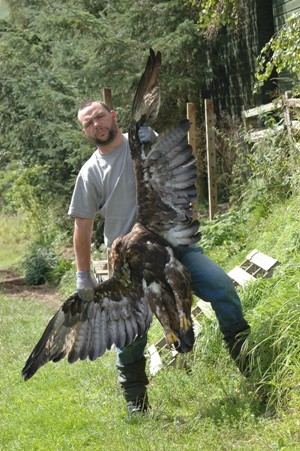
(vi) What if a gamekeeper was found with a dead eagle in the back of his vehicle, and the eagle had injuries consistent with being caught in an illegal spring trap (e.g. broken legs) and having had its head caved in with a blunt object (e.g. smashed skull)? This wouldn’t be enough to secure a conviction because the keeper would probably claim he had just found the dead bird and was taking it home to report it to the authorities. At best he’d be charged with ‘possession’.

The shocking truth is, there has never been a successful prosecution for the illegal killing of an eagle in the UK, in spite of the sometimes overwhelmingly compelling evidence in some cases. So, just what does it take for someone to be convicted of killing an eagle in the UK?

Scottish gamekeepers in court: latest

Two cases against two Scottish gamekeepers have been heard recently at Perth Sheriff Court:

David Campbell, head gamekeeper at Edradynate Estate, Perthshire, is charged with various offences relating to firearms and explosives (see here). His case has been continued for an intermediate diet on 26 July 2012. At that hearing it will be decided whether the case proceeds to trial on 20 August 2012. This is an interesting one for several reasons which will become clear in due course.

Jonathan Graham, apparently a gamekeeper at Glenlyon Estate, Perthshire, is charged with three offences under the Wildlife & Countryside Act (Section 5 (1) (b) relating to the prohibition of certain methods of killing or taking wild birds. The hearing was continued today until 27 June 2012. Those of you interested in the topical subject of crow cage traps (see here) might want to follow this case.

Crow traps: what you should know part 3

This article follows on from Crow traps: what you should know part 1 (here) and part 2 (here). We haven’t been able to find a detailed, up to date article on this subject so we’ve taken information from a variety of sources including the police, Paw Scotland, SNH, RSPB, OneKind, SSPCA and the Raptor Study Groups. This is just our interpretation of the available information and doesn’t constitute an official, legal interpretation. Who knows, maybe PAW Scotland will produce something more definitive in the near future…

How to tell the difference between a legally-operated and an illegally-operated crow cage trap.

As we discussed in part 2, it is not always easy to determine whether a trap is being legally-operated because some of the conditions that the trap operator must comply with under the terms of the general licence can be quite ambiguous. Quite often the distinction between a legally and an illegally-operated trap is blurred. It helps if you are already aware of the conditions of the general licence (see here for licences 1-3 used by crow trap operators) as although there is ambiguity on some issues, there are other things that are easier to recognise as an indication of almost certain illegal use.

Almost certainly illegal

1. An operational trap must display a tag or a sign with the telephone number of the local police station or Police Wildlife Crime Officer as well as a police-issued trap code number that allows the police to identify the trap owner. If you find a crow cage trap that’s being used without one of these signs it is being illegally-operated. Don’t be fooled by a sign that doesn’t contain these numbers but says something like, ‘RSPB bird conservation project”. We are aware that some trap operators have tried to trick the general public with misleading and sometimes fraudulent signs.

2. The type of bird used as a decoy inside the trap is restricted to certain species of corvids (check the specific general licences for current lists). If the decoy bird is anything other than a permitted decoy species, the trap is being illegally-operated. Particular attention should be paid if the decoy is a raven or a pigeon/dove. These are definitely NOT permitted decoy species and are an indication that the trap is probably being used illegally to attract non-target species (ravens and raptors).

3. The decoy bird(s) must not be tethered, blinded or maimed. If it is, the trap is being illegally-operated.

4. The decoy bird(s) must have ‘adequate’ food and water. The term ‘adequate’ is ambiguous and will be discussed in the ‘possibly illegal’ category below. However, if food and water is not present at all, the trap is being illegally-operated.

5. The decoy bird(s) must be provided with a ‘suitable’ perch that does not cause discomfort to the bird’s feet. The term ‘suitable’ is ambiguous and will be discussed in the ‘possibly illegal’ category below. However, if no perch is provided at all, the trap is being illegally-operated.

6. The decoy bird(s) must be provided with ‘adequate’ shelter with ‘adequate’ protection from the prevailing wind and rain. As before, the term ‘adequate’ is ambiguous and will be discussed in the ‘possibly illegal’ category below. However, if no shelter has been provided at all, the trap is being illegally-operated.

7. If there are dead birds inside the trap (either target or non-target species) that have been there for longer than 24 hours (i.e. they are decomposed or skeletal) then the trap is being illegally-operated. Trap operators are required to inspect each operational trap at least once every day at intervals of no more than 24 hours, except where severe weather prohibits. Dead or sickly birds must be immediately removed from the trap.

8. If the trap is not in use (no decoy bird(s)) but the trap door or a panel has not been either removed from the site completely or taken off the trap and secured with a locked padlock, then the trap is being illegally-operated. Wedging the door open with a boulder or a log is not enough – the door or a panel must be removed completely.

Possibly illegal

1. If a decoy bird has not been provided with ‘adequate’ food and water. ‘Adequate’ is open to interpretation and is highly subjective. If the water is filthy and covered in algae, is it considered ‘adequate’? What constitutes ‘adequate’ food for a carrion crow? Usually they are given dead rabbits or hares inside these traps but we’ve also seen dog biscuits and grain!

2. If a decoy bird has not been provided with an ‘adequate’ perch that does not cause discomfort to the bird’s feet. Again, this is ambiguous and depends on the decoy species. The perch should be thick enough for the bird to perch without its toes curling around and digging into its foot, which could cause injury and pain. So a strand of wire stretched across the inside of the trap is unlikely to be considered an ‘adequate’ perch.

3. If a decoy bird has not been provided with ‘adequate’ shelter with ‘adequate’ protection from the prevailing wind and rain. According to a OneKind report, some cage traps have been seen with a piece of plastic less than the size of an A4 sheet of paper serving as a shelter. Is this ‘adequate’? Probably not because it won’t offer shelter from the prevailing wind and rain. Other traps have been seen with the soggy pulp of a former cardboard box stuck in the corner – clearly inadequate!

4. If a decoy bird looks sickly or injured. The bird may have become sick or injured itself since the trap operator’s last visit, so the trap operator hasn’t committed an offence (unless he fails to remove the bird at his next visit). However, the bird could have a long-term sickness or injury (e.g. feathers worn down to stumps and bleeding carpals: injuries consistent with long-term attempts to escape by flying at the side of the cage) in which case the bird should have been removed and it’s highly probable an offence has been committed.

5. If there are multiple birds inside the trap. Crow cage trap operators are permitted to use more than one decoy bird as long as it is one of the permitted corvid decoy species (as opposed to a Larsen trap where only a single decoy is permitted). However, these decoy birds are not marked in any way as to distinguish them from any other trapped bird. This makes it difficult to determine whether the trap has been left un-inspected for longer than 24 hours (because the trap operator can claim all the birds inside the trap are being used as decoys).

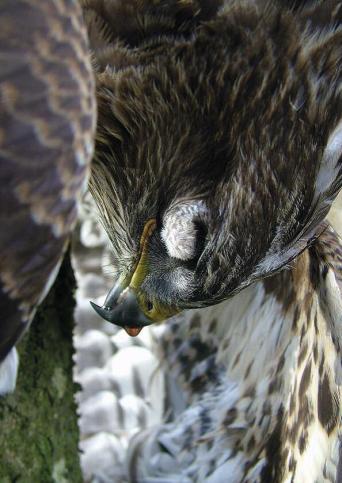
6. If there is a raptor (or another non-target species) caught inside the trap. It’s important to know that it is not illegal to accidentally catch a raptor or other non-target species inside a crow cage trap. It is illegal, however, for the trap operator not to release the bird, unharmed, immediately on discovery. How do you tell whether the raptor has been inside the trap for longer than 24 hours? It’s very difficult, unless you saw it inside the trap more than 24 hours previously, and even then this would be difficult to prove because (a) unless it is uniquely marked how do you know it’s the same bird?, and (b) the trap operator could claim the bird was released and has since re-entered the trap since the last inspection! If the raptor is dead and decomposed it is highly probable an offence has been committed.

What should you do if you suspect a trap is being illegally-operated?

1. Be suspicious.

2. Take photographs and/or video.

3. Record your location (either GPS or map reference if possible).

4. Record the date and time.

5. If you are with anyone, make sure they’ve seen what you’ve seen (corroborative evidence).

6. Don’t be fooled by anything written on the trap sign, even if it says ‘This is a legal trap’. It may well be a legal trap but it might be being illegally-operated.

7. Don’t interfere with the trap (but see point 5 below) or you could be prosecuted for criminal damage.

8. Beware of hidden cameras pointing at the trap and also be aware that some of these cameras can also record your voice!

9. As soon as possible after discovery, report your concerns to the authorities (see section below).

10. If the trap contains a raptor that looks in good health, you need to report it IMMEDIATELY (see below for your choice of reporting agencies). You shouldn’t be tempted to release the bird yourself (unless there is a genuine welfare concern, see below). If none of the reporting agencies can respond in good time, you should call the police again and request permission to release the bird yourself, as long as you are certain it is uninjured. Make sure you get the name or number of the police officer you speak to!

What should you do if you are concerned about the welfare of a trapped bird?

If you discover a trap that contains any bird that is in distress or is injured, you have a decision to make about what to do.

1. The recommended advice from the police is to call them (using the telephone number on the trap sign, assuming there is one). However, calling the police can be very hit and miss, depending on your location. Some police forces will send someone out straight away. Sometimes there may be a considerable delay if the police are busy with other call-outs. Sometimes you won’t be able to get a police response because the WCO is off-duty or just not answering the phone! Sometimes the police may call the trap operator and ask him to attend – this could be dangerous as the trap operator may take the injured bird (let’s say it’s a protected raptor species) and pretend to be conveying it to a vet when his real intention (when out of sight) may be much more sinister.

3. Apart from the police, the only other agency that has the statutory authority to investigate a potential animal welfare incident is the SSPCA. The benefit to calling the SSPCA first is that they have a 24 hour animal helpline (enter this into your phone now! – 03000 999 999). This phone number is specifically for calls about animal welfare incidents and SSPCA officers are trained to handle distressed animals. The SSPCA can attend an incident and remove an animal for veterinary care without needing permission from the police. They are also trained to recognise whether an offence has been committed and can prosecute without any help from the police. The SSPCA would be our first port of call every time.

4. Many people would think of the RSPB as an obvious first call but the RSPB has no more authority than you. They would have to involve one of the official reporting agencies (police or SSPCA) for anything to happen so it could be argued that you are wasting time by calling the RSPB first, although they would be a good source of advice and if the other two agencies can’t respond in good time the RSPB would be your next best bet. Tel: 0131 317 4100.

5. If none of the above agencies can respond in good time, which is rare but sometimes does happen, and you genuinely believe that the injured/distressed bird requires immediate help, any decent person would remove it and get it to a vet as fast as possible (as seen in the recent incident at Lindertis Estate here). This may involve damage to the trap (e.g. if the padlock has to be broken to open the door). Would this result in a criminal prosecution against the person trying to rescue a distressed or injured bird? It might seem unlikely but see here for a recent warning written by Scottish Land and Estates and published on the PAW Scotland website!! Would a prosecution against the rescuer depend on whether the trap was being legally or illegally-operated? It’s well documented that it may be an offence to interfere with a legally set trap, but we are often advised that if we find what we think is an illegally set trap (e.g. a pole trap) then we should disable it. Now we’ve all seen some of the strange decisions made by COPFS in the recent past but to criminalise the action of someone who is genuinely trying to help an injured/distressed animal and who has tried to involve the reporting agencies but without success, would doubtless result in public uproar. We’re not aware of any prosecutions of this type and we might expect COPFS to be able to tell the difference between someone who had a malicious intent to release a bird because they didn’t agree with it’s confinement and someone wanting to help a distressed animal.  It will probably help if there is photographic and/or video evidence of the distressed/injured bird inside the trap and if the actions have been reported to the SSPCA or the local police.

Please note: this advice goes against that given by PAW Scotland (see here) who say don’t attempt to remove a bird (although they don’t specify whether they’re talking about an injured/distressed bird, or just a trapped but healthy bird) but then they don’t offer any other advice if the reporting agencies fail to attend! It seems that this is a subject that requires greater clarity for all concerned. And of course, let’s not forget that if all trap operators were responsible individuals who could be trusted to operate within the law then a lot of the issues raised here would be redundant.

Crow traps: what you should know part 2

Following on from our earlier blog – Crow traps: what you should know part 1 (here)

The following information concerns the use of crow cage traps in Scotland; they are also used in other parts of the UK although the terms of use differ slightly (see here for information on their use in England, here for Wales and here for Northern Ireland).

What is a crow trap and why should we be concerned about them?

There are various types of animal traps in use in the countryside but the two we focus on in this article are the ‘ladder’ and ‘funnel’ crow cage traps. These are large, walk-in traps usually constructed with a wooden frame and wire mesh netting. A decoy bird (often a carrion crow but certain other decoy species are also permitted) is placed inside the trap to attract corvids or other target species. Birds that are attracted to the trap can enter via the roof, either through the horizontal slots of the ‘ladder’ or via a ‘funnel’. Once inside the trap it is virtually impossible for the birds to escape unaided. These trapped birds are usually destined to certain death at the hands of the trap operator who is legally authorised to kill them, subject to certain conditions (discussed in Part 3). In some rare circumstances, raptor workers deploy temporary crow cage traps to capture buzzards for marking projects, such as wing-tagging etc. Obviously these buzzards are released as soon as they’ve been marked; they aren’t killed by the trap operator!

There are many concerns surrounding the use of crow cage traps (some we’ll discuss below) but the over-riding concern is the indiscriminate nature of these traps, which means that species other than the target species can be, and often are, caught by gamekeepers, e.g. buzzards, goshawks, golden eagles etc. It is not illegal to (accidentally) trap these non-target species, but it is an offence for the trap operator not to release them, unharmed, at the earliest opportunity. More on this in Part 3.

Crow trap use is governed by a general licence, issued annually by Scottish Natural Heritage (see here). These licences are issued for the purpose of either (a) the conservation of wild birds, (b) to prevent serious damage to livestock, foodstuffs for livestock, crops, vegetables and fruit, and (c) to protect public health, public safety and prevent the spread of disease. Trap operators need not ‘apply’ for an individual licence, hence the name ‘general’ licence. Each general licence is subject to strict conditions (discussed in Part 3). If the trap operator complies with all the conditions of the general licence then the use of the crow trap is legal. However, in practice some of these conditions are ambiguous at best, and this is recognised by SNH who undertake regular consultations aimed at clarifying the terms of use (e.g. see here for their latest consultation plans).

Before we get in to the nitty gritty of how to recognise a legal trap from an illegal trap it’s worth mentioning that the RSPB (and other groups such as OneKind) has long campaigned for a more thorough review of the legal framework concerning these general licences for crow traps, particularly in relation to potential breaches of European legislation, including the EC Birds Directive. For anyone interested in the RSPB’s position, this document from 2007 (here) is informative.

Other concerns include the fact that there isn’t any effective monitoring of the impact these traps have on both target and non-target species. Crow traps are in use across Scotland year-round but are especially associated with upland grouse moors. It isn’t known exactly how many crow traps are in operation in Scotland but a conservative estimate would be in the hundreds, but probably nearer the thousands. There is currently no requirement for trap operators to record and/or report the number of target and non-target species caught and killed inside a trap (and even if there was such a requirement, who would believe the submitted figures? No gamekeeper is going to admit to illegally killing a protected species!). So how can the regulatory body (SNH) monitor the impact of crow trap use when they haven’t got a clue just how many traps are in use and how many birds and of what species are being killed each year? The follow-on question is, how can these general licences still be issued when the regulatory body cannot justify, in quantifiable terms, the need for lethal control measures?

Some may argue that there is now a record of the number of traps in use because recent changes to the general licences now require that a sign is attached to each trap with a unique identifying code issued by the local police force. However, this unique code is not assigned to an individual trap or to an individual trap operator, but rather to a landowner (or occupier) such as a sporting estate or a farm. This means that an estate owner can use the same code for multiple traps on his/her land (e.g. they may have just one trap or they may have 50+ traps depending on the size of the estate); the point is that the authorities do not have any means of knowing how many traps are in use on a particular estate because they only issue one code per estate.

From a law enforcement perspective, this use of a single identifying code for multiple traps makes it almost impossible to prosecute an individual for illegal use of the trap. For example, if a golden eagle is found dead inside a trap, and it’s obviously been there for a long time, then an offence has probably been committed (because traps must be checked at least once in every 24 hour period – see Part 3). Investigators may attend the scene but find that the trap is located on a large estate that employs multiple gamekeepers. None of the gamekeepers admit responsibility, so how does the investigator identify the individual responsible? A prosecution cannot commence unless an individual suspect is identified. It’s the same loophole we’ve seen used so many times when poisoned bait has been found on a large estate; nobody admits responsibility for laying the bait and thus the perpetrator(s) escape justice. It is only when the trap is located on a smaller estate where a single gamekeeper is employed that there is any chance of a prosecution.

Talking of loopholes….we’ve touched on this briefly in previous posts….in 2008 a new condition was added to the terms of use of the general licences. That new condition was that anyone who had a previous wildlife crime conviction was not allowed to use the general licence unless their conviction was considered ‘spent’, i.e. after five years from conviction. (Although even if you did have a recent conviction you could still apply for use of the licence and each case would be considered on merit, so it’s not quite the draconian condition that some imply). However, in 2009 the condition (of being banned for five years) was modified and we don’t recall any consultation about the insertion of this modification! The new modification says that you can still use the general licence if the sentence you received for your wildlife crime was an ‘admonishment’. Talk about a get-out clause! You might think this modification was quite reasonable, after all, an admonishment (effectively a telling off) is only given for minor offences, right? WRONG!!! Because there aren’t any mandatory sentences for wildlife crime offences in Scotland, a sheriff can choose a sentence at will (within the boundaries of sentencing limits at a Sheriff court, of course). In 2010, a sheriff imposed an admonishment on Graham Kerr, a gamekeeper on the Redmyre Estate, for possession of the banned pesticides Carbofuran and Alphachloralose (see here). The maximum penalty available was a £5000 fine and/or a six month prison term, reflecting the gravity of this type of offence. Had Kerr not also been handed a £400 fine for shooting a buzzard on the Redmyre Estate, his admonishment would have allowed him to continue using the general licence to operate a crow cage trap. In our opinion this is outrageous. What’s the point of having a condition of a five-year ban for a wildlife criminal if that condition is modified based on the whim of a sheriff’s sentencing choice rather than the nature of the actual criminal offence committed? It’s total nonsense. Why was this modification added to the terms of the general licence and who instigated its inclusion in 2009 and who approved it? Was anyone given the opportunity to object to its inclusion? Perhaps a Freedom of Information request is called for here…

This leads on to another concern…who is actually monitoring the trap operators? How do we know that someone with a recent criminal conviction (who was given a stronger sentence than an admonishment) is not still operating a crow cage trap? We know that many estates don’t sack their gamekeepers following a wildlife crime conviction, and we know of at least one estate where a previously convicted gamekeeper (guilty of raptor persecution) is now employed as a ‘gardener’!!

The potential for the misuse of crow traps is well known amongst raptor workers.  Previous reports on this issue have been produced by the RSPB (e.g. see here). Although this 2004 report is now fairly dated and some of the report’s recommendations have since been implemented, there is still a great deal of concern that crow traps are still being deliberately used to target raptor species, particularly buzzards and goshawks and in some areas, golden eagles.

So what can we do about it? In Part 3 we’ll explain the basics of what makes a crow cage trap legal, what makes one illegal, and the blurred line in between the two. We’ll also explain what members of the public should and shouldn’t do if you find a crow trap that you suspect is being operated illegally.

Crow traps: what you should know part 1

Without even the tiniest weeniest hint of irony, the Scottish Gamekeepers Association is complaining about ‘criminal activity in the countryside’ in reference to the recent alleged release of crows from a trap on a Scottish sporting estate.

Oh and it gets better…. according to the SGA, in response to this criminal activity Northern Constabulary has “issued an appeal for information”. Although we should point out that we’ve been unable to find any public record of this ‘appeal for information’ so we only have the SGA’s word to rely upon. But let’s assume the SGA is telling the truth…

Is this the same Northern Constabulary who apparently failed to fully investigate the suspected decapitation and shooting of a white-tailed eagle on Skye (see here) and the discovery of a poisoned red kite on the boundary of Skibo Estate (see here)?

That’s not the end of the irony either – the SGA goes on to suggest that cameras could be installed at crow traps, presumably to film any member of the public who may be inclined to interefere with the trap (which may amount to a criminal offence). Wouldn’t it be interesting to see whether that film footage would be considered as acceptable evidence in any subsequent prosecution, especially after recent film footage showing the activities of a Scottish gamekeeper using a stick to beat crows to death inside a crow trap on a Speyside sporting estate (see here), was deemed inadmissable evidence?

One rule for one but not the other? Surely not!

In light of the SGA’s recent one-sided promotion of crow traps and their encouragement to SGA members to report suspected trap interference (see here for their article) as well as the landowners’ representative body, Scottish Land and Estates, encouraging their members to do likewise (see here), we thought it only fair that we provide an alternative view on the use (and more importantly the mis-use) of crow traps on Scottish sporting estates and give the public the neccessary information about how to recognise the difference between a legal and an illegal trap, and what to do if you find an illegal one.

Watch this space…

Is this convicted gamekeeper a member of the SGA?

Last Tuesday (3 April 2012), Scottish gamekeeper Robert Christie of the Lindertis Estate was convicted at Forfar Sheriff Court of wildlife crimes (see here).

Nine days later, we are still waiting for the Scottish Gamekeepers Association (SGA) to issue a public statement condemning the criminal activities that led to the conviction and also clarifying Christie’s SGA membership status. Was he an SGA member at the time he committed the offences (2010)? If so, is he still a member now he has a criminal conviction?

It’s unusual for the SGA to be so coy about the membership status of a convicted gamekeeper. To their credit, in each of the cases that have been heard so far this year (and even in one case that didn’t even make it to court – the crow trap video case), the SGA has been quick to publicise whether the accused/convicted gamekeeper was an SGA member.

So why so coy this time? Perhaps we should give them the benefit of the doubt and assume that they just got caught up in the Easter holidays and haven’t got around to making a statement yet. Although they have managed to find the time to add various other news items to their website, including an announcement about a forthcoming snaring training course at a choice of venue that certainly raised our eyebrows (see here).

If anyone has tried to contact the SGA about Christie’s membership status we would be very interested to hear about it. For anyone who wants to ask them now, here are the SGA’s contact details:

Email: info@scottishgamekeepers.co.uk

Tel (Perth Office): 01738 587515

Why convicted gamekeeper Robert Christie only got a telling off

Two days ago we blogged about Scottish gamekeeper Robert Christie (Lindertis Estate) who was convicted at Forfar Sheriff Court after pleading guilty to wildlife crimes (see here).

Since then there has been a fair bit of press coverage but the media hasn’t really picked up on the fact that Christie’s ‘punishment’ was just an admonishment (effectively a telling off), even though the available penalties included a fine of up to £5,000 and/or a six month prison sentence.

However, an article published in yesterday’s Courier did include commentary about the penalty:

“…Sheriff Kevin Veal at Forfar decided not to impose a penalty on gamekeeper Robert Christie after hearing the ‘immediate and draconian consequences’ connected with breaching a trapping licence could render the 57-year-old unemployable for the rest of his working life”.

Christie’s solicitor, David McKie (who also happens to be the SGA’s solicitor – see here), reportedly commented:

There are implications under the general licence – if the court imposes anything more than an admonition the licence is automatically withdrawn for five years“.

Was what Christie did the crime of the century? No of course it wasn’t, but what it was, without a doubt, was a criminal offence under the wildlife legislation. It seems astonishing that the Sheriff would decide not to impose any penalty, especially given the current high priority that the Scottish Government has placed on tackling wildlife crime.

What we are seeing yet again is an inconsistency in sentencing (compare Christie’s penalty with that of Aswanley Estate gamekeeper Craig Barrie who was recently fined £520 for illegal use of a trap, see here) and the sense that wildlife crime is still not being taken seriously by some Scottish courts. Do you think this defence would be acceptable for other offences, such as a drink driving taxi driver? ‘Oh, sorry m’Lord, yes I was drunk when I drove my car and I really should have known the consequences of doing this as driving is my profession but the immediate and draconian measure of losing my licence will also mean I lose my job’.

Talking of taking wildlife crime seriously, the Scottish Gamekeepers’ Association has not yet issued any public statement of condemnation for Christie’s actions, nor have they said whether he is/was an SGA member. To find out about Christie’s SGA membership status, send an email to: info@scottishgamekeepers.co.uk

Article in the Courier here

Scottish gamekeeper ‘admonished’ for wildlife crimes

Scottish gamekeeper Robert Alexander Christie (58) was convicted today at Forfar Sheriff Court for wildlife crimes relating to the illegal use of a crow cage trap. He was ‘punished’ by receiving an admonishment.

Christie pled guilty to taking a wild bird, possessing a wild bird, and using an illegal trap by failing to adhere to the terms of the general licence (this general licence governs the use of crow cage traps in Scotland).

The offences took place on the Lindertis Estate near Kirriemuir, Angus on 8 August 2010. Lindertis Estate is listed as a sporting estate providing pheasant and partridge shooting (see here). A tawny owl was rescued from inside a crow cage trap in a wood on the estate by a member of the public. The owl was reportedly in poor condition (severely malnourished and unable to hold its own bodyweight on its legs) when it was found and it was sent to a vet for treatment. The owl was released back into the wild on 13 August.

The crow cage trap reportedly did not contain food or shelter, and a tray of water contained green algae, and the trap did not have an identification tag, all contrary to the terms of the general licence.

Christie has 24 years of gamekeeping experience and has been employed as a full-time gamekeeper on this estate for approximately 18 years.

Also due to appear in court was Christie’s employer, who according to Burke’s Peerage is a hereditary peer: The Rt Hon The Lord Colyton, although in the court listing his name was given as Alisdair John Munro Hopkinson. Charges against Hopkinson related to allegedly causing/permitting the gamekeeper to use an illegal trap (Wildlife & Countryside Act). However, charges against Hopkinson were not proceeded, perhaps because Christie pled guilty.

This case was prosecuted by one of the new specialist wildlife fiscals, Shona McJannett. She is quoted as saying:

Today’s conviction highlights the importance of ensuring that crow cage traps are operated legally in terms of the general licence. The protection of our wildlife is a priority and a robust view will be taken by the Crown Office and Procurator Fiscal Service in relation to any reports alleging breach of these general licence conditions.”

Now, it’s refreshing news to hear that COPFS will take a ‘robust view’ of this type of wildlife crime and hopefully they will continue to prosecute these cases, but the penalty handed out by the court doesn’t quite match the Fiscal’s view of the seriousness of the offence. Christie’s ‘punishment’ (the admonishment) is effectively no punishment at all. It’s basically a ‘telling off’ (see here for a definition) and because he wasn’t given a more serious penalty (e.g. a fine) it means he is NOT banned from continuing to operate crow cage traps under the general licence. What sort of deterrent is a telling off? What message does this send to other wildlife criminals? Does anyone think Christie will lose his job now he’s got a conviction for wildlife crime?

It is not known whether Christie is a member of the Scottish Gamekeeper’s Association. Anyone interested in finding out can ask the SGA by emailing: info@scottishgamekeepers.co.uk. We would be very interested to learn whether he is a member, and if so, does his wildlife crime conviction mean that he is now barred from the club professional body?

Despite the pathetic ‘penalty’ (can you even call it that?), big kudos to the SSPCA for leading on this investigation, and well done also to COPFS for prosecuting; it’s not often we have cause to congratulate COPFS but on this occasion its deserved.

If you are out and about in the Scottish hills and glens and  come across a trapped raptor caught inside a crow cage trap (or any other trap for that matter), then you should call the SSPCA hotline immediately: 03000-999-999

SSPCA press release here

News article on Deadline News website here

COPFS press release here

See here for another blog on why Christie only got a telling off

STOP PRESS: One of our readers (thank you!) has contacted us to say he thinks this is the same estate that we blogged about last June (see here). Obviously we’re unable to confirm or refute this as the name of the estate in the June blog was kept a big secret, although the location is very similar!