Industry leaders respond to buzzard-killing gamekeeper case

The public’s reaction to what gamekeeper Colin Burne did to those trapped buzzards (see here) has been widespread disgust and condemnation. People have been commenting all over the social media networks, with many angered that Burne’s punishment was so pathetic (a 12 month suspended sentence – in other words, keep your nose clean for the next year and we’ll say no more about it).

We thought it’d be interesting to read what the game-shooting industry’s leaders had to say about the case. At the very least, we would expect outright condemnation of Burne’s activities and a warning to others that criminal activites will not be tolerated by the industry. We visited a few websites this morning and this is what we found:

National Gamekeepers Organisation: silence

British Association for Conservation & Shooting (BASC): silence

Countryside Alliance: silence

Game and Wildlife Conservation Trust: silence

Now, compare these responses with that of the National Association of Regional Game Councils in Ireland, who reacted to the illegal shooting of a buzzard in January this year. Here’s what NARGC Director Des Crofton had to say:

The shooting of birds of prey, who are all protected, can only be condemned in the strongest possible terms. The person who shot this bird is not fit to have a firearm. I would urge the authorities, if the person is identified, that they are prosecuted, have their firearm licence revoked and never allowed have one again. This is inexcusable. If I ever found one of my members was responsible for something like this, he would be out of the association so fast his feet wouldn’t touch the ground“.

We blogged about Des Crofton’s statement at the time (see here), and mentioned that an equally strong leadership approach was required from industry leaders in England and Scotland. Sadly, it seems they’re not up to the job.

It would also be good to see a statement from the estate that leased the land to the Cliburn Shoot syndicate, stating that the lease had been withdrawn.

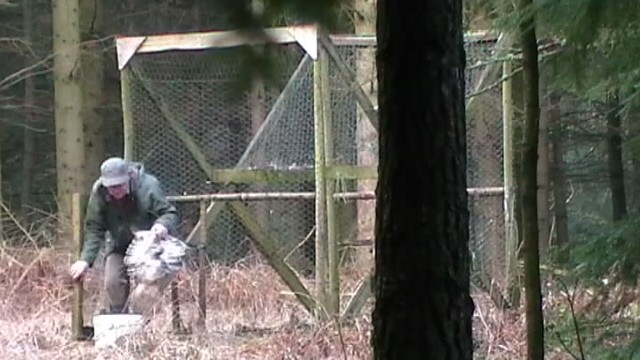
Burne dumping BZ in bucket

Buzzard-killing video – WARNING: GRAPHIC CONTENT

Further to our earlier story (here) about gamekeeper Colin Burne, convicted for trapping buzzards and clubbing them to death, the RSPB has now posted the unedited version of their covert video surveillance.

WARNING – GRAPHIC CONTENT. Video can be viewed here.

Burne clubbing buzzard to death

Buzzards trapped & beaten to death with a stick: gamekeeper convicted

A gamekeeper from Cumbria has today been convicted for killing buzzards by trapping them in a crow cage trap and then battering them to death with a wooden stick.

Gamekeeper Colin Burne, 64, of Winters Park, Penrith, was caught on camera bashing the buzzards’ skulls in with a wooden stake after the RSPB Investigations Team installed a covert video at the trap in February this year. The trap was being operated on land managed by a private shooting syndicate in Whinfell Forest, near Penrith, Cumbria. A further search of the area revealed ‘many other’ dead buzzards, to which Burne admitted killing five.

Burne admitted three charges at Carlisle Magistrates Court today. He received a 70-day jail sentence for each charge, suspended for 12 months due to his ill health.

RSPB press release here.

The film footage will be published shortly.

We’ll be looking for a statement from the National Gamekeepers Organisation to confirm that if Burne was one of their members, he has now been expelled for life.

The team involved with this investigation and conviction (RSPB Investigations, Cumbria Constabulary and the Crown Prosecution Service) deserve huge credit, especially given the short time span between crime and conviction (less than five months). It seems pretty clear from the evidence that this gamekeeper had been routinely killing buzzards for some time. Will his conviction stop him? It’s hard to say – a suspended sentence is hardly a strong deterrent – but perhaps his ill health will put an end to his criminal career. Certainly the Whinfell Forest shoot will be under closer scrutiny from now on, whether Burne is still involved or not.

So, here we have yet another criminal gamekeeper convicted on the basis of covert video surveillance in England. The CPS and the Magistrates Court don’t seem to have had a problem accepting the video footage as admissible evidence. Had Burne been operating just a few miles further north, this case would not have even reached court, thanks to the Crown Office’s outright refusal to accept this type of evidence. We are greatly looking forward to Paul Wheelhouse’s response to our question from the other day – has the Lord Advocate told the Crown Prosecutors in Scotland to start accepting covert surveillance footage as admissible evidence?

UPDATE 9th July 11.30am: Further details about what Colin Burne did have been published in the News and Star newspaper (here), including an edited version of the video footage showing Burne entering the crow cage trap armed with a fence post to club the buzzards to death. This bastard, who was part of the Cliburn Shoot, knew exactly what he was doing. When initially questioned by the police he denied harming the buzzards – it was only after the video footage was shown to him that he admitted his guilt.

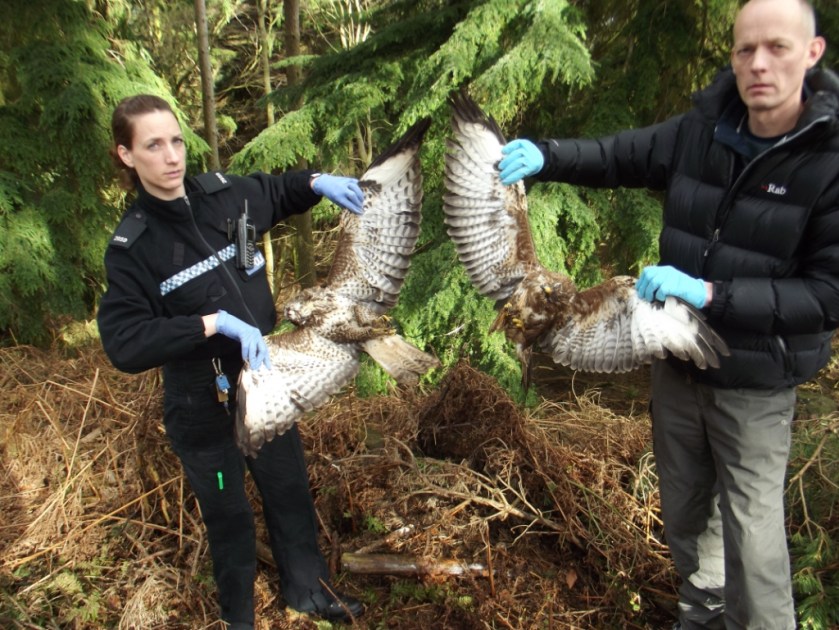
Photo: PC Helen Felton and RSPB Investigator Bob Elliot with two of the buzzards that Burne had clubbed to death, found hidden under a brash pile close to the trap.

PC Helen Felton and RSPB with two killed buzzards_a

UPDATE 9th July 2013 8.15pm: The unedited version of the video has now been posted by the RSPB. View it here. WARNING – IT’S GRAPHIC.

Convicted gamekeeper has membership ‘suspended’

filesLast week we blogged about North Yorks gamekeeper Shaun Leslie Allanson, who was convicted of committing wildlife crimes on the Blansby Park Estate (see here). We wondered at the time whether Allanson was a member of the National Gamekeepers’ Organisation (NGO), the English/Welsh equivalent of the Scottish Gamekeepers’ Association.

Well, it turns out that he was indeed a member at the time he commited those offences.

In a very welcome turn of events, the NGO have issued a public statement about Allanson (see here). Following his conviction, they immediately ‘suspended’ his NGO membership. Now, this isn’t as good as immediately booting him out and banning him from ever re-joining the organisation, but it is a good start.

According to the NGO’s disciplinary procedure (see here), Allanson will remain suspended until the NGO’s National Committee have a chance to meet and discuss the details of his case, and based on that meeting he will either be expelled or re-admitted. We will watch with interest to see what decision they make.

The NGO deserve some credit here. Regular blog followers will know that after previous cases of convicted gamekeepers we have struggled to get the relevant ‘professional body’ (i.e. the NGO or the SGA) to make any public comment at all. On this occasion though, the NGO took very swift public action without us having to spend weeks badgering them to do so. We blogged quite recently about the need for greater leadership amongst the game-shooting bodies and it looks as though the message has finally got through, to the NGO at least. They don’t often give us cause to congratulate them but this time they have. Well done to them.

Northumberland gamekeeper cautioned for trap offences

Yes folks, here’s another one…

RSPB press release:

A gamekeeper from Northumberland has been cautioned by Northumbria Police after failing to attend and properly check a crow cage trap over a fifteen day period in December last year.  The trap had captured three buzzards on one occasion.

RSPB covert surveillance cameras monitored the trap belonging to a shoot in South West Northumberland and found that the trap operator had failed to attend the trap at any point during the filming. Footage showed the trap had captured three buzzards.  All three buzzards were released unharmed, two by passing members of the public and the third by the RSPB.  The video footage later showed the third buzzard had been in the cage trap for two days.

Investigations by Northumbria police, assisted by the RSPB, identified the trap operator, who during a police interview admitted to failing to check the trap properly each day and failing to release the third buzzard out of the trap. Failure to operate the trap lawfully is contrary to the Wildlife and Countryside Act 1981.

Howard Jones from RSPB investigations stated: “It is unknown how these buzzards would have fared if they had not been released.  It further highlights the issue of birds of prey being attracted to crow cage traps and the vital importance that operators responsibly manage their traps.”

PC Colin Heath of Northumbria Police who led the investigation added: “We will continue to work closely with the RSPB to promote and protect our wild birds and to deal with offenders accordingly.”

Unfortunately, we are unable to name the gamekeeper as he’s been cautioned. We also need to be cautious in naming the location, although we can say it was a family-run shoot.

The big question is, why did this keeper only get a caution? Why wasn’t he charged and prosecuted?

Would you believe it, another guilty gamekeeper!

Another day, another location, another criminal gamekeeper, another wildlife crime conviction, another shit sentence.

This time it’s gamekeeper Shaun Leslie Allanson (37), convicted of crow cage trap misuse on the Blansby Park Estate, nr Pickering, North Yorkshire.

Today at Scarborough Magistrates Court, this ‘professional’ pleaded guilty to intentionally taking a buzzard using a live pigeon in a cage trap on 28 Aug 2012, and using a cage trap with a live pigeon decoy between 31 Aug and 19 Sept.

His punishment? 120 hours community service and £85 costs. Wonder if he’s a member of the National Gamekeepers’ Organisation? We’ll do some asking….

There’s a fuller story in the Telegraph here.

Well done North Yorkshire Police and well done to the Natural England employee who first recognised the crow trap was being used illegally and for releasing the buzzard to safety.

Clam traps: SNH in the last chance saloon

snh_logoOn Tuesday we blogged about SNH’s response to our concerns over the on-going clam trap fiasco (see here). We said we would outline what we thought the next step should be. Here are our thoughts:

There are two main issues. The first one is that the consultation process was flawed. It did not meet the standard required by the Scottish Government’s ‘Consultation Good Practice Guide’, which is applicable to an agency like SNH (see here).

For example, consultations should allow “at least 12 weeks to respond”. This particular consultation opened on October 1st 2012 and closed on November 9th 2012, thus only allowing 5.5 weeks in which to respond. In addition, in order to be transparent, SNH should have provided feedback on how each and every point raised during the consultation was treated. As far as we can tell, this has not taken place. Instead, it appears that the majority of points raised have been ignored (in terms of the final outcome of the consultation). In which case it could be argued that the whole consultation was pointless; SNH had already decided what they were going to do, regardless of the majority view of respondents, and they were just going through the motions of holding a public consultation to appease those of us who might object to their proposals.

The second main issue is the basis of evidence that SNH used to approve the use of clam-type traps. According to SNH, the consultation did not provide any evidence that clam-type traps were unsafe for target and/or non-target species, or a threat to protected species. Instead, they argued that as clam-type traps had previously been in use (albeit probably illegally!) it would be “disproportionate to ban their use outright”. There are several problems with this argument.

First of all, it is clear that no independent testing has taken place to provide evidence that these traps are safe. If SNH are using the ‘lack of available evidence’ to show that the traps are unsafe, then surely that mandate should also apply to demonstrate that the traps are safe before they are authorised for use? Is there any evidence to show that the traps have no welfare or lethal impacts to either target or non target species, which may include protected species, to justify their use? If there is evidence, it has not been made available to the public, in which case, SNH should have applied the precautionary principle and not authorised these traps until such time as independent testing shows they pose no threat to animal welfare as well as no impact on non-target species, some of which may be protected species.

Secondly, SNH have argued that by restricting the type of bait for these traps (bread and eggs only), they have “minimised the risk to non-target species”. Whilst this may be applicable to raptors, it certainly does not minimise the risk to other protected, non-target species, including the pine marten, a species that loves to eat eggs! According to SNH’s own website, it is an offence to intentionally or recklessly capture a pine marten unless you have a special licence to do so (see here). So why authorise a trap that, depending on its location, is highly likely to capture a pine marten?!

Thirdly, SNH said that it would be “disproportionate to ban their [the traps] use outright”. But, if you read the responses to the consultation, the majority of respondents were not asking for an ‘outright ban’ – they were asking for independent testing prior to the traps being authorised. Furthermore, there are alternative traps (Larsen trap) that could be used if clam-type traps were not approved this year or until such time as a trial showed that they are safe. So for SNH to say that not approving their use is ‘disproportionate’ is overstating the reason for approving the use of these traps.

So, where to go from here? In the first instance, we propose that people contact SNH and ask them to provide evidence to show that clam-type traps have no welfare or lethal impacts on either target or non-target species, and if they can’t provide such evidence then they should pull the clam-type trap from the General Licences until such time as that evidence is available.

This is SNH’s last chance to act. If the evidence is not forthcoming and SNH still refuse to withdraw the clam-type trap from the General Licences, then the next step would be to go to the Ombudsman and ask whether SNH has carried out this consultation appropriately.

If that fails, then we think there is a very strong case for making a formal complaint against SNH to the EU, for failing to protect the very species that they have a statutory duty to protect. This complaint wouldn’t just be limited to the clam-type trap issue – it would cover other traps that SNH have authorised, including crow-cage traps, without addressing the legitimate concerns about their use. These concerns have been raised over and over again during the last few years (see the current and previous consultation responses of groups such as RSPB, SRSGs and OneKind for examples) and SNH has consistently ignored them. They may argue that they’re going to address these concerns in their proposed ‘Code of Practice’ that they say they will develop ‘early this year’. The problem with that is it has not been made clear whether they will actually address all the concerns, and even if they do, whether this ‘Code of Practice’ will be a voluntary code (in which case it’ll be worthless) or whether breaking this code will be considered a formal breach of the conditions of the General Licence (and therefore should result in a prosecution).

It’s time to get serious. Please consider emailing SNH. It only takes a minute. The complaint should go right to the top again: Ian Jardine, (Chief Executive SNH) – ian.jardine@snh.gov.uk

If you’re not sure what to write, either copy the blog URL into the body an email, or you could use the following text as a guide – simply cut and paste or adapt it to your own words:

Dear Dr Jardine,

Re: the recent SNH consultation which led to the authorisation of clam-type traps in the 2013 Open General Licences.

Please can you provide the evidence you have used to demonstrate that clam-type traps have no welfare or lethal impacts to target or non-target species. If the evidence is unavailable, please consider withdrawing the use of clam-type traps from the Open General Licences until such time as independent and rigorously tested evidence is available.

Thanks.

Here comes 2013….the year of natural scotland

imagesHappy Hogmanay!

Tomorrow marks the start of another Scottish government themed year: The Year of Natural Scotland, in which we’re encouraged to celebrate Scotland’s stunning natural beauty and biodiversity. Good job it wasn’t this year’s theme as there might have been some red faces in the government:

  • SGA gamekeeper Whitefield sentenced for poisoning four buzzards (he already had an earlier wildlife crime conviction). His sentence this time? 100 hours community service.
  • Scottish gamekeeper McLachlan, convicted for possession of the banned poison Carbofuran. Fined £635.
  • Scottish gamekeeper Barrie lost an appeal for his sentence of £520 for illegal possession and control of a wild bird.
  • COPFS choosing not to prosecute a Scottish gamekeeper who had been filmed beating birds to death with a stick inside a crow cage trap.
  • Scottish gamekeeper Christie convicted for wildlife crimes relating to the illegal use of a crow cage trap. His sentence? An admonishment (a telling off).
  • Scottish gamekeeper Graham convicted for allowing a buzzard to starve to death inside a crow cage trap. Fined £450.
  • Scottish gamekeeper McKellar convicted for possession of banned poison. Fined £1,200.
  • Scottish gamekeeper Scobie convicted for using banned poison. Fined £270.
  • A satellite-tagged golden eagle mysteriously ‘disappeared’ in the Angus glens.
  • A satellite-tagged golden eagle mysteriously ‘disappeared’ to the North East of the Cairngorms National Park.
  • Peregrine chicks mysteriously ‘disappeared’ from a nest site in Dumfries & Galloway.
  • A golden eagle was found dead, poisoned in Lochaber.
  • A golden eagle was found dead in suspicious circumstances on the Isle of Harris. Still awaiting results.
  • A satellite-tagged golden eagle mysteriously ‘disappeared’ in the Monadhliaths.
  • A poisoned raven, crow, and three poisoned baits were found in the Borders.
  • A satellite-tagged golden eagle was found dead near a lay-by in Aberdeenshire. Its injuries and its sat tag data suggested it had been illegally trapped on an Angus grouse moor and then dumped during the night and left to die.
  • A golden eagle was found shot and critically injured on a grouse moor in Dumfries & Galloway.
  • Barry, the sat-tagged hen harrier from Langholm mysteriously ‘disappeared’.
  • Buzz, the sat-tagged buzzard mysteriously ‘disappeared’ in the Angus glens. (More on this case in the New Year).
  • Willow, a sat-tagged marsh harrier mysteriously ‘disappeared’ in Galloway.
  • A hen harrier was found shot dead on an Aberdeenshire grouse moor.

These are just a few of the ‘highlights’ from Scotland this year – there are a few more that we can’t yet report but we will in the New Year. And of course this list doesn’t include other confirmed incidents from other parts of these fair isles such as England, Wales, Northern Ireland and the Irish Republic; a list that includes shot and poisoned sea eagles, buzzards, kites, harriers, peregrines and sparrowhawks. Nor does it include the incidents that went undiscovered.

We’ll be blogging quite a lot about the Year of Natural Scotland, which hopefully won’t be just a banner-waving exercise by the government but an opportunity for them to put their money where their mouths are. You don’t think so? No, neither do we. Why should 2013 be any different from the previous three decades of ineffective action?

A hint of what’s to come is the revelation that the theme will be highlighted during several events throughout the year. Two particular locations caught our attention: the Scone Game Fair and the Moy Game Fair.

The Scone Game Fair is of course organised by the GWCT. That’s the same GWCT that has recently asked for the addition of buzzards and sparrowhawks to the General Licences (that means they want permission to kill them…we’ll be blogging about that shortly). It’s also the same Game Fair that has previously attracted sponsorship from some very, how shall we put it, ‘surprising’ sources.

The Moy Game Fair is held on the Moy Estate near Inverness. If you’re unaware of this place, try googling it.

Thanks for all your interest and support in 2012…we’ll see you soon. Sláinte!

This golden eagle was found shot, critically injured &left to die on a Scottish grouse moor. Photo SSPCA
This golden eagle was found shot, critically injured and left to die on a Scottish grouse moor. Photo SSPCA

Gamekeeper’s acquittal upheld by appeal court

A Scottish gamekeeper whose trial collapsed earlier this year on a legal technicality has had his acquittal upheld by the Appeal Court.

Anstruther Peter Smith, a beat-keeper on Airlie Estate near Kirriemuir, Angus, was originally charged with several alleged wildlife crime offences after three buzzards were discovered in a crow cage trap at Wellbank Wood in March 2011. It had been argued that allegedly the trap didn’t meet the standards required under the General Licence. Two buzzards were immediately released but one was treated for several days before release for injuries believed to have been sustained by the buzzard’s attempts to escape from the trap.

The case went to trial at Forfar Sheriff Court in June 2012, where Smith’s defence agent argued that an SSPCA inspector’s evidence should be ruled inadmissable on the basis that the defendant’s interview was ‘unfair’. Sheriff Kevin Veal agreed and Smith was acquitted.

The Crown appealed this decision but an appeal committee (Lady Paton, Lady Smith and Lord Wheatley) recently upheld it and refused the appeal. The full details of the case and the decision can be read here.

An overview article in the Courier here.

An injured buzzard inside a crow cage trap

Purdey Awards: “celebrating greatness”?

The annual Purdey Awards for Game and Conservation were established to celebrate those who achieve most in game conservation, according to the Purdey Awards website (here). These awards are viewed as the game-shooting industry’s most prestigious, giving recognition to those ‘who do most to help our flora and fauna, by improving biodiversity and developing better land management‘.

The 2012 Purdey Award winners were recently announced. We were particularly interested in the ‘Highly Commended’ category:

Brian Kaye of Redmyre Farm Shoot of Invergowrie, near Dundee, has been highly commended for his work in creating a high quality farm shoot and for enhancing the landscape and natural environment. Mr Kaye has not only dramatically improved the habitats and biodiversity for a wide variety of game birds and plant life, but has also demonstrated how shooting goes hand in hand with conservation. The award is made in recognition of outstanding work over 20 years in establishing an exemplary shoot over 320 acres of the Sidlaw Hills“.

Surely not the same Brian Kaye who owns Redmyre Estate near Invergowrie (according to the East of Scotland Association for Wildfowling and Conservation: see here)? Nah, it couldn’t possibly be. A gamekeeper on Redmyre Estate was convicted in 2010 of shooting dead a buzzard and for possession of the banned poisons Carbofuran and Alpha-chloralose (see here, here, and especially here).

Other ‘greats’ that have been celebrated with Purdey Award wins include:

Geoff Eyre, the sporting tenant on Howden Moor (2005 Purdey Gold Award). In 2011, the gamekeeper on Howden Moor was convicted of a series of wildlife crimes (see here).

Jimmy Shuttlewood, the head gamekeeper on Snilesworth Estate (2005 Purdey Special Award).  In 2008, Shuttlewood and two other gamekeepers were convicted of a series of wildlife crimes (see here).

Lochindorb Estate (2008 Purdey Gold Award). In 2010 a dead sea eagle that had been found on the estate mysteriously disappeared just before the police arrived (see here). In 2011, the trial against two Lochindorb gamekeepers began, accused of illegally snaring mountain hares. The case against one gamekeeper was dropped earlier this year; the trial against the other gamekeeper will continue in January 2013 (see here).