Chough-ing hell

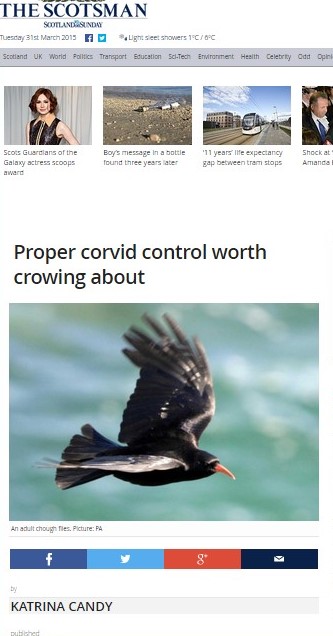
Chough control - CopyAn article appeared in the Scotsman the other day (see here) written by someone called Katrina Candy, Head of PR at GWCT (Scotland).

It was all about the apparent benefits of corvid ‘control’ (the words ‘trapping’ and ‘killing’ aren’t great words to use when your job is Head of Public Relations for an organisation that promotes game-shooting as a wildlife-friendly pastime).

It would seem that Ms Candy hasn’t read the latest research on the impact of corvids on other bird populations – see here for a good overview.

Her article was further discredited by the choice of illustration – none other than a chough, a highly protected species listed on Schedule 1 of the Wildlife & Countryside Act. Let’s hope the error was made by a picture editor at the Scotsman and not by the Head of PR for GWCT (Scotland).

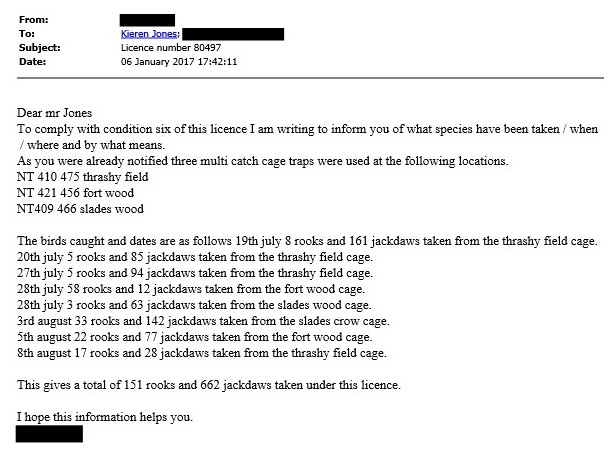
The article also mentioned a current ‘study’ being undertaken by GWCT and SASA, ‘to investigate how corvid traps are used under the current General Licence system in Scotland’. This ‘study’ involves asking trap-users (mostly gamekeepers) to keep records of what they’ve caught. These records (which of course are going to be unbiased and 100% truthful) will be analysed against data collected from trail cameras set at crow traps for ‘short periods of time’.

The proposed use of the trail cameras has apparently caused “some concerns” amongst members of the Scottish Gamekeepers’ Association. GWCT and SASA have had to reassure participants that the cameras will only be set with the trap-user’s permission and the footage will not be used “for policing trap-users” (see here).

Can’t imagine what they’re worried about.

It’ll be interesting to see the results.

Gamekeeper trial collapses after court dismisses RSPB video evidence

The case against Head gamekeeper Ian Sleightholm of the Bolton Hall Estate in North Yorkshire collapsed yesterday after magistrates at Northallerton ruled the RSPB’s video evidence inadmissible.

Sleightholm had been accused of alleged mis-use of a cage trap – specifically that the trap he was operating did not have adequate shade and that the water provided was unsuitable, in contravention of the terms of the General Licence.

The court ruled that the RSPB’s video evidence amounted to ‘an abuse of process’ because RSPB investigations staff “were trespassing on another farmer’s land when they visited the site, saw the trap and set up covert surveillance cameras”. The court ruled that because Sleightholm was unaware of the cameras, ‘he didn’t have the opportunity to discuss the issues with the RSPB or prepare his defence’ and this denied the accused the opportunity of a fair trial.

Eh?

The magistrates also ruled that the case should be dismissed because the only evidence put forward was photographic. It was argued that samples of the water should also have been collected to determine whether it was suitable or unsuitable drinking water.

This is fascinating. According to the terms of the English General Licence (under which Sleightholm was operating the trap), the following criteria apply:

Water must always be available to decoy birds and drinkable; it should be free from chemical additives and changed regularly to ensure that it is clean“.

As far as we’re aware, there is no legally-binding definition of what constitutes ‘drinkable’ water for birds. There’s plenty of legislation defining ‘drinkable’ water that is fit for human consumption (e.g. The European Drinking Water Directive) but these standards are unlikely to be applicable to water provided for decoy birds. So quite what test parameters the magistrates would be looking for to demonstrate that the water was suitable or unsuitable is a bit of a mystery.

We’d have thought that it’s pretty obvious when water is ‘clean’ or not, and photographic evidence should suffice. If the water container contains, say, green sludge, most people would consider that to be unclean. The terms of the General Licence do not define what constitutes “changed regularly” – does that mean daily, weekly, monthly, annually? Once again, the vagueness of the General Licence conditions do not stand up to legal scrutiny.

The collapse of this case is a bit of a surprise. Video evidence has long been considered admissible in English courts (as opposed to the difficulty of using it in the Scottish courts) and it’ll be interesting to see how the ruling in this case affects future cases where video evidence plays a central role in the prosecution’s case.

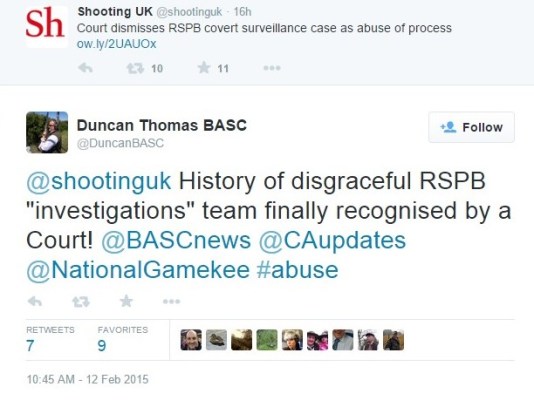
As you can imagine, there has been much crowing from the Dark Side about this result, and we were particularly interested in the following tweet from Duncan Thomas:

Duncan Thomas tweet RSPB covert video case

The name Duncan Thomas may sound familiar to some of you. He is a former Police Wildlife Liaison Officer with Lancashire Constabulary and now works as the North West Regional Officer for BASC. We recently blogged about him here. BASC is a member of the Partnership for Action against Wildlife Crime (PAW). Do you think his published opinion (which, incidentally, was also re-tweeted by the National Gamekeepers Organisation) is conducive to ‘partnership’ working, or do you think it exposes the ‘partnership’ sham for what it actually is?

UPDATE 20:00hrs: Does the spokesman of the National Gamekeeper’s Organisation have a headmaster fetish?

Jailing raptor-killing gamekeepers ‘not the answer’, says Robertson

Alastair Robertson Scotsman 24 Jan 2015The fall-out from the shock custodial sentence for raptor-killing gamekeeper George Mutch continues….

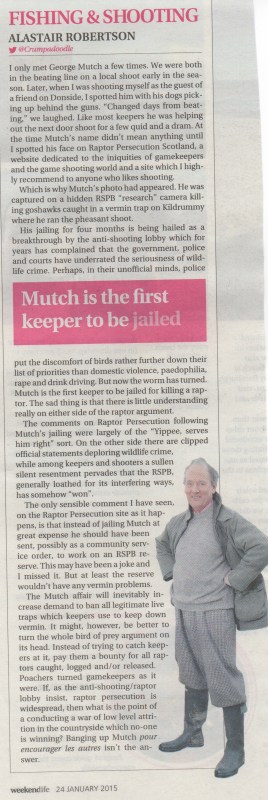
The following appeared in yesterday’s Scotsman weekend magazine (24th January 2015). It’s the regular country sports column written by Alastair Robertson, the pro-game shooting journalist who also contributes to Daily Mail, Mail on Sunday, Telegraph, The Sun, Country Life & The Field.

“I only met George Mutch a few times. We were both in the beating line on a local shoot early in the season. Later, when I was shooting myself as a guest of a friend on Donside, I spotted him with his dogs picking up behind the guns. “Changed days from beating”, we laughed. Like most keepers he was helping out on the next door shoot for a few quid and a dram. At the time Mutch’s name didn’t mean anything until I spotted his face on Raptor Persecution Scotland, a website dedicated to the iniquities of gamekeepers and the game shooting world and a site which I highly recommend to anyone who likes shooting.

Which is why Mutch’s photo had appeared. He was captured on a hidden RSPB “research” camera killing goshawks caught in a vermin trap on Kildrummy where he ran the pheasant shoot.

His jailing for four months is being hailed as a breakthrough by the anti-shooting lobby which for years has complained that the government, police and courts have underrated the seriousness of wildlife crime. Perhaps, in their unofficial minds, police put the discomfort of birds rather further down their list of priorities than domestic violence, paedophilia, rape and drink-driving. But now the worm has turned. Mutch is the first keeper to be jailed for killing a raptor. The sad thing is that there is little understanding really on either side of the raptor argument.

The comments on Raptor Persecution following Mutch’s jailing were largely of the “Yippee, serves him right” sort. On the other side there are clipped official statements deploring wildlife crime, while among keepers and shooters a sullen silent resentment pervades that the RSPB, generally loathed for its interfering ways, has somehow “won”.

The only sensible comment I have seen, on the Raptor Persecution site as it happens, is that instead of jailing Mutch at great expense he should have been sent, possibly as a community service order, to work on an RSPB reserve. This may have been a joke and I missed it. But at least the reserve wouldn’t have any vermin problems.

The Mutch affair will inevitably increase demand to ban all legitimate live traps which keepers use to keep down vermin. It might, however, be better to turn the whole bird of prey argument on its head. Instead of trying to catch keepers at it, pay them a bounty for all raptors caught, logged and/or released. Poachers turned gamekeepers as it were. If, as the anti-shooting/raptor lobby insist, raptor persecution is widespread, then what is the point of conducting a war of low level attrition in the countryside which no-one is winning? Banging up Mutch pour encourager les autres isn’t the answer”.

END

So, no real surprises. Gamekeepers and shooters apparently ‘loathe’ the RSPB for ‘interfering’ (= catching raptor-killing gamekeepers and reporting them to the police). Oh, and killing raptors doesn’t really merit a custodial sentence because it doesn’t rank as a priority crime, even though the Government and Police Scotland have both stated that tackling wildlife crime IS a priority, and even though the penalty available for EACH offence could be a £5,000 fine and/or a six month custodial sentence. Some would say Mutch got off lightly with just a four-month jail sentence.

Instead of trying to catch gamekeepers at it, Robertson’s theory is that gamekeepers should be paid a bounty for each raptor they manage not to kill. A bit like giving a bank robber a bounty for each bank he manages to walk past without robbing it. ‘Ah, well done lad, you’ve managed to go a whole day without committing a crime – here, have some tax-payer’s money in recognition of your self-control’.

Talking of Mutch, we were interested to receive a photo taken on a grouse moor in September 2014.  This was on Edinglassie Estate in Aberdeenshire. Edinglassie is an award-winning estate, receiving the GWCT’s Golden Plover Award in 2013 for their progressive & sustainable moorland management, and becoming WES-accredited (SLE’s Wildlife Estates Scotland thing). Is that George Mutch, clearing the butts after a drive? Who would employ Mutch to help out on a game shoot? (There’s no more helping out for a few quid and a dram – new rules mean that, unless in exceptional circumstances, HMRC views beaters etc as ’employees’ for tax purposes). Interesting. Although to be fair, in September he was still denying his guilt and hadn’t yet been convicted (that came in Dec). Can’t imagine an esteemed estate like Edinglassie would employ him now he’s been convicted of raptor persecution…..

Balaclava sales set to rise

Daily Mail Bloody battle of the glens (2)The angst generated by the successful use of video evidence to convict gamekeeper George Mutch continues, as does the game-shooting lobby’s pathetic attempts to discredit the RSPB….

The following excerpts are from a recent article in the Mail, written by Jonathan Brocklebank:

The camera was hidden in a pile of twigs deep inside a sporting estate whose owner had no idea that it had been infiltrated by Europe’s wildlife charity.

But then, RSPB Scotland needs no invitation or permission to launch covert surveillance ops on private land. These days, it gives its own go-aheads.

So it was that gamekeeper George Mutch, 48, came to be filmed with a juvenile goshawk he beat to death with a stick on the Kildrummy Estate, Aberdeenshire. He began a four month jail sentence this week after damning footage showed him using two traps to catch birds of prey.

His apparent motive was to protect pheasants from the raptors, thus ensuring a plentiful supply of game birds for the shooting parties whose business helps keep such estates alive. Mutch, thought to be the first person ever to be jailed in Scotland for killing a bird of prey, will win no sympathy from animal lovers.

But the court case did not simply highlight the inhumane behaviour of a lone gamekeeper who brought disgrace upon his profession. It also served as a demonstration of the now immense power of the charity whose evidence convicted him.

That power, say ever-growing numbers of critics, leaves few areas of outdoor and rural life untouched.

[There follows some predictably tedious claims made by Botham’s You Forgot The Birds campaign, whose failed complaints about the RSPB to the Charity Commission Mr Brocklebank failed to mention (see here), and how some landowners are erecting signs saying RSPB Not Welcome (see here). It then continues….]

During Mutch’s trial, Aberdeen Sheriff Court was told the RSPB routinely enters estates without asking the landowners and, once inside, staff are free to use hidden cameras to gather ‘data’.

When questioned in court, Ian Thomson, the charity’s head of investigations, explained why they needed no permission. “Because we are entering an area for scientific study, we feel we are using our access rights under the Land Reform Act”.

Is it, then, acceptable for RSPB officials to march onto a private estate and set up equipment to secretly video employees?

It seems so. A spokesman for the charity told the Mail: “In Scotland, the Land Reform Act (2003) enshrined a legal “right to roam” and this includes access for survey and research purposes, provided this is carried out responsibly”.

He said the shocking images captured on the video spoke for themselves.

Notwithstanding Mutch’s appalling actions, there is a distinct air of discomfort in the Scottish Gamekeepers’ Association (SGA) over the means by which the RSPB’s evidence was obtained.

A spokesman for the organisation said it seemed wrong for individuals “from one particular profession” to be under surveillance in their workplace without their knowledge.

He added: “Is it the case now that charities can do this rather than the police – and is this the correct thing?

They have said they used their rights of access to go on to the land to do this. Really, they should have asked the landowner out of courtesy, if anything. Although it is not sacrosanct in law to do so, I think it would rile people a lot less if there were a little bit more cooperation from organisations such as the RSPB.

These are the things that lead to the breakdown of trust. If they did things a little bit more with due respect, they would find themselves in a lot less problems”.

His words hint at both a clash of cultures and at competing interests in the schism between senior figures in the charity and the ‘tweedies’ who own and manage vast swathes of the Scottish countryside.

While Scottish Natural Heritage (SNH) routinely issues licences to farmers to control wildlife which threatens their livestock, it has never issued a licence to a gamekeeper or landowner to control any species threatening birds kept for game, which also count as livestock under the Wildlife & Countryside Act 1981. The reasons for this, gamekeepers believe, is obvious: politics.

[The rest of the article covers complaints from a gamekeeper on the Lochnell Estate in Argyll about people turning up unannounced to monitor raptor nests; how many members the RSPB has; how much income the RSPB generates; the RSPB’s involvement in the renewal energy debate; how the RSPB is seen as the ‘go to’ organisation for advice on developments; how arrogant the RSPB is; and ends with the question: Is there a time, perhaps, when a charity just becomes too big?]

ENDS

So, the SGA thinks that wildlife crime investigators should let landowners know, in advance, of their arrival on a privately-owned estate. They seem to be missing the point. The landowner can now be held criminally vicariously liable for some crimes against raptors that are carried out by their gamekeepers; what do you think is the first thing the landowner would do, if he/she was notified that wildlife crime investigators were on their way? Advanced warning would hardly be in the interest of an investigation, (or justice), would it? Besides, as was pointed out in the article, nobody has to give advanced warning to a landowner of an impending visit and as long as they act responsibly once on the land, they’re well within their rights – that’s kind of the point of the Land Reform Act.

And what’s all this guff about gamekeepers have never been issued an SNH licence to ‘control’ (kill) “any species” that is perceived as a threat to their game birds? What utter nonsense! Gamekeepers routinely use the SNH General Licences to ‘control’ (kill) corvids. Ironically, this is what Mutch was supposed to be doing when he was filmed killing a trapped goshawk and shoving two other raptors in sacks and walking off with them. Sounds to us like the SGA are trying to play the victim card, again, albeit unsuccessfully.

McAdam 1The SGA aren’t the only ones up in arms about the admissibility of the RSPB’s video footage which was used to devastatingly good effect in the Mutch trial.

Here’s what the CEO of Scottish Land & Estates (SLE), Doug McAdam, wrote in last week’s SLE e-newsletter:

There can be no doubt that the custodial sentence handed down this week to a gamekeeper convicted of wildlife crime will send a very strong message out to those who continue to break the law. The illegal killing of any bird of prey is unacceptable and anyone who engages in such activity can, rightly, expect to feel the full weight of the law.

However, this case has raised some fundamental issues regarding access rights and the law as it becomes clear that a central party to this investigation [he means the RSPB] has chosen to totally disregard Scottish Government approved guidance contained in the Scottish Outdoor Access Code regarding undertaking survey work on someone else’s land. This is a serious matter in its own right, but it also reaches well beyond matters of wildlife crime, crossing in to areas such as new development and planning work where it could have some serious implications”.

Why is this “a serious matter”? It’s no such thing (unless you happen to be CEO of an organisation that just wants to have another go at discrediting the RSPB or is concerned about what future video footage may reveal). The Scottish Outdoor Access Code is just that – it’s a code, not a statutory instrument. It has as much legal influence as the Green Cross Code. It is trumped, magnificently, by the 2003 Land Reform Act. The totally independent Sheriff in the Mutch trial (who, don’t forget, was brought in because the defence thought that the original Sheriff, as an RSPB member, might be biased – see here) deemed that, in this instance, the RSPB video footage was admissible.

That’s not to say that other video footage will be deemed admissible in other trials – it will depend entirely on the circumstances of the case. In the Mutch trial, the RSPB argued successfully that their cameras were not in place to ‘catch someone at it’ – they had been placed as part of a long-term study in to crow cage trap use. That their footage captured Mutch engaging in his disgusting crimes was just a very happy coincidence.

You have to wonder, with all this consternation from the game-shooting crowd, just what it is they’re so frightened that covert cameras might record….

Now might be a good time to buy some shares in balaclava-making companies.

New study suggests that killing crows is mostly pointless, most of the time

Yesterday saw the publication of a new scientific research paper entitled: A review of the impacts of corvids on bird productivity and abundance. The paper is available for free download here.

If you want to skip over the technical details, the authors have helpfully issued a press release which provides a more general overview for the more casual reader. It reads as follows:

A MURDER OF CROWS?

They steal, raid nests, and keep the company of witches. But the unpopular crow may not be as big a menace as people think.

A new study has found that crows – along with their avian cousins the magpie and the raven – have surprisingly little impact on the abundance of other bird species.

Collectively known as corvids, these birds are in fact being menaced by mankind in the mistaken belief that removing them is good for conservation.

The new study was led by researchers at the University of Cape Town and published this week in the leading ornithological journal Ibis. It found that in the vast majority of cases (82 percent), corvids had no impact at all on their potential prey species.

“Many nature lovers have been distressed to witness a crow or magpie raiding the nests of their beloved garden songbirds, stealing their eggs or eating their defenceless chicks,” said study co-author Dr Arjun Amar from the Percy FitzPatrick Institute for Ornithology. “Although this predation is entirely natural, these observations can be upsetting to witness and often leave people wondering if these predators might be reducing bird numbers.”

“However, our global review suggests that we should be cautious before jumping to conclusions over the impacts these species may have. Just because a predator eats something occasionally does not always mean that they have an impact,” Dr Amar said.

The study, the first of its kind, reviewed all published evidence on whether predation by corvids actually reduces the overall breeding performance of birds or, more importantly from a conservation perspective, reduces their numbers. Data were collated from 42 studies of corvid predation conducted across the globe over the last sixty years.

Not only were corvids unlikely to have any impact on their potential prey species, if there was an impact it most often affected the breeding success of the prey species rather their subsequent numbers. Half of cases found that corvids reduced breeding success whereas less than 10% of cases found that they reduced prey numbers in the long term.

“These results have big implications for the likely benefits of corvid control,” Dr Amar said. “They suggest that killing corvids will be of most benefit to those interested in gamebird shooting rather than conservationists.” He added: “Bird hunters are usually most interested in increasing numbers of birds available to shoot immediately after the breeding season and this appears to be where corvids have most impact”. “Conservationists on the other hand, are usually interested in increasing a species population size and our results suggest that only in a very few cases did corvids have an influence on this aspect of their prey,” Dr Amar said.

The review analysed the impact of six corvid species on a variety of prey species including gamebirds, songbirds, waders, herons, cranes, sea birds, waterfowl and raptors. The 42 studies incorporated into the review included 326 cases of corvid – bird prey interaction Most of the data stemmed from field research in the UK, France and the United States. The impacts were determined partly by comparing bird counts before and after corvids were either removed or their numbers reduced.

The review also found large differences between the impacts of crows, historically considered the most ‘cunning’ corvid, and magpies which are sometimes killed by home owners hoping to protect songbirds in their gardens. Crow species were six times more likely to have an impact on bird prey species than Magpies.

Mistaken assumptions about corvid predation were possibly explained by the birds’ diurnal nature and the fact that they are conspicuous nest predators: “Their importance in prey population regulation is often assumed prior to any assessment of the evidence,” the study warned.

Chrissie Madden, the lead author on the paper, hoped that the review would challenge the perception that all corvids were bad, thereby preventing needless killing: “Our results suggest that this is a mistaken belief and that generally speaking people would be wasting their time killing corvids to increase bird numbers”.

“Overall therefore, our study points to the fact that we are often too quick to jump to the conclusion that crows and magpies may be the cause of bird population declines,” she said.

END

SNH logo 2The paper itself is an interesting bit of science, but of more interest (to us at least) is the potential application of the research results. Basically, this review paper has shown that in the vast majority of cases, corvids (including crows and ravens) have little effect on their prey populations, and thus this raises an important question about the validity (and legality) of Government-issued General Licences which allow the mass killing of corvids, supposedly for the purposes of ‘conserving wild birds’.

General Licences have long been an issue of concern to conservationists, and we have blogged about this a lot (e.g. see here & scroll down through the posts and links). General Licences are routinely used by gamekeepers and land managers for the largely unregulated practice of killing so-called ‘pest’ species, especially corvids, in Larsen traps, clam traps and crow cage traps, or by shooting them. However, General Licences are not permitted to be used to kill ‘pest’ species for the purposes of protecting surplus stocks of gamebirds, even though that is exactly what gamekeepers have been doing, although they don’t admit to that – they simply claim they are ‘controlling vermin’ to protect wild birds such as waders.

How will SNH deal with the results of this latest study, given the overwhelming evidence that corvid predation isn’t having a significant impact on wild bird species in the majority of cases?

Don’t expect a quick response from SNH. We are still waiting for them to deal with other concerns that have been raised about the use of General Licences, some of which were raised in a publication dating back 15 years:

dick-stronach-1999-use-abuse-misuse-of-crow-traps

Interestingly, SNH has recently announced that their suite of 2015 General Licences will shortly (this week) be published on their website, WITHOUT conducting a public consultation and WITHOUT any substantive changes to their 2014 licences. Robbie Kernahan (SNH licensing dept) said:

From our previous consultations and discussions on the GL suite, I think we have a good understanding of the key issues and your outstanding concerns relating to General Licences“.

So that’s ok then. SNH understands the key issues and concerns but has decided not to address them. Brilliant.

Although, they are apparently addressing one aspect of trap use and have been conducting a questionnaire survey of trap-users (see here). As we blogged at the time, asking trap-users for a truthful account of their activities is, frankly, ridiculous. We all saw quite graphically last week, with the conviction of gamekeeper George Mutch, how some of these trap-users are operating.

We’ll be re-visiting this topic in the New Year.

Scottish gamekeeper George Mutch: guilty on all 4 counts

This is an historic day in the battle against the raptor killers.

Scottish gamekeeper George Mutch, 48, of Kildrummy Estate, Aberdeenshire, has been found guilty on all four charges, including the illegal killing of a trapped goshawk, which he clubbed to death, and the taking of two other birds, a goshawk and a buzzard.

No-one will be surprised to learn that yet another gamekeeper has been convicted of illegally killing raptors; Mutch is the 28th gamekeeper to be convicted of wildlife crime in the last three years alone (see here). The big surprise in this case has been the Sheriff’s ruling that the covert video footage, filmed by RSPB Scotland, was admissible evidence. This alone was a significant ‘win’ for those of us who have been exasperated, for years, that this type of evidence has been consistently rejected by the Crown Office, thus allowing The Untouchables to be, well, untouchable. Especially when covert video surveillance has been consistently used in England to secure convictions in similar cases.

So what prompted the change of heart? Undoubtedly, the efforts of former Environment Minister Paul Wheelhouse, who said in July 2013 that he would be urging the Crown Office to consider the use of video footage in cases against those committing wildlife crime.

According to our journalist contacts, COPFS prosecutor Tom Dysart’s performance in court was dynamite, pressing for the admissibility of the video footage and then later shredding the evidence of defence witness Hugo Straker from the GWCT. He also then shredded the evidence of Mutch, resulting in the Sheriff saying that Mutch’s evidence was ‘not credible’ and that his explanation for killing the goshawk (because it was injured) was “a convenient lie”. We never thought we’d say this but Tom Dysart apparently played a blinder. Long may it continue.

The video nasty in this case, showing Mutch trapping and then clubbing the goshawk to death, can be viewed here. WARNING – CONTAINS DISTURBING IMAGES.

Sheriff McPartlin will pass sentence in January and has already said he is considering a custodial sentence. We’ll see.

Meanwhile, the SGA has put out a fascinating press statement. It turns out that Mutch was an SGA member and apparently “his membership of the SGA has been in suspension for some time, until the outcome of the case was known. Now that it is, he will no longer be a member of the SGA“.

That’s interesting. Mutch committed his crimes in 2012, but according to the SGA’s 2013 silent auction booklet, the SGA accepted a fundraising donation from Kildrummy Estate, with George Mutch listed as the contact:

SGA Silent Auction Booklet 2013 (see Lot #17)

So not only was the SGA still accepting donations from this estate the year after the crimes were committed, but it’s also apparent that Mutch was still employed by Kildrummy Estate after he’d committed those crimes. Fascinating.

The SGA’s statement continues:

On the separate, theoretical, issue of the use of covert video evidence, it is clear to us that it should not be acceptable for individuals from one particular profession to be under surveillance in their place of work, without their knowledge, and to have their right to liberty and privacy from such encroachment, removed.

If this is to be the direction of travel, it is not right for Scottish Government to deny people whose livelihoods come under pressure due to the activity of certain species or animals, recourse to a legal solution to solve that conflict.

Currently, there are no legal or scientific means by which people can protect their investments or jobs in situations exacerbated by conflicts with species. Scottish Government has never granted anyone from the game industry a licence to protect investments, which they have the power to do, although it does grant licences routinely to other industries. This, in our view, is a barrier to justice and does nothing to prevent wildlife crime.

In a society supposedly enlightened when it comes to tackling this issue, we believe this is untenable and we will be seeking talks with Scottish Government so that this anomaly is finally closed, removing once and for all the rationale for people to commit wildlife crime.”

So, the SGA doesn’t agree with the use of covert video footage to convict those within the gamekeeping industry of wildlife crime. Why ever not? Surely, they’d be thrilled to root out those individuals who are causing so much damage to the industry’s reputation? By their reaction, you’d be forgiven for thinking that that’s not the case at all. And as Mutch was an SGA member when he committed his crimes, what does that tell us about the SGA’s ability to provide adequate training for its members? They even admit that Mutch is the 5th SGA member in three years to have been convicted!

And then they go into the usual whine about how wildlife crime would stop if only the Government would issue licences to allow the killing of protected species, (although they don’t actually mention the word ‘killing’ – instead they say “licence to protect investments”). The bottom line is, if the leisure industry of killing millions of gamebirds is reliant on the killing of protected species then that industry has had its day.

This case has taken over two years to conclude. We had thought that because the crimes were committed in 2012, before the vicarious legislation was enacted (1st Jan 2013), that there wouldn’t be a vicarious liability prosecution because we didn’t think it could be applied retrospectively. However, one of our legal friends has since advised us that there still may be a vicarious liability prosecution as long as it’s lodged within the three-year time frame from the date the offence was committed (August 2012). So potentially then, if the Crown deems it appropriate and they get it in before August 2015, we could have another vicarious liability prosecution on the cards.

For now though, let’s just enjoy the successful conviction of another raptor-killing gamekeeper, and acknowledge the work of the people who got it to this stage. Huge congratulations to the RSPB Scotland Investigations Team, the SSPCA, Police Scotland, COPFS, Sheriff McPartlin and former Environment Minister Paul Wheelhouse. Real partnership working at its best.

Media coverage:

RSPB press release and video here

BBC news here

STV news here (this one is amusing!)

Reporting Scotland here [6.25 – 8.40] (this film only available for 24 hrs)

Herald here

George Mutch trial: sheriff rules video evidence admissible

Sheriff Noel McPartlin, presiding over the trial of gamekeeper George Mutch (Kildrummy Estate, Aberdeenshire) yesterday ruled that the RSPB’s video footage is admissible.

His ruling was based on his view that the footage in question was a by-product of a legitimate survey (in to the use of crow cage traps) rather than the camera being placed with the sole intention of filming someone committing a criminal act.

This ruling doesn’t mean that covert video footage will be acceptable evidence in all criminal proceedings; each case will have to be considered based on its specific circumstances. But in this trial at least, the video evidence has been ruled lawful.

That is a big result. More often than not, this sort of evidence has not been accepted in Scotland, although it is routinely accepted in England. Credit is due to the Fiscal, Tom Dysart, and especially to former Environment Minister Paul Wheelhouse for all the political pressure he piled on to the Crown regarding the use of video evidence in wildlife crime prosecutions.

After two days of legal wrangling and following Sheriff McPartlin’s decision, Mutch’s trial got underway ‘properly’ yesterday, i.e. the evidence (video) was shown in court.

One recording filmed on August 14th 2012 showed a goshawk being caught inside a Larsen trap, which had been set inside a pheasant pen. A live Jay was being used as the decoy bird [illegally – the General Licences do not allow a Jay to be used as a decoy species in a Larsen trap]. Mutch was filmed approaching the trap the next morning at around 6am.

Prosecution expert witness David Anderson, a Conservation Manager for the Forestry Commission, was asked to tell the court what he could see in the footage, which was filmed in misty conditions. He said the man appeared to pick up an object to pin down the bird. “Then I saw the man got the bird, pulled it out and dispatched it with a stick or whatever they had in their hand”.

Another recording showed Mutch walking in to a crow cage trap (also set inside a pheasant pen) and catching a goshawk that had been caught in the trap. The bird was placed (alive) inside a white sack and removed from the cage.

Mutch has denied all the charges against him.

The trial continues at Aberdeen Sheriff Court and hopefully it’ll conclude today.

SNH launches ‘independent’ (ahem) study into trap use

The long-awaited study into the use of corvid traps in Scotland has finally begun.

This research was first proposed in late 2012, following SNH’s controversial decision to permit the use of clam-type traps on the 2013 General Licences (see here for associated blog posts). There was much opposition to this inclusion, based on concerns that these traps are likely to cause unacceptable risks to non-target species (including raptors). SNH ignored the majority of respondents to a public consultation, who had called for research to be conducted BEFORE the traps were authorised; SNH decided to go ahead and allow the use of these traps and do the research AFTERWARDS.

Following a series of Parliamentary Questions in December 2012 about this decision, Environment Minister Paul Wheelhouse said: “We will commission objective research on these traps“. SNH then announced they would conduct ‘rigorous and independent’ tests.

SNH has now commissioned two organisations to conduct that ‘objective, rigorous and independent’ research. Those two organisations are Science and Advice for Scottish Agriculture (SASA) and the Game and Wildlife Conservation Trust (GWCT).

We have no problem with SASA – they have no vested interests in the removal of predators to enhance the number of gamebirds available for shooting and therefore can be seen as being thoroughly independent on this topic. But GWCT? This is the organisation that has consistently petitioned for buzzards and sparrowhawks to be included on the General Licences (thus allowing them to be culled in the interests of game-shooting) and many of their Trustees are directly involved with game-shooting. Not what we’d call ‘independent’.

According to the SNH press release about this new study, the research will cover all the different types of traps that are currently licensed for use in Scotland (e.g. clam-type traps, Larsen traps, crow cage traps). That’s good – concerns about these traps and their use have been unresolved for many years. These include (but are not limited to) compliance (or not) with European environmental legislation; welfare concerns; poor trap design that allows indiscriminate species trapping; year-round use (as opposed to seasonal use); ineffective regulation of crow trap users; ineffective monitoring of crow trap use (i.e. number and species caught/killed); inability to identify an individual trap user (traps are registered to estates, not to individual users); and a lovely get-out clause for any General Licence user with an unspent criminal conviction. Will this new research address all of those concerns? We’ll have to wait and see.
The press release states that the first phase of the research involves a survey of trap users from the following organisations: British Association for Shooting and Conservation (BASC), Scottish Gamekeepers Association (SGA), Scottish Land and Estates (SLE), GWCT, and National Farmers Union of Scotland (NFUS). Hmm. Does anybody believe that these users are going to admit to having caught a non-target species? Or admit to ‘accidentally’ injuring or killing a trapped non-target species? Given that it is widely accepted (even by the Environment Minister) that these traps are often used for the illegal persecution of raptors, how reliable will these survey results be?

Curiously, there’s no mention of other interest-groups being involved (e.g. RSPB, SSPCA, SRSG, OneKind) – all of whom have previously expressed concerns about how these traps are used – but hopefully that’s just an oversight in the wording of the press release and not an accurate reflection of their actual participation in the study.

Later stages of the study will apparently include ‘field studies of how different traps are used in practice’. We hope the final report will also include information about every single incident of illegal trap-use recorded in Scotland over the last five years, including incidents that resulted in the conviction of a gamekeeper and those cases that remain unresolved.

Download the SNH press release: General Licences – Trapping Project – May 2014 press release

UPDATE 13.40hrs: A previous study looking at the use, abuse and misuse of crow cage traps in Scotland was undertaken by the Scottish Raptor Study Groups and RSPB Scotland in 1998. It was published in 1999 in the journal Scottish Birds (Vol. 20, pages 6-13). Download it here: Dick & Stronach 1999 Use, Abuse & Misuse of Crow Traps

Latest measure to tackle raptor persecution now in place

Last July, following a series of raptor persecution incidents, Environment Minister Paul Wheelhouse announced his intention to introduce ‘further measures’ to tackle the ongoing problem (see here).

One of those measures has recently come in to force (as of 1st Jan 2014).

That measure is an enabling paragraph in some of the 2014 General Licences that says this:

SNH reserves the right to exclude the use of this General Licence by certain persons and/or on certain areas of land where we have reason to believe that wild birds have been taken or killed by such persons and/or on such land other than in accordance with this General Licence.

First of all, we applaud Paul Wheelhouse’s intentions, at least, and his determination to make sure this measure has been enacted. Good for him. However, as we blogged at the time, we really don’t see how this latest measure can be enforced (see here for our reasons).

For once, it seems that many of the game-shooting organisations are in agreement with us. Before SNH issued the 2014 General Licences, they had their usual consultation period and asked for comments about this new enabling paragraph, amongst other things (see here). They have just published those consultation responses and all the respondents from within the game-shooting lobby raised many of the same concerns as us.

So, even though this new measure is now in place, it is highly unlikely that it will ever be effectively deployed….a bit like the legislation relating to vicarious liability. We might be wrong, of course, but only time will tell.

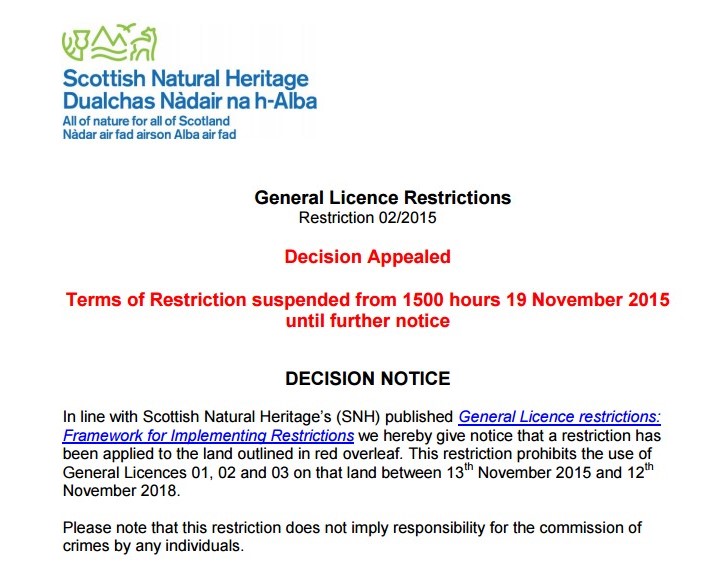
In general terms, the 2014 General Licences are not much better than the 2013 General Licences in that many of the previous concerns raised (going back several years!) have still not been addressed. We’ve blogged about this a lot (e.g. see here, here, here, here, herehere, here, here, here, here) and don’t intend to go over all the points again….not just yet, anyway. We understand that SNH is intending to organise further research in 2014 to address many of the concerns, although they said that when they issued the 2013 General Licences and yet here we are, another year gone by and we’re still waiting for that research.

While we wait, it’s worth you having a look at the responses to the 2014 General Licence consultation – especially the response from the Scottish Gamekeepers’ Association, who once again are asking for ‘quota systems’ for buzzards, ravens, pine martens and badgers.

Download the PDF here: Consultation responses to General Licences 2014

Naturally, we’ll be watching with interest to see whether SNH has cause to withdraw the use of the General Licences, on the basis that they have ‘reason to believe’ that wild birds have been illegally taken or killed. The enabling paragraph probably cannot be used retrospectively so we’ll just have to wait until we see the next incident of criminal activity, which probably won’t be too far off, and then we’ll see what happens.


North Yorks still worst place for raptor persecution in 2012

The RSPB has published its 2012 Birdcrime report documenting bird persecution throughout the UK.

North Yorkshire has once again come top of the league for the number of reported crimes against birds of prey (34), with Aberdeenshire a close second with 31 reported incidents. Both counties, of course, include large areas of land used for driven grouse shooting.

The 2012 report includes statistics that are all too familiar: confirmed shootings of short-eared owls, sparrowhawks, buzzards, barn owls, tawny owls, hen harriers, golden eagles, marsh harriers, and peregrines; confirmed nest destruction of peregrines, goshawks and barn owls; confirmed illegal spring-trapping of buzzards, golden eagle and peregrine; other types of illegal trapping (including crow cage traps) of sparrowhawks, tawny owls, buzzards and goshawks; and the confirmed illegal poisoning of ravens, red kites, buzzards, golden eagles, marsh harriers, peregrines, cats and dogs.

Remember, these are just the confirmed incidents. Plenty more ‘probable’ and ‘unconfirmed’ cases, and of course there are all the incidents that went undiscovered/unreported.

Does that sound to you like the game-shooting industry is cleaning up its act?

Well done to the RSPB for their meticulous work and especially for their willingness to share these data with the general public.

RSPB press release here

Download the RSPB’s 2012 Birdcrime report here

The photograph shows the shot hen harrier Bowland Betty, found on a North Yorkshire grouse moor in 2012. Nobody has been brought to justice for her death.