
Last week Scottish Natural Heritage (SNH) published some information about its proposed changes to the General Licences, effective from 1 April 2020.
Some of those changes include the removal of some bird species from some licences, and the removal of General Licences from some protected areas (to be replaced by individual licences) but we don’t intend to comment on any of that just now as Wild Justice’s legal team is currently evaluating the lawfulness of the proposals.
However, the news that ravens would NOT be added to the General Licences is very welcome, although we are hearing rumours that the so-called Strathbraan Community Collaboration for Waders (basically a load of gamekeepers) and GWCT might be preparing another application for a specific licence to kill ravens in Strathbraan. Freedom of Information requests have been submitted and we’ll keep you posted.
A considerable war chest is still available from the legal challenge made against the Strathbraan raven cull in 2018 and these funds are ring-fenced which means another legal challenge can be launched with immediate effect if necessary.
Another welcome aspect of SNH’s 2020 General Licences is the decision to register individual operators of bird traps.
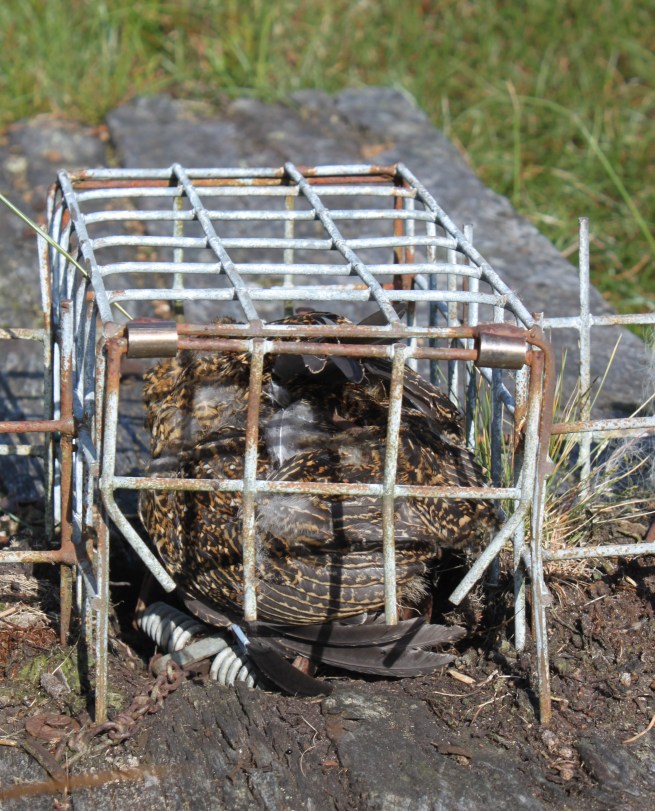
[A multi-catch crow cage trap, baited with a live decoy bird and used to capture hundreds of birds which are then killed, often by being beaten to death with a stick. Photo by OneKind]

Previously in Scotland, the General Licence conditions have stated that live-catch corvid traps (e.g. Larsen traps, Larsen mate traps and multi-catch crow cage traps) have to display an identification number of the trap owner, but this number does not identify an individual trap operator, only the owner, typically the landowner or sporting agent. So if an alleged breach/offence has been detected, and the trap is located on a large grouse shooting estate where multiple gamekeepers are employed, it has been virtually impossible for the Police to identify an individual suspect (and thus charge anyone) because the estate and gamekeepers simply close rank, offer a ‘no comment’ response and fail to identify the actual trap user.
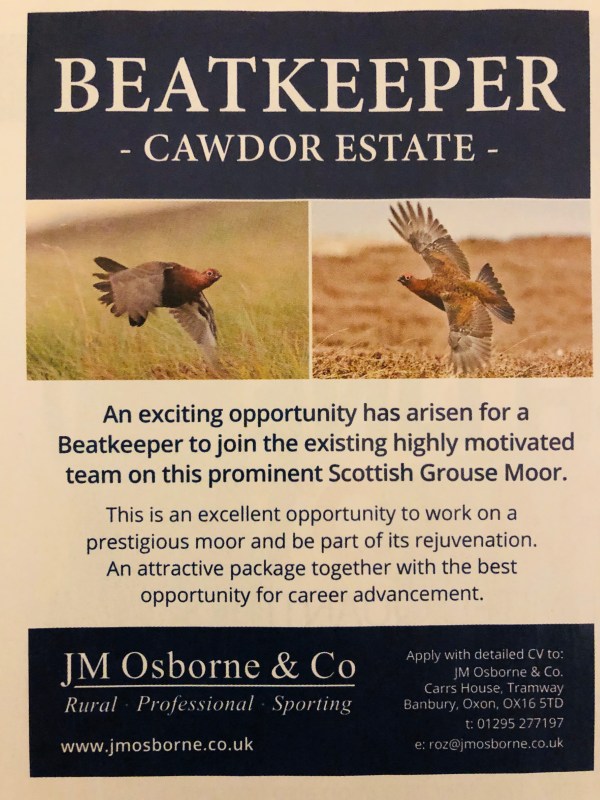
In reality this situation is laughable because very often on large shooting estates gamekeepers are employed specifically to manage a delineated area of an estate, known as a ‘beat’. Their job title is even ‘beatkeeper’ (as illustrated in this January 2020 advert, below) so the idea that, when an alleged offence has been discovered, an individual trap operator at a particular location on an estate can’t be identified is what might be called taking the piss.
Nevertheless, this apparent inability to identify a named suspect has happened time and time and time again, as regular blog readers will be only too aware. It’s why we (e.g. here) and especially the RSPB (e.g. here) have been campaigning for years to have this loophole closed.
The new registration requirements in the 2020 Scottish General Licences still don’t go far enough – there should at least be a requirement for trap operators to submit annual returns so that SNH, and others, can monitor the number of birds killed. But nevertheless, the requirement for individual trap users to be registered is a big step in the right direction. And this level of improved accountability, although still lacking, is way ahead of the General Licences in England and Wales as documented in this timely blog from the RSPB today.
For further information on the Scottish General Licences 2020 see these documents prepared by SNH:





 Raptor Persecution UK