
Row escalates over SNH’s decision to authorise clam traps

The controversial clam trapEarlier in December we blogged about SNH’s decision to authorise the use of clam-type traps under the 2013 General Licences, despite the concerns of a number of organisations that these traps are likely to cause injury to non-target species, especially raptors (see here).

This story has now been picked up by the BBC (see here). According to this article, at least two organisations (SSPCA and RSPB) have called on SNH to reconsider its decision on clam traps. Judging by the comment attributed to SNH’s Licensing Manager, Ben Ross, a U-turn looks unlikely:

We will commission objective research on these traps; if the research shows they pose unacceptable risks, we will then prohibit them“.

Surely this is the wrong way around? You do the research to assess their suitability BEFORE you decide to approve their use, not afterwards!

But that’s not the end of the story. When we first blogged about SNH’s decision to approve these traps, we also raised concerns that SNH had appeared to ignore the recommendations made to them by all groups except those with an interest in game-shooting (blog article here). We asked blog readers to contact SNH and ask to see ALL the consultation responses they’d received, so that we could assess which groups’ recommendations had been accepted and which had been ignored. This was a successful tactic – in a letter to consultees yesterday, SNH wrote this:

Following our response letter to the consultation we received a number of information requests for us to publish all responses that we received to the consultation. This email is to let you know that we are legally obliged to provide this information and as such will be publishing it on our website either later today or tomorrow……..As we have received a number of requests for the information, we will make the responses available on our website“.

So well done and thank you to those of you who made the effort to send an email request to SNH. We look forward to seeing the consultation responses published on the SNH website later today.

Let’s also not forget that the written answers are due tomorrow in response to MSP Claire Baker’s parliamentary questions about the use of these clam-type traps (see here).

Parliamentary questions asked about SNH’s decision on clam traps

Claire Baker MSPFollowing on from earlier blog posts about SNH’s latest baffling decision to authorise the use of clam-type traps in the 2013 General Licences (see here), a well-informed MSP has now asked the following excellent parliamentary questions:
Claire Baker (Scottish Labour, Mid-Scotland and Fife), Date lodged 7/12/2012

Question S4W-11729 To ask the Scottish Government what independent testing has been carried out to evaluate the risk of injury to birds and other animals from (a) Larsen Mate and (b) Elgeeco cage traps.
 
Question S4W-11730 To ask the Scottish Government what independent testing has been carried out to evaluate the impact of (a) Larsen Mate and (b) Elgeeco cage traps on (i) protected species and (ii) species not targeted by the devices.
 
Question S4W-11731 To ask the Scottish Government what provision must be made for (a) food, (b) water and (c) shelter for (i) birds and (ii) other animals caught by a (A) Larsen Mate and (B) Elgeeco cage trap before a general licence for its use can be granted.
 
Question S4W-11732 To ask the Scottish Government what its position is on issuing general licences for untested cage traps.
 
Question S4W-11733 To ask the Scottish Government whether independent evidence establishing a need to supplement a trap with a (a) Larsen Mate and (b) Elgeeco cage trap is required before a general licence for its use can be granted.

Expected answer date: 21/12/2012

Those answers should make for interesting reading. Well done Claire Baker MSP.

Meanwhile, we’re still waiting for SNH to publish ALL the responses they received on their 2013 General Licence consultation. They told us last Thursday that they were “currently preparing the information for publication” (see here).

SNH to publish consultation responses

snh_logoFollowing yesterday’s blog and the request to SNH to publish all the consultation responses relating to the 2013 General Licences (see here), SNH have just sent us the following tweet:
We’re currently preparing the information for publication“.

Even if SNH redacts names in the documents, it should be obvious which response belongs to which group.

Credit where it’s due – thank you, SNH, we look forward to seeing this published.

Thank you and well done to all of you who publicised this request on Twitter and Facebook, and especially to those of you who made the effort and emailed SNH. We’ll blog again about the consultation responses once they’ve been published.

SNH announce changes to 2013 general licences

snh_logoIn October we blogged about how SNH was preparing to make changes to the 2013 General Licences via a public consultation process (see here).

They’ve now just published their proposed changes and by the looks of things, they’ve ignored almost every single recommendation except those made by the game-shooting lobby.

Their letter to consultees, in which they outline their proposed changes, can be read here.

Many concerns remain unaddressed, and particularly about the use of crow cage traps under the General Licence, including trap design (welfare issues), year-round use (as opposed to seasonal use), uncontrolled positioning of these traps, ineffective regulation of crow trap users and ineffective monitoring of crow cage trap use.

There’s one particularly strange ammendment:

Requirement for persons to have read and understood conditions: We will remove the requirement for people to have read the licences before using them. New licenses will require users to ensure that they have understood the conditions“.

What’s the significance of removing the requirement for people to have read the licences before using them? This sounds like the introduction of a very dodgy legal loophole…we wonder who made this recommendation to SNH?

The controversial clam trapHowever, the biggest concern is that SNH has officially authorised the use of ‘clam’-type traps (see above), even though they are fully aware of concerns that these traps are likely to cause injury to non-target species (e.g. see here and here). SNH acknowledges these concerns and proposes to “commission research in 2013 that will examine how these traps are currently being used“. Why authorise a trap before you’ve carried out research to assess the potential damage that trap could cause? By authorising its use without being able to define the trap, SNH has just opened up the floodgates for gamekeepers and other users to put out any trap, call it a clam-type trap, hang an ID tag on it and it’ll be legal. How will SNH control trap size, height, spring tension? It’s nothing short of disgraceful that these traps have been authorised without a proper, independent assessment of their use. SNH say they will work with the representative bodies of the trap users as part of their research. Brilliant – do they really think those users are going to tell them when they’ve caught a non-target species? Or when they’ve ‘accidentally’ injured or killed a non-target species? You only have to read the evidence given in the current hare-snare trial to know the answer to that.

What a total shambles. What we’d like to see now is a complete list of ALL the consultation responses that SNH received for the 2013 general licences. Why? So we can assess whose recommendations SNH has listened to, and whose have been ignored. SNH has not made these consultation responses available in the public domain, but it’s common practice for any public authority conducting a consultation to do so (just look at the Environmental Audit Committee consultation on wildlife crime – every single consultation response was made publicly available).

We urge our blog readers to write to Robbie Kernahan, SNH Head of Wildlife Operations, and ask for ALL of the 2013 general licence consultation responses to be put on the SNH website. Here’s his email address: licensing@snh.gov.uk

2013 general licence consultation: OneKind’s response

Last month we blogged about how SNH was preparing to make changes to the 2013 General Licences via a consultation process (see here).
General Licences are not exactly what they say on the tin – they’re general but there’s no approval process for anyone to have one. If you want to kill certain bird species using certain methods, you don’t need to demonstrate any qualification or competence or even have proven experience: you simply download a copy of a General Licence and as long as you’ve read it (or say you’ve read it) and understood the terms, you’re good to go. It’s strange that it’s even called a ‘licence’ given that the user doesn’t have to do anything special in order to get one.

There are very obvious concerns with this form of ‘licensing’, as well as the ‘licences’ themselves, and we’ve blogged about some of these concerns before (e.g. see here, here, here, here and here).

The consultation has now closed and we expect to see the ammended new ‘licences’ on the SNH website in early December. It would also be interesting to see copies of all the comments that had been made during the consultation process. Whether SNH will publish those remains to be seen.

One group that participated in the consultation process was the animal charity, OneKind. They’ve published their responses which can be read here. Well done indeed.

Evil feathered babysnatchers poised to take over Scotland

The Modern Poisoners’ Society has reacted angrily to the news that sea eagles are set to breed in urbanised East Scotland.

Their outburst was prompted by an article in yesterday’s Scotsman that reported on the latest phase of the East Coast Sea Eagle Reintroduction Project (see here).

Albert Hogburn, Director of the Twat Unit in the Modern Poisoners’ Soc said: “First it was the west coast, now it’s the east coast, what next, are we going to see eagles in Southern Scotland, too? It’s outrageous! We’re going to be the laughing stock of Europe if we’re not careful and what would that do to our fragile economy? Nobody’s going to visit Scotland if we’ve got these evil feathered babysnatchers lurking on top of every doctor’s surgery, sharpening their talons on the roof tiles ready to pounce.

But don’t you worry. Obviously we’ll continue to use poison out in the countryside, because that’s our bread and butter, but we’ve got to have a different strategy for use in urban areas. I’ve had my twats working 24/7 on a new trap design – forget the Clam Trap, we’ll soon be unveiling the Pram Trap, just as soon as our government funding comes through. It’ll be better than the Clam Trap because you can’t really use those in the High Street, whereas the Pram Trap, which works by attaching nooses to the pram’s hood so that when the babysnatcher comes down for the kill its feet will get tangled up, can be rolled out across towns and cities in full public view. We’re also working on a partnership with one of the supermarkets to offer 10% discount to all customers who come in with a dead babysnatcher. The promotion booth will probably be positioned next to the lottery stand at the front of the store. People will feel lucky if they’ve managed to kill a babysnatcher, so lottery ticket sales should increase ten-fold. It’ll be win-win. How bloody fantastic is that?”.

Donald Spewing-Moore from the Royal Bird Protection Society said: “I thought they were up to something. I saw them last week huddled up inside a grouse butt, deep in conversation and guarded by 40 armed naked virgins. I shouted, ‘Oi, Twats, what you doing?’ but they didn’t hear”.

Clap Trap

SNH is seeking input as it prepares to make changes to the 2013 General Licences.

This is a welcome move. The 2012 General Licences are not really fit for purpose, to say the least. We’ve blogged before about certain aspects of these licences, particularly those relating to the use of crow cage traps (see Crow traps: what you should know Part 1 here, Part 2 here, and Part 3 here) as well as clam traps (see here and here).

However, when you have a look at the consultation letter put out by SNH (see here) you’ll notice that they’ve carefully avoided many of the most concerning issues.

To better understand some of these issues, please read Crow Traps: What you should know Part 2 (here is the link again). These issues include (but are not limited to) compliance (or not) with European environmental legislation; welfare concerns; poor trap design that allows indiscriminate species trapping; year-round use (as opposed to seasonal use); ineffective regulation of crow trap users; ineffective monitoring of crow trap use (i.e. number and species caught/killed); inability to identify an individual trap user; and a lovely get-out clause for any General Licence user with an unspent criminal conviction.

The highly contentious issue of the ‘clam trap’ (also known as ‘Larsen mate trap’, ‘snapper trap’ and ‘butterfly trap’) has been raised in this consultation, although SNH’s plans for how to deal with it are astonishing. They recognise that welfare concerns remain about the use of these traps, but instead of banning them until independent research shows they are safe to use, they’ve decided to continue their use and commission research on their use “shortly”. They do suggest that they’ll require clam trap users to notify them of intended use, but really, what’s the point of that, other than being able to identify users as potential participants in their future ‘evidence gathering’ exercise?
When you consider the high level of training and accreditation required by those who want to trap wild birds for scientific research (i.e. bird ringing) and compare this with the very low standards required for those who want to trap wild birds to kill them (sorry, ‘control them for conservation purposes’), you realise what a joke the current system is.

The consultation is open until 9th November 2012. You can fill in the form (here is the link again), or, if you think that there are important issues that haven’t been addressed on the consultation form, why not write directly to SNH and explain your concerns? Email your comments to Robbie Kernahan, Head of Wildlife Operations, SNH: licensing@snh.gov.uk

SNH plan to publish a revised suite of General Licences for 2013 by early December.

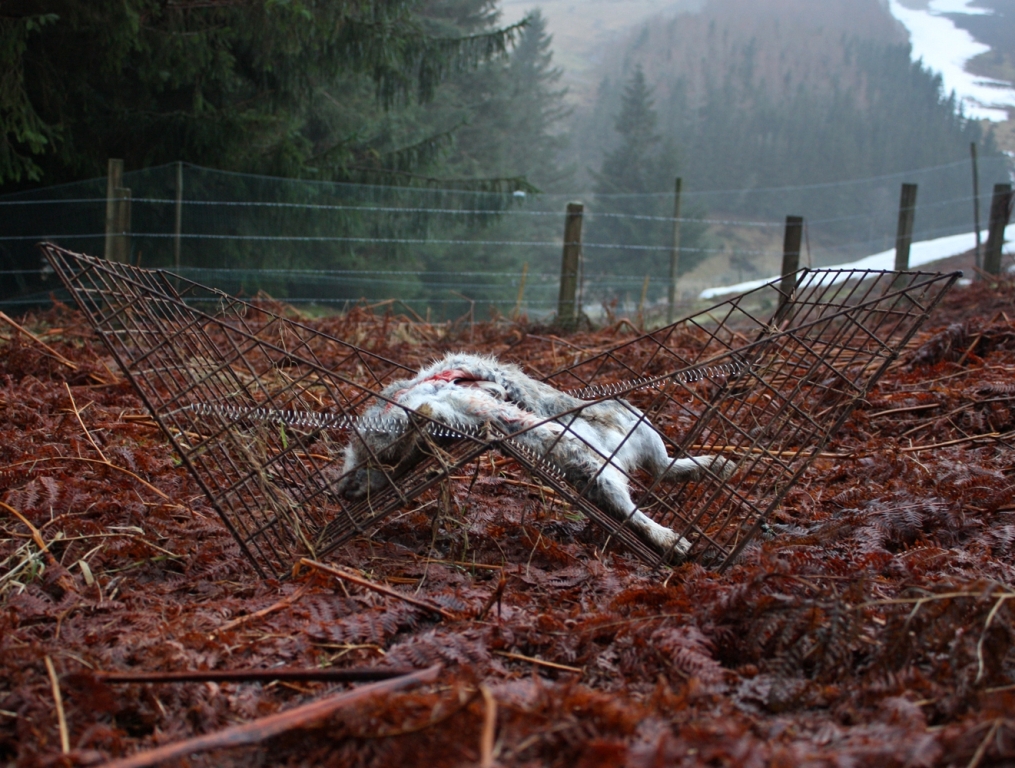
Photo: clam trap – why haven’t these been banned?

This is a photograph of a clam trap, also known as a snapper trap, butterfly trap and Larsen mate trap. They are used to trap corvids, although obviously the traps are indiscriminate and can also be used to catch raptors and other protected species. We’ve recently blogged about clam traps and the controversy over whether they are a legal or an illegal trap (see here).

The clam trap photographed here shows a slight variation of use. Usually the trap will be held open by a false perch that collapses when weight is applied (e.g. when a bird lands on it) which causes the trap to snap shut. In this photo the false perch is absent and instead, the trap is set to snap shut when weight is applied to the base (e.g. when a bird lands on the bait).

It’s quite incredible that SNH has not yet banned the use of these traps on welfare grounds. Just look at the photograph. Imagine if a large raptor (e.g. buzzard, kite, goshawk, eagle) is caught in one of these things. Apart from the injuries that could be caused to the bird when the trap snaps shut (they are designed to shut with speed and force so it’s highly probable that the bird’s wings will still be open and thus caught in the jaws of the trap as it snaps shut), the trapped bird then has to endure up to 24 hours inside this cage before it is checked by the trap operator. Would it be able to move inside the trap? Does it have a perch? Does it have water? Does it have shelter? All these are basic requirements covering the use of crow cage traps and Larsen traps where a decoy bird is in use. Why should a clam trap be exempt from these welfare requirements? Is it because there isn’t a decoy bird in use? What about the welfare requirements of the trapped bird, whether it be a target or a non-target species? It’s probably fair to say that it would be stressful for any large raptor to be caught inside one of these things, whether it’s injured or not, and to be trapped like that for up to 24 hours? That’s assuming the trap operator bothers to do the 24 hour check. In our view it fails on all welfare considerations. The general licences used to permit the use of crow traps also explicitly ‘do not permit the use of any form of spring-over trap’. What’s this then if it isn’t a form of spring-over trap? Some organisations have argued that it isn’t a form of spring-over trap…no prizes for guessing who that was.

Unsurprisingly, the Scottish Gamekeepers’ Association supports the use of these traps (see here and here) as does Scottish Land and Estates [formerly known as SRPBA] (see here).

Whilst we all wait for SNH to make a decision on the legality of clam traps….if you see one of these traps you are advised to report it immediately to the police, SSPCA and RSPB. As with the other crow cage traps, the clam trap should have an identification code attached along with the telephone number of the local Police Wildlife Crime Officer. See here for a discussion on the legalities of other crow cage traps and what to do when you find one.

Traps in our countryside: a walker’s guide

Thanks to Steve from the animal protection charity OneKind who has advised that his 2010 article, ‘Traps in our countryside: a walker’s guide’ has now been updated.

This excellent illustrated guide provides detailed information for the general public on how to distinguish a legal trap from an illegal trap. The updated version also includes information about a new trap which is known by several common names: clam trap, snapper trap, butterfly trap and Larsen mate trap. This particular trap is causing controversy: the game-shooting industry argues it is legal and safe whereas others strongly disagree and some have even suggested its use could be an offence under animal welfare legislation, although this has yet to be tested in a court of law. It is understood that SNH is still consulting about the lawfulness of this trap and more information should be forthcoming in the near future (see here).

The SGA’s views on the clam trap can be read here and here. A copy of their consultation response to SNH on the use of clam traps can be read here.

A copy of the SRPBA’s (now called Scottish Land and Estates) consultation response to SNH on the use of clam traps can be read here. Its interesting to compare this with the SGA’s response – copy and paste, anyone?

Click here to read OneKind’s updated article – Traps in our Countryside: a walker’s guide.

Click here to read our recent article – Crow Traps: what you should know.