Police launch investigation after Red Kite killed in poisoning hotspot

Press release from Police Service of Northern Ireland (PSNI), 25 June 2025:

INVESTIGATION AFTER TESTING CONFIRMS RED KITE POISONED

Police have commenced an investigation after tests confirmed that a red kite which was found dead near Loughbrickland [County Down] had been fatally poisoned.

Testing determined that the legally protected bird of prey bird, which was discovered on land in the Tullymore Road area at the end of December, had died by what’s believed to have been targeted poisoning using the rodenticide Chloralose and the insecticide Bendiocarb.

Red Kite photo by Dr Marc Ruddock of the NI Raptor Study Group

Superintendent Johnston McDowell, the Police Service lead for Wildlife Crime and Animal Welfare, said: “Red kites, along with all birds of prey, are protected in Northern Ireland under the Wildlife (Northern Ireland) Order 1985, as amended by the Wildlife and Natural Environment (NI) Act 2011

These birds were reintroduced to Northern Ireland in 2008 after being extinct here for centuries, and tragically this is not the first time we have had reports of this nature in this same area. Two ravens were also recently found dead having been poisoned using similar chemicals [Ed: see here], and it saddens me that these incredible birds are being intentionally killed.

Anyone who finds a dead bird of prey such as a red kite which they suspect to have been poisoned, shot or illegally trapped, or anyone with information about the illegal trade in these birds, should contact police and report their concerns. The poisons used in these most recent incidents are deadly not only to birds and wildlife, but also to humans and as such anyone who comes across the body of any of these birds shouldn’t touch them, but alert the authorities instead.

PSNI along with Northern Ireland Environment Agency conducted a number of enquiries along with a site visit, and utilised the technical and advisory support of the UK’s National Wildlife Crime Unit throughout the time since the discovery of the Red Kite.  

The Police Service also works closely with our colleagues in the Health and Safety Executive and the Department of Agriculture and Rural Development to identify poisons being used and where a crime is found to have been committed, we will take steps to identify and prosecute offenders. Those found guilty of persecution of protected birds of prey can face a custodial sentence and/or fines of up to £5,000 per offence.”

The Health and Safety Executive NI, one of the enforcing authorities responsible for Biocidal Product Regulations in Northern Ireland, said: “HSENI, who is one of the enforcing authorities responsible for Biocidal Product Regulations in Northern Ireland said: “Where duty-holders are found to have incorrectly used or have misused biocidal products or continue to use or store biocidal products that have been withdrawn from the market, HSENI will take appropriate enforcement action to achieve compliance. This highlights the importance of responsible use of all chemicals including biocidal products.”

A spokesperson for the Department of Agriculture, Environment and Rural Affairs said: “The intentional poisoning wildlife and birds is abhorrent. Supplying, storing (being in possession of) or using a Plant Protection Product (PPP), that has been banned, is an offence. It is also an offence to use an authorised PPP in contravention of the conditions and the specific restrictions established by the authorisation and specified on the product label. If convicted of committing an offence, fines will incur.”

Superintendent McDowell added: “Our Operation Raptor – Peregrine Watch, is an initiative between the PAW Bird of Prey Sub Group and our Air Support Unit, working alongside local police officers, which uses drones to monitor and protect the nesting sites of birds of prey, and is a direct result of birds being targeted, just like in this case, with very serious and dangerous substances in a number of areas across Northern Ireland.

Along with our partners we will continue to investigate wildlife crime and seek to prevent further instances, whilst bringing offenders to justice.”

Please report wildlife crime by calling 101. A report can also be made online via http://www.psni.police.uk/makeareport/ or you can also contact Crimestoppers anonymously on 0800 555 111 or online at http://crimestoppers-uk.org/. 

If you have any information on this particular incident please quote incident number 419 24/12/24.

ENDS

Earlier this month representatives from the NI Raptor Study Group, Ulster Wildlife and the RSPB handed in a 50,000-signature petition to Environment Minister Andrew Muir, calling for a ban on the possession of dangerous, raptor-killing poisons (here).

It’s not yet clear what the Minister intends to do, if anything.

If you’re a NI resident and you’re reading this, please consider contacting your local politician and ask them to raise the issue at Stormont – all the Minister has to do is write a list of proscribed poisons and get it added to section 15B of the Wildlife (Northern Ireland) Order 1985. It really should be very simple.

The most recent summary report of raptor persecution in Northern Ireland (2021-2022, published last year by the NI Partnership for Action Against Wildlife Crime), shows that illegal poisoning is the most commonly used method of persecution in the country. The report can be read/downloaded here:

Police investigation launched after two ravens found poisoned in Newry

The Police Service of Northern Ireland (PSNI) has issued a press release following confirmation that two ravens found dead in December 2024 had been poisoned.

PSNI press release (3 April 2025):

INVESTIGATION AFTER TWO RAVENS CONFIRMED TO HAVE BEEN FATALLY POISONED

Police in Newry have commenced an investigation after two ravens were confirmed to have been fatally poisoned in Poyntzpass.

Testing determined that the birds, which were found in a field in the Drumbanagher Wall area in December, had consumed high levels of the rodenticide Chloralose, and Bendiocarb, an insecticide and concluded this was likely an abuse case, potentially causing their deaths.

Raven photo by Pete Walkden

Superintendent Johnston McDowell, the Police Service lead for Wildlife Crime and Animal Welfare, said: “These birds should have been safe in the wild and yet someone has sought to intentionally poison them. This is not the first time we have had reports of this nature in the area and it saddens me that our incredible wildlife and birds are being killed. They are a beautiful asset to our countryside that we should work to protect.

It’s important that anyone who comes across dead birds, which they believe to have been poisoned, shot, illegally trapped or even taken to sell, that they report their find to PSNI immediately and do not handle them. The poisons being used are deadly not only to birds and wildlife but also to humans and chances should never be taken when potentially dealing with such chemicals.”

The Health and Safety Executive NI, one of the enforcing authorities responsible for Biocidal Product Regulations in Northern Ireland, said: “Where duty-holders are found to have incorrectly used or have misused biocidal products or continue to use or store biocidal products that have been withdrawn from the market, HSENI will take appropriate enforcement action to achieve compliance. This highlights the importance of responsible use of all chemicals including biocidal products.” 

A spokesperson for the Department of Agriculture, Environment and Rural Affairs said: “Illegal poisoning of birds and wildlife is completely reprehensible. It is an offence to supply, store (be in possession of) and use a Plant Protection Product (PPP, or Pesticide), that has been banned or withdrawn. Further it is an offence to use an authorised PPP in contravention of the conditions and the specific restrictions established by the authorisation and specified on the product label. The penalty, if convicted on summary conviction, is a fine not exceeding the statutory maximum or on conviction on indictment, to an unlimited fine.”

Superintendent McDowell added: “Along with our partners we will continue to investigate these crimes and seek to prevent further instances whilst bringing offenders to justice.

Please report wildlife crime by calling 101. A report can also be made online via http://www.psni.police.uk/makeareport/ or you can also contact Crimestoppers anonymously on 0800 555 111 or online at http://crimestoppers-uk.org/

If you have any information on this particular incident please quote incident number 723 13/12/25.

ENDS

This isn’t the first time poisoned ravens have been found in Newry. In October 2024 wildlife crime officers ‘visited an estate in Newry to talk to residents and employees about the confirmed poisoning of ravens on two separate occasions‘ (see here, although there are no details about when those two poisoning crimes took place).

It would help if the Department for Agriculture, Environment & Rural Affairs (DAERA) would get on with updating and implementing stronger pesticide legislation in Northern Ireland. It’s not difficult -they just have to write a list of the banned chemicals and add it to the Wildlife (Northern Ireland) Order 1985, as amended. This simple measure is widely supported by over 50,000 people who signed the Northern Ireland Raptor Study Group’s recent petition calling for this action.

UPDATE 25 June 2025: Police launch investigation after Red Kite killed in poisoning hotspot (here)

Red kite found poisoned on Swinton Estate – North Yorkshire Police refuses to investigate

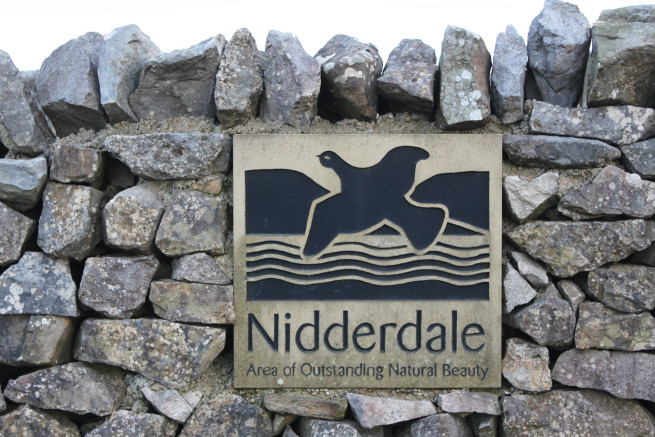
Last November I was reading an online article on the Teeside Live website about the Nidderdale Area of Outstanding Natural Beauty (AONB) in North Yorkshire being dubbed ‘the bird poisoning capital of the UK‘ (here).

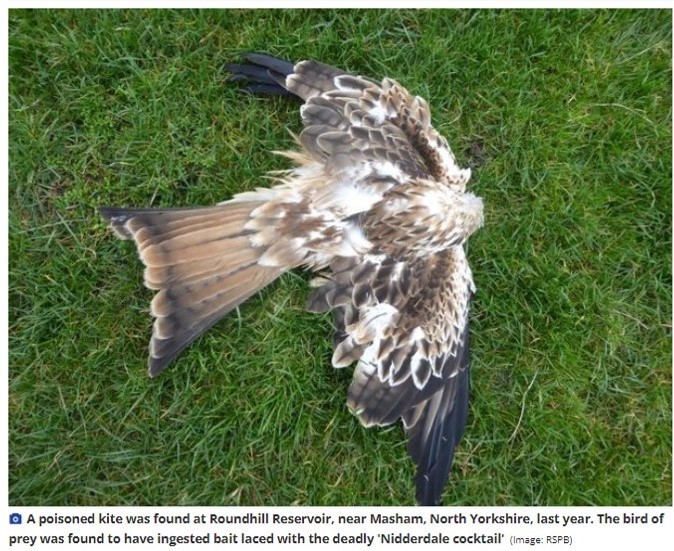
The article was illustrated with various photographs, including this image of a poisoned red kite that was reportedly found dead at Roundhill Reservoir, near Masham in 2021:

The given location caught my eye as I understand the Roundhill Reservoir is surrounded by the Swinton Estate, a notorious grouse-shooting estate that has been at the centre of police investigations into confirmed and alleged raptor persecution for years.

For example, this is the estate where hen harrier ‘Bowland Betty’ was found dead in 2012, later confirmed to have been shot (here & here) although it has never been established whether she was shot on or off the estate. It’s also where a Swinton Estate gamekeeper was convicted for twice setting an illegal pole trap in 2013 (here) and where another hen harrier, ‘River’, was found shot dead in 2019 (here). Around the same time as River’s demise, an unidentified gunman had been filmed with two dogs walking through a hen harrier roost on the estate (here). There have also been reports from local raptor workers of the ‘mysterious disappearances’ of many raptors on this estate for over a decade.

The owner of Swinton Estate is Mark Cunliffe-Lister, Earl of Swinton, who in 2020 became the new Chairman of the grouse moor owners’ lobby group, the Moorland Association (here). This is a high profile position and in recent years Mr Cunliffe-Lister’s estate has become somewhat of a poster child for DEFRA’s ludicrous hen harrier brood meddling trial, where the estate has championed the removal of some hen harrier chicks in return for permitting others to remain and to be diversionary fed by estate staff, although this hasn’t been without controversy either after it emerged that Natural England had appeared to ‘bend the rules’ in favour of estate activities (e.g. see here). Controversially, in 2021 a Guardian journalist described Swinton Estate as the ‘hen harrier’s friend’ (here), supported by a statement from Stephen Murphy (Natural England) about the estate’s head gamekeeper, “What he’s done for harriers, word’s can’t describe“. Murphy also claimed that hen harrier Bowland Betty had definitely been shot elsewhere and merely flew on to the estate to die – an unevidenced claim that was later amended in the article. Last year the estate won what was described as ‘a prestigious conservation award’ for its involvement in the hen harrier brood meddling trial (here).

So, back to that article I was reading in November 2022. I didn’t recall hearing about a poisoned red kite being found on the Swinton Estate in 2021 and I’m pretty sure I would have remembered, given the location, so I did some digging to make sure the poisoning had been confirmed and the location verified, just in case the journalist had cocked up (she’d already mistakenly described Nidderdale as a ‘village’ instead of a region so I couldn’t rely on her account of the poisoned red kite to be accurate).

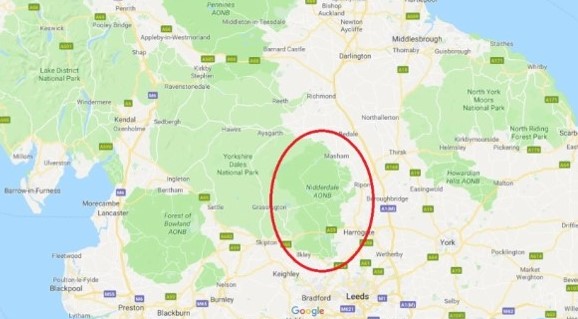
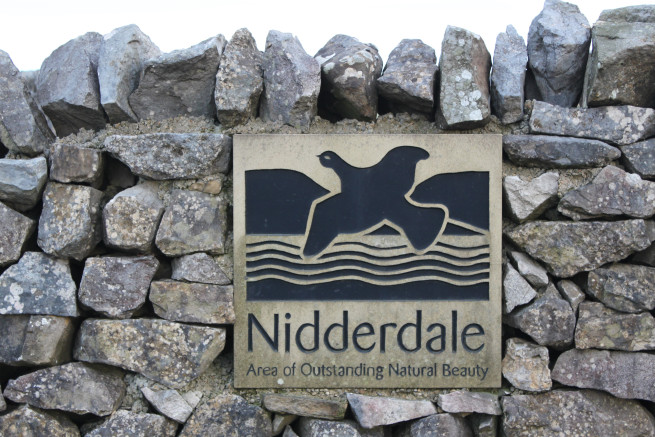
The Nidderdale Area of Outstanding Natural Beauty (AONB), North Yorkshire
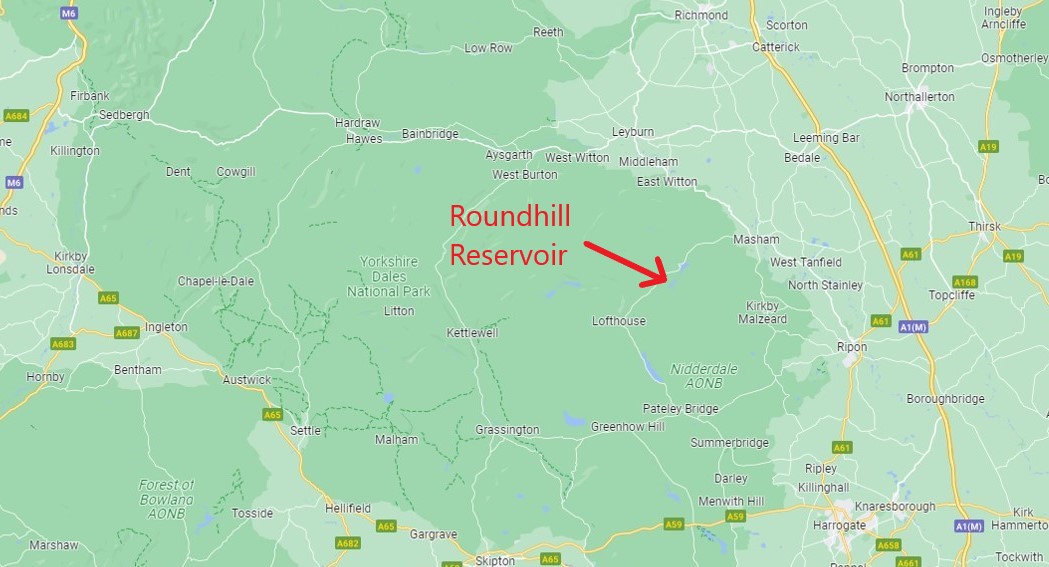
Roundhill Reservoir in the Nidderdale AONB

I found details about this crime on the HSE’s Wildlife Incident Investigation Scheme spreadsheet, which confirmed the kite had been found poisoned on a Right of Way footpath in November 2021. The poisons found in the kite’s stomach included Bendiocarb, Carbofuran, Chloralose and Isofenphos – this highly toxic combination has become known as the ‘Nidderdale Cocktail’ as it’s so frequently used to kill birds of prey in this region, especially red kites (e.g. see here, here, here).

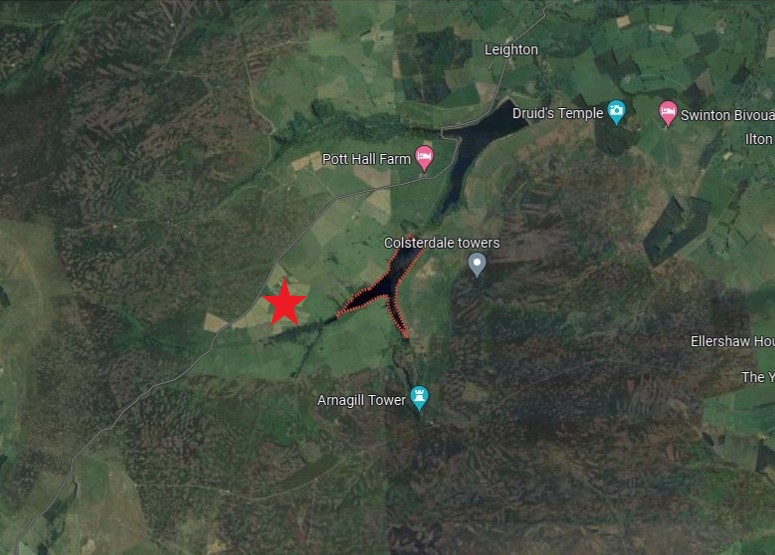
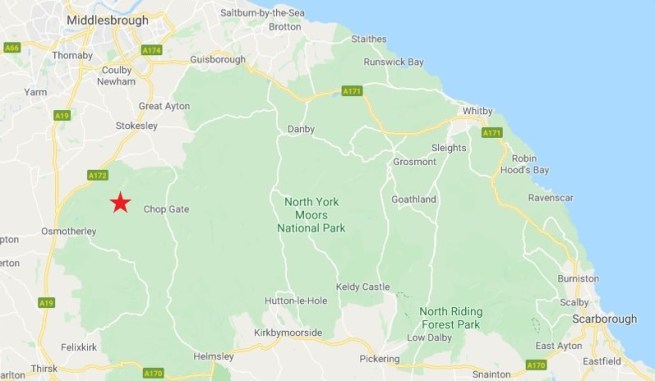
The red star denotes the approximate location of the poisoned red kite found in November 2021, close to Roundhill Reservoir and surrounded by the grouse moors of Swinton Estate

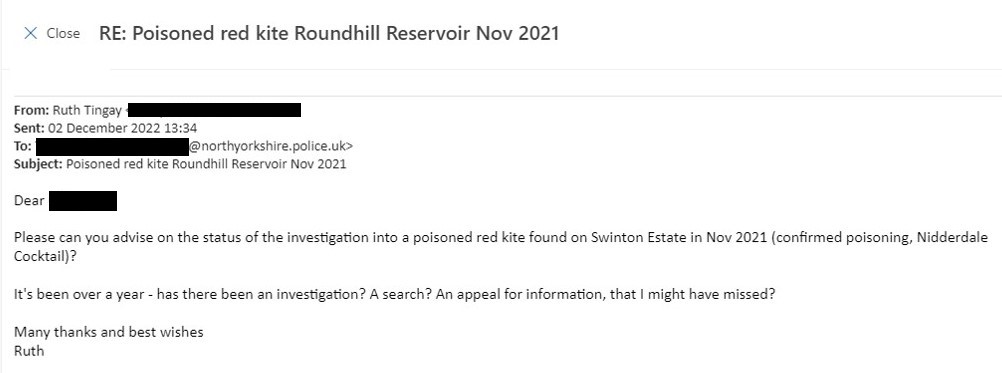
However, I couldn’t find any media coverage of this crime, nor any police appeals for information, nor any warnings to the public about the continued use of poisons so dangerous that some of them have been banned for years. Given that a year had already passed since the poisoned kite was discovered, I found this puzzling. So I contacted North Yorkshire Police’s rural crime team and asked them about the status of the investigation:

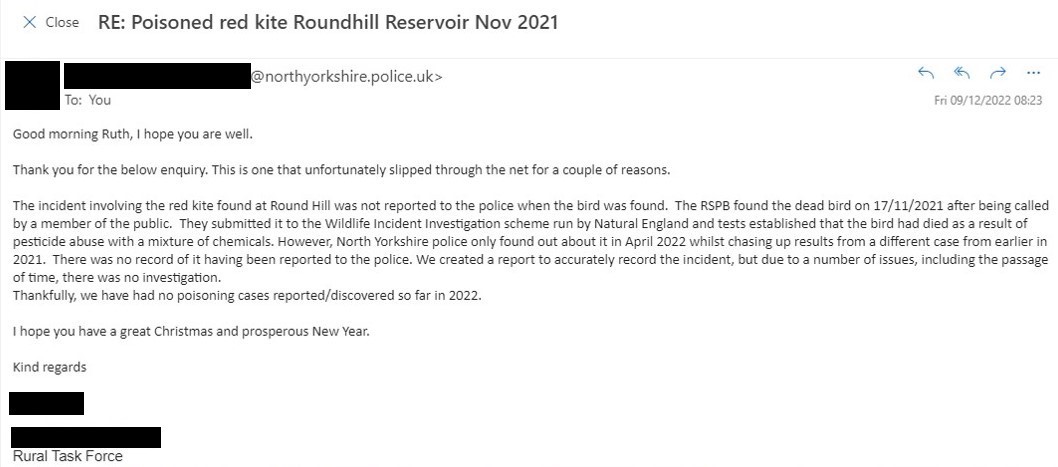
Here’s the astonishing response I received:

This North Yorkshire Police Inspector admitted that this poisoned red kite “unfortunately slipped through the net” but then went on to justify the police’s decision not to investigate by accusing the RSPB of failing to notify the police about this incident when the poisoned kite was first picked up. He claimed the police only found out about it five months later, in April 2022, whilst chasing the lab for the results of another investigation.

His allegations about the RSPB aside (and which I’ll come to, below), I was still stunned that he thought that launching an investigation, and issuing a public appeal for information, let alone issue a warning to the public about the use of poisons in the countryside, wasn’t worthwhile due to the ‘passage of time’ (five months), especially given the location where the poisoned kite had been found.

A couple of years ago a previous North Yorkshire Police Inspector had issued a public appeal/warning, ten months after the discovery of another poisoned red kite in Nidderdale (see here), so it seemed to me that there was no reason not to issue one after a five month delay.

I wrote back to North Yorkshire Police asking for an explanation:

Apparently, it wasn’t up for debate. Here’s the response I received:

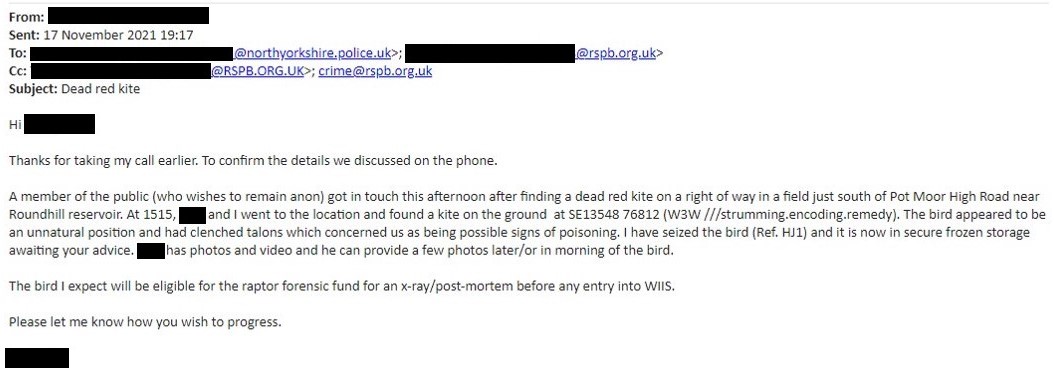
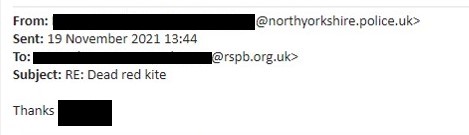
Meanwhile, I contacted the RSPB and put to them the allegations this Inspector had made, that the RSPB hadn’t notified the police about the discovery of this red kite. It turns out those allegations were utterly unfounded/untrue. The RSPB DID contact North Yorkshire Police, on the day the poisoned kite was discovered, and took instruction from the police about submitting the corpse for toxicology analysis. Furthermore, they had the email correspondence to prove it:

So what are we to make of North Yorkshire Police’s refusal to investigate a confirmed poisoning incident (a so-called national wildlife crime priority), on an estate with a long history of alleged wildlife crime, that has enjoyed recent adulation from Natural England staff and the media, that has played a significant role in the hen harrier brood meddling trial, and whose owner is a high profile representative of the grouse-shooting industry?

Does Mr Cunliffe-Lister even know about this poisoned kite being found on his estate? Given the Moorland Association’s claimed ‘zero tolerance’ of raptor persecution, and Mr Cunliffe-Lister’s widely-reported apparent welcoming of birds of prey on his estate, I’d have expected him to speak out and condemn this disgraceful poisoning incident, as any decent landowner would. It’d be interesting to know whether North Yorkshire Police have informed him, or not.

Whatever, North Yorkshire Police’s refusal to investigate this crime is wholly unacceptable. In the first instance, I’ll be writing a letter of complaint to the North Yorkshire Police, Fire and Crime Commissioner, Zoe Metcalfe.

In her Police and Crime Plan 2022-2025 (here), she details an objective of ‘an improved [police] response to crime in rural areas, especially wildlife crime...’ as this had been identified as a major concern for North Yorkshire residents in the recent PCC consultation.

UPDATE 23.30hrs: Natural England’s senior management team has a lovely day out…on Swinton Estate!! (see here).

Local resident puts up £5,000 reward to find Nidderdale poisoner

In April, during lockdown, two dogs became violently ill on a dog walk near Pateley Bridge in Nidderdale, North Yorkshire.

One of them survived but sadly the other one (Molly) did not.

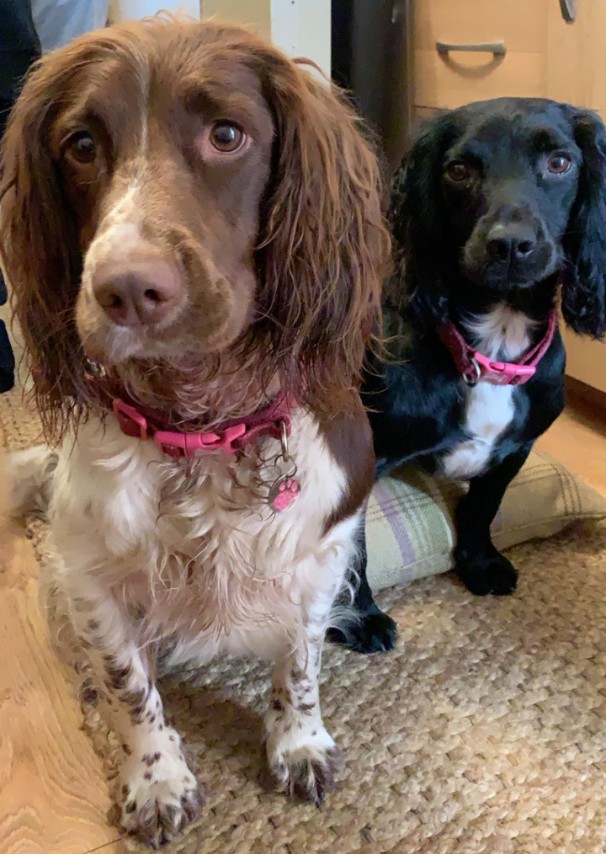
[Molly, photo by Chloe Ambler]

In August, North Yorkshire Police confirmed (here) that Molly had died after ingesting what has widely become known as the ‘Nidderdale Cocktail’ – a lethal combination of four pesticides (Bendiocarb, Chloralose, Isophenphos and Carbofuran) that has been identified in a number of raptor persecution poisoning crimes in the area.

The police investigation has included conducting high profile raids at several Nidderdale addresses, accompanied by poisons experts from Natural England and persecution experts from RSPB (see here). The police have also issued a warning notice (here) for local residents to take extra care, one in a long line of warnings given Nidderdale’s notorious reputation as a red kite poisoning hotspot (see here).

[Photo by Ruth Tingay]

A local resident has now stepped forward to offer a £5,000 reward for information leading to the poisoner(s). Keith Tordoff, who owns the sweet shop in Pateley Bridge, told BBC news:

It affects tourism. It affects business. Everybody’s affected by this stain on the reputation of Nidderdale and we’ve got to get the message across to these people, this has got to stop.”

You might recognise Keith’s name. It’s not the first time he’s put up a reward for information to help catch the raptor killers and he featured in a recent Channel 4 News documentary about raptor persecution on grouse moors in North Yorkshire, where he told the presenter he’d faced a backlash for speaking out, including having eggs thrown at his windows and receiving anonymous threatening letters (here).

Molly’s owner, Chloe Ambler, wants the poisoner(s) to be held to account. She told the BBC:

“[It’s] absolutely devastating. You feel like you’ve been robbed.

I need someone to be held responsible because at the end of the day we’ve lost amazing Molly.

It’s been so awful for us and I don’t see why people should get away with that.”

Howard Jones, an investigations officer at RSPB, said:

It is absolutely dreadful and this underlines what is the completely irresponsible nature of placing poison out into the countryside.

These people are doing it and know it’s illegal but they don’t care.”

TAKE ACTION

If you’re sick to the back teeth of illegal raptor persecution on driven grouse moors, please consider participating in this quick and easy e-action to send a letter to your local Parliamentary representative (MSP/MP/MS) urging action. Launched on Hen Harrier Day by Wild Justice, RSPB and Hen Harrier Action, over 58,000 people have signed up so far.

This means that over 58,000 pre-written letters complaining about illegal raptor persecution and the environmental damage caused by intensive grouse moor management, are winging their way to politicians of all parties across the UK. If you want your local politician to receive one, Please join in HERE

Thank you

Dog poisoning confirmed in Nidderdale raptor persecution hotspot

In April during lockdown, two pet dogs became ill during a walk in Pateley Bridge in Nidderdale. One of them (Molly) subsequently died and the vet suspected poisoning.

[Molly (left) and Poppy, photo via North Yorkshire Police]

Samples were submitted for toxicology, although analysis was delayed due to Covid19. Meanwhile, North Yorkshire Police issued a warning notice (here) for local residents to take extra care, especially as illegal poisoned baits had been used in the area many times before, killing birds of prey, especially red kites (here).

Just a couple of weeks ago North Yorkshire Police, along with poisons experts from Natural England and persecution experts from RSPB, conducted high profile raids at several Nidderdale addresses as they continue to investigate ongoing poisoning crimes (see here).

The toxicology results confirmed that Molly had died after ingesting what has widely become known as the ‘Nidderdale Cocktail’ – a lethal combination of four pesticides (Bendiocarb, Chloralose, Isophenphos and Carbofuran) that has been identified in a number of raptor persecution poisoning crimes.

It’s interesting to note that this particular ‘cocktail’ isn’t restricted to use in Nidderdale; it has also been used on several estates elsewhere in England and Scotland. Wouldn’t it be fascinating to see whether there was a common link between these various estates, you know, something like a shared agent or perhaps a gamekeeper who’s worked on all the estates?

On Wednesday, North Yorkshire Police issued the following press release seeking more information about the poisoning of Molly:

Police appeal for information after dog dies from suspected pesticide abuse

Properties searched as investigation into poisoning continues

North Yorkshire Police is appealing for information as part of an ongoing investigation into the poisoning of two pet dogs, believed to be as a result of pesticide abuse.

On 23 April 2020, two spaniel dogs fell seriously ill immediately after a walk, with their owner, in the countryside near Pateley Bridge. The dogs were rushed to the vets and whilst one of the two recovered, the second was so severely ill that she did not survive.

The incident was reported to the police and local area searches conducted, as a well as a warning put out to other dog owners. Samples taken from the dog which died were submitted to the Wildlife Incident Investigation Scheme (WIIS) administered by Natural England and the results showed the presence of four pesticides. The dog had a significant quantity of Bendiocarb in its system, along with smaller quantities of Chloralose, Isofenphos and Carbofuran. The tests concluded that exposure to these pesticides most likely caused this dog’s death and the severe symptoms suffered by the second dog.

The same combination of four poisons have been found to cause the deaths of two red kites and a buzzard in Nidderdale since 2016, with other cases of poisoned birds of prey in the area also involving one or more of the chemicals involved.

North Yorkshire Police Inspector, Matt Hagen, explains:

The fact we have seen this same combination of chemicals, the ‘Nidderdale cocktail’ as it is sometimes known, also cause the death of birds of prey in this same location would indicate that the poisons have been deliberately left in a place where they could be found by wildlife and unfortunately in this case, domestic pets.

Pesticide abuse of any kind will not be tolerated and we are doing everything we can to try and find those responsible.”

Following receipt of the test results and acting on local intelligence North Yorkshire Police conducted searches at a number of properties in the area with assistance from Natural England and the RSPB.  Unfortunately none of these searches resulted in any further evidence as to how these poisons reached the two dogs or who may have been responsible for this suspected pesticide abuse so officers are now appealing for information from the public.

Mark Thomas, Head of Investigations at the RSPB, said:

Nidderdale is surrounded by grouse moors and sadly we know from experience, and from the government’s own data, that there is a strong correlation between raptor persecution and driven grouse shooting. Carbofuran is one of the most commonly-abused substances in the poisoning of birds of prey. It is a highly toxic, banned substance, putting wildlife, pets and people at risk. This is not the first time harmful substances have been found left out in the open and sadly it unlikely to be the last. This reckless and irresponsible behaviour, which had led to the death of a beloved family pet, cannot be allowed to continue.”

Whilst Chloralose is licenced for use in England in a low concentration as a rodenticide, Bendiocarb, Isofenphos and Carbofuran are all banned from use in the UK. None of these chemicals should ever be used in an environment where domestic animals and/or wildlife should come into contact with them.

Anyone misusing or abusing pesticides may be committing a variety of offences. If you come across an object, often an animal carcass, which you believe may be contaminated with a pesticide or other poisons, do not touch it. Take as many photos and details as you can and report this to the police as soon as possible.

Dog owners worried by this incident should take care to keep their dogs on a lead or within sight and under control at all times when taking them for a walk. Dogs should only be walked on public rights of way or other land where the owner has permission to be.

Anyone with any information which could help the police in this investigation should call 101, quoting reference: 12200068444 or if you wish to remain anonymous call Crimestoppers on 0800 555 111.

ENDS

The RSPB also published a blog about this case, which includes comments from Molly’s owners (see here).

There’s also good coverage in the Yorkshire Post (here).

Yet another poisoned buzzard found dead on a grouse moor in North York Moors National Park

Joint press release from North Yorkshire Police and RSPB (24 July 2020)

APPEAL FOR INFORMATION AFTER ANALYSIS REVEALS BUZZARD POISONED

Buzzard found dead on moorland near Swainby, North Yorkshire

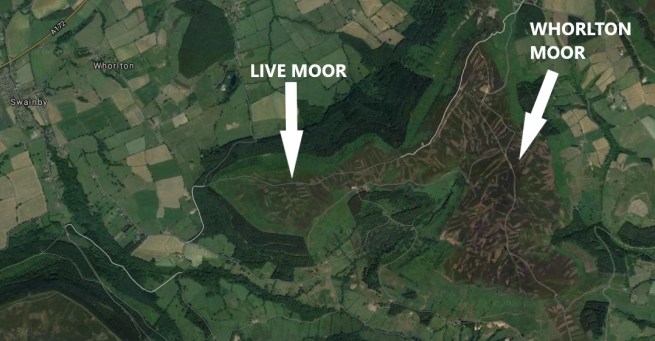
North Yorkshire Police and the RSPB are appealing for information after a dead buzzard was found on Live Moor close to the village of Swainby.

The bird was discovered by a member of the public on 20 March 2020 and reported to the RSPB before being removed. North Yorkshire Police submitted the buzzard for a post mortem examination which revealed an extremely high concentration of  toxic chemical, Chloralose in the bird’s system. Given the buzzard was in good bodily condition and had no injuries, the analysis shows poisoning to be the cause of death.

[The poisoned buzzard. Photo by RSPB]

North Yorkshire Police Inspector, Matt Hagen, explains:

A low percentage of chloralose was commonly used in rodenticides to kill mice but is only currently permitted for use indoors and at a small dose. As such, there is no way this buzzard could have come into contact with such a high concentration of this poison by accident and we believe someone deliberately set out to kill this bird by poisoning.

Unfortunately, this is the latest in a number of similar cases where birds of prey have been subjected to cruel and illegal persecution here in North Yorkshire. We are doing everything we can to try and find those responsible but we really need the public’s help as they are acting as our eyes and ears around the county. Anyone with information about this or any other incident of bird of prey persecution should contact the police on 101, we all have a part to play in putting an end to these unacceptable crimes.

Howard Jones, RSPB Investigations Officer, said:

Buzzards are a protected species yet continue to be relentlessly shot, trapped and poisoned in North Yorkshire. RSPB data shows that North Yorkshire is consistently the county with the highest number of crimes against birds of prey.

Alphachloralose is a commonly abused product in the illegal killing of birds of prey. The amount of it found in this bird was enough to kill a human child. People, pets and other wildlife are at risk from this kind of illegal behaviour, which is why we urge anyone who may have information about this incident to do the right thing and come forward.”

Anyone who has information which could assist with this investigation should contact North Yorkshire Police on 101 or if you wish to remain anonymous, you can call Crimestoppers on 0800 555 111. Quote reference: 12200116641.

ENDS

What this press release doesn’t say is that this illegally poisoned buzzard was found dead on a grouse moor inside the North York Moors National Park.

Nor does the press release explain the delay in publishing an appeal for information (corpse found 20 March, press release issued 24 July).

There are some individuals from the grouse shooting industry who are claiming on social media that this delayed reporting is a deliberate ploy to coincide with the run-up to the start of the grouse-shooting season on 12 August, and thus create bad publicity for the industry to ruin the ‘celebrations’. It’s a commonly-heard complaint and simply allows the persecution apologists to focus on anything other than the news that yet another bird of prey has been found illegally killed on yet another grouse moor.

Had they bothered to ask the police why there was such a long delay they might have understood that the toxicology labs were closed during lockdown and are now having to work through a significant backlog of cases, so confirmation of poisoning will take longer than usual.

It’s no surprise the grouse shooting industry wants to divert attention from this latest crime to be uncovered on a grouse moor inside this national park. It’s the third raptor persecution crime to be reported in the North York Moors National Park in recent months, following the discovery in April of five dead buzzards shoved in a hole on a grouse moor in Bransdale, four of which were later confirmed to have been shot (see here), and then last week’s news that three gamekeepers on the Queen’s grouse moor at Goathland had been suspended following a police investigation in to the trapping and alleged killing of a goshawk in May (see here).

The grouse shooting industry’s professed ‘zero tolerance for raptor persecution’ (see here) is as unconvincing now as it was when it was claimed last year, and the year before that, and the year before that, and the year before that, and the year before that, and the year before that, and the year before that, and the year before that, and the year before that, and the year before that, and the year before that, and the year before that……etc.

North Yorkshire Police search for illegal poisons in Nidderdale

North Yorkshire Police made quite a statement on Friday morning when at least 10 marked police vehicles descended upon Pateley Bridge in Nidderdale, along with forensic-suited poisons experts from Natural England. When asked by local residents what they were doing, the police replied they were conducting searches in relation to the illegal killing of birds of prey in the area.

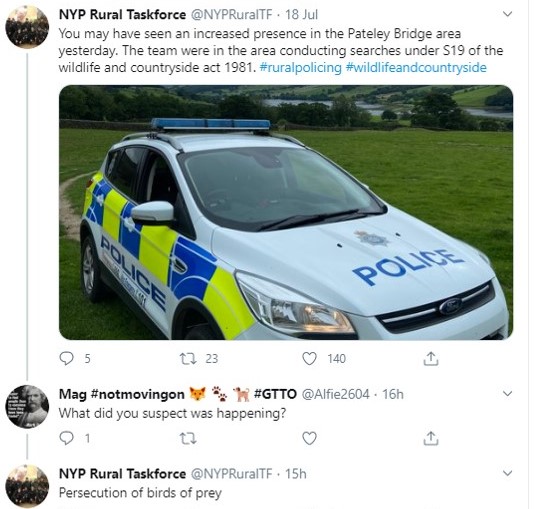
North Yorkshire Police’s Rural Task Force tweeted about it yesterday:

This is a very good example of proactive policing. The Nidderdale AONB is one of the UK’s most notorious hotspots for illegal raptor persecution, particularly on many of its driven grouse moors e.g. see here for a recent damning report published by the local AONB authority and for just a small sample of reported persecution crimes in recent years see hereherehereherehereherehere here, here, here, here, here and here.

During lockdown, the police were appealing for information about two separate illegal poisoning incidents in the area, involving two dogs (here) and a buzzard (here) and it’s believed Friday’s search may have been in relation to these most recent incidents.

Illegal poisoning happens with such frequency in this area that the specific concoction used has even been named the ‘Nidderdale Cocktail’ (Bendiocarb, Carbofuran, Isofenphos, and Chloralose). Bendiocarb is licenced for use in England as an ingredient in a number of insect control products but should not be released into an environment where wildlife could come into contact with them. Carbofuran, Isofenphos and Chloralose are all banned substances which should not be used under any circumstances.

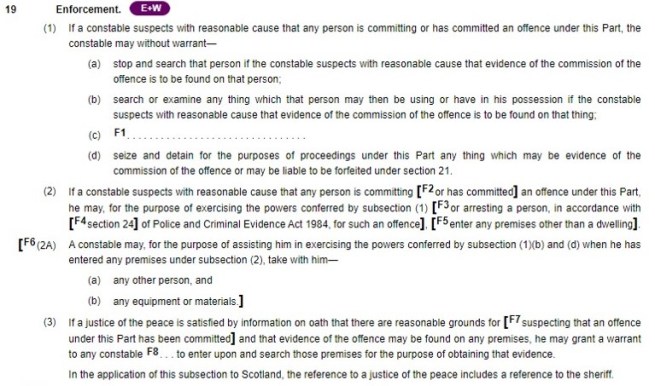
In the police’s tweet, they mention searches ‘under S19 of the Wildlife & Countryside Act 1981’. This refers to Section 19 of the Act, entitled ‘Enforcement’ and allows officers to enter private land, without a warrant, to conduct searches where there is reasonable suspicion that an individual is committing or has committed an offence:

North Yorkshire Police haven’t revealed whether anything was found, and nor would we expect them to at this early stage, but the fact they turned up in force, accompanied by Natural England staff who have expertise in poison storage, labelling and identification, and that they weren’t shy about telling local shoppers why they were there, sends a very clear message to the Nidderdale raptor killers.

Well done, North Yorkshire Police & Natural England. More of this, please.

Red kite found poisoned in North Yorkshire (yes, another one)

Press release from North Yorkshire Police (2 May 2018):

WILDLIFE POISONING WARNING AFTER RED KITE FOUND DEAD NEAR KNARESBOROUGH

Police are appealing for information after receiving confirmation that a red kite, found dead near Knaresborough in December 2017, had been poisoned with a pesticide.

The discovery has prompted a warning from North Yorkshire Police – as part of the force’s Operation Owl campaign – about the cruel, illegal and dangerous practice of lacing animal carcasses with poison to kill other wildlife.

The dead kite was found by a member of the public just outside the village of Ferrensby between Knaresborough and Boroughbridge in North Yorkshire. The bird was in good physical condition and there was no evidence to indicate the cause of death. The finder was concerned that the bird may have been killed illegally, and reported it to the police.

Specialist wildlife crime officers at North Yorkshire Police had the bird x-rayed and this ruled out any cause of death due to physical injury. The police then arranged with Natural England for the bird to be sent away for a post mortem and toxicology tests.

The results showed the bird had significant amounts of chloralose, a pesticide, in its kidney – and it was concluded that this was the cause of death. The post mortem could not identify the nature of the kite’s last meal. The bird would have succumbed within a few minutes of consuming the poison. The location where the kite picked up the poison is not known.

Officers need to hear from anyone who has any information about the illegal use of pesticides to poison birds of prey in North Yorkshire. The practice of lacing animal carcasses with poison to kill other wildlife is both cruel and illegal. It is also poses a serious risk to members of the public and their children or pets if they come into contact with them.

Operation Owl is an ongoing initiative by North Yorkshire Police, the RSPB and the RSPCA, together with the North York Moors and Yorkshire Dales National Parks, the Nidderdale Moorland Group, and others, to reduce the number of illegal attacks on birds of prey. As part of the operation, police carry out surveillance checks on known raptor persecution hot-spots at random times to disrupt offender activity. Officers are also calling on the public to be the ‘eyes and ears’ of the police when out in the countryside.

Sergeant Kevin Kelly, of North Yorkshire Police’s Rural Taskforce, said:North Yorkshire’s wonderful countryside is host to many specially-protected birds of prey, including red kites. It is completely unacceptable that people think they can ignore the law and subject these birds to poisonings and other forms of persecution without consequence.

Like other forms of rural crime, raptor persecution is not a problem that the police can tackle alone. If everyone keeps their eyes open for illegal traps and poisoned bait, it will be a massive boost to our surveillance operation. Operation Owl is a real opportunity to reduce the number of wild birds that suffer and die unnecessarily, and send a clear message to offenders that we will not tolerate this crime in our countryside.”

Howard Jones, RSPB Investigations Officer, said:We are deeply saddened to hear of another illegally poisoned red kite in North Yorkshire. Although the re-introduction of this species into the region has been a conservation success, there continues to be an unacceptable level of persecution towards these majestic birds. Kites are struggling to expand their range into upland areas such as the Yorkshire Dales and, in this case, it is clear that they are not safe in other areas of the county either. We will continue to work closely with North Yorkshire Police and Yorkshire Red Kites to tackle the issue of illegal killing.”

Doug Simpson, Yorkshire Red Kites Co-ordinator, said:I am particularly concerned about this case, it being the first recorded kite death from illegal poisoning in this particular area. It is yet another instance of a red kite persecution victim having been found by someone out walking in the countryside, 22 of our 42 confirmed illegally killed or injured kites having been found in this way.”

Anyone with any information about this incident is asked to call North Yorkshire Police on 101, choose option 1 and be ready to quote reference 12170217776.

Alternatively email bill.hickson@northyorkshire.pnn.police.uk If you wish to remain anonymous, call the RSPB’s confidential Raptor Crime Hotline for free on 0300 999 0101.

ENDS

Latest SASA figures reveal widespread poisoning incidents in early 2011

The latest figures detailing illegal animal poisoning incidents in the first quarter of 2011 have just been released by Science and Advice for Scottish Agriculture (SASA) on behalf of the Scottish Government.

The figures cover the period January to March 2011, and show that criminal raptor poisoning incidents were detected in each of the three months. They include 3 buzzards, 1 golden eagle, 1 red kite and 2 peregrines.  Poisoning incidents were widespread, taking place across Scotland, including in the Borders, Strathclyde, Tayside, Grampian and the Highlands. The illegal poisons used included Carbofuran, Chloralose and Strychnine. So much for the game-shooting industry’s self-regulation. I guess 2011 will not be the year they ‘stamp out’ illegal raptor persecution.

Not for the first time, two of the five recorded incidents were apparently unpublicised in the media: 1 x buzzard poisoned with Carbofuran in the Borders in January 2011, and 1 x red kite poisoned with Chloralose in the Highland region in February 2011.

SASA poisoning figures for period Jan – Mar 2011 available here

two more buzzards poisoned in Scotland

Two dead buzzards found next to a poisoned rabbit bait were poisoned by carbofuran. The buzzards and the bait were discovered in a farm field near Boat of Garten on October 15 this year, by staff from the Strathspey Estate. They called the police and the birds were sent off for toxicology tests. A spokesman from Strathspey Estate said they were shocked by the poisoning. He added, “Considering the efforts made to enhance the wildlife conservation and biodiversity on the estate, it is inconceivable that any of our staff had any part whatsoever in the laying of poisoned bait“.

Northern Constabulary and Strathspey Estate are “working closely” to find those responsible. I’m not sure how delaying the news of these deaths for 7 weeks will have helped the investigation but still, at least Northern Constabulary appear to be involved this time. Shame we can’t report the same for the two poisoned eagles found dead on Northern Constabulary’s patch back in June. Six months have now elapsed and still no news…

BBC news for the buzzard poisoning: http://www.bbc.co.uk/news/uk-scotland-highlands-islands-11958330

Strathspey Estate is owned by the Earl of Seafield, who also owns the Seafield Estate. A buzzard was found poisoned by chloralose on Seafield Estate back in 1991, but no further public records of alleged raptor persecution have appeared since then. Strathspey Estate is actively involved in projects on capercaillie and Scottish wildcat, and is also helping with the satellite-tracking of two golden eagles born on the Estate in summer 2010. The Earl of Seafield signed the SRBPA/SEBG letter to Roseanna Cunningham in May 2010, on behalf of the Seafield & Strathspey Estates, condemning the illegal poisoning of raptors in Scotland. Sandy Lewis, the Chief Executive of Seafield Estate was previously the Chair of the SEBG (Scottish Estates Business Groups), and is, according to the SEBG website, currently their regional rep for North and West Scotland. He was involved in a fascinating legal case earlier this year, involving a grouse-shooting lease in Strathspey. The case also involved land agents Mark Osborne and Nick Baikie, familiar names to readers of this blog. Here are two links to that story:

http://findarticles.com/p/news-articles/mail-on-sunday-london-england-the/mi_8003/is_2010_August_8/pocket-sportsman-grouse-court-told/ai_n54730059/

http://www.scotcourts.gov.uk/opinions/2010CSOH62.html