Devon gamebird breeder guilty of using banned pesticide Carbofuran

Prominent gamebird breeder Christopher Hodgson, Director of Ashley Game Farm Ltd in Wembworthy, Chulmleigh, Devon appears to have pleaded guilty to multiple offences including the use of the banned pesticide Carbofuran.

Ashley Game Farm Ltd is an exceptionally large breeding facility that, according to its website, ‘specialises in supplying pheasants and partridges to shoots in the west country and all areas of the UK and Europe‘. It claims to have ‘a hatching capacity for 410,000 eggs per week along with further investment in a second location at Tarrington, Hereford‘ and ‘retains around 80,000 chicks at Ashley Game Farm every week‘.

A multi-agency raid was carried out at Ashley Game Farm in March 2021 (here) following the discovery of a poisoned buzzard and poisoned baits in 2020.

Officers from Devon & Cornwall Police, Natural England, National Wildlife Crime Unit and the RSPB recovered a number of substances during the raid that were then sent for expert analysis.

Multi-agency raid in 2021. Photo by RSPB Investigations

This led to charges being laid against Christopher Hodgson as well as Ashley Game Farm Ltd in relation to the alleged use of Carbofuran and the alleged possession, storage and use of various plant protection, veterinary medicine and rodenticide products without authorisation at the game farm (see here).

Despite being banned for use in the EU for over 20 years, Carbofuran remained the ‘gamekeepers poison of choice’ for the illegal killing of raptors in the UK for many years, although in the last few years it has been overtaken by Bendiocarb.

Hodgson was due to appear in court today but information provided by the North and East Devon Magistrates Court indicates he and Ashley Game Farm Ltd have already pleaded guilty and will be sentenced in July.

Here are the details of the offences provided by the court:

Ashely Game Farm:

  • On or before 26/03/2021 at Ashley Game Farm Limited, namely stored a plant protection product, namely Rivett MAPP 11300, without a valid authorisation or permission granted in accordance with Retained EU Regulation 1107/2009. Contrary to section 24 and 27 of the Plant Protection Products (Sustainable Use) Regulations 2012.
  • Between 01/10/2020 and 27/03/2021 at Ashley Game Farm Limited, used a plant protection product, namely Carbofuran, in contravention of Article 28 (1) of Retained EU Regs 1107/2009. Contrary to section 24 and 27 of the Plant Protection Products (Sustainable Use) Regulations 2012.
  • On or before 26/03/2021 at Ashley Game Farm Limited, used a Biocidal product, namely Lodi’s Sapphire Grain otherwise in accordance with the terms and conditions of its authorisation under Article 22 (1) and the labelling and packaging requirements of Article 69.  Contrary to section 24 and 27 of the Plant Protection Products (Sustainable Use) Regulations 2012.
  • On or before 26/03/2021 at Chulmleigh contravened a requirement imposed by a prohibition notice served under section 22 of the Health and Safety at Work etc Act 1974 in that used a Biocidal product, namely Mole Valley Farmers Difenacoum Cut Wheat Rat Bait without authorisation being in force allowing for its use. Contrary to sections 22 and 33(1)(g) of the Health and Safety at Work etc Act 1974.
  • On or before 26/03/2021 at Chulmleigh in the county of Devon possessed an unauthorised veterinary medicinal product, namely possessed an unauthorised veterinary medical product, namely Dimetridazole (DMZ). Contrary to regulations 26(1), 43(r) and 44(1) of the Veterinary Medicines Regulations 2013.

Christopher Hodgson:

On or before 26/03/2021 being a Director of Ashley Game Farm Limited, a body corporate who had committed an offence, stored a plant protection product, namely Rivett MAPP 11300, without a valid authorisation or permission granted in accordance with Retained EU Regulation 1107/2009 and the offence was committed with the consent or connivance, or attributable to the neglect of Christopher Hodgson. Contrary to section 24 and 27 of the Plant Protection Products (Sustainable Use) Regulations 2012.

Between 01/10/2020 and 27/03/2021 being a Director of Ashley Game Farm Limited, a body corporate who had committed an offence, namely used a plant protection product, namely Carbofuran, in contravention of Article 28 (1) of Retained EU Regulation 1107/2009 and the offence was committed with the consent or connivance, or attributable to the neglect of Christopher Hodgson. Contrary to section 24 and 27 of the Plant Protection Products (Sustainable Use) Regulations 2012.

Ashley Game Farm Ltd displays the logo of the Game Farmers’ Association on its website:
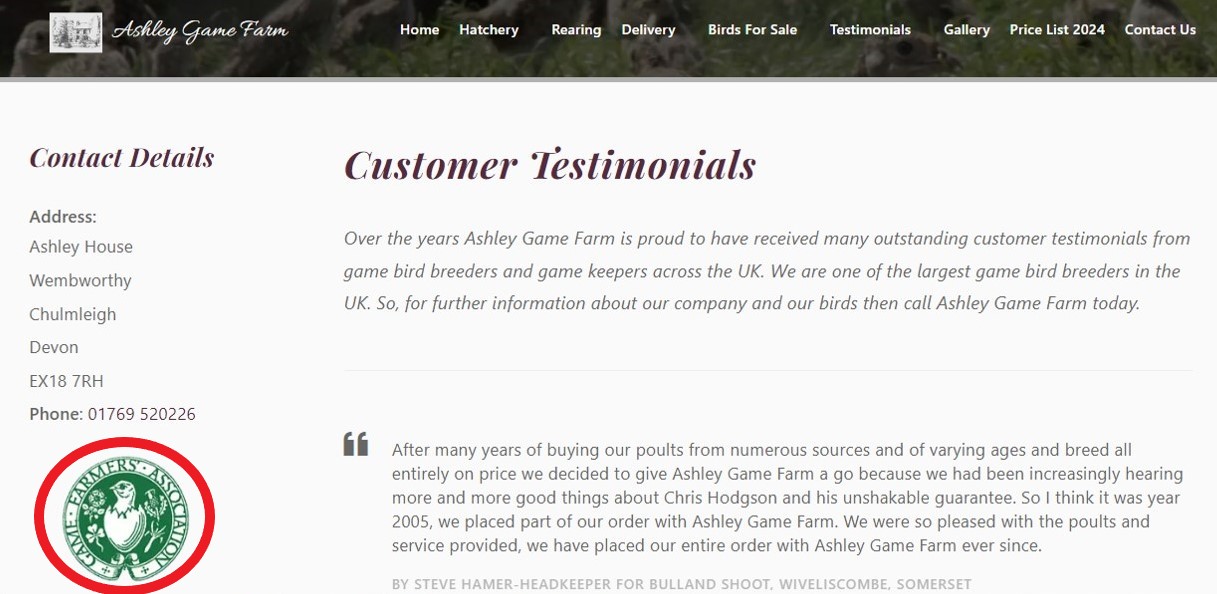
The Game Farmers’ Association (strapline: ‘representing the UK’s game farmers & promoting high standards‘) is one of the eight organisations in the shooting industry’s umbrella partnership, ‘Aim to Sustain‘, a lobbying campaign group aimed at promoting ‘sustainable and responsible’ game shooting. Presumably Christopher Hodgson and Ashley Game Farm Ltd will be expelled as a result of this criminal conviction.

Hodgson will appear in court in Exeter on 18 July 2024 for sentencing.

Well done to Devon & Cornwall Police, National Wildlife Crime Unit, Natural England and the RSPB’s Investigations Team for excellent partnership-working.

UPDATE 20 July 2024: Poisoned buzzard leads to discovery of multiple pesticide offences – Ashley Game Farm & Director Christopher Hodgson fined £40,000+ (here)

Prosecution continues against Ashley Game Farm Director Christopher Hodgson after discovery of poisoned buzzard, baits & other pesticide offences

The prosecution continues of Christopher Hodgson, Director of Ashley Game Farm in Devon following the discovery of a poisoned buzzard and two poisoned baits.

The discovery, in October 2020, led to a multi-agency raid of the premises in March 2021 with assistance from Natural England, RSPB and the NWCU (see here) and which identified a number of alleged pesticide and veterinary medicine offences at the address.

Multi-agency search team attended Ashley Game Farm in March 2021. Photo: RSPB Investigations

I understand that the prosecution is against Christopher Hodgson as well as against his company, Ashley Game Farm.

Ashley Game Farm is an exceptionally large breeding facility that, according to its website, ‘specialises in supplying pheasants and partridges to shoots in the west country and all areas of the UK and Europe‘. It claims to have ‘a hatching capacity for 410,000 eggs per week along with further investment in a second location at Tarrington, Hereford‘ and ‘retains around 80,000 chicks at Ashley Game Farm every week‘.

Ashley Game Farm Director and owner Christopher Hodgson, 69, was due in court in Barnstaple on Friday 2 February 2024 to face multiple charges in relation to the alleged use of Carbofuran and the alleged possession, storage and use of various plant protection and veterinary medicine products without authorisation at the game farm.

Mr Hodgson has not yet entered a plea.

The case has now been adjourned until 28 May 2024.

As this case is still live, comments won’t be accepted on this blog until criminal proceedings have concluded. Thanks for your understanding.

UPDATE 28 May 2024: Devon gamebird breeder guilty of using banned pesticide Carbofuran (here).

UPDATE 20 July 2024: Poisoned buzzard leads to discovery of multiple pesticide offences – Ashley Game Farm & Director Christopher Hodgson fined £40,000+ (here)
Prominent Devon gamebird breeder due in court to face multiple charges after discovery of poisoned baits & poisoned buzzard

A prominent gamebird breeder is due in court this week to face multiple charges following the discovery of a poisoned buzzard and two poisoned baits at Ashley Game Farm in Chulmleigh, Devon in October 2020.

The dead buzzard and the two pheasant carcasses, which were discovered by a member of the public, all tested positive for Carbofuran.

Following these toxicology results, Devon & Cornwall Police led a multi-agency raid at Ashley Game Farm in March 2021 with assistance from Natural England, RSPB and the NWCU (see here) which identified a number of pesticide and veterinary medicine offences at the address.

Multi-agency search team attended Ashley Game Farm in March 2021. Photo: RSPB Investigations

Ashley Game Farm is an exceptionally large breeding facility that, according to its website, ‘specialises in supplying pheasants and partridges to shoots in the west country and all areas of the UK and Europe‘. It claims to have ‘a hatching capacity for 410,000 eggs per week along with further investment in a second location at Tarrington, Hereford‘ and ‘retains around 80,000 chicks at Ashley Game Farm every week‘.

Ashley Game Farm Director and owner Christopher Hodgson, 69, is due in court in Barnstaple on Friday 2 February 2024 to face multiple charges in relation to the alleged use of Carbofuran and the alleged possession, storage and use of various plant protection and veterinary medicine products without authorisation at the game farm.

I think this is Hodgson’s first appearance so he hasn’t yet entered a plea.

As this case is now live, comments won’t be accepted on this blog until criminal proceedings have concluded. Thanks for your understanding.

UPDATE 9 February 2024: Prosecution continues against Ashley Game Farm Director Christopher Hodgson after discovery of poisoned buzzard, baits & other pesticide offences (here).

24 more White-tailed eagles reintroduced in Ireland

Press release from the Irish Government:

WHITE-TAILED EAGLE CHICKS SPREAD THEIR WINGS FURTHER INTO IRISH SKIES

  • 24 white-tailed eagle chicks were released in August around the country, as part of an ongoing National Parks and Wildlife Service (NPWS) programme to reintroduce this once extinct species
  • A total of 171 white-tailed eagles have now been released through the programme to date
  • A small, established population of eagles is now fledging chicks around the country and has even produced triplets

Over the past week, twenty-four white-tailed eagle chicks have been released in locations around Lough Derg, the Shannon Estuary and the west of Ireland, as part of a long term reintroduction programme managed by the NPWS.

White-tailed eagles are predators who play an important role in nature and the ecosystem.

Once native to Ireland, they became extinct in the nineteenth century. Since 2007, the NPWS has been working with partners in Norway along with farmers and communities around the country to reintroduce the white-tailed eagle to Ireland.

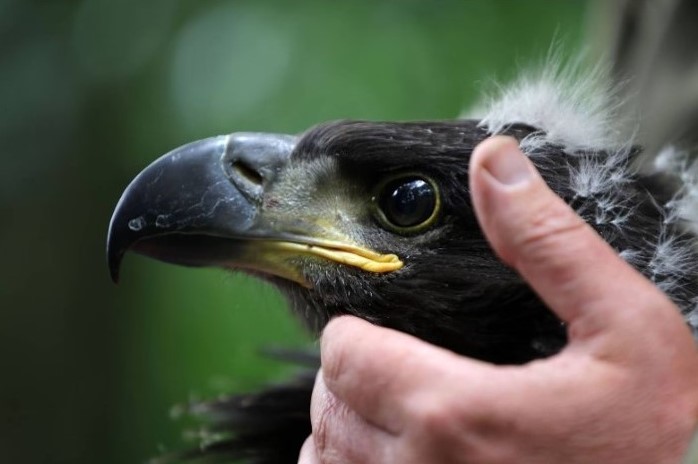
Young White-tailed eagle. Photo: Valerie O’Sullivan

Minister of State for Heritage and Electoral Reform, Malcolm Noonan TD, who released four chicks at Killarney National Park as part of the release programme, said:

The juvenile white-tailed eagles we have released this week are joining a growing population across our island. This incredible endeavour is the result of 16 years’ work and collaboration, not just on the reintroduction programme, but also on habitat restoration and engagement with landowners to secure their ongoing protection.

These apex predators perform a vital role in our ecosystems and the sight of them soaring in the thermals is a privilege that everyone who lives in or visits Ireland will now have the opportunity to enjoy. I would like to pay tribute to NPWS staff for their commitment and dedication to this initiative, our international partners from Norway, and the communities around the country who are embracing the return of the white-tailed eagle to our landscapes.”

A comprehensive satellite tagging system is now in place so that the birds can be monitored as they disperse around the country.

Minister for Housing, Local Government and Heritage, Darragh O’Brien who also participated in the release of chicks at in the vicinity of Lough Derg added:

This reintroduction programme is the result of a combined effort by my Department’s National Parks and Wildlife Service, participating landowners and communities and endangered species experts. I commend each of them for the role they are playing in protecting these iconic birds of prey“.

Niall Ó Donnchú, Director General with the NPWS said:

This programme is one of several initiatives underway in the NPWS to protect endangered species in Ireland and prevent their decline. This work takes time, and calls for a partnership approach if it is to be sustainable in the long term. Collaboration with the science community and international partners, along with the involvement of our expert staff and communities around the country has been key to the success we have seen so far“.

Eamonn Meskell, Divisional Manager NPWS, Killarney National Park who heads up the white-tailed eagle reintroduction Programme added:

There is huge interest from the public in the white-tailed eagle programme. Locations where they are spotted attract many visitors and local interest and we love to hear about sightings of the birds around Ireland and further afield. There are great stories to tell about the project. For example, the first Irish bred female to breed in over a hundred years has fledged seven chicks in three years! In Lough Derg this year for the second time a nesting pair fledged triplets. This is incredibly unusual – even in the wilds of Norway, and it shows how well suited Ireland really is for the white-tailed eagle from both a habitat and a feeding perspective. We’ll be watching this year’s chicks with interest as they mature and hopefully go on to fledge more chicks“.

Bente Lyngstad, chargé d’affaires at the Norwegian Embassy in Ireland said:

Watching the release of the white-tailed sea eagles is a truly extraordinary and mighty experience. Over the years more than 150 eagle chicks have been collected in Norway and released in Ireland. Today’s stock in Ireland is the result of a long-term collaboration between Norway and Ireland, which again stems from our deep friendship and our shared values. I would like to acknowledge all volunteers whose efforts have been imperative to make this happen“.

The retention of species is essential for maintaining the intricate web of life and the functioning of ecosystems. It contributes to the sustainable use of natural resources and the well-being of both present and future generations. Yet we now see a rapid loss of species world-wide. This development must be halted. The reintroduction of white-tailed sea eagles into their natural habitat is a great example of how we can work together against biodiversity loss.”

ENDS

These releases form part of phase two of the reintroduction project. Phase one involved releasing 100 White-tailed eagles into Killarney National Park in County Kerry, between 2007-2011. A scientific review of the project in 2019 suggested that the small population was still vulnerable to issues such as Avian Influenza, extreme weather events and illegal poisoning so phase two began in 2020, to reintroduce more young birds and release them in different parts of the country.

Unfortunately some of the eagles released in phase two have already been killed illegally after consuming poisoned bait (see here and here).

McKellar twins from Auch Estate sentenced for killing cyclist & burying his body in a stink pit

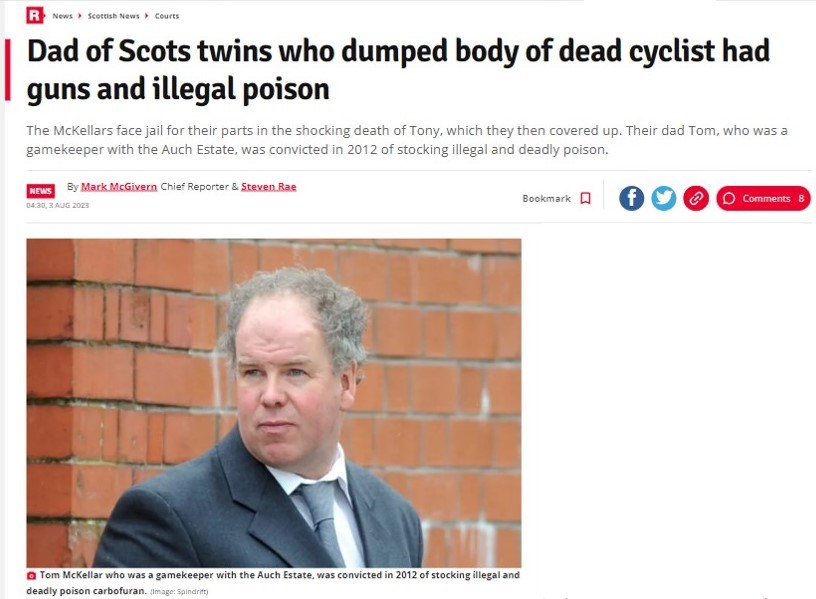
Twin brothers Alexander and Robert McKellar have today been sentenced at the High Court in Glasgow for their roles in knocking down cyclist Tony Parsons and burying his body in a stink pit on the notorious Auch Estate near the Bridge of Orchy, where their father had previously been convicted for the illegal possession of two hand guns and a banned pesticide (Carbofuran) after the discovery of a poisoned golden eagle (see here).

Alexander & Robert McKellar. Photos: Police Scotland

Alexander McKellar, who had previously been charged with murder but pleaded guilty to a lesser charge of culpable homicide, was sentenced to 12 years in prison.

Robert McKellar was sentenced to five years and three months for attempting to defeat the ends of justice by assisting his brother in covering up the crime by burying Mr Parsons in a remote spot on the Auch Estate.

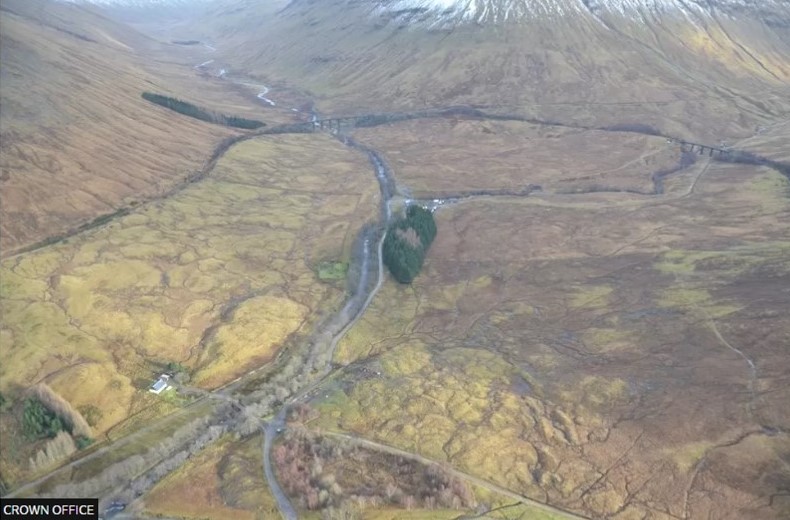
Aerial view of Auch Estate. Photo: COPFS

Mr Parsons was knocked off his bicycle by Alexander McKellar’s vehicle, part-way through a charity ride on a rainy night in September 2017. Instead of providing him with assistance, the McKellar twins drove back to Auch Estate, switched vehicles, and returned to collect Mr Parsons and his possessions and then hid everything under a tarpaulin in some woods on the estate. Mr Parson’s body was later moved to a stink pit on the estate where he was buried, and the McKellar twins burned his possessions.

Their hideous crimes only came to light in 2021 after Alexander McKellar confessed to his then girlfriend, who went to the police. That they’d been able to conceal these offences for so long, despite major searches by Police Scotland officers, mountain rescue teams, police dogs, police air support unit, as well as volunteers, and with repeated media appeals, is a clear demonstration of how easy it is for criminal evidence to be hidden on vast, remote sporting estates. Makes you think, doesn’t it?

Previous blogs on this case here and here.

More detail emerges about McKellar twins who buried cyclist’s body in stink pit on Auch Estate

Further to the horrific story about how charity cyclist Tony Parsons had been killed and then subsequently buried in a stink pit by the McKellar twins on the infamous Auch Estate near Bridge of Orchy in the Scottish highlands (see here), more information has emerged in this grisly case.

The Daily Record has reported that the McKellar twins’ father was Tom McKellar, who was convicted in 2012 for the illegal possession of a banned pesticide (Carbofuran) and two hand guns at his home on the Auch Estate where he worked as a farm manager (also described in some publications as a gamekeeper)- see here and here for some background to that case.

The article in the Daily Record (here) also includes comments made by locals about the McKellar twins and it reports that the brothers ‘worked as stalkers on a hunting estate‘ and ‘had been exposed to the killing of animals for much of their lives‘.

The article continues:

The boys had grown up in a life where shooting animals, trapping them was a way of life, part of the running of a shooting estate that protected the game bird and deer stocks. They were both working on the land from a young age and soon working as deer stalkers. Their father was said to be highly regarded in the local community but the fact he had illegal guns and hugely toxic, illegal poison at his property didn’t exactly make him look like the best role model‘.

The article also states: ‘The men eventually buried Tony’s body in a “death hole” that was full of the rotting remains of foxes, grouse and other animals that had been killed on the estate‘.

I’m not sure that grouse shooting takes place on the Auch Estate – the habitat doesn’t look as though it would support commercial driven grouse shooting at any rate. The estate is best known for offering deer stalking and fishing, although the estate agent’s brochure from the 2020 sale does say that walked-up shooting is available and mentions rough shooting for woodcock:

Further information about the site where Tony’s remains were found was reported in an STV article (here) published last September when the case moved to trial at the High Court in Glasgow. The article reports that Tony’s body was ‘hidden under animal remains with bleach also poured on his remains‘. (Thanks to a blog reader for sending the STV link).

There has been a lot of online commentary about this gruesome case, which isn’t surprising given the shocking crimes committed by the McKellar twins. Some have questioned why I’m reporting the case on this blog. I don’t feel the need to justify what gets reported on here but in this case I thought it would have been obvious given the estate’s history as a raptor persecution crime scene, the relationship of the McKellar twins to Tom McKellar, and the use of a stink pit to bury a body.

I think it’s also interesting to highlight that a crime as serious as this one can remain hidden on large estates like Auch for years. We often refer to raptor persecution crimes on vast, privately-owned sporting estates as being the ‘tip of the iceberg’ because inevitably estate employees have every opportunity, and of course the motive, to hide the evidence of their criminal activity. The crimes that are uncovered are usually only discovered by chance.

The killing of Tony Parsons and his burial in a stink pit on the Auch Estate by two individuals who lived and worked there only came to light because someone had the courage and decency to report it to the police when Alexander McKellar confessed to her what he and his brother had done.

I see a lot of parallels.

The McKellar twins are due to be sentenced later this month.

UPDATE 25th August 2023: McKellar twins from Auch Estate sentenced for killing cyclist & burying his body in a stink pit (here)

Cyclist’s body found buried in stink pit on infamous Auch Estate

There was a pretty gruesome criminal case taking place at the High Court in Glasgow last week relating to the infamous Auch Estate at the Bridge of Orchy.

Long-term blog readers may well remember the Auch Estate – a deer-stalking and fishing sporting estate where a poisoned golden eagle was found in June 2009 along with a carbofuran-killed fox and a carbofuran-laced sheep carcass. The discovery led to a raid at the farm manager’s home where Carbofuran was discovered in a game bag and two illegal handguns were discovered in the loft.

Three years later after prolonged legal proceedings, farm manager Tom McKellar (then aged 50) was convicted for having possession of the banned pesticide Carbofuran, although he wasn’t charged with poisoning the golden eagle or placing the poisoned bait. He was given a pathetic £1,200 fine for possession of Carbofuran and a 300-hour community service order for possession of the two handguns, a crime which would normally have attracted a mandatory five year custodial sentence (see here and here for some background to that case).

Aerial view of Auch Estate. Photo: Crown Office

The case heard last week at Glasgow High Court centred on twin brothers Alexander and Robert McKellar (now aged 31). In September 2017 after drinking with a German hunting party at a local hotel, Alexander McKellar’s vehicle hit a charity cyclist, Tony Parsons, who was cycling on the A82, causing him serious injury. Instead of helping him, the two brothers drove back to Auch Estate (where they were reportedly self employed farm workers living with their parents – Alexander McKellar was also reported to be a deer stalker), dumped their phones and changed vehicle and went back to pick up Tony Parson’s body, bike and possessions, and drove back to the estate and initially hid Mr Parsons in a wood.

They later removed him from the wood and took him to another location on the estate, reported in court as a location used for “the purposes of disposing dead animals”, in other words, a stink pit. There they dug a grave and buried Mr Parsons and burned his possessions.

Mr Parson’s remains were not discovered until January 2021 after a girlfriend of one of the McKellar brothers told police she’d been shown the grave site in 2020. Prior to her report, in 2018 the police had been tipped off to “pay attention” to the McKellar twins and had visited the estate in January 2019 but were apparently ‘asked to leave’.

Details of the case can be read here, here and here.

The McKellar brothers were due to stand trial for the murder of Mr Parsons but the court has accepted a not guilty plea from Robert McKellar and a guilty plea from Alexander McKellar to a lesser charge of culpable homicide. Both have pleaded guilty to attempting to defeat the ends of justice. They will be sentenced on 25th August at Glasgow High Court.

Let’s hope there’s some justice for Tony Parsons and his family.

UPDATE 4th August 2023: More detail emerges about McKellar twins who buried cyclist’s body in stink pit on Auch Estate (here)

UPDATE 25th August 2023: McKellar twins from Auch Estate sentenced for killing cyclist & burying his body in a stink pit (here)

Red kite found shot & poisoned in notorious grouse moor area of North Pennines AONB

Press release from the RSPB (27th June 2023):

RED KITE SHOT AND POISONED IN DURHAM RAPTOR CRIME SPOT

  • The protected bird of prey was found dead, hanging in a tree near Stanhope Burn, in the North Pennines Area of Outstanding Natural Beauty
  • The Weardale area has become a hotspot for raptor persecution
  • Police and partners want members of the public to report dead birds of prey and generate more information on raptor persecution in the area

A Red Kite found dead in Stanhope has been confirmed as having been both shot and poisoned, once again highlighting the area’s serious problem with bird of prey persecution.

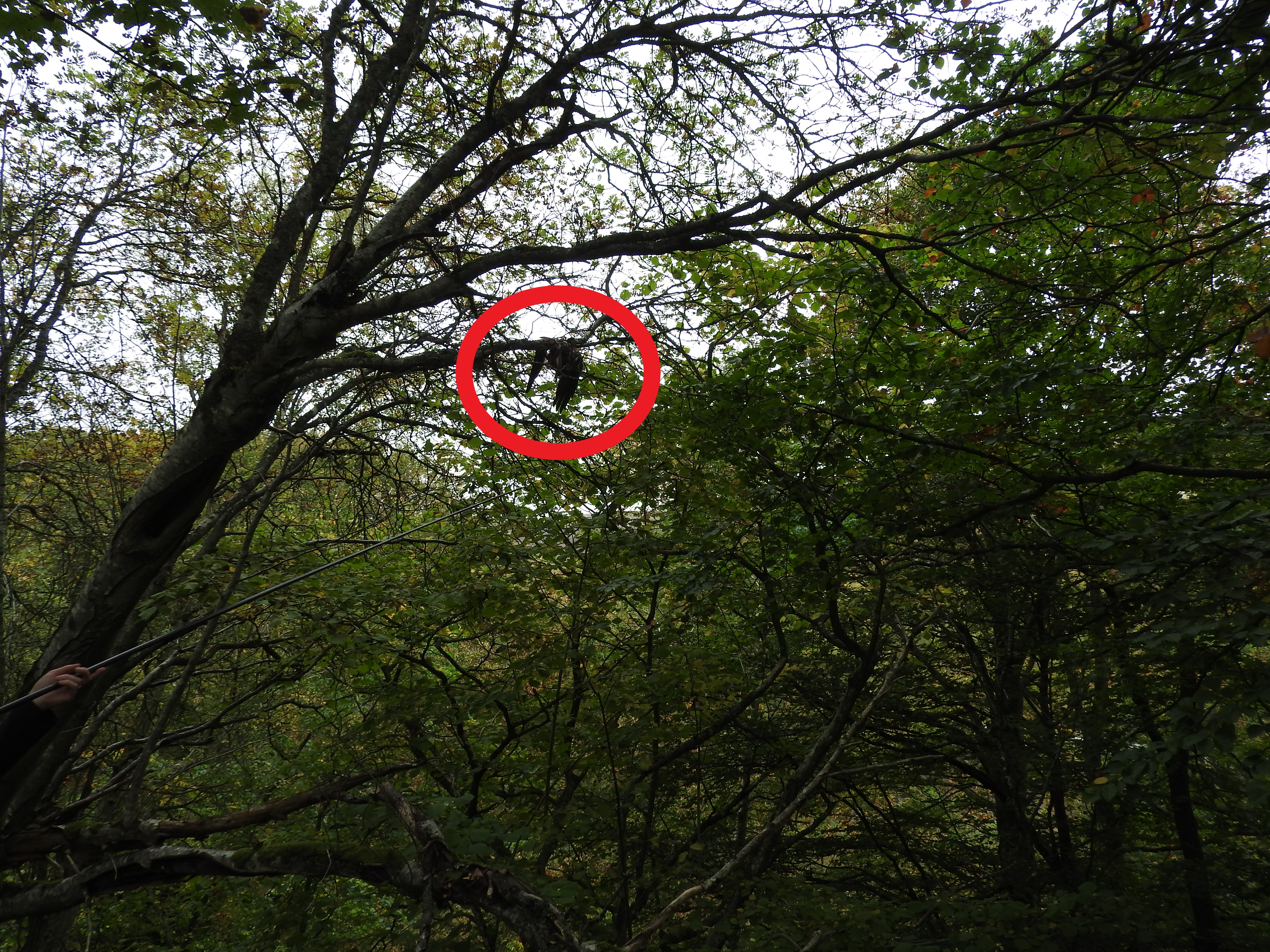
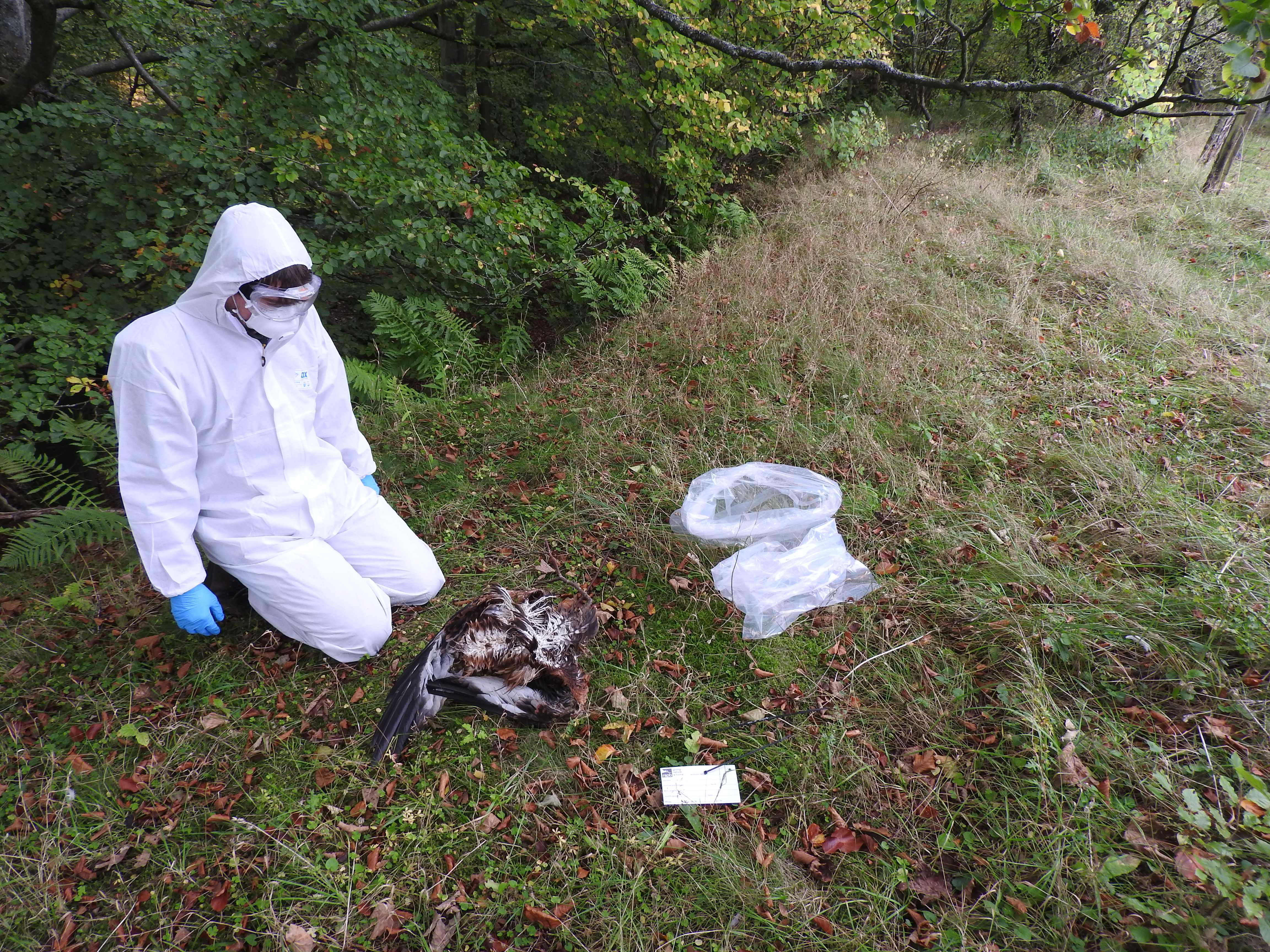
The protected bird of prey was discovered hanging in a tree by a member of the public in October 2022. The bird’s body was x-rayed and found to contain pieces of shot revealing that the bird had been shot at some point in its life. But when the bird was sent for official toxicology examination, the body was found to contain the highly toxic pesticides carbofuran and bendiocarb – which were confirmed by testing to be the cause of death. Both these substances are frequently seen in bird of prey poisoning cases despite being banned for legal use in the UK for many years.

Illegally shot & poisoned red kite hanging in a tree near Stanhope in the North Pennines AONB, October 2022. Photo: RSPB
Investigator collecting the shot & poisoned red kite near Stanhope, Oct 2022. Photo: RSPB

Red Kites are graceful birds with long wings and a distinctive forked tail. Forty years ago their numbers were limited to a small population in Wales due to illegal persecution, until successful reintroduction programmes in the 1980s and 90s brought them back from the brink. However persecution remains a threat, even today. Like all birds of prey, they are legally protected in the UK, punishable by jail and/or an unlimited fine.

Last month (May 23), police and partners carried out searches of land and buildings the area, in connection with the incident.

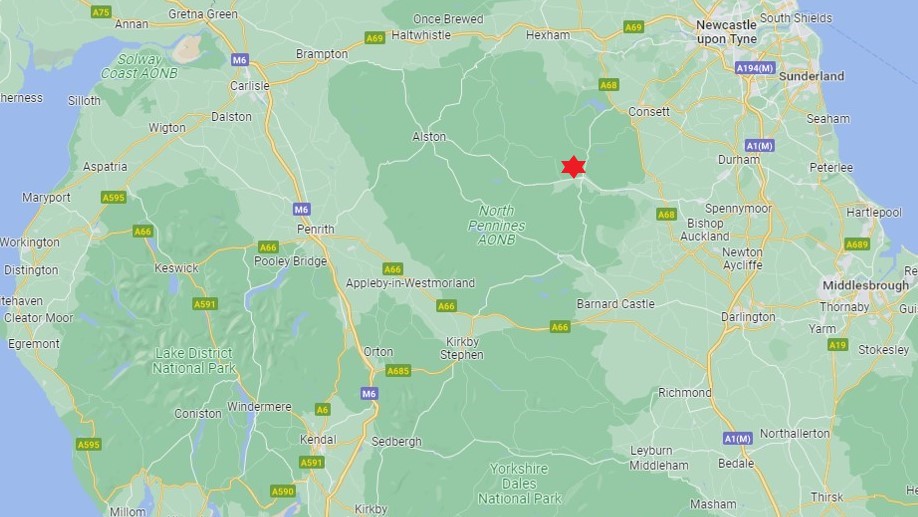
Red star indicates approximate location of latest crime in the North Pennines AONB
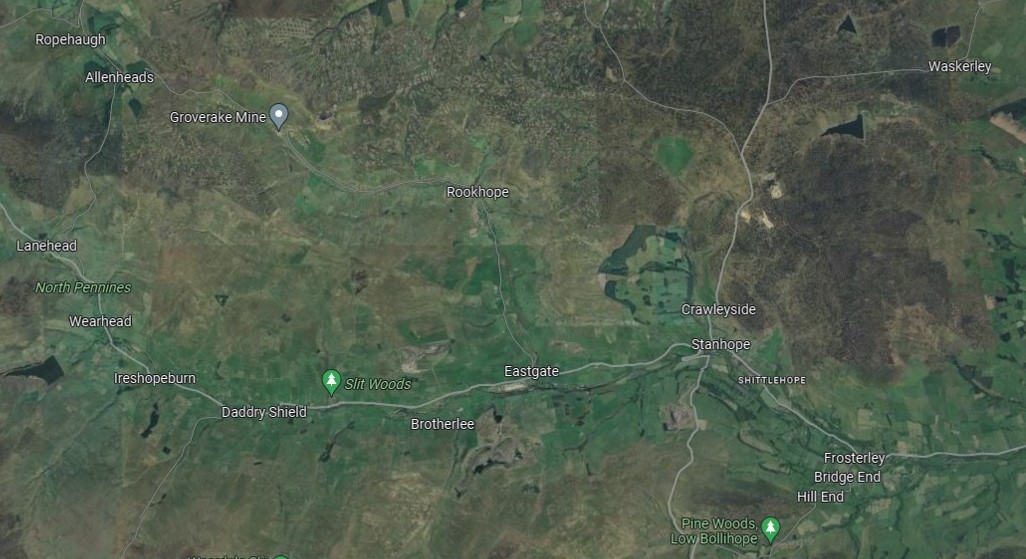
Stanhope Burn, to the NW of Stanhope, is next to moorland managed for driven grouse shooting

This is the latest of a series of crimes involving birds of prey being illegally killed in this part of the North Pennines Area of Outstanding Natural Beauty (AONB).

In 2020, two GPS satellite-tagged Red Kites disappeared in the Edmundbyers area in suspicious circumstances [Ed: see here]. Both tags – fitted as part of a species monitoring scheme by Friends of Red Kites, who monitor the red kite population in North-east England – had been transmitting as expected until they suddenly stopped. Neither bird, nor their usually very reliable tags, have been seen since.  

In 2021, a Red Kite was found poisoned by carbofuran and bendiocarb, also in the Edmundbyers area.

The following year, police together with partner agencies conducted a raid on nearby grouse moor estates in Durham and Northumberland, following previous incidents and intelligence related to bird of prey killing in the area [Ed: see here].

And in March 2023, a Red Kite was found shot, but still alive, on a grouse moor in Edmundbyers [Ed: see here]. Luckily, after care by local vets and a specialist rehabilitator, the bird recovered and was released back into the wild [Ed: see here].

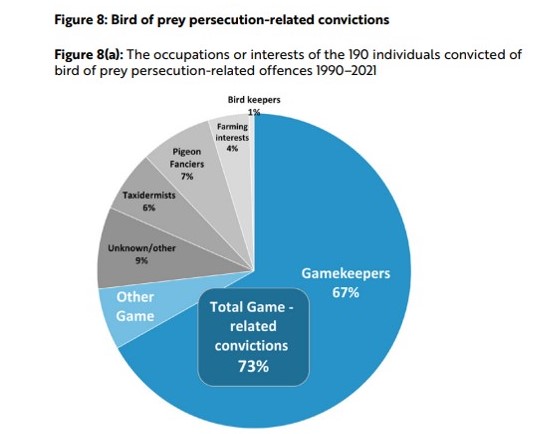
The RSPB’s Birdcrime report, published last autumn, revealed that over two-thirds (71%) of all confirmed raptor persecution incidents in 2021 related to land managed for gamebird shooting. And since 1990, 67% of those convicted of these crimes have been gamekeepers.

Data from RSPB’s Birdcrime Report (2021)

Mark Thomas, RSPB Head of Investigations, said: “We are concerned about a spate of concentrated raptor crimes which is rendering the Weardale grouse moors a hotspot for the illegal killing of birds of prey. As such, we are concentrating our efforts of detection on this area, in the hope of catching anyone targeting protected birds such as Red Kites, which should be breeding successfully in this area. But we critically need the public to be our eyes and ears and report potential crimes to ourselves and the police.

The fact that bird of prey persecution continues against the public interest makes it clear that additional regulation for grouse moors is necessary. We believe all grouse moors and their owners or sporting tenants must be licensed, as is happening in Scotland, to provide a meaningful deterrent to the illegal killing birds of prey. Ultimately this could mean the loss the licence to shoot grouse, if the Police are satisfied that wildlife crimes against raptors are occurring on a particular landholding. Law-abiding estates should have nothing to fear from this approach”.

PC David Williamson of Durham Constabulary said: “The illegal killing of birds of prey unfortunately is continuing in our rural areas. It is unacceptable that anyone should think they can ignore the law and kill these birds by poisoning, shooting, trapping or nest destruction and disturbance. I am sure that people in our community will know who is committing these offences and I would urge anyone with any information to report this. Durham Constabulary will continue to work with our partners to tackle this criminal activity, investigate any reports and prosecute offenders”. 

If you notice a dead or injured bird of prey in suspicious circumstances, call the police on 101 and fill in the RSPB’s online reporting form HERE.

If you have information about anyone killing birds of prey which you wish to report anonymously, call the RSPB’s confidential Raptor Crime Hotline on 0300 999 0101.  

ENDS

Red kite found poisoned on Swinton Estate – North Yorkshire Police refuses to investigate

Last November I was reading an online article on the Teeside Live website about the Nidderdale Area of Outstanding Natural Beauty (AONB) in North Yorkshire being dubbed ‘the bird poisoning capital of the UK‘ (here).

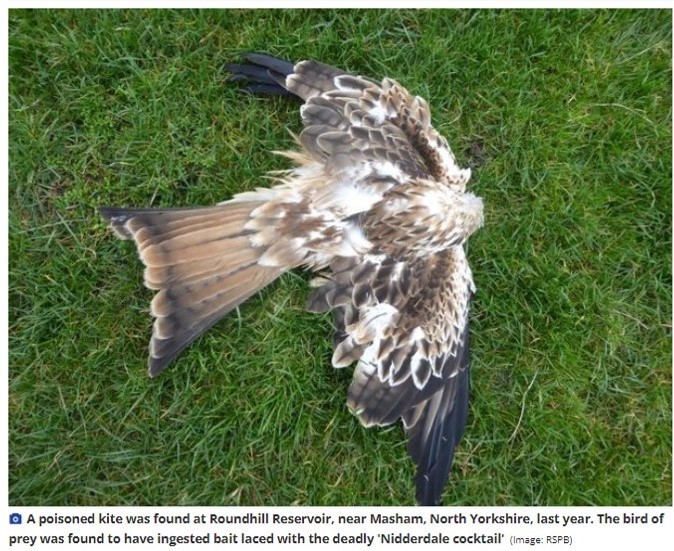
The article was illustrated with various photographs, including this image of a poisoned red kite that was reportedly found dead at Roundhill Reservoir, near Masham in 2021:

The given location caught my eye as I understand the Roundhill Reservoir is surrounded by the Swinton Estate, a notorious grouse-shooting estate that has been at the centre of police investigations into confirmed and alleged raptor persecution for years.

For example, this is the estate where hen harrier ‘Bowland Betty’ was found dead in 2012, later confirmed to have been shot (here & here) although it has never been established whether she was shot on or off the estate. It’s also where a Swinton Estate gamekeeper was convicted for twice setting an illegal pole trap in 2013 (here) and where another hen harrier, ‘River’, was found shot dead in 2019 (here). Around the same time as River’s demise, an unidentified gunman had been filmed with two dogs walking through a hen harrier roost on the estate (here). There have also been reports from local raptor workers of the ‘mysterious disappearances’ of many raptors on this estate for over a decade.

The owner of Swinton Estate is Mark Cunliffe-Lister, Earl of Swinton, who in 2020 became the new Chairman of the grouse moor owners’ lobby group, the Moorland Association (here). This is a high profile position and in recent years Mr Cunliffe-Lister’s estate has become somewhat of a poster child for DEFRA’s ludicrous hen harrier brood meddling trial, where the estate has championed the removal of some hen harrier chicks in return for permitting others to remain and to be diversionary fed by estate staff, although this hasn’t been without controversy either after it emerged that Natural England had appeared to ‘bend the rules’ in favour of estate activities (e.g. see here). Controversially, in 2021 a Guardian journalist described Swinton Estate as the ‘hen harrier’s friend’ (here), supported by a statement from Stephen Murphy (Natural England) about the estate’s head gamekeeper, “What he’s done for harriers, word’s can’t describe“. Murphy also claimed that hen harrier Bowland Betty had definitely been shot elsewhere and merely flew on to the estate to die – an unevidenced claim that was later amended in the article. Last year the estate won what was described as ‘a prestigious conservation award’ for its involvement in the hen harrier brood meddling trial (here).

So, back to that article I was reading in November 2022. I didn’t recall hearing about a poisoned red kite being found on the Swinton Estate in 2021 and I’m pretty sure I would have remembered, given the location, so I did some digging to make sure the poisoning had been confirmed and the location verified, just in case the journalist had cocked up (she’d already mistakenly described Nidderdale as a ‘village’ instead of a region so I couldn’t rely on her account of the poisoned red kite to be accurate).

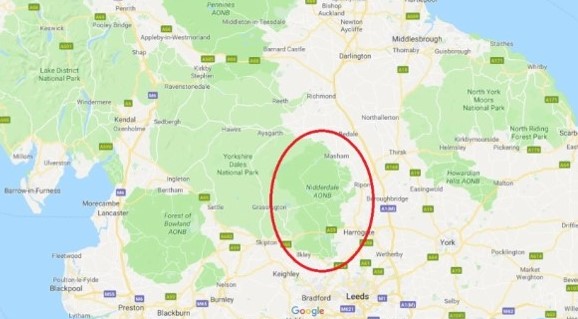
The Nidderdale Area of Outstanding Natural Beauty (AONB), North Yorkshire
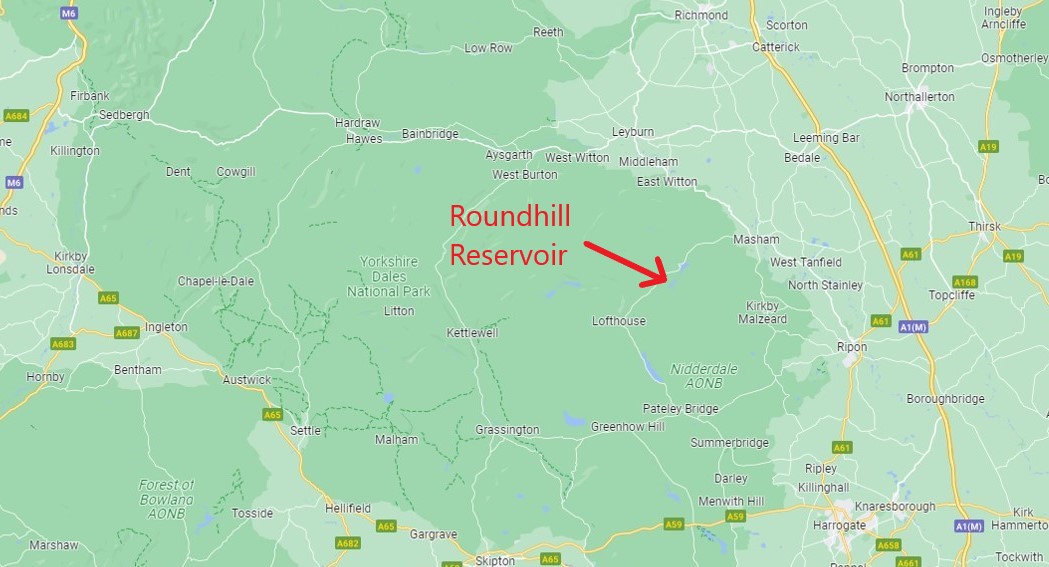
Roundhill Reservoir in the Nidderdale AONB

I found details about this crime on the HSE’s Wildlife Incident Investigation Scheme spreadsheet, which confirmed the kite had been found poisoned on a Right of Way footpath in November 2021. The poisons found in the kite’s stomach included Bendiocarb, Carbofuran, Chloralose and Isofenphos – this highly toxic combination has become known as the ‘Nidderdale Cocktail’ as it’s so frequently used to kill birds of prey in this region, especially red kites (e.g. see here, here, here).

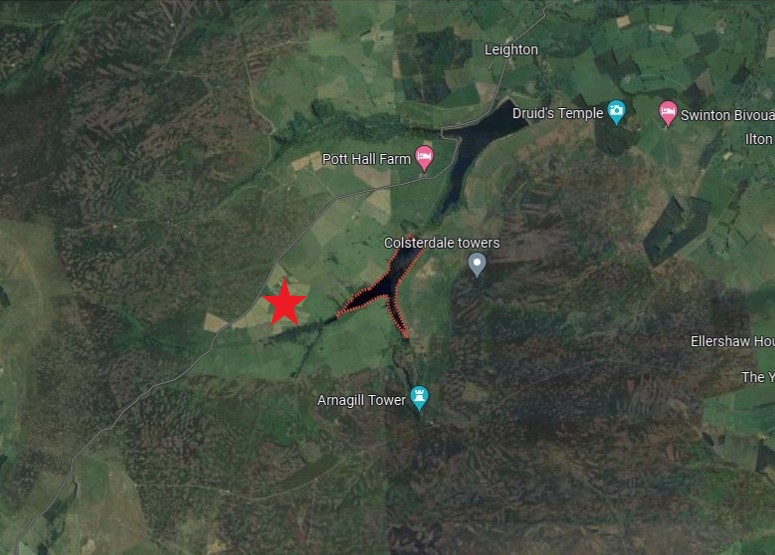
The red star denotes the approximate location of the poisoned red kite found in November 2021, close to Roundhill Reservoir and surrounded by the grouse moors of Swinton Estate

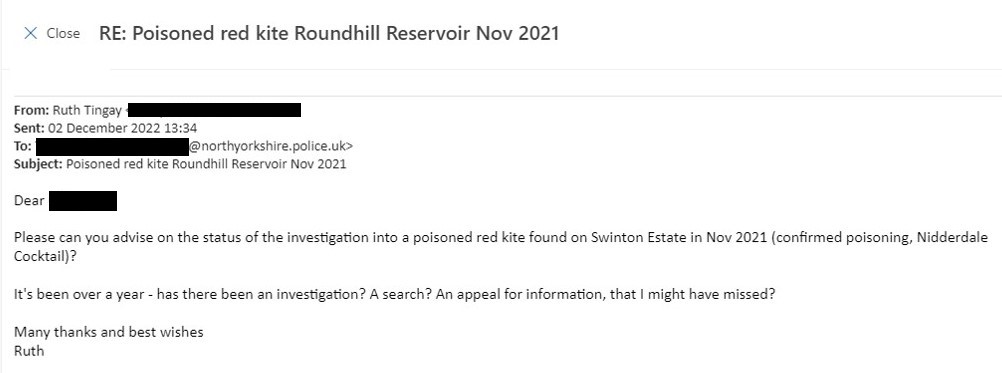
However, I couldn’t find any media coverage of this crime, nor any police appeals for information, nor any warnings to the public about the continued use of poisons so dangerous that some of them have been banned for years. Given that a year had already passed since the poisoned kite was discovered, I found this puzzling. So I contacted North Yorkshire Police’s rural crime team and asked them about the status of the investigation:

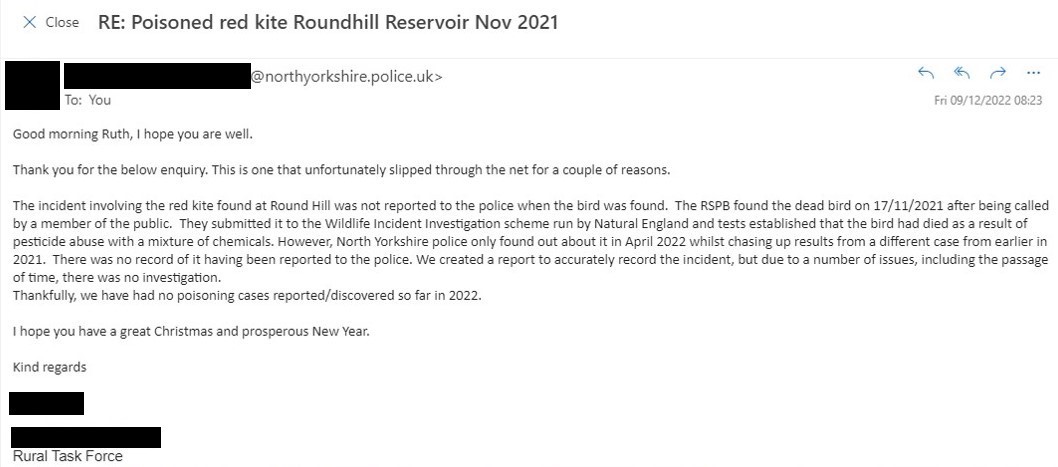
Here’s the astonishing response I received:

This North Yorkshire Police Inspector admitted that this poisoned red kite “unfortunately slipped through the net” but then went on to justify the police’s decision not to investigate by accusing the RSPB of failing to notify the police about this incident when the poisoned kite was first picked up. He claimed the police only found out about it five months later, in April 2022, whilst chasing the lab for the results of another investigation.

His allegations about the RSPB aside (and which I’ll come to, below), I was still stunned that he thought that launching an investigation, and issuing a public appeal for information, let alone issue a warning to the public about the use of poisons in the countryside, wasn’t worthwhile due to the ‘passage of time’ (five months), especially given the location where the poisoned kite had been found.

A couple of years ago a previous North Yorkshire Police Inspector had issued a public appeal/warning, ten months after the discovery of another poisoned red kite in Nidderdale (see here), so it seemed to me that there was no reason not to issue one after a five month delay.

I wrote back to North Yorkshire Police asking for an explanation:

Apparently, it wasn’t up for debate. Here’s the response I received:

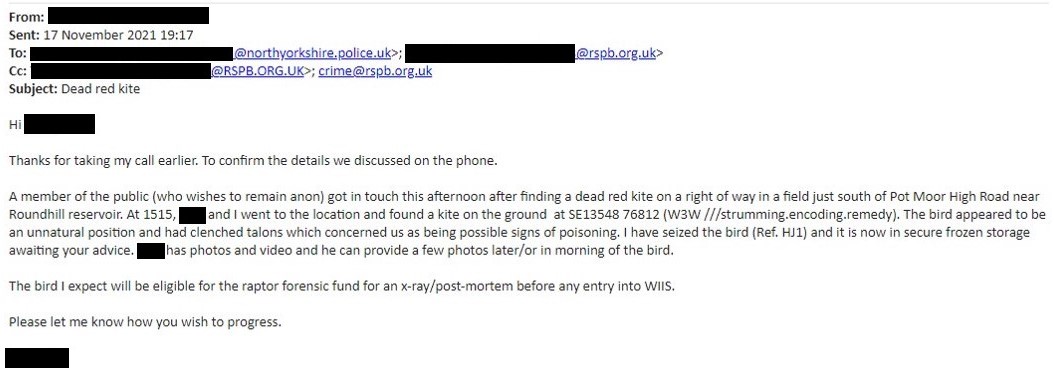
Meanwhile, I contacted the RSPB and put to them the allegations this Inspector had made, that the RSPB hadn’t notified the police about the discovery of this red kite. It turns out those allegations were utterly unfounded/untrue. The RSPB DID contact North Yorkshire Police, on the day the poisoned kite was discovered, and took instruction from the police about submitting the corpse for toxicology analysis. Furthermore, they had the email correspondence to prove it:

So what are we to make of North Yorkshire Police’s refusal to investigate a confirmed poisoning incident (a so-called national wildlife crime priority), on an estate with a long history of alleged wildlife crime, that has enjoyed recent adulation from Natural England staff and the media, that has played a significant role in the hen harrier brood meddling trial, and whose owner is a high profile representative of the grouse-shooting industry?

Does Mr Cunliffe-Lister even know about this poisoned kite being found on his estate? Given the Moorland Association’s claimed ‘zero tolerance’ of raptor persecution, and Mr Cunliffe-Lister’s widely-reported apparent welcoming of birds of prey on his estate, I’d have expected him to speak out and condemn this disgraceful poisoning incident, as any decent landowner would. It’d be interesting to know whether North Yorkshire Police have informed him, or not.

Whatever, North Yorkshire Police’s refusal to investigate this crime is wholly unacceptable. In the first instance, I’ll be writing a letter of complaint to the North Yorkshire Police, Fire and Crime Commissioner, Zoe Metcalfe.

In her Police and Crime Plan 2022-2025 (here), she details an objective of ‘an improved [police] response to crime in rural areas, especially wildlife crime...’ as this had been identified as a major concern for North Yorkshire residents in the recent PCC consultation.

UPDATE 23.30hrs: Natural England’s senior management team has a lovely day out…on Swinton Estate!! (see here).

Reintroduced white-tailed eagle poisoned with banned pesticide Carbofuran

A young white-tailed eagle, released into the wild as part of a conservation reintroduction project, has been found poisoned with the banned pesticide Carbofuran.

The National Parks & Wildlife Service in Ireland is appealing for information after the discovery of the dead eagle in November 2022 on land between counties Cavan and Westmeath.

The juvenile male white-tailed eagle who was just over a year old had been brought in as a chick in 2021 from Norway under phase two of a national re-introduction programme (e.g. see here and here).

It had been fitted with a satellite tag prior to its release on Lough Derg in 2021 and subsequent monitoring showed the eagle had been spending time around Lough Sheelin in Co Westmeath with two other white-tailed eagles, but tag data indicated the eagle had become stationary in November.

The corpse was retrieved and toxicology tests undertaken at the State Laboratory confirmed the eagle had been poisoned with Carbofuran, a deadly pesticide so dangerous it was withdrawn for use in Ireland over a decade ago.

NPWS regional manager, Maurice Eakin, said white-tailed eagles were a protected species under the Wildlife Acts. The death of the bird last November highlighted “once again” the extent of the illegal practice of using poisonous material as pest control.

“In this instance, it is particularly disturbing that the reckless laying of poison has resulted in the death of a white-tailed eagle, one of our largest and most majestic bird species, which had been persecuted to extinction by the early 1900s,” he said.

The NPWS is seeking any information from the public in the Westmeath/Cavan region, particularly anyone who may have seen anyone or any vehicles acting suspiciously in recent weeks in the area between Lough Sheelin and Lough Ramor.

Over 100 white-tailed eagles, donated by Norway, have been reintroduced to the Irish Republic since 2007, with the first successful breeding taking place in 2012 and there have been many successes over the last decade, bringing biodiversity and ecosystem benefits as well as a boost to local economies via ecotourism.

However, a scientific review of the reintroduction project in 2019 indicated that the small population was still vulnerable to illegal poisoning events so additional eagles have been reintroduced as part of phase two of the reintroduction to help bolster the population. It’s sadly ironic that one of those eagles has become the latest poisoning victim.