The BBC 2 Scotland documentary, ‘Fair Game? Scotland’s Sporting Estates’ was aired last night and opened with the BBC reporter visiting the Leadhills Estate with an undercover investigator from OneKind. This investigator was the guy who watched gamekeeper Lewis Whitham staking out a rabbit laced with Carbofuran in April 2009, leading to a conviction in 2010 (see blog post 17 Nov 2010). The BBC reporter, David Miller, was shown what was alleged to be an illegal ‘snapper trap’, and in forestry a few feet away he was shown the rotting carcasses of foxes and other animals, piled up at a ‘stink pit’ – used as a lure to draw in predators who are then snared as they approach the area. Also in the forest, he was shown the decomposing bodies of two raptors that someone had apparently tried to conceal under pine needles. Miller was visibly disturbed by what he’d witnessed in one small corner of one sporting estate, calling it ‘our ugly secret’ – not quite the public ‘conservation’ image that the shooting industry likes its estates to portray. The OneKind investigator has written an excellent account of his time out on the hill with Miller: http://www.onekind.org/resources/blog_article/fair_game
The discovery of the dead raptors and the apparently illegal snapper trap led to a later police search, in which a third raptor corpse was discovered, in addition to more raptor skulls. The trap was removed, and Leadhills Sporting Ltd denied all responsibility for the dead birds. Fountains Forestry, the owners of the private forest on the shooting estate, also denied any knowledge of the bodies and said the snares found were illegal as they had not given permission for anyone to set snares on that ground. Later in the programme, we learned about the weight of evidence of alleged criminal activity on Leadhills Estate. Since 2003, the RSPB has recorded 46 incidents where the government, police and/or other agencies have confirmed that poisoned baits have been set or birds have been illegally killed, just on Leadhills Estate. We were told that the current management at Leadhills Estate took over in 2008 and they say they ‘deplore wildlife crime’. However, the RSPB has since recorded 10 incidents since 2008, although none since 2009 – following the conviction of gamekeeper Lewis Whitham.
There followed a series of interviews with various people, including Dave Dick, the former head of RSPB Scotland Investigations (and a regular contributor to this site – thank you Dave), who talked about the hundreds of raptor persecution incidents he had seen first-hand over the last 20-30 years. We also heard from Mark Oddy from Buccleuch Estates who spoke briefly about the old glory days of grouse-killing at Langholm, and then we went to the RSPB’s Abernethy Reserve where Duncan Orr-Ewing showed Miller that it is possible for grouse-shooting and raptors to co-exist. Orr-Ewing also discussed the RSPB’s persecution figures and how these clearly show the effect of persecution on some raptor species. Government scientists have predicted that there should be 500 pairs of hen harriers on the UK’s grouse moors – there are actually only five. You don’t need to be Carol Vorderman to work out the missing numbers.
Next up was gamekeeper Peter Fraser from Invercauld Estate, who is also the SGA’s new vice chairman (see blog post 26 Nov 2010). There followed a fascinating conversation between Miller and Fraser, when Miller pointed out that 3 poisoned buzzards [and a poisoned raven] had been discovered on Invercauld Estate in 2003 [our sources suggest it was 2005] for which no-one was ever prosecuted:
Fraser: “All keepers know and understand that if they do that [poison a raptor] and they’re caught, you automatically lose your job”. NOT TRUE, Mr Fraser, as anyone who has read the contents of this blog site can attest.
Miller: “There are scientists who argue clearly that birds of prey in Scotland are being killed, shot, poisoned on our hills. Does that happen on this estate or neighbouring estates?”
Fraser: “Well, as I’ve said on this estate, if anyone does that we’re finished, and I can honestly say no. Never”.
Miller: “So, how do you explain the dead birds which routinely turn up in the Scottish countryside?”
Fraser: “I wish I could answer you that. Erm, in every walk of life there are some that lets the profession down and unfortunately we’re no different to everybody else. And it has been known that these birds have been planted on various areas so it’s a ticklish subject to deal with and to be quite honest, but er, I would like to think that poisoning has been greatly reduced over the years”. NOT TRUE, Mr Fraser – read the government statistics!
Miller: “Just to be clear, when poisoned or shot birds of prey are found on a gamekeeper’s land, clearly the stakes are very very high. Are you suggesting that those birds may have been deliberately placed there by a third party?”
Fraser: “Well, I haven’t got that evidence on me but erm I’m quite sure that has happened, quite sure that has happened”.
So there you have it. Peter Fraser, vice chairman of the SGA, admits that he has no evidence to support the claim that poisoned raptors have been ‘planted’ on sporting estates. It’s a shame Miller didn’t mention the poisoned buzzard found here in 1992, nor the 1997 conviction of an Invercauld Estate gamekeeper for the illegal use of a spring trap (see blog post 4 March 2010). Also a great pity that Fraser wasn’t asked how many breeding pairs of golden eagles and hen harriers are present on Invercauld Estate.
We then heard from Mike Yardley, a journalist and shooter, who stood smugly bragging about the ’20 safaris’ and other trips he has taken in Africa, North America and throughout Europe to shoot animals – and we were even treated to viewing some of his home videos of these trips. He probably met every expectation that the general public has of a typical shooter. It was hilarious. Not all shooters are of his ilk, of course, but the programme failed to get this across.
We heard from Robbie Kernahan from SNH who admitted that the evidence of illegal raptor persecution ‘should not be ignored’. We also heard from the laird at Alvie Estate, Jamie Williamson, who didn’t really discuss the issue of raptor persecution at all, and then we heard from an apparently very cagey Simon Lester, head gamekeeper at Langholm Estate who was obviously trying to pick his words carefully and not put his foot in it. Unfortunately he didn’t have anything substantial to offer in the comments that he did make. There was also an interlude at Mar Lodge Estate, although this was mainly about deer management and not really raptor persecution.
Miller went on to provide some interesting details about the performance of the procurator fiscals at the Crown Office. The BBC had asked them about the number of gamekeepers they had taken to court. Amazingly, they said they had only started recording their performance on wildlife crime early last year! Why? Since then, they’ve had one successful prosecution – Lewis Whitham from Leadhills Estate. There is ‘a handful’ of cases in the system – presumably these include the current cases concerning Skibo Castle Estate, Moy Estate and Inverinate Estate. We await these results with great interest to assess whether the extent of the charges brought are an accurate reflection of the evidence uncovered.
The finale came with an interview with Doug McAdam, CEO of SRPBA. Another apparently cagey performance that included what some might perceive as a blatant lie. Miller asked McAdam whether he thought the game industry was being unfairly targeted:
McAdam: “I think that there is a feeling out there amongst landowners and estates that there are people who would seek at every opportunity to damage the reputation of landowners and estates. If we look at the statistics, 28 cases of confirmed bird of prey poisoning incidents in Scotland in 2010 – it’s small, it’s in the tens, and it is a decreasing number”.
Actually, Doug, if you care to look at the official poisoning statistics that your organisation helped to analyse, you’ll see that the number of poisoned raptors discovered in 2010 was GREATER than the number discovered in 2009. Do you think that if you say it enough times (i.e. that the poisoning figures are declining) that somehow we’ll all forget the official statistics and believe your version? I don’t think so.
Miller also asked him: “Your very well informed members must know where those [poisoning] cases are taking place, surely?”
McAdam: “Er, I don’t, I don’t think that’s necessarily the case, no”.
So, our ignorant landowners are now pushing for licences to kill protected raptors as a method of reducing illegal persecution incidents, but they ‘don’t neccessarily’ know where these incidents are taking place. Brilliant.
For those of us hoping for some words of wisdom from SGA chairman Alex Hogg, sorry, he wasn’t included. I wonder why?
The programme is available for one week on the BBC iPlayer: http://www.bbc.co.uk/iplayer/episode/b0116lfs/Fair_Game_Scotlands_Sporting_Estates/
Here is the SRPBA response to the programme: FairGameSRPBAresponse May 2011

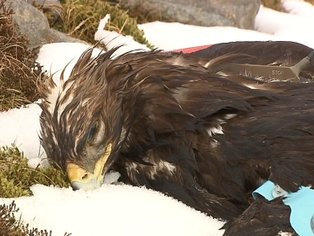 Today the Scottish government has published its latest report on animal poisoning in Scotland. The figures relate to recorded incidents in 2010 and demonstrate a sharp rise in the number of wildlife poisonings, including the widespread illegal poisoning of raptors. The report shows that 69% of all ‘abuse’ cases involved the poisoning of birds of prey, covering a wide area including Borders, Dumfries & Galloway, Highland, Lothian, Strathclyde and Tayside. The illegal pesticide Carbofuran was detected in half of these incidents. The raptors that tested positive for poisons included 40 buzzards, 4 golden eagles, 1 sea eagle, 1 kestrel, 5 barn owls, 2 tawny owls, 2 peregrines, 21 red kites and 11 sparrowhawks.
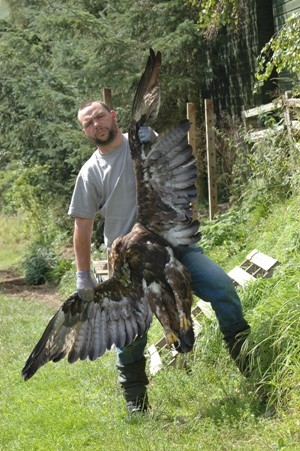 Today is the inglorious 12th, the start of the four-month grouse shooting season in the uplands of northern England and Scotland. Today, and for many days to come, ridiculously rich people will dress up in clownish outfits and head for the moors in the hope of shooting dead some birds. Many will pay an estimated average of £15,000 for the experience. I wonder how many of them will enjoy the sight of a hunting hen harrier or a golden eagle quartering across the moor? Very few, infact probably none of them because scientific evidence shows that hen harriers and golden eagles have been exterminated on most grouse moors in the UK, with just a few notable exceptions. Has anyone been convicted? One person was once convicted for killing a hen harrier, and that’s it. Nobody has ever been convicted for killing a golden eagle (someone was once taken to court a few years back but the case was dropped). Even though several dead eagles and the UK’s biggest stash of the poison they died from were all found on a sporting estate last year, still nobody has ever been convicted.
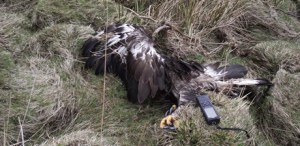 The latest figures detailing illegal animal poisoning incidents in the first quarter of 2011 have just been released by Science and Advice for Scottish Agriculture (SASA) on behalf of the Scottish Government.
 Two years ago in July 2009, Alma, a two-year golden eagle who had been satellite-tracked across Scotland from her birth place on the Glenfeshie Estate,
  We have received the following message from a member of the investigations team at the Scottish charity
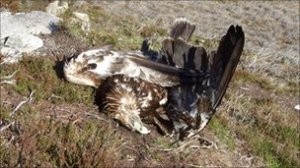
 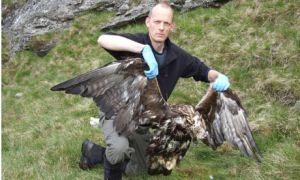 Two years ago today, this dead golden eagle was discovered by hill walkers in Glen Orchy, Argyll. Government tests later showed it had been poisoned by the illegal pesticide Carbofuran. This poisoning incident made the national press (e.g.
  Despite this conviction, the Crown accepted he had ‘no part’ in the deaths of two poisoned golden eagles and a sparrowhawk (killed with Carbofuran)
  Raptor Persecution UK