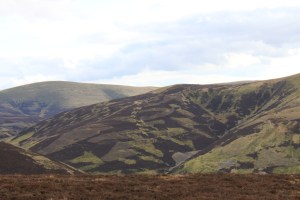
John Dodd sells Glenogil Estate

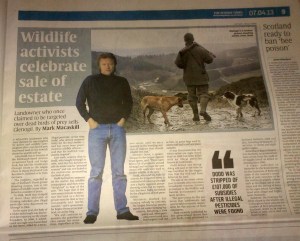
Sunday Times 7th April 2013 Glenogil saleJohn Dodd, the multi-millionaire owner of the controversial Glenogil Estate, has ‘quietly sold up’, according to an article in the Sunday Times.

The new owner is reported to be Baron Ferdinand von Baumbach, someone we know little about. Although we’re not sorry to see Dodd leave, it’s not so much who owns the estate that interests us, but rather whether (a) they intend to maintain it as a driven grouse moor and if so, (b) who will be advising on grouse moor ‘management’.

It’s been widely reported that Dodd took management advice from ‘grouse wizard’ Mark Osborne (e.g. see here) and indeed Glenogil is promoted on Osborne’s William Powell Sporting website as ‘one of the finest shooting estates in Scotland’ (see here), as well as on the William Powell Country website (here). It’s not just Osborne who rates this estate: last year The Field magazine included Glenogil in an article called ‘Britain’s 50 Great Shoots’ (see here) and in 2008 The Telegraph described it as a thriving grouse moor (see here).

However, for those of us with more of an interest in the area’s wildlife rather than with the artificially-high number of grouse that can be killed, you have to look elsewhere for information. A good place to start is the RSPB’s annual persecution reports. Below is a list of confirmed incidents recorded at Glenogil and ‘Nr Noranside’  from 2006-2010, sourced from these reports and also from Scottish Government data. Not one of these reported incidents has resulted in a criminal prosecution and Dodd has repeatedly and strenuously stated his staff are innocent. Dodd had his farming subsidy cut by £107,650 in 2008 when the Scottish Executive suspected that poisoned baits found on and near to the estate in 2006 were being used to target birds of prey (see here).

2006 March: poisoned rabbit bait (Carbofuran)

2006 April: poisoned buzzard (Alphachloralose)

2006 April: poisoned tawny owl (Alphachloralose)

2006 May: poisoned rabbit bait (Carbofuran)

2006 June: poisoned woodpigeon bait (Carbofuran)

2008 May: poisoned white-tailed eagle (Carbofuran, Isophenfos, Bendiocarb) [‘Nr Noranside’]

2008 May: poisoned buzzard (Bendiocarb) [‘Nr Noranside’]

2008 May: poisoned mountain hare bait (Carbofuran, Isophenfos, Bendiocarb) [‘Nr Noranside’]

2008 May: 32 x poisoned meat baits on fenceposts (Carbofuran, Isophenfos, Bendiocarb) [‘Nr Noranside’]

2008 Oct:  poisoned meat bait (Carbofuran) [‘Nr Noranside’]

2009 March: poisoned buzzard (Carbofuran)

2009 March: poisoned buzzard (Carbofuran)

2009 August: poisoned white-tailed eagle (Carbofuran)

2010 May: poisoned red kite (Carbofuran) [‘Nr Noranside’]

2010 September: poisoned buzzard (Chloralose)

2010 October: poisoned buzzard (Carbofuran)

2010 October: poisoned pigeon bait (Carbofuran)

2010 October: poisoned pigeon bait (Carbofuran)

John Dodd was the co-founder of Artemis Investment Management Ltd., a company that has sponsored the GWCT’s Scottish Game Fair (see here).

The Sunday Times article can be read in two parts:

Part 1 Glenogil sale Sunday Times 7 April 2013

Part 2 Glenogil sale Sunday Times 7 April 2013

Going to the Scottish Birdfair? Read this first

PrintThere’s an article today in the Sunday Herald about the RSPB’s controversial choice of venue for next month’s Scottish Birdfair. For the second year running, the RSPB has chosen to hold this event at Hopetoun House, the stately home of Lord Hopetoun whose family also owns the Leadhills (Hopetoun) Estate in South Lanarkshire, a grouse moor that has been at the centre of raptor persecution allegations for years. Sunday Herald article here.
Regular blog readers will know we’ve commented on this issue at length: see here, here, here, here, here and especially here.

In today’s article, veteran Scottish Raptor Study Group member Ronnie Graham urges potential Birdfair attendees to “make an informed decision” about going.

The following information might help. This is a list of confirmed persecution incidents listed at Leadhills/Abington between 2003-2011. This information has been sourced from the RSPB’s own annual persecution reports, in addition to Scottish Government data. The list does not include other ‘unconfirmed’ or ‘probable’ incidents, such as the discovery of skeletal raptor bodies found buried in forestry or dead raptors found shoved inside rabbit holes. Data are only available up to 2011, so any incidents that might have occured in 2012 or the first quarter of 2013 are not included. There are 41 confirmed incidents on this list; of these, only a couple have been successfully prosecuted (see here for a good example of why prosecutions fail). The list is a good example of why conviction rates should not be used to indicate the extent of criminal activity.

2003 April: hen harrier shot

2003 April: hen harrier eggs destroyed

2004 May: buzzard shot

2004 May: short-eared owl shot

2004 June: buzzard poisoned (Carbofuran)

2004 June: 4 x poisoned rabbit baits (Carbofuran)

2004 June: crow poisoned (Carbofuran)

2004 July: poisoned rabbit bait (Carbofuran)

2004 July: poisoned rabbit bait (Carbofuran)

2005 February: poisoned rabbit bait (Carbofuran)

2005 April: poisoned buzzard (Carbofuran)

2005 June: poisoned rabbit bait (Carbofuran)

2005 June: poisoned rabbit bait (Carbofuran)

2006 February: poisoned buzzard (Carbofuran)

2006 March: poisoned buzzard (Carbofuran)

2006 March: poisoned pigeon bait (Carbofuran)

2006 April: dead buzzard (persecution method unknown)

2006 May: poisoned rabbit bait (Carbofuran)

2006 May: poisoned rabbit bait (Carbofuran)

2006 May: poisoned egg baits (Carbofuran)

2006 June: poisoned buzzard (Carbofuran)

2006 June: poisoned raven (Carbofuran)

2006 June: 6 x poisoned rabbit baits (Carbofuran)

2006 June: poisoned egg bait (Carbofuran)

2006 September: 5 x poisoned buzzards (Carbofuran)

2006 September: poisoned rabbit bait (Carbofuran)

2006 September: poisoned rabbit bait (Carbofuran)

2007 March: poisoned buzzard (Carbofuran)

2007 April: poisoned red kite (Carbofuran)

2007 May: poisoned buzzard (Carbofuran)

2008 October: poisoned buzzard (Carbofuran) [listed as ‘Nr Leadhills’]

2008 October: poisoned rabbit bait (Carbofuran) [listed as ‘Nr Leadhills’]

2008 November: 3 x poisoned ravens (Carbofuran) [listed as ‘Nr Leadhills’]

2009 March: poisoned rabbit bait (Carbofuran)

2009 March: poisoned raven (Carbofuran)

2009 April: poisoned rabbit bait (Carbofuran)

2009 April: poisoned magpie (Carbofuran)

2009 April: poisoned raven (Carbofuran)

2010 October: short-eared owl shot

2011 March: illegally-set clam trap

2011 December: buzzard shot

2013 wildlife crime conference: Duncan Orr-Ewing, RSPB

This is the third blog in our series about the 2013 Scottish Police Wildlife Crime conference. (NB: these are not being produced in the order the presentations were made at the conference). Here’s what Duncan Orr-Ewing of RSPB Scotland had to say on the topic of raptor persecution:

“Good morning everybody, I think most of you know me here, but my name is Duncan Orr-Ewing, I’m Head of Species and Land Management at RSPB Scotland, based in Edinburgh. My talk today, what I plan to do is give a bit of an outline of the issue if you like, then cover some of the sort of on-going work that is underway to try and address the problems, and then take a bit of a forward view if you like, on what the next steps might be. I should probably also confess at this point that I’m also a Director of the Langholm Demonstration Project, which Simon’s just talked about. I’m not planning to talk a lot about that but obviously as a science-based organisation the RSPB is heavily involved with that and a range of other scientific projects to try and identify solutions to some of the issues on-going in this area. I should also say, just briefly at the outset, as a science-based organisation our focus is on the conservation of raptors, we’re informed by the science, our focus is on raptor populations. We are not opposed to hunting as an organisation provided it’s carried out sustainably and legally.

Taking us back to the beginning, I think the advent of the Scottish Parliament has seen political unity break out on this issue, and I’m minded to remind you all of Donald Dewar’s statement that the persecution of birds of prey in Scotland is a national disgrace, and subsequent Environment Ministers of all political persuasions that we’ve had in power in Scotland have also pretty well taken this sort of line. This is not a political issue, this is a significant conservation issue. The RSPB is involved with this because it is a conservation issue and we’re rightly standing up for the interests of raptors. And I would also remind you at this stage that there are no enlightened countries, shall we say, in the world, that I think I can point to, where people are allowed to illegally, or, in most cases I would also say, legally kill raptors. They’re rightly protected as I’ll come on to say.

So just talking about some of the issues, this is the Skibo Estate in Sutherland taking you back a few years, in the foreground you’ll see one of three golden eagles that were found poisoned on that estate. Why should we be concerned about this? This incident, in itself, has probably resulted in a set-back for that local golden eagle population for many many years to come, that one incident. So the question we ask ourselves here is, why has this been allowed to happen? The individuals that have been involved with this, why are they involved with the hunting industry? Why haven’t they been removed by the hunting industry? Why haven’t they been marginalised? Instead, we see some of these people held up as exemplars of best practice, in particularly in the grouse moor industry, and that is very disappointing and I think that has to be addressed.

I’ll also remind you that raptors are not just important as the Minister said, on their own volition, in their own right, they’re also important because they’re important to local economies. Need I say the story of the sea eagle, a reintroduced species, its value to the local Mull economy – £5 million per annum. People come to Scotland to see our environment, they’re attracted to seeing some of these iconic species that we have here, the sea eagle is one of those.

Another example, and there are examples across the whole of Scotland, the length and breadth of Scotland, the Galloway Kite Trail, also bringing in hundreds of thousands of pounds a year to a local Dumfries & Galloway economy. And some of these benefits that come from raptor conservation, supported it has to be said by local estates and enlightened land owners, they are now very important to the economies of some of our most rural areas in Scotland.

So why are raptors protected? And this is a very fundamental point which informs very much how we think about this issue. Firstly, they’re long-lived birds with slow reproductive rates, so illegal killing can be highly detrimental to their populations. Scotland also has a particularly poor history in conserving our raptor species. We have had national extinctions, I mean even birds like the buzzards, because of what we did two centuries ago, were driven to the edge of what should be their former range and only now are some of these species recovering their populations, and indeed, some have had to be reintroduced by humans with the support of local land owners because they were driven to extinction, and the red kite and the sea eagle being those. And we still, I’m afraid, based on some of this history, still have a prejudice in the UK and Scotland towards predators, and this isn’t just raptors, this is all sorts of predators, you know, big cats, wild cats, pine martens, otters, badgers, there is prejudice against these species as well, which persists in some places.

So I want to touch now just on what the impact of illegal killing has on three raptor species and I’m taking the golden eagle, hen harrier and red kite as examples, and we now have a very good body of science to support these assertions.

Conservation status of the golden eagle in ScotlandSo I’m referring here to the SNH Golden Eagle Framework, and here the red areas that are on the map show the areas in Scotland where the golden eagle population is considered to be in unfavourable conservation status. And overlaid on that map are the incidents of illegal persecution, poisoning incidents, between 2006 and 2012. And you’ll see there’s a strong coincidence with illegal persecution of golden eagle poisoning in this case and where the bird is in unfavourable conservation status. And in 2012 alone, I’ll just highlight three cases of crime against golden eagles that were detected: one in the far north west of Scotland, one in the Angus area and the other in Dumfries & Galloway/Strathclyde border. And every time one of these cases happens, I would say, you know, the trust that should be there between land managers and conservationists takes a step back.
With hen harrier I take you back to 2000 and a case in Strathspey in Morayshire, and here was a case of a gamekeeper shooting a hen harrier at the nest, successfully convicted for this, and I’m afraid that this was the first successful conviction of a gamekeeper for killing a hen harrier, although this is considered to be widespread practice, and I’ve put this in really just to show how difficult it is to secure convictions in this kind of case because these cases occur in remote areas, in this case on a grouse moor, you know, far away from public roads, it is difficult to get access and bring these people to justice but in this case we were successful in doing that and subsequently there have also been a couple of other successful convictions. But we think this is still widespread practice, and following on from the Joint Raptor Study than Simon mentioned earlier, we do know that that resulted in an escalation of crime against hen harriers because people saw that hen harriers were blamed for suppressing grouse populations and as a result people saw justification for taking the law into their own hands. And in 2010, as a result of this, we’ve just carried out a national population survey with the Raptor Study Groups and others, into hen harriers, we have a national population decline of 20% in hen harriers. And if I tell you that on grouse moors, driven grouse moors in the UK, we only have five breeding pairs of hen harriers, and as many of you will know the hen harrier is on the verge of extinction in England as a result of human persecution. Other work that has been done by people in this room actually and GWCT and others has shown that there is room for 500 breeding pairs of hen harriers on driven grouse moors in the UK, so their population is being suppressed  and they are at very low levels. And I’ve just put this in to show that this is a species that isn’t affected really by illegal poisoning – most of the impacts on hen harriers are either by direct nest destruction, or in this case, illegal trapping. You can see a male hen harrier there, caught in a leg-hold trap.

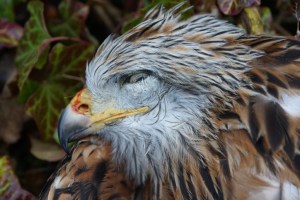
red kite 12And red kite, a species which I have a fair bit of involvement with myself, again we’re in a unique situation here where we have an almost totally marked population of birds, because the bird was reintroduced, all the birds that were released were wing-tagged and we know the fate of these birds because we’ve been radio-tracking them and recording all the wing tag data. And we’re also in a position where we’re able to compare between two reintroduction areas so in the south of England, in the Chilterns, there was a similar reintroduction and we released the same number of birds, about 90 birds were released, also 90 birds in north Scotland and the population in 2006 of red kites in the Chilterns area, with similar productivity, same number of young produced compared roughly to north Scotland is over 300 pairs whereas in north Scotland the population has bubbled along and has stayed pretty well static at about 50 breeding pairs. Indeed the Chilterns population this year is nearly 1,000 breeding pairs whereas the north Scotland population is still stuck below 60 breeding pairs. And the main difference between these rates of growth is explained by the prevailing levels of illegal poisoning in the two countries, i.e. we have far higher levels of illegal poisoning. And last time I was here speaking to you was about red kites and I reported that since reintroduction we’d found 50 kites that had been confirmed as being illegally poisoned since reintroduction began in 1989 and that figure is now 75 in Scotland. And where is this happening? There is a strong coincidence, illegal activity in the east of Scotland in the areas shaded, which are grouse moors, hence the work we’re doing at Langholm and elsewhere to try and find some solutions to this problem. And increasingly it is looking like the driven grouse moor areas are the problem areas to focus on.
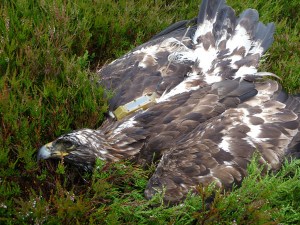
The big concern if you like with the driven grouse shooting set-up these days is that this sport seems to be moving into a new, more intensive phase. So over the past 10-15 years we’ve seen land management systems that have been employed for England for quite a number of years, coming up to Scotland, means more intensive management, more keepers, more predator control, killing as you’re aware of hares and deer tick hosts, increased burning, and we’ve mapped this and we know that there is a strong coincidence where this intensive management is coming in there is a prevalence also of illegal raptor persecution. And I would see this very much as the problem area to focus on in the forthcoming years. There have been some very notorious cases of course, that have occurred in these places where this intensification of management has taken place, in this case ‘Alma’, a golden eagle being radio-tracked and being found dead in the Angus glens a few years ago, illegally poisoned.

So is the situation improving? I think the answer is yes in some places, and this is a map of BTO data on the breeding bird survey buzzard trend, and you will see that the buzzard population, as many of you will know, has increased quite rapidly in recent years but now it’s plateau-ed off as you’d expect and we have a largely stable buzzard population but this species is still absent from some areas of its former range but I think the next breeding bird atlas, coordinated by BTO, will show that the buzzard has recovered large areas of its former range, which is good progress.

Earlier today we were talking about the illegal poisoning incidents in Scotland. This is a bar chart showing the number of reported poisoning incidents over the years since 1989, and as the Minister mentioned, over the past couple of years we have seen a significant decline in illegal poisoning and that is again very good progress. We would say this is informed by a few things perhaps as background which have helped us get to where we are today and this is work in progress, there’s no room for complacency here and we will work with Scottish Land and Estates and others to make sure that we continue to bear down on this problem.

AlmaBut the high point [on the graph] in 2009 was when Alma, the eagle that I mentioned earlier, was found poisoned. We also had a case, the Skibo case also mentioned earlier, a seizure of 10kg of Carbofuran, one of the poisons most implicated in illegal poisoning. And then again, 2011, another satellite-tagged eagle found poisoned. And of course the introduction of vicarious liability making land owners more responsible for the actions of their employees. These welcome steps, apart from the poisonings of course, are helping to move the situation onwards but as I say, we’re not complacent and we will continue to work with partners in the Partnership Against Wildlife Crime to bear down on this problem. What we’ve learned through poisoning hopefully will transfer to other types of raptor crime in due course.
Ok, this is just to remind you also that there are quite a large number of birds that have been killed since 1989 through illegal poisoning – 930 birds and animals have been discovered poisoned and hopefully in the future we can make a dent in that situation. Ultimately, consign illegal poisoning to history, that’s what we want to do.

But also worth mentioning that birds of prey are killed in other ways, they’re shot, trapped or have their nests destroyed and we need to start progressing that as well, as was stated earlier.

So what are the solutions? As we’ve heard earlier, we’re developing legal alternatives to killing birds of prey, and diversionary feeding is one such method, which in the case of the hen harrier has been shown to be pretty effective and we hope over the next few years the grouse moor sector will start adopting this technique and rolling it out across driven grouse moors across Scotland and perhaps even in the north of England. These are legal techniques to solve problems.

I think we also need a model of how grouse moors can be managed more sustainably. It’s not acceptable that this continued intensification occurs and the people that are involved with it are held up as exemplars of best practice if that involves illegal activity. We need a model that fits more with 21st century public expectations and is not predicated on ever-increasing grouse bags. Some of the moors which we see now have the highest grouse bags they’ve had for many years. You would think there would be room for raptors there. They also don’t have the grouse cycle that they used to have because we have medicated grit and other methods developed by GWCT to prevent that from happening. So why can’t these places tolerate raptors? Many of the grouse moors that we’re talking about here don’t have any breeding raptors, let alone hen harriers and eagles, they are black holes for raptors. But we also need more land owners and their employees to work with the police and marginalise those who undermine other good practice and that is happening to a large extent now, through PAW and the work of Scottish Land and Estates and others and we very much welcome that.

And of course there has to be a deterrent out there and that includes effectively robust policing, enforcement, to deal with those serious incidents when they occur.

And I throw this open, but do we need more regulation of the sporting industry? It was discussed last time, the Wildlife and Natural Environment (WANE) Act went through the Scottish Parliament. We have one of the most unregulated shooting industry anywhere in the world. Does this contribute to this problem? In Germany, North America, Scandinavia, other countries, they have quite an established system of regulation for hunting.

But what it’s all about for us, and we will measure success of all of these actions, is through improved populations of the key species, in this case goshawks, ospreys, hen harriers. That is how we will measure progress. But this will be delivered through a range of partnership arrangements as well. It’s easy to knock these partnership arrangements but they are important. They build trust, they build dialogue and in Scotland as a small country of only 5 million people we have good communication between most of the key players here, and that can only help us move this along.

I’m delighted that Scottish Land and Estates are developing their Wildlife Estates initiative; some RSPB staff are involved with helping develop this and we will help Scottish Land and Estates encourage those good land owners who want to do the right thing as we move forward with that programme.

The Langholm Demonstration Project, I won’t dwell on that in detail because Simon’s covered a lot of it – a very important project. This is the model for sustainable grouse moor management going forward. Many of you  may not see that, and Simon said, it’s not without problems, the project, but we’re working our way through those problems as partners, and this less intensive approach to grouse moor management, within the law, with protected raptor species, has to be the way forward, and a combination of hunting and conservation occurs.

And of course I should mention the Partnership Against Wildlife Crime, which over the past few years has really developed into a solid partnership and we’re all working together in the same direction. Thank you very much”.

Pets killed by the bird poisoners

poisonThere’s an article in the Express today talking about pets that have been poisoned by gamekeepers (see here). According to the article, ‘new figures show 60 dogs and 28 cats have been poisoned in the last decade’. Unfortunately, the article doesn’t tell us who published these ‘new figures’ or on what evidence they’re based.

We do know that pets are poisoned, snared, shot etc by gamekeepers because we’ve read the stories in the newspapers and seen the toxicology reports –  we just aren’t sure about the accuracy of these ‘new figures’.

The article goes on to say, ‘over the past decade more than 250 protected birds such as golden and white-tailed eagles, peregrine falcons, red kites and buzzards have died and there are fears a child could fall victim if they touch the bait’. This figure, we know, is definitely an underestimate of the number of raptors poisoned over the last decade.

The main thrust of the article is based around last week’s news that the UK government has decided to ignore the Environmental Audit Committee’s recommendations for addressing wildlife crime (see here) and how the Opposition are now slagging them off for it.

If you think gamekeepers should be held accountable for what they get up, please sign this e-petition: HERE.

Red kite poisoned, 20 months after its mother suffered the same fate

Poisoned kite photo Marc RuddockA young red kite has been poisoned in County Wicklow in the Republic of Ireland, 20 months after its mother was killed the same way.

The young bird was found in January and tests have confirmed it had been poisoned with both Carbofuran and Alphacloralose – the first time both chemicals have been found in an Irish kite. It’s mother was poisoned with Alphachloralose in December 2011.

The Golden Eagle Trust (the group behind the reintroduction of golden eagles, white-tailed eagles and red kites in the Irish Republic) described the poisoning of two generations of a red kite family as “totally devastating”.

The latest bird (Blue White 21) is the first of 21 Irish-born kites to be poisoned. It was found by a member of the public close to the golf club in the town. The bird was still alive but died shortly afterwards.

News article from Golden Eagle Trust here

News article in the Irish Independent here

No need to criminalise possession of Carbofuran, reckons UK govt

EACLast October the cross-party Environmental Audit Committee recommended a range of measures to help tackle wildlife crime in the UK (excluding Scotland) following an extensive public inquiry into the scale of wildlife crime (see here, here, here, here, here for previous blog entries). The recommended measures included:
  • Criminalising the ‘possession’ — not just the use — of the poison Carbofuran, to make it easier to secure bird poisoning convictions;
  • Introducing an offence of vicarious liability to make landowners responsible for wildlife crimes on their land;
  • Providing long-term Home Office and Defra funding to the National Wildlife Crime Unit, and
  • Tightening up the recording of wildlife crime data to help keep track and tackle trends in wildlife crime.

Today, the Government has published its response to the EAC report and has rejected calls from MPs to criminalise possession of Carbofuran and has refused to give funding certainty for the National Wildlife Crime Unit.

Chair of the Environmental Audit Committee, Joan Walley MP, said:

“The Government has missed an opportunity to take two simple measures to protect important wildlife threatened by poachers and criminals in the UK.

It has failed to follow Scotland’s lead in criminalising possession of carbofuran – the main poison used to kill birds of prey. And it has refused to provide the long-term financial certainty that the National Wildlife Crime Unit needs, only making money available for the next 12 months.

It’s good news that the Government will watch how well the ‘vicarious liability’ law works in Scotland, making landowners responsible for what happens on their estates. But the Government should also look at how well the tougher law in Scotland acts as a deterrent, not simply how many convictions there are there.”

Here are the government’s specific responses on the two measures directly relating to raptor persecution:

Recommended measure: To discharge its obligations under the EC Birds Directive, to demonstrate its commitment to addressing raptor persecution and to send a clear signal that it regards poisoning birds of prey as wholly unacceptable, we recommend that the Government immediately introduces an Order under Section 43 of the Natural Environment and Rural Communities Act 2006 proscribing possession of carbofuran and other similar substances in England and Wales.

Government’s response: The Government is firmly committed to addressing raptor persecution in England and Wales and this is one of the UK’s wildlife crime priorities (with a focus on hen harrier, goshawk, golden eagle, white-tailed eagle, red kite and peregrine). There is a robust legal framework for protecting birds of prey with penalties which can include imprisonment for offenders.

Approvals for pesticide products containing carbofuran were revoked in 2001; this means that the advertisement, sale, supply, storage or use of products containing carbofuran is already a criminal offence under existing UK pesticide legislation. This offence carries, on conviction, an unlimited fine.

Similar restrictions apply to all other pesticides as the basis of UK and EU pesticide legislation is that no pesticide may be sold, stored or used unless it is first approved. All sale, storage and use of approved pesticides are subject to strict legislative control and are also subject to a code of practice3  as published by Defra.

Additionally the use of any poisonous substance to kill or take wild birds is already an offence under section 5 of the Wildlife and Countryside Act 1981. The laws surrounding the possession of pesticides, such as carbofuran, which are harmful to wildlife, have been considered, and the conclusion is that there are alternative ways to handle the issue other than introducing an Order under s.43 of the Natural Environment and Rural Communities Act 2006. These include the existing powers under UK pesticide legislation (the Plant Protection Products Regulations 2011 and the Plant Protection Products (Sustainable Use) Regulations 2012), or by encouraging participation in amnesty initiatives, such as the Home Office’s pesticide amnesty, which have already been run very successfully.

 It is difficult to see what more the Government could do that could make it any worse for someone caught using or possessing carbofuran or other similar pesticides.

Recommended measure: Given the scale of ongoing persecution of birds of prey, the current law appears to carry insufficient deterrent weight. We recommend that the Government evaluates the effect of the introduction of an offence of vicarious liability in relation to raptor persecution in Scotland and considers introducing a similar offence in England and Wales in that light. We expect the Government to report to us, or otherwise publish, the results of that review within the next 12 months.

Government’s response: There is already strong legal protection afforded to birds of prey through the provisions of the Wildlife and Countryside Act 1981 where it is an offence to intentionally kill or injure any wild bird; take, damage or destroy the nest of any wild bird while that nest is in use or being built; or take or destroy an egg of any wild bird.

Some birds are further protected by their listing in Schedule 1 to the Act. It is an offence to intentionally or recklessly disturb them while they are building a nest, or are on, in, or near a nest containing eggs or their young. Native raptors are listed in the Schedule and so are afforded this additional protection.

The Scottish Government introduced the concept of vicarious liability for certain offences by an employee or agent through the Wildlife and Natural Environment Act (Scotland) 2011 which inserted a new section 18A into the Wildlife and Countryside Act 1981 (as it applies in Scotland). This provision came into force in January 2012 but it is early days, and as yet there have not been any convictions under the new provisions. While there are no plans to introduce similar vicarious liability offences in England, we will be looking closely at how the new offences in Scotland work in practice and once prosecutions begin to be brought forward it will be possible to start to assess the impact that the introduction of this legislation has made. It is important that such measures are able to deliver a real improvement in the enforcement of wildlife offences if they are to be considered in the shaping of our future wildlife crime policy in England and as yet it is not possible to assess the effect of these measures.

We are happy to review this as soon as suitable statistics are available.

To read all of the Government’s responses, read the report here.

Poisoning stats down, incredulity up

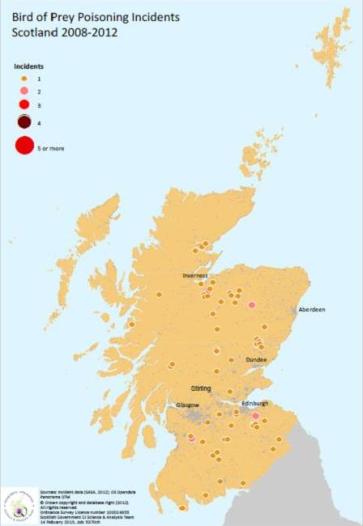
Poisoning 2008-2012The ‘official’ 2012 incidents of confirmed poisoned raptors in Scotland have just been published and show a marked decline in the number of poisoning incidents. According to the latest figures, the number of reported poisoned raptors fell from 16 in 2011 to three in 2012 (one golden eagle and two buzzards).

PAW Scotland press release here

BBC news article here

Are these figures an accurate reflection of what’s going on? We don’t think so. In fact we know they’re not. What the latest poisoning maps fail to show is the number of poisoned baits that were discovered in 2012, the number of other bird species that were poisoned in 2012, and the number of other animals that were poisoned in 2012. And obviously the maps don’t show the poisoning incidents that went undetected/unreported in 2012.

We know for certain that missing from this map is a poisoning incident recorded in the ‘Border’ region in May 2012. According to the published SASA statistics, a poisoned raven and crow were found, along with meat bait and two rabbit baits. This incident is listed as being subject to an ‘on-going police investigation’. Notably, this incident was not reported in the press. Why not? More importantly, why is this incident missing from this map? Why is the focus just on the number of confirmed poisoned raptors? Yes, the illegal poisoning of raptors is of huge concern, but it’s not just raptors that are victim to this barbaric practice. By excluding the discovery of poisoned baits and other types of poisoned species, the wider picture is not being shown. Why is that?

For example, we also know from the SASA stats that a horse and a dog were poisoned with Strychnine in January 2012, a cat was poisoned with Carbofuran and Isofenphos in March 2012, and another cat was poisoned with Carbofuran and Isofenphos in July 2012. None of these incidents appear on this map. There may well be others but the published SASA stats only go up to September 2012 – there’s the customary six-month delay in publishing more recent incidents. Obviously it’s not in the public interest to know where and when lethal poison is being laid out until many months after the event.

On a similar note, has anyone noticed the dot on the map in the Whithorn region (SW Scotland)? Could this possibly be the dead buzzard we blogged about last week (see here)? All we were told was that a man had been arrested following an investigation into a dead buzzard that had been found on the Glasserton Estate. Why didn’t the police press statement mention that the forensic tests confirmed it had been poisoned? Why are we not warned when potentially lethal poisoned baits are being placed out in areas where we might visit with our children and our pets? Why is it so difficult to tell the public what’s actually going on?

On a superficial level then, the latest figures suggest that all those people who’ve been busily poisoning our raptors for the last 100+ years have suddenly stopped. It’s highly implausible, but of course it is possible. Other possibile explanations include (a) the illegal poisoners have just got better at hiding the evidence; (b) they’ve switched to a new type of poison that isn’t currently being screened for in the SASA lab; (c) they’ve switched from poisoning as their method of choice to other methods that are less detectable, such as shooting and trapping.

Fortunately, the authorities are wise to point (c). Environment Minister Paul Wheelhouse said: “There has been real progress but we will not be complacent. I am determined to stamp out these practices once and for all and will remain vigilant to any change in approach being taken by those who seek to persecute raptors“. Of course, this statement is almost a carbon copy of statements made by previous Environment Ministers, going back several years, all of whom were ‘determined to stamp out illegal raptor persecution’ and all of whom failed. The current Minister has recently been presented with three perfect opportunities to make a stand: the dead golden eagle found on Deeside with two broken legs which is believed to have been caught in an illegal trap on an Angus grouse moor before being dumped further north away from the estate (we’ll be blogging more about this case in the next few days); the shot and critically injured golden eagle found on a grouse moor in Dumfries and Galloway; and the shot hen harrier that was found dead on another sporting estate in Grampian. It’ll be interesting to see how many more of these incidents he will tolerate before stronger sanctions are applied. Or, more to the point, how many more incidents we will allow him to tolerate.

Another poisoned buzzard in Scotland

SASA (the Government’s Science & Advice for Scottish Agriculture) have just published their latest ‘Summary of Incidents’ where they report on the number of animals that have been submitted for poisoning analysis, dating from January – September 2012 (see here).

It’s an interesting read. The results from the first three-quarters of 2012 suggest a decline in the number of reported raptor poisoning incidents. Does this reflect an actual decline in poisonings, or does it mask something more cynical, such as a change of tactics in the method of persecution used? Nobody can tell for sure at this stage, although you’d have to be pretty naive to believe the first explanation, especially after the recent shocking non-poisoning incidents such as the dead golden eagle found in a lay-by with two broken legs, believed to have been illegally trapped on an Angus grouse moor and then moved by vehicle in the dead of night and dumped by the side of the road, barely alive and left to suffer an horrific death. Then there was the golden eagle that was found shot and critically injured on a grouse moor in Dumfrieshire, now making a slow recovery. And then the shot hen harrier found dead on another grouse moor in Grampian. And these are just the ones we know about.

The latest SASA results show that a buzzard was found dead in Grampian in September 2012, confirmed to have been poisoned by the illegal pesticide Carbofuran. We don’t remember seeing any police reports about this incident. Perhaps they kept it quiet so as not to hinder their investigation? Fair enough, but it’s now four months later…Perhaps Grampian Police will report where was it found, and whether anyone is being charged. They probably won’t though; yet another incident being quietly swept under the carpet? We blogged about these poisoning incidents going unreported the last time SASA published their stats (see here).

There were a number of dead buzzards that were submitted to SASA for testing between Jan-Sept 2012, including the satellite-tagged ‘Buzz’, believed to be the first sat-tracked buzzard in Scotland (see here). His last signal came from near Brechin, Angus in late September. His corpse was picked up by the side of the road. Given the location and the on-going history of raptor persecution in the nearby area, his body was submitted for a post-mortem. He hadn’t been poisoned though – SASA concluded that his probable cause of death was starvation. It would have been nice if Tayside Police had provided information about this result, given so many were following his movements on Roy Dennis’ website…

Buzz wasn’t the only buzzard to starve to death. There are four other buzzards listed in the report with the same probable cause of death; strange really, when there are some people who maintain that buzzards are gorging themselves silly on gamebirds.

Interestingly, the dead golden eagle found in suspicious circumstances on Harris in June did not not appear in the SASA results, even though the press reported at the time that poisoning was suspected (see here). Perhaps Northern Constabulary will provide an update on the outcome of this one? Yeah, you’re right, of course they won’t.

The importance of the “vicious” gamekeeper’s conviction

Hebblewhite carbofuranFollowing on from yesterday’s blog about the conviction of “vicious” gamekeeper Robert William Hebblewhite (see here), more information has emerged about what happened in court.

We mentioned yesterday how unusual it was for a gamekeeper to be convicted of actually killing the dead raptor(s) found on their land; typically, in case after case, the gamekeeper is convicted for the lesser offence of “possession” (e.g. of poison) and the charge for the actual killing is dropped. This has caused an immense amount of frustration, not only for those investigators who often spend months working on getting a case to court, but also for us, the members of the public, who feel a massive sense of injustice every time it happens.

Well, not so in this case. If you read the article published here, you’ll notice that the judge (in this case District Judge John Stobard) was having none of it.

The prosecutor (Mark Holmes) contended that Hebblewhite’s motive was clear. He was the gamekeeper on this shoot, with responsibilities for pest control. The shoot had been losing birds because buzzards were in the area (his words, not ours!). Pheasant carcasses laced with Carbofuran had been found next to the Carbofuran-poisoned buzzards. A jar of Carbofuran was found in Hebblewhite’s van (see photo). Hebbelewhite’s van had been seen going to the scene on several occasions.

Hebblewhite had pleaded guilty to possession of Carbofuran (the lesser offence) but not for poisoning the buzzards.

The defence argued that the poisoner could have been anyone.

District Judge John Stobard wasn’t fooled. He is reported to have said this:

The birds died from Carbofuran and here in a van is the very stuff  that killed them. The defence says it could have been anyone. Well, could it? I’m not here to discuss the case as a philosophical argument. What is the reality of the matter?

This defendant is here to secure the presence of the shoots that take place by the way of being a gamekeeper. He must look after the pheasants and protect them from other animals.

I think he has done so in an old fashioned and particularly nasty way by lacing the pheasant with Carbofuran in the full knowledge the buzzards would be killed.

It can only point to one conclusion – he did it“.

So finally, here’s a judge who put two and two together and didn’t make five. It’s quite telling though, that this is such an unusual result that we need to highlight it here. What does that say about how our justice system deals with raptor persecution crimes? What does it tell us about our low expectations for these court cases?

In Scotland we’re so used to seeing ridiculous legal obstacles placed in the way of justice that we now expect the poisoner/trapper/killer to get off. “Did you see the defendant place the poison? Did you see the eagle/buzzard/goshawk/red kite actually eat from that very poisoned bait? Was it filmed? Did you have permission to film on that land? Can you forensically match the poison on the bait/inside the dead raptor with the big stash of illegal poison found in the defendant’s house /shed /garage /vehicle /porch /gamebag /jacket pocket? No? Well then he can’t be convicted”.

Well done again to the RSPB Investigations Team, to the CPS, and particularly to District Judge John Stobard for seeing the bleedin’ obvious and acting upon it.

UPDATE: There’s an excellent news piece on this conviction from BBC Look North. Decent coverage and explains that raptor poisoning is a national issue. Great stuff. Available on BBC iPlayer here for limited period (starts at 11.58 – ends at 14.40).

“Vicious” gamekeeper convicted of killing buzzards

A poisoned buzzard
A poisoned buzzard

The RSPB Investigations Team scored another victory today as a Lincolnshire gamekeeper was convicted of killing two buzzards and possessing the banned poison Carbofuran.

Robert William Hebblewhite, 71, of Appleby, Scunthorpe, was fined £1,950 at Lincoln Magistrates Court.

The two buzzards were found dead in Sept 2011 on land at Bonsall Lane in Blyton, near Gainsborough, where he works as a gamekeeper. Toxicology tests revealed the birds had died from Carbofuran poisoning from poison-laced pheasant carcasses. The RSPB said Hebblewhite was in possession of enough Carbofuran to destroy all the raptors in Lincolnshire.

It’s not known whether Hebblewhite is a member of the National Gamekeepers Organisation. Hopefully they will put out a statement to clarify his membership status and to condemn this disgusting, persistent practice.

Congratulations to the RSPB guys for a successful prosecution. Importantly, he was convicted for actually killing the birds and not just for the lesser offence of possession of poison, which is the result we usually see. Well done indeed.

RSPB press release here