‘Missing’ hen harrier Brian: official responses from Environment Secretary & Cairngorms National Park Authority

Two days after the news that young satellite-tagged hen harrier Brian has gone ‘missing’ in the Cairngorms National Park (see here), we now have official responses from Environment Secretary Roseanna Cunningham and from the CEO of the Cairngorms National Park Authority, Grant Moir.

brian-july16_jennyweston

Well done to journalist Christopher Foote (STV news) for publicising this incident (here) and for managing to get these official responses.

Let’s start with the response from the Environment Cabinet Secretary:

I take this issue very seriously and it shows the need to establish whether the disappearance of these birds is indicative of criminal activity. 

It is clearly suspicious, but we must ensure that a robust statistical analysis of all the data from over 200 tagged birds supports any conclusion. 

I will consider what action to take in the light of the full evidence, and I am not ruling out any options.”

Well, at least she didn’t trot out the usual Ministerial line that we’ve heard repeatedly from successive Environment Ministers over a period of several years (e.g. “I’m very disappointed” and “I will not hesitate to bring in further measures if they are deemed necessary“). And at least she has acknowledged this incident, which is better than remaining silent about it. But other than that, this is just yet another holding statement.

We’re partly sympathetic to her position. She has recently instructed a review of raptor satellite tag data (which we fully support) but that review is not expected to be finished until March 2017. That six month delay is not her fault, and nor is it the fault of the review’s authors. They need to conduct a thorough interrogation and analysis of the data and their methods will need to stand up to potential legal scrutiny depending on the Secretary’s subsequent decision to act. We’re well aware (as Roseanna will be) that the well-financed grouse shooting industry will take whatever legal action it can to prevent any Governmental challenge to its current practices, so this review does have to be robust and that will, inevitably, take time. On that basis, a holding statement at this stage is probably the best we could expect.

However, we’re also partly unsympathetic to Roseanna’s position. As we’ve said before, many, many, times, the evidence of criminal activity on grouse moors is already overwhelming and has been available for several decades. It has built and built and built. We don’t need to wait for yet another study to reach the same conclusion. It’s hugely frustrating that we have to put up with the constant stalling tactics from the Government before any action is taken. Again, Roseanna Cunningham isn’t entirely responsible for the stalling – every other Environment Minister has played their part in that, and some more than others – but eventually, a point is reached where the stalling and inaction is no longer tolerable.

Let’s now look at the statement from Grant Moir, CEO of the Cairngorms National Park Authority:

We are working with Police Scotland, SNH and Scottish Government to look at next steps around wildlife crime in the Cairngorms National Park.”

Really, Grant? 48 hours of thinking time and that’s the best you can offer? You needn’t have bothered. No, really, you needn’t have bothered.

Photograph of hen harrier Brian by Jenny Weston

Too embarrassing for words

Following this morning’s news that satellite-tagged hen harrier Brian has ‘disappeared’ in the Cairngorms National Park just a few weeks after fledging (see here), we’ve been waiting to see what the Environment Secretary and the Cairngorms National Park Authority had to say about it, and more importantly, what they intended to do about it.

This won’t take long……they’ve said absolutely nothing at all.

All as silent as Brian’s satellite tag.

Nothing on the CNPA news website, nothing on their twitter feed, nothing on the PAW Scotland website, and nothing on the Environment Secretary’s twitter feed.

Sorry Brian, you’re just too embarrassing for words.

brian-july16_jennyweston

UPDATE 29 September 2016: Official response from Environment Secretary and CEO of Cairngorms National Park Authority (here)

Satellite-tagged hen harrier ‘disappears’ in Cairngorms National Park

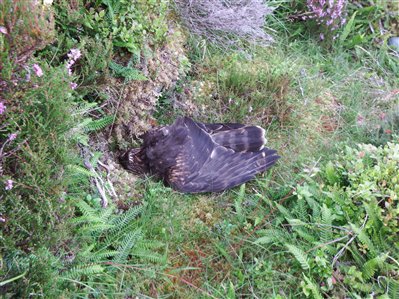
Another of this year’s hen harrier chicks has ‘disappeared’ just a few weeks after fledging, this time in the Cairngorms National Park.

This one was called Brian, after raptor worker Brian Etheridge, and he had hatched in a nest in Perthshire, within the National Park. After fledging, he stayed within the Park boundary until his signal, ‘suddenly and without warning‘, stopped abruptly on 22 August 2016 a few miles from Kingussie. Searches for his body and tag proved fruitless. The details of Brian’s short life can be read here on the RSPB Skydancer blog.

kingussie

brian-july16_jennyweston

This is a photo of Brian taken at the nest in July with his newly-fitted satellite tag (photo by Jenny Weston).

Brian is the second of this year’s cohort to suddenly ‘disappear’ – in early August, hen harrier Elwood also vanished, in the grouse moor ridden Monadhliath mountains just to the NW of the Park (see here).

The area around Kingussie is also ridden with driven grouse moors. In fact, it wasn’t far from here where hen harrier Lad’s corpse was found in September 2015, suspected shot (see here).

So what now? A few weeks ago, following the ‘disappearance’ of eight satellite-tagged golden eagles, as well as hen harrier Elwood, in the Monadhliaths, Environment Secretary Roseanna Cunningham announced a review of the sat tag data of three raptor species – golden eagle, hen harrier, red kite – to ‘look for patterns of suspicious activity‘ (see here). That review is very welcome but the team working on the analysis is not expected to report until March 2017 at the earliest. That’s six months away. And then there’ll be further delays as the Government digests the review’s findings and thinks about how to respond, or not.

And to be frank, we don’t need to wait for the review to detect ‘patterns of suspicious activity’ – the pattern of illegal persecution has been known for years. The cause of these raptor disappearances is not unreliable sat tags (94% reliability in a recent study of Montagu’s harriers – see here), nor is it non-existent wind farms (see here), nor is it ‘bird activists’ killing the birds to smear the grouse shooting industry (see here).

We’ve said this before and we’ll say it again. Endless peer-reviewed scientific papers and government reports on golden eagles, hen harriers, red kites and peregrines have unequivocally linked the illegal killing of these raptors with intensively-managed driven grouse moors. Why pretend nobody knows what’s going on?

The ‘disappearance’ of Brian is bad enough, but for this ‘disappearance’ to take place in the Cairngorms National Park just adds to the ever-increasing catalogue of shame that the Park Authority needs to address. Cue expressions of ‘disappointment’ and more stalling tactics (futile partnership-working and discussions) from the CNPA.

Here’s that catalogue of shame, in full:

2003

Apr: 3 x poisoned buzzards (Carbofuran) + 2 grey partridge baits. Kingussie, CNP

Jun: Attempted shooting of a hen harrier. Crannoch, CNP

2004

May: 1 x poisoned buzzard (Carbofuran). Cuaich, CNP

Nov: 1 x poisoned red kite (Carbofuran). Cromdale, CNP

Dec: 1 x poisoned buzzard (Carbofuran). Cromdale, CNP

2005

Feb: 1 x poisoned buzzard (Carbofuran). Cromdale, CNP

Feb: 1 x poisoned buzzard (Carbofuran). Cromdale, CNP

Mar: 3 x poisoned buzzards, 1 x poisoned raven (Carbofuran). Crathie, CNP

2006

Jan: 1 x poisoned raven (Carbofuran). Dulnain Bridge, CNP

May: 1 x poisoned raven (Mevinphos). Grantown-on-Spey, CNP

May: 1 x poisoned golden eagle (Carbofuran). Morven [corbett], CNP

May: 1 x poisoned raven + 1 x poisoned common gull (Aldicarb) + egg bait. Glenbuchat, CNP

May: egg bait (Aldicarb). Glenbuchat, CNP

Jun: 1 x poisoned golden eagle (Carbofuran). Glenfeshie, CNP

2007

Jan: 1 x poisoned red kite (Carbofuran). Glenshee, CNP

Apr: Illegally set spring trap. Grantown-on-Spey, CNP

May: Pole trap. Grantown-on-Spey, CNP

May: 1 x poisoned red kite (Carbofuran). Tomintoul, CNP

May: Illegally set spring trap. Grantown-on-Spey, CNP

Jun: 1 x poisoned buzzard (Carbofuran) + rabbit & hare baits. Grantown-on-Spey, CNP

Jun: 1 x poisoned buzzard (Carbofuran) + rabbit bait. Grantown-on-Spey, CNP

Jul: 1 x poisoned raven (Carbofuran). Ballater, CNP

Sep: 1 x shot buzzard. Newtonmore, CNP

Sep: 1 x shot buzzard. Grantown-on-Spey, CNP

Dec: 1 x poisoned buzzard (Alphachloralose). Grantown-on-Spey, CNP

Dec: 1 x poisoned buzzard (Carbofuran) + rabbit bait. Grantown-on-Spey, CNP

2008

Jan: 1 x poisoned buzzard (Alphachloralose). Nr Grantown-on-Spey, CNP

Mar: 1 x poisoned buzzard (Carbofuran). Nr Grantown-on-Spey, CNP

Dec: 1 x poisoned buzzard (Alphachloralose). Nr Grantown-on-Spey, CNP

2009

May: 2 x poisoned ravens (Mevinphos). Delnabo, CNP

Jun: rabbit bait (Mevinphos). nr Tomintoul, CNP

Jun: 1 x shot buzzard. Nr Strathdon, CNP

Jun: 1 x illegal crow trap. Nr Tomintoul, CNP

2010

Apr: Pole trap. Nr Dalwhinnie, CNP

Jun: 1 x pole-trapped goshawk. Nr Dalwhinnie, CNP

Jun: Illegally set spring trap on tree stump. Nr Dalwhinnie, CNP

Sep: 2 x poisoned buzzards (Carbofuran) + rabbit bait. Glenlochy, CNP

Oct: 2 x poisoned buzzards (Carbofuran) + rabbit bait. Nr Boat of Garten, CNP

2011

Jan: 1 x shot buzzard. Nr Bridge of Brown, CNP

Mar: 1 x poisoned golden eagle (Carbofuran). Glenbuchat, CNP

Apr: 1 x poisoned buzzard (Carbofuran & Aldicarb). Nr Bridge of Brown, CNP

May:  1 x poisoned buzzard (Carbofuran) + rabbit bait. Glenbuchat, CNP

May: 1 x shot short-eared owl, found stuffed under rock. Glenbuchat, CNP

Jun: 1 x shot peregrine. Pass of Ballater, CNP

Aug: grouse bait (Aldicarb). Glenlochy, CNP

Sep: Satellite-tagged golden eagle ‘disappears’. Nr Strathdon, CNP

Nov: Satellite-tagged golden eagle ‘disappears’. Nr Strathdon, CNP

2012

Apr: 1 x shot short-eared owl. Nr Grantown-on-Spey, CNP

Apr: Peregrine nest site burnt out. Glenshee, CNP

May: Buzzard nest shot out. Nr Ballater, CNP

2013

Jan: White-tailed eagle nest tree felled. Invermark, CNP

May: 1 x shot hen harrier. Glen Gairn, CNP

May: Satellite-tagged golden eagle ‘disappears’. Glenbuchat, CNP

2014

Apr: Satellite-tagged white-tailed eagle ‘disappears’. Glenbuchat, CNP

May: Armed masked men shoot out a goshawk nest. Glen Nochty, CNP

2015

Sep: Satellite-tagged hen harrier ‘Lad’ found dead, suspected shot. Newtonmore, CNP.

2016

May: 1 x shot goshawk. Strathdon, CNP

Jun: Illegally set spring traps. Invercauld, CNP

Aug: Satellite-tagged hen harrier ‘Brian’ ‘disappears’, near Kingussie, CNP

In addition to the above list, two recent scientific publications have documented the long-term decline of breeding peregrines on grouse moors in the eastern side of the National Park (see here) and the catastrophic decline of breeding hen harriers, also on grouse moors in the eastern side of the Park (see here).

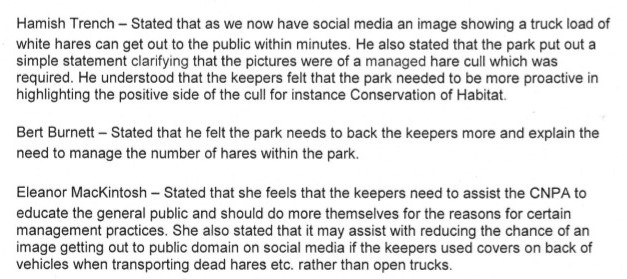
And let’s not forget the on-going massacre of mountain hares, taking place annually within the boundary of the National Park (e.g. see here, here).

Let’s see how the Environment Secretary and the Cairngorms National Park Authority respond this time. We’ll add links to any statements if/when they appear throughout the day.

UPDATE 18.40 hrs: Too embarrassing for words (here)

UPDATE 29 September 2016: Official responses from Environment Secretary and Cairngorms National Park Authority (here)

Illegal raptor killing is PR disaster for Cairngorms National Park, says Convener

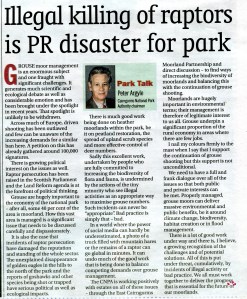
strathspey-badenoch-herald-park-talk-15th-sept-2016Illegal raptor killing is a PR disaster for the Cairngorms National Park, says Peter Argyle, the current Convener of the Cairngorms National Park Authority.
He’s not wrong.

Since the Cairngorms National Park was established in 2003, there have been over 60 recorded incidents of illegal persecution (see here) and these are only the ones that have reported. There are likely to have been many, many more that have gone undiscovered.

Writing in a blog published on the CNPA website (here), and also published in the Strathspey and Badenoch Herald last week (see photo), Peter follows in the footsteps of his predecessor Duncan Bryden, who, two years ago, wrote to the then Environment Minister Paul Wheelhouse about how raptor persecution “threatens to undermine the reputation of the National Park as a high quality wildlife tourism destination” (see here).

Peter’s blog is fairly balanced; he acknowledges that there are some estates within the National Park who are engaged in on-going conservation efforts (Glenfeshie would be a good example) but he also recognises that illegal raptor persecution is undertaken by those seeking to maximise grouse numbers. And therein lies the problem.

Peter says, “Properly managed, grouse moors can deliver massive environmental and public benefits, be it around climate change, biodiversity, habitat creation or in flood management“. But what does “properly managed” actually mean? Presumably not the intensive management regimes currently in use on many grouse moor estates within the Park which most definitely are not delivering ‘massive environmental and public benefits’ – in fact the exact opposite (see here).

Peter also says, “I nail my colours firmly to the mast when I say that I support the continuation of grouse shooting but this support is not unconditional“. He wants to have “a full and frank dialogue over all of the issues so that both public and private interests can be met“. He doesn’t seem to have grasped the fact that years of dialogue have proven futile, resulting in Golden eagles poisoned, golden eagles ‘disappearing’, chronic golden eagle survival rates (here), white-tailed eagles ‘disappearing’, white-tailed eagle nests felled, hen harriers shot, breeding hen harriers in catastrophic decline (here), goshawks shot, goshawk nests being attacked, peregrines shot, peregrine nest sites burnt out, breeding peregrines in long-term decline (here), buzzards poisoned, buzzards shot, red kites poisoned, short-eared owls shot, poisoned baits laid out, illegally-set traps, and mountain hares massacred.

We’ve blogged before about how the Cairngorms National Park Authority can take steps to stop the illegal persecution of raptors within the Park boundary (here) and we’d remind Peter, not that he needs it as Park Convener, of the CNPA’s four aims, set out by Parliament:

  1. To conserve and enhance the natural and cultural heritage of the CNP;
  2. To promote sustainable use of the natural resources of the CNP;
  3. To promote understanding and enjoyment (including enjoyment in the form of recreation) of the special qualities of the CNP by the public;
  4. To promote sustainable economic and social development of the CNP’s communities.

These aims are to be pursued collectively. However, if there is conflict between the first aim and any of the others then greater weight must be given to the first aim (section 9.6 of the National Parks (Scotland) Act).

If you haven’t already, please consider participating in the CNPA’s current consultation process on the Park’s five-year management plan. This plan will help guide the CNPA’s work on the most pressing issues, one of which has been identified as grouse moor management. Let the CNPA know of your concerns about intensive grouse moor management within the Park boundary, about the environmental damage it is causing and how self-regulation has failed, repeatedly, since the Park was first established back in 2003. The consultation closes on 30 Sept and the documents can be accessed here.

Royal grouse shoot in the Cairngorms National Park: a military operation?

The tabloids have been making much of the fact that the Queen was photographed driving Kate Middleton to a picnic on Balmoral Estate last week, joining Prince William who had apparently been grouse shooting (Daily Mail here; Daily Mirror here; Daily Record here).

Whilst the tabloids focused on the important things like patterned scarves and casual sleeveless jackets, our attention was drawn to something else:

At the butts behind imposing Creag Bhiorach, dozens of soldiers were waiting to do the beating and drive the grouse towards the waiting guns“.

Eh? Soldiers working as beaters on a royal grouse shoot in the Cairngorms National Park? Shurely shome mishtake?

Surely a case of mistaken identity? Surely anybody camo-ed up to work as beaters weren’t professional soldiers paid for by our taxes? Surely they were simply local men and women from the rural community, reliant on the oh-so-important beater’s wage (average £55 per day) so ‘vital’ to the local economy? Isn’t that what we’re so frequently told?

But maybe it’s not a mistake. Maybe soldiers are being used to work as beaters on the royal grouse shoot. Have a look at this (here), a report detailing the royal duties of the (now former) 1st Battalion The Argyll and Sutherland Highlanders in 1962:

“(b) Beating.

There were seventeen days of grouse driving on the two moors, Micras and Gairnshiel, which lie side by side to the North of the River Dee. The Balmoral ground was not driven at all, there being too few birds to merit it. On all shooting days one officer and forty ORs turned out as beaters to the Royal shooting party. This duty required a high standard of fitness, alertness and a definite restraint on language: it was not universally a popular duty despite the extra-duty pay (!), but the standard of beating achieved was good enough to please Gillan, the head-keeper, and to provide a total bag for the guns of over 2,200 brace which was considerably higher than anticipated at the beginning of the season”.

Has this been going on since 1962? Great to see our taxes being put to such good public use, and inside a National Park, too.

How to stop the illegal persecution of raptors in the Cairngorms National Park

Yesterday we blogged about the illegal persecution of birds of prey in the Cairngorms National Park (CNP) and how, 13 years after the Park was first established, persecution continues (see here).

Some (but definitely not all) the grouse moor managers within the CNP are running rings around the Park Authority (CNPA), and have been doing so for years: Golden eagles poisoned, golden eagles ‘disappearing’, white-tailed eagles ‘disappearing’, white-tailed eagle nests felled, hen harriers shot, breeding hen harriers in catastrophic decline, goshawks shot, goshawk nests being attacked, peregrines shot, peregrine nest sites burnt out, breeding peregrines in long-term decline, buzzards poisoned, buzzards shot, red kites poisoned, short-eared owls shot, poisoned baits laid out, illegally-set traps, and mountain hares massacred. All within the Cairngorms National Park, a so-called haven for Scottish wildlife. It’s scandalous.

Lad HH

So what has the Cairngorms National Park Authority been doing about all this? To date, they’ve adopted the softly, softly partnership approach, which, to be fair, is a reasonable starting point. But this approach relies on ALL the ‘partners’ pulling together in the same direction; it’s not going to work if some of the ‘partners’ don’t or won’t comply with the law (i.e. not killing protected birds of prey).

We’ve seen the Cairngorms Nature Action Plan, a five-year initiative which included the aim of restoring the full community of raptor species within the NP and managing mountain hare populations for the benefit of golden eagles (see here). Three years on and evidence we produced yesterday shows the Plan is going nowhere fast (see here).

We’ve seen the Convenor of the CNPA pleading with the then Environment Minister to help combat raptor persecution within the NP because it ‘threatens to undermine the reputation of the National Park as a high quality wildlife tourism destination‘ (see here). The then Environment Minister (Dr Aileen McLeod) attended a meeting with ‘partners’ during which there was a ‘recognition of the progress made in recent years’ (see here). Eh? Have a look at our list of raptor persecution crimes within the CNP (here) – can you spot any sign of progress? No, because there hasn’t been any.

The next approach from the CNPA was the ‘East Cairngorms Moorland Partnership’. This is an interesting one. One of the stated aims of this ‘partnership’, comprising six contiguous estates and the CNPA, is to ‘enhance raptor and other priority species conservation’. A noble aim, but when you look at the details of this Partnership’s work plan it’s all pretty vague and lacking substance. It can be downloaded here:

east-cairngorms-moorland-partnership_statementofpurpose

Things don’t improve when you realise who is involved with this ‘Partnership’. One of the six estates is none other than Invercauld Estate. You remember Invercauld Estate – the place where illegally-set spring traps were recently discovered (here). The Estate’s response was (a) to suggest it didn’t happen but if it had happened it was probably a set-up to smear the grouse-shooting industry (see here), and (b) despite nothing happening, the Estate ‘took action’ although we’re not allowed to know what that ‘action’ entailed because it’s a secret (see here). Presumably, the setting of illegal traps isn’t part of the work plan designed to ‘enhance raptor and other priority species conservation’.

So where does the CNPA go from here? Well, we said yesterday that there was light at the end of the tunnel. And there is. The CNPA is currently consulting on the NP’s ‘Partnership Plan’ for 2017-2022. This is the management plan for the CNP for that five-year period and will help guide the CNPA’s work on the most pressing issues. The CNPA has identified several ‘big issues’ on which it wants to hear your views, and one of those is ‘Moorland Management’.

The question the CNPA is posing is:

How can management for grouse be better integrated with wider habitat and species enhancement objectives such as woodland expansion, peatland restoration and raptor conservation?

The obvious answer to achieving raptor conservation is to get the grouse shooting estates to stop illegally killing raptors! But how?

In the consultation document, the CNPA says the East Cairngorms Moorland Partnership is the stated mechanism for delivering raptor conservation within the eastern side of the NP. Er, illegally set traps being found on one of the Partnership estates doesn’t inspire confidence, does it?

There must come a time when the CNPA has to realise that the ‘partnership’ approach is not working, and to be frank, is unlikely to ever succeed. In our opinion, that time is now.

The CNPA actually has a great deal of power and authority to act against those who continue to persecute raptors within the NP. Have a read of this blog (here) published on the always interesting ParksWatchScotland blog. The authors suggest that the CNPA can introduce ‘hunting byelaws’ for grouse shooting estates within the CNP. Permits could be removed if wildlife crime is discovered and also if Estates refuse to allow monitoring cameras. Permits could also be used to limit the size of grouse ‘bags’, thus helping break the cycle of ever-increasing intensification of grouse moor management practices. Permits could also be used to limit the number of traps in use.

As the authors also point out, byelaws were recently created for the Loch Lomond & Trossachs NP to try and limit camping. So why not create them for the CNP to try and limit raptor persecution?

The CNPA has four aims, set out by Parliament:

  1. To conserve and enhance the natural and cultural heritage of the CNP;
  2. To promote sustainable use of the natural resources of the CNP;
  3. To promote understanding and enjoyment (including enjoyment in the form of recreation) of the special qualities of the CNP by the public;
  4. To promote sustainable economic and social development of the CNP’s communities.

These aims are to be pursued collectively. However, if there is conflict between the first aim and any of the others then greater weight must be given to the first aim (section 9.6 of the National Parks (Scotland) Act).

We’d encourage as many of you as possible to participate in the CNPA’s consultation process (it closes on 30 Sept 2016) and mention the idea of these byelaws and the CNPA’s responsibility for conserving the natural heritage above all else. You might think, ‘Oh, what’s the point, the CNPA won’t listen to me, they’re in the pockets of the large shooting estates’. Well, perhaps so in the past but perhaps things are changing. Have a read of this blog (here), entitled ‘Time to move with the times‘ recently written by Will Boyd Wallis, Head of Land Management and Conservation at the CNPA. There are clear signs in Will’s blog that the old regime is being challenged and the more people who write in support of this, the better.

You can access the consultation documents here.

The illegal killing of birds of prey in the Cairngorms National Park

Many people think of the Cairngorms National Park as a wildlife haven. It’s what many expect of a National Park; indeed, it’s what we should all expect of a National Park.

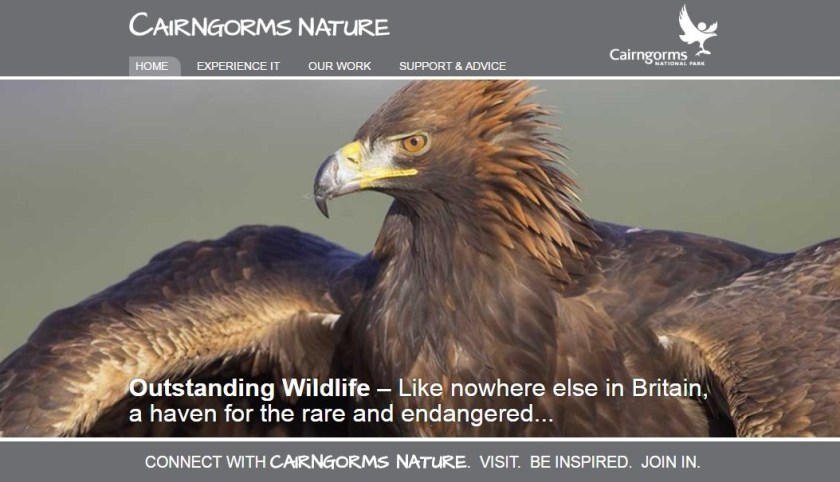
The Cairngorms National Park Authority (CNPA) promotes it as such (this screen grab taken from the CNPA website):

CNPscreengrab

But just how much of a ‘wildlife haven’ is it?

Here’s the gruesome reality.

The following list, which we’ve compiled from various data sources but predominantly from the RSPB’s annual persecution reports, documents over 60 illegal raptor persecution incidents inside the Cairngorms National Park (CNP) since 2002. (The Park wasn’t formally established until 2003 but we’ve included 2002 data as the area had been mapped by then). This list includes just the crimes we know about. How many more went unreported/undiscovered?

2002

Feb: 2 x poisoned buzzards (Carbofuran) + rabbit bait. Tomintoul

Mar: 2 x poisoned buzzards (Carbofuran) + 2 rabbit baits. Cromdale

2003

Apr: 3 x poisoned buzzards (Carbofuran) + 2 grey partridge baits. Kingussie, CNP

Jun: Attempted shooting of a hen harrier. Crannoch, CNP

2004

May: 1 x poisoned buzzard (Carbofuran). Cuaich, CNP

Nov: 1 x poisoned red kite (Carbofuran). Cromdale, CNP

Dec: 1 x poisoned buzzard (Carbofuran). Cromdale, CNP

2005

Feb: 1 x poisoned buzzard (Carbofuran). Cromdale, CNP

Feb: 1 x poisoned buzzard (Carbofuran). Cromdale, CNP

Mar: 3 x poisoned buzzards, 1 x poisoned raven (Carbofuran). Crathie, CNP

2006

Jan: 1 x poisoned raven (Carbofuran). Dulnain Bridge, CNP

May: 1 x poisoned raven (Mevinphos). Grantown-on-Spey, CNP

May: 1 x poisoned golden eagle (Carbofuran). Morven [corbett], CNP

May: 1 x poisoned raven + 1 x poisoned common gull (Aldicarb) + egg bait. Glenbuchat, CNP

May: egg bait (Aldicarb). Glenbuchat, CNP

Jun: 1 x poisoned golden eagle (Carbofuran). Glenfeshie, CNP

2007

Jan: 1 x poisoned red kite (Carbofuran). Glenshee, CNP

Apr: Illegally set spring trap. Grantown-on-Spey, CNP

May: Pole trap. Grantown-on-Spey, CNP

May: 1 x poisoned red kite (Carbofuran). Tomintoul, CNP

May: Illegally set spring trap. Grantown-on-Spey, CNP

Jun: 1 x poisoned buzzard (Carbofuran) + rabbit & hare baits. Grantown-on-Spey, CNP

Jun: 1 x poisoned buzzard (Carbofuran) + rabbit bait. Grantown-on-Spey, CNP

Jul: 1 x poisoned raven (Carbofuran). Ballater, CNP

Sep: 1 x shot buzzard. Newtonmore, CNP

Sep: 1 x shot buzzard. Grantown-on-Spey, CNP

Dec: 1 x poisoned buzzard (Alphachloralose). Grantown-on-Spey, CNP

Dec: 1 x poisoned buzzard (Carbofuran) + rabbit bait. Grantown-on-Spey, CNP

2008

Jan: 1 x poisoned buzzard (Alphachloralose). Nr Grantown-on-Spey, CNP

Mar: 1 x poisoned buzzard (Carbofuran). Nr Grantown-on-Spey, CNP

Dec: 1 x poisoned buzzard (Alphachloralose). Nr Grantown-on-Spey, CNP

2009

May: 2 x poisoned ravens (Mevinphos). Delnabo, CNP

Jun: rabbit bait (Mevinphos). nr Tomintoul, CNP

Jun: 1 x shot buzzard. Nr Strathdon, CNP

Jun: 1 x illegal crow trap. Nr Tomintoul, CNP

2010

Apr: Pole trap. Nr Dalwhinnie, CNP

Jun: 1 x pole-trapped goshawk. Nr Dalwhinnie, CNP

Jun: Illegally set spring trap on tree stump. Nr Dalwhinnie, CNP

Sep: 2 x poisoned buzzards (Carbofuran) + rabbit bait. Glenlochy, CNP

Oct: 2 x poisoned buzzards (Carbofuran) + rabbit bait. Nr Boat of Garten, CNP

2011

Jan: 1 x shot buzzard. Nr Bridge of Brown, CNP

Mar: 1 x poisoned golden eagle (Carbofuran). Glenbuchat, CNP

Apr: 1 x poisoned buzzard (Carbofuran & Aldicarb). Nr Bridge of Brown, CNP

May:  1 x poisoned buzzard (Carbofuran) + rabbit bait. Glenbuchat, CNP

May: 1 x shot short-eared owl, found stuffed under rock. Glenbuchat, CNP

Jun: 1 x shot peregrine. Pass of Ballater, CNP

Aug: grouse bait (Aldicarb). Glenlochy, CNP

Sep: Satellite-tagged golden eagle ‘disappears’. Nr Strathdon, CNP

Nov: Satellite-tagged golden eagle ‘disappears’. Nr Strathdon, CNP

2012

Apr: 1 x shot short-eared owl. Nr Grantown-on-Spey, CNP

Apr: Peregrine nest site burnt out. Glenshee, CNP

May: Buzzard nest shot out. Nr Ballater, CNP

2013

Jan: White-tailed eagle nest tree felled. Invermark, CNP

May: 1 x shot hen harrier. Glen Gairn, CNP

May: Satellite-tagged golden eagle ‘disappears’. Glenbuchat, CNP

2014

Apr: Satellite-tagged white-tailed eagle ‘disappears’. Glenbuchat, CNP

May: Armed masked men shoot out a goshawk nest. Glen Nochty, CNP

2015

Sep: Satellite-tagged hen harrier ‘Lad’ found dead, suspected shot. Newtonmore, CNP

2016

May: 1 x shot goshawk. Strathdon, CNP

Jun: Illegally set spring traps. Invercauld, CNP

In addition to the above list, two recent scientific publications have documented the long-term decline of breeding peregrines on grouse moors in the eastern side of the National Park (see here) and the catastrophic decline of breeding hen harriers, also on grouse moors in the eastern side of the Park (see here).

And let’s not forget the on-going massacre of mountain hares, taking place annually within the boundary of the National Park (e.g. see here, here).

So, who still thinks the Cairngorms National Park is a ‘wildlife haven’?

With over 40% of the National Park covered by driven grouse moors, it’s anything but. The next blog will explore how the Cairngorms National Park Authority has failed, so far, to effectively address the illegal killing of birds of prey, but there is a small chink of light ahead…..more shortly.

UPDATE 7/9/16: How to stop the illegal persecution of raptors in the Cairngorms National Park (here)

An interesting letter from Invercauld Estate

In July we blogged about the discovery in June of a critically-injured Common gull that had been found caught in two illegally-set spring traps on Invercauld Estate in the Cairngorms National Park (see here).

Cairngorms Invercauld - Copy

We also blogged about a bizarre press statement from Invercauld Estate (issued via the GWCT’s twitter feed) in which they denied any illegal activity had taken place or if it had, it was perhaps a set-up ‘intended to discredit the grouse industry‘ (see here).

We also blogged about the Scottish Gamekeepers’ Association’s press statement, which said the SGA was conducting its own enquiry (see here).

We also blogged about Police Scotland’s view that a Common gull had been found caught in an illegally-set trap but ‘despite a thorough investigation‘, Police enquiries had failed to find further evidence to proceed with a potential prosecution and ‘there are at present no further investigative opportunities available‘ (see here).

So that looked like the end of it. Until, through a series of FoIs to the Scottish Government and the Cairngorms National Park Authority, a very interesting letter has emerged.

The letter, dated 27 July 2016 (so a week after the original story had broken) was written by Angus McNicol, who identifies himself as the Estate Manager for Invercauld Estate, and was addressed to the Cabinet Secretary for the Environment, Roseanna Cunningham. A copy of the letter was also sent to the Cairngorms National Park Authority. It’s a fascinating read.
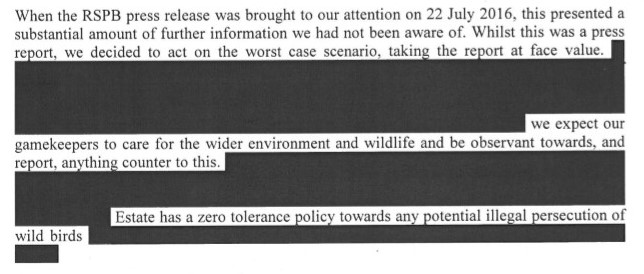
Here is a copy of the letter: Invercauld Estate letter

Having read it, our first question was, ‘Why was this letter written?’ That’s a hard question to answer because we can’t get inside Mr McNicol’s head to read his thought processes. We can, though, speculate about the intentions. In our opinion, this letter was written to reassure the Cabinet Secretary that Invercauld Estate takes wildlife crime seriously and they’ve done something about it.

You’ll see that one paragraph in this letter has been partially redacted (by the Scottish Government – and, incidentally, the copy of the letter received from the Cairngorms National Park Authority was redacted in exactly the same place). It’s this partial paragraph that interests us the most. Here it is:

Invercauld redacted

Let’s focus on the sentence immediately before the redaction begins. “Whilst this was a press report, we decided to act on the worst case scenario, taking the report at face value“. Assuming that the ‘worst case scenario‘ might have been that an Estate employee was responsible for illegally setting the traps, the Estate ‘decided to act‘. What action they took is unknown, because that bit has been redacted. But interestingly, the word ‘gamekeepers’ appears later in the same paragraph.

Later in the letter, Mr McNicol reiterates that ‘action‘ had been taken:

Invercauldredacted2

So, was the ‘action’ to which Mr McNicol refers, disciplinary action against one or more Invercauld Estate gamekeepers in relation to this crime? Has somebody been sacked?

If that’s actually what happened, and if Mr McNicol has admitted this in writing, wouldn’t that trigger an investigation in to a potential vicarious liability prosecution?

Is that why, later in the letter, Mr McNicol goes to great lengths to explain the measures that Invercauld Estate has put in place to ensure its staff do not commit wildlife crimes? These measures, explained in such detail, might form the defence of ‘due diligence’ – remember, if an estate is accused of being vicariously liable for certain wildlife crimes, a defence of due diligence is permitted (see here).

Whether an estate’s attempts at due diligence are a sufficient defence to an accusation of vicarious liability is for a court to decide. We presume, if our interpretation of what happened is accurate, that both the Scottish Government and the Cairngorms National Park Authority have notified Police Scotland about the content of Mr McNicol’s letter and Police Scotland will now be following this up with an investigation? Time will tell.

The content of Mr McNicol’s letter raises some other interesting points.

Why, if Invercauld Estate has taken action against an employee, did the Estate deny in their original press statement that the offence had even taken place or claim that if it had, it had been a set-up ‘intended to discredit the grouse industry‘?

Who is the person/organisation that conducted “independent searches of hill ground and of buildings on the Estate to check for illegal traps, snares and illegal pesticides“? Presumably it wasn’t the GWCT – they can hardly be classed as being ‘independent’ if they’re publishing press statements on their twitter feed on behalf of Invercauld Estate. And presumably it wasn’t anybody from Scottish Land & Estates – they can hardly be classed as ‘independent’ as Mr McNicol states Invercauld Estate is a member of SLE. And presumably it wasn’t anybody from the SGA – they can hardly be classed as ‘independent’ as Mr McNicol states that ‘all the relevant staff are members of the SGA‘. So who was it?

When did these ‘independent searches of hill ground and of buildings on the Estate to check for illegal traps, snares and illegal pesticides” take place, and how often have they been conducted?

Why did Police Scotland, as part of what they described as a ‘thorough investigation‘, only speak to a representative of Invercauld Estate (Mr McNicol)? Why didn’t officers question, under caution, the gamekeepers who work on the part of the Estate where the illegally-set traps were found?

It’s all very interesting.

Perhaps we’ll get some answers once the SGA has finished its enquiry in to what happened. Presumably they’ll be publishing their findings in due course….

Coordinated hunt & shooting of a hen harrier in 2013 – location revealed

A couple of years ago (20 June 2014) we blogged about the alleged coordinated hunt and shooting of a male hen harrier on a grouse moor in Scotland (see here).

This alleged crime had actually taken place in May 2013 – it was reported to Police Scotland by the two members of the public who had witnessed the event, Police Scotland investigated but no further evidence was available to take the case forward.

For some reason, Police Scotland failed to publicise this incident or appeal for information, despite hen harrier persecution being a UK National Wildlife Crime Priority. Instead, it was left to the RSPB to issue a press release over a year later (see here) as part of a wider call for more sporting estates to take action to protect hen harriers.

At the time, the location of this incident was pretty sketchy. The RSPB press release said it took place ‘on a moor in the eastern Cairngorms, within the boundary of the Cairngorms National Park’.

But then roll on to late 2015 and the publication of RSPB Scotland’s 20-year review of raptor persecution crimes. If you have a look at Table 3 in this report, which details confirmed incidents of persecution or attempted persecution (excluding poisoning) of birds of prey in Scotland 2013, the following information appears:

HH shot Glen Gairn

According to this table, a hen harrier was shot at ‘Glen Gairn’ in Aberdeenshire in May 2013. We presume, given the date and location, this is the same incident as referred to in that 2014 RSPB press release.

So, Glen Gairn. Where’s that then?

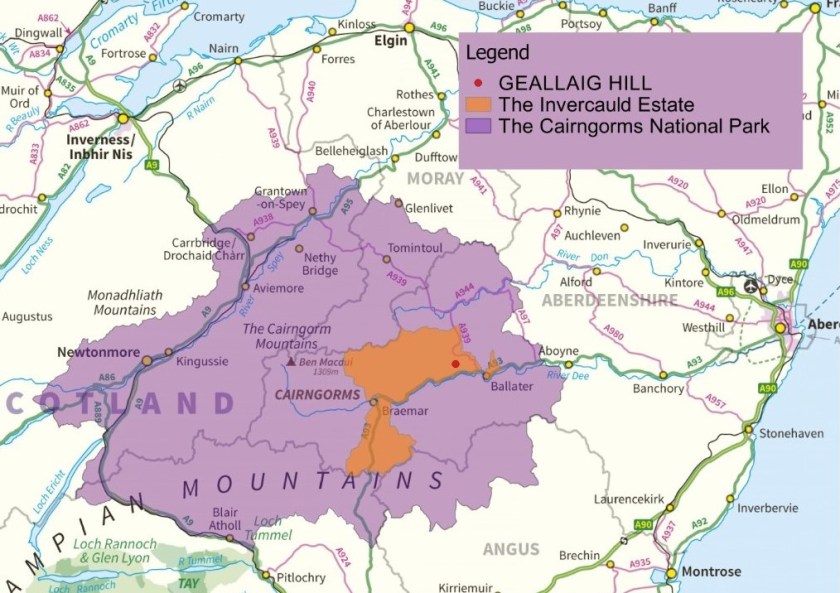
Well, would you believe, part of Glen Gairn appears to lie at the eastern boundary of Invercauld Estate, not a million miles from where those illegally-set spring traps were recently discovered at Gellaig Hill. (Map detail created from information provided on Andy Wightman’s Who Owns Scotland website).

Glen Gairn final - Copy

Now, we should urge caution here before anyone jumps to conclusions. This map is slightly misleading because it suggests that Glen Gairn lies entirely within the boundary of Invercauld Estate. It doesn’t. Glen Gairn extends east across the river, beyond the Invercauld Estate boundary, and on to the grouse moors of neighbouring Dinnet Estate.

We don’t know exactly where in Glen Gairn those two members of the public watched the alleged coordinated hunt and then shooting of that male hen harrier in 2013. It could have been on the Dinnet side of the Glen, or it could have been on the Invercauld side of the Glen, or it could have extended across both sides of the Glen. We don’t know, but presumably Police Scotland will know if those two members of the public were able to give accurate grid references.

As so often happens, there was insufficient evidence to proceed with a prosecution so we have no idea who was responsible. It must have been the handiwork of those pesky moorland fairies. They do seem to be quite active in this part of the Cairngorms National Park, don’t they?

Police statement on illegal traps found on Invercauld Estate

A few weeks ago we blogged about the discovery of two illegally-set spring traps and a critically injured Common gull found on a grouse moor on Invercauld Estate (Cairngorms National Park) in June 2016 (see here). We later blogged about the Estate’s subsequent denial that illegal activity had taken place and the Estate’s ‘understanding that the Police had not found evidence of illegal activity’ (see here).

Cairngorms Invercauld - Copy

We asked Police Scotland to clarify whether evidence of illegal activity had been found on Invercauld Estate (we didn’t ask who had found such evidence, just whether any evidence had been found). Here is the response from Police Scotland:

Thank you for your email to ACC Graham and concern about wildlife crime in Scotland.

The RSPB media release refers to an incident that it reported to both Police Scotland and the SSPCA following the discovery by two members of the public of a Common Gull caught in an open spring (Fenn) trap on the Invercauld Estate. As a result of the injuries sustained in the trap the bird was euthanized by an SSPCA officer who attended and the full circumstances along with clarification of an illegally set trap were subsequently passed to Police Scotland. Once aware of the specifics and having confirmed the availability of resources from partner agencies, Police Scotland  accompanied by specialist RSPB and SSPCA staff undertook a search of the area using powers available under S19 Wildlife and Countryside Act, 1981. That search was only able to identify signs of what appeared to have been trap-setting activity on the hillside i.e. holes in the ground but no actual traps. However, in light of the initial observations by the members of the public police officers spoke with representatives from Invercauld Estate. Unfortunately, the Estate was unable to shed any further light on this suspected illegal activity.

Other than the witness statements, there is no further evidence available from the initial discovery of the trapped bird and as previously highlighted the joint partner agency search failed to uncover any traps in place on the hillside. As a consequence, and despite a thorough investigation, there are at present no further investigative opportunities available to Police Scotland.

Police Scotland is committed to tackling wildlife crime and works closely with fellow members of the Partnership for Action Against Wildlife Crime (Scotland) to address wildlife crime issues across Scotland. We would encourage anybody with information about those that commit wildlife crime to contact Police Scotland by telephoning 101 or by contacting Crimestoppers anonymously on 0800 555 111.

Regards,

 Andrew Mavin

 Sergeant Andrew Mavin

Scottish Wildlife Crime Coordinator

Specialist Crime Division

Police Scotland

END

It’s a carefully worded statement but even so, is still quite opaque. The statement appears to confirm the discovery of an illegally-set trap (“….along with clarification of an illegally set trap….”) [actually, the gull’s legs were caught in two illegally-set traps, not just one] but then later it mentions ‘suspected illegal activity‘, although this appears to be a direct reference to other potential trap-setting activity on the hill, and not a direct reference to the two illegally-set traps that were reported by two hill walkers and then by the attending SSPCA Inspector.

Whether illegally-set traps were found on Invercauld Estate is not in question. The evidence, collected by the SSPCA Inspector, shows that two illegally-set traps had been found and that they’d caused appalling injuries to the trapped Common gull. The unanswered question, as ever, is who set those traps?

Invercauld gull

We will wait with interest to see whether SNH imposes a General Licence restriction order on this part of Invercauld Estate. Remember, even if there is insufficient evidence for a criminal prosecution, SNH may still impose this penalty if they consider the evidence is sufficient to warrant a GL restriction penalty. We may have to wait a while to find out, because SNH appears to have stopped issuing GL restrictions while it waits for a court decision on whether the process it uses to impose a GL restriction is fair. As you may remember, the Raeshaw Estate in the Scottish Borders has called for a judicial review of SNH’s decision to impose a GL restriction (see here) and we understand that the court has recently granted permission for the judicial review to take place.

While we wait for that judicial review, we will have more to write about the Invercauld Estate case…..watch this space.

In the meantime, you might want to consider signing THIS PETITION calling for the licensing of all gamebird hunting in Scotland (online petition currently at 3,089 signatures)

When you’ve done that, please consider signing THIS PETITION calling for a ban on driven grouse shooting (online petition currently at 79,404 signatures).