
Badger cull model proposed for pine martens, otters, oh and buzzards

Thanks to the contributor who sent in the August edition of ‘Modern Gamekeeping’, a monthly rag that claims to be ‘Britain’s only independent gamekeeping industry publication’, although it boasts ‘to be in partnership with The British Association for Shooting and Conservation (BASC), so the notion of being an independent publication is somewhat perplexing.

The first article in this month’s rag is entitled: “Rise of the Mesopredator”. The sub-heading reads: “Editor Peter Carr welcomes the expected badger cull which, if it proves successful, may be a useful model to adopt for future predator licensing applications”.

It’s a longish article and because I’ve got to type it out I’m going to ignore the first half  which basically is a scare-mongering exercise on the badger ‘problem’, and I’ll just regurgitate the second half:

Perhaps government will learn from this experience [a “too large” badger population] and look at other burgeoning predator populations in our countryside that are an increasing threat to our game birds, fisheries and other wildlife interests. If the proposed area-specific badger culling programme is successful, this model could be used in relation to the control of other mesopredators threatening countryside interests.

The problem predator situation in our Isles has been made much worse by misguided conservationists who have released and translocated certain mesopredators once thought to be threatened. Translocated pine martins [sic], for instance, have since spread across much of the country, destroying many of Scotland’s remaining capercaillie populations. One report conducted at Abernethy recorded that predators had destroyed 65 per cent of known capercaillie nests on the estate, and that a whopping great 57 per cent of these were known to be predated by pine martens.

Is it right to promote a predatory species that has found its natural balance to the detriment of an already struggling species such as the caper? I think not. Surely in areas of serious concern common sense has to be realised, and limited licensing of control put in place to prevent further loss of this iconic species.

The rapidly increasing otter population presents a similar story. In many areas, otters have turned to raiding commercial fisheries after decimating wild fish stocks.

Celebrity angler John Wilson MBE recently caused a major stir in the press when he once more called for immediate action against marauding otters and cormorants that have caused a catastrophic loss of fish in many parts of the country. Specimen carp fisheries that generate a significant amount of money and other wild coarse fisheries have crashed in recent years due to predation by both otters and cormorants. Serious concerns from salmon fisheries have also been expressed, especially in vulnerable spawning redds.

John Wilson has compiled a dossier over many months recording how his local waters and associated businesses have been affected by both otters and cormorants. He has called for other anglers around the country to help him compile further evidence and said: “why is it within the law for a farmer to shoot someone’s dog that is worrying his sheep, yet fish farmers, fishery owners and angling clubs etc are not freely allowed to cull predators such as cormorants and otters decimating their stocks of fish, it all beggars belief”.

The ‘Go Fishing’ star also recently appeared on prime time BBC news slamming predating otters that have been reintroduced all over the country by conservationists. “The otter is a wanton killer; it grabs a carp, eats a pound or two of flesh around the throat region and then leaves it. One in 20 people in Britain go fishing, paying 35 million pounds to the Government to look after our fisheries. I don’t think it is special pleading at all”, said the Norfolk-based TV angling legend. He certainly does have a point that should be seriously considered.

Let us hope that Government continues to see sense, and puts the regulation of wildlife concerns that affect our countryside’s economy and biodiversity into the hands of those that are in the know. Whether it’s badgers, otters, pine martens or buzzards, none of us want to eradicate these species, but it really is a question of balance that should be shared by all stake holders, and interested parties. Control practices should be implemented by professionals, and a high percentage of these, if ever licenses are put in place, will be by gamekeepers, river keepers and water ghillies. Let’s hope it is not too far in the future”.

No surprises there then – the usual anti-predator rhetoric that just happens to have thrown buzzards into the mix in what looks like a ‘jumping on the band wagon’ after-thought. Unfortunately this great rag is not available to read on-line, although you can subscribe (see here). It’s published by Blaze Publishing Ltd, with James Marchington listed as ‘Editorial Director’. The author of this particular article, Peter Carr, may be the same Peter Carr listed as ‘ex-gamekeeper, professional stalker, big game hunter and editor of Sporting Rifle magazine’ on the National Gamekeepers’ Organisation’s website.
SNH agrees to collaborate with GWCT – should we be concerned?

Scottish Natural Heritage (SNH), the government’s statutory advisory body on nature conservation, has recently pledged its intent to work closely with the Game and Wildlife Conservation Trust (GWCT – formerly known as The Game Conservancy). Here is their published joint statement of intent – unfortunately a rather turgidly written set of objectives – that includes reference to predators such as buzzards and ravens.

It’s an interesting alliance and one which will no doubt be a cause of concern for some.

The GWCT  defines itself as an “independent charity”. Some commentators suggest that the GWCT is not independent of the shooting industry; a claim based on the interests of its good directors and officers (see here).

The GWCT accepts sponsorship from Artemis Investment Management Ltd (see here). All perfectly lawful of course but open to scrutiny nevertheless.

The GWCT’s Scottish Committee Chairman was questioned over the mysterious disappearance of a dead white-tailed eagle, reported to have been discovered on his estate but then it apparently vanished in to thin air when the police arrived the following day (see here). He denied any involvement.

The GWCT is reported to be involved with controversial ‘research’ commissioned by Songbird Survival. This ‘research’ is aimed at killing corvids and it has been suggested that in future it could extend to killing raptors (see here).

The GWCT was at the forefront of criticism into the SNH-funded Hen Harrier Conservation Framework Report. Basically, the GWCT did not accept the peer-reviewed scientific findings that hen harriers are being systematically slaughtered on UK grouse moors. Instead they wanted to deflect attention on to golden eagle/hen harrier interactions (a bit difficult seeing as golden eagles are also absent breeders on most grouse moors) and on to predation of harriers by foxes (foxes are just as unwelcome on grouse moors as hen harriers so the impact must be minimal, and certainly not enough to cause two-thirds of the harrier population to ‘disappear’).

So, a joint partnership a cause for concern? You decide.

GWCT website here. SNH website here.

Poison hunt called off and incidents ‘missing’ from official SASA figures

In April, we reported on a series of suspected poisoning incidents at Fullerton Woods, Troon, Ayrshire. Poisoned rabbit baits were reported to have been found in February and March 2011 and were believed to be implicated in the deaths of a fox, two dogs and possibly two buzzards (story here).

In an article published in the Troon Times on 31 May 2011, wildlife police were reported to be “no longer hunting poachers after dead animal bodies were found in Troon Woods“. The on-line article does not provide any more information about this decision.

Interesting then that in the SASA animal poisoning report released earlier this week, the dead animals from Fullarton Woods were not included in the list of suspected poisoning incidents in Scotland between January and March 2011. Does this mean the dead animals were not submitted for poison analysis? Or does this mean that they were submitted somewhere other than SASA? Or has SASA deliberately excluded them from their interim report?

There’s another missing incident in the SASA report. Remember the allegedly poisoned buzzard discovered on Mountquhanie Estate, Fife, in January 2011? The news report at the time stated that the dead bird had been sent for post-mortem to establish the cause of death. Where is this bird in the SASA report? Was it sent to SASA for post-mortem, or somewhere else? If it was sent somewhere else then surely the SASA figures cannot be used by the government as the official reporting mechanism for poisoning incidents, because they are excluding a number of suspected incidents?

Latest SASA figures reveal widespread poisoning incidents in early 2011

The latest figures detailing illegal animal poisoning incidents in the first quarter of 2011 have just been released by Science and Advice for Scottish Agriculture (SASA) on behalf of the Scottish Government.

The figures cover the period January to March 2011, and show that criminal raptor poisoning incidents were detected in each of the three months. They include 3 buzzards, 1 golden eagle, 1 red kite and 2 peregrines.  Poisoning incidents were widespread, taking place across Scotland, including in the Borders, Strathclyde, Tayside, Grampian and the Highlands. The illegal poisons used included Carbofuran, Chloralose and Strychnine. So much for the game-shooting industry’s self-regulation. I guess 2011 will not be the year they ‘stamp out’ illegal raptor persecution.

Not for the first time, two of the five recorded incidents were apparently unpublicised in the media: 1 x buzzard poisoned with Carbofuran in the Borders in January 2011, and 1 x red kite poisoned with Chloralose in the Highland region in February 2011.

SASA poisoning figures for period Jan – Mar 2011 available here

Head gamekeeper jailed for cannabis factory on sporting estate but not charged for poisoned buzzard

In April 2010, we reported on the conviction of 26 year old gamekeeper Ben Walker, who was found guilty of 17 offences relating to the killing of protected species with poisonous baits on the Sufton Estate in Herefordshire in late 2009 (report here). During the police investigation into the alleged criminal activities on this sporting estate, it is reported that a poisoned buzzard was found in an outbuilding used by his boss, head gamekeeper Mark Rigby. As usual, it was not possible to ascertain who was responsible for the death of this bird – even though it might appear obvious. There are no reports of either keeper being charged for possession of the poisoned bird. However, a search of an adjacent outbuilding uncovered what has been described as ‘a large cannabis cultivation operation’. It seems it was not so difficult to establish the identity of the guilty party in this instance, because, according to the RSPB, at Worcester Crown Court on 24 November 2010 head gamekeeper Mark Rigby pleaded guilty to four counts of producing and possessing a Class B drug with intent to sell and he was imprisoned for two years.
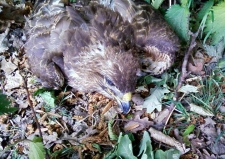
The conviction of Rigby is reported in the latest issue of Legal Eagle, the RSPB’s investigations newsletter, here.

Suspected poisoning of buzzard found dead in Wester Ross

According to the Ross-shire Journal 20 May 2011, Northern Constabulary are investigating the possible poisoning of a buzzard found dead in May. Discovered by a dog-walker near Dundonnell, Wester Ross on 14 May 2011, the carcass was covered in dead insects. Dead insects on a carcass are often an indication of the presence of a poisonous substance. The buzzard has been sent for toxic analysis.

Thanks to the contributor who sent this in.

Nesting buzzard shot dead in Hertfordshire

Police in Hertfordshire have launched an investigation after a nesting buzzard died after being shot with a shotgun. Full story here

“Professional gamekeepers do not poison raptors” says Alex Hogg

Episode 11 of the BBC 2 Scotland ‘Landward’ programme went out on Friday 27 May and included a segment on the new vicarious liability regulation in the Wildlife and Natural Environment (Scotland) Act 2011. The programme is available here for a limited period.

The segment opened with Duncan Orr-Ewing, Head of Species at RSPB Scotland, who told the interviewer, “Bird of prey poisoning is particularly associated with driven grouse moors in the upland of Scotland, in the central and eastern highlands, parts of Perthshire and also down in the southern uplands”.

The interviewer, Dougie Vipond, asked: “So who is doing this? Who is killing the birds?”

Orr-Ewing: “Well, it is estate employees, gamekeepers who are usually involved, but they are only employees, they are acting under the direct instructions so ultimately it is the landowners that are responsible for this”.

A short section followed with a brief interview with Liz Plath, listed as a rural law specialist and a partner at Thorntons Law LLP. Basically she explained in simple terms how vicarious liability brings the landowner or the employer into the frame in cases of raptor poisoning.

Next up was Alex Hogg, chairman of the SGA, whose opening line was: “Professional gamekeepers do not poison raptors”. Funny that, because if you bother to look back at the statistics on raptor poisoning for the ten-year period that Hogg has been in post, you’ll see that raptor poisoning incidents have been recorded on many estates, and yes, ‘professional’ gamekeepers have been convicted.

He then contradicted himself (and not for the first time) by saying: “It’s only a small minority that are still at it. A rogue few if you like”.  Lest we forget, here is the official government map showing confirmed raptor poisoning incidents between 2006-2010. Widespread, I’m sure you’ll agree, and the trend is pointing upwards.

He continued: “And we’ve tried our hardest over the past, I’ve now been in this job for ten years, to impress on everybody that it’s absolutely illegal to poison raptors”. Peer pressure from Hogg and co., while welcome, has been ineffective. It can’t help the situation when he and others from his industry continue to claim that raptors are having a significantly negative effect on game birds, songbirds, waders and lambs. Is there any scientific evidence for this? No, not a shred.

Next up came David Hendry, listed as the proprietor of Cardney Estate, near Dunkeld in Perthshire. Now this was an interesting interview. The piece opened with an introduction to Hendry, and video footage of a diving osprey on his estate. We were told that this estate ‘is home to many endangered birds of prey’. Unfortunately, Hendry was not asked how many and what species of raptors made their home there. The osprey was implied, but of course the osprey only eats fish, not exotic red-legged partridge (also known as French partridge) or pheasant, which are reared and released in large numbers for sport shooting on this estate, according to this shooting directory.

Vipond talked about the belief that the only way to stop poisoning is to introduce a licensing system which would allow landowners to control [kill] raptors. Hendry agreed, and suggested “it should become the gamekeeper’s job for instance to look after the rare raptors like harriers, your merlins, bring on your red kites, but they should also be allowed to reduce buzzards and sparrowhawks to numbers that are sustainable, because what we have today is not sustainable”.

Ok, so this is the first time we’ve officially heard that sparrowhawks are also the landowners’ intended target for licensed killing. Until now, the list has ‘just’ included buzzards and ravens. So what happens if they get the go ahead to kill these species? Will we see goshawks added to the next list? They’re just an over-sized sparrowhawk after all, so why not? And golden eagles? They’re just over-sized buzzards, so why not? Where will it stop?

It’s also very interesting that he thinks the current number of buzzards and sparrowhawks is ‘unsustainable’. According to this shooting website, Cardney Estate offers shooting days where between 200-400 exotic birds (partridge/pheasant) can be shot. That’s 200-400 birds per shooting day, depending on the time in the season. In September 2010, a record 677 birds were shot on one day according to one participant! Sounds to me like this sporting estate is doing very nicely thank you, without the need to kill off any indigenous protected raptors, whatever species they may be.

We then went back to Orr-Ewing, who was asked for his opinion about the need to ‘manage’ [kill] protected raptors. “These birds of prey are rightly protected because they’re vulnerable. We have a history of killing birds of prey in Scotland, many species are just recovering from that situation, there’s no other country in Europe that [legally] kills birds of prey”.

His first three points are accurate, but his last statement is not. In 2008 the provincial government of Lower Austria issued a decree allowing hunters to shoot 1,000 buzzards and 250 goshawks over the following five years. It previously allowed the killing of Montagu’s harriers until the EC stepped in to halt it. The decree allowing the legal persecution of buzzards and goshawks resulted in an international public outcry – the same can be expected if the licensed killing of raptors for the benefit of the game bird-shooting industry is permitted in Scotland.

And of course, it’s not just poison that is used to illegally kill raptors. Unfortunately our government does not produce annual statistics on the other incidences of raptor persecution that take place every single year. Thankfully, the RSPB does. Their annual reports (one covering bird persecution in the UK as a whole, and the other covering incidents in Scotland) are a welcome insight into the extent of the problem. Their 2010 annual reports are due for publication in the very near future. Their efforts to compile and publish these reports are worthy of the public’s gratitude because without them, we would only have Alex Hogg and co’s word about the extent of illegal raptor killing on Scotland’s sporting estates.

Roseanna Cunningham MSP stands firm on licences to kill raptors

Following on from the recent publicity about Scottish landowners demanding licences to kill protected birds of prey (see here and here),  last week Elaine Murray MSP (Labour: Dumfriesshire) kicked off the new parliamentary session with the following question:

To ask the Scottish Executive whether it remains its position that ‘the balance of public interest [is] not at present in favour of issuing licences for the control of birds of prey to protect non-native reared game birds’ as stated by the Minister for Environment at the meeting of the Rural Affairs and Environment Committee on 3 November 2010 (Official Report c. 3330“. (Written question SW4-00007)

Roseanna Cunningham MSP gave a succint, one word answer: “Yes“.

Meanwhile, Alex Hogg (Chairman of the SGA) continues with the ridiculous argument that buzzards are “decimating all our wildlife“. He was talking to a BBC Scotland film crew at the time, for a forthcoming edition of Landward. I’m sure we’ll all look forward to watching that and listening to the scientific evidence that Alex puts forward to back up his claim: http://www.scottishgamekeepers.co.uk/content/19th-may

Review of ‘Fair Game?’ documentary – our “ugly secret”

The BBC 2 Scotland documentary, ‘Fair Game? Scotland’s Sporting Estates’ was aired last night and opened with the BBC reporter visiting the Leadhills Estate with an undercover investigator from OneKind. This investigator was the guy who watched gamekeeper Lewis Whitham staking out a rabbit laced with Carbofuran in April 2009, leading to a conviction in 2010 (see blog post 17 Nov 2010). The BBC reporter, David Miller, was shown what was alleged to be an illegal ‘snapper trap’, and in forestry a few feet away he was shown the rotting carcasses of foxes and other animals, piled up at a ‘stink pit’ – used as a lure to draw in predators who are then snared as they approach the area. Also in the forest, he was shown the decomposing bodies of two raptors that someone had apparently tried to conceal under pine needles. Miller was visibly disturbed by what he’d witnessed in one small corner of one sporting estate, calling it ‘our ugly secret’ – not quite the public ‘conservation’ image that the shooting industry likes its estates to portray. The OneKind investigator has written an excellent account of his time out on the hill with Miller: http://www.onekind.org/resources/blog_article/fair_game

The discovery of the dead raptors and the apparently illegal snapper trap led to a later police search, in which a third raptor corpse was discovered, in addition to more raptor skulls. The trap was removed, and Leadhills Sporting Ltd denied all responsibility for the dead birds. Fountains Forestry, the owners of the private forest on the shooting estate, also denied any knowledge of the bodies and said the snares found were illegal as they had not given permission for anyone to set snares on that ground. Later in the programme, we learned about the weight of evidence of alleged criminal activity on Leadhills Estate. Since 2003, the RSPB has recorded 46 incidents where the government, police and/or other agencies have confirmed that poisoned baits have been set or birds have been illegally killed, just on Leadhills Estate. We were told that the current management at Leadhills Estate took over in 2008 and they say they ‘deplore wildlife crime’. However, the RSPB has since recorded 10 incidents since 2008, although none since 2009 – following the conviction of gamekeeper Lewis Whitham.

There followed a series of interviews with various people, including Dave Dick, the former head of RSPB Scotland Investigations (and a regular contributor to this site – thank you Dave), who talked about the hundreds of raptor persecution incidents he had seen first-hand over the last 20-30 years. We also heard from Mark Oddy from Buccleuch Estates who spoke briefly about the old glory days of grouse-killing at Langholm, and then we went to the RSPB’s Abernethy Reserve where Duncan Orr-Ewing showed Miller that it is possible for grouse-shooting and raptors to co-exist. Orr-Ewing also discussed the RSPB’s persecution figures and how these clearly show the effect of persecution on some raptor species. Government scientists have predicted that there should be 500 pairs of hen harriers on the UK’s grouse moors – there are actually only five. You don’t need to be Carol Vorderman to work out the missing numbers.

Next up was gamekeeper Peter Fraser from Invercauld Estate, who is also the SGA’s new vice chairman (see blog post 26 Nov 2010). There followed a fascinating conversation between Miller and Fraser, when Miller pointed out that 3 poisoned buzzards [and a poisoned raven] had been discovered on Invercauld Estate in 2003 [our sources suggest it was 2005] for which no-one was ever prosecuted:

Fraser: “All keepers know and understand that if they do that [poison a raptor] and they’re caught, you automatically lose your job”. NOT TRUE, Mr Fraser, as anyone who has read the contents of this blog site can attest.

Miller: “There are scientists who argue clearly that birds of prey in Scotland are being killed, shot, poisoned on our hills. Does that happen on this estate or neighbouring estates?”

Fraser: “Well, as I’ve said on this estate, if anyone does that we’re finished, and I can honestly say no. Never”.

Miller: “So, how do you explain the dead birds which routinely turn up in the Scottish countryside?”

Fraser: “I wish I could answer you that. Erm, in every walk of life there are some that lets the profession down and unfortunately we’re no different to everybody else. And it has been known that these birds have been planted on various areas so it’s a ticklish subject to deal with and to be quite honest, but er, I would like to think that poisoning has been greatly reduced over the years”. NOT TRUE, Mr Fraser – read the government statistics!

Miller: “Just to be clear, when poisoned or shot birds of prey are found on a gamekeeper’s land, clearly the stakes are very very high. Are you suggesting that those birds may have been deliberately placed there by a third party?”

Fraser: “Well, I haven’t got that evidence on me but erm I’m quite sure that has happened, quite sure that has happened”.

So there you have it. Peter Fraser, vice chairman of the SGA, admits that he has no evidence to support the claim that poisoned raptors have been ‘planted’ on sporting estates. It’s a shame Miller didn’t mention the poisoned buzzard found here in 1992, nor the 1997 conviction of an Invercauld Estate gamekeeper for the illegal use of a spring trap (see blog post 4 March 2010). Also a great pity that Fraser wasn’t asked how many breeding pairs of golden eagles and hen harriers are present on Invercauld Estate.

We then heard from Mike Yardley, a journalist and shooter, who stood smugly bragging about the ’20 safaris’ and other trips he has taken in Africa, North America and throughout Europe to shoot animals – and we were even treated to viewing some of his home videos of these trips. He probably met every expectation that the general public has of a typical shooter. It was hilarious. Not all shooters are of his ilk, of course, but the programme failed to get this across.

We heard from Robbie Kernahan from SNH who admitted that the evidence of illegal raptor persecution ‘should not be ignored’. We also heard from the laird at Alvie Estate, Jamie Williamson, who didn’t really discuss the issue of raptor persecution at all, and then we heard from an apparently very cagey Simon Lester, head gamekeeper at Langholm Estate who was obviously trying to pick his words carefully and not put his foot in it. Unfortunately he didn’t have anything substantial to offer in the comments that he did make. There was also an interlude at Mar Lodge Estate, although this was mainly about deer management and not really raptor persecution.

Miller went on to provide some interesting details about the performance of the procurator fiscals at the Crown Office. The BBC had asked them about the number of gamekeepers they had taken to court. Amazingly, they said they had only started recording their performance on wildlife crime early last year! Why? Since then, they’ve had one successful prosecution – Lewis Whitham from Leadhills Estate. There is ‘a handful’ of cases in the system – presumably these include the current cases concerning Skibo Castle Estate, Moy Estate and Inverinate Estate. We await these results with great interest to assess whether the extent of the charges brought are an accurate reflection of the evidence uncovered.

The finale came with an interview with Doug McAdam, CEO of SRPBA. Another apparently cagey performance that included what some might perceive as a blatant lie. Miller asked McAdam whether he thought the game industry was being unfairly targeted:

McAdam: “I think that there is a feeling out there amongst landowners and estates that there are people who would seek at every opportunity to damage the reputation of landowners and estates. If we look at the statistics, 28 cases of confirmed bird of prey poisoning incidents in Scotland in 2010 – it’s small, it’s in the tens, and it is a decreasing number”.

Actually, Doug, if you care to look at the official poisoning statistics that your organisation helped to analyse, you’ll see that the number of poisoned raptors discovered in 2010 was GREATER than the number discovered in 2009. Do you think that if you say it enough times (i.e. that the poisoning figures are declining) that somehow we’ll all forget the official statistics and believe your version? I don’t think so.

Miller also asked him: “Your very well informed members must know where those [poisoning] cases are taking place, surely?”

McAdam: “Er, I don’t, I don’t think that’s necessarily the case, no”.

So, our ignorant landowners are now pushing for licences to kill protected raptors as a method of reducing illegal persecution incidents, but they ‘don’t neccessarily’ know where these incidents are taking place. Brilliant.

For those of us hoping for some words of wisdom from SGA chairman Alex Hogg, sorry, he wasn’t included. I wonder why?

The programme is available for one week on the BBC iPlayer: http://www.bbc.co.uk/iplayer/episode/b0116lfs/Fair_Game_Scotlands_Sporting_Estates/

Here is the SRPBA response to the programme: FairGameSRPBAresponse May 2011