RSPB response to DEFRA’s proposed (illegal) buzzard trial

Following on from Monday’s story about DEFRA’s plan to fund a buzzard ‘management’ trial on pheasant-shooting estates in Northumberland (see here), the RSPB has published a response statement.

Martin Harper, RSPB Conservation Director said:

We are shocked by Defra’s plans to destroy buzzard nests and to take buzzards into captivity to protect a non-native game bird released in its millions. Buzzards play a minor role in pheasant losses, compared with other factors like collisions with vehicles.

Common pheasants are not native to the UK. Around 40 million birds are released every year for shooting. The impacts of this practice on wildlife have been poorly documented, but serious questions have been raised about the impact such a large injection of captive-reared birds might have on the predator-prey balance in our countryside.

Buzzards will take young pheasants from rearing pens, given the opportunity, but the RSPB believes the issue can be managed without destroying nests or moving buzzards. Measures include providing more cover for young pheasants in release pens, visual deterrents to discourage birds of prey and providing alternative food sources.

There are options for addressing the relatively small number of pheasant poults lost to buzzards. Destroying nests is completely unjustified and catching and removing buzzards is unlikely to reduce predation levels, as another buzzard will quickly take its place. Both techniques would be illegal under current wildlife laws, and I think most people will agree with us that reaching for primitive measures, such as imprisoning buzzards or destroying their nests, when wildlife and economic interests collide is totally unacceptable.

At a time when funding for vital conservation work is so tight, and with another bird of prey, the hen harrier, facing extinction as a breeding bird in England, I can think of better ways of spending £400,000 of public funds. This money could work harder for wildlife, and I hope the Government will therefore put a stop to this project.”

Full statement can be read on British Birds here

So what can you do? You can email DEFRA Minister Richard Benyon MP (richard.benyon.mp@parliament.uk) and tell him what you think about this illegal, scientifically-illiterate and unethical trial. You might want to ask him what scientific evidence was used to justify the proposal and ask him whether there was any consultation on the issue, and if there was, which organisations were consulted?

Go for it. There has been so much interest in this story and so many people expressing their outrage – let’s put it to good use and make sure Mr Benyon knows the strength of feeling on this.

UPDATE: Message sent to RPS readers from Nigel Middleton, Conservation Officer (Eastern Region) for the Hawk and Owl Trust:

Please Everybody , just to let you know the RSPB, Hawk and Owl Trust and Northern England Raptor Study Groups are aware of what is going on hence the press statement [today], all the groups are totally against the proposals and have representatives on the commitee that is fighting the cause of the buzzard, even if i have to chain myself to richard benyons office! i hope you will all back me. Please send as many letters expressing your disgust at such a move not just to him but also your local MPs. They will not win on this one.”

UPDATE (24 May) – see here for national media response to this ‘management’ proposal.

Buzzard ‘management’ trial gets govt approval and £375K funding

So, while we’ve all been busy asking what the government plans to do about the imminent demise of the English hen harrier breeding population, the government has itself been busy putting together some funding, at the behest of the National Gamekeepers’ Organisation, to set up a trial to evaluate ‘management techniques’ to reduce the so-called ‘significant’ effect of buzzards on pheasant poults.

Yes, you read that correctly. DEFRA is interested in finding measures of controlling a native species (at the request of gamekeepers) that not only is recovering from past persecution (by gamekeepers), but still is undergoing illegal persecution (by gamekeepers) in the interests of protecting a non-native species that is reared and released (by gamekeepers) for people to kill for sport. Amazing.

It’s been estimated that over 40 million non-native pheasants are released in to the countryside each year, although it’s difficult to assess the accuracy of this number as there aren’t any limits on the number that can be released and there aren’t any reporting requirements for this to be monitored. What is clear is that the game shooting industry is undisputably linked to the continuing illegal persecution of birds of prey in this country and yet here is a government department basing a research decision solely on the opinion of some within that industry without a shred of scientific evidence to support their claims. [Interestingly, GWCT did a study a few years back on the fate of released pheasants; “Of 486 radio-tagged birds, we think three were killed by raptors” – see here. That’s 0.6%! Is that ‘significant’?].

So what does this trial entail? Basically, whoever is given the contract to conduct the research has to evaluate four different methods of buzzard management techniques:

1. Cut vegetative or artifical cover inside and outside pheasant-rearing pens. Provide shelters/refuges in the form of brash piles or wigwams. Possibly also wooden shelters/ refuges.

2. Diversionary feeding. Whole carcasses left on posts out of reach of ground predators. Type of carcass to be agreed with site owners. Provide for limited periods to reduce risk of increase in local buzzard population.

3. Translocation (permanent). Permanent removal off-site, for example, to a falconry centre. NE [Natural England] would be able to provide assistance for researchers in planning and licensing negotiations with potential recipients.

4. Nest destruction. Breeding birds displaced by destroying nests under construction, for example, using squirrel drey-poking pole or shotgun from below thereby forcing the pair to move on to find another nest site or not breed that year. Care would be needed to avoid injuring birds.

The study is anticipated to last for up to three years and £125k per annum will be available to fund it. The study sites have not yet been formally identified but DEFRA is encouraging bidders to use ‘a site that consists of 6 shoots spread over an area of 2000-2400 hectares in Northumberland’. It is not yet known who has won the bid to conduct this research (bidding closed at the end of April) but we’ll be keeping a close eye out on that.

DEFRA does emphasise its interest in ‘non-lethal’ management techniques, at the moment at least, but I think we can all probably see where this is heading. Part of the justification DEFRA uses for this study is the increase in buzzard numbers from 1995-2009 (duh – of course they’re increasing as they recolonise areas where previously they had been wiped out). Are we getting to the stage where raptor fieldworkers should start thinking about witholding their field survey results? If this is what the government is using those data for then there’s quite a strong argument for it!

Here’s the background info provided by DEFRA to research bidders: Buzzard control experiment overview

STOP PRESS (Tues 22 May) – Many thanks to everyone who has tweeted and posted on Facebook and on their own blogs about this story. Our visitor numbers have sky-rocketed in response, no doubt helped by a certain Chris Packham (thanks, Chris!). Please keep spreading the word; DEFRA cannot be allowed to get away with this. RSPB will be issuing a statement tomorrow.

STOP PRESS (Weds 23 May) – go here to read RSPB response and find out what you can do to stop this trial.

Crow traps: what you should know part 2

Following on from our earlier blog – Crow traps: what you should know part 1 (here)

The following information concerns the use of crow cage traps in Scotland; they are also used in other parts of the UK although the terms of use differ slightly (see here for information on their use in England, here for Wales and here for Northern Ireland).

What is a crow trap and why should we be concerned about them?

There are various types of animal traps in use in the countryside but the two we focus on in this article are the ‘ladder’ and ‘funnel’ crow cage traps. These are large, walk-in traps usually constructed with a wooden frame and wire mesh netting. A decoy bird (often a carrion crow but certain other decoy species are also permitted) is placed inside the trap to attract corvids or other target species. Birds that are attracted to the trap can enter via the roof, either through the horizontal slots of the ‘ladder’ or via a ‘funnel’. Once inside the trap it is virtually impossible for the birds to escape unaided. These trapped birds are usually destined to certain death at the hands of the trap operator who is legally authorised to kill them, subject to certain conditions (discussed in Part 3). In some rare circumstances, raptor workers deploy temporary crow cage traps to capture buzzards for marking projects, such as wing-tagging etc. Obviously these buzzards are released as soon as they’ve been marked; they aren’t killed by the trap operator!

There are many concerns surrounding the use of crow cage traps (some we’ll discuss below) but the over-riding concern is the indiscriminate nature of these traps, which means that species other than the target species can be, and often are, caught by gamekeepers, e.g. buzzards, goshawks, golden eagles etc. It is not illegal to (accidentally) trap these non-target species, but it is an offence for the trap operator not to release them, unharmed, at the earliest opportunity. More on this in Part 3.

Crow trap use is governed by a general licence, issued annually by Scottish Natural Heritage (see here). These licences are issued for the purpose of either (a) the conservation of wild birds, (b) to prevent serious damage to livestock, foodstuffs for livestock, crops, vegetables and fruit, and (c) to protect public health, public safety and prevent the spread of disease. Trap operators need not ‘apply’ for an individual licence, hence the name ‘general’ licence. Each general licence is subject to strict conditions (discussed in Part 3). If the trap operator complies with all the conditions of the general licence then the use of the crow trap is legal. However, in practice some of these conditions are ambiguous at best, and this is recognised by SNH who undertake regular consultations aimed at clarifying the terms of use (e.g. see here for their latest consultation plans).

Before we get in to the nitty gritty of how to recognise a legal trap from an illegal trap it’s worth mentioning that the RSPB (and other groups such as OneKind) has long campaigned for a more thorough review of the legal framework concerning these general licences for crow traps, particularly in relation to potential breaches of European legislation, including the EC Birds Directive. For anyone interested in the RSPB’s position, this document from 2007 (here) is informative.

Other concerns include the fact that there isn’t any effective monitoring of the impact these traps have on both target and non-target species. Crow traps are in use across Scotland year-round but are especially associated with upland grouse moors. It isn’t known exactly how many crow traps are in operation in Scotland but a conservative estimate would be in the hundreds, but probably nearer the thousands. There is currently no requirement for trap operators to record and/or report the number of target and non-target species caught and killed inside a trap (and even if there was such a requirement, who would believe the submitted figures? No gamekeeper is going to admit to illegally killing a protected species!). So how can the regulatory body (SNH) monitor the impact of crow trap use when they haven’t got a clue just how many traps are in use and how many birds and of what species are being killed each year? The follow-on question is, how can these general licences still be issued when the regulatory body cannot justify, in quantifiable terms, the need for lethal control measures?

Some may argue that there is now a record of the number of traps in use because recent changes to the general licences now require that a sign is attached to each trap with a unique identifying code issued by the local police force. However, this unique code is not assigned to an individual trap or to an individual trap operator, but rather to a landowner (or occupier) such as a sporting estate or a farm. This means that an estate owner can use the same code for multiple traps on his/her land (e.g. they may have just one trap or they may have 50+ traps depending on the size of the estate); the point is that the authorities do not have any means of knowing how many traps are in use on a particular estate because they only issue one code per estate.

From a law enforcement perspective, this use of a single identifying code for multiple traps makes it almost impossible to prosecute an individual for illegal use of the trap. For example, if a golden eagle is found dead inside a trap, and it’s obviously been there for a long time, then an offence has probably been committed (because traps must be checked at least once in every 24 hour period – see Part 3). Investigators may attend the scene but find that the trap is located on a large estate that employs multiple gamekeepers. None of the gamekeepers admit responsibility, so how does the investigator identify the individual responsible? A prosecution cannot commence unless an individual suspect is identified. It’s the same loophole we’ve seen used so many times when poisoned bait has been found on a large estate; nobody admits responsibility for laying the bait and thus the perpetrator(s) escape justice. It is only when the trap is located on a smaller estate where a single gamekeeper is employed that there is any chance of a prosecution.

Talking of loopholes….we’ve touched on this briefly in previous posts….in 2008 a new condition was added to the terms of use of the general licences. That new condition was that anyone who had a previous wildlife crime conviction was not allowed to use the general licence unless their conviction was considered ‘spent’, i.e. after five years from conviction. (Although even if you did have a recent conviction you could still apply for use of the licence and each case would be considered on merit, so it’s not quite the draconian condition that some imply). However, in 2009 the condition (of being banned for five years) was modified and we don’t recall any consultation about the insertion of this modification! The new modification says that you can still use the general licence if the sentence you received for your wildlife crime was an ‘admonishment’. Talk about a get-out clause! You might think this modification was quite reasonable, after all, an admonishment (effectively a telling off) is only given for minor offences, right? WRONG!!! Because there aren’t any mandatory sentences for wildlife crime offences in Scotland, a sheriff can choose a sentence at will (within the boundaries of sentencing limits at a Sheriff court, of course). In 2010, a sheriff imposed an admonishment on Graham Kerr, a gamekeeper on the Redmyre Estate, for possession of the banned pesticides Carbofuran and Alphachloralose (see here). The maximum penalty available was a £5000 fine and/or a six month prison term, reflecting the gravity of this type of offence. Had Kerr not also been handed a £400 fine for shooting a buzzard on the Redmyre Estate, his admonishment would have allowed him to continue using the general licence to operate a crow cage trap. In our opinion this is outrageous. What’s the point of having a condition of a five-year ban for a wildlife criminal if that condition is modified based on the whim of a sheriff’s sentencing choice rather than the nature of the actual criminal offence committed? It’s total nonsense. Why was this modification added to the terms of the general licence and who instigated its inclusion in 2009 and who approved it? Was anyone given the opportunity to object to its inclusion? Perhaps a Freedom of Information request is called for here…

This leads on to another concern…who is actually monitoring the trap operators? How do we know that someone with a recent criminal conviction (who was given a stronger sentence than an admonishment) is not still operating a crow cage trap? We know that many estates don’t sack their gamekeepers following a wildlife crime conviction, and we know of at least one estate where a previously convicted gamekeeper (guilty of raptor persecution) is now employed as a ‘gardener’!!

The potential for the misuse of crow traps is well known amongst raptor workers.  Previous reports on this issue have been produced by the RSPB (e.g. see here). Although this 2004 report is now fairly dated and some of the report’s recommendations have since been implemented, there is still a great deal of concern that crow traps are still being deliberately used to target raptor species, particularly buzzards and goshawks and in some areas, golden eagles.

So what can we do about it? In Part 3 we’ll explain the basics of what makes a crow cage trap legal, what makes one illegal, and the blurred line in between the two. We’ll also explain what members of the public should and shouldn’t do if you find a crow trap that you suspect is being operated illegally.

£400 fine for shooting buzzard

The case against John Winn Roberts, 43, of Woodend Meadow, Ballymagorry, Strabane, Northern Ireland, who was accused of intentionally injuring a wild bird (shooting a buzzard) on the Isle of Wight last November, was finally heard yesterday after several adjournments at the Isle of Wight magistrates court (see here and here).

He pled guilty to shooting a buzzard and was fined £400 plus costs (maximum penalty available for this type of offence is £5,000 and/or a 6 month prison sentence).

Putting aside the pathetic sentence, well done to Hampshire Constabulary, RSPCA and the quarry company Barton Vectis for getting this case to court.

We haven’t yet seen any media reports about this conviction.

Case against alleged buzzard shooter adjourned again

In January 2012 we blogged about John Winn Roberts, a man accused of shooting a buzzard at a quarry site on the Isle of Wight in November 2011 (see here). He was up in court on 20th January where he pleaded not guilty to shooting the buzzard and his case was adjourned until 22 March 2012.

In court on 22 March 2012, this case was further adjourned and is now expected to result in a one-day trial at the end of April.

This case is not connected to the recent buzzard shooting on the Isle of Wight reported yesterday (here).

Isle of Wight police appeal for witnesses after buzzard found shot dead

Take note, Northern Constabulary – it’s really not that difficult to put out a timely press release when investigating a raptor persecution crime, as your police colleagues on the Isle of Wight demonstrate here:

Specialist police wildlife crime officers on the Isle of Wight are appealing for witnesses following the discovery of a dead buzzard believed to have been shot. The buzzard’s body was found on 30 March 2012 at Lower Road, Adgestone near Sandown.

Anyone with information should contact Wildlife Crime Officer PC Nick Massey at Ryde Police Station by phoning 101.

Isle of Wight News (Ventnor Blog) here

BBC news story here

2012 wildlife crime conference: Nevin Hunter (NWCU)

This is the second blog in the series focusing on presentations made at the recent police wildlife crime conference in Scotland. This time we look at what the new head of the National Wildlife Crime Unit, Nevin Hunter, had to say. (For background info on Nevin, see here).

Nevin Hunter, NWCU

“Ok, you know we’ve got UK priorities, erm, you’ve heard mention already of the national intelligence model and the way in which we try and work and deal with wildlife crime and I’m not going to focus on that too much, I’m going to focus on some other aspects. Erm, you know, everything we’re about now is about harm reduction really in terms of, of, wildlife crime, erm, you know, we’re looking at national crime threats and four distinct areas of work because many of you will be aware of this in terms of its enforcement but as I’ve gone around speaking to a number of people from, erm, a number of different partner organisations over the last few weeks I’ve been trying to stress something really and that, that actually a lot of the prevention, intelligence and enforcement has been having a fourth element to it that, and that’s all around reassurance because if we want to get people to engage with us and support us in the fight against wildlife crime we’ve got to think about that as a virtuous circle if we can, if we can, er, have effective prevention, we get good intelligence, we get effective enforcement, that is going to build reassurance amongst those people who are supporting us, erm, that will then lead in itself to more preventative actions, intelligence, enforcement and that’s what I talk about in terms of virtuous circle, so it’s really important that we continue to build upon that.

Erm, I put this slide up just for one reason alone. We are the UK National Wildlife Crime Unit and, er, it’s really important that everybody understands we’ve got the UK perspective, you know, we’ve shown over the last few years, erm, things like Operation RAMP that we really can deliver at an international level, erm, some of you know me well, in the last three and a half years I’ve spent seconded to, to Animal Health, erm, dealing with CITES endangered species issues, erm, and bird registration issues and have been, you know, I wrote the UK operation order for Operation RAMP that a number of you in the audience will have been involved with, er, albeit that I was working then with the civil service, erm, dealing with, with those types of issues. Erm, but we can do this work, what we’ve got to remember though, erm, you know, we’ve shown we can operate at an international level, er, we can provide operational support, erm, and I’ve got mutual administrative systems and regional mutual assistance treaty, right, we can, we can do that type of work, we’ve shown we can do that and we’ve really built on that and we’ll continue to do so but I look at it a lot of the work we do that at an international level is core business to us now and we know how to deal with that, we, you know, CITES is a priority we can deal with that sort of work but I’m very conscious coming in to this role with the UK National Wildlife Crime Unit it’s really important to me that we start delivering and really thinking about the priorities that we’ve got in the UK.

Erm, now you can’t, you can’t actually get a picture of a black hole but one of the issues that people regularly, sort of regularly flag to me up that, er, the last several weeks the feeling at times that, that the National Wildlife Crime Unit can be seen as a bit of a black hole in that lots of things come in to us but you guys and girls out there are dealing with things operationally on the ground what you see come out from us. Now that doesn’t mean that we’re not working hard, you know, I, I know how hard the people in the unit worked, I worked really closely with Brian and the team over the last few years, erm, they all work incredibly hard, erm, dealing with a number of priority areas but I’m very conscious that your perception of us out there may not be as good as it could be in terms of where we’re delivering at a UK level. We really do deliver at an international level, that’s quite clear. Erm, and I want to look at, focus about, erm, perhaps things that we ought to be looking at, now these are my perceptions and some of them are my views so please, erm, I hope I’m not going to insult anybody but I think you need to think about these things.

Erm, I think there needs to be a re-focus on the UK wildlife crime priorities, are all of these relevant, erm, are they things that we can deliver on? Erm, we need to perhaps consider and review how we deliver the processes, can we define these better for wildlife crime, erm, those of you who see it and most of you certainly from a policing point of view will get copied in to the strategic and tactical assessments that we make, they are, they’re very long documents and when I’ve gone around speaking to people the vast majority of people have said we don’t read all of them, we read the little bits that are of interest to us, but there’s a huge amount of time spent in the unit putting those documents together. Now, concerns are raised about how relevant they are in terms of how timely they are, er, because we’re trying to process a mass of information, get that into those types of documents, erm, and we are doing it, that, in the best way we can, is it the fact that we’ve got a large number of priorities, the fact we’re being asked to produce very large documents actually as effective are we being as effective as we can be with that?

Erm, I see that role for the head of the unit going ahead now is going to be to drive action by the priority delivery groups, er, and when I talk about that I’m talking about outcomes, erm, I went to a meeting recently with Mr Crompton and Brian Stuart, erm, and Mr Benyon the UK Minister and I know that ministers, you know, across the UK are looking at the whole issues, it’s about outcomes now, we’ve got to be outcome-driven so we’ve got to be looking at how we deliver, we’ve got wildlife crime priorities in the UK and I’ll be making sure we deliver those, er, and I see it as a role for me in the future with my team to help drive through those UK priorities.

Erm, in terms of operation ways, erm, way ahead, erm, I think we need to make sure that we make the priorities relevant to you. We’ve got to be looking at effective disruption of criminality, yeah? If we’re going to use the national intelligence model to its best effect we need to get it in there and disrupting criminality, yeah? It needs to be and there’s a role for me and my team in that. We need to make it relevant to you, erm, so I see now that there should be a role of operational support from the head of unit, erm, you know, when we get large complex investigations, erm, from a policing point of view we’re going to look at silver command type structure, bronze, silver, gold command as you’ll be aware of from a policing point of view, you know, we’ve got to be thinking then about what roles, erm, what roles somebody like a silver commander, a lot of silver commanders are going to be involved, erm, perhaps we’re looking at inspectors, chief inspectors, superintendents probably going to be involved with some of these complex cases with no understanding of wildlife crime. You may have gone and made a business case to them to get the job and to run it, erm, but is there a role for somebody like me to come and provide the tactical advisor bit for an operational silver commander to make sure they’re able to make the best decisions and I don’t think we’ve played that role in the past, erm, but with my sort of background now I bring that into the, into the equation to be able to support and when we may get complex operations, erm, and I think that that’s a way in which we can connect with you.

I think we need to be looking as well at, erm, if we look, if there’s a perception that we might be a bit of a black hole, yeah? You want to see stuff, and this is what people are telling me, you want to see stuff coming out of the unit, er, I know Colin and others within the unit have discussed over the last year or two about whether we could look at something like a weekly dissemination to yourselves. Erm, the national domestic extremism unit produces a weekly update of all extremism issues around the UK, erm, going out to all forces across the UK giving updates of the major issues. Perhaps we need to be looking at that, erm, if you’ve got ideas on that or things you’d like to see us bring in to that type of document please let us know. Now we may have to look at it in terms of integrity within the unit in terms of our staffing because we are challenged at the moment but we want to move towards something where not only are you putting information and intelligence into us, you know we welcome intelligence all the time, but we want to be putting stuff out to you because we need, we need that virtuous circle again, we need you to be linked in to what we’re doing and to see you actually getting stuff coming out of us.

Erm, I think we can look as well at, to consider platforms, erm, such as the police on-line knowledge area, now that’s hosted at the moment by the national police improvement agency, erm, and under something called POKA, that’s as I say the police on-line knowledge area, er, it’s effectively a secure messaging, er, system, message boarding system. Now I’ve been talking about this via email and discussion the last few weeks and that’s an opportunity perhaps if we could put, develop wildlife communities, er, coordinate that according to in terms of the police communities where we can then start to share, er, information, knowledge, understanding, er, will we get any of the sort of developments that the, er, sheriff was talking about earlier on, can we feed things into there, feed peoples experiences so that you’ve got an opportunity to look at things that may be going on across the, er, Scotland and the wider UK, er, where we can learn from because we need to take these opportunities.

Ok, just to finish off, enforcement challenges, erm, I think key for what we do in the future has got to be about support the majority of people to undertake lawful activities, that’s key about what we do. Erm, targeting the minority of those who undermine, er, and, and who operate at local, national and serious and organised levels, you know, we’ve got, we’ve got to look at that and, and I flagged that up and I’ll give you two examples of why I think it’s, ok, we’ve got to mean business and I’m flagging two issues here, poaching, ok? It’s really important that we harness the energy of people like gamekeepers, factors, landowners and others to tackle across Scotland, er, and the rest of the UK with a, with something like potentially a national operation. That’s one of the things that, er, in the last few weeks I’ve been speaking to, er, Scottish Land Estates and, er, National Gamekeepers down in, down in the south of the border now, you know, is there potential for things like operations, national operations and we need to harness those energies. Whilst we want people like gamekeepers on side, erm, and there’s also the potential that when looking at raptor persecution that we, you know, anybody who’s allowed to use, uses or allows to be used things like carbofuran and that sort, that’s a photograph on there from a poisoning incident, erm, erm, that I dealt with several years ago down in Devon, similar types of things, somebody’s been squirting carbofuran granular form on to a pheasant poult, putting it out to try and kill buzzards, erm, people have got to understand that there’s potential that if they’re, if they’re doing that then now, you know, there’s a likelihood they’ll go to jail, now the finger gets pointed all the time at gamekeepers so I’m saying on the one hand well let’s work with gamekeepers to potentially push forward things like anti-poaching initiatives, work with them at the same time saying we need help to deal with the persecution of raptors, erm, so we’ve got to, got to get people on our side, erm, and that I see as something that I’ve got a big part to play in trying to drive things forward and show that we’re tackling the UK priorities.”

[Jesus Christ. Somebody needs to get these NWCU people on to a public speaking training course. Although in all fairness to Nevin, it looks as though he wasn’t properly briefed about his audience. Even so, get rid of the jargon, get rid of the bureaucracy and simplify your message. E.g. “Hello everyone, I think NWCU has a good track record at an international level but I recognise that we’ve been a bit shit at a national level and I intend to address that issue. We need your help to accomplish that”. Who cares about which model is used, or whether the commander has a bronze, silver or gold certificate for cycling proficiency? WE DON’T CARE, NEVIN! What we care about is whether you and your team can get results and bring more of those who continue to persecute raptors and other wildlife, to justice. That’s it. A helpful hint: launching a national operation in partnership with gamekeepers is unlikely to improve your unit’s credibility with the raptor workers. Just saying…]

2012 wildlife crime conference: Charlie Everitt (NWCU)

The 2012 annual police wildlife crime conference took place a couple of weeks ago. Quite a few of this year’s presentations were relevant to raptor persecution so we’ll be commenting on these in due course. To start off the series we’ll focus on what Charlie Everitt had to say. Charlie is the Scottish Investigative Support Officer at the UK National Wildlife Crime Unit (NWCU). See here for more details.
Charlie Everitt: Update on Raptor Persecution

Scottish Raptor Persecution Priority Delivery Group, and that’s a mouthful, erm, has been concentrating more on poisonings just at the moment, and also on processes so that we can get things right in order to take things forward for core purposes. Consequently we’re just finishing off and hoping to sign off at the next meeting an evidence gathering protocol. Now this is guidance and best practice for organisations who are likely to come across raptor persecution victims, er, giving advice and guidance on who they should contact, how the, er, any carcasses should be recovered and where they should be handed in to, so it’s giving best practice in order to maximise our chances for convictions in court so we get the process right. So that should be signed off, er, at the next meeting.” [See here for a previous blog about an earlier draft of this protocol. We haven’t seen the final version yet but look forward to seeing it in the near future].

“And similarly we’re looking at, er, another protocol with regards to satellite tagged birds, and this is a case where we have birds that have been satellite tagged and maybe the tag, er, stops giving off a signal, erm, or the signal remains stationary, just a protocol as to what we should do, er, in order to take the next step in order to recover the satellite and to investigate what’s happened. So just to make sure that we are lawful in what we are doing. So that’s a protocol as well that should get signed off very soon.

And the third angle, and it’s taking up a fair bit of time, is looking at a very new approach to the whole raptor, erm, raptor persecution issue. Now I can’t really say a great deal more on this at the minute, it’s in its early stages of development just now but when it is it will be put through tests and if it is fit for purpose it will be rolled out and, erm, yes you’ll all be made well aware of it when it does emerge.

We’ve also been looking to the use of science to try and benefit from what science can deliver to us. Now the science of course can back up intelligence and information crucially and the science has been used to good effect when combined with information and intelligence in a presentation to Northern Constabulary last year about the red kites on the Black Isle and their failure to manage to expand from there. So I think that was a good example of just how the two can sit together.” [Eh?]

“The Raptor Study Group of course do a lot of good work with regards to monitoring, erm, raptors and are able to work out where black holes might appear where we should have raptors and where there might not be some. Now there might be good reason for these black holes appearing, [no shit, Sherlock!] er, but what it does do, as I say, when you mix the intelligence and information with the science we get the fuller picture of what might be happening on the land there.

And the final thing we’re looking at doing is to ensure that we can capture all the information from the Raptor Study Group because they’re the people who are out on the land and if they do have any snippets of information we want to make sure that we capture all that intelligence and information in the National Wildlife Crime Unit through the five X five X five system, so that’s, er, er, another area which I’m looking to address very soon.

Now we’ve had some prosecutions, er, either concluded, erm, or, er, occurring during 2011, er, just run through some for you just as an update. In May a shoot manager in Skibo was fined £3,300 for possessing 10.5 kilograms of carbofuran, er, that was the biggest haul we’ve ever recovered in Scotland. And also in May last year a keeper from Moy was fined £1,500 for the possession of a dead red kite. On in October a ‘keeper from Huntly was fined £250 for the illegal use of a cage trap and possession of an illegally trapped buzzard. In November two photographers from London and Norwich were fined £600 and £500 respectively for recklessly disturbing a pair of white-tailed sea eagles at a nest in Mull. In January of this year a former gamekeeper from Biggar was ordered to carry out 100 hours of community service for poisoning four buzzards with alphachloralose and this is a guy who had been convicted before back in 2008. And also in January of this year a, er, another keeper from Lamington was fined £635 for possession of carbofuran. Now for me I think that’s a really good return for one year’s worth of work, er, and there used to be years when we only got two or three convictions in a year, now we have a good number and, er, I think buried inside all of those results is excellent partnership working which I think we must recognise with all our partner agencies.”

[We believe it’s misleading to use these cases as an indicator of success. What Charlie failed to mention is that in some of these cases (Skibo, Moy and Lamington) the only successful charges related to ‘possession’. Nobody was actually charged for poisoning the raptors that were found at each of these sites (and in the Moy case, there were also other offences that related to the illegal use of spring traps, for which nobody was charged). It looks like the Crown Office has gone for the minimum charge possible (i.e. possession) just to secure a conviction. To put this in context, it would be like claiming a success if someone had gone on a killing rampage using a car but was only convicted for not having any road tax. One of the other cases mentioned (Biggar – i.e. David Whitefield from Cullter Allers Farm, who already had a previous conviction for wildlife crime) was given a pathetic 100 hours community service order for poisoning four buzzards! Not good enough and certainly not an indication of ‘a really good return for one year’s worth of work’].

“The 2011 poisoning figures as the Minister suggested was significantly down, er, er, which is great news and very, very welcome to us to hear. Erm, all I’ll say is let’s see if we can continue that downward trend for the next three to five years and actually, and then, erm, solidify into a trend so that we do have this downward movement in poisonings but very grateful for anything where we have a drop in poisonings and that is, erm, excellent news.”

[Charlie failed to distinguish between reported poisoning incidents and actual poisoning incidents. There’s quite a difference and this should put the 2011 poisoning figures into context. He also failed to acknowledge the other methods of illegal killing and their impact on the overall issue of raptor persecution in Scotland. See here for previous blog on this].

“The hotspot maps meantime continue to help the police to focus their attention and, erm, identify where the areas need to be for resources to be deployed.

Now a few years back Lothian & Borders police had a pesticides dog that was able to sniff out carbofuran but it was very quickly withdrawn after there were some health and safety concerns. Well I’ve been having this chat with some of the dog handlers across Lothian & Borders and, er, they have told me that that dog is now available again for any searches, er, which Scotland want to undertake with regards to carbofuran. So that’s I think a positive move they’ve managed to sort out any health and safety issues there and just to put a little bit of context into that, Spain now have 15 dogs that can sniff out carbofuran and other poisons. Carbofuran poisoning has dropped by 40% since the early 2000s so we can think about the impact of the dogs.”

[Again, Charlie has only given half the story here. Yes, in parts of southern Spain (but not all!) the number of reported poisoning incidents has dropped by 40% since sniffer dogs were employed from 2004 onwards. However, crucially, there has also been a concurrent effort to increase enforcement against the poisoners. This includes the use of fines that have a real deterrent (up to €200,000 [~£167,000!]) as well as prison sentences; the temporary closure of the hunting area where poison has been detected; the suspension of hunting rights where the hunting methods are considered to have an unsustainable effect on natural resources; the employment of specialised units (x 3, containing 18 dogs) to patrol areas for the detection of poison – these patrols include ‘emergency inspections’ after poison has been reported, as well as ‘routine inspections’ of hotspots where the use of poison is suspected; and the use of three toxicology labs for poison testing. This is particularly interesting as when poison has not been detected in the first lab, but the use of poison is still suspected based on forensic evidence found at the crime scene (e.g. presence of certain insects), then the carcass/bait is submitted to one of two other labs that use more powerful techniques. In 2010, poison was detected in 38% of these carcasses/baits even though it was undetected at the first lab.

So yes, Charlie, the use of one single sniffer dog in Scotland is a positive move, but without the wider enforcement measures as outlined above, we’d be exceptionally naïve to expect that what has been achieved in parts of southern Spain will be replicated here in Scotland].

“Vicarious liability is also, erm, very much in discussion at the moment and I think last year I described myself as being cautiously optimistic about it. Well this year I’m very optimistic about it, er, with all the work that has been going on, er, behind the scenes and, er, what I would say is that this is not something that is just going to be a case of well we can’t get the person who has put out the poison so let’s just go and charge the landowner, this is going to require a lot of work, er, by any police forces looking into it, er, and looking to, to, er, look at charges of vicarious liability. The industry have also looked into it and have indeed a number of organisations in order to understand what they need to do to fulfil their obligations and that is to be welcomed because it does give us a minimum standard across the, er, industries which is as I say very, very welcomed.

So I was interested in the Minister’s comment as well that, erm, I got the impression that he wasn’t really looking for many prosecutions from this, erm, he was hoping that this would sort of be a Sword of Damocles if anybody was to continue poisoning so, er, I think with some of the work that’s been going on in the Raptor Priority Delivery Group that I think that is a very realistic possibility that we will get things sorted before we ever have to resort to vicarious liability.

One final thing, well another thing I’d just like to, er, just bring to your attention is a egg collector who was, lived down in London, erm, and his house was searched, a number of eggs removed including some golden eagle and osprey, erm, eggs which had been taken from Scotland. The CPS did some work, er, with one of the partner organisations and sought an ASBO against him and although he’s currently in jail, when he re-emerges he will not be allowed to enter Scotland during the nesting season for the next ten years. Now that’s a very powerful piece of legislation and a powerful condition to put on him and it’s something which I’ve asked for them to see if we can get hold of the paperwork to look at the procedure to see if we can do some, mirror something like that up in Scotland because it’s not just for, erm, for egg collecting that this is relevant, I can see other angles of hare coursing, er, deer coursing and the like so, er, that is going to be an interesting development to see what how it transpires.

Finally on the raptor persecution side, these are the guys who make up the Scottish Raptor Persecution Priority Delivery Group. Now there have been articles that are out in the public domain where we actually have organisations, people from organisations that are representative of the group, trying to drive wedges in against other organisations which, er, are in that group as well, which is often very disruptive and really doesn’t help us with the trying to take the full raptor persecution debate forward. What I would say to you is that if you do have an issue which you would like to discuss in, er, er, in an appropriate forum, rather than having a, er, er, a rant shall I say for a better word in, er, other media, here is a foum which you could bring this to through your representative in order to get a good full informed debate amongst all the organisations that need to be consulted in it. So that’s what I’d urge you to do if you do have any issues and you want to bring forward then please do not hesitate to contact them through your, through your representative.” [We think this rebuke was aimed at the Scottish Gamekeepers Association who recently published an article that suggested raptor workers could be laundering eggs and chicks on the black market – see here for previous blog on that].

2011 poisoning stats ‘out’ in every sense of the word

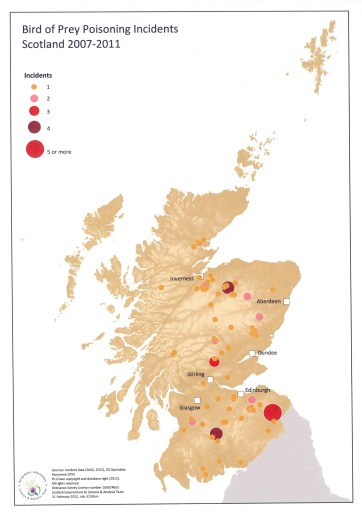
The Scottish Government has today published the 2011 poisoning map (otherwise known as Scotland’s map of shame).

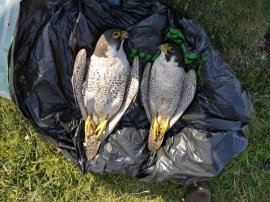
The newspapers are heralding the figures as a success story, as the numbers show an apparent drop in poisoning incidents (“only [only??!] 16 raptors were killed as a result of being illegally poisoned in Scotland – 12 fewer than in 2010 and the lowest death toll since the first maps were published six years ago“, says The Scotsman). The victims included seven buzzards, four red kites, two peregrines, two sparrowhawks and a golden eagle.

On a superficial level this does look like convincing progress, but let’s scratch the surface and see what’s underneath…

The official Scottish government poisoning map only shows the places where poisoned birds were discovered. Given the remote areas involved and the fact that most of these poisoned birds were found by chance (by passing hillwalkers etc.), the official figures can in no way represent the actual number of raptors that were poisoned (but undetected) during 2011.

The figures behind the map also do not show the areas where poisoned baits (but no dead birds) were discovered during 2011. Nor do they show the other incidents of raptor persecution that were discovered during 2011, including shooting, trapping and nest destruction incidents. According to an article in today’s Guardian, it is claimed that last year’s illegal shooting, trapping and nest destruction incidents “have remained constant with previous years“. We’ll have to wait a good few months for the RSPB Birdcrime Report to see the actual figures. (Incidentally, how come the 2011 poisoning figures, as compiled by SASA, have not yet been released to the public? They’re obviously available as they were used to construct the poisoning map. So far they’ve only published data up to September 2011. Isn’t it in the public interest to release them? Why all the secrecy?).

It seems plausible that some shooting estates are doing their best to distance themselves from any sign of illegal raptor persecution, especially in light of the new law on vicarious liability. A likely example of this behaviour was an incident in the Borders in September 2011. A dog walker discovered a bag full of dead raptors by the side of the busy A68  road (see here for earlier blog on this). The police were alerted and the birds were sent to SASA for toxicology tests. The results showed that the two sparrowhawks and two buzzards had been poisoned with the banned pesticide Carbofuran. Because the dead birds had been dumped away from any shooting estate or farm, without being seen, it was virtually impossible for the police to prosecute anyone (SASA reports that the police have now closed the case due to a lack of positive leads – see here). What is the probablity that other estates up and down the country are poisoning raptors on their land and then removing the evidence as far from their location as possible?  It was pure chance that this bag of poisoned raptors was discovered. How many more are left rotting and undiscovered across the country?

But let’s suppose, just for a minute, that the latest map IS an accurate representation of all raptor poisoning incidents that took place in 2011. Should we then accept that shooting estates are cleaning up their act and they’ve all suddenly decided, after over 100 years of persecution, that raptors are actually ok and shouldn’t be killed? The only way to measure that will be to look at LONG-TERM TRENDS of poisoning incidents as well as LONG-TERM TRENDS of raptor populations. We’ve blogged about this before (see here) but it’s worth repeating some of it to show the bigger picture. The graph (adapted from the RSPB’s excellent report: The Illegal Killing of Birds of Prey in Scotland in 2010, see here) shows the long-term trend of poisoning incidents in Scotland from 1989-2010. Look carefully at the graph and you’ll see peaks and troughs in the numbers recorded. Yes, there certainly have been previous drops in the number of poisoning incidents, but then look what happened in the following years – another increase, and then another drop, then another increase etc. Before the game-shooting lobby starts its self-congratulatory back-slapping, we need to see a continuous decline in the number of recorded incidents, AND we need to see raptor populations recovering in those areas where persecution has been endemic. This will take time, but could arguably be judged in about five years’ time.
Of course we all hope that the 2011 figures are the start of a new era in raptor conservation in Scotland. As Environment Minister Stewart Stevenson has said in today’s media: “I hope this proves to be the beginning of a continuing reduction in such cases, leading to the end of this outdated, dangerous and cruel practice“. It is notable that his statement contains more than a hint of caution. That man’s no fool.

See an excellent article about the latest figures in today’s Guardian here

Article in The Scotsman here

Nest cameras to protect raptors in south west England

In a bid to tackle increasing levels of wildlife crime, Devon & Cornwall Police have teamed up with the RSPB to launch ‘Operation Wilderness’, a new scheme that will see 24 hr nest cameras installed at vulnerable sites across the region.

This is a proactive response to the spate of raptor persecution incidents last year, which included the illegal poisoning (with Carbofuran) of four goshawks and a buzzard (see here) and three peregrines (see here and here). There is also concern about egg collectors and pigeon fanciers in the area.

The cameras have been paid for by the Devon Bird Watching and Preservation Society, and Operation Wilderness is being led by Police Wildlife Crime Officer PC Josh Marshall.

Well done to everyone involved  – this is an impressive  joint effort.

BBC news article here