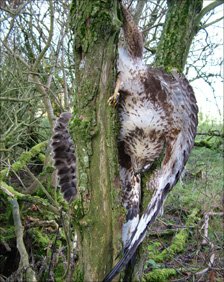
Photo: hiding the evidence

This is a photo of a dead buzzard inside a hole. How did it get there? Did the person who illegally killed the buzzard stuff it inside the hole to hide the evidence from casual passers-by? Or did the buzzard crawl inside the hole to die of natural causes? Yep, that must be it. Didn’t 13 of them do the same thing on a Scottish sporting estate a few years ago? Interesting that they all chose rabbit holes within close proximity to a crow cage trap. Oh and then there were the gunshot wounds…

Red kites have also been known to do it, funnily enough on another Scottish sporting estate. First they removed their wing tags, placed them in a hole and then covered the hole with moss. Then they severed their own legs, placed those in holes and also covered the holes in moss. Remarkable.

Wriggling out of vicarious liability?

Regular blog readers will be well aware that the concept of vicarious liability in relation to raptor persecution became enacted in Scotland on January 1st 2012 as part of the WANE Act. For new readers, some background can be found here. Vicarious liability has had its critics but until the first test case in court, nobody really knows just how strong, or weak, the new legislation will prove to be.

An interesting comment about vicarious liability was received on the blog at the end of last week; it suggests legal loopholes may be being exploited to avoid possible conviction. Given the interest in VL, we’ve decided to re-post the comment here. Thanks to Steve from OneKind for submitting it:

Information gathered by Onekind suggests how some estate owners may try to avoid vicarious liability in the future by sending their game keepers on all the trapping and best practice courses there are going. According to our intelligence, top lawyers are being hired to travel around the country lecturing to gamekeepers on the law related to wildlife crime. Our information suggests that the idea behind this action, being taken by landowners and worked on by these top Lawyers, is that if a wildlife crime were to occur on their land by one of their keepers then the landowner can say that he put his keeper through the relevant courses and that he doesn’t know why the keeper did what he did. They hope that this will be enough to persuade the court that they were not complicit with the crime carried out on their land. Further information we have acquired tells us that a well-known land owner has been urging other landowners to take this idea on and which will probably be up and running properly within the next few months“.

I guess we’ll wait and see whether this defence is used if/when charges of vicarious liability are ever brought against anyone. It’s an interesting one because what they are allegedly proposing to do is not illegal, but its hardly in the spirit of moving towards the elimination of raptor persecution from the game-shooting industry, is it? In its defence, some will probably argue that we should all be thankful that gamekeepers are receiving such excellent training, but some may argue that some of the training is far from excellent. For example, OneKind has concerns about the adequacy of the snare training courses and suggests there may be an ulterior motive for running them (see here).

The use of legal loopholes to avoid possible conviction is a well-known tactic in many areas of crime, not just wildlife crime, although wildlife crime does have its fair share of examples. A recent one was reported in a newspaper at the beginning of July (sorry, no URL available) concerning the case of a gamekeeper on the Airlie Estate at Kirriemuir, Angus. He was accused of alleged criminal activity after the discovery of three buzzards inside a crow cage trap. However, he was acquitted after Sheriff Kevin Veal decided that the keeper was not given proper information about why he was being interviewed by an SSPCA inspector and a Tayside Police wildlife crime officer. Some lawyers are very good at their jobs.

It certainly pays to employ a professional lawyer rather than a pretend one. An employee from a very well-known organisation recently sent an email to a group (no, not us!) who publish the names of convicted gamekeepers and other wildlife criminals on their website. The email suggested that certain names should be removed from the website because the convictions were considered spent. The email explained the relevant law under which the names should be removed and went into some detail about how the law applied. The employee signed off with an impressive number of letters after their name, including LLB (a law degree). Uncannily, the information that the impressively-qualified employee wrote about this particular law bore an incredibly close resemblance to a Wikipedia entry on the same subject. Hmm, not quite so impressive now!

Stuff and nonsense

The airwaves are busy with criticism of last night’s episode of Countryfile, which featured a few pieces on evil birds of prey, especially buzzards and peregrines.

It’s too tedious to reproduce all the arguments here – we’ve heard it all before, although the SGA chairman Alex Hogg’s apparent inability to count was quite amusing. In a voiceover we were told that Alex was due to release 700 pheasant poults into his woodland pens (prior to letting them loose into the wider countryside so they can be shot dead). The interviewer (Tom Heap) then asked Alex if he had any idea how many poults he might be losing to buzzards. Alex’s response: “We’re probably losing, getting on for over a thousand pheasants in a year to buzzards“. Hmm.

At least the RSPB’s Duncan Orr-Ewing was able to provide some balanced and constructive discussion, but it was disappointing that the producers failed to include any meaningful discussion on the persecution issue. Tom Heap took to his Twitter account after the programme and offered this:

Am intrigued…many accusing #countryfile of buzzard bias. Why? Real country issue, meticulous balance. Proud of our work“.

For anyone who missed it, the episode can be seen on BBC iPlayer for the next seven days (here).

Gamekeeper convicted after trapped buzzard starved to death

Following the post we wrote on 31 May 2012 (see here), another Scottish gamekeeper has been convicted of a wildlife crime offence, this time for allowing a buzzard to starve to death inside a crow cage trap.

Jonathan Smith Graham (30), a gamekeeper on Glen Lyon Estate in Perthshire (see here), pleaded guilty to using a crow cage trap in which a buzzard was trapped and then starved to death. He has been fined £450 which is pretty pathetic when you consider the scope of available penalties (up to £5,000 &/or 6 months in prison), but perhaps more importantly he has now been banned from operating a crow cage trap for five years. Sheriff McCreadie’s comments about Graham’s actions (and in-actions) were also greatly encouraging and are welcomed. Credit to Tayside Police for undertaking the investigation on their own initiative and to wildlife fiscal Shona McJannett for a successful prosecution.

For the details of this case see here, here and here.

Some questions:

1. Will Jonathan Smith Graham be sacked from his gamekeeper job at Glen Lyon Estate now he has a wildlife crime conviction? Ask them directly: sally@glenlyonestate.co.uk

2. Was he/is he a member of the Scottish Gamekeepers’ Association? (His defence lawyer was David McKie – the SGA’s solicitor – just coincidence?). If he is a member, will he be expelled now he has a wildlife crime conviction? Ask them directly: info@scottishgamekeepers.co.uk and while you’re there, ask them if they’re ready to say yet whether convicted gamekeeper Robert Christie (Lindertis Estate) is/was a member (see here).

3. Why hasn’t the SGA issued a public statement condemning the actions of this gamekeeper? Ask them directly: info@scottishgamekeepers.co.uk

4. Is Glen Lyon Estate a member of Scottish Land and Estates? Ask them directly: info@scottishlandandestates@co.uk

What aren’t they telling us and why aren’t they telling us?

It seems blogger Alan Tilmouth was much more astute than us. Last week we blogged about Alan’s FoI to DEFRA to find out which Northumberland shoots were set to host the DEFRA buzzard ‘study’. DEFRA wrote back to Alan to ask whether he still wanted to proceed with his FoI even though the ‘study’ had now been cancelled. Alan saw this as a ‘concealment’ attempt by DEFRA – we saw it as just a delaying tactic (see here). We were wrong!

DEFRA has now written to Alan again, this time to tell him that yes, they hold the information he requested but no, they aren’t going to reveal it for ‘public safety’ reasons!!! See Alan’s blog here for their full statement.

Public safety my arse! Does anyone else smell the rancid odour of a cover up? Time to write to the Information Commissioner, Alan!

It seems DEFRA aren’t very good at responding to FoI requests, especially those relating to the game-shooting industry. Mark Avery has also been having trouble getting DEFRA to respond to his FoIs about Walshaw grouse moor (see here).

Talking of cover ups, still no official word from Tayside Police, Grampian Police or the RSPB on that dead golden eagle that we reported on Monday (see here). Hmmm…

#buzzardgate aftermath

Following DEFRA’s recent u-turn on their planned ‘study’ that included blasting buzzard nests with shotguns and catching up adult buzzards and sticking them in an aviary for the rest of their lives (see here), questions are still being asked about the finer details of the ‘study’.

Blogger Alan Tilmouth, who was one of the most active in the campaign against the proposed ‘study’, wrote a FoI request to DEFRA to find out the names and locations of the ‘study’ sites. Today he received a response, which he suggests is an attempt by DEFRA to conceal the information (see Alan’s blog here). I’m not sure that I’d agree that it’s a concealment attempt, but perhaps a delaying tactic nonetheless. Well done Alan – looking forward to their next response!

#Buzzardgate continues to receive media attention and today a letter was published in the Independent calling for a pledge on buzzard protection, as well as calls for action to stop the continued illegal persecution of birds of prey. The letter was signed by an eclectic mix of organisations, some of whom have not previously entered into the arena of campaigning directly for raptor protection (RSPB, National Trust, Greenpeace UK, Friends of the Earth, Wildfowl & Wetlands Trust, Hawk & Owl Trust, Mammal Society, Badger Trust, People’s Trust for Endangered Species, Northern England Raptor Forum, Humane Society International, Butterfly Conservation and the British Mountaineering Council). Good on them and let’s hope we hear more from them all in the coming months. We’re stronger together. Letter here.

SGA leaders try to spin the science….but fail

Those award-winning scientific gurus at the Scottish Gamekeepers’ Association have been sharing their intellectual acumen as they interpret recent scientific research relating to raptors.

First up is Professor Bert Burnett, who chose Facebook as his outlet (well, scientific journals are just so passé) for an examination of the recent paper on historical eagle distribution in the UK and Ireland (see here). His thesis starts with this:

The RSPB are even more powerful than i thought. The are now able to contact the dead, who had the foresight to record raptor numbers on blocks of stone knowing that the RSPB would be needing the info in 3,000 years time. Has anyone actually checked the validity of this latest garbage from RSPB? We have also had teradactals  etc in the uk, have the RSPB got the population info on them as well? With a bunch of irate 21st century farmers breathing down their necks, me thinks the RSPB are getting fidgity“.

Thirty-four minutes later, Professor Burnett decided that actually, this peer-reviewed scientific paper might be useful after all, as it appears to support his hypothesis that eagles are not constrained by persecution and certainly not by gamekeepers, no siree bob:

looking at the post 3000 year population figures from RSPB i note that the golden eagle pop. was 650 for the uk as a whole. Scotland has 440 now, living in a much changed counryside from 3000bc, i would think this is a huge success story not the doom and gloom pushed out by the RSPB“.

Had Professor Burnett studied the data in a little bit more detail, he would have noted that the golden eagle breeding population estimate for c. 500 was actually 1,000 – 1,500 pairs. Oops.

Professor Burnett’s esteemed colleague, Professor Alex Hogg, also had his own unique interpretation on recent scientific research, this time on the DEFRA buzzard ‘study’. Choosing that highly-acclaimed scientific journal Shooting Times to report his scientific results, Prof Hogg wrote this:

In Scotland, we are already ahead of where England is now with this [the proposed buzzard ‘study’ that included the destruction of nests and permanent removal of adult buzzards into captivity]. The trials have been done“. (Read full article here).

Really? Where and when were these trials done in Scotland, and where are the published, peer-reviewed results?

Professors Burnett and Hogg are not the only ones from the game-shooting community who have been demonstrating a shocking ability to misinterpret science….more in a following post.

George Monbiot: a journalist who says it like it is

George Monbiot is fast becoming my favourite journalist (and not just because he uses this blog as a source of information!).

In his latest article, due to be published in the Guardian tomorrow but released on his website tonight (see here), Monbiot digs a little deeper inside the #buzzardgate debacle and uncovers some fascinating information.

In addition to #buzzardgate he also discusses the scandalous state of the English hen harrier population. He is one of very few authors willing to state, categorically and without caveats or apologies, that the missing English hen harriers [approx 329 pairs] ‘have been shot or poisoned by grouse-shooting estates’. There’s no dilution or ‘maybes’ or ‘possiblys’ in the name of so-called ‘partnership building’ – English hen harriers have been wiped out by grouse-shooting estates and Monbiot is not afraid to say so.

If you read Monbiot’s biography  (here) you’ll see that the thing he fears is ‘other people’s cowardice’.

We can all learn from him.

DEFRA backs down on buzzard ‘management’ trial!!

News just in, from Defra’s twitter account, Richard Benyon says the following:

“We’ve listened to public concerns, so we are stopping current research and developing new proposals on #buzzards”

Fantastic news (well, at least until we find out what these ‘new proposals’ entail). A big, fat, massive WELL DONE to everyone who blogged, tweeted, emailed, petition-signed etc about this outrageous ‘study’. The people have been heard! It’s incredible to see how effective 9 days of campaigning can be!

By the way, it looks like GWCT had tendered for the buzzard ‘study’ (see here). They seem to be quite good at undertaking unpopular ‘research’ – they’re currently carrying out  a ‘study’ funded by those doyens of conservation, Songbird Survival, which involves a large scale corvid removal experiment (basically killing crows & magpies and calling it science….hmm, sound familiar? See here). If you’re not sure who Songbird Survival are, see here.

We’ll post responses about the DEFRA u-turn here as and when they are published:

Update on DEFRA website here (scroll down underneath the ‘mythbuster’ bit)

Article in the Guardian here (includes info about new research proposals)

RSPB response here

BBC news article here

Article in the Independent here

Article in the Telegraph here

Mark Avery’s thoughts here

Country Land & Business Association (CLA)  response here

British Assoc. for Shooting & Conservation (BASC) response here  (just a statement, no opinion offered)

Countryside Alliance response here (Benyon’s glum chums)

National Gamekeepers’ Organisation response here (not very happy either)