Wildlife crime penalties: have your say

There has long been dissatisfaction with the penalties handed out to those convicted of wildlife crime. Yesterday’s sentencing of convicted mass raptor poisoner Allen Lambert of Stody Estate merely served to highlight the issue, again. But what we perceive to be unacceptably lenient penalties is certainly nothing new, and especially those sentences given to people (usually gamekeepers) associated with the game-shooting industry.

There’s a huge lack of public confidence in the way the judiciary deals with these criminals, with many people often talking about corruption, vested interests, biased judges/sheriffs etc. We’ve all come to expect unduly lenient measures – you only have to look at the comments on social media even before Lambert’s sentence was announced – people were predicting a metaphorical ‘slap on the wrist’, and in essence, that’s indeed what he got, even though the judge had stated that Lambert’s crimes “had crossed the custody threshold“.

Quite often (although apparently not in Lambert’s case), the accused’s employer (typically a wealthy landowner) will even fork out for a Queen’s Counsel (QC) to put forward the accused’s defence. A QC is considered to be an exceptional lawyer of outstanding ability – it’s hardly a level playing field to pit a QC against an ‘average’ public prosecutor, leading to even more public concern about the perceived ‘fairness’ of these trials and any subsequent punishment.

Sentencing for wildlife crimes has been hit or miss in both Scotland and England. For most wildlife crime offences (although not all), the maximum sentence available for each offence is a £5,000 fine and/or a six month custodial sentence. So for example, if someone had been convicted of poisoning two buzzards, they could potentially be hit with a £10,000 fine and a 12 month custodial sentence. As far as we’re aware, the maximum sentence has never been given. Instead, a large dollop of judicial discretion has been applied, resulting in weak and inconsistent penalties and a growing level of frustration amongst the general public who wish to see justice being done.

For example, in 2011, a gamekeeper in South Lanarkshire was convicted of poisoning four buzzards with the banned pesticide Alphachloralose. His sentence? An admonishment (basically a telling off). The maximum penalty available to the Sheriff was a £20,000 fine and/or a two-year custodial sentence. What was even more astonishing about this case was that the gamekeeper had been convicted of another wildlife crime three years earlier (illegal use of a crow cage trap in which he’d caught a buzzard), on the same land, for which he’d received a £300 fine. So the poisoning of four buzzards with a banned pesticide was his second conviction and yet he was given the most lenient penalty available.

A few months later, and just down the road in South Lanarkshire, a second gamekeeper was convicted of possessing the banned pesticide Carbofuran, which had been found in his vehicle. No charges were brought for the discovery of a dead buzzard and a pheasant bait (both tested positive for Carbofuran) found on land where this gamekeeper worked. His sentence? A £635 fine for possession (maximum sentence available was a £5,000 fine and/or a six month custodial sentence).

Things may be about to change in Scotland. Environment Minister Paul Wheelhouse has, to his credit, instructed a review of wildlife crime penalties. The group’s remit is:

“To examine and report on how wildlife crime in Scotland is dealt with by the criminal courts, with particular reference to the range of penalties available and whether these are sufficient for the purposes of deterrence and whether they are commensurate with the damage to ecosystems that may be caused by wildlife crime”.

Now, while we don’t for one minute think that a potential increase in penalties will be the great panacea to stopping wildlife crime (for that to happen there also needs to be a significant change in investigation and enforcement procedures…..it’s pointless having a severe penalty in place if the criminal knows the chances of being caught are virtually nil…but more on that in due course), it is nevertheless an encouraging step, assuming of course that the review committee recommends an increase in penalties. They may not – see here for our previous comments on the membership of this review committee, which inexplicably includes the owner of a game-shooting estate.

This is where you come in. There is an opportunity for you to share your views with the review committee by answering a simple questionnaire that includes some carefully-thought out questions. The deadline for responding is two weeks today (21st November 2014) and the questionnaire can be filled in on-line and emailed to the committee. Please click here to download.

This is an excellent opportunity to have your say and perhaps have some influence on future wildlife crime sentencing options. Although the review is only applicable to sentencing options in Scotland, you do not have to live in Scotland to participate – it’s open to anyone from anywhere. And who knows, if improvements are made in the Scottish system then it provides more leverage for calls to do a similar review of wildlife crime penalties in England, Wales and Northern Ireland.

The review committee is due to report its findings (and recommendations) early in the New Year.

Stody Estate mass poisoner gets…..10 week suspended sentence

Gamekeeper Allen Lambert, convicted of mass raptor poisoning at Stody Estate, Norfolk, has been given a 10 week suspended sentence for poisoning 11 raptors (suspended for one year), a six week suspended sentence for possession of firearms and dead buzzards (suspended for one year) and has been ordered to pay £930 prosecution costs and an £80 victim surcharge.

This sentence will infuriate many. Lambert’s crimes contributed to one of the worst incidents of mass raptor poisoning in the UK. Although it’s not the worst incident, it’s right up there near the top of the list and is certainly the worst mass poisoning of raptors uncovered in England.

District Judge Peter Veits said Lambert’s crimes ‘had crossed the custody threshold’ but that his sentence would be suspended. Why? Sentencing is supposed to serve two purposes. It’s supposed to be a deterrent, not only to the convicted criminal, but also to others who may be contemplating committing the same crime. It’s also supposed to provide a punishment to the perpetrator for having acted criminally.

Does a suspended jail sentence meet any of these aims? No, it certainly does not.

What a wasted opportunity for the judiciary to send out a clear message to those who continue to commit abhorrent wildlife crimes. It’s so rare to actually get a conviction for poisoning; usually it’s the much lesser charge of ‘possession’ of banned poisons [in Scotland] or ‘storage’ of illegal poisons [in England] but here’s a gamekeeper who has been found guilty of actually poisoning 11 protected raptors. Sure, the judge’s sentencing options are constrained within statutory boundaries but the sentence in this case is nowhere near as strong as it could have been. Some of Lambert’s crimes are offences under the Wildlife & Countryside Act. Under this legislation, the maximum sentence, calculated for EACH offence is a £5,000 fine and a six month custodial sentence. That’s just for poisoning 11 birds – in Lambert’s case there are numerous other offences to consider, including firearms offences which usually carry a custodial sentence.

A suspended custodial sentence and a less than £1000 ‘fine’ (prosecution costs) for what Lambert did is absurdly lenient. According to the RSPB, since 2001, four gamekeepers have received suspended custodial sentences for persecution offences. During the same period, 12 egg collectors have actually been jailed. The inconsistency in wildlife crime sentencing is remarkable.

In Scotland there is currently a wildlife crime penalty review underway, at the behest of Environment Minister Paul Wheelhouse. There is an opportunity for you to participate, by filling in a questionnaire which seeks views on whether penalties for wildlife crime offences in Scotland are sufficient deterrent. The closing date is 21 November. Full details here.

So, Lambert’s pretty much got off scot free, but what of his (now former) employers, the Stody Estate? According to the BBC, ‘there is no evidence the estate owner, Charles MacNicol, knew about the poisonings. He wouldn’t tell BBC News whether he knew, or whether he condemned the killings’. Lambert was not sacked by Stody Estate, but instead was allowed to take early retirement, according to ITV news.

What we do know is the Stody Estate has received millions in agricultural subsidies over the years (see here), and as a result of blog readers’ efforts, the Rural Payments Agency is understood to be investigating to see whether financial penalties can be applied for cross-compliance offences (see here).

UPDATE 8/11/14: Here are the judge’s comments on Lambert’s sentencing:  DJ Peter Veits sentencing 6 Nov 2014

Media coverage of Lambert’s sentencing

RSPB press release here

BBC news here

BBC news video here

RSPB Investigations blog here

Daily Mail here

ITV news here

Norfolk Eastern Daily Press here

Telegraph here

Guardian here

Independent here

Norfolk Constabulary press statement here

Lambert 9 bz

Sentencing due for Stody Estate mass poisoner

Allen Lambert, the mass poisoning gamekeeper from Stody Estate, Norfolk, will be sentenced today following his convictions last month.

What sort of sentence does a convicted mass poisoner deserve? He was found guilty of poisoning 10 buzzards and 1 sparrowhawk. He was found guilty of the illegal storage and use of some of the most dangerous pesticides in the world. He was found guilty of having equipment capable of being used to prepare poisoned baits. He was found guilty of having nine dead buzzards in his possession.

Let’s hope the magistrate views this case with the seriousness it deserves.

Previous blogs on this case here, here, here.

First vicarious liability prosecution: part 3

Criminal proceedings continued today against Ninian Robert Hathorn Johnston Stewart in the first known vicarious liability prosecution under the WANE Act 2011.

Mr Johnston Stewart, the landowner of Glasserton & Physgill Estates, is charged with being vicariously liable for the criminal actions of Glasserton gamekeeper Peter Bell, who was convicted in 2013 of laying poisoned bait which killed a buzzard (Carbofuran) and possession of three banned pesticides (Carbofuran, Strychnine and Alphacloralose) (see here).

Today’s hearing was continued for an intermediate diet on 8th December 2014.

Previous blogs on this case here and here

Case against Scottish gamekeeper William Dick: part 4

Criminal proceedings continued today against Scottish gamekeeper William Dick.

Dick, 24, of Whitehill Cottages, Kirkmahoe, Dumfries is accused of bludgeoning and then repeatedly stamping on a buzzard. The offences are alleged to have taken place in Sunnybrae, Dumfries in April 2014. Dick has denied the charges.

Today’s hearing was a notional diet and the next hearing will be an intermediate diet on 24 February 2015. A provisional trial date has been set for 23 March 2015, pending the outcome of the intermediate diet in February.

Previous blogs on this case here, here, here

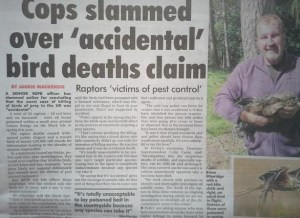
Ross-shire Massacre: more on that Police Scotland press release

Brian Etheridge statementA week ago, Police Scotland issued a ludicrous press statement concerning the illegal poisoning of 22 raptors in Ross-shire. They said that they could CONFIRM that the birds “were most likely not targeted deliberately but instead were the victims of pest control measures“.

We’ve blogged quite a bit on that press statement already (see here, here, here, here). Our main issue with it is that the police appear to have ruled out intent (i.e. inferring the birds were accidental victims) before they’ve even identified a suspect. How could they possibly know what the intent was without first having a confession from the poisoner? We also take issue with them citing ’16’ victims instead of 22 victims. It may well be that they only have confirmed poisoning results from 16 of the 22, but to completely ignore the other six birds merely diminishes the scale of this crime.

We are not alone in this view. An article in the North Star quotes the RSPB’s Brian Etheridge (he’s the guy who has worked with the Black Isle red kite population for 19 years and was heavily involved in the discovery of the poisoned birds) as folllows:

It’s a very stupid statement. That’s almost justifying the killing. It’s like saying that a drunk driver who kills somebody didn’t go out with the intention of killing anyone. He was just drunk and it was an accidental death“.

Last week, we invited blog readers to contact two of the partner agencies involved in this investigation (RSPB Scotland & SSPCA) to formally ask whether they agreed with the content of the Police Scotland statement. The SSPCA is yet to respond, but Ian Thomson, Head of Investigations at RSPB Scotland has issued the following statement:

The use of poisoned bait, deliberately placed in the open countryside, is an indiscriminate and criminal act, whatever the intention of the perpetrator, and is aggravated in this case by the fact that an illegal chemical was used.

Whether these birds were killed deliberately or otherwise is irrelevant. Someone placed a fast-acting and very toxic poison out in the open, in an area well-known as being frequented by protected birds of prey, including a significant part of the north of Scotland red kite population. The resulting deaths were an entirely predictable result. It is very fortunate that the members of the local community who discovered poisoned birds did not become victims themselves.

The placing of poisoned bait, just a few miles from the popular Tollie red kite feeding station, was not only a reckless attack on local wildlife but also on the local tourist economy.

 I hope this provides clarification of our position”.

END.

Now, while Mr Thomson’s statement doesn’t really answer directly the question he was asked (and to be fair, we’d have been surprised if he had, given that the RSPB has to work in partnership with the police), it is nevertheless very revealing. He specifically mentions poisoned bait – something Police Scotland has so far failed to do, but more importantly, if you read between the lines, it’s pretty obvious that RSPB Scotland isn’t too happy about the Police Scotland statement: “Whether these birds were killed deliberately or otherwise is irrelevant” and “The resulting deaths were entirely predictable“. Indeed.

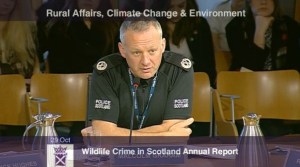
The Police Scotland statement came in for further scrutiny at the Scottish Government’s Rural Affairs Committee hearing on Wednesday. The session was all about wildlife crime and two senior police officers, as well as a rep from COPFS, gave evidence to what turned out to be an impressively well-informed Committee. We’ll be blogging more on what was said at that hearing in due course, but suffice to say it was extremely illuminating. The official transcript apparently won’t be available until Monday, but in the meantime we thoroughly recommend you watch the video of the hearing (available here).

Malcolm GrahamSo, what was said about the Police Scotland press statement during that hearing? Quite a lot! The discussion on this specific item lasted for 18 minutes (see video 01.20-01.30 and then 01.34-01.42) and those well-informed Committee members clearly expressed their concern about the Police Scotland statement.

The police officers (ACC Malcom Graham, pictured left, and DCS Robbie Allan) tried to defend their position – notably, they didn’t apologise for any of the confusion their statement had caused – but their defence wasn’t very impressive. They did state, clearly, that they hadn’t intended to infer the poisonings were accidental, and they did confirm a criminal investigation was on-going. That was good, but they couldn’t justify why they thought the birds “were most likely not targeted deliberately” and quite surprisingly, they claimed that their partner agencies had been in support of the press release! Here’s part of what Assistant Chief Constable Malcolm Graham had to say:

 “We put out information into the public domain that we thought was going to clarify what we thought our best assessment was, lay behind the intent of the acts that we’re investigating, and from everything that we have done, in combination with a number of other agencies who are active in this field AND WHO SUPPORTED THE PRESS RELEASE THAT WE PUT OUT [Emphasis by RPS], we wanted to say that it didn’t appear that the activity had sought to deliberately target the birds that had been killed“.

We find it very hard to believe, given the formal press statement issued by RSPB Scotland, that they were in any way supportive of the Police Scotland statement. So who were these “other agencies who are active in this field” who “supported the press release“? We’re very interested in this and perhaps Assistant Chief Constable Malcolm Graham would like to be given the opportunity to explain, given how keen on public accountability Police Scotland claim to be. Perhaps he wouldn’t like to explain, but we’ll never know unless we ask. Emails to: ACC.CrimeMCPP@scotland.pnn.police.uk

Disingenuous SGA uses flawed analysis to misrepresent raptor crime data

There’s a shockingly poorly-researched article in today’s Telegraph, penned by Scottish journalist, Auslan Cramb.

He claims that ‘Wind turbines have killed more birds of prey than persecution‘ this year. The basis of his flawed claim is his analysis of the latest SASA data, covering the period Jan-June 2014.

Cramb states that, “Four raptors were killed by turbines between January and June. Over the same period, two birds were confirmed to have been poisoned or shot“.

Dear God. Let’s just have a closer look at the SASA data, shall we?

March 2014: Dead peregrine found in Strathclyde – Carbofuran poisoning.

April 2014: Dead peregrine found nr Stirling – [shot on the nest].

April 2014: Dead buzzard found in Fife. Poisoned [“banned poison” not named by police].

June 2014: Dead hen harrier found in Muirkirk – [shot].

That’s four confirmed illegal killings in the report. Can’t Mr Cramb count? There’s also a further entry:

January 2014: Dead rook, rabbit bait & hare bait (Carbofuran) found in Strathclyde. Not a raptor, granted, but its misleading not to mention this incident especially as Carbofuran-laced baits are routinely used to kill raptors. This incident is no less serious than a poisoned raptor.

But what’s missing from the SASA report? According to our research, the following:

January 2014: 1 dead bird [species unidentified] & suspected poison bait, South Lanarkshire.

March 2014: 16 red kites poisoned in Ross-shire [“banned poison” not named by police].

March 2014: 6 buzzards poisoned in Ross-shire [“banned poison” not named by police].

April 2014: 1 dead buzzard, allegedly shot, bludgeoned and stamped on, Dumfries & Galloway. A criminal trial is underway.

That makes a total of 27 confirmed illegally-killed raptors between Jan-June 2014, plus one rook and one unidentified bird.

Now, it’s quite possible that Mr Cramb is unaware of some of those additional persecution incidents (although if he was a half-decent journalist he would have done some homework – information about all of those crimes can be found on this blog).

However, it is inconceivable that the 22 raptors poisoned in the Ross-shire Massacre in March this year escaped his attention. He’s a journalist – it’s his job to keep abreast of the news.

Sure, the 22 poisoned raptors are not listed in the SASA report because mysteriously, SASA has chosen to exclude them, probably at the request of Police Scotland – we blogged about this exclusion here and the ramifications of their secrecy just keep coming, as evidenced here), but it’s very poor journalism for him to have excluded them from his analysis on windfarm deaths vs persecution deaths.

Cramb’s poor research skills are one thing. However, his flawed analysis appears to have been readily accepted by the Scottish Gamekeepers’ Association, and used by them to misrepresent the truth about raptor persecution stats. In the article, Cramb says this of the SGA:

A spokesman for the SGA said the report revealed the truth behind the “prejudice” aimed at landowners and farmers which painted the shooting industry as “guilty until proven innocent“.

He added: “It is important the public can understand for themselves the true picture regarding wildlife crime.

“After the appalling finger-pointing at the shooting and farming industries following Conon Bridge this year by the highly politicised conservation movement, we will be interested to see if those groups now call for the same licensing measures against the government-backed wind farm industry”‘.

So, the SGA have accepted Cramb’s analysis even though they are fully aware that the 22 illegally-poisoned raptors at Conon Bridge are not included in his results. They can’t deny knowledge of the Ross-shire Massacre because the SGA spokesman even mentioned it in his quote!

We would argue that the SGA is being disingenuous, readily accepting Cramb’s flawed analysis because it suits their agenda to keep denying the extent of raptor persecution crimes in Scotland. That’s outrageous. Why is this organisation still allowed to sit on the PAW Scotland Raptor Group, whose objective is to raise awareness of raptor persecution, not to deny it? They’re a disgrace.

Telegraph article here

UPDATE 3rd November 2014: RSPB Scotland has also blogged about this here

Ross-shire Massacre: Police Scotland, see what you’ve done?

Last Friday, Police Scotland put out an idiotic press release stating that they could now CONFIRM that the 22 raptors illegally poisoned in the Ross-shire Massacre seven months ago “were most likely not deliberately targeted“. It was an astonishing statement, not least because they had ruled out criminal intent before they’d even got a suspect, and despite the fact that those birds are known to have been killed with a banned poison. We blogged about it here and we’ll be blogging further on this shortly, following the grilling that senior police officers received during yesterday’s Scot Gov RACCE Committee hearing (see here).

Following that Police Scotland press statement, Tim (Kim) Baynes of Scottish Land & Estates wrote a letter to the Herald complaining about media speculation and stating (falsely) that raptor persecution crimes had declined (see here).

In response to that letter, yesterday Duncan Orr-Ewing of RSPB Scotland set out the facts about the increase in raptor persecution crimes (see here).

Today, another letter has appeared in the Herald, in response to Duncan Orr-Ewing’s letter. This letter was tweeted by the SGA this morning, with the following statement: “Herald letter from Ayrshire reader on the legal concept of innocent until proven guilty”.

Here’s the letter:

Thursday 30 October 2014

RSPB has its own agenda

DUNCAN Orr-Ewing, Head of Species and Land Management for RSPB Scotland, does not let the facts get in the way of his argument (Letters, October 29).

I would remind Mr Orr-Ewing that he stated in this very journal that a crime had been committed with the poisoning of raptors on the Black Isle and he then proceeded to promote his agenda against gamekeepers and shooting estates. Police Scotland has stated that no crime was committed, but that has not stopped RSPB advocating regulation which would allow it to attempt to criminalise legal businesses.

Rather than being a positive, the involvement of RSPB in police investigations creates a massive question about impartiality. This underlines the danger of allowing bodies with their own agendas to be involved in criminal investigations. They appear willing to ignore the fact that in this country we are all innocent until proven guilty.

David Stubley,

22 Templeton Crescent, Prestwick.

So Mr Stubley thinks that the Ross-shire Massacre was not a crime. This is precisely why Police Scotland should never have issued their press statement. Although their press statement did say: “The criminal investigation into their deaths is still ongoing”, those seeking to diminish this crime as something ‘accidental’ have been given the perfect fodder to perpetuate their ignorant claims which many average members of the public will likely believe.

As for the SGA re-tweeting this letter, with no mention that the Ross-shire Massacre was indeed a crime, well that speaks volumes, doesn’t it?

Mr Stubley is no stranger to muddying the water about the Ross-shire Massacre. In May he wrote another letter to the Herald about this crime:

Wednesday 21 May 2014

Falling prey to an accident?

I NOTE that immediately after the discovery of several dead raptors on the Black Isle many people jumped to the conclusion that they had been poisoned by a gamekeeper, even though there was not a shred of evidence to back up this assumption.

Several weeks later and despite a large reward being offered no-one has been charged. I have a suggestion for a possible cause of the poisoning.

Those responsible for the reintro­duction of red kites and other birds set up feeding sites where the birds know they will be fed and therefore congregate in large numbers. The birds are fed on agricultural beasts which have been killed, roadkill or, during the shooting season, gamebirds which cannot be sold. Could one of those food sources have been exposed to poison by accident? This would surely explain the concentration of dead birds and the lack of anyone to blame.

David Stubley,

22 Templeton Crescent, Prestwick.

We wonder if Mr Stubley is a member of the SGA? Just sayin’……

Police Scotland’s media strategy about this high profile crime has been appalling. They complained yesterday during the RACCE Committee hearing that media speculation hadn’t been helpful. They could easily have alleviated that speculation by publishing clear, timely and precise information about this crime, without jeopardising their criminal investigation.

More on this shortly.

Killing with impunity: Birdcrime 2013 published

Birdcrime 2013The RSPB has published its latest annual report on crimes against birds in the UK in 2013.

Their press release here.

The killing goes on, with impunity.

76 individual birds & other animals were confirmed illegally poisoned in 2013. This is more than double the figure from 2012 (29 confirmed victims).

Poisoning victims in 2013 included 30 buzzards, 20 red kites, 1 golden eagle and 1 white-tailed eagle.

68 confirmed incidents involved the shooting or destruction of birds of prey. Victims included two hen harriers, two marsh harriers and 5 peregrines.

These are just the confirmed incidents. A total of 338 incidents were reported to the RSPB in 2013, with North Yorkshire once again being the worst location. There’s also a worrying number of incidents from Powys in South Wales, seemingly relating to poisoned baits.

Birdcrime 2013 is a thoroughly depressing read. The RSPB calls on the shooting industry, again, to clean up its act. Judging by the contents of this report, that’s a seemingly futile request.

Well done and thanks to the RSPB for not only compiling these thorough statistics but importantly, for sharing them in the public domain.

Download Birdcrime 2013: Birdcrime 2013

Hen harrier Bowland Betty, found shot dead on a grouse moor in North Yorkshire. (Photo by Natural England).

Bowland Betty

Ross-shire Massacre: SLE complains about media speculation

A letter has been published in the Herald today, penned by Tim (Kim) Baynes of Scottish Land and Estates:

Speculation around bird of prey deaths has become more hysterical

The announcement by Police Scotland that the 20 raptors found poisoned in March near Conon Bridge were “not deliberately targeted” raises number of serious matters.

Despite the trend of crimes against birds of prey having gone down in the last 3-5 years, particularly by poisoning, the speculation around each case has become more hysterical; the RSPB even tried to link the Conon Bridge incident to grouse moor management. There are now websites and bloggers and organisations involved in police investigations who are not slow to feed information to the media and promote speculation.

This speculation is having a corrosive knock-on effect on many other aspects of land management, severely straining the relationship between land managers and conservation bodies.

This also brings into focus the new measure whereby General Licences to control pest birds may be withdrawn where there is only a suspicion of wildlife crime, rather than it being proven in court.

Any deliberate killing of a bird of prey is illegal and is to be condemned but it is not in anyone’s interests that various activists and organisations can leap to conclusions without any evidence to support their point of view which in turn is afforded political and media credence. It would be a major step forward if government and other interested organisations were to take a lead in ensuring that reckless speculation should be discouraged. If everyone sticks to the facts and works more constructively together then the interests of conservation will be better served.

Tim Baynes,

Scottish Moorland Group,

Scottish Land & Estates,

Stuart House,

Eskmills Business Park,

Musselburgh.

So our Kim wants everyone to “stick to the facts”. His own track record on sticking to facts isn’t very impressive (e.g. see here, here, here).

His latest letter was written in response to Police Scotland’s outrageous announcement last Friday that the illegal poisoning of 22 raptors at Conon Bridge seven months ago was “not deliberately targeted” (see here). That idiotic statement was pure speculation – is Kim complaining about that?

Earlier this year, Jamie McGrigor MSP speculated, during a televised parliamentary debate, that the Ross-shire Massacre could have been the result of accidental food contamination at the Tollie Red Kite feeding station (see here). Did Kim complain about that?

Kim & Co had better batten down the hatches – speculation is bound to be rife when Police Scotland consistently fail to provide timely, and accurate, updates about such appalling crimes.

Understandably, Kim and his mates would probably prefer everyone to just shut up about raptor persecution crimes. It’s a bit too late for that.

Oh, and by the way, Kim, seeing as how you love facts, here’s one: It was twenty two dead raptors at Conon Bridge, not twenty. And here’s another fact: the Government’s 2013 wildlife crime report showed an increase in raptor persecution crimes. And guess what? The 2014 figures will also show an increase, because the ‘Conon Bridge 22’ will be included in those stats.

In other news, tissue sales are set to increase in Musselburgh.

There’s also an article in the Herald, based around the content of Kim’s letter and how he thinks that the speculation has ‘sullied’ the reputation of SLE members (here).