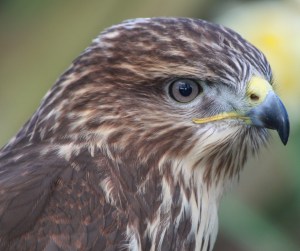
Buzzard shot & fatally injured in Borders

buzzard 3A buzzard that was found badly injured in the Borders in July had been hit by shotgun pellets in its head and wing. Its injuries were so severe the bird had to be euthanised.

The bird was found by a member of the public on 24th July by the side of the road between Heriot and Innerleithen. This is driven grouse moor country and the area has a long history of raptor persecution – if you’re unfamiliar with the region, check out google maps.

The SSPCA is appealing for information.

SSPCA press statement here

BBC News article here

Environment Minister Dr Aileen McLeod has made the following statement:

The illegal persecution of birds of prey is always unacceptable, but this case – with the pain and suffering caused to the buzzard – is particularly abhorrent. Anyone with information on this incident should contact the relevant authorities as soon as possible.

 “I am resolute in my determination to do all I can to put a stop to crimes such as this, with the Scottish Government working with law enforcement and others through the Partnership Against Wildlife Crime in Scotland (PAWS). I expect all right-minded people involved in the countryside, including with shooting, to support our efforts.

 “The Scottish Government has already put in place new and strengthened measures to crack down on wildlife crime, including vicarious liability prosecutions and general licence restrictions, for example. But let me be absolutely clear – I will consider taking further action if necessary and the licencing of shooting businesses in Scotland remains an option.

How many more times are we going to hear this now seemingly empty threat about ‘taking further action if necessary’? What does ‘if necessary‘ actually mean if it doesn’t mean that this latest incident is worthy of further action? Each time we’re told about another raptor that has been illegally killed we ask the Government when further action will be taken. Each time, we’re fobbed off with this line: “I will consider taking further action if necessary“. In the last few days alone we’ve learned of a shot hen harrier and two shot buzzards. Are none of these crimes worthy of ‘taking further action’?

Don’t know about you but we’d be really interested to find out exactly how Dr McLeod defines ‘if necessary‘. Does she have a target number of raptor killings in mind that will trigger further action? If so, what is that figure? Let’s ask her. Emails to: ministerforenvironment@scotland.gsi.gov.uk

Buzzard found shot dead in Loch Lomond & Trossachs National Park

Police are appealing for information following the discovery of a shot dead buzzard in the Loch Lomond and the Trossachs National Park.

The corpse was discovered by a member of the public about half a kilometre east of Ward’s Cottage, Gartocharn at around 2.15pm on Wednesday 5th August. It was found with a bullet wound in its chest.

Anyone with information is asked to contact the police on 101.

Scottish gamekeeper convicted of killing buzzard

The long-running case against Scottish gamekeeper William (Billy) Dick concluded today with a conviction for illegally killing a buzzard.

Dick, 25, of Whitehill Cottages, Kirkmahoe, Dumfries, had been observed by two witnesses on the Newlands Estate striking a buzzard with rocks and then repeatedly stamping on it, in April last year. The observers were alerted to the scene by the sound of a gun shot. Dick had denied the charges (in addition to two alleged firearms offences, which were subsequently dropped) but was convicted today at Dumfries Sheriff Court.

He will be sentenced in early September.

Well done to the SSPCA and Police Scotland for their investigation and to the Crown Office for a successful prosecution.

We understand that a vicarious liability prosecution will get underway at Dumfries Sheriff Court later this month.

The Newlands Estate offers driven partridge and driven pheasant shooting. This estate has previously donated to the GWCT’s Scottish Auction (see here – page 23).

While we wait for the sentencing hearing, here are some questions you might like to ask:

1. Is/was Dick a member of the Scottish Gamekeepers’ Association? Emails to: info@scottishgamekeepers.co.uk

2. Is Dick still employed on the Newlands Estate? Emails to: awbd@newlandsestate.co.uk

3. Is the Newlands Estate a member of Scottish Land & Estates? They get a mention in the SLE’s 2013 newsletter (here – page 10). Emails to: info@scottishlandandestates.co.uk

The photograph of Billy Dick was sourced from his Facebook page.

Previous blogs on this case here, here, here, here, here, here, here, here, here

Scottish farmer convicted of shooting buzzard

A poultry farmer in the Borders who shot a buzzard, claiming he had mistaken it for a carrion crow, has been fined £600.

Michael Harrison, 70, of West Linton, Peebleshire, who runs an egg production facility, told Sheriff Jamie Gilmour at Edinburgh Sheriff Court on Wednesday, “I just made a mistake. I shot at this crow and it came down, but when I saw it was a buzzard, I was mortified. I was born in the countryside and brought up on a farm. All my life I have been a wildlife supporter”.

Harrison had pled guilty under the Wildlife & Countryside Act to ‘intentionally or recklessly’ shooting the buzzard in November 2014. He also pled guilty to injuring the buzzard by standing on its wing – presumably in an attempt to ‘control’ it when he realised the bird was still alive. The buzzard’s injuries were too severe for it to survive and it had to be euthanised.

Sheriff Gilmour said he would reduce the fine from £900 to £600 because of Harrison’s early guilty plea and allowed seven days for payment. He told Harrison: “It is important you identify your quarry. That is an important part of shooting”.

It’s farcical that a buzzard could be mistaken for a carrion crow, especially if it’s in close enough range for it to be shot and especially if the person pulling the trigger claims to have been born and brought up in the countryside and should therefore be capable of basic bird identification skills. In light of this conviction, presumably Police Scotland will not renew Harrison’s shotgun certificate? Yeah, right.

Well done to the SSPCA for their prompt investigation of this crime, which was crucial to gather evidence, and to the Crown Office for a successful & speedy prosecution, leading to a rare conviction for the actual shooting of a protected species. The penalty, as usual, is at the low end of the scale (max penalty of £5,000 and/or six month custodial sentence).

Stody Estate subsidy penalties: an update

IMG_4752 (2) - CopyOn 1st October 2014, gamekeeper Allen Lambert from the Stody Estate in Norfolk was found guilty of poisoning 10 buzzards and one sparrowhawk, which had been found dead on the estate in April 2013. He was also convicted of storing banned pesticides & other items capable of preparing poisoned baits (a ‘poisoner’s kit’), and a firearms offence (see here and here).

On 6th November 2014, Lambert was sentenced. Even though the magistrate acknowledged that Lambert’s crimes passed the custody threshold, he only received a 10 week suspended sentence for poisoning 11 raptors (suspended for one year), a six week suspended sentence for possession of firearms and nine poisoned buzzards (suspended for one year), and was ordered to pay £930 prosecution costs and an £80 victim surcharge.

On 5th October 2014, we blogged about the millions of pounds worth of subsidies that had been awarded to Stody Estate in recent years (see here) and we encouraged blog readers to contact the Rural Payments Agency (RPA) to ask whether Stody Estate would receive a financial penalty in the form of subsidy withdrawal for being in breach of the terms & conditions of their subsidy-fest.

On 10th October 2014, the RPA responded by saying they would consider what action could be taken against Stody Estate (see here).

Then it all went quiet.

In December 2014, one of our blog readers submitted an FoI to the RPA to ask what was happening. In January 2015, the RPA responded by saying they ‘weren’t able to provide a meaningful response’ but said they would take action if it was found to be appropriate to do so (see here).

Six months on, we thought it was time for an update so an FoI was sent to the RPA to ask whether they had implemented a subsidy penalty. This is their response:

Dear XXXXX XXXXX

Thank you for your email dated 5 July 2015 regarding Stody Estate.

Cross Compliance rules only apply to recipients of Single Payment Scheme or certain Rural Development scheme payment in the year in which a cross compliance breach is found.

The person prosecuted for the offences mentioned in your e-mail is not a recipient of either of these types of payment.  Therefore before RPA can take further action, it will be necessary to determine whether there [sic] a link between this person and a subsidy recipient and, if there is, whether that recipient can be considered liable for the actions of the person who committed the breaches.

Identifying whether the person prosecuted is linked to a subsidy recipient will form a key part of our investigations.

Should you have any further queries please contact us again quoting reference number XXXXX

Regards

Helen Hunter

Customer Service Centre, Operations

END

This is all very interesting. The mass illegal poisoning of birds of prey took place on Stody Estate and a Stody Estate employee, gamekeeper Allen Lambert, was convicted of these crimes and several others. But the Rural Payments Agency is still trying to determine whether there is a link between Lambert and the Stody Estate. Eh?

It’s not very convincing is it?

Perhaps the RPA should have a read of the judge’s comments about the relationship between Lambert and his (now former) employer – see here.

DEFRA’s plans unchanged despite loss of 5 breeding hen harriers

In June, following the news that five breeding male hen harriers had ‘disappeared’ from active nests this year, one of our blog readers submitted an FoI to DEFRA to ask about the Westminster Government’s contingency plans to protect hen harriers and to deal with the criminals who continue to persecute hen harriers and other wildlife:

Sir/ Madam

I am making a Freedom of Information request regarding hen harriers/ illegal persecution of wildlife.

1) With the recent losses of five male birds in northern England, as published in Natural England’s press release (https://www.gov.uk/government/news/five-hen-harriers-have-now-disappeared-from-northern-england), what is the Government’s contingency plan(s) to prevent the species becoming extinct in the wild in England as a direct result of illegal persecution within the next 5 years, i.e. the duration of this Parliament?  If there are no contingency plans, why are there no contingency plans?

2) In a recent court case in Spain (see http://www.venenono.org/?p=2506 with an English summary available here:https://raptorpersecutionscotland.wordpress.com/2015/06/09/now-thats-a-deterrent/, the sanction imposed on an individual found guilty of a wildlife offence was considerably more severe compared with recent similar incidents in England.  Does the UK Government have any plans to introduce similar sanctions that would act as a meaningful deterrent to wildlife criminals?  If not, why not?

3) Does the Government consider the current sanctions available to Magistrates/ Judges sufficiently severe to act as a deterrent to wildlife criminals, within the context of those imposed in the aforementioned Spanish case?

4) As in Spain, is the Government seriously considering introducing ‘sniffer dogs’ able to detect the use of poisoned bait as described in the article published by Raptor Persecution Scotland? If not, why not?

Many thanks,

XXXXX XXXXX

Here is DEFRA’s response:

Dear XXXXX XXXXX

Thank you for your request of 11 June about the illegal persecution of hen harriers. I have been asked to reply.

We share your concerns regarding the recent losses of five hen harriers but are encouraged by the news of several nests this year, following on from four nests in 2014, with 16 fledglings. In 2013, for the first time in over 50 years, there were no known fledglings.

All wild birds are protected under the Wildlife and Countryside Act 1981, which implements the EC Wild Birds Directive in Great Britain. This provides a powerful framework for the conservation of wild birds, their eggs, nests and habitats. I can assure you that we are committed to ensuring the strict protection afforded to wild birds of prey under our wildlife legislation is effectively enforced. There is a robust legal framework for protecting such birds with strong penalties for offenders, which can include imprisonment.

Despite the protection afforded to birds of prey, it is clear that they continue to be persecuted. To address this, senior Government and enforcement officers in the UK identified raptor persecution as a National Wildlife Crime Priority. Raptor persecution is subject to a prevention, intelligence and enforcement plan led by a senior police officer. The National Wildlife Crime Unit, which is part-funded by Defra, monitors and gathers intelligence on illegal activities affecting birds of prey and provides assistance to police forces when required.

It should be noted that despite instances of poisoning and killing of birds of prey, populations of many species, such as the peregrine falcon, red kite and buzzard have increased. While a small minority is prepared to kill birds of prey and where possible these people are brought to justice, this demonstrates that the policies in place to conserve these species are working.

One of our most threatened birds of prey is the hen harrier and we take the decline in hen harrier populations in England very seriously. In August 2012 Defra established the Hen Harrier Sub-Group of the Uplands Stakeholder Forum whose members include representatives from Natural England, the Moorland Association, the National Gamekeepers’ Organisation, the Game and Wildlife Conservation Trust, National Parks UK and the RSPB.

All members of the Hen Harrier Sub-Group have a common interest to protect hen harriers.  They have made concerted efforts to engage and have produced a Joint Action Plan that contains a suite of actions intended to contribute to the recovery of the hen harrier population in England. The commitment shown by the differing organisations involved in the Sub-Group to help the recovery of one of our most iconic birds demonstrates a desire to bring about behavioural change amongst gamekeepers and confidence that this can be achieved through a package of complementary actions.

The Joint Action Plan includes three measures to stamp out illegal persecution, a trial toolkit comprising two measures for land owners to safely accommodate hen harriers on grouse moors and a measure to reintroduce them to suitable habitat in other parts of England. Defra officials are currently working with Sub-Group members to finalise the Plan.

As previously stated there are already strong penalties in place for people committing offences against birds of prey. You have asked if the Government intends to introduce tougher penalties for those convicted of wildlife crimes. I should first point out that Parliament is responsible for deciding the maximum penalties for offences. There are currently no plans to increase the penalties for offences against wildlife. Within the maximum limits, it is up to the court to decide the appropriate sentence in any case, having taken into account all the facts of the case.

We are aware that sniffer dogs are used in other countries, including Italy, Spain and Greece, to detect poisoned bait but are not aware that enforcement bodies in the UK have this resource or are considering it for the future. This would be a matter for individual Police forces to decide upon.

Yours sincerely,
Charlie Coombs
Customer Contact Unit

Gamekeeper’s trial collapses after District Judge rules RSPB covert video “disproportionate”

A Shropshire gamekeeper has been cleared of charges relating to the alleged illegal use of a trap after the District Judge pronounced the RSPB’s use of covert surveillance “disproportionate”.

Neil Wainwright had been accused of using a Larsen trap, illegally baited with two live quails, to trap birds of prey. The trap, set near to a pheasant pen, had been seen by an RSPB investigator (whilst walking on a public right of way), who had returned the following day to install covert video (on private land) to determine the identity of the trap user.

Footage from the camera had identified Wainwright, who was also reportedly seen carrying a dead buzzard. The RSPB then alerted the police who began an investigation, resulting in the Crown Prosecution Service taking the case to court.

This case featured several court hearings, and during one of these Wainwright had admitted using the trap baited with live quail but had claimed he was targeting mink, not birds of prey. So his use of the trap wasn’t in question (because he hadn’t denied using it); just his purpose for using it (which was the basis for some of the charges against him).

It’s very strange then, that the District Judge, Kevin Grego, should then exclude the video evidence and claim its use to be “disproportionate” because the RSPB didn’t have the landowner’s permission to film there. This implies that the RSPB should have sought the landowner’s permission, which would have been a complete non-starter because for all they knew, the landowner and/or the agent may have been complicit with any alleged offences so asking for permission to film would have defeated the objective of filming. It may also imply that the judge thought that the RSPB should have approached the police before setting the camera. However, for the police to have been involved they would have needed to seek authority to film under the Regulation of Investigatory Powers Act 2000. The chances of them getting that authority for what may be considered a minor offence (in terms of the scale used to categorize the seriousness of all crimes, not just wildlife crimes) on private land would be pretty slim.

In which case, any trap user intent on illegal activity to trap and kill birds of prey on private land can be assured that the chance of being prosecuted is virtually non-existent. In other words, they’re untouchable.

This is the second time this year that RSPB video footage in relation to the alleged mis-use of a trap by a gamekeeper has been ruled inadmissible in England – see here for earlier case. These are interesting developments because covert video footage has long been accepted as admissible in the English courts, as opposed to the difficulty of having it accepted by the Scottish courts. And although neither of these two recent cases set a legal precedent, you can bet your house that defence lawyers in future English cases will be pointing to these findings as they try to justify having similar evidence dismissed.

These examples serve to demonstrate, once again, just how high the odds are stacked against securing a conviction for wildlife crimes that take place in relatively remote areas where direct witnesses are few and far between.

Wainwright’s case wasn’t a complete failure though. He was convicted of three other offences which wouldn’t have come to light without this investigation in to the alleged mis-use of the trap: failure to properly store ammunition (two offences, for which he was fined a total of £300) and failure to store a dangerous chemical securely (Phostoxin, a highly toxic fumigant used to gas moles, rabbits etc) which was found in his vehicle (one offence, for which he was fined £200). He was also ordered to pay £85 costs and a £30 surcharge.

Previous blogs on this case here, here and here.

BBC news article on Wainwright’s trial here

Judicial review: awaiting written decision

The judicial review brought by a Northumberland gamekeeper to question whether Natural England followed due process when they refused to give him licences to kill buzzards and sparrowhawks, has finished.

We now await the written decision of the judge, which can take weeks.

Useful background information about the judicial review process here and here.

Judicial review underway for gamekeeper who wants to kill buzzards

An important judicial review is underway at the High Court this week. It concerns the legal question about whether Natural England acted fairly when it refused licences to a gamekeeper to allow him to kill buzzards and sparrowhawks to protect his pheasants.

The JR has been brought by Northumberland gamekeeper Ricky McMorn and is backed by the National Gamekeepers’ Organisation.

Article in the Chronicle here.

We’ve blogged extensively about this over the last three years. See here for earlier posts, which include discussions about whether DEFRA/Natural England should entertain a licence application from a gamekeeper with a previous conviction for possession of a banned poison (apparently that’s not a problem), whether the National Gamekeepers’ Organisation should expel a member with a conviction for possession of a banned poison (apparently not), and whether there’s any scientific evidence to demonstrate buzzards (and sparrowhawks) have a substantially detrimental effect on game bird shoots (there isn’t).

Henry’s Tour day 42: Leadhills

Thurs 11th June Copy

Henry went with an armed escort to visit Leadhills in South Lanarkshire.

He looks a bit distressed. Perhaps he was being deafened by the booming gas guns that have recently been deployed on the grouse moors of the Leadhills (Hopetoun) Estate.

Or perhaps he’d just been told about the long list of wildlife crimes that have been discovered in this corner of South Lanarkshire; 46 confirmed since 2003, but only two resulting in successful convictions (2004 – Leadhills Estate gamekeeper convicted of shooting a short-eared owl; 2009 – Leadhills Estate gamekeeper convicted of placing out a poisoned rabbit bait).

Here’s the list, all from Leadhills unless otherwise stated:

2003 April: hen harrier shot [prosecution failed – inadmissible evidence]

2003 April: hen harrier eggs destroyed [prosecution failed – inadmissible evidence]

2004 May: buzzard shot [no prosecution]

2004 May: short-eared owl shot [gamekeeper convicted]

2004 June: buzzard poisoned (Carbofuran) [no prosecution]

2004 June: 4 x poisoned rabbit baits (Carbofuran) [no prosecution]

2004 June: crow poisoned (Carbofuran) [no prosecution]

2004 July: poisoned rabbit bait (Carbofuran) [no prosecution]

2004 July: poisoned rabbit bait (Carbofuran) [no prosecution]

2005 February: poisoned rabbit bait (Carbofuran) [no prosecution]

2005 April: poisoned buzzard (Carbofuran) [no prosecution]

2005 June: poisoned rabbit bait (Carbofuran) [no prosecution]

2005 June: poisoned rabbit bait (Carbofuran) [no prosecution]

2006 February: poisoned buzzard (Carbofuran) [no prosecution]

2006 March: poisoned buzzard (Carbofuran) [no prosecution]

2006 March: poisoned pigeon bait (Carbofuran) [no prosecution]

2006 April: dead buzzard (persecution method unknown) [no prosecution]

2006 May: poisoned rabbit bait (Carbofuran) [no prosecution]

2006 May: poisoned rabbit bait (Carbofuran) [no prosecution]

2006 May: poisoned egg baits (Carbofuran) [no prosecution]

2006 June: poisoned buzzard (Carbofuran) [no prosecution]

2006 June: poisoned raven (Carbofuran) [no prosecution]

2006 June: 6 x poisoned rabbit baits (Carbofuran) [no prosecution]

2006 June: poisoned egg bait (Carbofuran) [no prosecution]

2006 September: 5 x poisoned buzzards (Carbofuran) [no prosecution]

2006 September: poisoned rabbit bait (Carbofuran) [no prosecution]

2006 September: poisoned rabbit bait (Carbofuran) [no prosecution]

2007 March: poisoned buzzard (Carbofuran) [no prosecution]

2007 April: poisoned red kite (Carbofuran) [no prosecution]

2007 May: poisoned buzzard (Carbofuran) [no prosecution]

2008 October: poisoned buzzard (Carbofuran) [listed as ‘Nr Leadhills’] [no prosecution]

2008 October: poisoned rabbit bait (Carbofuran) [listed as ‘Nr Leadhills’] [no prosecution]

2008 November: 3 x poisoned ravens (Carbofuran) [listed as ‘Nr Leadhills’] [no prosecution]

2009 March: poisoned rabbit bait (Carbofuran) [no prosecution]

2009 March: poisoned raven (Carbofuran) [no prosecution]

2009 April: poisoned rabbit bait (Carbofuran) [gamekeeper convicted]

2009 April: poisoned magpie (Carbofuran) [no prosecution]

2009 April: poisoned raven (Carbofuran) [no prosecution]

2010 October: short-eared owl shot [no prosecution]

2011 March: illegally-set clam trap [no prosecution]

2011 December: buzzard shot [no prosecution]

2012 October: golden eagle shot (just over boundary with Buccleuch Estate) [no prosecution]

2013 May: shot otter found on estate [no prosecution]

2013 June: significant cache of pre-prepared poisoned baits found on estate [no prosecution]

2013 August: red kite found shot and critically-injured in Leadhills village [no prosecution]

2014 February: poisoned peregrine (Carbofuran) [‘Nr Leadhills’] [no prosecution]

Word has it from a local informant that a suspected shot raven was found on Leadhills Estate in May 2015. Post-mortem results are awaited.

Just a few weeks ago, we were sent footage of a young man dressed in camouflage who was lying on the moor holding a firearm, looking over at a plastic decoy peregrine which had been placed on top of a small mound. When he realised he’d been spotted, he removed the decoy and took off back down the hill on a quad bike. Can’t imagine who that was or what his intentions might have been.