‘Giant buzzards’ eating dogs, warns Tipperary newspaper

The following article was headline news last week in the Tipperary Star, a local rag in the Irish Republic:

ATTACKING BUZZARDS TARGET TERRIERS

By Noel Dundon

A call to have the protection orders on buzzards lifted has been made following a number of incidents in which the birds of prey have taken terriers and other animals in deadly swoops through mid Tipperary.

Buzzards are causing major problems in the mid-Tipperary area at the present time with a number of terriers having been taken, leading to a call for protection orders to be lifted.

Two families have been left in distress after their dogs were preyed upon and killed by giant buzzards in the Templetuochy area where hares, rabbits, cats and other small animals have also been taken.

However, it has also been revealed that are birds of prey circling overhead Deputy Michael Lowry in Glenreigh, Holycross, while Moyaliffe, Drombane, Inch, Clonmore and Castleiney are also areas where buzzards have been spotted on the attack.

There is one report of a Yorkshire terrier having been attacked, but survived and was patched up by a veterinary surgeon, only to be attacked again and killed a short time later – all by the same buzzard which can have a wingspan of up to three feet with very powerful and strong claws used to take prey.

Forested areas which afford cover are the best hunting ground for buzzards and dog and cat owners are being advised to be on the watch out for their pets which could be taken at the blink of an eye.

There are also concerns that with the increase in buzzards, the spring lambing season after Christmas could be an ideal hunting ground for them – but a very costly one for sheep owners.

ENDS

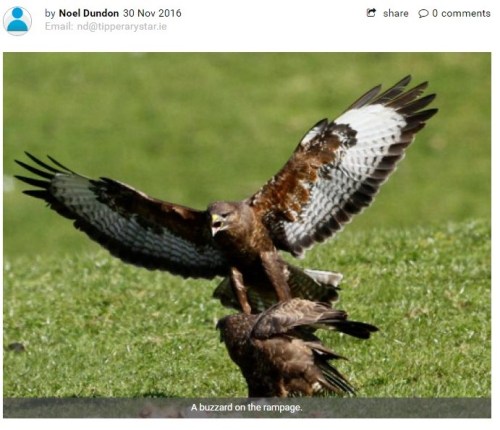
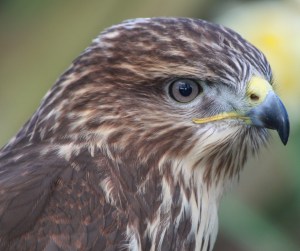
The online version of the article was illustrated with this photograph, entitled ‘A buzzard on the rampage’.

Is this ‘journalist’ having a laugh? Since when did ‘giant buzzards’ (or even normal-sized buzzards) start killing dogs, and since when did the sight of soaring buzzards above a politician’s head become a cause for alarm?

This type of sensationalist, ignorant, scare-mongering would be funny if it didn’t have consequences. Unfortunately, this baseless demonisation of birds of prey does have consequences, and serious ones at that. As we see all too often, there are still people clinging on to 19th Century attitudes who think that raptors are ‘vermin’ and should be destroyed. Articles like this one above will only fuel their prejudice and lead to the illegal persecution of these birds.

Tipperary is no stranger to raptor persecution – in the last few years the following crimes have been recorded:

July 2015: shot buzzard

May 2014: poisoned peregrine

January 2014: shot white-tailed eagle

July 2013: shot peregrine

June 2013: shot peregrine

June 2013: shot peregrine

Raptor persecution is a serious issue in Ireland, and the latest official report shows the trend is pointing upwards with 35 confirmed persecution incidents in 2015 – the highest number since recording began in 2011 (see here).

We’d encourage strong (but polite) words of complaint to the Tipperary Star:

Email journalist Noel Dundon: nd@tipperarystar.ie

Email editor Anne O’Grady: aog@tipperarystar.ie

UPDATE 6/12/2016: BirdWatch Ireland has issued a strong statement in response to the Tipperary Star (see here).

Shot buzzard rehabilitated & returned to the wild in North Yorkshire

At the end of October we blogged about a buzzard that had been found with shotgun injuries in Thirsk, North Yorkshire (see here).

The bird’s broken femur was expertly pinned by Mark Naguib of Battle Flatts Veterinary Clinic and the buzzard then underwent a period of care and rehabilitation with the wonderful Jean Thorpe of Ryedale Wildlife Rehabilitation.

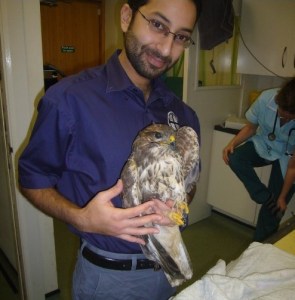
Yesterday this buzzard was released back to the wild (pictured here with vet Mark Maguib – photo by Jean Thorpe)

We’ve said this before but we’ll say it again – Jean’s work is entirely voluntary. If you want to support her efforts, please consider making a donation here.

Statement from Wildlife Estates Scotland on membership status of Newlands Estate

Those of you who’ve been following the long drawn-out saga of prosecutions relating to the wildlife crime that took place on Newlands Estate, Dumfriesshire in 2015 will know that we’ve been asking questions of various organisations associated with this estate.

One of those questions has been about the membership status of the Newlands Estate in the ‘Wildlife Estates Scotland (WES)’ scheme, administered by Scottish Land & Estates. Since Newlands Estate gamekeeper Billy Dick’s conviction (for killing a buzzard) was upheld in July this year, we’ve asked this:

‘Will the Newlands Estate’s accredited membership of Wildlife Estates Scotland (WES) now be revoked? The conditions of membership of this scheme include: “the requirements to maintain best practice standards of animal welfare and comply with all legal requirements and relevant Scottish codes of practice”. At the time of Mr Dick’s conviction, a spokesperson for WES said the Newlands Estate’s membership and accreditation of WES had been ‘voluntarily suspended’ pending the outcome of legal proceedings. Well, now the gamekeeper’s criminal conviction for wildlife offences has been upheld, how about answering the question?’

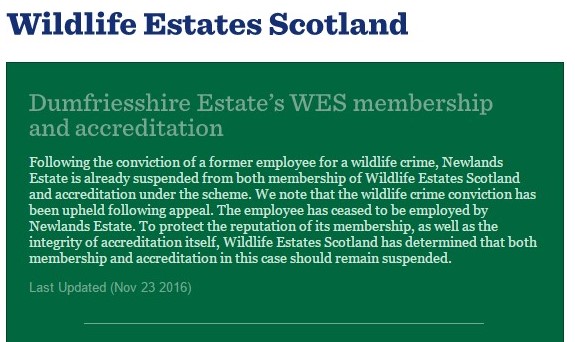
Four months on, and thanks to blog readers for writing to WES, the following statement has appeared on the WES website this morning:

wes-statement-newlands

So, Newlands Estate is still a member of WES, albeit in a suspended state. Presumably, WES is waiting to find out whether the allegation of vicarious liability is proven against landowner Andrew Duncan during forthcoming legal proceedings.

That’s an interesting position for WES to take. A wildlife crime did take place on Newlands Estate and a Newlands Estate employee was convicted for it. Why isn’t that sufficient cause for WES to expel Newlands Estate? Two conditions of WES membership were clearly breached (“the requirements to maintain best practice standards of animal welfare and comply with all legal requirements and relevant Scottish codes of practice“). Whether Mr Duncan is subsequently convicted or acquitted of vicarious liability is irrelevant and will not erase these facts.

Let’s imagine, for example, that Mr Duncan is exonerated and WES decides to lift the suspension on membership. WES will still have a wildlife crime estate on its membership list. How does that ‘protect the reputation of its membership, as well as the integrity of accreditation itself’? Here’s a hint, WES: IT DOESN’T.

Other questions we’ve been asking since Newlands Estate gamekeeper Billy Dick’s failed appeal in July 2016 are yet to be answered:

  1. Is/was criminal gamekeeper William (Billy) Dick a member of the Scottish Gamekeepers’ Association? The SGA refused to comment on Mr Dick’s membership status at the time, saying they ‘wanted to wait until the legal process had concluded’. Well, now Mr Dick’s criminal conviction for wildlife offences has been upheld, how about answering the question? Emails to: info@scottishgamekeepers.co.uk
  2. Will Scottish Land & Estates now expel the Newlands Estate from the ranks of SLE membership? SLE said at the time that Newlands Estate’s membership of SLE had been ‘voluntarily suspended’ pending on-going legal proceedings. Well, now the gamekeeper’s criminal conviction for wildlife offences has been upheld, how about answering the question? Emails to: info@scottishlandandestates.co.uk

Vicarious liability prosecution: Andrew Duncan (Newlands Estate), part 11

They’re having a laugh.

Criminal proceedings continued yesterday (22 November 2016) against landowner Andrew Walter Bryce Duncan, who is alleged to be vicariously liable for the crimes committed by gamekeeper William (Billy) Dick in April 2014.

Gamekeeper Dick was convicted in August 2015 of killing a buzzard on the Newlands Estate, Dumfriesshire by striking it with rocks and repeatedly stamping on it (see here). Mr Dick was sentenced in September 2015 and was given a £2000 fine (see here). Mr Dick attempted to appeal his conviction but this was refused on 15 July 2016 (see here).

Here’s a quick review of the proceedings against Andrew Duncan so far:

Hearing #1 (18th August 2015): Trial date set for 23rd Nov 2015, with an intermediate diet scheduled for 20th Oct 2015.

Hearing #2 (20th October 2015): Case adjourned. November trial date dumped. Notional diet hearing (where a trial date may be set) scheduled for 18th January 2016.

Hearing #3 (18th January 2016): Case adjourned. Another notional diet & debate scheduled for 11th March 2016.

Hearing #4 (11th March 2016): Case adjourned, pending the result of gamekeeper Billy Dick’s appeal. Another notional diet scheduled for 4th April 2016.

Hearing #5 (4th April 2016): Case adjourned, pending the result of gamekeeper Billy Dick’s appeal. Another notional diet scheduled for 3rd June 2016.

Hearing #6 (3rd June 2016): Case adjourned, pending the result of gamekeeper Billy Dick’s appeal. Another notional diet scheduled for 17th June 2016.

Hearing #7 (17th June 2016): Case adjourned, pending the result of gamekeeper Billy Dick’s appeal. Another notional diet scheduled for 15th July 2016.

Hearing #8 (15 July 2016): Case adjourned. Another notional diet scheduled for 2 August 2016.

Hearing #9 (2 August 2016): Proceedings moved to trial. Intermediate diet scheduled for 15 November 2016 and provisional trial date set for 7/8 December 2016.

Hearing #10 (15 November 2016): The case was adjourned for another intermediate diet scheduled for 22 November 2016. A new trial date may be set depending on what happens during this hearing.

Hearing #11 yesterday (22 November 2016): The case was adjourned for yet another intermediate diet scheduled for 6 December 2016. Trial dates expected to be assigned during this Dec hearing, so presumably the provisional trial dates of 7/8 Dec have been dumped.

Vicarious liability in relation to the persecution of raptors in Scotland (where one person may potentially be legally responsible for the criminal actions of another person working under their supervision) came in to force nearly five years ago on 1st January 2012. To date there have been two successful prosecutions/convictions: one in December 2014 (see here) and one in December 2015 (see here).  One further case did not reach the prosecution stage due, we believe, to the difficulties associated with identifying the management structure on the estate where the crimes were committed (see here).

Vicarious liability prosecution: Andrew Duncan (Newlands Estate) part 10

Criminal proceedings continued on 15 November 2016 against landowner Andrew Walter Bryce Duncan, who is alleged to be vicariously liable for the crimes committed by gamekeeper William (Billy) Dick in April 2014.

Gamekeeper Dick was convicted in August 2015 of killing a buzzard on the Newlands Estate, Dumfriesshire by striking it with rocks and repeatedly stamping on it (see here). Mr Dick was sentenced in September 2015 and was given a £2000 fine (see here). Mr Dick attempted to appeal his conviction but this was refused on 15 July 2016 (see here).

Here’s a quick review of the proceedings against Andrew Duncan so far:

Hearing #1 (18th August 2015): Trial date set for 23rd Nov 2015, with an intermediate diet scheduled for 20th Oct 2015.

Hearing #2 (20th October 2015): Case adjourned. November trial date dumped. Notional diet hearing (where a trial date may be set) scheduled for 18th January 2016.

Hearing #3 (18th January 2016): Case adjourned. Another notional diet & debate scheduled for 11th March 2016.

Hearing #4 (11th March 2016): Case adjourned, pending the result of gamekeeper Billy Dick’s appeal. Another notional diet scheduled for 4th April 2016.

Hearing #5 (4th April 2016): Case adjourned, pending the result of gamekeeper Billy Dick’s appeal. Another notional diet scheduled for 3rd June 2016.

Hearing #6 (3rd June 2016): Case adjourned, pending the result of gamekeeper Billy Dick’s appeal. Another notional diet scheduled for 17th June 2016.

Hearing #7 (17th June 2016): Case adjourned, pending the result of gamekeeper Billy Dick’s appeal. Another notional diet scheduled for 15th July 2016.

Hearing #8 (15 July 2016): Case adjourned. Another notional diet scheduled for 2 August 2016.

Hearing #9 (2 August 2016): Proceedings moved to trial. Intermediate diet scheduled for 15 November 2016 and provisional trial date set for 7/8 December 2016.

At hearing #10 on Tuesday (15 November 2016) the case was adjourned for another intermediate diet scheduled for 22 November 2016. A new trial date may be set depending on what happens during this hearing.

Vicarious liability in relation to the persecution of raptors in Scotland (where one person may potentially be legally responsible for the criminal actions of another person working under their supervision) came in to force over four and a half years ago on 1st January 2012. To date there have been two successful convictions: one in December 2014 (see here) and one in December 2015 (see here).  One further case did not reach the prosecution stage due, we believe, to the difficulties associated with identifying the management structure on the estate where the crimes were committed (see here).

Following gamekeeper Mr Dick’s failed appeal in July 2016 (see here), we posed a number of questions. These are still to be answered:

  1. Is/was criminal gamekeeper William (Billy) Dick a member of the Scottish Gamekeepers’ Association? The SGA refused to comment on Mr Dick’s membership status at the time, saying they ‘wanted to wait until the legal process had concluded’. Well, now Mr Dick’s criminal conviction for wildlife offences has been upheld, how about answering the question? Emails to: info@scottishgamekeepers.co.uk
  2. Will Scottish Land & Estates now expel the Newlands Estate from the ranks of SLE membership? SLE said at the time that Newlands Estate’s membership of SLE had been ‘voluntarily suspended’ pending on-going legal proceedings. Well, now the gamekeeper’s criminal conviction for wildlife offences has been upheld, how about answering the question? Emails to: info@scottishlandandestates.co.uk
  3. Will the Newlands Estate’s accredited membership of Wildlife Estates Scotland (WES) now be revoked? The conditions of membership of this scheme include: “the requirements to maintain best practice standards of animal welfare and comply with all legal requirements and relevant Scottish codes of practice”. At the time of Mr Dick’s conviction, a spokesperson for WES said the Newlands Estate’s membership and accreditation of WES had been ‘voluntary suspended’ pending the outcome of legal proceedings. Well, now the gamekeeper’s criminal conviction for wildlife offences has been upheld, how about answering the question? Emails to: info@scottishlandandestates.co.uk

We’ll also be watching closely to see whether the Newlands Estate will now be subject to a General Licence Restriction from SNH. If you recall, this restriction may be imposed by SNH where evidence of raptor crime is apparent and it has been available as a sanction for offences committed since 1 January 2014. Mr Dick killed the buzzard on Newlands Estate in April 2014. Although, even if the GL restriction is put in place, the estate can easily side-step it by applying for an ‘individual’ licence instead (e.g. see here).

Buzzard with shotgun injuries found in Thirsk, North Yorkshire

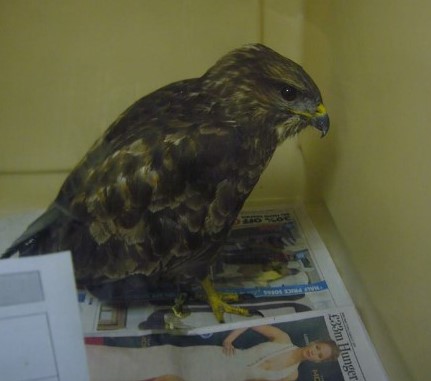
A buzzard with shotgun injuries has been found in Thirsk, North Yorkshire, this week. It had a broken femur. The bird has undergone surgery and is currently in rehabilitation with the wonderful Jean Thorpe of Ryedale Wildlife Rehabilitation.

bz-thirsk-oct-2016shot

bz-thirsk-oct-2016-xray

A quote from Jean: “Amazing work once again by Mark Naguib of Battleflatts vets. The shot buzzard is stood square once again with shiny pins correcting the break. He looks so much better already. Long way to go yet but looking good so far“.

North Yorkshire Police have been informed.

North Yorkshire maintains its status as one of the worst places in the UK for the illegal killing of birds of prey. It’s a county where much of the landscape is dominated by grouse moors, particularly in the two National Parks: the North York Moors NP and the Yorkshire Dales NP, as well as a large number of pheasant and partridge shoots.

This year, other raptor persecution crimes uncovered in North Yorkshire have included several illegally spring-trapped buzzards, several shot buzzards, at least ten shot red kites, and a gamekeeper filmed setting three illegal pole traps on a grouse moor.

Time to stop demonising the Langholm buzzards

buzzard 3Raptors have long been accused of ‘eating too many’ red grouse, and none more so than at Langholm.
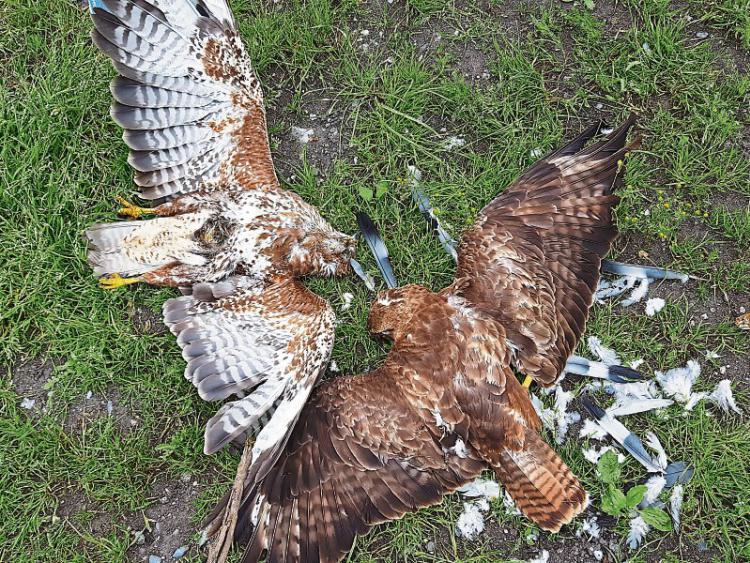
Sure, we all know that some raptors can eat a lot of grouse – during the Langholm 1 study it was shown that raptor predation reduced the autumn grouse abundance by 50%, leading to the cessation of driven grouse shooting (here). In other words, the ‘surplus’ birds from an artificially-high red grouse population were no longer available to be shot and the red grouse population dropped back to normal (natural) density. But we also know, through the work completed during the recent Langholm 2 study, that diversionary feeding of hen harriers has shown that the proportion of red grouse in the diet of diversionary-fed hen harriers was a negligible 0-4% (see here).

Seeing as (diversionary-fed) hen harriers could no longer be blamed, attention switched to blaming the buzzards. Simon Lester, the now former Head Keeper at Langholm is quoted in a 2014 book A Sparrowhawk’s Lament as follows:

I can put my hand on my heart and say that harriers aren’t a problem. Harriers aren’t limiting grouse at Langholm because diversionary feeding works. What’s stopping us shooting grouse is Buzzard predation“.

Unfortunately (for Simon), this claim of buzzard predation causing problems at Langholm is wholly unsupported by the scientific evidence. Research undertaken during three breeding seasons at Langholm 2 (2011-2013) showed the proportion of red grouse in the diet of buzzards was just 1-6% (see here and here).

‘Ah, but what about buzzard predation during the winter?’, cried the grouse shooting community. Well, that question has just been answered by the latest study, published last week. It turns out that not only aren’t Langholm buzzards taking many grouse during the breeding season, they’re also taking bugger all during the winter. Over a period of two years, red grouse formed 1.1% and 0.6% of prey items, and occurred in 3% and 2% of pellets from each winter, respectively. Small mammals were the main prey in both years, comprising 60–67% of items and occurring in 88–92% of pellets.

Despite such robust and compelling evidence, there are some who still want to pin the blame on the buzzards. Last November, Mark Oddy (Buccleuch Estates – one of the Langholm 2 project partners) suggested, “We now have to grasp the nettle and try and put forward a case, which probably in the first instance under licence, will allow some type of lethal control, ‘cos I don’t see what the future alternative is” (see here).

And in July this year, Tim (Kim) Baynes of Scottish Land & Estates wrote: “The confounding factor seems to have been the overall impact of buzzards, ravens and other raptor species predating adult grouse all year round, with harriers starting to overwinter on the moor, too“. He went on: “There were 80 pairs of raptors from seven species nesting on and around the moor at the last count, excluding ravens. Everyone involved now agrees that this level of multi-species raptor predation makes grouse-shooting unviable. Demonstrating this is a vital step in making the case for action to resolve it.

Eh? Can these people not understand simple scientific data? Or are they just choosing to ignore the evidence?

Give it up guys, Langholm buzzard dietary studies have been done to death: they’re not really in to eating red grouse.

Three poisoned buzzards found in Co Laois, Ireland

The National Parks and Wildlife Service in Ireland is appealing for information after the discovery of three poisoned buzzards.

The buzzards were discovered in a field in Cappakeel, Emo, County Laois over the August Bank Holiday weekend. Toxicology tests have revealed they’d been poisoned with Carbofuran.

Full details from the Leinster Express here

poisoned-buzzards-laois

Buzzard shot dead in Richmondshire, North Yorkshire

shot bz nyorksAug16North Yorkshire Police are appealing for information after the discovery of a buzzard that had been shot dead.

On 4th August 2016 a member of the public reported that a buzzard had been found dead near Manfield, North Yorkshire. The buzzard was recovered by the RSPB and taken to a vet in Leeds. An x-ray showed ten fragments inside the bird, consistent with being shot. It is not known how long the buzzard had been dead before it was found.

PC Rob Davies, of North Yorkshire Police’s Rural Taskforce, said: “Buzzards are fully protected under the Wildlife and Countryside Act 1981, making it a criminal offence to kill or injure them. The extent to which raptors are persecuted is completely unacceptable, so I am urging anyone with any information about this incident to get in touch with me without delay.”

Anyone who is aware of suspicious activity in the area, or has any information that could assist the investigation, is asked to contact PC Rob Davies at North Yorkshire Police by dialing 101 and selecting option 2, or via email rob.davies@northyorkshire.pnn.police.uk. Alternatively, contact Crimestoppers anonymously on 0800 555 111. Please quote reference number 12160140036.

North Yorkshire maintains its status as one of the worst places in the UK for the illegal killing of birds of prey. It’s a county where much of the landscape is dominated by grouse moors, particularly in the two National Parks: the North York Moors NP and the Yorkshire Dales NP, as well as a large number of pheasant and partridge shoots.

This year, other raptor persecution crimes uncovered in North Yorkshire have included several illegally spring-trapped buzzards, several shot buzzards, at least ten shot red kites, and a gamekeeper filmed setting three illegal pole traps in the vicinity of a hen harrier.

There’s still time to sign the e-petition calling for a ban on driven grouse shooting. Over 116,000 people have had enough – have you? Please sign here.

Buzzard found poisoned in Ayrshire

buzzard 3The SSPCA is appealing for information following the discovery of a young dead buzzard in Ayrshire.

A member of the public found the bird on farmland between Maybole and Patna in April. Toxicology results indicate it had been poisoned with a lethal pesticide. The SSPCA believes this was the result of “a deliberate act”.

SSPCA press release here