Vicarious liability prosecution: Andrew Duncan (Newlands Estate), part 13

Criminal proceedings continued yesterday (24 January 2017) against landowner Andrew Walter Bryce Duncan, who is alleged to be vicariously liable for the crimes committed by gamekeeper William (Billy) Dick in April 2014.

Gamekeeper Dick was convicted in August 2015 of killing a buzzard on the Newlands Estate, Dumfriesshire by striking it with rocks and repeatedly stamping on it (see here). Mr Dick was sentenced in September 2015 and was given a £2000 fine (see here). Mr Dick attempted to appeal his conviction but this appeal was rejected on 15 July 2016 (see here).

Here’s a quick review of the proceedings against Andrew Duncan so far:

Hearing #1 (18th August 2015): Trial date set for 23rd Nov 2015, with an intermediate diet scheduled for 20th Oct 2015.

Hearing #2 (20th October 2015): Case adjourned. November trial date dumped. Notional diet hearing (where a trial date may be set) scheduled for 18th January 2016.

Hearing #3 (18th January 2016): Case adjourned. Another notional diet & debate scheduled for 11th March 2016.

Hearing #4 (11th March 2016): Case adjourned, pending the result of gamekeeper Billy Dick’s appeal. Another notional diet scheduled for 4th April 2016.

Hearing #5 (4th April 2016): Case adjourned, pending the result of gamekeeper Billy Dick’s appeal. Another notional diet scheduled for 3rd June 2016.

Hearing #6 (3rd June 2016): Case adjourned, pending the result of gamekeeper Billy Dick’s appeal. Another notional diet scheduled for 17th June 2016.

Hearing #7 (17th June 2016): Case adjourned, pending the result of gamekeeper Billy Dick’s appeal. Another notional diet scheduled for 15th July 2016.

Hearing #8 (15 July 2016): Case adjourned. Another notional diet scheduled for 2 August 2016.

Hearing #9 (2 August 2016): Proceedings moved to trial. Intermediate diet scheduled for 15 November 2016 and provisional trial date set for 7/8 December 2016.

Hearing #10 (15 November 2016): The case was adjourned for another intermediate diet scheduled for 22 November 2016. Trial date of 7/8 December 2016 is dumped.

Hearing #11 (22 November 2016): The case was adjourned for yet another intermediate diet, scheduled for 6 December 2016.

Hearing #12 (6 December 2016): The case was adjourned for yet another intermediate diet, scheduled for 24 January 2017. A provisional trial date (this will be the third time a trial date has been assigned) is scheduled for 24 April 2017.

Hearing #13 (24 January 2017): Guess what? The case was adjourned for another intermediate diet, scheduled for 11 April 2017. As far as we know, the provisional trial date of 24 April still stands although this could change depending on what happens at the intermediate diet on 11 April.

Vicarious liability in relation to the persecution of raptors in Scotland (where one person may potentially be legally responsible for the criminal actions of another person working under their supervision) came in to force five years ago on 1st January 2012. To date there have been two successful prosecutions/convictions: one in December 2014 (see here) and one in December 2015 (see here).  One further case did not reach the prosecution stage due, we believe, to the difficulties associated with identifying the management structure on the estate where the crimes were committed (see here).

UPDATE 11 April 2017: The Crown Office has dropped all proceedings (see here).

Public funds to promote wildlife criminals in Scotland?

In December 2016 we blogged about the ‘Game for Growth’ strategy, which is a plan to promote Scottish country sports and boost its value to the economy. The strategy, which was launched at a parliamentary reception on 20th December 2016 (here) is being led by the Scottish Country Sports Tourism Group (SCSTG) and is being part-funded by VisitScotland using tax payers’ money (see here).

You may recall that Scottish Greens MSP Andy Wightman lodged a parliamentary question about the use of these public funds, as follows:

Question S5W-05930: Andy Wightman (Lothian, Scottish Green Party). Date lodged: 22/12/2016

To ask the Scottish Government whether it will provide a breakdown of the recipients of financial contributions from VisitScotland to the strategy, Game for Growth Strategy – Country Sports Tourism in Scotland 2016; what information it has regarding how each recipient will use this; what action it has taken to ensure that no money was provided to the owners or managers of landholdings on which crimes against wildlife have been committed; whether it will publish the strategy on its website, and what aspects of this it is supporting or plans to support with public money.

This question has now been answered:

Answered by Fiona Hyslop MSP (Cabinet Secretary for Culture, Tourism & External Affairs) on 11/1/2017:

VisitScotland has approved a grant of £17,925 to the Scottish Country Sports Tourism Group to promote Scotland as the destination of choice for all country sports. The Group will use this to develop content and supporting digital activity to attract visitors from across the UK and Scandinavia. As this money is for a specific project, no funding will be provided to individual estates or land owners. There is no intention to publish the strategy on VisitScotland’s website and so there will be no funding support for this.

It’s an interesting response. It does clarify that public funds (at least these public funds) will not be given directly to individual estates or landowners, but it is also clear that individual estates will still benefit from this public funding, albeit indirectly, because the SCSTG will use the funds to promote these individual estates as part of an online PR campaign.

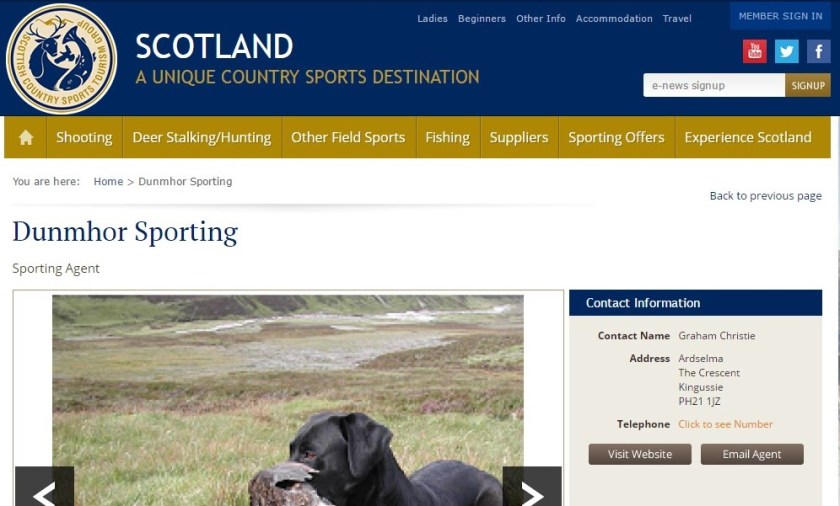
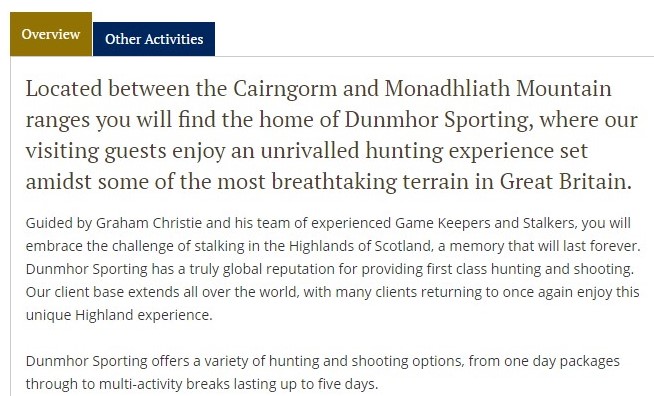
In our December blog, we noted that the SCSTG website was promoting the Dunmhor Sporting Agency as a provider of country sports activities in Scotland:

We were surprised to see Dunmhor Sporting being promoted on the SCSTG website because Graham Christie of Dunmhor Sporting was convicted in December 2015 of being vicariously liable for the criminal actions of his gamekeeper, who had used an illegal gin trap to catch and injure a buzzard on the Cardross Estate. We just looked at the SCSTG’s website again and Dunmhor Sporting is still being promoted as a country sports provider.

So much for the game shooting industry ousting its criminal members.

We wonder whether the Cabinet Secretary for Culture, Tourism & External Affairs, Fiona Hyslop, is aware that a now (part) publicly funded organisation (the Scottish Country Sports Tourism Group) is promoting a convicted wildlife criminal and if so, whether she thinks this is an appropriate use of public funds?

Emails to: scottish.ministers@gov.scot and mark it FAO Fiona Hyslop

Withheld raptor crime data: some info for DCS Scott of Police Scotland

This morning the Scottish Parliament’s Environment, Climate Change & Land Reform (ECCLR) Committee heard evidence on the Scottish Government’s 2015 annual wildlife crime report.

The archived video can be viewed here.

The official transcript can be read here: ecclr-transcript-wildlife-crime-10-jan-2017

The session was dynamite and there are many things to discuss – we’ll be blogging a lot more about this in the coming days but we wanted to start with the issue of withheld raptor crime data.

As some of you may remember, we criticised the Government’s annual wildlife crime report when it was published in November, precisely because we knew that several confirmed raptor crimes had not been included in the data presented to the Government by Police Scotland (see here). At the time, we didn’t elaborate on which specific crimes had been withheld from the report but we argued that the withholding of data completely undermined the public’s confidence in the report’s findings.

We were delighted to see this issue raised at this morning’s evidence session by Mark Ruskell MSP (Scottish Greens), and with devastating aplomb.

In the video link above, the discussion starts at 1:06:31.

Mark asked the Police Scotland representatives (ACC Steve Johnson and DCS Sean Scott) why some raptor crimes that had been recorded by RSPB Scotland had been excluded from the Government’s report. DCS Scott looked blank, and then mumbled something about perhaps the crimes weren’t actually crimes at all so they wouldn’t have been recorded. Mark pressed on and gave DCS Scott specific details about the crimes in question and even showed him a photograph of one of the illegally set traps involved, to check that it was indeed an illegally-set trap and thus a confirmed crime. DCS Scott maintained he didn’t know about these specific crimes, even when Mark gave him more detailed information about the location. This went on for some time and it was excellent to see Mark’s persistence and his unwillingness to be fobbed off. Eventually, DCS Scott committed to finding out about these specific crimes and gave assurance that he would later write to the ECCLR Committee to explain why these data had been withheld from the Government’s report.

To help DCS Scott, here’s some background about these specific crimes:

If you look at Table 19 in the Scottish Government’s 2015 annual wildlife crime report, there is a list of raptor persecution crimes and the data are attributed to Police Scotland. Listed under Lothian & Borders, Police Scotland recorded the following incidents between April 2014-March 2015:

Peregrine shooting (Sept 2014)

Attempted trapping (species not identified) (Sept 2014)

Buzzard shooting (October 2014)

Tawny owl shooting (Dec 2014)

Now, compare the Police Scotland data with the data published in Table 4 in the RSPB’s annual report – ‘The Illegal Killing of Birds of Prey in Scotland, 1994-2014, A Review‘. In that report, listed under Scottish Borders, the RSPB has recorded the following additional confirmed crimes for the same time period, that were excluded from the Police Scotland data in the Government’s annual report:

Crow trap baited with 2 live pigeons, surrounded by 4 set spring traps, nr Heriot (May 2014) – there is even a photograph of this illegally-set trap on page 16)

and

4 x shot buzzards, nr Heriot (May 2014).

pigeon-in-trap-heriot-2014

rspb-table-4

It was later revealed during the second part of the ECCLR Committee evidence session this morning, in evidence given by Ian Thomson (Head of Investigations, RSPB Scotland) that the above offences were uncovered during a Police Scotland-led multi-agency raid on this estate ‘nr Heriot’, so it is somewhat surprising that DCS Scott claimed to have no knowledge about them.

In due course we look forward to reading DCS Scott’s written explanation about why these data were withheld from the Government’s 2015 annual wildlife crime report.

In the meantime, kudos and thanks to Mark Ruskell MSP, who was one of several MSPs who performed exceptionally well at this morning’s evidence session. More on that in later blogs…..

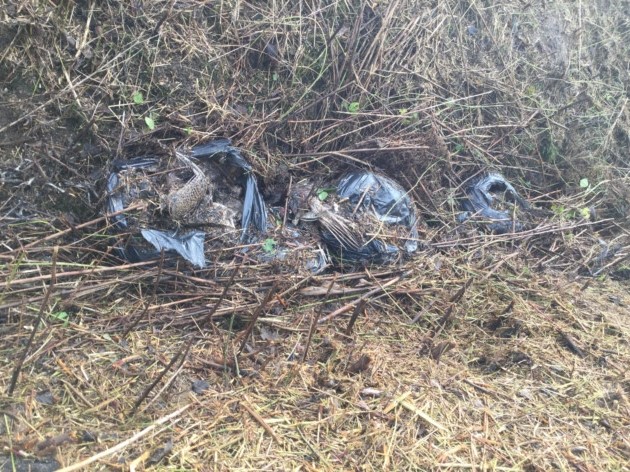
Ten bin bags of dead pheasants dumped under hedge in Norfolk

There’s an article on the Eastern Daily Press website today (here) about how ten black bin bags full of dead pheasants have been found dumped under a hedge on Persehall Manor Farm in Bunwell, Norfolk. The person who found them believes the birds had been shot.

Isn’t it wonderful that Natural England will now issue licences to kill buzzards (see here and here), in the name of ‘protecting’ pheasants, just so those pheasants can then be shot for fun and then dumped in bin bags to putrefy and rot. A great conservation story we can all be proud of.

It’s also worth repeating something we’ve mentioned before when another load of dumped pheasants had been found on a sporting estate in Scotland:

In a letter to the Daily Telegraph in November 2005 headed ‘Game birds for eating not dumping’, Tim Bonner of the Countryside Alliance said this:

Every bird shot in Britain goes into the food chain, whether into participants’ freezers, or through game dealers into an increasing number of supermarkets, butchers, pubs and restaurants“.

Update on the 3 shot buzzards in Somerset

Following on from today’s earlier blog about the three shot buzzards in Somerset (here), we’ve now been informed that one was shot in Somerset (Chedzoy) on New Year’s Day and died of its injuries and the other two were shot in separate incidents in Wales (locations unknown) and were transported to the RSPCA wildlife hospital in Somerset where they are undergoing treatment.
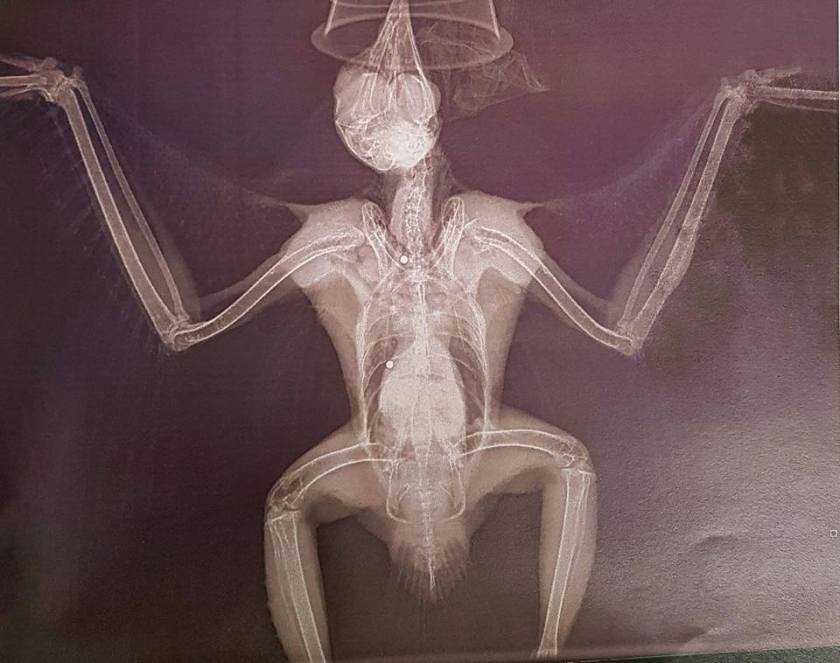
Thanks to the two blog readers who contacted us with updated info.

3 buzzards shot in separate incidents in Somerset

In the first few days of the New Year, three buzzards have been shot in separate incidents in Somerset.

Two are being treated at an RSPCA wildlife hospital but the third didn’t make it. Two men were seen shooting at this third buzzard near Chedzoy on New Year’s Day.

And this is an area where DEFRA/Natural England are planning to reintroduce hen harriers because persecution levels are considered low. Three shot birds in four days suggests otherwise.

UPDATE 17.30hrs here

Parliamentary reception for group promoting wildlife criminal

Yesterday we blogged about the launch of the Scottish Country Sports Tourism Group’s new initiative, Game for Growth, aimed at promoting the value of country sports to the Scottish economy (see here).

We mentioned that Andy Wightman MSP had lodged a Parliamentary Question asking whether public funds (via VisitScotland as part of the Game for Growth initiative) had been given to the owners or managers of landholdings where wildlife crime had taken place.

We also mentioned our surprise that the Scottish Country Sports Tourism Group’s website is promoting a sporting agent with a current conviction for raptor persecution.

What we didn’t mention was that the launch of the Game for Growth initiative took place at a prestigious parliamentary reception at Holyrood on 20 December 2016, with wide media coverage.

This parliamentary reception was hosted by Edward Mountain MSP (Conservative, Highlands & Islands) and included speeches from Malcolm Roughead, Chief Exec of VisitScotland, and Cabinet Secretary for Rural Economy & Connectivity, Fergus Ewing MSP.

The revelation that the Scottish Country Sports Tourism Group is actively promoting a convicted wildlife criminal will probably be a surprise to Edward Mountain MSP, and undoubtedly a source of deep embarrassment; he surely wouldn’t have hosted them had he known. It’s reasonable to assume he didn’t know because his expertise appears to be in fishing rather than gamebird hunting. Sustainable sport fishing does bring in millions to the rural economy and it isn’t underpinned by wildlife crime, so it’s easy to see why he would lend support to the Game for Growth initiative.

Unfortunately for Edward, as well as the sport fishing industry, the Gift of Grouse is also prominently involved with the Game for Growth initiative (check out that banner in the photo) and this isn’t the first parliamentary reception they’ve been involved with that has led to awkward questions being asked.

We await the Scottish Government’s response to Andy Wightman’s Parliamentary Questions about public funding for wildlife criminals with great interest.

Parliamentary Question: is public money being used to promote wildlife criminals in Scottish shooting sector?

scstg-logoLast week it was announced that the Scottish Country Sports Tourism Group (SCSTG) has plans to boost the value of game shooting, stalking and fishing to the rural economy by £30 million, via its new ‘Game for Growth’ strategy.

The Game for Growth strategy document can be read here: sctsg-game-for-growth-strategy-document-dec-2016

It’s a pretty turgid read, full of tedious marketing soundbites, but basically it sets out how the industry plans to promote Scottish country sports over the next four years to reach a wider national and international market. This will be achieved mostly, it seems, by claiming the industry is sustainable with fabulous conservation benefits and ignoring the vast environmental damage and wildlife crime associated with some activities within this sector.

visit-scotland-1Interestingly, VisitScotland (the national tourism agency linked to the Scottish Government) has apparently committed to boosting the country sports tourism sector and has announced a matched ‘Growth Fund’ to help SCSTG develop its marketing strategy and increase its online presence.

We’re not the only ones to raise an eyebrow at this. Andy Wightman MSP has lodged the following Parliamentary Question about it:

Question S5W-05930: Andy Wightman (Lothian, Scottish Green Party). Date lodged: 22/12/2016

To ask the Scottish Government whether it will provide a breakdown of the recipients of financial contributions from VisitScotland to the strategy, Game for Growth Strategy – Country Sports Tourism in Scotland 2016; what information it has regarding how each recipient will use this; what action it has taken to ensure that no money was provided to the owners or managers of landholdings on which crimes against wildlife have been committed; whether it will publish the strategy on its website, and what aspects of this it is supporting or plans to support with public money.

Expected answer date: 19/01/2017

These are legitimate questions, and especially when you take a closer look at the SCSTG website, which has been developed to connect potential visitors with various country sports providers across Scotland. For example, if you want to pay money to shoot mountain hares in Scotland, you can use the website’s search facility and a number of sporting agents/estates who offer this ‘sport’ will be highlighted.

We used the search facility to look for various ‘sporting’ opportunities and were very surprised to find that sporting agency Dunmhor Sporting was being promoted:

Why the surprise? Well, Graham Christie of Dunmhor Sporting was convicted in December last year of being vicariously liable for the criminal actions of his gamekeeper, who had used an illegal gin trap to catch and injure a buzzard on the Cardross Estate.

Why is the Scottish Country Sports Tourism Group promoting an agent who has a current conviction for wildlife crime? And why is VisitScotland providing match funding to an organisation that is promoting a convicted wildlife criminal?

Gamekeepers want sea eagles, kites, buzzards, sparrowhawks & ravens added to General Licences

Further to this morning’s blog about RSPB Scotland’s damning response to SNH’s General Licence consultation (see here), we said we’d write a separate blog about some of the other responses that SNH received.

SNH has now published all the responses, and they’re well worth a read: all-responses-to-snh-general-licence-consultation-2016

There are many organisations and individuals calling for ravens to be added to the General Licences (no surprise) and, yet again, there are a number of requests for buzzards and sparrowhawks to also be added, which would allow these species to be casually killed across Scotland without any monitoring or regulation, although some have suggested these raptors should be on ‘regional’ General Licences to limit the casual killing to a particular area. How thoughtful.

One of the reasons given for adding ravens and buzzards to the General Licences was this: “There are arguably too many of them around and they cloud the skies in our local area“.

Here’s a photograph of some ravens and buzzards clouding the skies:

Actually, this is a photograph (by Richard Barnes) of Dunlin flocking on the coast of North America but it could just as easily be a plague of swarming raptors over a Scottish grouse moor, if you happen to be a pathological raptor hater stuck with an 18th century attitude, that is.

Take a look at the consultation response from Garry MacLennan. Surely not the same Garry MacLennan, Head Gamekeeper at Invermark Estate? Aren’t raptors supposed to be ‘thriving’ there? Perhaps the headline should have read ‘Raptors are thriving on Scottish grouse moors and we want licences to kill them’.

Also have a look at the responses from Iain Hepburn (the same Iain Hepburn as the head gamekeeper at Dunmaglass Estate?), Duncan Mackenzie and Calum Kippen (the same Corrybrough Estate gamekeepers who attended the recent meeting between the Cairngorms National Park Authority & the Scottish Gamekeepers’ Association?). Aren’t these the gamekeepers who want licences to monitor and ring raptors? Don’t they see a bit of a conflict of interest there if they also want licences to kill these raptors?

Best of all though, is the response from Bert Burnett (presumably of the SGA). Bert suggests that ravens should be added to the General Licences and argues that regional general licences “could be rolled out for various species that may start to cause problems like sea eagles and kites etc“. Ah yes, that very serious problem of sea eagles mistaking small children for prey.

Of course, these calls for licences to cull raptors are nothing new. Scottish (and English) gamekeepers and land owners have been asking for these for 20 years (see here, here, here, here, hereherehere). So far, SNH has resisted but given Natural England’s recent capitulation on buzzard-killing licences, how much longer before we see the same in Scotland?

Vicarious liability prosecution: Andrew Duncan (Newlands Estate), part 12

Criminal proceedings continued yesterday (6 December 2016) against landowner Andrew Walter Bryce Duncan, who is alleged to be vicariously liable for the crimes committed by gamekeeper William (Billy) Dick in April 2014.

Gamekeeper Dick was convicted in August 2015 of killing a buzzard on the Newlands Estate, Dumfriesshire by striking it with rocks and repeatedly stamping on it (see here). Mr Dick was sentenced in September 2015 and was given a £2000 fine (see here). Mr Dick attempted to appeal his conviction but this was refused on 15 July 2016 (see here).

Here’s a quick review of the proceedings against Andrew Duncan so far:

Hearing #1 (18th August 2015): Trial date set for 23rd Nov 2015, with an intermediate diet scheduled for 20th Oct 2015.

Hearing #2 (20th October 2015): Case adjourned. November trial date dumped. Notional diet hearing (where a trial date may be set) scheduled for 18th January 2016.

Hearing #3 (18th January 2016): Case adjourned. Another notional diet & debate scheduled for 11th March 2016.

Hearing #4 (11th March 2016): Case adjourned, pending the result of gamekeeper Billy Dick’s appeal. Another notional diet scheduled for 4th April 2016.

Hearing #5 (4th April 2016): Case adjourned, pending the result of gamekeeper Billy Dick’s appeal. Another notional diet scheduled for 3rd June 2016.

Hearing #6 (3rd June 2016): Case adjourned, pending the result of gamekeeper Billy Dick’s appeal. Another notional diet scheduled for 17th June 2016.

Hearing #7 (17th June 2016): Case adjourned, pending the result of gamekeeper Billy Dick’s appeal. Another notional diet scheduled for 15th July 2016.

Hearing #8 (15 July 2016): Case adjourned. Another notional diet scheduled for 2 August 2016.

Hearing #9 (2 August 2016): Proceedings moved to trial. Intermediate diet scheduled for 15 November 2016 and provisional trial date set for 7/8 December 2016.

Hearing #10 (15 November 2016): The case was adjourned for another intermediate diet scheduled for 22 November 2016. Trial date of 7/8 December 2016 is dumped.

Hearing #11 (22 November 2016): The case was adjourned for yet another intermediate diet, scheduled for 6 December 2016.

Hearing #12 (6 December 2016): The case was adjourned for yet another intermediate diet, scheduled for 24 January 2017. A provisional trial date (this will be the third time a trial date has been assigned) is scheduled for 24 April 2017.

Vicarious liability in relation to the persecution of raptors in Scotland (where one person may potentially be legally responsible for the criminal actions of another person working under their supervision) came in to force nearly five years ago on 1st January 2012. To date there have been two successful prosecutions/convictions: one in December 2014 (see here) and one in December 2015 (see here).  One further case did not reach the prosecution stage due, we believe, to the difficulties associated with identifying the management structure on the estate where the crimes were committed (see here).