UK wildlife crime legislation & enforcement to be assessed (again)

Press release from DEFRA (2nd March 2021)

Assessment launches to appraise UK wildlife and forest crime legislation and enforcement

New toolkit launched to assess the way we tackle wildlife crime in the UK

A UN backed assessment of UK wildlife and forest crime legislation and enforcement has launched today, using the United Nations Office on Drugs and Crime (UNODC) International Consortium on Combating Wildlife Crime (ICCWC) toolkit.

The toolkit will review wildlife crime policing structures, including the National Wildlife Crime Unit (NWCU) and UK Border Force and efficacy of prosecutions. The toolkit consists of five parts: legislation; enforcement; judiciary and prosecution; drivers and prevention. To date, the toolkit has been implemented in 15 countries. The UK will be the first G20 country to have invited this assessment.

This assessment will comprise a comprehensive analysis of the strengths and weaknesses of our preventive and criminal justice responses, which are crucial to curtailing wildlife and forest crime nationally and internationally.

[51 hen harriers have been confirmed illegally killed or have disappeared in suspicious circumstances, mostly on or close to driven grouse moors, since 2018. There hasn’t been a single prosecution for any of them]

Originally developed in 2012, the Wildlife and Forest Crime Analytic Toolkit was created by the UNODC, in partnership with the UK and other members of ICCWC. The assessments in the UK will run until August this year.

Speaking at the launch today, Environment Minister, Minister Pow, said:

We have made tremendous progress tackling wildlife crime in this country, but we know there is more to do.

We requested this assessment to help build on our progress and will look closely at the recommendations, working with key stakeholder groups to inform a cross-government response.

Together we can reduce these horrific crimes for the benefit of our biodiversity, our precious habitats and our rural communities for generations to come“.

Chief Inspector Kevin Kelly, Head of the UK National Wildlife Crime Unit, said:

I have been immersed in Policing wildlife crime for the entirety of my Police service and I am delighted to see the ICCWC Tool kit coming to Policing UK. This will shine a much needed spotlight on Wildlife Crime and raise the importance of it in the wider Policing picture, as Wildlife Crime often feeds into more serious and organised crime types.

It will be a pleasure for the NWCU to work with colleagues to ensure the success of the tool kit. It’s vitally important that we continue to celebrate our success and highlight the importance of fighting Wildlife Crime. But I welcome the opportunity to reflect on our practices and look to become better and more efficient“.

Since 2016, Defra and the Home Office have jointly committed £300,000 a year to funding the UK National Wildlife Crime Unit (NWCU). The unit plays a valuable role in detecting and preventing wildlife crime by monitoring and gathering intelligence on illegal activities, undertaking analysis and directly assisting law enforcers with their investigations.

The past few years have seen successful launches of police operations such as Operation Galileo, an anti-hare coursing campaign led by Lincolnshire police force and Operation Owl, led by North Yorkshire Police, which aims to raise awareness of raptor persecution amongst the wider public and police officers.

The NWCU is one part of the UK’s network fighting wildlife crime, Police customs officers and other enforcers carry also out vital work on the ground.

In addition, the UK Border Force continues to make successful seizures and work with international partners to ensure illegal wildlife trade products do not enter the market.

Last year, as part of operation Thunder 2020, UK Border Force worked with fellow enforcement agencies across 105 countries to tackle the global illegal wildlife trade. With other targeted operations also taking place throughout the year including checks on exports to South East Asia for movements of illegal ivory, Border Force made 490 seizures of illegally trafficked live specimens or derivative products at numerous UK Border control areas from Grangemouth in Scotland to Southampton port.

There are now over 770 wildlife crime officers in England and Wales and 133 covering Scotland. These officers are specially trained to conduct and support investigations into wildlife crimes.

The UK’s participation in this will help inform recommendations on improving the prevention and enforcement of domestic and international wildlife crime in the UK and will reaffirm our global leadership role in tackling wildlife crime.

ENDS

So Environment Minister Rebecca Pow thinks, ‘We have made tremendous progress tackling wildlife crime in this country….’? Not on tackling raptor persecution, we haven’t. It’s still rampant and the criminals are still escaping justice. What’s tremendous and progressive about that?

Some might argue that this is a good reason for a review of legislation and enforcement, and to some extent that’s fair comment. However, reviews on this topic have been undertaken before, conclusions are drawn, everyone agrees we must improve but then nothing happens and we end up having another review several years later to make everyone think the Government cares about tackling wildlife crime.

Perhaps this review will be different. It’s using a novel approach (a United Nations toolkit). But do we really need it? I’d argue no. We already know full well who is committing the majority of raptor persecution crimes, we know where they’re committing those crimes and we know why they’re committing those crimes.

We don’t need another review, we just need effective enforcement instead of the regulatory authority accepting money with gagging orders attached, from the very industry responsible for these crimes.
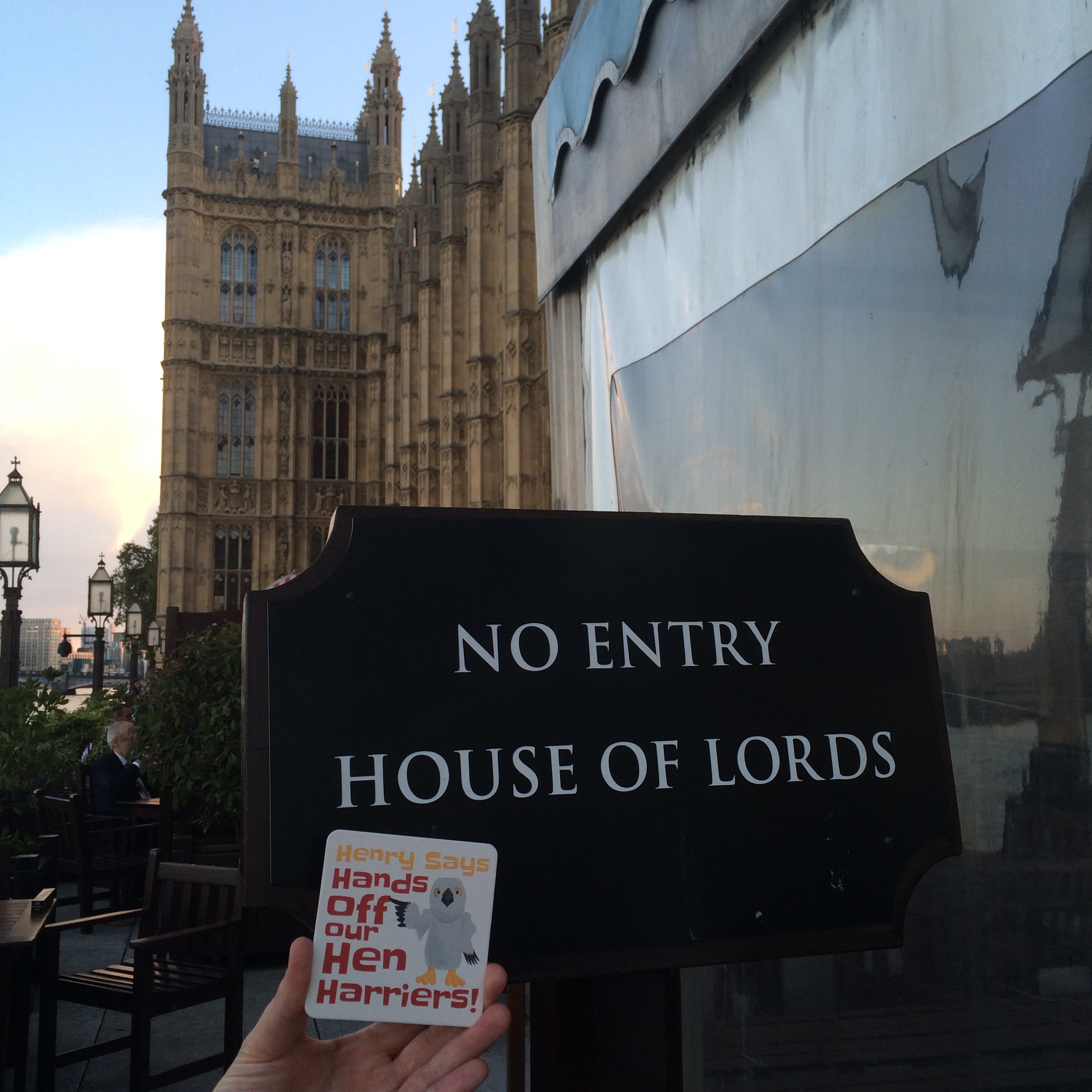
On-going hen harrier persecution raised in House of Lords

I’d wager that the subject of the illegal killing of hen harriers on driven grouse moors has been discussed many times in the House of Lords, probably on the terrace bar and probably accompanied by some hearty back-slapping, sniggering and cheering.

[Photo by Ruth Tingay]

Fortunately, the hen harrier does have some friends in high places, not least long-time supporter and Life Peer Natalie Bennett (Green party), who tabled the following written question on 21st January 2021 after learning that yet another satellite-tagged hen harrier had ‘vanished’ in suspicious circumstances (see here).

From Hansard: UIN HL12411, Baroness Bennett of Manor Castle –

To ask Her Majesty’s Government what plans they have to prevent the killing of satellite-tagged hen harriers.

Answered 4th February 2021 by Lord Goldsmith of Richmond Park, The Minister of State, Department for Environment, Food and Rural Affairs

All wild birds are protected under the Wildlife and Countryside Act 1981, which provides a powerful framework for the conservation of wild birds, their eggs, nests and habitats. The Government is committed to ensuring the protection afforded to wild birds of prey is effectively enforced. There are strong penalties for offenders, including imprisonment.

We are also committed to securing the long-term future of the hen harrier as a breeding bird in England. The Hen Harrier Action Plan sets out what will be done to increase hen harrier populations in England and includes measures to stop illegal persecution. The long-term plan was published in January 2016 and we believe that it remains the best way to safeguard the hen harrier in England. A copy of the plan is attached.

Raptor persecution is one of six national wildlife crime priorities. Each wildlife crime priority has a delivery group to consider what action should be taken and develop a plan to prevent crime, gather intelligence on offences and enforce against it. The Raptor Persecution Priority Delivery Group focuses on the golden eagle, goshawk, hen harrier, peregrine and white-tailed eagle. The National Wildlife Crime Unit, which is part funded by Defra, monitors and gathers intelligence on illegal activities affecting birds of prey and provides assistance to police forces when required.

So, five years on from the launch of DEFRA’s heavily criticised Hen Harrier Action Plan, which would be better re-named the Hen Harrier Persecution Plan, and with an embarrassing amount of evidence to demonstrate that the illegal killing of hen harriers is still rampant, this response from Zac Goldsmith is pathetically lame.

The evidence that hen harrier persecution continues relentlessly includes the devastating results of a peer-reviewed scientific study, based on Natural England’s own data and published in a high-ranking journal, demonstrating that at least 72% of satellite-tagged hen harriers are presumed illegally killed on grouse moors (see here).

There’s also the rather inconvenient tally of 51 hen harriers confirmed illegally killed or reported ‘missing’ in suspicious circumstances since 2018, when grouse moor owners pretended they’d be more tolerant of the species (here) and then the admission just a few days ago from Natural England’s Chair that “continuing illegal persecution [of hen harriers] is preventing the recovery we need to see” (here).

This issue is one of the most pressing wildlife conservation issues in the UK, and yet DEFRA has nothing more to offer than, ‘We believe the Hen Harrier Action Plan remains the best way to safeguard the hen harrier in England‘.

For how many more years is DEFRA going to hide behind it’s obviously-failing action plan? It’s been five years, and counting.

Here’s a more realistic view of the Hen Harrier Action Plan, from blog reader Dr Gerard Hobley.

Enough said.

51 hen harriers confirmed illegally killed or ‘missing’ since 2018

For anyone who still wants to pretend that the grouse shooting industry isn’t responsible for the systematic extermination of hen harriers on grouse moors across the UK, here’s the latest catalogue of crime that suggests otherwise.

[This male hen harrier died in 2019 after his leg was almost severed in an illegally set trap that had been placed next to his nest on a Scottish grouse moor (see here). Photo by Ruth Tingay]

Ten days ago this list totalled 48 hen harriers, all either confirmed to have been illegally killed or to have ‘disappeared’, most of them on or next to driven grouse moors.

They disappear in the same way political dissidents in authoritarian dictatorships have disappeared” (Stephen Barlow, 22 January 2021).

Today the list has been updated to include some others whose reported disappearances in 2020 have been confirmed, including Bronwyn (here) and Rosie (here), bringing the current running total to 51 hen harriers.

This disgraceful catalogue will continue to grow – I know of at least one more on-going police investigation which has yet to be publicised and I suspect there’s one other, although I’m still waiting for clarification on that one.

I’ve been compiling this list only since 2018 because that is the year that the grouse shooting industry ‘leaders’ would have us believe that the criminal persecution of hen harriers had stopped and that these birds were being welcomed back on to the UK’s grouse moors (see here).

This assertion was made shortly before the publication of a devastating new scientific paper that demonstrated that 72% of satellite-tagged hen harriers were confirmed or considered likely to have been illegally killed, and this was ten times more likely to occur over areas of land managed for grouse shooting relative to other land uses (see here).

2018 was also the year that Natural England issued itself with a licence to begin a hen harrier brood meddling trial on grouse moors in northern England. For new blog readers, hen harrier brood meddling is a conservation sham sanctioned by DEFRA as part of its ludicrous ‘Hen Harrier Action Plan‘ and carried out by Natural England (NE), in cahoots with the very industry responsible for the species’ catastrophic decline in England. For more background see here.

Brood meddling has been described as a sort of ‘gentleman’s agreement’ by commentator Stephen Welch:

I don’t get it, I thought the idea of that scheme was some kind of trade off – a gentleman’s agreement that the birds would be left in peace if they were moved from grouse moors at a certain density. It seems that one party is not keeping their side of the bargain“.

With 51 hen harriers gone since 2018, I think it’s fair to say that the grouse shooting industry is simply taking the piss. Meanwhile, Natural England pretends that ‘partnership working’ is the way to go.

‘Partnership working’ appears to include authorising the removal of hen harrier chicks from a grouse moor already under investigation by the police for suspected raptor persecution (here) and accepting a £10K bung from representatives of the grouse shooting industry that prevents Natural England from criticising them (see here).

[Cartoon by Gill Lewis]

So here’s the latest gruesome list:

February 2018: Hen harrier Saorsa ‘disappeared’ in the Angus Glens in Scotland (here). The Scottish Gamekeepers Association later published wholly inaccurate information claiming the bird had been re-sighted. The RSPB dismissed this as “completely false” (here).

5 February 2018: Hen harrier Marc ‘disappeared’ on a grouse moor in Durham (here)

9 February 2018: Hen harrier Aalin ‘disappeared’ on a grouse moor in Wales (here)

March 2018: Hen harrier Blue ‘disappeared’ in the Lake District National Park (here)

March 2018: Hen harrier Finn ‘disappeared’ near Moffat in Scotland (here)

18 April 2018: Hen harrier Lia ‘disappeared’ in Wales and her corpse was retrieved in a field in May 2018. Cause of death was unconfirmed but police treating death as suspicious (here)

8 August 2018: Hen harrier Hilma ‘disappeared’ on a grouse moor in Northumberland (here).

16 August 2018: Hen harrier Athena ‘disappeared’ on a grouse moor in Scotland (here)

26 August 2018: Hen Harrier Octavia ‘disappeared’ on a grouse moor in the Peak District National Park (here)

29 August 2018: Hen harrier Margot ‘disappeared’ on a grouse moor in Scotland (here)

29 August 2018: Hen Harrier Heulwen ‘disappeared’ on a grouse moor in Wales (here)

3 September 2018: Hen harrier Stelmaria ‘disappeared’ on a grouse moor in Scotland (here)

24 September 2018: Hen harrier Heather ‘disappeared’ on a grouse moor in Scotland (here)

2 October 2018: Hen harrier Mabel ‘disappeared’ on a grouse moor on the edge of the Yorkshire Dales National Park (here)

3 October 2018: Hen Harrier Thor ‘disappeared’ next to a grouse moor in Bowland, Lanacashire (here)

23 October 2018: Hen harrier Tom ‘disappeared’ in South Wales (here)

26 October 2018: Hen harrier Arthur ‘disappeared’ on a grouse moor in the North York Moors National Park (here)

1 November 2018: Hen harrier Barney ‘disappeared’ on Bodmin Moor (here)

10 November 2018: Hen harrier Rannoch ‘disappeared’ on a grouse moor in Scotland (here). Her corpse was found nearby in May 2019 – she’d been killed in an illegally-set spring trap (here).

14 November 2018: Hen harrier River ‘disappeared’ on a grouse moor in the Nidderdale AONB (here). Her corpse was found nearby in April 2019 – she’d been illegally shot (here).

16 January 2019: Hen harrier Vulcan ‘disappeared’ in Wiltshire close to Natural England’s proposed reintroduction site (here)

7 February 2019: Hen harrier Skylar ‘disappeared’ next to a grouse moor in South Lanarkshire (here)

22 April 2019: Hen harrier Marci ‘disappeared’ on a grouse moor in the Cairngorms National Park (here)

26 April 2019: Hen harrier Rain ‘disappeared’ on a grouse moor in Nairnshire (here)

11 May 2019: An untagged male hen harrier was caught in an illegally-set trap next to his nest on a grouse moor in South Lanarkshire. He didn’t survive (here)

7 June 2019: An untagged hen harrier was found dead on a grouse moor in Scotland. A post mortem stated the bird had died as a result of ‘penetrating trauma’ injuries and that this bird had previously been shot (here)

5 September 2019: Wildland Hen Harrier 1 ‘disappeared’ on a grouse moor nr Dalnaspidal on the edge of the Cairngorms National Park (here)

11 September 2019: Hen harrier Romario ‘disappeared’ on a grouse moor in the Cairngorms National Park (here)

14 September 2019: Hen harrier (Brood meddled in 2019, #183704) ‘disappeared’ in North Pennines (here)

23 September 2019: Hen harrier (Brood meddled in 2019, #55149) ‘disappeared’ in North Pennines (here)

24 September 2019: Wildland Hen Harrier 2 ‘disappeared’ on a grouse moor at Invercauld in the Cairngorms National Park (here)

24 September 2019: Hen harrier Bronwyn ‘disappeared’ near a grouse moor in North Wales (here)

10 October 2019: Hen harrier Ada ‘disappeared’ on a grouse moor in the North Pennines AONB (here)

12 October 2019: Hen harrier Thistle ‘disappeared’ on a grouse moor in Sutherland (here)

18 October 2019: Member of the public reports the witnessed shooting of an untagged male hen harrier on White Syke Hill in North Yorkshire (here)

November 2019: Hen harrier Mary found illegally poisoned on a pheasant shoot in Ireland (here)

January 2020: Members of the public report the witnessed shooting of a male hen harrier on Threshfield Moor in the Yorkshire Dales National Park (here)

23 March 2020: Hen harrier Rosie ‘disappeared’ at an undisclosed roost site in Northumberland (here)

1 April 2020: Hen harrier (Brood meddled in 2019, #183703) ‘disappeared’ in unnamed location, tag intermittent (here)

5 April 2020: Hen harrier Hoolie ‘disappeared’ on a grouse moor in the Cairngorms National Park (here)

8 April 2020: Hen harrier Marlin ‘disappeared’ on a grouse moor in the Cairngorms National Park (here)

19 May 2020: Hen harrier Fingal ‘disappeared’ on a grouse moor in the Lowther Hills, Scotland (here)

21 May 2020: Hen harrier (Brood meddled in 2019, #183701) ‘disappeared’ on a grouse moor in Cumbria shortly after returning from wintering in France (here)

27 May 2020: Hen harrier Silver ‘disappeared’ on a grouse moor on Leadhills Estate, Scotland (here)

9 July 2020: Unnamed female hen harrier (#201118) ‘disappeared’ from an undisclosed site in Northumberland (here).

25 July 2020: Hen harrier Harriet ‘disappeared’ on a grouse moor in the Yorkshire Dales National Park (here)

14 August 2020: Hen harrier Solo ‘disappeared’ in confidential nest area in Lancashire (here)

7 September 2020: Hen harrier Dryad ‘disappeared’ on a grouse moor in the Yorkshire Dales National Park (here)

16 September 2020: Hen harrier Fortune ‘disappeared’ from an undisclosed roost site in Northumberland (here)

19 September 2020: Hen harrier Harold ‘disappeared’ on a grouse moor in the Yorkshire Dales National Park (here)

20 September 2020: Hen harrier (Brood meddled in 2020, #55152) ‘disappeared’ next to a grouse moor in North Yorkshire (here)

To be continued……..

Anybody still wondering why the grouse shooting industry wants conservationists to stop fitting satellite tags?

Hen harrier Bronwyn ‘disappears’ in North Wales

Six days ago I updated the list of hen harriers that were confirmed to have been illegally killed or were ‘missing’, suspected killed, since 2018.

The running total had reached 48 hen harriers (see here).

Thanks to an eagle-eyed blog reader, it’s been pointed out that I’d missed one – a satellite-tagged hen harrier called Bronwyn who vanished in 2019 in an area in North Wales where two other tagged hen harriers have also ‘mysteriously disappeared’.

[Young hen harrier Bronwyn just prior to fledging in 2019. Photo by RSPB]

You can read about the strange circumstances of Bronwyn’s disappearance on this RSPB blog (here). Sorry, I’m not sure how I missed this one.

So that brings the running total of illegally killed/missing hen harriers to 49, but that’s not the end of it. There are more to add to that list.

An update will follow shortly.

48 hen harriers confirmed illegally killed or ‘missing’ since 2018

In September 2020 I blogged that at least 45 hen harriers were ‘missing’ in suspicious circumstances or had been confirmed illegally killed since 2018 (see here).

Today the list is updated to 48 hen harriers, ‘missing’ or confirmed illegally killed since 2018, after the recent news (here, here and here) that three more satellite-tagged hen harriers have ‘disappeared’ since September 2020.

Here’s the blog that’ll be published every time this list is updated:

It’s getting to that time of year when the grouse shooting industry pumps out its patently misleading propaganda relating to hen harrier conservation in the UK. The aim is to hoodwink the public in to believing that the industry loves hen harriers and is doing all it can to protect and nurture the tiny remnant breeding population (but conveniently forgetting to mention that the breeding population is only in such dire straits because the grouse shooting industry has been ruthless in its maniacal intolerance of this supposedly protected species).

And the industry’s pursuit of the hen harrier is not simply ‘historical’ or indicative of past behaviour, as some would have us believe. It is on-going, it is current, and it is relentless.

[This male hen harrier died in 2019 after his leg was almost severed in an illegally set trap that had been placed next to his nest on a Scottish grouse moor (see here). Photo by Ruth Tingay]

To illustrate this fact, I intend to keep a running tally of all the hen harriers that I know (because most of these victims had been fitted with a satellite tag) to have either ‘disappeared’ in suspicious circumstances or have been confirmed as being illegally killed since 2018.

Why only since 2018 when we know that hen harriers have been a persecution target for years and years and years? Well, 2018 is the year that the grouse shooting industry ‘leaders’ would have us believe that the criminal persecution of hen harriers had stopped and that these birds were being welcomed back on to the UK’s grouse moors (see here).

This assertion was made shortly before the publication of a devastating new scientific paper that demonstrated that 72% of satellite-tagged hen harriers were confirmed or considered likely to have been illegally killed, and this was ten times more likely to occur over areas of land managed for grouse shooting relative to other land uses (see here).

I only started compiling this list of dead / missing hen harriers in June 2020 when I learned that all five of last year’s brood meddled hen harrier chicks were ‘missing’, presumed dead (see here). It has since been updated a few times as we found out about more satellite-tagged hen harriers that had vanished during lockdown in suspicious circumstances on grouse moors in the Cairnorms National Park (here), on a notorious grouse moor in South Lanarkshire (see here) and on a grouse moor believed to be involved with the brood meddling in the Yorkshire Dales National Park (here).

It’s now time to update the death list again, as I’ve learned of yet another three satellite-tagged hen harriers that have ‘disappeared’ in suspicious circumstances, only revealed after an FoI request to Natural England who seem reluctant to let the public know about these ongoing losses. I can’t think why. Some might think NE’s silence was connected to a financial agreement it made recently with representatives from the grouse shooting industry. That would be a preposterous suggestion – as ridiculous as Natural England removing hen harrier chicks from the moors at the behest of the grouse shooting industry and calling it conservation. It’d never happen, right?

That brings the gruesome tally to 48 hen harriers. I’m still waiting to hear whether three hen harriers, satellite-tagged by Natural England this year and have since vanished (here), are being treated as suspicious disappearances by the police and if so, they will be added to this list. I’m also aware of at least one ongoing police investigation that has yet to be publicised so that bird will also be added to this list if the circumstances dictate it’s appropriate.

Four eight.

Forty eight.

In the space of two years.

Nobody has been prosecuted for any of these cases. We have every expectation that this list will be updated again in the near future.

For now, here are the 48:

February 2018: Hen harrier Saorsa ‘disappeared’ in the Angus Glens in Scotland (here). The Scottish Gamekeepers Association later published wholly inaccurate information claiming the bird had been re-sighted. The RSPB dismissed this as “completely false” (here).

5 February 2018: Hen harrier Marc ‘disappeared’ on a grouse moor in Durham (here)

9 February 2018: Hen harrier Aalin ‘disappeared’ on a grouse moor in Wales (here)

March 2018: Hen harrier Blue ‘disappeared’ in the Lake District National Park (here)

March 2018: Hen harrier Finn ‘disappeared’ near Moffat in Scotland (here)

18 April 2018: Hen harrier Lia ‘disappeared’ in Wales and her corpse was retrieved in a field in May 2018. Cause of death was unconfirmed but police treating death as suspicious (here)

8 August 2018: Hen harrier Hilma ‘disappeared’ on a grouse moor in Northumberland (here).

16 August 2018: Hen harrier Athena ‘disappeared’ on a grouse moor in Scotland (here)

26 August 2018: Hen Harrier Octavia ‘disappeared’ on a grouse moor in the Peak District National Park (here)

29 August 2018: Hen harrier Margot ‘disappeared’ on a grouse moor in Scotland (here)

29 August 2018: Hen Harrier Heulwen ‘disappeared’ on a grouse moor in Wales (here)

3 September 2018: Hen harrier Stelmaria ‘disappeared’ on a grouse moor in Scotland (here)

24 September 2018: Hen harrier Heather ‘disappeared’ on a grouse moor in Scotland (here)

2 October 2018: Hen harrier Mabel ‘disappeared’ on a grouse moor on the edge of the Yorkshire Dales National Park (here)

3 October 2018: Hen Harrier Thor ‘disappeared’ next to a grouse moor in Bowland, Lanacashire (here)

23 October 2018: Hen harrier Tom ‘disappeared’ in South Wales (here)

26 October 2018: Hen harrier Arthur ‘disappeared’ on a grouse moor in the North York Moors National Park (here)

1 November 2018: Hen harrier Barney ‘disappeared’ on Bodmin Moor (here)

10 November 2018: Hen harrier Rannoch ‘disappeared’ on a grouse moor in Scotland (here). Her corpse was found nearby in May 2019 – she’d been killed in an illegally-set spring trap (here).

14 November 2018: Hen harrier River ‘disappeared’ on a grouse moor in the Nidderdale AONB (here). Her corpse was found nearby in April 2019 – she’d been illegally shot (here).

16 January 2019: Hen harrier Vulcan ‘disappeared’ in Wiltshire close to Natural England’s proposed reintroduction site (here)

7 February 2019: Hen harrier Skylar ‘disappeared’ next to a grouse moor in South Lanarkshire (here)

22 April 2019: Hen harrier Marci ‘disappeared’ on a grouse moor in the Cairngorms National Park (here)

26 April 2019: Hen harrier Rain ‘disappeared’ on a grouse moor in Nairnshire (here)

11 May 2019: An untagged male hen harrier was caught in an illegally-set trap next to his nest on a grouse moor in South Lanarkshire. He didn’t survive (here)

7 June 2019: An untagged hen harrier was found dead on a grouse moor in Scotland. A post mortem stated the bird had died as a result of ‘penetrating trauma’ injuries and that this bird had previously been shot (here)

5 September 2019: Wildland Hen Harrier 1 ‘disappeared’ on a grouse moor nr Dalnaspidal on the edge of the Cairngorms National Park (here)

11 September 2019: Hen harrier Romario ‘disappeared’ on a grouse moor in the Cairngorms National Park (here)

14 September 2019: Hen harrier (Brood meddled in 2019, #183704) ‘disappeared’ in North Pennines (here)

23 September 2019: Hen harrier (Brood meddled in 2019, #55149) ‘disappeared’ in North Pennines (here)

24 September 2019: Wildland Hen Harrier 2 ‘disappeared’ on a grouse moor at Invercauld in the Cairngorms National Park (here)

10 October 2019: Hen harrier Ada ‘disappeared’ on a grouse moor in the North Pennines AONB (here)

12 October 2019: Hen harrier Thistle ‘disappeared’ on a grouse moor in Sutherland (here)

18 October 2019: Member of the public reports the witnessed shooting of an untagged male hen harrier on White Syke Hill in North Yorkshire (here)

November 2019: Hen harrier Mary found illegally poisoned on a pheasant shoot in Ireland (here)

January 2020: Members of the public report the witnessed shooting of a male hen harrier on Threshfield Moor in the Yorkshire Dales National Park (here)

1 April 2020: Hen harrier (Brood meddled in 2019, #183703) ‘disappeared’ in unnamed location, tag intermittent (here)

5 April 2020: Hen harrier Hoolie ‘disappeared’ on a grouse moor in the Cairngorms National Park (here)

8 April 2020: Hen harrier Marlin ‘disappeared’ on a grouse moor in the Cairngorms National Park (here)

19 May 2020: Hen harrier Fingal ‘disappeared’ on a grouse moor in the Lowther Hills, Scotland (here)

21 May 2020: Hen harrier (Brood meddled in 2019, #183701) ‘disappeared’ on a grouse moor in Cumbria shortly after returning from wintering in France (here)

27 May 2020: Hen harrier Silver ‘disappeared’ on a grouse moor on Leadhills Estate, Scotland (here)

7 September 2020: Hen harrier Dryad ‘disappeared’ on a grouse moor in the Yorkshire Dales National Park (here)

16 September 2020: Hen harrier Fortune ‘disappeared’ from an undisclosed roost site in Northumberland (here)

19 September 2020: Hen harrier Harold ‘disappeared’ on a grouse moor in the Yorkshire Dales National Park (here)

20 September 2020: Hen harrier (Brood meddled in 2020, #55152) ‘disappeared’ next to a grouse moor in North Yorkshire (here)

To be continued……..

Anybody still wondering why the grouse shooting industry wants conservationists to stop fitting satellite tags?

Proposal to reintroduce golden eagles to Wales: information finally released

Regular blog readers will be aware that there are currently two separate groups with a stated interest in reintroducing golden eagles to Wales, although both have very different, conflicting approaches.

Previous key blogs on this topic can be read here, here, here, here, here, here, here, here and here.

I’ve been particularly interested in the approach of one of these groups, Wilder Britain, which is headed up by Dr Paul O’Donoghue who is known for, amongst other things, his failed application (under the name of Lynx UK Trust) for a trial release of Lynx at Kielder Forest (here) and his failed attempt (under the name of Wildcat Haven Enterprises CIC) to sue Andy Wightman MSP for alleged defamation (here).

Since February 2019, O’Donoghue has made a lot of noise in the media about his ‘plan’ to reintroduce golden eagles to Wales and he’s been fundraising to support this ‘plan’ but so far, in complete contrast to the Eagle Reintroduction Wales Project, very little detail of his background research or his ‘plan’ has emerged.

As a result, in August last year I submitted a Freedom of Information request to Natural Resources Wales (NRW, the Welsh Government’s statutory conservation agency) for information about any correspondence it’d had with O’Donoghue about reintroducing golden eagles.

It took NRW three months to respond (instead of the statutory 20 working days) and when it finally did respond, it refused to divulge any information because it claimed the requested information was exempt (see here).

I didn’t agree that the requested information was exempt so I challenged NRW to review the decision. It did review it and, two months later, I received the following response yesterday:

The accompanying information that NRW released is posted below. It’s not especially interesting; there’s what looks to be a great deal of posturing and bluster, but essentially NRW has not yet received a licence application from Wilder Britain in relation to the reintroduction of golden eagles to Wales.

Here are the released documents:

Of much more interest was the second part of the letter from NRW to me, where it sets out its position on reintroductions in general and then specifically on proposed golden eagle reintroductions. This information is useful as it clarifies several issues, including what licences would be required for a reintroduction and the option for NRW to conduct its own public consultation prior to a decision being made. This should be reassuring for many.

It’s also useful to see NRW’s commitment to meeting IUCN standards, and that includes addressing the persecution issue and whether it’s still a risk to golden eagles. Recent revelations exposed on this blog indicate that it is indeed still a significant risk (see here).

In amongst the released documents from NRW is correspondence from Wilder Britain last summer about an intention to submit licence applications to NRW by Xmas 2020 with a view to releasing eagles in summer 2021. This seems ambitious, even without the new Covid lockdown, especially when some key eagle experts in Norway (from where O’Donoghue has claimed to be sourcing donor birds) have apparently said they haven’t agreed to any such project.

Let’s see what happens this year.

Sentencing delay for man convicted of offences against badger and red kites

Back in December it was reported that a man had been found guilty of wildlife crimes against a badger and red kites in Wales (see here).

Dewi James Price, 39, of Commercial Street, New Tredegar, Caerphilly, faced a potential custodial sentence and the sentencing hearing was due to take place at Cardiff Crown Court on 23 December 2020.

However, it has since been reported that sentencing was delayed after Price’s lawyer told the judge that her client wanted to appeal the convictions. Apparently the court adjourned the hearing until 8th January 2021.

This seems a bit odd. Has anybody heard of sentencing being delayed in these circumstances before? Sure, appeals against convictions are common and are an important part of the judicial process, but don’t these appeals usually come after sentencing, not before?

Here’s a copy of the news report from Powys County Times:

Man convicted of killing Builth Wells badger to appeal

By Iwan Gabe Davies (23 Dec 2020)

A MAN found guilty after a trial of hunting and killing a badger is to appeal against his conviction.

Dewi Price, 39, of Commercial Street, New Tredegar, Caerphilly, was also found guilty of offences against red kites.

He was convicted in his absence at Newport Magistrates’ Court.

Price was found guilty of killing a badger in the Builth Wells area of Powys on February 18, 2018.

The defendant was also convicted of taking a red kite in Gelligaer, Caerphilly, on May 19, 2019.

He was also found guilty of intentionally or recklessly disturbing a red kite while it was in, on or near a nest containing eggs or young and of intentionally or recklessly disturbing the dependent young of a red kite.

Price had been due to be sentenced at Cardiff Crown Court but Judge Michael Fitton QC was told by the defendant’s barrister Rosamund Rutter that her client wanted to appeal against his conviction.

The case was adjourned until January 8.

Price was granted conditional bail.

ENDS

UPDATE 13th February 2022: Badger killer and red kite chick thief avoids prison (here)

Man guilty of wildlife crime offences against red kites & a badger

Article from the South Wales Argus (13th December 2020)

Caerphilly man found guilty of hunting and killing badger

A MAN is facing a prison sentence after he was convicted after a trial of hunting and killing a badger.

Dewi James Price, 39, of Commercial Street, New Tredegar, Caerphilly, was also found guilty of offences against red kites.

He had denied the charges during a trial at Newport Magistrates’ Court.

Price was found guilty of killing a badger in the Builth Wells area of Powys on February 18, 2018.

The defendant was also convicted of taking a red kite in Gelligaer, Caerphilly, on May 19, 2019.

He was also found guilty of intentionally or recklessly disturbing a red kite while it was in, on or near a nest containing eggs or young and of intentionally or recklessly disturbing the dependent young of a red kite.

Price’s case sentence was adjourned and is due to take place at Newport Crown Court on December 23.

He was granted conditional bail.

ENDS

UPDATE 7 January 2021: Sentencing delay for man convicted of offences against badger and red kites (here)

UPDATE 13 February 2022: Badger killer and red kite chick thief avoids prison (here)

Post mortem reveals Welsh golden eagle had suffered gunshot injury

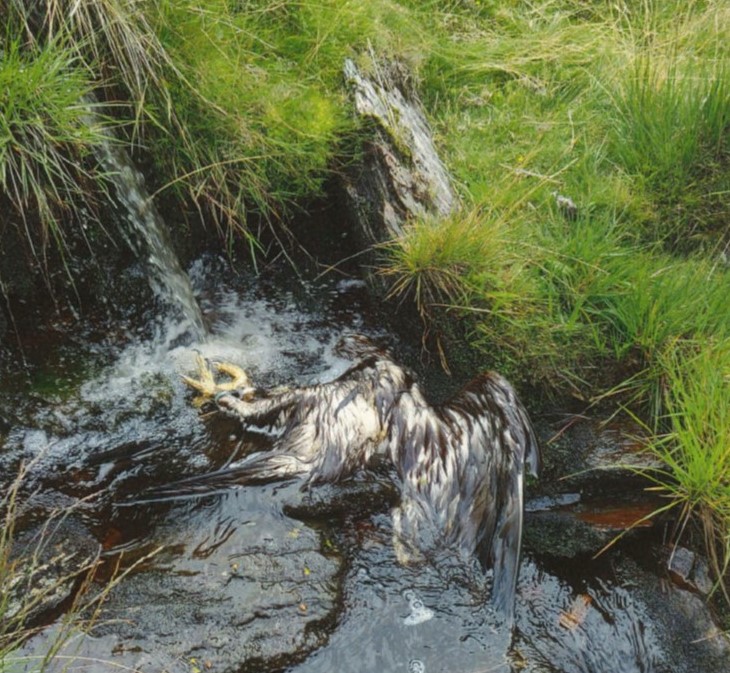
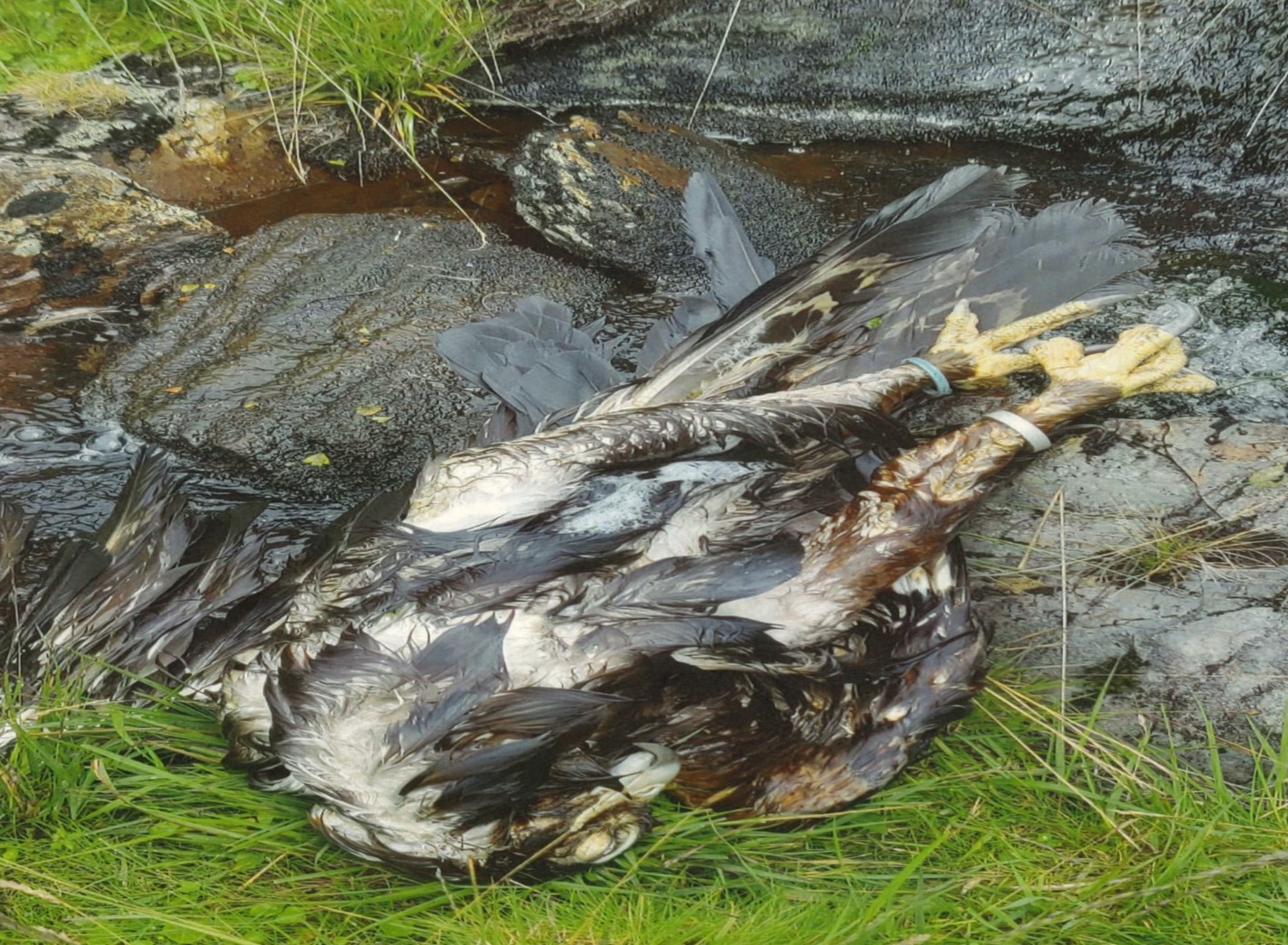
In August 2020 a walker found an adult golden eagle dead in a river in Powys, Wales.

The discovery prompted a great deal of media interest (e.g. here) as this eagle was believed to be the lone bird that had survived for approx 12 years in the wild in Wales, having escaped from captivity when she was three months old.

Just a few days before her corpse was found she’d featured in a BBC documentary presented by Iolo Williams, The Last Wilderness of Wales (available here on BBC iPlayer and well worth a watch for footage of this eagle doing her thing).

At the time of the news reports the cause of death was still to be established.

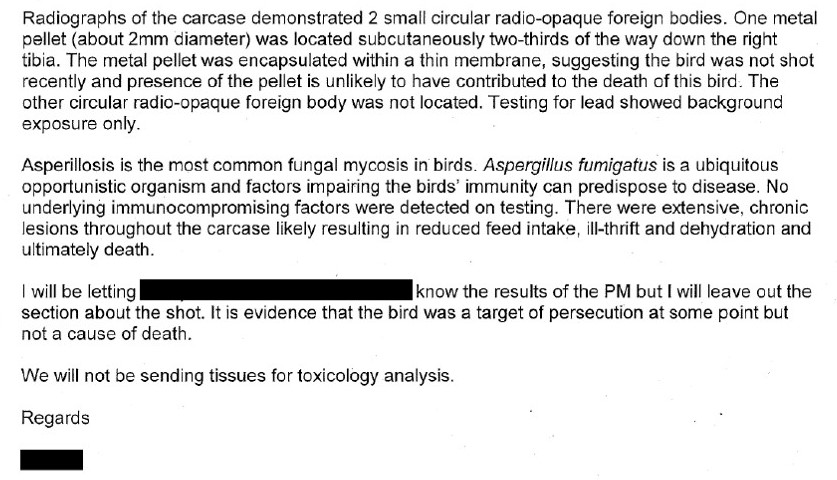
The Welsh Government organised for a post mortem where it was determined she’d died of systemic Aspergillosis. The PM report included the following description:

Asperillosis is the most comon fungal mycosis in birds. Aspergillus fumigatus is a ubiquitous opportunistic organism and factors impairing the birds’ immunity can predispose to disease. No underlying immunocompromising factors were detected on testing. There were extensive, chronic lesions throughout the carcase likely resulting in reduced feed intake, ill-thrift and dehydration and ultimately death‘.

That all looked straight forward and no cause for concern. However, an x-ray of the corpse had also revealed something much more sinister, as documented in the PM report as follows:

So, this golden eagle had been shot previously, although it’s not clear when and the pathologist thought this was unlikely to have contributed to the bird’s death.

Interestingly, the Welsh Government chose to suppress this information. Here is some internal correspondence, released under FoI, where the suppression is detailed:

In later correspondence also released under FoI, Welsh Government officials said this wasn’t deliberate suppression but just standard procedure when informing the original reporter of the incident about the cause of death, excluding any additional information that the PM may have uncovered. Government officials also stated that the Environment Minister had been informed about the gunshot injury.*

That seems reasonable behaviour under normal circumstances. However, finding the only golden eagle in Wales dead in a river couldn’t be described as ‘normal’ under any circumstances. And discovering that the eagle had been shot would also be of significant public interest, not least when there’s currently an active debate about the proposed reintroduction of golden eagles to Wales which could happen as early as next year (see here).

I’d say that public understanding of illegal persecution, including the targeting of a golden eagle, was actually fundamental to the debate.

Although according to an FoI response from the Welsh Government’s statutory conservation agency Natural Resources Wales (NRW) last month, officials there claimed to have received no correspondence about the shooting of this golden eagle either. That seems a bit odd, doesn’t it? Surely officials in the environmental section of the Welsh Government talk to officials in NRW, especially on a subject as significant as the shooting of a golden eagle?

It’s not the first time information about golden eagles in Wales has been suppressed. Last month NRW withheld correspondence it had had with Wilder Britain, one of two competing organisations involved with the proposed reintroduction of golden eagles to Wales (see here).

In an FoI refusal letter, NRW argued that Wilder Britain had refused permission to release its correspondence with NRW. I’ve lodged a review of that decision because I don’t believe it should apply to correspondence written by NRW to Wilder Britain in relation to a proposed reintroduction project. I believe the public have a right to know what advice NRW has been giving to someone proposing to reintroduce golden eagles to Wales and especially now that it’s been confirmed that Wales’s only wild-living golden eagle had at some stage been illegally shot.

*Update 12.24hrs: The person who took the dead eagle from the walker and delivered it for post mortem has been in touch to say the Welsh Government did provide details of the pellet and did not try to dissuade her from sharing that information with the media. This information is supported by some of the FoI material I’ve received, which shows that the Welsh Government informed her about the pellet sometime after they’d first mentioned to her that Aspergillosis was the cause of death, and seemingly only after being prompted by an outside agency to do so.

There is further correspondence, released under FoI which hasn’t been published here, in which the Welsh Government explicitly states, ‘We aren’t planning any proactive comms‘ [about the eagle being shot].

UPDATE 17.00HRS: This blog post has been picked up by Wales Online (here)

UPDATE: This blog post has been picked up by the Mail Online, who couldn’t report it accurately (claiming the eagle was shot twice) nor manage to acknowledge the source of their story).

UPDATE 16 February 2021: Toxicology analysis has confirmed this eagle had ‘high concentrations of rat poison in its liver, which may have contributed to its death’, according to the BBC (here)

New paper documents history of eagles in Wales

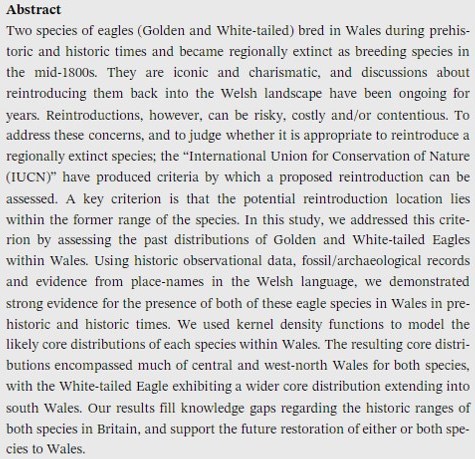
An important new scientific paper has just emerged documenting the history of golden and white-tailed eagles in Wales.

Published in the journal Conservation Science & Practice, this new paper builds on the earlier, painstaking work of the much missed Richard Evans who, along with colleagues (see here), mapped the historical distribution of eagles across Britain and Ireland.

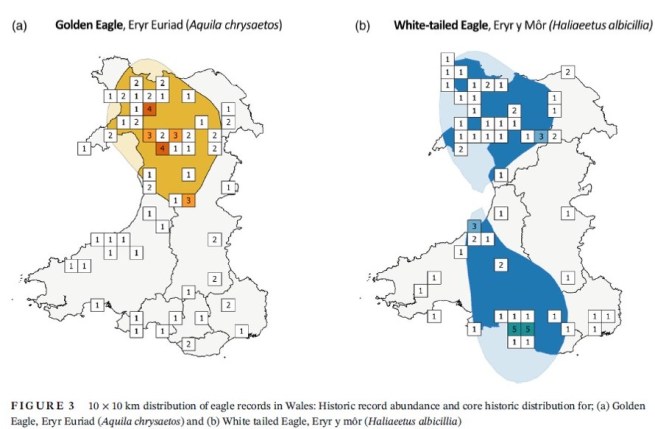
This latest paper, authored by Cardiff University PhD student Sophie-lee Williams et al, thoroughly evaluates the evidence for both species in Wales and maps their likely core distributions. The authors conclude there is strong evidence that both species were widespread across Wales but fell victim to persecution and haven’t bred there for over 150 years.

This paper is open access which means it is freely available to everyone.

Download it here: Williams et al 2020_Past distribution eagles Wales

The significance of this paper relates to a proposed reintroduction of golden and/or white-tailed eagles to Wales. Many blog readers will recall that this prospect has been on the table for a while and whilst there is still a lot more work to complete before licence applications are submitted, understanding the species’ past historical ranges is important.

Some blog readers may recognise some of the names involved in this latest research. They are part of the Eagle Reintroduction Wales Project (ERWP) (website here) who we blogged about last year when news emerged that a different team was also contemplating an eagle reintroduction in Wales, but apparently without the careful research assessment being undertaken by the Cardiff University team (see here). Fortunately, so far, that alternative approach hasn’t advanced very far (see here and here).

Hopefully it won’t be too long before we see more research results from the ERWP that’ll take us another step closer to restoring these eagles back to Wales.