Leaked email reveals Natural England’s views on Hen Harrier Action Plan

The following internal email was written by Rob Cooke (Natural England Director) on 6 February 2017:

Hen Harriers

Hen harriers (HHs) are having a rough time in England. Although juvenile birds have a high natural mortality there is plenty to suggest that illegal persecution is ongoing, either through shooting or disturbance. The level of persecution is such that it is undoubtedly having an impact on the conservation status of the species in England.  Amongst a diet usually dominated by meadow pipits and voles can be red grouse, which is where the problem arises.  As a semi-colonial nester HHs can predate high numbers of grouse which can bring them into conflict with grouse shooting.

In early 2016 Defra published the Joint Action Plan to increase the English hen harrier population. The two new elements proposed a southern reintroduction and trialling a brood management scheme; Natural England chairs sub-groups on both.  Brood management is the most controversial element. Notwithstanding that, establishing a separate southern population has attracted criticism, even from some of those who purport to want to see more HHs, presumably as they fear that it will divert attention from persecution in the uplands. The notion that anyone wanting to see more HHs can argue against a reintroduction is I’m afraid beyond me (and as I type this I can see a red kite gliding by overhead).

Put simply brood management (BM) is removing eggs/chicks from vulnerable nests, rearing them in captivity and releasing them back into the uplands.  Of course if there was no persecution threat the nests wouldn’t be vulnerable (to human persecution at any rate) and therein lies the rub.  Those opposed to BM say it effectively condones persecution, and actually more effort should be put into stopping that.  I agree with that, but in practice despite the collective efforts of us, the police, RSPB and others it has not proved possible to stop persecution.  Radio tagged birds disappear, and even when recovered proving who fired the shot is very difficult in large remote upland areas.  There is an argument being made that driven grouse shooting should be banned (rejected recently by parliament), and the RSPB’s approach is that there should be greater regulation of shooting.  Effective regulation requires effective enforcement, and in Scotland where there is a stronger regulatory framework (incl vicarious liability and SNH’s power to remove General Licences) they still have a significant ongoing HH and raptor persecution issues.

The rationale behind BM is that if upland managers have a way of managing the density HHs (so that any impact on grouse is sustainable) then there will not be a ‘need’ to persecute the birds.  Whether this is the case or not time will tell (it is a trial after all), but we need to give it a go, since there is no Plan B on the table. Undertaking BM does not mean that anyone will put any less effort into enforcement, and there will continue to be tagging and rigorous protection of nest sites, where Stephen Murphy and his network of dedicated volunteers do wonders.  Since all the birds will be returned to the uplands there should be no impact on the population (and possibly even, more chicks will survive to adulthood than would otherwise have been the case as nests do suffer natural predation). It goes without saying that the trial will be subject to full veterinary, statutory assessment and licensing processes. BM would not require the removal of all birds from grouse moors, but would kick in when a published density threshold was reached.
rowan-x-rayRecent events have resulted in a large number of FoI requests and fair bit of resultant commentary on raptor blogs.  Much of this is commentators adding up 2 and 2 and coming to 5.  In particular the huge amount of space devoted to whether NE ‘watered down’ a media release concerning Rowan’s post-mortem to say ‘likely to have been shot’, as opposed to ‘shot’.  The simple truth is that the post-mortem did not say definitively that the bird was shot so nor did we (or the RSPB either – ‘injuries consistent with being shot’).  That prosaic point aside what is really disappointing is that this focus detracts from the spotlight which needs to be shone on the continuing plight of HHs and work underway to change that.  The lurid accusation that NE is in some way colluding with those responsible for hen harrier persecution is simply absurd.

Natural England leads much of this work and criticism is par for the course; constructive criticism is good and keeps us on our toes, but it is disappointing that much destructive criticism comes from the ‘wildlife sector’; rather darkly I wonder whether those who are responsible for persecution are sitting back smugly watching this internecine bickering.  The bottom line is that there are a number of people working extremely hard to improve the status of HHs in England.  We are all working to our strengths and membership organisations need to be able to take their members with them, to persuade them and win their support; hard line approaches can lead to alienation.  I believe in the sincerity of those involved in the plan, even if we might have differing motivations, but no one is blind to the challenges; persecution still happens and it needs to stop. If this plan does not deliver then we will need to look at other approaches.

But ‘How’ is the question? Simple enforcement is not enough so we need to adopt other approaches as well. After all, our experience over the last 15 years or so is that even reducing persecution is much easier said than done. There has been progress of sorts to date; the issue is very much in the public eye, we have the Moorland Association and other representative bodies openly condemning raptor persecution, we have tackling wildlife crime as a Govt priority and we have a Govt published plan. The proof of course will be in the eating; it won’t be easy but we do need to give it a try.

We need to be robust in our objective of restoring HHs to favourable conservation status in England, and not be distracted by those who, from whatever perspective, would derail us.

ENDS

There’s so much that could be discussed /debated /argued about the content of this email that we’d be here all day, so for brevity we just wanted to focus on two aspects.

First, the statement: “I believe in the sincerity of those involved in the plan“.
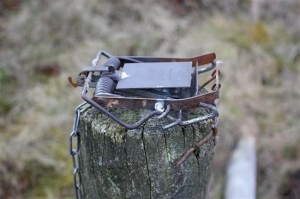
pole trapOn what basis does he believe in this supposed sincerity? The plan was launched over a year ago in January 2016, with the ‘partners’ supposedly all signed up. Since then we’ve seen an armed man sitting next to a decoy hen harrier on a grouse moor in the Peak District National Park; a gamekeeper caught on film setting three illegal pole traps on a grouse moor in the Yorkshire Dales National Park; an endless number of raptor shootings, trappings and poisonings across England, many on or next to a grouse moor; an increase in the number of reported gas guns and banger ropes being deployed on grouse moors to deter breeding hen harriers; only three hen harrier nests in England (where there could be 330) and not one of them was on a grouse moor; and eight satellite tagged hen harrier fledglings from the 2016 season have already either ‘disappeared’ in the uplands or have been confirmed shot.

We haven’t seen any evidence whatsoever that the grouse shooting industry is sincere about stopping raptor persecution.

Secondly, we wanted to highlight Rob’s penultimate paragraph, because it really beggars belief. According to Rob, ‘there has been progress of sorts to date’ and he defines this ‘progress’ as follows:

  1. The issue is very much in the public eye. Well yes, it is, but that is no thanks to Natural England or their friends in the grouse shooting industry. Public awareness of hen harrier persecution has been increased thanks to (a) the RSPB’s Hen Harrier Life Project and (b) a hell of a lot of effort by grassroots campaigners, notably Mark Avery with his book Inglorious and his three petitions to ban driven grouse shooting, Chris Packham, LUSH, hundreds of people getting involved in BAWC’s Hen Harrier Day events across the UK for the last three years, and thousands of ordinary people using social media to great effect, day in, day out.
  2. We have the Moorland Association and other representative bodies openly condemning raptor persecution. What we actually have is the Moorland Association and other representative bodies consistently denying that raptor persecution is a big problem; consistent attacks on the RSPB, particularly from the You Forgot the Birds propaganda machine, which is funded by the grouse shooting industry; consistent personal attacks on high profile campaigners; consistent attempts to discredit RSPB persecution data, and a consistent refusal to condemn confirmed raptor persecution crimes unless pushed hard by campaigners, and even then a response is rarely forthcoming (see yesterday’s blog about the poisons cache on East Arkengarthdale Estate as a classic example).
  3. We have tackling wildlife crime as a Govt priority. Do we? Is there any evidence of this?
  4. We have a Govt published plan. We do indeed, and it has been repeatedly and deservedly criticised by conservationists. As Mark Avery often says, it is not an action plan for hen harriers, it is an action plan for grouse moor owners.

Sorry Rob, but if you think the grouse shooting industry is going to stop killing hen harriers (or any other raptors) any time soon, based on the ‘evidence’ you’ve provided, then you’re delusional.
 

Poisons cache on East Arkengarthdale Estate: no prosecution, no subsidy penalty

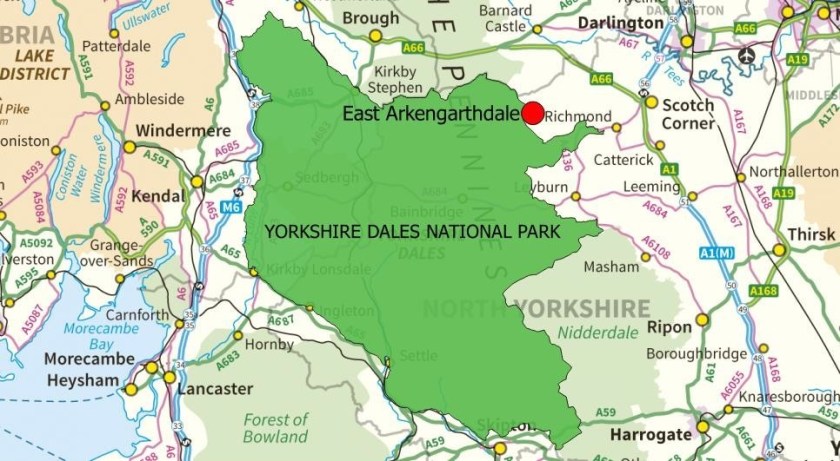
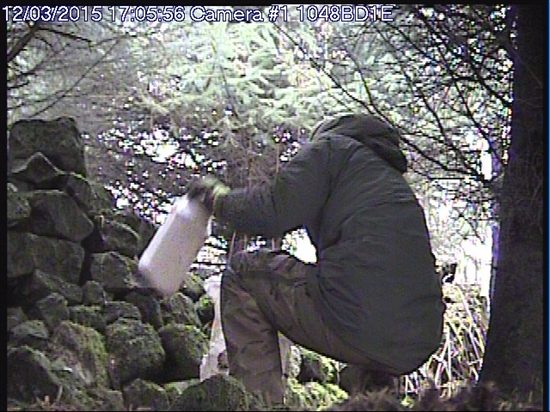
In December 2016 we blogged (here) about the discovery of an illegal poisons cache, buried in a small forestry plantation on Hurst grouse moor, part of the East Arkengarthdale Estate in North Yorkshire.

east-arkengarthdale

The discovery had been made (and filmed) by the RSPB’s Investigations team in December 2014 and March 2015. RSPB Investigator Guy Shorrock wrote a blog about it (here).

We learned that an unnamed gamekeeper had been responsible for the poisons cache but the Crown Prosecution Service had decided not to prosecute due to ‘procedural concerns’. Nevertheless, North Yorkshire Police revoked this gamekeeper’s shotgun and firearms certificates. The gamekeeper appealed this decision (and was represented by the BASC Chairman, no less) and the court decided his certificates should be returned.

So we asked the Rural Payments Agency (as did many of you, thank you) whether the illegal poisons cache was a breach of the conditions under which the Estate had received almost £200,000 of agricultural subsidies (public money) and if so, whether any part of those subsidies would be withdrawn as a penalty, in the same way a penalty had been applied to the Stody Estate in Norfolk for poisoning offences that took place in 2013 (see here).

Here’s the Rural Payments Agency’s response:

You have asked the following questions about the discovery of a hidden pesticide cache on Hurst Moor, North Yorkshire in 2014:

1. Did the CAP subsidies received by the specified business in 2014 cover the land where the poisons cache was discovered?
2. If so, does having a poisons cache, administered by a gamekeeper, qualify as a cross-compliance breach?
3. If so, will the Rural Payments Agency be applying a subsidy penalty?

The RPA has determined that a subsidy penalty was not appropriate, for the reason set out below. It therefore did not need to establish the precise location of land where the poisons cache was discovered.

We considered this case under the cross compliance rules that applied in 2014 and we hope the following will explain why RPA does not have the scope to apply cross compliance penalties for breaches of this nature.

Within cross compliance, all breaches relating to storage of pesticides were provided for by a set of rules known as the sustainable use rules.  These were part of the wider set of rules covered by the plant protection product Statutory Management Requirement (SMR) which, in 2014 was SMR 9. Please refer to page 63 of the Guide to Cross Compliance in England 2014, for further information.

From 1 January 2014 a change to European legislation meant the sustainable use rules were removed from the scope of SMR 9 as far as cross compliance rules applicable to SPS payments were concerned. This meant there was no scope to apply cross compliance penalties to SPS payments for pesticide storage and unapproved product breaches that occurred from 1 January 2014 onwards.

The sustainable use rules continued to apply to rural development schemes covered by cross compliance rules, for example the full range of Environmental Stewardship schemes. This was the case until the end of 2014, after which further changes to European legislation fully removed the sustainable use rules from the scope of cross compliance.

In the rural development legislation that applied in 2014, the obligation to comply with the statutory management requirements did not apply to non-agricultural activities on a holding. In this case the evidence is that the breach was committed in connection with the non-agricultural activity of game shooting. In addition, the evidence is that the cache was not found on agricultural land, but within a small plantation of trees. Therefore it is not possible to apply cross compliance penalties to rural development payments for a breach of this nature.

END

So, no prosecution, no revocation of firearms, and no subsidy penalty.

arken

But what about a positive reaction from the grouse shooting industry itself? Surely, as members of the Partnership Against Wildlife Crime (PAW) and the Raptor Persecution Priority Delivery Group (RPPDG), organisations like the Moorland Association and the National Gamekeepers’ Organisation would want to move swiftly to distance themselves from this Estate and this gamekeeper?

Well, we asked them about this (as did many of you, thank you) two months ago (here) and guess what? We haven’t heard a word of condemnation or any hint of expulsion. Just the standard wall of silence we’ve come to expect.

What we did find, though, was East Arkengarthdale grouse moor being listed as among ‘the best shoots in the UK 2015/2016‘, as recommended by ‘prominent figures and agents’ from the industry. It’s really worth having a look at this list – there are a few other ‘interesting’ names that many of you will recognise.

If ever you wanted evidence of a criminally-riddled industry protecting its own, or evidence of sham partnership working, you’ll be hard pressed to beat this case as an example.

Buzzard shot in Essex

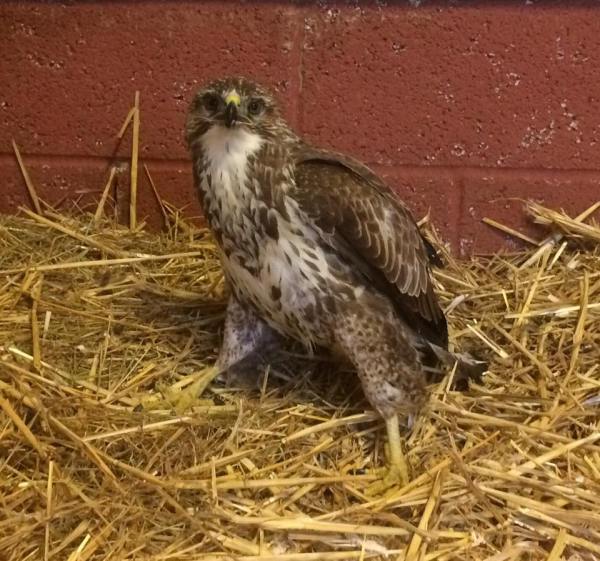
The following images and text have been posted on the South Essex Wildlife Hospital facebook page:

‘A very weak buzzard found at the side of a road was assumed to have been a road traffic casualty. Having x-rayed the bird, the reason it wasn’t flying was obvious. Several shot gun pellets were lodged in its body, wing and leg. Vet Tom removed as many as he could once the bird was strong enough for surgery. It is recovering and does seem much stronger now. We hope to release it soon but must be sure it is able to survive in the wild’.

This case has been reported to the police.

Mystery hen harrier ‘John’ from the class of 2016

Yesterday Mark Avery wrote a blog about DEFRA’s ridiculous hen harrier brood meddling plan, due to start this year.

In his blog, Mark reminded us that in 2016 there were four young hen harriers that were satellite-tagged at two nests on Forestry Commission land in Northumberland, as mentioned in this local newspaper article last summer.

Since the summer of 2016, we’ve been able to follow the movements of two of those birds because their sat tags were fitted by the RSPB, who have posted fortnightly updates on the RSPB Hen Harrier Life Project website. One of those birds (Finn) is still alive, and the other one (Carroll) is dead.

So what of the other two birds, tagged in Northumberland by Natural England?

Well, one of them was called Mick, and we were told nothing about this bird until a few days ago when we learned he’d ‘disappeared’ in the Yorkshire Dales National Park just before Xmas 2016.

The other one, we’ve learned on the grapevine, is/was called ‘John’. Again, we’ve been told nothing of this bird’s movements since he fledged last summer – we don’t even know if he’s still alive.

Nothing like a bit of public engagement, eh Natural England?

We’ll need to update our record on the fate of the class of 2016, now we know about Mick & John. So here it is:

Hen harrier Elwood – ‘disappeared’ in the Monadhliaths just a few weeks after fledging (Aug ’16).

Hen harrier Brian – ‘disappeared’ in the Cairngorms National Park just a few weeks after fledging (Aug ’16).

Hen harrier Donald – missing in northern France, presumed dead (Autumn ’16).

Hen harrier Hermione – found dead on Mull, believed to have died from natural causes (Sep ’16).

Hen harrier Rowan – found dead in Yorkshire Dales National Park. He’d been shot (Oct ’16).

Hen harrier Tarras – ‘disappeared’ in the Peak District National Park (Oct ’16).

Hen harrier Beater – missing in Scottish Borders, presumed dead (Nov ’16).

Hen harrier Bonny – ‘disappeared’ in the North Pennines, presumed dead (Dec ’16)

Hen harrier Mick – ‘disappeared’ in the Yorkshire Dales National Park, presumed dead (Dec ’16).

Hen harrier Carroll – found dead in Northumberland, PM revealed a parasitic disease & two shotgun pellets (Jan ’17).

Ten down, seven to go (Aalin, DeeCee, Finn, Harriet, Wendy, Sorrel, John).

Two red kites confirmed poisoned in Nidderdale, North Yorkshire

Yesterday, North Yorkshire Police put out the following press release:

POLICE WARNING FOLLOWING RED KITE POISONING

Police are appealing for information and warning about the dangers of illegal bird of prey poisoning.

Two red kites were found poisoned in the Nidderdale area of North Yorkshire in 2016.

One was found near Pateley Bridge on 12 March 2016. Tests have attributed its death to alphachloralose. Traces of aldicarb and three rodenticides (difenacoum, bromadiolone and brodifacoum) were also identified.

The second was found near Bouthwaite on 18 May 2016. Shockingly, tests have shown the presence of eight different poisons – alphachloralose, aldicarb, bendiocarb, carbofuran and isofenphos, together with three rodenticides.

Officers are appealing for information about the two incidents, and warning members of the public about the dangers of this illegal practice. Hard-hitting posters urging people to report suspected wildlife poisoning are being distributed across the county.

Inspector Jon Grainge, of North Yorkshire Police’s Rural Taskforce, said: “The use of poisons in the two Nidderdale cases is particularly shocking. The practice of lacing animal carcasses with poison to kill other wildlife is cruel and illegal. It is also a serious risk to members of the public and their children or pets if they come into contact with them.

If you find a mammal or bird that you believe has been poisoned, please do not touch it, as poisons can transfer through skin contact. Also keep youngsters and pets well away. Make a note of the location, including GPS co-ordinates if possible, and anything else that is around or near the animal, and contact the police immediately”.

Anyone with information about the poisoning of the red kites found in Nidderdale should contact North Yorkshire Police on 101, quoting reference number 12160043415, or email ruraltaskforce@northyorkshire.pnn.police.uk.

ENDS

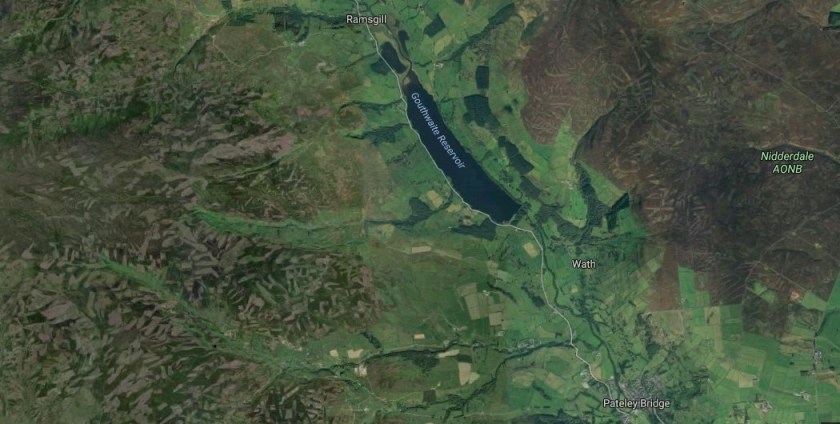
Have a look at this map. The poisoned red kite at Bouthwaite was found just to the north of the Gouthwaite Reservoir, and the poisoned red kite near Pateley Bridge was found just to south. Look at the land use on either side of the reservoir: this is driven grouse shooting country.

nidderdale

Presumably these two poisoned red kites were part of the ten suspicious red kite deaths investigated in North Yorkshire in 2016. Most of those were confirmed shot but there were a number of suspected poisonings too.

It seems strange that North Yorkshire Police is only now appealing for information about two poisoned red kites that were found nine and eleven months ago respectively. The delay may be due to issues at the toxicology lab (it wouldn’t be the first time) and therefore beyond North Yorkshire Police’s control. The delay is certainly at odds with the commendable speed with which North Yorks Police announced some of last year’s shot red kites (e.g. see here – shot kite found on Sunday, press release out by Monday). They were also incredibly quick off the mark to go out and investigate the three illegal pole traps found on the Mossdale Estate grouse moor in the Yorkshire Dales National Park last year, and although senior officers ballsed up what should have been a straight forward prosecution, at least they were honest and transparent, admitted the mistake and amended their policies as a result.

The long delay aside, it is very good to see North Yorkshire Police provide detailed information about the type of poisons used in these two crimes (take note, Police Scotland). It’s also very good to see them proactively warning the public of the danger of these highly toxic substances (again, take note Police Scotland), especially as we head towards spring, which is typically the time when illegal raptor persecution really hots up.

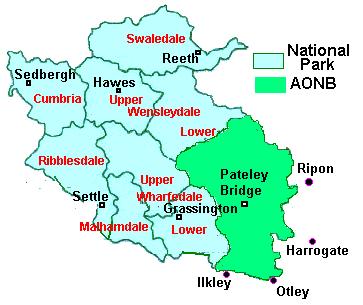
North Yorkshire Police have certainly got their work cut out fighting wildlife crime, and particularly raptor persecution. North Yorkshire is consistently rated the worst county in the UK for the number of reported crimes against raptors, and a lot of it takes place in the Nidderdale Area of Outstanding Natural Beauty and the neighbouring Yorkshire Dales National Park. We were only talking about this region two days ago in relation to the ongoing persecution of hen harriers.

ydnp_aonb

Photo of red kite by Mali Halls

Driven grouse shooting auctioned at Tory fundraising ball

Every year the Tory party hosts a lavish Black & White fundraising ball for wealthy donors, with a range of opulent prizes on offer in an auction.

We’ve blogged about this event before (see here) when in 2015 one of those auction prizes – an opportunity to shoot 500 pheasants and partridge at the Maristow and Bickleigh Estate in Devon – reportedly sold for £110,000.

This year’s ball took place on Monday evening and one of the auction lots was ‘a fantastic grouse shoot for 8’ at the Westerdale and Rosedale Estate in the North York Moors National Park.

Would this be the same grouse moor where an horrifically injured buzzard with a severed leg and gunshot wounds was found last summer?

westerdale-bz2

It’s not known on whose land this buzzard was shot and trapped, nor the identity of the perpetrator(s), just that the critically injured bird was picked up on a Westerdale grouse moor within the North York Moors National Park. It didn’t survive.

Hawk and Owl Trust dig themselves in to a deeper hole re: shot hen harrier Rowan

The Hawk and Owl Trust are digging themselves in to a deeper hole.

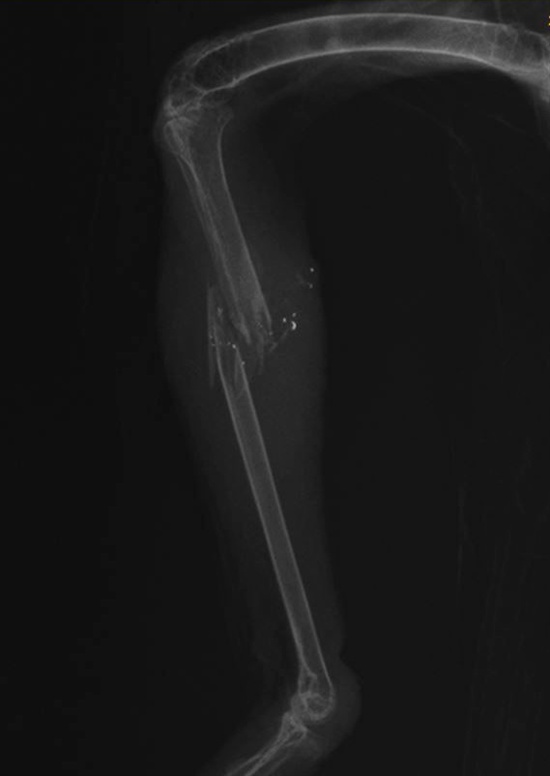
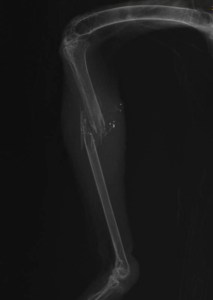
Most people looking at the x-ray of hen harrier Rowan’s leg injuries, which was published yesterday, would be able to interpret the image fairly easily. A fractured leg with a number of radio-dense foreign bodies associated with the injury site; radio-dense foreign bodies with a radio density consistent with metal. This is not a difficult image to interpret and it’s pretty clear that Rowan’s injuries weren’t caused when he was shaving his legs and slipped (thanks Lewis Thomson @LT_FoD for the most amusing suggestion seen on Twitter yesterday!).

rowan-x-ray

The Hawk and Owl Trust (and Natural England and Cumbria Police) had the benefit of additional evidence in the form of photographs (presumably a gunshot entry wound was visible on the leg directly adjacent to the fracture site) and a written report from the pathology expert who had conducted the post mortem. The opinion of the pathologist was that Rowan had been shot and Cumbria Police accepted his expert opinion.

So we come back to the questions we raised earlier:

(a) Why did the joint press release issued by Hawk & Owl Trust / Natural England on 28 October (just prior to the Westminster grouse shooting debate) exclude all the post mortem evidence that was available to them on 27 October?

Their press release included the line: “We are unable to make further comments or enter into discussion at this time as this may be prejudicial to ongoing investigations“. Our friend Mark Avery suggested to us an alternative line: “We are unable to make further comments or enter into discussion at this time as this may be prejudicial to the Westminster debate on driven grouse shooting“.

(b) Cumbria Police’s draft press release on 3 November clearly stated that the post mortem had concluded Rowan had been shot. Why then, on 7 November and after consultation with Natural England (and possibly Hawk & Owl Trust) was this police press release altered from Rowan ‘was shot’ to Rowan ‘was likely to have been shot’?

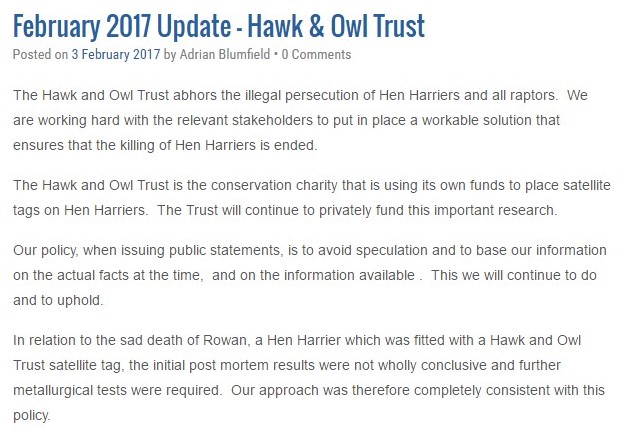
Yesterday evening, the Hawk and Owl Trust issued a statement in an attempt to justify their lack of transparency:

The most interesting sentence is the penultimate one:

“……the initial post mortem results were not wholly conclusive and further metallurgical tests were required“.

Really? Who said the initial post mortem results weren’t wholly conclusive? (Clue: it wasn’t the pathologist).

And who said further metallurgical tests were required? (Clue: it wasn’t the pathologist).

Have those further metallurgical tests been done? If so, where are the results? If they haven’t been done, four months on, then why not if they were supposedly “required”?

Emails to: enquiries@hawkandowl.org 

Shot hen harrier Rowan – here’s that x-ray

For those of you who have been following the story of the Natural England / Hawk & Owl Trust / Cumbria Police cover-up re: whether hen harrier Rowan had been shot (see here and here), the RSPB has just published the x-ray:

rowan-x-ray

Is that a shattered leg bone with bits of shotgun pellet lodged in the soft tissue?

Clear, irrefutable evidence that Rowan was shot – not ‘likely to have been shot’, but most definitely, without a shadow of a doubt, shot.

We’ll come back to this later – just off to meet some journalists – but Natural England / Hawk & Owl Trust / Cumbria Police have some very serious questions to answer.

Satellite-tagged Hen Harrier ‘Carroll’ is dead

With depressing predictability, another of the 2016 cohort of young hen harriers has been found dead.

‘Carroll’ hatched in a nest on Forestry Commission land in Northumberland – one of only three nests in England last year. Named after the late raptor worker Mick Carroll, this bird was satellite-tagged as part of the RSPB’s Hen Harrier LIFE Project.

Her satellite tag revealed that she didn’t wander very far during her short life, spending much of her time within the boundary of the Northumberland National Park. This map of her movements has been provided by the RSPB’s Hen Harrier Life Project:

On 26 January 2017 a local landowner found Carroll’s body and immediately reported it to the authorities. A post mortem revealed she had died with a parasitic infection, but it also revealed two shotgun pellets lodged under healed wounds, one in the leg and one in the throat. Thankfully, the RSPB is handling this case, not Natural England, so the x-ray showing the shotgun pellets in her body has been published. There’s no attempt at obfuscation, no suggestion Carroll was ‘likely to have been shot’, no attempted cover up – the message is clear –  at some point, Carroll had been shot, perhaps when she was in the supposed ‘safety’ of the Northumberland National Park. The RSPB knows very well that publishing this x-ray will not ‘affect the course of justice’ as Natural England has claimed for shot hen harrier Rowan, whose corpse was found in the ‘safety’ of the Yorkshire Dales National Park. The RSPB knows it won’t affect the course of justice because they know justice won’t be served – nobody will be prosecuted for shooting this precious, threatened species.

Carroll’s name can now be added to the growing list of young hen harriers that have died or ‘disappeared’ since fledging in 2016:

Hen harrier Elwood – ‘disappeared’ in the Monadhliaths just a few weeks after fledging.

Hen harrier Brian – ‘disappeared’ in the Cairngorms National Park just a few weeks after fledging.

Hen harrier Donald – missing in northern France, presumed dead.

Hen harrier Hermione – found dead on Mull, believed to have died from natural causes.

Hen harrier Rowan – found dead in Yorkshire Dales National Park. He’d been shot.

Hen harrier Tarras – ‘disappeared’ in the Peak District National Park.

Hen harrier Beater – missing in Scottish Borders, presumed dead.

Hen harrier Bonny – ‘disappeared’ in the North Pennines, presumed dead.

Nine down, six to go (Aalin, DeeCee, Finn, Harriet, Wendy, Sorrel).

What an appalling situation. Does anybody (apart from the Hawk & Owl Trust) still believe that the grouse shooting industry has cleaned up its act?

UPDATE 07.30hrs: There’s a very good RSPB Skydancer blog about Carroll’s demise here

Shot hen harrier Rowan – a Natural England/Hawk and Owl Trust cover up? Part 2

This is Part 2 of a two-part blog. For Part one, please read here.

The following information is a timeline of what happened and has been compiled from a series of FoIs. Natural England has refused to release some of the information we asked for (notably a copy of the post mortem report that was paid for with tax payers’ money, but also some email correspondence) because apparently this may ‘affect the course of justice’.

Satellite-tagged hen harrier Rowan was found dead in Cumbria on 22 October 2016.

His corpse was collected by Stephen Murphy (Natural England) and sent to the Zoological Society of London for a post mortem on 24 October 2016.

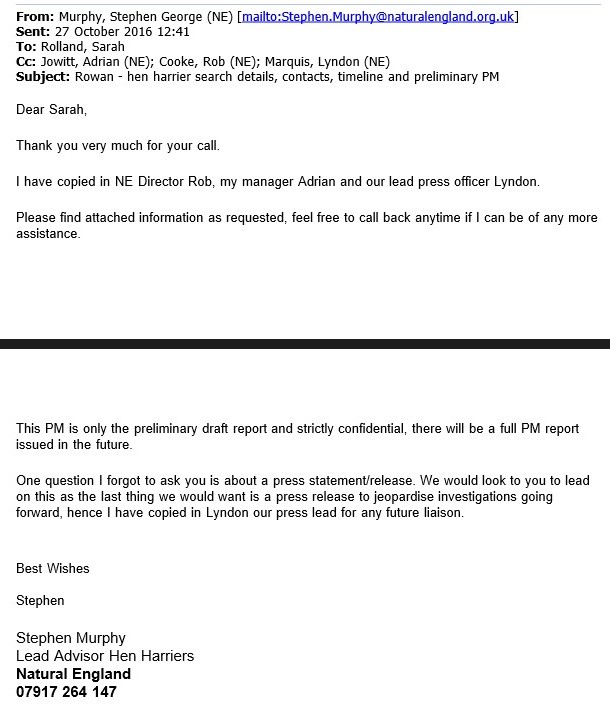
The post mortem was conducted on 26 October 2016 and the preliminary findings were passed to Natural England on 27 October 2016. The preliminary findings indicated the bird had been shot. Stephen Murphy passed on the preliminary findings to Cumbria Police on 27 October 2016:

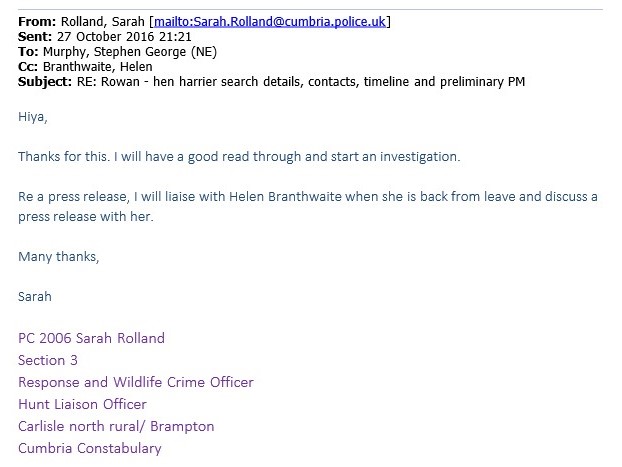
Cumbria Police launched an investigation the same day, based on the findings of the preliminary post mortem report (i.e. that Rowan had been shot):

The following day, on 28 October 2016 (the Friday before the Monday Westminster debate on driven grouse shooting), Natural England and the Hawk & Owl Trust issued the following vague joint press statement:

The body of a juvenile, male hen harrier – named Rowan – was recovered in Cumbria on 22nd October. He was satellite tagged at the Langholm project in the Scottish borders, as part of a joint venture between Natural England and the Hawk and Owl Trust. Following an autopsy, Natural England has passed details to the police for investigation.

We are unable to make further comments or enter into discussion at this time as this may be prejudicial to ongoing investigations.

On Monday 31 October 2016 – the Westminster debate on driven grouse shooting took place.

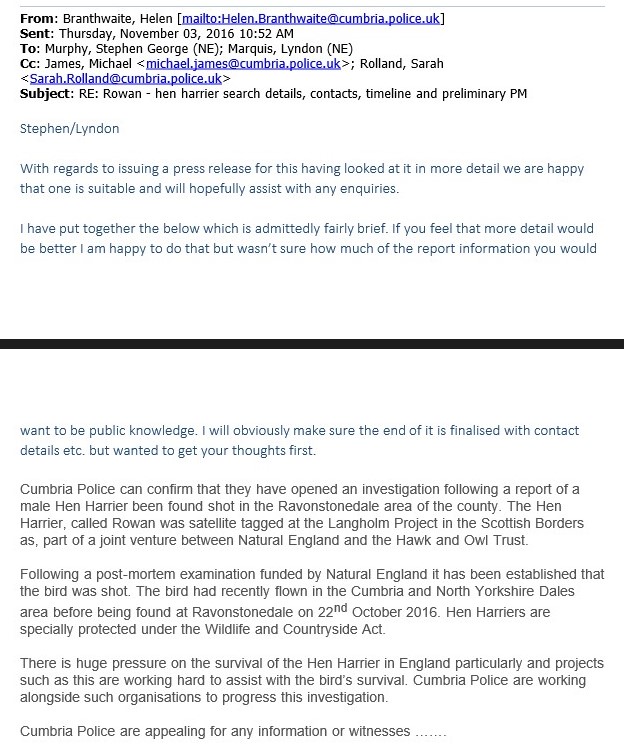
On 3 November 2016, WCO Helen Branthwaite of Cumbria Police sent a copy of a draft press statement about Rowan’s death to Natural England. Pay close attention to the wording of this draft police press statement, particularly the sentence, ‘Following a post mortem examination funded by Natural England it has been established that the bird was shot’:

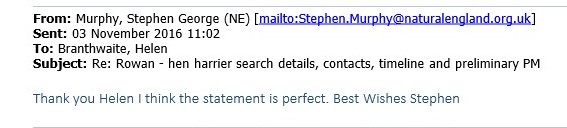
Stephen Murphy (Natural England) replied to WCO Helen Branthwaite with this:

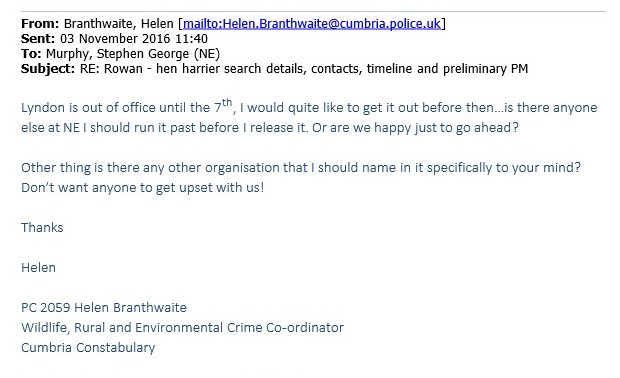
WCO Helen Branthwaite replied to Stephen Murphy to say she couldn’t get hold of the Natural England press officer (Lyndon Marquis) and asked if anyone else at Natural England should take a look over the draft police press statement:

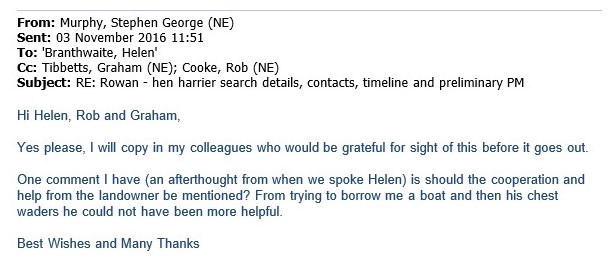
Stephen Murphy replied to Helen and suggested that Graham Tibbetts (Head of Media at Natural England) and Rob Cooke (a Director at Natural England) should take a look:

At this point, the email chain goes cold (so either this conversation ended here or, if it did continue, Natural England has decided to withhold this information from the FoI response).

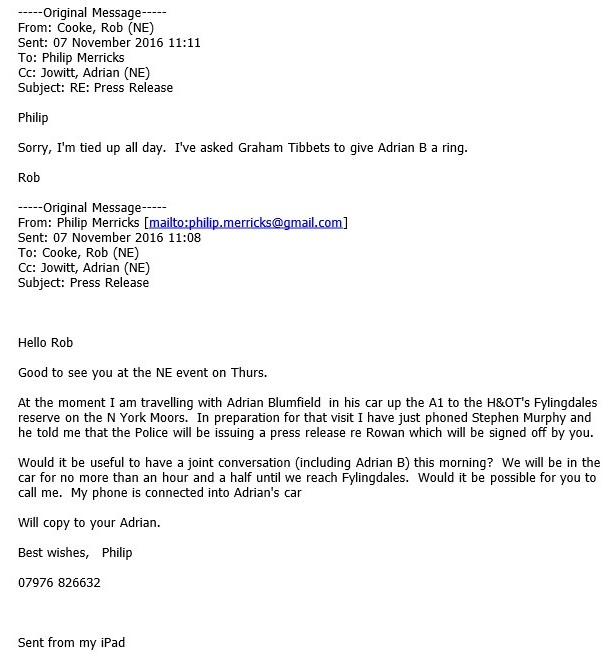
Four days later, on 7 November, Philip Merricks (Hawk & Owl Trust) wrote to Rob Cooke (Natural England) asking for a telephone conversation between Rob Cooke, Philip Merricks, Adrian Blumfield (Chief Operating Officer, Hawk & Owl Trust) to discuss the imminent Police press release about Rowan “which will be signed off by” Rob Cooke. Rob Cooke replied and said he would ask Graham Tibbetts (NE’s Head of Media) to make contact with Adrian Blumfield:

We don’t know if that telephone conversation took place because if it did, there won’t be a written record of it, but it is clear that the intention to have a conversation was there.

Later that same day, Cumbria Police issued the following press statement:

Cumbria Police have opened an investigation into the death of a hen harrier.

The body of a male Hen Harrier was found in the Ravenstonedale area of the county on 22nd October 2016. A post-mortem examination funded by Natural England and carried out by the Zoological Society of London has established that the bird was likely to have been shot.

The hen harrier, called Rowan, was satellite tagged at the Langholm Project as part of a joint venture between Natural England and the Hawk and Owl Trust. The bird had recently flown in the Cumbria and North Yorkshire Dales area before being found at Ravenstonedale.

Hen Harriers are specially protected under the Wildlife and Countryside Act, and the Government has set raptor persecution as one of their wildlife crime action priorities.

There is huge pressure on the survival of the hen harrier in England particularly and projects such as this are working hard to assist with the bird’s survival. Cumbria Police are working alongside such organisations to progress this investigation.

Anyone with information is asked to contact police on 101 and ask to speak to PC 2059 Helen Branthwaite.

Pay really close attention to the wording of this Police press statement, and notice which words have been changed from the draft police press statement that WCO Helen Branthwaite sent to Natural England on 3 November. The press statement no longer says that the post mortem established that Rowan had been shot; it now says the post mortem established that Rowan was ‘likely to have been shot‘.

This raises some really interesting questions.

If Cumbria Police were happy to tell the public that Rowan had been shot, based on a post mortem report (see their draft police press statement), why did the final police press statement only say he was ‘likely to have been shot’? Why the ambiguity?

It is apparent from the wording in Philip Merricks’ email that Rob Cooke (Natural England) was going to “sign off” the police press statement so did Natural England and the Hawk & Owl Trust collude to have this detail changed? It would certainly be in both their interests to have it changed because a ‘muddied’ ambiguous statement about a ‘likely shot’ hen harrier is far less damaging to their friends in the grouse shooting industry than a clear, evidence-based confirmatory statement that a hen harrier had been shot, especially at the time when driven grouse shooting and its associated criminality was being debated at Westminster.

If there was any doubt in WCO Helen Branthwaite’s mind that Rowan had been shot, did she contact the pathologist at ZSL for clarification or did she just accept the word of Natural England / Hawk & Owl Trust? If so, why?

These questions could easily be answered if we had sighting of the post mortem report, because then we’d know whether the final Police press statement was an accurate reflection of the post mortem’s findings or whether it was a cover-up job, but Natural England has refused to release it. Quite how the publication of a shot bird’s x-ray ‘might affect the course of justice’ is a mystery, especially when many police forces routinely publish such images as part of their appeals for information.

Unless of course Natural England is worried that its release might affect the uncovering of corruption….