Police lead more multi-agency raids after suspected raptor persecution & poisoning in Durham & Northumbria

Statement from Durham Constabulary (27th May 2022)

Joint operation targets suspected raptor persecution and poisoning of birds of prey

Police have carried out searches at several locations this week in connection with suspected raptor persecution and poisoning of birds of prey. 

Officers from Durham and Northumbria attended the addresses across the two force areas following information received from the public. 

Suspicious substances were seized from some of the locations and taken away for forensic examination. 

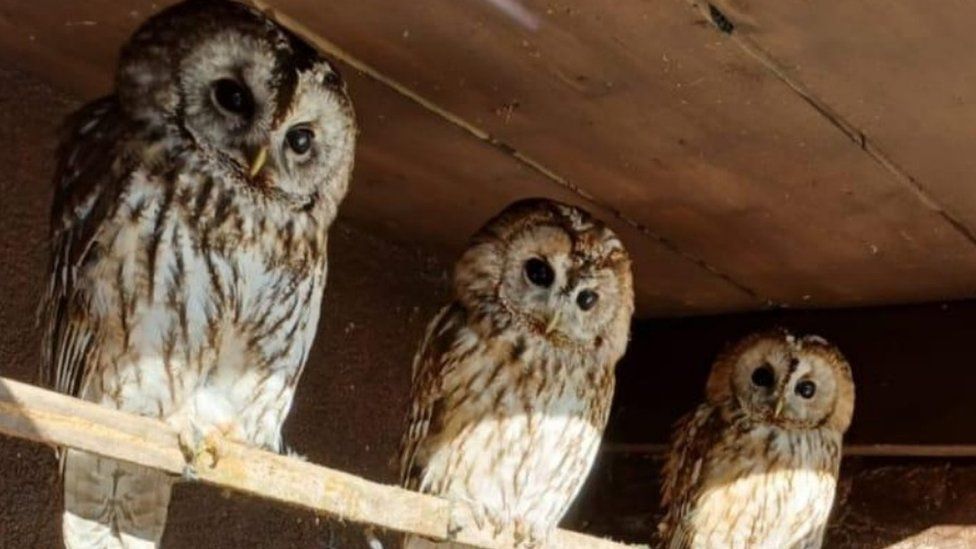
[Photo from Durham Constabulary]

The multi-agency operation was carried out with the help and support of Natural England, the Royal Society for the Protection of Birds (RSPB) and the National Wildlife Crime Unit.

It also formed part of Operation Owl, which is a national initiative to increase awareness of bird of prey persecution and to seek support in tackling it head on. 

Raptor persecution is one of the UK Wildlife Crime Priorities, which includes poisoning, shooting, trapping, and habitat and nest destruction. 

PC David Williamson, Durham Constabulary’s Wildlife Crime Officer, said: “In the UK, birds of prey are a protected species and any criminal offences committed against these beautiful creatures are completely unacceptable. 

We have acted on intelligence from the local community to carry out this operation and try and disrupt those involved in these activities

We’d encourage anyone with an information on potential criminal activity in their area to call us on 101 or report it via Crimestoppers anonymously on 0800 555 111.”

ENDS

Well done Durham Constabulary, Northumbria Police, Natural England, RSPB and the National Wildlife Crime Unit.

These latest multi-agency raids are the latest in a surge of similar investigations in response to raptor persecution crimes over the last 18 months, including a raid in Suffolk on 18th January 2021 (here), a raid in January 2021 in Nottinghamshire (here), on 15th March 2021 a raid in Lincolnshire (see here), on 18th March 2021 a raid in Dorset (here), on 26th March 2021 a raid in Devon (see here), on 21st April 2021 a raid in Teesdale (here), on 2nd August 2021 a raid in Shropshire (here), on 12th August 2021 a raid in Herefordshire (here), on 14th September 2021 a raid in Norfolk (here), a raid in Wales in October 2021 (here) a raid in Humberside on 10th December 2021 (here), a raid in North Wales on 8th February 2022 (here) and another raid in Suffolk on 22nd April 2022 (here).

So far, only two of these investigations have concluded. These are the Nottinghamshire case (from January 2021), where gamekeeper John Orrey was sentenced in January 2022 for battering to death two buzzards he’d caught inside a trap (here), and the Suffolk case (also from January 2021) where gamekeeper Shane Leech was convicted of firearms and pesticides offences in November 2021 after the discovery of a poisoned buzzard found close to pheasant-rearing pens in Lakenheath (here).

The conviction yesterday of gamekeeper Archie Watson in Wiltshire (here) was the result of another multi-agency raid undertaken in 2020 (here).

I was at a wildlife crime meeting recently when it was announced that at least 12 raptor persecution cases are pending court hearings, some of them also dating back to 2019. That’s indicative of the hard work of these investigators and they deserve full credit for their efforts. It’s been a long, long time since that number of raptor persecution cases have got anywhere near a court room. Well done all.

Gamekeeper Archie Watson convicted of raptor persecution & firearms offences on Wiltshire pheasant shoot

On 1 June 2022 at Swindon Magistrates Court gamekeeper Archie Watson (21) of Dragon Lane, Manningford Bruce, Pewsey received a 12-month community order to carry out 180 hours unpaid work and was ordered to pay £393 costs and £95 surcharge for pleading guilty to raptor persecution offences relating to the discovery in 2020 of at least 11 buzzards, four red kites and one gull species that had been dumped down a well on Galteemore Farm, a pheasant-shooting venue in Wiltshire.

[Gamekeeper Watson caught on camera dumping a buzzard in the well. Photo by Guy Shorrock/RSPB]

Watson was caught on camera 13 times after the RSPB installed a covert video recorder following a tip off by a member of the public. He denied killing the birds but pleaded guilty to possession of dead birds – three red kites, five buzzards and a herring or black-backed gull – contrary to the Wildlife and Countryside Act 1981. He claimed in court that he had ‘found’ the dead birds on the estate.

He also pleaded guilty to firearms offences after a loaded shotgun was discovered on the seat of his unlocked vehicle. Following a search at Watson’s home, several firearms were discovered that had been left unlocked and next to unsecured ammunition.

There has been significant media coverage of this latest conviction and I’d encourage you to read the following articles and watch the Channel 4 video, which reveals the extent of the multi-agency investigation that brought Watson to court:

RSPB Investigations blog here

Wiltshire Police statement here

Crown Prosecution Service statement here

Channel 4 News video here

ITV News coverage here

One of this blog’s readers attended court yesterday and has provided this excellent commentary on what went on:

[Court documents showing the charges faced by gamekeeper Archie Watson]

Charges 1 to 3 were dropped by the CPS as they couldn’t present sufficient evidence that Watson was the person who actually did the killing. It appears that he did not admit to killing them under questioning prior to the case and continued to maintain that in court that he had merely ‘found’ the carcasses as part of his duties out and about on the estate. He then disposed of them in a well estimated to be 8m deep with no water apparent and covered by a manhole cover. 

Having been alerted to the suspected disappearance of raptors (I couldn’t hear who by) the RSPB and possibly others (Wildlife Crime Unit?) set up camera surveillance at the site of the well. After an initial inspection of the contents of the well (by lowering a GoPro camera into it) it was found to contain remains of various birds including Common Buzzards, Red Kites and a Herring or Lesser Black Backed Gull). Following this the number of surveillance cameras was increased.

Watson was identified in the recordings on more than one occasion depositing bird carcasses into the well and on one occasion was recorded on audio in conversation with another person (not named) indicating that he knew ‘gulls were protected’. The evidence was passed to the police (Wiltshire Constabulary) who obtained warrants to search two addresses linked to Watson who was then arrested while staying at the address of a relative in Beckhampton (Nr Avebury, Wiltshire).

Searches of Watson’s home address in Dragons Lane, Manningford Bruce Nr Pewsey, Wilts turned up no evidence relating to raptor persecution however a glass jar containing white powder (later identified as Bendiocarb) was found in his vehicle. Watson claimed this was used as an insecticide against wasps and ants while the prosecution stated that it was also known to have been used in other recorded raptor poisoning incidents.

However at this site there was found evidence of multiple firearms offences concerning the safe storage of weapons and ammunition. In particular a Benelli M2 automatic (pump action) shotgun was found to be left unattended and unsecured in his Toyota pickup vehicle, still loaded with 11 shotgun cartridges. Watson was also found to be in possession of two BTO leg rings [from a buzzard and a red kite] which were attached to a keyring. Prosecution stated that to remove these rings from any bird it would have been necessary to break its legs. Watson claimed he had found these rings whilst metal detecting at his Uncle’s farm near Pewsey.

A search of Galteemore Farm in Beckhampton where the well was located found no further evidence of raptor persecution other than the contents of the well. A detailed inspection of the well was conducted under the supervision of the Fire Brigade and in conjunction with the Hampshire Confined Spaces team. It was found to contain the remains of a sheep, 9 bird skulls, multiple bird carcasses and an unidentified mammal skull’. 

[Examination of the carcasses as they were exhumed from the well. Photo by Guy Shorrock/RSPB]

Watson maintained at interview that he had not killed the birds but had simply used the well to dispose of carcasses he had ‘found’ whilst conducting his duties as gamekeeper. One of those function was to “keep the site clear” of such remains. He claimed to have found one of the buzzards on the A4 main road but had for some unspecified reason seen fit to dispose of it in the well. 

The prosecution provided witness testimony from a local wildlife expert that suggested it was highly unlikely to find such a high number of dead raptors over a relatively small area of open farmland where the birds had died of natural causes. Starvation was cited as one reason such birds may die and possibly only two such cases could be expected per annum. An impact statement was read out from a Mr Shorrock from the RSPB who said that there had been a serious problem with raptor persecution in the area. Forensic analysis of several of the bird carcasses found evidence of metal fragments.

As the charges for killing the birds had already been dropped due to lack of direct evidence Watson was the person responsible, it was also agreed that there was no case to answer on animal cruelty by Watson, which could have incurred an 18 week custodial sentence.

The defence argued for leniency on the grounds of it being Watson’s first (indicted) offence, previous ‘good character’ and that the length of time between the offences (2 years) had given him time to reflect on his actions and that he had “learnt his lesson”. It was stated that Watson had left school at 16 and been apprenticed as a gamekeeper sometime thereafter. He was 19 at the time of the offences and accepts that he had become ‘complacent’ around the proper use and care of the firearms. His firearms certificates had been revoked and whilst the court could apply for the destruction of the weapons it had not done so.

It was stated that clearly others had been using the well to dispose of carcasses and had been caught on video but were not identified in this case. The defence suggested that the custodial threshold had not been met because of these factors. The defence suggested that the risk of reoffending was “low” and that there was no evidence of further offending.

The Magistrates asked for clarifications on whether there was public access to the farmland? Watson suggested it was accessible only by a private driveway and was fenced but it was clear he was referring only to the immediate environs of the farm buildings and later stated that the entire holding was c.1000 acres. On a further supplementary question from the magistrates it was revealed that there is public access to the land and that it is adjacent to the historic monument of Avebury which attracts up to a quarter of a million visitors a year. These questions related specifically to the issue of firearms safety.

It was also asked why Watson had not reported finding the BTO leg rings to the appropriate authorities or even the BTO themselves to which the defence only replied that there was “no statutory obligation to report” this. It was also made clear that the number of birds Watson was being charged with being in possession of was reduced to 5 buzzards, 3 Red Kites and the Gull. No explanation was given for this.

At sentencing the Magistrates gave Watson credit for pleading guilty at the earliest opportunity and had therefore spared the public the time and cost of a trial. They regarded the firearms offences as being particularly serious and a combined sentence for all the offences combined was given as 180 hour unpaid community service plus costs of £393 plus a £95 surcharge for the forensic analysis of the bird carcasses. Watson was then referred to the Probation officer within the court before being allowed to leave the premises’.

ENDS

There’s so much to say about this case. First of all, full credit is due to the multi-agency investigation team who had to go to extraordinary lengths to retrieve the evidence. Their level of commitment was exemplary.

Second, this case illustrates in grim detail the lengths that those who kill birds of prey will go to hide the evidence of their crimes. Had it not been for a tip off by a member of the public, raptor-killing on this pheasant shoot would no doubt still be continuing, at huge cost to local raptor populations.

The defendant’s explanation for what was uncovered was so implausible that it’s laughable, but it’s no laughing matter and again, goes to highlight how difficult it is to secure a conviction, even with the level of evidence amassed in this case.

Watson’s sentence was derisory. It’s what we’ve come to expect, even though the number of corpses involved in this case make it the biggest raptor persecution investigation in England to date.

It’s not known whether Archie Watson was a member of the National Gamekeepers Organisation or BASC, as other recently-convicted gamekeepers have been, but to date neither organisation has bothered to issue a statement to condemn Watson’s crimes. How telling.

The blog reader who attended court also said this:

Also, I think he pleaded guilty on advice because they knew he’d have to answer difficult questions under oath on the stand that may have led to identifying who else was involved. And who was paying for his defence costs and the fine?

I asked him some of these questions outside the court with my GoPro on but the b@stard SD card wasn’t in properly and no recordings came through. He didn’t answer anyway but he was smirking and laughing with his mates as they went to their pickup’.

Some of the forensics work in this case, undertaken by the Natural History Museum at Tring, was funded by Wild Justice’s Raptor Forensics Fund, established in 2020 to help support police investigations into alleged raptor persecution crime. Thank you to all those who have contributed to this fund. The court ordered Watson to pay back the costs (£288).

Dorset Police’s generic FoI response on poisoned eagle investigation is inaccurate and unsatisfactory

Earlier this morning I mentioned (here) that yesterday, Dorset Police had finally got around to responding to some Freedom of Information requests made to them by members of the public about the premature closing of the investigation into the poisoned white-tailed eagle found on a shooting estate in January 2022.

I said that the responses that I’d seen (the ones that had been forwarded to me by blog readers – thank you) seemed to be a cut and paste job, just repeating the rhetoric that the investigation was ‘full and proportionate’ (no, it was neither of these things) and that the post mortem results were ‘inconclusive’ (no, the pm report revealed the eagle’s liver contained 7 x the lethal dose of the rodenticide Brodifacoum, which can only be a result of (a) mis-use of the rodenticide or (b) deliberate abuse of the rodenticide. Either way, these are both offences).

I thought it’d be useful to publish the generic response so you can see how Dorset Police is dodging specific questions and at one point, denying that political interference was even a prospect (er, even though we all read MP Chris Loder’s tweets, suggesting the police shouldn’t be investigating this crime!). This is highlighted in red below:

I’m looking forward to receiving Dorset Police’s response to my request for a review of their decision to refuse my FoI original request made on 4th March 2022 (that response is now two weeks overdue), and also a response to my most recent FoI request to Dorset Police, which was due yesterday:

Premature closure of poisoned eagle investigation was ‘proportionate’ claims Dorset Chief Constable

Yesterday evening Dorset Police held an hour-long live web chat on Facebook offering the public an opportunity to put questions to Chief Constable Scott Chilton and the Dorset Police & Crime Commissioner (PCC) David Sidwick.

Many thanks to all those who posed questions about Dorset Police’s unfathomable decision to prematurely close the investigation into the death of the white-tailed eagle found poisoned on an unnamed shooting estate in January this year.

To their credit, the Chief Constable and the PCC took two questions on this subject but I’m afraid their answers were unconvincing and simply a repeat of the damage limitation exercise they undertook last month (here).

The Chief Constable maintained that the decision to close the investigation without first conducting a search of the estate to look for evidence of potential criminality was ‘proportionate’. He also said that following complaints, he’d asked a senior detective to review the case and he, too, had determined that there was ‘insufficient evidence’ and ‘no outstanding lines of enquiry’ to progress the case. Well of course, if you fail to conduct a search you’re not going to find any evidence, are you? It’s simply bonkers.

Both the Chief Constable and the PCC were adamant that undue political interference did not take place. “Absolutely not true“, said Chief Constable Chilton, and “No credibility to that whatsoever“, said PCC David Sidwick.

You can watch a recording of the chat here. The two questions about wildlife crime and the poisoned eagle are at 28.35 and 33.17 mins.

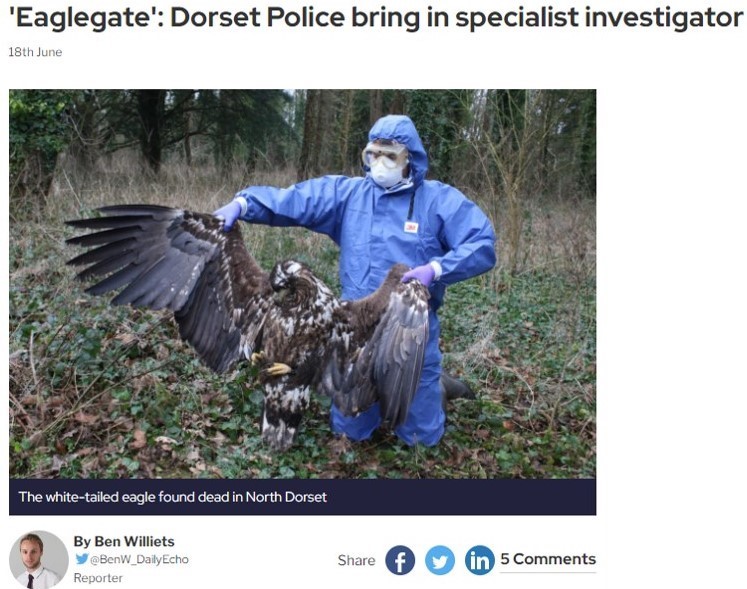
[The poisoned white-tailed eagle found dead on an unnamed shooting estate in Dorset in January 2022. Photo by Dorset Police]

Yesterday also saw the release of a number of FoI responses from Dorset Police (although not mine – that’s still way overdue) and the ones that some blog readers have shared with me seem to be a cut and paste job, just repeating this line:

As a result of the sea eagle being found dead on land in the North Dorset area, our team has carried out a full and proportionate investigation under Section 1 of the Wildlife Countryside Act 1981 in conjunction with Natural England, National Wildlife Crime Unit, the RSPB and the Roy Dennis Wildlife Foundation to identify any offences and perpetrators who may be responsible‘.

But that’s just not true. The RSPB has questioned the decision to close the investigation without undertaking the pre-planned investigation, and called the decision ‘completely baffling’ (here).

There’s still much, much more to come out about this case. For reasons that will become clear, I need to wait until the end of the week to publish some of it.

For a full list of previous blogs on this case please see here and scroll to the bottom.

Your opportunity to question Dorset Police Chief Constable on poisoned eagle case & breaches of FoI law

Here’s your opportunity to ask questions of Dorset Police Chief Constable Scott Chilton and the Dorset Police & Crime Commissioner David Sidwick about the Force’s failure to fully investigate the circumstances of a poisoned white-tailed eagle found dead on an unnamed shooting estate in January this year (see here).

The police investigation was closed prematurely, without even a search of the estate. This coincided with the Force’s award-winning wildlife crime officer going on long-term sick leave and, reportedly, being told that if/when she returned she’d no longer be leading the wildlife crime team (now rebranded as the Rural Team).

Both Dorset Police and the Dorset Police & Crime Commissioner are also in breach of the Freedom of Information Act by failing to respond to requests for information about their communication with local Conservative MP Chris ‘eagles aren’t welcome in Dorset’ Loder, who published a series of tweets berating Dorset Police for investigating the poisoning of the eagle.

Many thanks to Miles King (@MilesKing10) for sharing the details of a Facebook Live event, taking place this evening at 6.30pm, where the public is invited to put policing questions to Chief Constable Chilton and Commissioner Sidwick:

Unfortunately I can’t make this evening’s event but here are some questions you might like to ask:

Who took the decision to close the investigation into the poisoned eagle without conducting a search of the estate?

On what basis was that decision made?

Was the decision unduly influenced by political interference?

Why isn’t Dorset Police searching for evidence of poisoned baits?

Why isn’t Dorset Police searching for evidence of unlawful poison storage?

Was this decision unduly influenced by political interference?

How does Dorset Police justify the potential risk to other white-tailed eagles in the area?

Why has the word ‘wildlife’ been removed from Dorset Police’s Rural Wildlife crime team?

Who took the decision to remove it?

On what basis was that decision made?

Was the decision unduly influenced by political interference?

Why has Dorset Police’s award-winning wildlife crime officer, Claire Dinsdale, been told she will no longer lead on wildlife crime when/if she returns from long-term sick leave?

Where are the toxicology results of all the other dead raptors found on estates in north Dorset in recent months, suspected of being poisoned?

Why is Dorset Police refusing to respond to FoI requests, in breach of legislation?

Why is the Dorset Police & Crime Commissioner refusing to respond to FoI requests, in breach of legislation?

Photos released of shot sparrowhawk found glued to a stick & dumped in a ditch in Doncaster

Three days ago, South Yorkshire Police appealed for information after a sparrowhawk was shot dead, glued to a stick, wrapped inside a plastic bag and dumped in a drainage ditch (here).

The grisly discovery was made by a member of the public in the Thorne area of Doncaster, close to the canal, on Sunday 10th April.

Photos have now been released, including an x-ray showing the pellet embedded in the bird’s body:

Investigating officer PC Sarah Barrowcliffe of South Yorkshire Police said:

Sparrowhawks are a protected species and it is an offence to harm themThis was a shocking act of violence against a beautiful and defenceless bird, and officers are working hard to identify those responsible.

South Yorkshire Police is committed to the investigation of serious wildlife offences, including the killing of birds of prey.

Anyone with information please call South Yorkshire Police on Tel 101, quoting incident number #918 of April 11th 2022.

Big decisions for National Trust’s policy on grouse moors in Peak District National Park after latest loss of hen harriers

Earlier this month the Peak District Raptor Monitoring Group (PDMG) announced the suspicious disappearance of two male hen harriers, and the subsequent failure of two hen harrier nests each containing five eggs (see here).

[One of the abandoned hen harrier nests. Photo by PDRMG]

Both nests were situated on a grouse moor owned by the National Trust and leased to a tenant. The grouse moor isn’t currently being used for driven grouse shooting (the tenant is believed to be focusing his energy on another moor that he owns) but the nests were close to the National Trust’s boundary and the moor is adjacent to other, privately-owned and intensively managed driven grouse moors, many that have been at the centre of other raptor persecution investigations for a number of years in what is a well-known raptor persecution hotspot (e.g. see here).

The Peak District National Park Authority has issued a statement in response to this latest incident:

Responding to reports of the failure of two hen harrier nests following the disappearance of male hen harriers thought to be supporting the nests in the area, the Peak District National Park Authority said:

“We share the immense frustration and disappointment of the National Trust and all those involved in monitoring our birds of prey, that the opportunity for not one, but two potentially viable nests for the iconic hen harrier has been lost again in the Peak District this year. This is a species which is emblematic of our uplands and where their haunting and often enigmatic presence should be welcomed.

“The fact that successful nesting attempts for the hen harrier in the Peak District remains firmly in single figures across almost two decades, demonstrates the significant challenge that remains for all those working to see their return in a long-term and sustainable way – addressing both conservation needs and the potential impact of wildlife crime.

“We understand a police investigation is ongoing into the matter and stand ready to provide any support to this”‘.

The National Trust has a new General Manager in the Peak District, Craig Best, and his reaction to the suspicious disappearances of the two harriers was as follows:

It’s deeply concerning to learn of the disappearance of two male hen harriers from the High Peak and subsequent abandoning of nests by the females. While the circumstances around this incident are not yet clear, it is indefensible that these beautiful birds still face persecution. The incident has been reported to the police and we’re working closely with statutory agencies and the RSPB to find out what happened.

We want to see a landscape that is full of wildlife, including birds of prey, and we work hard with a range of expert partners to create the right conditions for these species to thrive. Over the past few years we have seen several instances of successful hen harrier breeding in the Peak District“.

The disappearances attracted a lot of media attention, some of it accurate, some of it not so much, but it made local and national news and I was pleased to see that a couple of them had picked up on the fact that now 70 hen harriers are confirmed missing or illegally killed in the UK since 2018. Here’s some of the coverage in Sheffield Star, BBC News, and The Times, reproduced below:

There was also a feature on the BBC’s East Midlands Regional News, where BBC journalist Simon Hare interviewed Mike Price from the PDRMG – you can watch the video here:

The loss of two more hen harriers and their nests sparked a number of calls for the National Trust to ban driven grouse shooting on its land. I think that’s because many people assumed the harriers had been killed on the grouse moor where they were attempting to breed. The NT faced similar calls for a ban in 2016 when I posted footage of an armed gamekeeper who had been filmed crouching in the heather next to a decoy hen harrier on another NT-owned grouse moor in the Peak District National Park, presumably trying to entice a harrier to come in close so he could shoot it (see here).

That footage was so disturbing and the public reaction to it so strong, it prompted the National Trust to pull the shooting lease early and replace the shooting tenant with someone more conservation-focused, in what was a significant response at that time although some campaigners saw it as a lost opportunity to remove driven grouse shooting altogether (see here).

Since then, the NT has modified its tenancy agreements (e.g. see here), at least one new tenant has been and gone, and at least one current tenant is hosting a number of successfully breeding raptor species whilst moderately managing a driven grouse shoot (far less grouse shot last year compared to the thousands shot on some of the more intensively-managed moors). It has been reported recently that the NT has agreed to introduce even more modifications on its moors such as the removal of medicated grit, burning restrictions and the removal of traps and snares, although I haven’t yet seen a formal statement on this from the National Trust.

Some may argue that banning driven grouse shooting entirely from National Trust land is the only way forward, but some local raptor workers suggest the situation is a bit more nuanced than that and that just banning it on NT moors could actually lead to an increase in raptor persecution. They argue that as long as the NT has raptor-friendly shooting tenants, those tenants’ gamekeepers are acting as a sort of shield against gamekeepers from neighbouring, privately-owned estates from entering NT land and killing whatever they want. Of course, that doesn’t stop the raptors being killed if they fly from NT land on to neighbouring private estates to hunt, which is what many suspect has happened with these latest two ‘disappearances’.

It seems to me that the Peak District National Park Authority should be the organisation banning driven grouse shooting across the entire National Park. That would seem to be a far more effective prospect than a piecemeal approach by the National Trust, at least in terms of tackling the rampant raptor persecution taking place inside this National Park.

That’s not to say that the National Trust shouldn’t be banning driven grouse shooting, though. As we know, raptor persecution is only one of many environmentally-damaging issues associated with driven grouse shooting – burning, widespread and unregulated use of an environmentally toxic veterinary drug (medicated grit), and the lawful killing of thousands of native animals (e.g. foxes, stoats, weasels, corvids etc) to name just a few, all to create an artificial environment to maximise the production of red grouse for paying guests to shoot in the face for a bit of a laugh. That the NT still supports this management in what are supposed to be enlightened times, is quite remarkable.

However, if the National Trust has recently changed its policy, as has been reported, this could effectively lead to an end of driven grouse shooting on NT land without a formal ‘ban’ having to be introduced. But where will that leave the raptors trying to nest on NT land, still surrounded by privately-owned intensively-managed driven grouse moors?

Interesting times ahead in the Peak District National Park.

Sparrowhawk shot, glued to a stick & dumped inside plastic bag in Doncaster

South Yorkshire Police is appealing for information after a sparrowhawk was shot dead, glued to a stick, wrapped inside a plastic bag and dumped in a drainage ditch.

The grisly discovery was made by a member of the public in the Thorne area of Doncaster, close to the canal, on Sunday 10th April. The bird is believed to have been shot with a pellet gun.

Investigating officer PC Sarah Barrowcliffe of South Yorkshire Police said:

Sparrowhawks are a protected species and it is an offence to harm them. This was a shocking act of violence against a beautiful and defenceless bird, and officers are working hard to identify those responsible.

South Yorkshire Police is committed to the investigation of serious wildlife offences, including the killing of birds of prey.

Anyone with information please call South Yorkshire Police on Tel 101, quoting incident number #918 of April 11th 2022.

UPDATE 30th May 2022: Photos released of shot sparrowhawk found glued to a stick and dumped in a ditch in Doncaster (here)

Derbyshire Police criticised as prosecution collapses against alleged peregrine egg thief in Peak District

The trial of a man accused of stealing peregrine eggs from a nest site in the Peak District National Park in Derbyshire has collapsed after elements of the police investigation were ruled unlawful.

This case relates to the alleged theft of peregrine eggs in 2020, where video footage filmed by the RSPB showed an individual climbing to a peregrine nest and removing the eggs (see here, here, here and here for previous blogs).

The trial began at Chesterfield Magistrates this week but collapsed yesterday as the defence lawyer challenged certain procedural aspects of the police’s investigation, namely the arrest and the subsequent search of the man’s property.

The judge considered the evidence and ruled in the defendant’s favour, i.e. that certain aspects of the police investigation were indeed unlawful. The defendant left court with a not guilty verdict.

I am awaiting the full details of this judgement before commenting on Derbyshire Police’s failure to follow police procedural rules but this does seem pretty basic stuff. And surely the lawyers from the Crown Prosecution Service should have picked up these errors before the case even reached court? Hopefully the court will publish the judgement so we can see the extent of the police’s apparent ineptitude in this case.

A BBC reporter, Simon Hare, tweeted this yesterday from the court:

This evening, the RSPB has published its video footage of a man stealing the eggs from the peregrine’s nest site.

It’s such a disappointing result. With excellent footage from the RSPB that will have taken a great deal of time and skill to procure, this is a case that should have been straightforward. It’s doubly frustrating because as you’ll all know, it’s so rare that good quality evidence is available in so many raptor persecution cases, so when it is available we all hope it will lead to justice being served.

Understanding what went wrong in this case will be important and lessons need to be learned, not least by Derbyshire Police’s Rural Crime Team.

Further breach of Freedom of Information Act by Dorset Police re: poisoned eagle

Yesterday I blogged about how Dorset Police and the Dorset Police & Crime Commissioner, David Sidwick, were both in breach of the Freedom of Information Act by failing to respond to Chris Packham’s FoI requests about the poisoned eagle incident within the statutory period of 20 working days (see here).

Today I can report a further breach of the Freedom of Information Act by Dorset Police in relation to my FoI requests, also relating to the poisoned eagle incident.

[The poisoned white-tailed eagle found dead on an unnamed shooting estate in North Dorset in January 2022. Photo by Dorset Police]

Regular blog readers may recall I submitted an FoI request to Dorset Police on 4th March 2022, asking for copies of all correspondence between Dorset Police and local Conservative MP Chris ‘eagles aren’t welcome in Dorset‘ Loder on the subjects of wildlife crime, police wildlife crime officers, and eagle reintroductions, from 1 January 2022 to date.

On 17th March 2022 Dorset Police tried to fob me off with a refusal notice with what is perhaps the most ludicrous excuse I’ve ever seen (see here to read it in full).

I appealed that decision and requested a review of it on 14th April 2022. According to the FoI Act, the public authority has another 20 working days in which to respond to that review request. Taking into account all the public bank holidays in April and May, Dorset Police should have responded no later than 17th May 2022.

It’s now 26th May 2022 and Dorset Police hasn’t responded. I have written to them, again, to remind them of their legal obligations. If their silence continues I will escalate my complaint.

Meanwhile, you may also recall that I’d sent a similar FoI request to the Dorset Police & Crime Commissioner (PCC) (David Sidwick) in early March. After a series of reminders to the PCC’s office (see here), I did finally get a response in late April 2022.

However, under scrutiny it became apparent that some of the correspondence I’d requested to see between Chris Loder MP and the PCC, David Sidwick, was missing from the bundle of information I received (see here).

So I wrote back to the PCC and asked them to forward ALL the correspondence, not just the bits they were happy for me to see.

That response was due back next Monday (30th May 2022) but I’m pleased to say it has arrived early and is now sitting in my inbox.

I’ve had a quick skim-read and it’s immediately obvious why ‘someone’ might not have wanted me to see it. I don’t have time to blog about that right now but will come back to it shortly…

UPDATE 16.00hrs: There’s quite a lot going on behind the scenes. For strategic reasons, I won’t be blogging further on this FoI response from the PCC until later next week. I’m sorry I can’t explain why right now but it will hopefully become apparent (and in a good way) next week. Thanks for your patience.