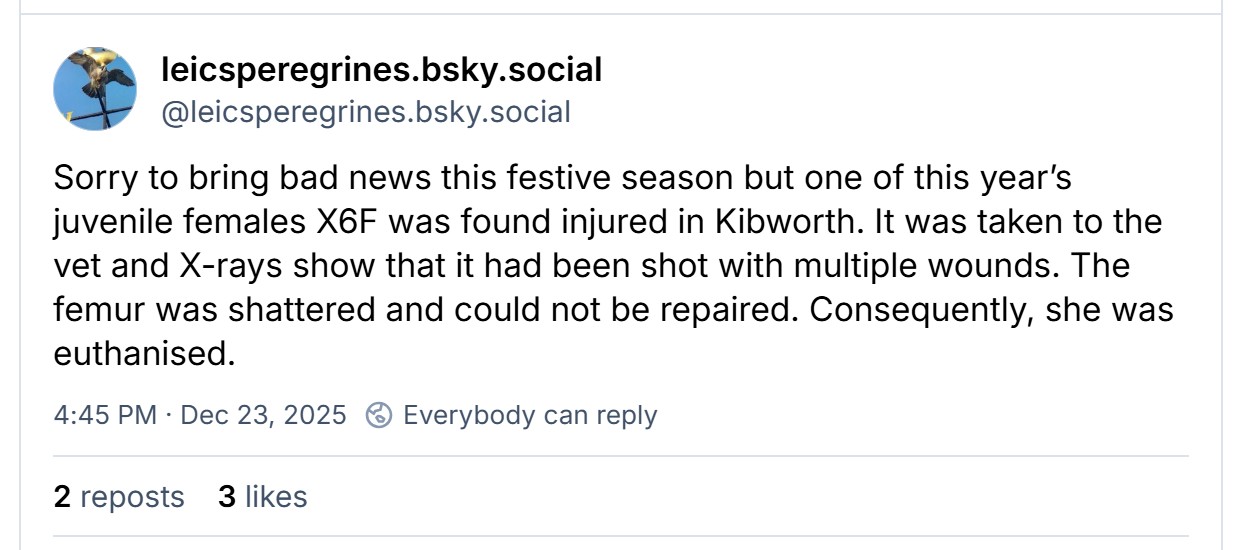
Hen Harrier ‘Susie’, whose chicks were stamped to death in 2022, has been found dead on a North Pennines grouse moor with gunshot injuries

If ever there was an example demonstrating the high level of persecution faced by Hen Harriers on UK grouse moors, the lack of consequences for the offenders, and the lack of justice for the victims, the short life of a Hen Harrier called ‘Susie’ illustrates it all.

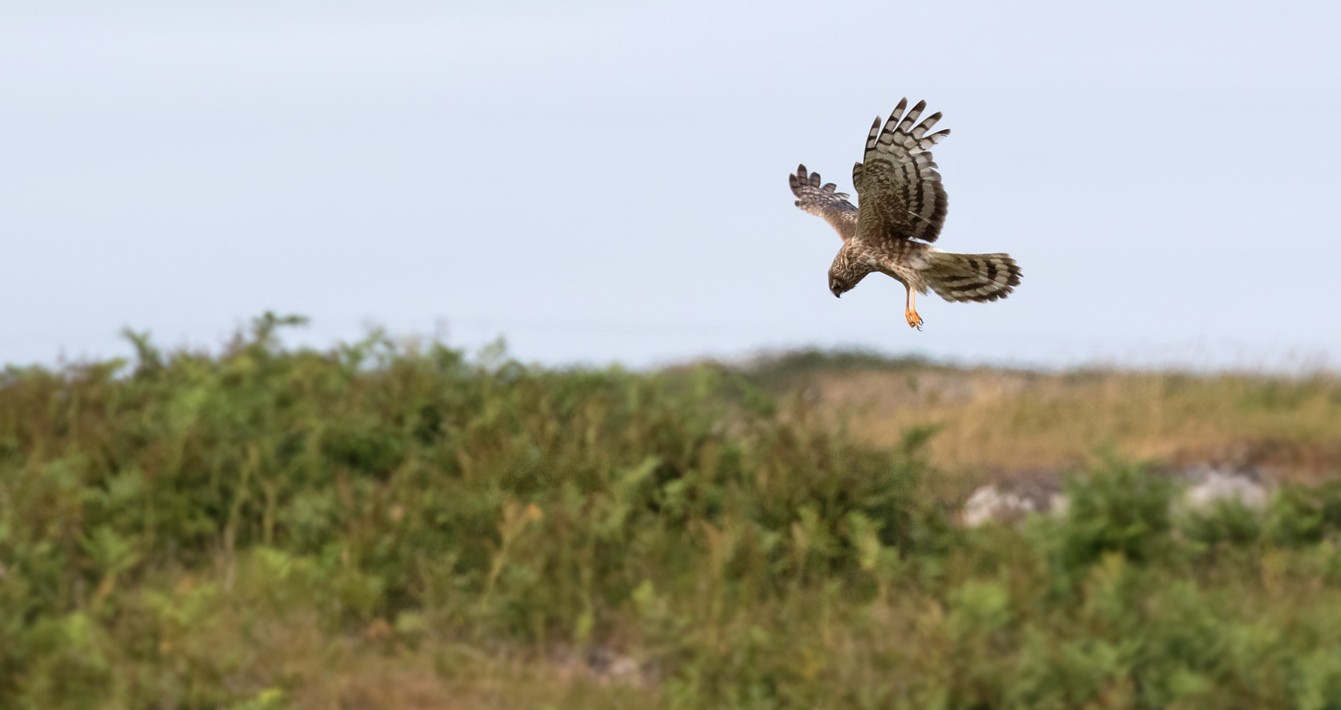
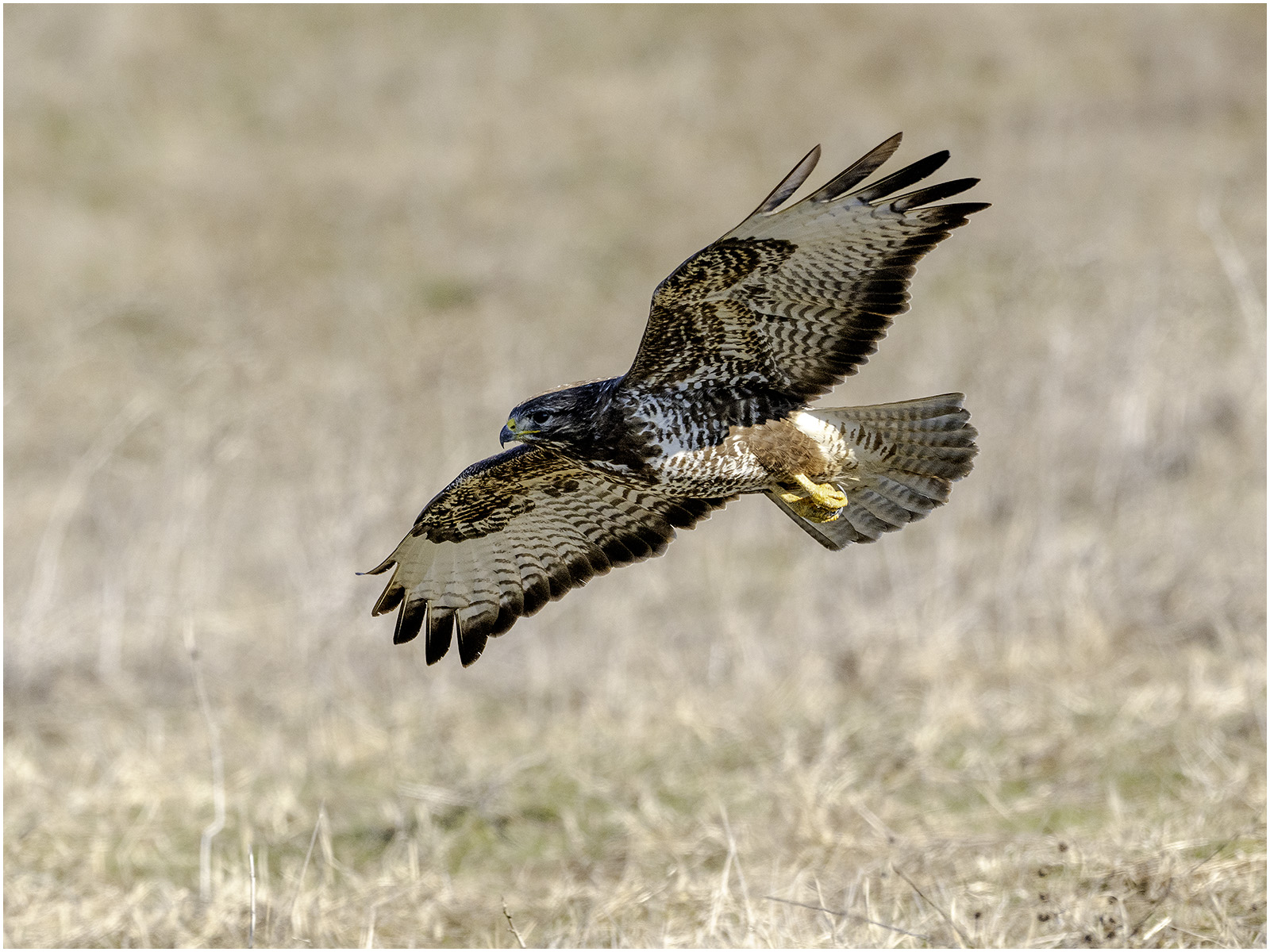
Hen Harrier (photo by Pete Walkden)

Susie hatched in Cumbria in 2020 and was satellite-tagged by Natural England on 21 July 2020. She first bred in Bowland in 2021, and the following year she moved up to a grouse moor near Whernside in the Yorkshire Dales National Park where she produced four chicks.

The Whernside nest was being monitored (nest camera) by Natural England as part of the ludicrous Hen Harrier Brood Meddling Trial. On 20 June 2022, NE researchers noticed that Susie’s satellite tag was unexpectedly and abruptly shown tracking approximately 35km away from her nest. An adult female should be attentive and close to her nest during this period. Her sudden exit from the nest area was worrying.

The following day, Natural England field staff visited the nest and made the grim discovery of three dead Hen Harrier chicks.

Reviewing the nest camera footage, they saw that after dark, at 9.54pm on 15 June 2022, the camera showed the nest site appeared normal with Susie settled in the nest with her chicks. However, at 9.59pm a sudden irregular ‘whiteout’ of the camera occurred, blinding the camera.

The camera used was movement-activated, and it was not triggered again until the following morning when footage captured apparently dead chicks in the nest and Susie attempting to feed them.

She could be seen removing her dead chicks from the nest. Three of these were found just outside the nest, and it is not known where she deposited the fourth.

Post-mortem examinations of the three chicks were subsequently conducted and showed that each suffered with multiple fractured bones including the humerus in one chick, both femurs in the second chick, and in the third chick, the humerus and a crushed skull. The fractures were complete and showed a considerable trauma had taken place for each chick.

It’s quite clear that ‘someone’ had visited the nest, disabled the camera, and stamped the chicks to death.

Six months later (!), in December 2022, North Yorkshire Police laid out the evidence and issued an appeal for information (see here).

Representatives from the grouse shooting industry responded by trying to manipulate the narrative of this brutal and sadistic crime (see here) and of course, nobody came forward with any information that could identify the person / people responsible.

The following year, in 2023, the story featured in a three-episode podcast by The Guardian, called ‘Killing the Skydancer’ (here, here and here). Meanwhile, Susie bred successfully (unknown location) and fledged five chicks. It was to be her last breeding season.

In April 2024, Natural England published its latest update on the fate of its satellite-tagged Hen Harriers. It did so quietly, without any publicity whatsoever. Susie’s entry on that spreadsheet read,

Last known transmission 12 February 2024, Northumberland. Found dead. Site confidential. Recovered, awaiting post mortem’.

Nothing more was heard about Susie’s fate until a year later, in another spreadsheet update in April 2025. Susie’s entry now read:

Ongoing police investigation, final transmission location temporarily withheld at police request‘. 

Again, there was no publicity about Susie, or about any of the other Natural England-tagged Hen Harriers that had either ‘vanished’ or had been found dead in suspicious circumstances.

Over one and a half year’s after Susie was found dead, the details have finally emerged, and once again Natural England has slipped them out quietly, without fanfare or commentary, in its October 2025 spreadsheet update. Susie’s entry now reads:

Found dead 12 February 2024, Northumberland, Grid reference NY759585. Confirmed dead, had been victim of shooting. When found dead remains would not allow determination of whether the bird died as a result of being shot. Bird died between 25 November 2023 and 12 February 2024‘.

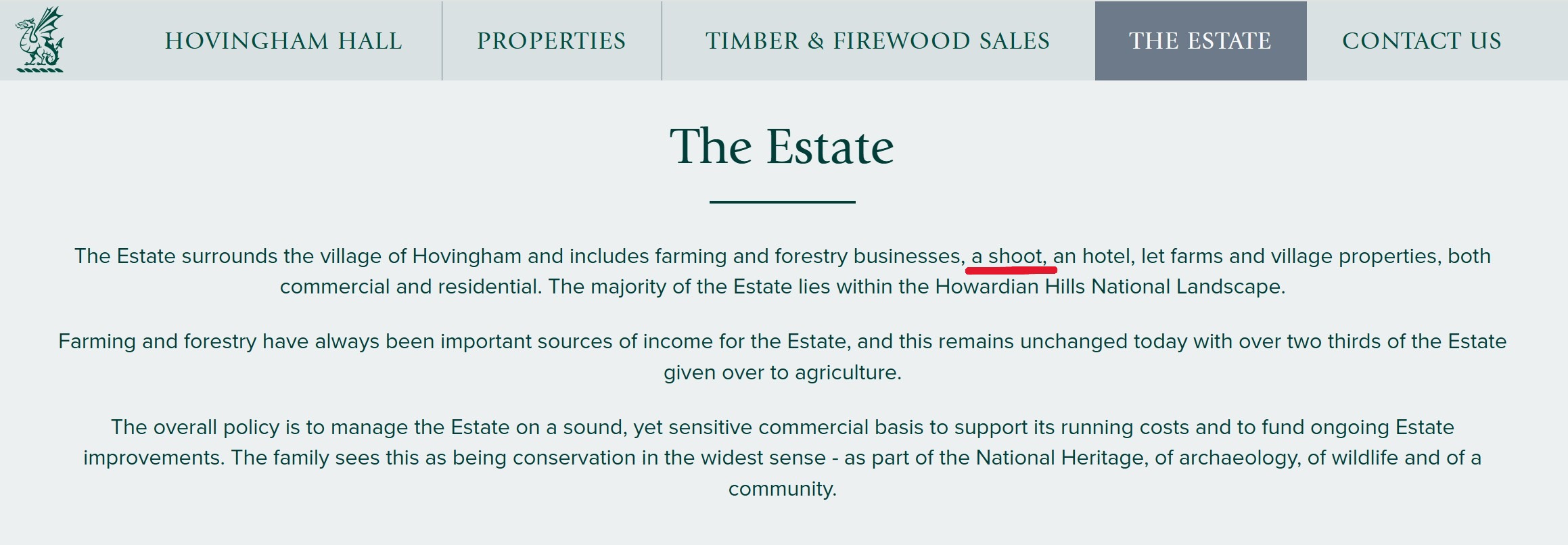
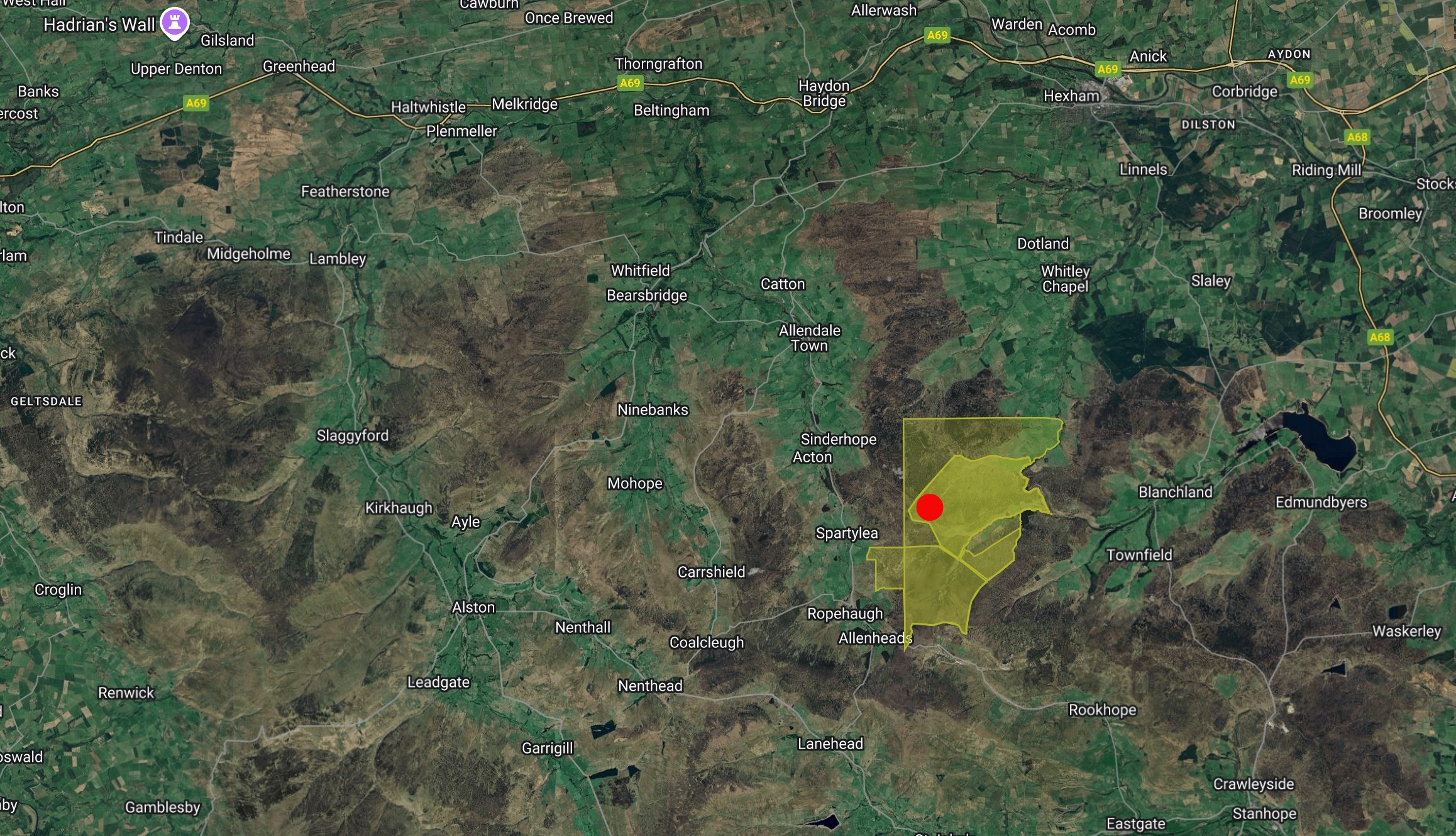
Susie’s corpse was found on a grouse moor in the North Pennines National Landscape (a so-called protected landscape, formerly known as the North Pennines Area of Outstanding Natural Beauty, AONB), and the grid reference places her on what I believe to be the Whitfield Estate:

Susie had been shot at some point, but where, and when, is not known.

There is no suggestion that she was shot and killed on the Whitfield Estate – she could have been shot many months earlier and survived for a while before succumbing to her injuries. Without seeing the post mortem and x-ray results (which have not been published), it’s impossible to know whether her gunshot injuries caused any broken bones that could have impeded her ability to fly any distance.

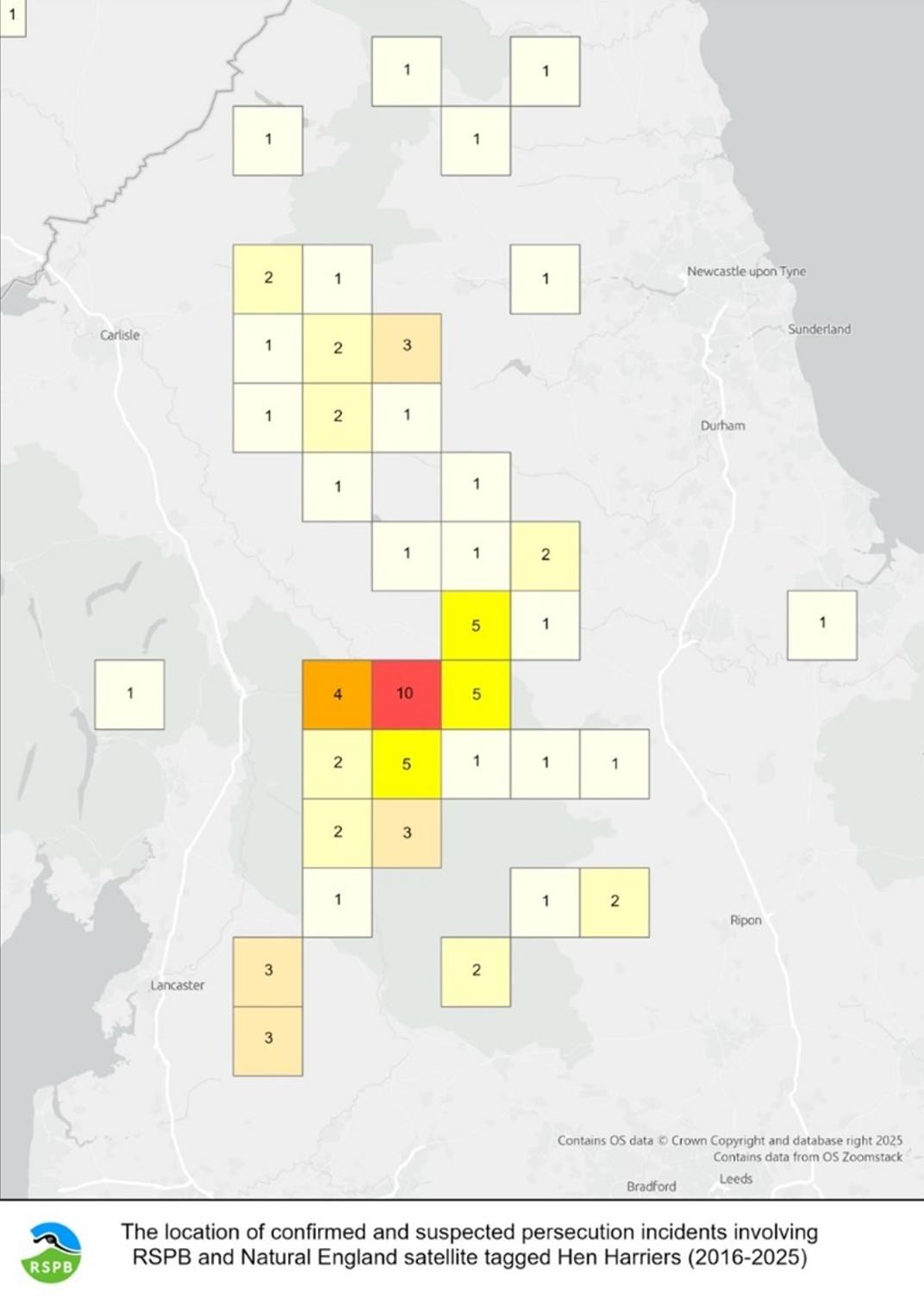
That Susie was the victim of at least two separate persecution incidents (that we know about) during her three-and-a-half-year life, illustrates the severity of threat this species still faces in the UK. This should come as no surprise to anybody who has been following this blog for any length of time, nor to those who may have read the RSPB’s damning 2025 report, Hen Harriers in the Firing Line.

These appalling crimes continue because hardly anyone is ever brought to justice. There is rarely any consequence for the offenders, which gives them the green light to carry on.

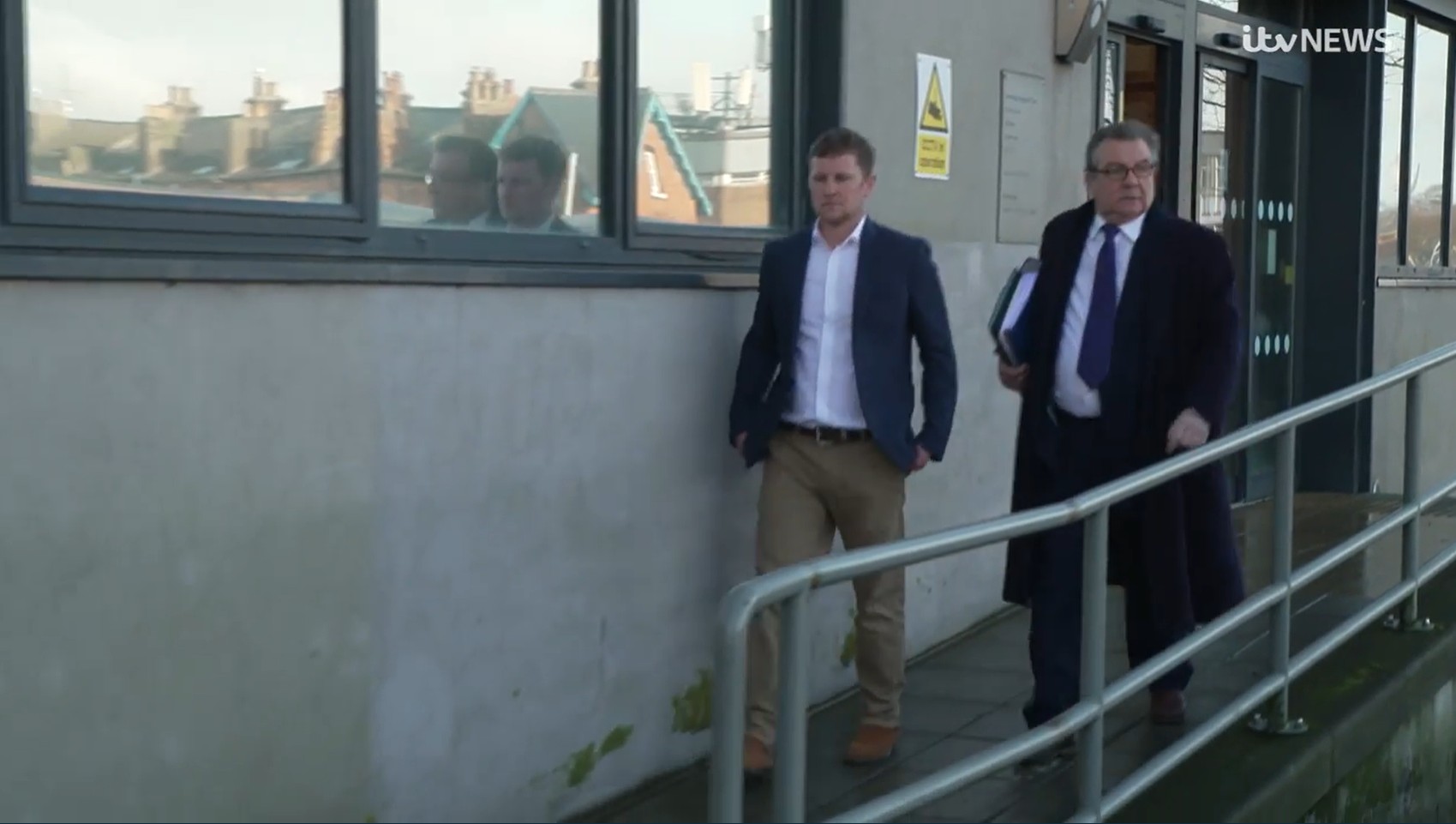
There has been a change in tactics by the raptor killers in recent years, as we saw in the RSPB’s covert footage in Oct 2024 where three individuals were caught plotting, and then apparently shooting, a Hen Harrier on a grouse moor in Grassington in the Yorkshire Dales National Park. They specifically targeted the Hen Harrier that was not carrying a ‘box’ (a satellite tag) because they thought that by doing so their crime would be undetected. A gamekeeper is standing trial in January 2026 for his alleged involvement – he denies it – it will be up to the court to decide whether he was involved or not.

That case is a very uncommon prosecution, reliant on evidence provided by the RSPB’s excellent Investigations Team.

There won’t be a prosecution for the shooting of Hen Harrier Susie because there’s no evidence (that I’m aware of) that links an identified individual to that crime. Just as there was no prosecution of the person(s) responsible for stamping her chicks to death in their nest in 2022.

We all get it – finding sufficient evidence to prosecute those responsible for committing crimes in remote landscapes is incredibly difficult, but the investigating authorities could, and should, be doing much more to publicise these offences to raise awareness and help the general public spot suspicious activity.

The police’s appeal for information about the chick-stamping crime in the Yorkshire Dales National Park came six months after the event – that’s pathetic.

I haven’t seen ANY police appeal or press release about the shooting of Susie or the discovery of her corpse in Northumberland in February 2024. Not a single word.

Where is the publicity from the National Wildlife Crime Unit-led Hen Harrier Taskforce? The specialist group set up explicitly to tackle the ongoing illegal killing of Hen Harriers. Not a single word.

Where is the publicity from the police-led Raptor Persecution Priority Delivery Group (RPPDG), one of whose functions is apparently ‘awareness raising‘ and ‘raising the profile [of illegal raptor persecution] via media exposure‘? Not a single word.

Natural England has remained tight-lipped, as it always does, claiming that it requires the go-ahead from the police to issue any media. Why? Sure, in the early stages of a police investigation keeping quiet is often necessary to avoid alerting the perpetrator who may take the opportunity to remove/hide evidence before the police turn up. But 18+ months of silence, about a crime that relates to a publicly-funded project, and then to quietly slip out the information buried deep inside a spreadsheet?

Honestly, this needn’t be so bloody difficult.

X-ray reveals shotgun pellets embedded in ‘grounded’ Buzzard, Nottinghamshire

An x-ray of a grounded Buzzard has revealed two embedded shotgun pellets and a broken tail, according to Brinsley Animal Rescue in Nottinghamshire.

A statement published by the charity yesterday reads as follows:

Last Sunday we admitted a buzzard that had been found grounded, the caller had been struggling to find a rescue who were able to help and had them for several days before we took the call, thankfully they had been feeding the buzzard and keeping them safe.

On examination it was clear there they weren’t the best of condition not least the tail position, which was to the side and the bird wasn’t able to move it. X-rays have confirmed that not only was the tail broken, but there are several shot gun pellets lodged in the bird. It is probable that they have been shot and the broken tail is a result of the bird crash landing.

We have successfully treated and released birds with broken tails, but not a bird of prey, whilst the bones will eventually fuse, its vital that they have full mobility before they can be released and only time will tell if this ends well‘.

Photo and x-rays from Brinsley Animal Rescue

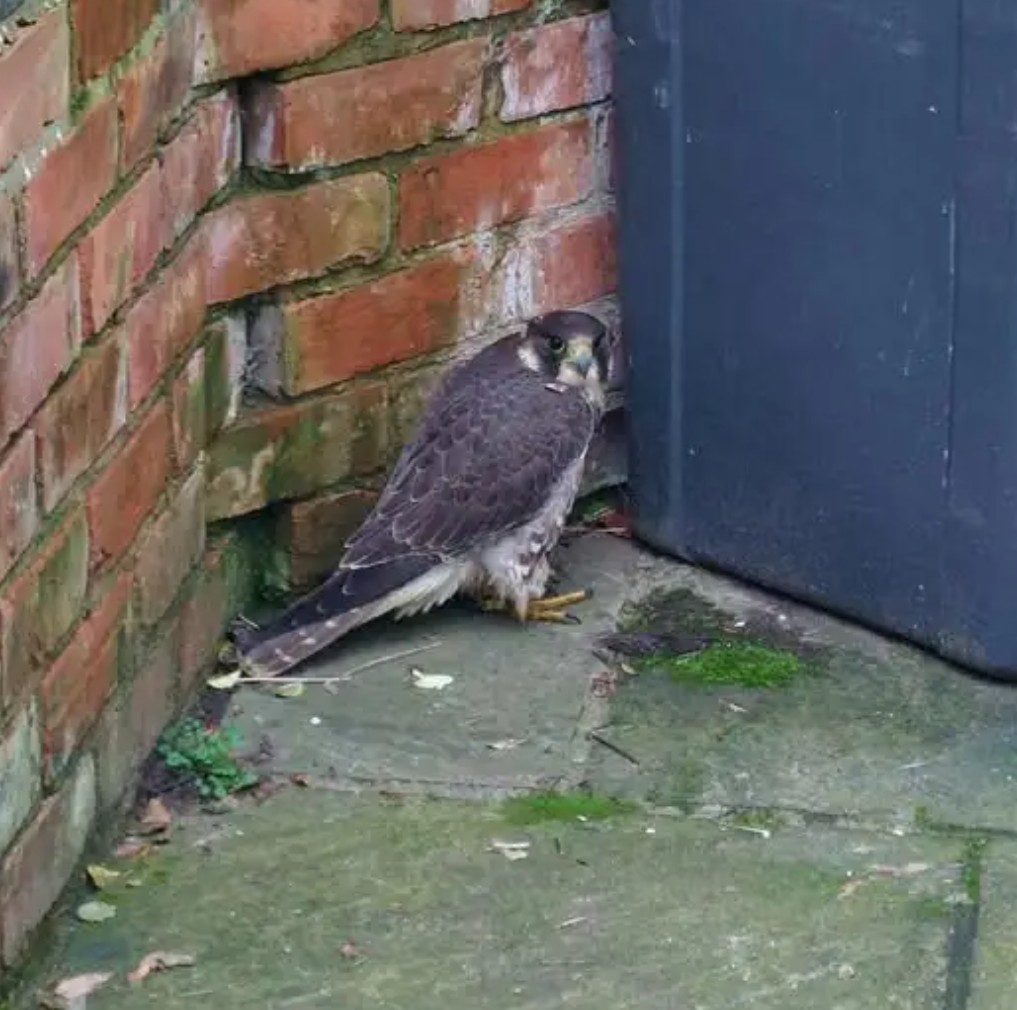
Peregrine Falcon chicks at Worcester Cathedral died from ingesting poison

Three Peregrine chicks that hatched on Worcester Cathedral all died within a few weeks, earlier this spring. Two of the dead chicks were retrieved and sent for post mortem and the results have now shown they died from ingesting poison.

The name of the poison hasn’t been published but a statement by the group who monitor the adult Peregrines at Worcester Cathedral (‘Peregrine Falcons in Worcester’) says, ‘Both birds had internal bleeding consistent with death from poison‘, which suggests the poison was probably a Second Generation Anti-coagulant Rodenticide (SGAR).

The adult breeding pair (known as ‘Peter’ and ‘Peggy’) are fine.

The BBC News website has an article on the news (here) and states that West Mercia Police had received a report but the investigation has closed due to ‘evidential difficulties’.

One of the adult Peregrines at Worcester Cathedral. (Photo from Worcester Cathedral)

A recent report written by Dr Ed Blane and published on the Wildlife Poisoning Research UK website shows that there has been a substantial increase in Peregrine exposure to SGARs, and especially to the poison Brodifacoum. The same issue is affecting Foxes and Otters.

This follows a report published last year ‘Collateral Damage‘ by Wild Justice which reported an alarming increase in SGARs exposure in Buzzards and Red Kites and was heavily critical of the Rodenticide Stewardship Scheme and how the government was ignoring the evidence.

As a result, the Health & Safety Executive, which controls the approval regime in the UK for rodenticides and decides what can and cannot be used, ran a public consultation in September 2025 to look at alternatives to SGARs.

The results of that consultation are awaited.

Shot Buzzard found in Herefordshire

A young Buzzard was found in a field in Leominster, Herefordshire last week, unable to fly.

An x-ray revealed at least two shotgun pellets lodged in its body. It’s not known when the bird was shot, or where.

Photo by Sasha Norris
Photo via Sasha Norris

The Buzzard is currently receiving expert veterinary care from Dr Sasha Norris of Hereford Wildlife Rescue with assistance from Holmer Veterinary Surgery in Hereford and Battle Flatts Veterinary Clinic in Yorkshire.

Sasha reports that the Buzzard was ‘alert, bright and eating well’ this morning.

‘Eyes on the Skies’ – new campaign to raise awareness of raptor persecution in the Yorkshire Dales National Park

Following the recent collapse of the Yorkshire Dales National Park Bird of Prey Partnership (due to its failure to tackle crimes against birds of prey), and the news that since 2015, 29 Hen Harriers have gone ‘missing’ in suspicious circumstances and almost 40 other raptors have been found poisoned, trapped or shot in the Yorkshire Dales National Park since 2015, including Peregrines, Hen Harriers, Red Kites and Buzzards, there’s some welcome news from a local community who has had enough and has decided to do something about it. Bravo!

Press release from Friends of the Dales:

SPEAKING OUT FOR BIRDS OF PREY

Friends of the Dales, the environmental campaigning charity, is launching a powerful new campaign − Eyes on the Skies − calling for an end to criminal killing of birds of prey in the Yorkshire Dales. The campaign kicks off with a high-profile live webinar on Tuesday 21 October at 5.30pm, featuring leading conservation expert Kate Jennings, UK Head of Site Conservation & Species Policy at the RSPB.

Kate will highlight the long history of bird crime in the Yorkshire Dales, drawing on evidence and case studies from the RSPB’s Investigations Team which works in support of the police and statutory agencies to bring criminals before the courts.

We are delighted that Kate is joining us at the Eyes on the Skies launch event,” said Jonathan Riley, Chair of Trustees at Friends of the Dales. “She will shine a spotlight on Bird Crime in the Yorkshire Dales and the illegal and inhumane methods criminals use to trap, shoot and poison birds of prey − crimes that persist despite more than seventy years of legal protection.”

The Yorkshire Dales remains a blackspot for raptor persecution, with species such as hen harriers, short-eared owls, and red kites especially targeted. Just last week the RSPB issued a press release about the disappearance of Sita, a one-year-old female satellite-tagged Hen Harrier. The RSPB said that Sita is the 29th hen harrier “to suspiciously disappear in the national park since 2015” and that the bird “is likely to have been shot”.

It is appalling that the hen harrier, one of the UK’s rarest birds, continues to be shot, trapped, and poisoned in our National Park, which should be a sanctuary for wildlife,” added Jonathan.

Public concern for these crimes is growing. In early 2024, more than 1,000 people responded to the first consultation on the new Management Plan for the Yorkshire Dales National Park, with ending the illegal persecution of birds of prey emerging as one of the top priorities.

David Butterworth, Chief Executive of the Authority also confirmed: “The Yorkshire Dales National Park Authority is unwavering in its commitment to raptor conservation. We will continue to collaborate with landowners, managers and organisations sharing our vision. We applaud those whose efforts have helped some species recover. But we must also confront the grim reality that criminal persecution still occurs.”

Friends of the Dales Eyes on the Skies campaign supports one of the core objectives of the new management plan for the Yorkshire Dales National Park, as well as the vital work of other organisations such as the National Wildlife Crime Unit, RSPB and Hen Harrier Action. The campaign will amplify messages around the scale and nature of these appalling crimes, educate people in how to spot and report any suspicious or illegal activity they might see and also inspire people to learn more about the birds themselves and why they are vital to a healthy, biodiverse ecosystem.

David Butterworth added: “The uplands of the Yorkshire Dales National Park should be a stronghold for a diverse range of raptor species. As apex predators, their presence signals a healthy environment. Their absence, conversely, is a warning.”

Summing up Jonathan Riley said: “Our Eyes on the Skies campaign will incorporate many more events including further webinars from insider experts, outdoor educational events and even some more creatively focussed activities. So, on behalf of the charity, I would encourage anyone who is interested in learning more to register for the free launch event on Tuesday 21 October at 5:30 pm, and sign up to our monthly email newsletter so they can be kept updated.”

Register for the Eyes on the Skies launch event and learn how to take action at: https://friendsofthedales.org.uk/events

ENDS

UPDATE 5 November 2025: Video of launch now available on Friends of the Dales YouTube channel – here.

29 ‘missing’ Hen Harriers & nearly 40 birds of prey poisoned, trapped or shot in Yorkshire Dales National Park since 2015

Media attention has been drawn to the Yorkshire Dales National Park this week, following the RSPB’s press release on the suspicious disappearance of a satellite-tagged Hen Harrier named ‘Sita’.

When it comes to the illegal killing of birds of prey, the Yorkshire Dales National Park is rarely out of the news, and that’s hardly surprising when 29 satellite-tagged Hen Harriers have gone ‘missing’ there and 39 other raptors have been found poisoned, trapped or shot there since 2015, including Peregrines, Hen Harriers, Red Kites and Buzzards.

Yorkshire Dales National Park. Photo by Ruth Tingay

Given these appalling figures, the RSPB has described the Yorkshire Dales National Park as a ‘no-fly zone for birds of prey’.

High profile cases within the National Park have included the conviction of a gamekeeper who was filmed shooting two Short-eared Owls on a grouse moor and then stamping the corpse of one of them into the peat and shoving the other one inside a drystone wall (here); a gamekeeper filmed on a grouse moor using a tethered Eagle Owl to attract Buzzards that he then shot and killed from close range (here); the stamping to death of four Hen Harrier chicks in a nest on a grouse moor (after obscuring the camera pointing at the nest, here); the grisly death of a Hen Harrier caused by his head and leg being pulled off whilst he was still alive (here); and three individuals caught on camera on a grouse moor discussing the shooting and killing of a Buzzard and a Raven before apparently shooting and killing a Hen Harrier (here) – one gamekeeper has been charged with conspiracy to kill a Hen Harrier, he has pleaded not guilty and his case will proceed to trial in January 2026 after his barrister failed in his attempt to have the case thrown out on a legal technicality.

The Yorkshire Dales National Park Authority has also long recognised the extent of this criminal activity and has responded to public concern (e.g. see here and here). Earlier this year the Park Authority terminated its five-year ‘partnership’ with the grouse shooting industry to tackle these crimes, after recognising the futility of this endeavour. Two conservation organisations (the RSPB and the Northern England Raptor Forum) had already walked away from the sham in 2023 and 2024 respectively.

In an article published a couple of days ago by the Craven Herald & Pioneer, Mark Corner, a member of the Yorkshire Dales National Park Authority is quoted saying the continued illegal killing of raptors in the Park was “a crying shame“.

He added: “As the member champion for the natural environment, I’m personally embarrassed that we are the worst spot in the country in terms of the illegal killing of birds.”

In the same article, there’s an hilarious quote from the Yorkshire Dales Moorland Group, which is one of a number of regional groups set up in 2015 to represent local grouse moor owners and their gamekeepers in an attempt to counter the bad publicity about ongoing illegal raptor persecution. I think that members of most of these regional moorland groups have been, or still are, the subject of police investigations into illegal raptor persecution.

A spokesperson for the Yorkshire Dales Moorland Group reportedly told the reporter that ‘hen harrier numbers were at a 200-year high across the uplands’.

That’s simply not true – Hen Harrier breeding attempts on grouse moors across the north of England have been in sharp decline over the last two years – the only areas where they remain stable is on land managed for conservation rather than for Red Grouse shooting.

According to its FaceBook page, the Yorkshire Dales Moorland Group claims to have “around 100,000 acres of managed uplands here in the Dales where the estates are members of this group (virtually all of the moors)“.

Why is it then, there were only two Hen Harrier breeding attempts in 2025 across the whole of the Yorkshire Dales and neighbouring Nidderdale? I’d like the Moorland Group to provide a plausible explanation for these absences.

The Yorkshire Dales Moorland Group also told the Craven Herald reporter:

Our keepers have and will always assist the police in searches for missing persons, lost dogs or missing birds. Tag failure is rare but not unheard of.

The default accusation that persecution is responsible is regrettable. The conservation work undertaken by moor keepers is commendable as can be seen by the abundance of raptors and other rare species in the Dales“.

What “abundance of raptors” are those then? All the dead ones? Or just the ones that are allowed to breed because they don’t pose any threat to Red Grouse stocks?

And if these grouse shooting estates are so keen to help the police, how many of them signed the letter last year agreeing to allow the police to enter the land and use equipment for the purposes of crime prevention and detection? Did any of them sign it?

And if these gamekeepers are so keen to help police investigations, how many of them have given ‘no comment’ responses when interviewed about suspected raptor persecution crimes on these moors? Maybe it’d be quicker to count how many gamekeeper didn’t give a ‘no comment’ interview.

The article also quotes Alex Farrell, Head of Uplands at BASC:

As a committed conservation organisation, we are taking progressive steps with our partners to oversee the continued recovery of hen harriers.

Figures released by Natural England today show that collaborative effort resulted in 106 fledged hen harrier chicks in England this year – up from 80 last year“.

What “progressive steps” is BASC taking?

Oh, and those figures released by Natural England show that the small increase in Hen Harrier fledging rates are in spite of, not because of, any so-called ‘collaborative effort’ from the grouse shooting industry.

The data couldn’t be any clearer (see here).

More information about the suspicious disappearance of Hen Harrier ‘Sita’ who vanished on a grouse moor in Yorkshire Dales National Park

In May this year I blogged about a young satellite-tagged Hen Harrier named ‘Sita’ who had disappeared under suspicious circumstances from a winter roost site on an unnamed grouse moor in the Yorkshire Dales National Park in February 2025 (here).

There was very little information available – neither North Yorkshire Police or the National Wildlife Crime Unit’s Hen Harrier Taskforce had made any statements or appeals for information.

Eight months on, today the RSPB has helpfully published some information about Sita’s disappearance having been told by North Yorkshire Police and the NWCU that there were no further lines of enquiry.

The RSPB’s press release is as follows:

ANOTHER HEN HARRIER LIKELY TO HAVE BEEN SHOT IN THE YORKSHIRE DALES NATIONAL PARK

  • The satellite tag of a one-year-old Hen Harrier sent its last transmission from land managed for grouse shooting between Swaledale and Wensleydale
  • Illegal persecution of Hen Harriers is the main factor limiting the recovery of this rare, red-listed species in the UK
  • This Hen Harrier is the 29th to suspiciously disappear in the national park since 2015 with each tag worth £3000.

As part of the RSPB’s on-going Hen Harrier monitoring, a female bird, named Sita was fitted with a satellite tag in summer 2024, fledging from her nest in the Forest of Bowland. Subsequently, her tag data showed that she had settled at a wintering site on moorland between Reeth and Redmire, in the northeast of the Yorkshire Dales National Park. However, concern was raised when Sita’s tag stopped transmitting from a roost site on 27 February 2025.

Hen Harrier ‘Sita’ being fitted with a satellite tag in Bowland in 2024. Photo by Northern England Raptor Forum (NERF).

When sat-tagged Hen Harriers die naturally, the tag will continue to transmit, allowing recovery of the bird, which can then undergo analysis to determine the exact cause of death. However, it is accepted that sudden, unexplained transmission loss without signs of tag malfunction in this species sadly indicates that the bird is likely to have been shot, especially if no tag or body is then found.

The RSPB reported the incident to North Yorkshire Police, the National Wildlife Crime Unit (NWCU) and their Hen Harrier Task Force, however, despite launching a police investigation neither Sita nor her tag have been found. In late August, almost six months after the incident took place, the Police and NWCU formally confirmed that there were no further lines of enquiry. Sita is one of several satellite tagged Hen Harriers that have disappeared under suspicious circumstances this year, with several cases being referred to the NWCU in recent weeks.

Dominated by grouse moorland, the Yorkshire Dales National Park, is sadly one of the most well-known hotspots for bird of prey killing. Between 2015 and 2024, 67 confirmed or suspected incidents were recorded within or near the National Park. These include 39 incidents where birds of prey (including Peregrine, Hen Harriers, Red Kites and Buzzards) were targeted, poisoned, trapped or shot and is the location where 28 suspicious disappearances of tagged Hen Harriers have taken place. Sita’s loss brings the total to 29.

Hen Harrier Action, the wildlife conservation charity that sponsored Sita’s satellite tag from public donations, expressed deep concern at her disappearance and the continuing threat to these birds.

Paul Samuels, Hen Harrier Action Co-chair:The Yorkshire Dales National Park is a landscape where Hen Harriers ought to be thriving. Yet time and time again headlines about the Park are dominated by illegal persecution stories, most often associated with grouse moors. Sita’s short life and sad end should be a catalyst for change.”

As repeated police investigations have shown, crimes against Hen Harriers are strongly linked to land managed for grouse shooting, where some individuals illegally kill birds of prey as they are regarded as a threat to their commercial grouse stocks. The RSPB is calling for licensing of grouse shooting to be introduced in England – mirroring the system introduced in Scotland in 2024 under the Wildlife Management and Muirburn (Scotland) Act 2024. Under such legislation, estates implicated in bird of prey persecution could lose their licence to shoot grouse.

Howard Jones, RSPB Senior Investigations Officer:The most effective way to stop the killing of these incredible birds is through licensing grouse shooting in England. It’s very simple, the sooner this is introduced the quicker Hen Harriers will get the protection that they urgently need.”

If you notice a dead or injured bird of prey in suspicious circumstances, call the police on 101 and fill in the RSPB’s online reporting form: https://www.rspb.org.uk/birds-and-wildlife/advice/wild-bird-crime-report-form/

If you have information about anyone killing birds of prey which you wish to report anonymously, call the RSPB’s confidential Raptor Crime Hotline on 0300 999 0101.

ENDS

This is the first time we’ve been given any level of detail about Sita’s last known location, on a grouse moor between Reeth and Redmire on the north-east side of the Yorkshire Dales National Park.

If you look at the land ownership in that area (courtesy of Guy Shrubsole’s excellent website, Who Owns England?), you’ll see there are at least two large grouse shooting estates between Reeth and Redmire:

The turquoise area is Grinton Estate and the green area is Bolton Estate. I don’t know who owns the unmapped area of moorland to the east. There’s no suggestion that any of them were involved in Sita’s suspicious disappearance. I can’t pin down the Hen Harrier’s last known location with any more precision because, sensibly, the RSPB has not publicised the location of the winter roost from which Sita vanished, and nor would I want them to.

I applaud the RSPB for releasing the information they have – there’s no legitimate justification for North Yorkshire Police and the NWCU’s Hen Harrier Taskforce to suppress this case. None whatsoever, especially when they’ve stated they have no further lines of enquiry.

The withholding of information about ‘missing’ and/or confirmed illegally killed Hen Harriers is an ongoing issue, involving several other police forces in northern England. I’m aware of at least 14 cases involving the disappearance and/or illegal killing of Hen Harriers that are currently being withheld from the public, some of them dating back over 18 months so there can be no excuse about not wanting to jeopardise investigations, which in all likelihood have come to a similar dead end (pun intended).

I also noted the following sentence in the RSPB’s press release:

Sita is one of several satellite tagged Hen Harriers that have disappeared under suspicious circumstances this year, with several cases being referred to the NWCU in recent weeks‘ [emphasis is mine].

So just how many suspected or confirmed incidents of Hen Harrier persecution are being withheld, and why? It sounds like we’re quickly heading towards 20 cases.

I’ll be returning to this topic shortly…

Trial of 87-year-old man accused of 11 offences relating to raptor persecution is put on hold as defence applies for Judicial Review of judge’s ruling

The trial of an 87-year-old man, accused of multiple offences linked to alleged raptor persecution, has been put on hold after his defence lawyer told the court he intends to apply for Judicial Review of the judge’s ruling that the case should not be dropped.

Brian Chorlton, of Morkery Lane, Castle Bytham, Lincolnshire, was summoned to court in April 2025 following reports that birds of prey were being poisoned in the Castle Bytham area.

In May 2025, Chorlton appeared at Lincoln Magistrates’ Court and pleaded not guilty to 11 charges relating to the unapproved or unlawful storage of the chemical Aldicarb, possession of a poisoner’s kit, and possession and use of four pole traps. The trial was set to take place in October 2025.

However, on 18 September 2025 a case management hearing took place at Lincoln Magistrates’ Court where the defence submitted three separate legal arguments calling for the case to be dismissed. I won’t elaborate on those arguments at this stage but they are unusual, and are not related to the use of covert surveillance as is often the case.

The District Judge rejected all three legal arguments and the application to dismiss the case was rejected.

The District Judge said he intended for the trial to proceed in October but offered a further case management hearing, due to take place one week later, to allow the defence time to consider the ruling.

That second case management trial took place at Lincoln Magistrates’ Court yesterday (25 September 2025) and the defence announced its intention to apply to the High Court for Judicial Review of the judge’s earlier ruling.

This means the original trial date (October 2025) has now been vacated. There will be a further case management hearing in January 2026 for the defence to update the court on its application for Judicial Review.

Royal Courts of Justice in London. Photo by Ruth Tingay

The application for Judicial Review is a process whereby the defence will be seeking permission from a High Court judge to proceed to a full Judicial Review. This typically takes between two to six months but can take longer, depending on the court’s schedule and the availability of a judge and also whether the judge wants an oral hearing or is satisfied with the written submissions on which to make a decision.

If permission is granted, the case will then move to a full Judicial Review and that can take up to a year before it’s heard, sometimes longer, and if the judge’s decision is reserved, there can then be a further wait, often months, waiting for the judgement to be delivered.

NB: As criminal proceedings are still live, comments have been switched off.

More detail on court ruling accepting admissibility of RSPB’s covert surveillance in prosecution of gamekeeper accused of conspiracy to kill a Hen Harrier

Earlier this month a judge ruled that covert video surveillance obtained by the RSPB is admissible evidence in the prosecution of gamekeeper Racster Dingwall, who has been charged in relation to the alleged shooting of a Hen Harrier on a grouse moor (Coniston & Grassington Estate) in the Yorkshire Dales National Park on 2nd October 2024.

Mr Dingwall pleaded not guilty to two charges at an earlier court hearing at Skipton Magistrates’ Court in May 2025. Those two charges are:

  1. Possession of an article capable of being used to commit a summary offence under Section 1 to 13 or 15 to 17 of the Wildlife & Countryside Act;
  2. Encourage/assist in the commission of a summary offence believing it will be committed.

The pre-trial hearing at York Magistrates’ Court on 9 September 2025 was specifically to hear legal argument about the admissibility of the RSPB’s video evidence, on which this prosecution is based.

I wrote briefly about the judge’s decision to accept the RSPB’s video evidence at the hearing on 9 September and said I would elaborate further when I had the time.

The following commentary seeks to provide more information about the judge’s decision and is based entirely on the notes I made during that hearing.

York Magistrates’ Court. Photo by Ruth Tingay

This pre-trial hearing was held before District Judge Adrian Lower. The involvement of a District Judge (professionally and legally qualified) is perhaps the reason why this case moved from Skipton Magistrates’ Court to York Magistrates’ Court.

District Judges don’t tend to sit in the smaller, or rural courts, but where a case is legally complex then there is often a request to move the case to another court to be heard before a District Judge rather than the lay magistrates (also known as Justices of the Peace) in a smaller court, who are volunteers and not legally trained/qualified to the extent of a District Judge.

Mr Dingwall and his solicitor did not attend the pre-trial hearing at York on 9 September 2025 – District Judge (DJ) Lower acknowledged that Mr Dingwall had been excused (the reason for his absence wasn’t given in open court).

The sole representative in court for Mr Dingwall was his barrister, Mr Justin Rouse KC. Long-term blog readers may recognise this name – Mr Rouse KC represented a gamekeeper from the Bleasdale Estate in Bowland, Lancashire in 2017-2018 who had been charged with nine offences relating to the alleged killing of two Peregrines on this grouse-shooting estate in 2016 in appalling circumstances. The prosecution had relied heavily on covert surveillance provided by the RSPB but the case collapsed when the presiding District Judge accepted Mr Rouse’s defence argument that the evidence should be ruled inadmissible (not necessarily on the strength of Mr Rouse’s arguments but more likely on the weakness of the prosecution lawyer, who was hopelessly underprepared for court- see here for detailed commentary on that case).

Appearing for the prosecution (CPS – Crown Prosecution Service) at York Magistrates’ Court on 9 September 2025 was Mr Jody Beaumont.

The hearing opened with DJ Lower stating that he’d read the submissions from both sides (about the admissibility of the RSPB’s video surveillance) and that he didn’t intend to hear a repetition of those submissions in court. He asked whether Mr Rouse KC and Mr Beaumont had anything new to add and both replied that they didn’t.

No doubt DJ Lower wanted to save valuable court time, but his decision not to have the legal arguments presented in open court makes it very difficult to provide an informed commentary on what happened next, because I don’t have the benefit of knowing the exact details of each side’s position.

Nevertheless, a general sense of the defence’s argument could be gleaned from some of the remarks made later by DJ Lower and it became apparent that there were two main issues to be discussed – the admissibility of the video evidence and an issue about disclosure.

The interpretation that follows is based on my understanding of what was said and should be viewed with appropriate caution given the circumstances just described.

It was clear that Mr Rouse KC for the defence had made an application to the court to exclude the RSPB’s video evidence (and thus have the case dismissed), under Section 78 of the Police & Criminal Evidence Act 1984 (PACE).

Section 78:

‘…..In any proceedings the court may refuse to allow evidence on which the prosecution proposes to rely to be given if it appears to the court, that, having regard to all the circumstances, including the circumstances in which the evidence was obtained, the admission of the evidence would have such an adverse effect on the fairness of the proceedings that the court ought not to admit it’.

DJ Lower said that Mr Rouse’s view was that the RSPB should be viewed as a public authority in the way it gathered evidence (i.e. regulated by various legislation such as the Human Rights Act 1998 & Regulation of Investigatory Powers Act 2000 (RIPA) which controls the manner of covert surveillance operations) – this is a very similar argument to the one Mr Rouse used in the Bleasdale case and, if accepted by the court in this latest case, would result in the RSPB’s evidence being ruled inadmissible because the RSPB hadn’t operated by the provisions required of a public authority in undertaking covert surveillance on private land (i.e. needing authorisation).

DJ Lower said he could not agree with the submission that the RSPB was a ‘public authority’. He said that the RSPB is arguably a substantial business, “a charity like no other“, but that although the RSPB was involved in the investigation, the material had been handed to North Yorkshire Police. He continued, “There is bound to be close coordination between the RSPB and North Yorkshire Police but that doesn’t mean that the RSPB becomes a public authority and is regulated as such by various legislation“.

DJ Lower agreed that there needs to be consideration about whether the RSPB should be considered a public authority but that this was not a decision a judge could make – it should be for Parliament to consider.

He said that the crux of the S.78 application was – regardless of whether the RSPB is or isn’t a public authority – would submission of the evidence have such an adverse effect on the fairness of proceedings? He said this was a discretionary judgement for the court to make and in his judgement, “there would be no adverse affect“.

He continued: “The RSPB evidence has been subject to review by the CPS and it is their decision to prosecute or not. I cannot see how admitting the evidence gathered from the RSPB would have an adverse effect on the fairness of proceedings. I am not prepared to dismiss the case“.

DJ Lower then referred to an alleged abuse of process, claimed by the defence (the details of this are unknown). DJ Lower asked Mr Rouse whether he had anything more to say on that allegation and Mr Rouse accepted that it had been addressed by the judge.

The legal argument then moved on to the disclosure issues (the details of which are unknown, which made the discussion confusing).

There seemed to be an argument about the defence not yet having had access to between 70-80 hours worth of RSPB video footage. Mr Beaumont (CPS) told the court that there was an ongoing discussion about how to manage the files and send them to the defence, but given that ‘senior management’ were involved, “this should be sorted out very soon“.

The defence was interested in a series of photographs taken by the RSPB between 16 September – 19 October 2024 consisting of “vehicles, houses, males, dogs and moorland“. Mr Rouse thought they may be capable of undermining the defence.

Mr Rouse said that because the RSPB investigators say they were acting on intelligence, the defence had asked for that intelligence material that led the RSPB to installing the surveillance equipment.

Mr Rouse continued, saying the defence’s principal concern about the disclosure of footage was the extent of “data breaches for the defendant and others recorded when they should not have been recorded” because “the RSPB were trespassing and the capture of data was unlawful“.

Mr Rouse also raised concerns about the police’s Section 19 (WCA) search of the moor. He asked how the police knew where to search, was the RSPB involved in that search, and if so, the identities of any RSPB staff involved should be disclosed. DJ Lower and Mr Beaumont agreed.

DJ Lower dismissed Mr Rouse’s concerns over privacy because any images captured by the RSPB could be “pixellated to protect the identity of members of the public“.

He suggested the discussion about disclosure should be continued between the defence and the prosecution, and that disclosure of all relevant evidence should take place within 28 days, and at the latest by 4pm on 7th October 2025.

DJ Lower set a two-day trial date (29th-30th January 2026, pending witness availability) at York Magistrates’ Court and said the case would be reserved for him.

He granted Mr Dingwall unconditional bail and asked his representative to ensure Mr Dingwall understood the consequences of non-attendance at court on 29 January 2026.

NB: Because criminal legal proceedings are live, the comment facility has been switched off.

Lincolnshire Police launch investigation as 7 dead birds of prey found in raptor persecution hotspot

From Lincolnshire Police (11 September 2025)

Officers from Lincolnshire Police Rural Crime Action Team are investigating after a number of dead birds of prey were found in the countryside between Belchford and West Ashby in recent months.

Four birds of prey were previously discovered in the area. As a result of these reports, we carried out a Section 19 search under the Wildlife and Countryside Act today. During this search, a further three dead birds of prey were located.

Also in attendance and assisting with our thanks were members of the RSPB and National Wildlife Crime Unit.

The search team included officers from Lincolnshire Police Rural Crime Action Team, the RSPB and the National Wildlife Crime Unit. Photo via Lincolnshire Police

All of the birds have been recovered and will be sent for specialist testing through the Wildlife Incident Investigation Scheme (WIIS) to establish the cause of death.

The Officer In Charge, Detective Constable Aaron Flint Lincolnshire Police’s Force Wildlife Crime officer, said:

The discovery of multiple dead birds of prey in one locality is deeply concerning. We take all reports of suspected wildlife crime seriously, and our investigation is ongoing. Until we receive toxicology results, we cannot confirm the cause of death, but deliberate harm to birds of prey is a criminal offence and will be fully investigated.

We are appealing for anyone who may have information which could assist our enquiries. Did you see anything suspicious in the area in recent weeks or months? Have you found any other dead wildlife, bait, or unusual items in the countryside locally?

If you can help, please contact Lincolnshire Police on 101, quoting crime number 25000511499, email aaron.flint@lincs.police.uk or alternatively, you can report anonymously via Crimestoppers on 0800 555 111.

ENDS

This isn’t the first police investigation into the illegal killing of birds of prey in this area.

In March this year, gamekeeper John Bryant 40, of West Ashby, Horncastle, Lincolnshire was convicted after a trial at Lincolnshire Magistrates’ Court of four offences in relation to an investigation into the illegal poisoning of a Red Kite and two Buzzards in the Belchford area (here).

Bryant was ordered to pay over £7,000 in fines (see here and here) and he also lost an appeal against the Police’s decision to revoke his shotgun and firearms certificates (here).

The discovery of seven more dead raptors in the same area this year is, as Detective Constable Aaron Flint says, ‘deeply concerning’.

Well done DC Aaron Flint and team for another successful multi-agency raid and a timely press release – this level of transparency is rare and I can think of a number of police forces who could learn lessons from this approach.